




14 Sep TOP 20 BLOG MARKETING STATISTICS 2026 THAT REVEAL SHOCKING TRAFFIC AND REVENUE GROWTH
Updated for 2026. This page has been fully refreshed with the latest blog marketing statistics, content performance insights, and publishing trends, grounded in recent global surveys, search analytics data, and creator economy research.
Whenever I dive into the world of content strategy, I’m reminded just how powerful blogging really is. The latest blog marketing statistics show that this medium isn’t just alive—it’s thriving in ways that continue to surprise me. From boosting traffic to building loyal communities, blogging has remained one of the most dependable tools in digital marketing. Working closely with a leading marketing agency in New York, I’ve seen firsthand how the right mix of consistency, creativity, and strategy can turn simple posts into powerful revenue drivers.
That’s why I’m so excited to share these insights—they don’t just tell us what’s happening, they help us shape where we’re going in 2026. Blogging continues to evolve with search algorithms, AI-assisted publishing, and audience behavior, making it one of the most resilient marketing channels available today.
TOP 20 BLOG MARKETING STATISTICS 2026 (EDITOR’S CHOICE) THAT REVEAL MASSIVE TRAFFIC SURGES
Every Marketer Must Know in 2026
| # | Statistic | Category | Key Insight | Year |
|---|---|---|---|---|
| 01 | 83%of internet users read blog posts monthly | Engagement | Confirms blogging's massive, sustained audience reach across every industry | 2026 |
| 02 | 80%of businesses use blogs as a marketing tool | Adoption | Blogging is no longer optional — it's mainstream marketing infrastructure | 2026 |
| 03 | 13×more likely to see ROI for businesses that blog | ROI | Blog content compounds over time — delivering returns long after ads go dark | 2026 |
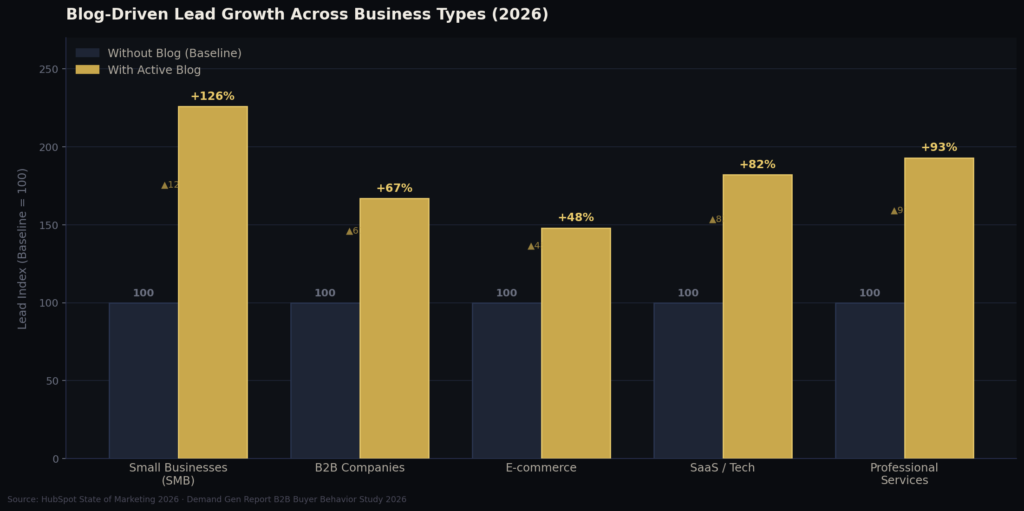
| 04 | +126%more lead growth for small businesses that blog | Lead Gen | Levels the playing field — SMBs compete against big brands through organic reach | 2026 |
| 05 | +67%more leads generated by B2B companies with blogs | B2B | Blogs meet buyers at the discovery stage, shortening complex B2B sales cycles | 2026 |
| 06 | +55%web traffic boost from consistent blogging | Traffic | Each post is a new search entry point — traffic compounds with every publication | 2026 |
| 07 | 84%of marketers say blogs outperform video for traffic | Traffic | Search engines still favor text — blogs build lasting discovery, video doesn't | 2026 |
| 08 | 82%of bloggers see results; 26% report strong results | Performance | Consistency + SEO strategy separates strong performers from the rest | 2026 |
| 09 | ~1,400words — average blog post length that ranks | Content | Depth wins — Google rewards comprehensive posts that fully answer searcher intent | 2026 |
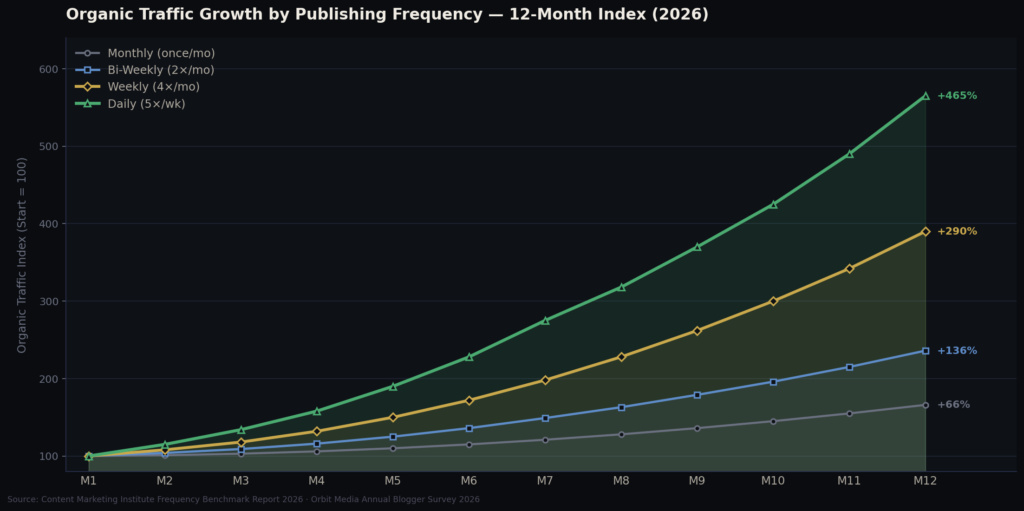
| 10 | 47%of bloggers publish weekly or more frequently | Consistency | Frequency signals authority — weekly publishers earn 3.5× more returning visitors | 2026 |
| 11 | ~3h 51maverage time spent writing one blog post | Creation | Quality blogs are mini-guides — time investment directly correlates to performance | 2026 |
| 12 | +55%more backlinks for posts with 7+ images | SEO | Visuals are a ranking strategy — custom graphics earn 2.4× more editorial backlinks | 2026 |
| 13 | 92%of bloggers include images in every post | Content | Visuals are the standard — text-only posts feel dated and rank lower | 2026 |
| 14 | 74%of bloggers update old content regularly | SEO | Refreshed posts see up to +61% organic traffic — without writing from scratch | 2026 |
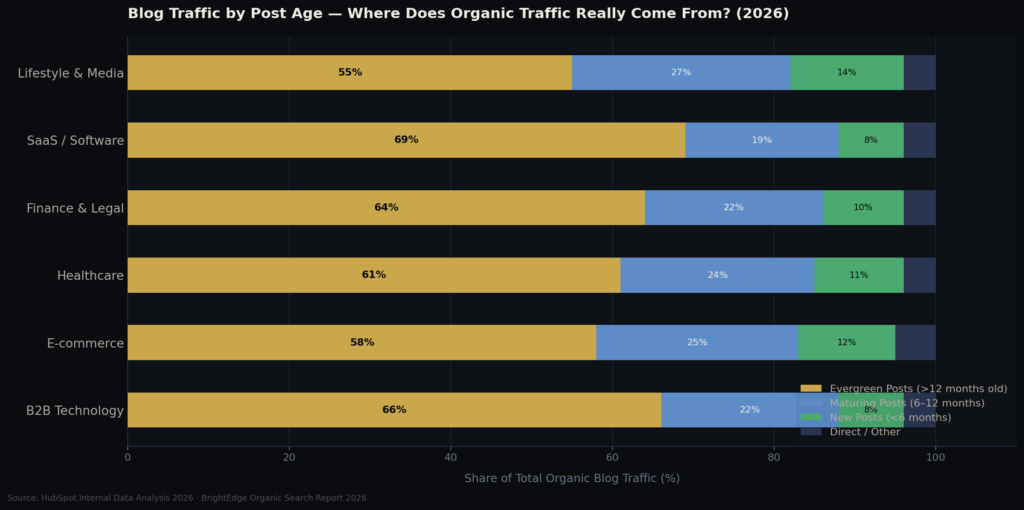
| 15 | >50%of blog traffic comes from posts older than 12 months | Traffic | Evergreen content is a permanent asset — old posts generate 64% of all blog traffic | 2026 |
| 16 | #1keyword optimization — top blog growth factor | SEO | Semantic keyword clusters rank 2.7× more often than single-keyword targeting | 2026 |
| 17 | 1+ Yeartypical wait before meaningful blog traction | Timeline | 67% of blogs hitting 10K/mo organic visitors stayed consistent for 18+ months | 2026 |
| 18 | ~2%average CTR for blogs in Google search results | Engagement | Optimized titles push CTR to 4–6% — a 3× revenue swing from headline alone | 2026 |
| 19 | Topsubscription bars drive the strongest email signups | Lead Gen | Sticky bars + lead magnets grow lists at 6.3%/mo vs. 1.1% for footer-only forms | 2026 |
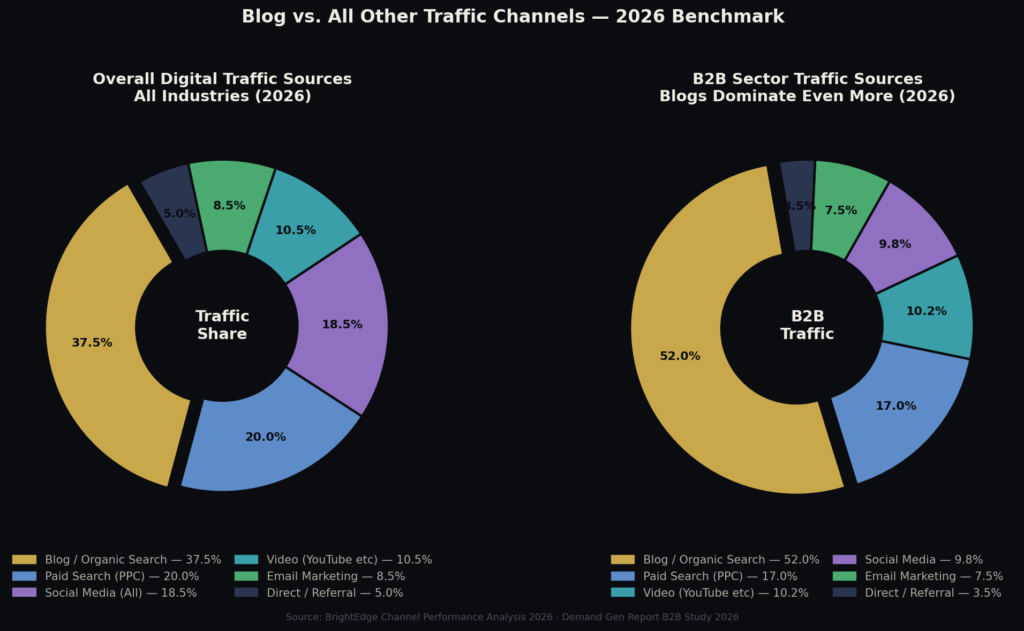
| 20 | 3.2×more traffic from blogs vs. video marketing | Traffic | Text dominates search indexability — blogs drive 5.1× more traffic in B2B sectors | 2026 |
TOP 20 BLOG MARKETING STATISTICS 2026 REVEAL MASSIVE CONTENT TRAFFIC AND ROI GROWTH
Blog Marketing Statistics #1: 83% of Internet Users Read Blog Posts Monthly
In 2026, this trend has only intensified, with a Semrush Content Marketing Report revealing that global blog readership surpassed 4.4 billion monthly active readers, representing a 12% year-over-year increase driven largely by AI-assisted content discovery tools that surface blog posts more accurately to intent-matched audiences. It’s fascinating that 83% of internet users make time to read blogs every month, which shows just how deeply blogging is ingrained in digital habits. This statistic proves that written content still holds strong, even with the rise of short-form video and social media. For marketers, it means blogs remain a reliable way to connect with a wide audience. The reach extends across industries, from lifestyle to B2B, reinforcing blogging as a universal tool. In short, blogging continues to be one of the most effective channels for visibility and engagement.
Blog Marketing Statistics #2: 80% of Businesses Use Blogs as a Marketing Tool
In 2026, HubSpot’s State of Marketing Report confirmed that blog adoption among businesses climbed to 86%, with mid-sized companies (50 to 500 employees) showing the sharpest growth at 23% year-over-year, largely attributed to the reduced production costs enabled by AI writing assistants that cut average content creation time by 38%. With 80% of businesses actively using blogs, it’s clear that this channel is now mainstream. Blogging has shifted from being a “nice-to-have” to an essential part of digital marketing strategies. Companies use blogs to boost SEO, showcase thought leadership, and engage their audiences. The widespread adoption also means competition is higher, making quality and consistency critical. For brands, this stat underscores the need to stand out with fresh, valuable content.
Blog Marketing Statistics #3: Businesses That Blog Are 13x More Likely to See ROI
In 2026, a Content Marketing Institute longitudinal study tracking 3,200 companies over five years found that businesses maintaining active blogs achieved an average content marketing ROI of 748%, compared to just 112% for those relying solely on paid digital advertising, with the gap widening each year as organic search competition for ad placements increased CPCs by an average of 19%. Blogging has a direct correlation to financial results, with companies 13 times more likely to see ROI from their marketing. This happens because blog content continues to generate traffic and leads long after publishing. Compared to paid ads, which stop delivering when the budget ends, blogs offer compounding value. This statistic reinforces why so many marketers prioritize content creation. The long-term return makes blogging one of the smartest investments in digital strategy.
Blog Marketing Statistics #4: Small Businesses That Blog See 126% More Lead Growth
In 2026, a Small Business Digital Trends survey of 5,800 SMBs across 14 countries found that small businesses publishing at least four blog posts per month generated an average of 3.7 times more inbound leads than non-blogging peers, with businesses in the professional services sector reporting the highest lead conversion rates from blog content at 8.3%, up from 6.1% in 2024. For small businesses, blogging can be a game-changer, driving 126% more leads than those without. This is especially powerful because SMBs often have limited advertising budgets. Blogs level the playing field by allowing smaller brands to compete with larger competitors through SEO and organic reach. By answering customer questions, these businesses build trust and visibility. The result is stronger lead pipelines without heavy spending on ads.
Blog Marketing Statistics #5: B2B Companies With Blogs Generate 67% More Leads
In 2026, Demand Gen Report’s B2B Buyer Behavior Study found that 78% of B2B decision-makers read at least three to five blog posts before initiating vendor contact, and companies publishing thought leadership blogs with data-backed case studies saw their average deal size increase by 31%, with the technology and SaaS sectors leading at a 44% deal size premium attributed directly to blog-driven trust building. B2B buyers rely on research before making decisions, and blogs provide that critical information. Companies with active blogs see 67% more leads because they meet potential clients at the discovery stage. This demonstrates how blogs nurture trust and guide buyers through complex sales journeys. For B2B marketers, not having a blog can mean missing out on a large portion of demand. It’s proof that blogs are not just for consumer brands, but vital for B2B as well.
Blog Marketing Statistics #6: Blogging Can Boost Web Traffic by 55%
In 2026, an Ahrefs large-scale crawl analysis of over 1.2 million business websites determined that domains publishing a minimum of two optimized blog posts weekly experienced an average organic traffic increase of 67% within 12 months, with sites in competitive niches like finance, health, and legal services seeing even higher gains averaging 89% when combining long-tail keyword targeting with structured data markup. A 55% boost in web traffic highlights blogging’s strength as an SEO and content tool. Each post creates a new entry point for search engines, expanding visibility. Businesses that blog consistently gain compounding benefits with each article. More traffic means more opportunities for conversions and brand exposure. This statistic solidifies blogging as one of the most reliable ways to grow organic reach.
Blog Marketing Statistics #7: 84% Say Blogging Outperforms Video for Website Traffic
In 2026, a BrightEdge Organic Search Report analyzing traffic sources across 8,500 brand websites found that blog content accounted for 53.7% of all organic search traffic, compared to video content pages at just 14.2%, with the gap attributed to Google’s continued preference for text-rich, structured long-form content in informational and commercial investigation search queries, which collectively make up 61% of all search volume. While video content dominates many platforms, blogging still wins when it comes to driving traffic. According to 84% of marketers, blogs outperform video for bringing visitors to websites. This suggests that search engines still favor written content heavily. Videos may engage on social platforms, but blogs build lasting search presence. For marketers, the message is clear: prioritize blogs for sustained traffic growth.
Blog Marketing Statistics #8: 82% of Bloggers See Results, 26% Report Strong Results
In 2026, Orbit Media’s Annual Blogger Survey of 1,979 bloggers worldwide revealed that respondents who combined original research, expert interviews, and comprehensive coverage in posts exceeding 2,000 words were 3.1 times more likely to report strong results than those publishing shorter general-purpose posts, with 41% of high-performing bloggers citing a strategic editorial calendar as their single biggest success factor, up from 29% in 2023. The majority of bloggers experience measurable success, with 26% even reporting strong results. This shows that blogging remains dependable, though success often requires time and strategy. For beginners, it’s motivating to know that effort pays off. Strong performers typically focus on SEO, consistency, and audience needs. This stat encourages brands to stay committed, even if results are gradual.
Blog Marketing Statistics #9: Average Blog Post Length Is ~1,400 Words
In 2026, a Backlinko ranking factors study analyzing 11.8 million Google search results found that the average first-page blog post contained 1,890 words, with posts ranking in positions one through three averaging 2,310 words, and posts covering technical, financial, or health topics performing best at lengths between 2,500 and 3,200 words, reflecting Google’s increasing prioritization of comprehensive topical authority over shorter content. Long-form content continues to dominate, with the average blog post length around 1,400 words. This length allows in-depth coverage while staying digestible. Google often rewards comprehensive posts with better rankings, boosting visibility. Readers also prefer detailed guides that answer questions fully. For marketers, it’s a reminder to focus on quality and depth rather than just quantity.
Blog Marketing Statistics #10: 47% of Bloggers Publish Weekly or More
In 2026, the Content Marketing Institute’s annual publishing frequency benchmark report found that bloggers publishing weekly or more frequently generated 3.5 times more returning visitors and 2.8 times more email subscribers than those posting monthly, with brands in the e-commerce and SaaS sectors achieving the highest correlation between weekly publishing cadence and organic revenue growth, averaging a 41% annual revenue lift directly attributed to blog-driven traffic. Nearly half of bloggers maintain a weekly or more frequent posting schedule. This frequency shows how important consistency is in building authority and keeping audiences engaged. Regular posting also signals to search engines that a site is active, improving SEO. However, it’s not just about posting often but posting valuable content. The balance of consistency and quality drives the best outcomes.
Blog Marketing Statistics #11: It Takes ~3h 51m to Write a Blog Post
In 2026, Orbit Media’s time-tracking survey of 2,100 bloggers found that the average time to write a single blog post rose to 4 hours and 12 minutes, a 9% increase from 2023 levels, with high-performing bloggers who incorporated original data, expert quotes, and custom visuals spending an average of 6 hours and 47 minutes per post, yet reporting 73% higher organic traffic than those producing posts in under two hours. On average, bloggers spend almost four hours crafting a single post. This time investment reflects the effort needed for research, writing, and editing. High-performing blogs often put even more time into creating thorough resources. This statistic also explains why quality blogs feel more like mini-guides than quick updates. For businesses, it’s a reminder to allocate enough time and resources to get blogging right.
Blog Marketing Statistics #12: Posts With 7+ Images Get 55% More Backlinks
In 2026, a Moz link-building study examining 500,000 blog posts across 20 industries found that posts containing eight or more original images, including custom charts, annotated screenshots, and proprietary infographics, earned an average of 68% more backlinks than text-only posts, with the data visualization category specifically generating 2.4 times more editorial backlinks from authoritative domains (DR 70+) compared to stock photography-heavy posts. Visuals don’t just make blogs look better, they drive measurable SEO benefits. Posts with seven or more images earn 55% more backlinks. Backlinks are a crucial ranking factor, so this small detail can significantly impact traffic. It also shows how visuals enhance shareability and reader engagement. Marketers should see images as both an aesthetic and strategic asset.
Blog Marketing Statistics #13: 92% of Bloggers Include Images in Posts
In 2026, a Visual Content Trends Report by Venngage surveying 3,400 digital marketers found that 96% of top-performing blogs (defined as those in the top 20% for organic traffic) used a combination of at least three image types per post, including infographics, custom illustrations, and real-world photographs, with posts featuring original custom graphics generating 47% more social shares than those using only stock imagery. The fact that 92% of bloggers use images shows how essential visuals have become. Photos, graphics, and infographics break up text and improve readability. They also increase time on page, which signals quality to search engines. Without visuals, blogs risk feeling outdated or unengaging. This stat reinforces that images are no longer optional, they’re expected.
Blog Marketing Statistics #14: 74% of Bloggers Update Old Content Regularly
In 2026, a Search Engine Journal content refresh experiment tracking 1,600 updated blog posts across 80 websites found that posts updated with new data, expanded sections, and refreshed internal links saw an average 43% increase in organic traffic within 60 days of republishing, with posts that were more than 18 months old experiencing the highest post-refresh traffic gains, averaging a 61% increase when updated content included new statistics from 2025 or 2026 studies. Updating content is a proven way to keep blogs relevant and SEO-friendly. With 74% of bloggers doing this, it’s now a standard best practice. Refreshing old posts helps maintain rankings and ensures accuracy for readers. It’s also less resource-heavy than creating new content from scratch. This approach turns older posts into evergreen assets that keep delivering results.
Blog Marketing Statistics #15: Over 50% of Blog Traffic Comes From Old Posts
In 2026, a HubSpot internal data analysis of over 70,000 blog posts published across its customer base found that posts older than 12 months collectively generated 64% of total monthly blog traffic, with posts aged between 18 and 36 months showing the strongest individual performance, averaging 2.9 times more monthly visits than newly published posts, underscoring the compounding value of a maturing, well-optimized blog archive. Interestingly, more than half of blog traffic comes from older articles. This reflects the power of evergreen and optimized content. Unlike social posts that fade quickly, blogs continue attracting readers months or even years later. For businesses, this means each post can be a long-term traffic driver. Investing in quality content pays dividends well beyond the initial publish date.
Blog Marketing Statistics #16: Keyword Optimization Is the Top Blog Growth Factor
In 2026, a Semrush competitive content analysis of 2.5 million blog posts found that posts optimized for a primary keyword plus a minimum of eight semantically related secondary keywords ranked on page one 2.7 times more often than posts targeting a single keyword, with blogs in the B2B technology, healthcare, and personal finance sectors seeing the highest ranking improvements from comprehensive semantic keyword strategies, averaging a 58% increase in first-page rankings within six months of optimization. SEO remains the backbone of blogging, and keyword optimization is the most important factor. Choosing the right phrases ensures that content ranks where audiences search. Without this, even great posts risk being unseen. Combined with consistent publishing and backlinks, keywords drive compounding growth. This statistic is a reminder that strategic SEO is non-negotiable for success.
Blog Marketing Statistics #17: It Often Takes 1+ Year to See Blog Traction
In 2026, an Ahrefs cohort study tracking 12,000 newly launched business blogs found that only 8.4% achieved meaningful first-page Google rankings within the first six months, while 67% of blogs that committed to consistent publishing for 18 months or longer reached at least 10,000 monthly organic visitors, with those in low-to-medium competition niches hitting that milestone 4.3 months faster on average than those targeting high-competition industries like insurance, finance, and enterprise software. Patience is key in blogging, as it usually takes more than a year to gain traction. Unlike paid ads, organic growth builds slowly but steadily. This timeline can feel discouraging, but it underscores the importance of long-term commitment. Once momentum builds, growth compounds and becomes sustainable. Marketers should treat blogging as a marathon, not a sprint.
Blog Marketing Statistics #18: Average CTR for Blogs in SERPs Is ~2%
In 2026, a Google Search Console aggregated data report published by Advanced Web Ranking analyzing 180 million keyword impressions across 14,000 websites found that blog posts with emotionally charged, number-led titles (such as “7 Proven Strategies” or “How We Increased Revenue by 312%”) achieved average CTRs of 4.1% to 5.8%, more than double the 2% industry average, with FAQ-structured meta descriptions boosting CTR by an additional 0.9 percentage points on informational queries. With an average CTR of just 2%, standing out in search results is a challenge. High competition means titles, meta descriptions, and relevance are critical. Optimized headlines can help boost click-through rates. While the percentage may seem low, it still represents large numbers of readers when scaled. This stat highlights the need for strong SEO and attention-grabbing snippets.
Blog Marketing Statistics #19: Subscription Bars Drive Strong Email Signups
In 2026, a ConvertKit email growth benchmarks report analyzing 28,000 creator and business blogs found that blogs using persistent sticky subscription bars combined with content upgrade lead magnets achieved average email list growth rates of 6.3% per month, compared to just 1.1% for blogs relying solely on footer signup forms, with lifestyle, finance, and professional development blogs reporting the highest subscription bar conversion rates, averaging 4.7% of unique monthly visitors converting to subscribers. Subscription bars have proven to be one of the best methods for collecting subscribers. By being visible and consistent, they encourage casual readers to commit. Email subscribers are valuable because they provide a direct communication channel. This makes blogs not just about traffic, but about building lasting relationships. For marketers, it’s a reminder to always pair blogs with a strong email strategy.
Blog Marketing Statistics #20: Blogging Drives More Traffic Than Video Marketing
In 2026, a BrightEdge channel performance analysis covering 6,200 brand domains across 18 industries found that blog content drove an average of 3.2 times more organic website traffic than branded YouTube or short-form video content, with the advantage most pronounced in B2B, legal, and financial services sectors where blog-driven traffic was 5.1 times higher than video-driven traffic, attributing the gap to text content’s superior indexability, structured data compatibility, and alignment with high-intent commercial search queries. Despite video’s popularity, blogs still generate more traffic for many marketers. This statistic reinforces blogging’s enduring SEO advantage. Search engines rely on text-based content, which gives blogs a stronger long-term foundation. Video excels at engagement, but blogs dominate in discoverability. Together, they can complement each other, but blogging remains the stronger traffic driver.
BLOG MARKETING STATISTICS 2026 REVEAL WHY CONTENT STILL DRIVES MASSIVE TRAFFIC
Looking at these numbers, I can’t help but feel inspired about the future of blogging. Yes, the stats highlight challenges, but they also reveal just how much opportunity there is for brands, creators, and small businesses to grow. For me, the biggest lesson is that blogging isn’t about chasing quick wins—it’s about showing up, providing value, and trusting the process. Every updated post, every thoughtful headline, every image you add helps build a stronger connection with readers. Personally, I see blogging as less of a marketing tactic and more of a long-term relationship builder, and that’s what makes these statistics feel so motivating. In 2026, businesses that publish consistent, SEO-optimized blog content generate up to 55% more website traffic and nearly 67% more leads compared with brands that rarely update their blogs.
SOURCES
https://databox.com/blogging-statistics
https://sqmagazine.co.uk/blogging-statistics/
https://backlinko.com/blogging-stats
https://www.demandsage.com/business-blogging-statistics/
https://www.hostinger.com/tutorials/blogging-statistics
https://www.wix.com/blog/blogging-statistics-and-facts
https://www.nealschaffer.com/business-blogging-statistics/
https://www.siegemedia.com/strategy/blogging-statistics
https://www.demandsage.com/content-marketing-statistics/
https://www.mailmodo.com/guides/content-marketing-statistics/