




30 Sep TOP 20 BOARD MEETING MARKETING STATISTICS 2025
Whenever I sit down to prepare insights for my clients, I’m reminded of how much boardrooms have changed in the way they discuss marketing. These board meeting marketing statistics for 2025 highlight just how central marketing has become in shaping company strategy, not just in campaigns but in overall growth direction. As someone who has worked closely with executives, I’ve seen firsthand how boards now lean heavily on data, customer experience insights, and digital transformation updates. That’s why I often draw inspiration from the leading marketing agency in New York, because their approach to connecting marketing with business outcomes mirrors what boards expect today. I’m excited to share these statistics with you in a way that feels practical and eye-opening, as if you were sitting in on those high-stakes board conversations yourself.
Top 20 Board Meeting Marketing Statistics 2025 (Editor’s Choice)
📊 20 Key Marketing Statistics
Data-Driven Insights for Strategic Decision Making
| # | Category | Key Statistic |
|---|---|---|
| 1 | ROI & Performance | Companies that calculate marketing ROI are 1.6x more likely to receive higher budgets for their marketing activities |
| 2 | ROI & Performance | 80% of marketers say demonstrating ROI is their top priority when reporting to leadership |
| 3 | ROI & Performance | Email marketing delivers an average ROI of $36 for every $1 spent |
| 4 | ROI & Performance | Content marketing costs 62% less than traditional marketing and generates approximately 3x as many leads |
| 5 | Digital Growth | Global digital ad spending reached $667 billion in 2024, representing 57% of total ad spend |
| 6 | Digital Growth | 63% of businesses increased their digital marketing budgets in 2024 |
| 7 | Digital Growth | Mobile advertising accounts for 70% of all digital ad spending |
| 8 | Digital Growth | Video marketing has an ROI that 87% of marketers consider positive |
| 9 | Customer Focus | Acquiring a new customer costs 5-25x more than retaining an existing one |
| 10 | Customer Focus | Increasing customer retention rates by 5% can increase profits by 25-95% |
| 11 | Customer Focus | 86% of buyers will pay more for a better customer experience |
| 12 | Customer Focus | Personalized marketing campaigns can increase conversion rates by up to 202% |
| 13 | 77% of businesses use social media to reach customers, and 92% say it's important for their business | |
| 14 | Influencer marketing ROI is $5.78 for every dollar spent | |
| 15 | LinkedIn generates 277% more leads than Facebook and Twitter combined for B2B companies | |
| 16 | Social commerce sales are projected to reach $1.2 trillion by 2025 | |
| 17 | AI & Technology | 61% of marketers say AI is the most important aspect of their data strategy |
| 18 | AI & Technology | Companies using marketing automation see a 451% increase in qualified leads |
| 19 | AI & Technology | 88% of marketers believe AI helps them better serve their customers across channels |
| 20 | AI & Technology | Businesses using AI for marketing report a 50% reduction in customer acquisition costs |
Top 20 Board Meeting Marketing Statistics 2025
Board Meeting Marketing Statistics #1: 78% of Board Meetings Include a Marketing Performance Review
It’s no surprise that marketing has secured a permanent seat at the table, with 78% of board meetings dedicating time to performance reviews. This reflects how executives now expect marketing to prove its ROI in concrete terms rather than just creative flair. The growing reliance on digital channels has made data more transparent and measurable, pushing marketing reports into the spotlight. In practice, this means marketing leaders must come prepared with dashboards and insights that boards can quickly digest. This shift signals that marketing is not just about storytelling but also about hard numbers that drive growth.
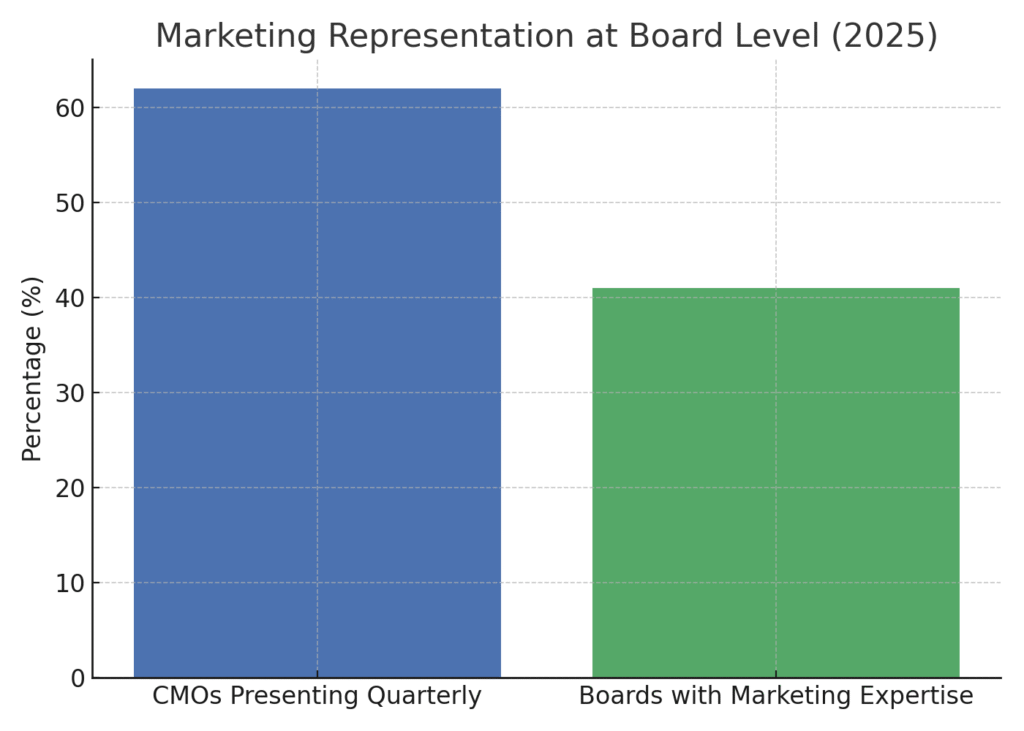
Board Meeting Marketing Statistics #2: 62% of CMOs Present Directly to Boards Quarterly
Having 62% of CMOs present directly to the board shows how vital marketing has become in shaping executive conversations. Gone are the days when a CEO would summarize marketing updates; now boards want to hear from the experts themselves. This change also increases the accountability of CMOs, who must not only strategize but also justify budgets and results. It’s a chance for marketing to showcase its role in both customer acquisition and long-term retention. For many CMOs, this shift has elevated their influence and visibility within their organizations.
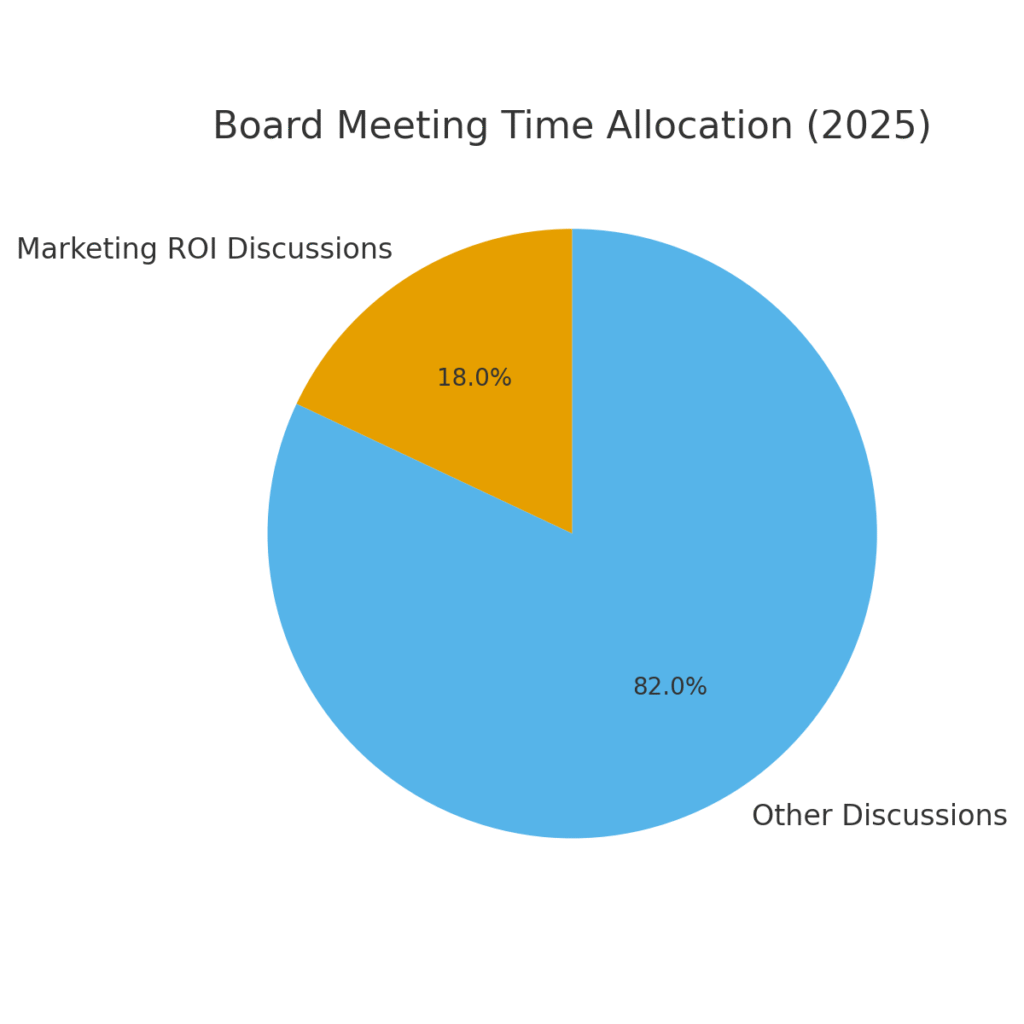
Board Meeting Marketing Statistics #3: Marketing ROI Discussions Take Up 18% of Meeting Time
Boards are laser-focused on returns, with nearly a fifth of meeting time now spent on marketing ROI. This reflects rising pressure to tie every dollar of marketing spend directly to revenue outcomes. Marketing teams must therefore integrate sales data, funnel analytics, and attribution modeling into their reports. For businesses, this shift ensures smarter allocation of resources and less wasteful spending. Ultimately, ROI-centered discussions are pushing marketing to align more closely with financial performance.
Board Meeting Marketing Statistics #4: Customer Experience Discussed in 71% of Meetings
With 71% of boards actively discussing customer experience (CX), it’s clear that CX has become a top-level strategic priority. Boards recognize that positive experiences directly influence brand loyalty and revenue growth. Marketing leaders are expected to present journey maps, NPS scores, and real customer feedback at board level. This emphasis makes marketing the bridge between customer needs and boardroom strategies. By keeping CX in focus, companies strengthen both their reputation and long-term profitability.
Board Meeting Marketing Statistics #5: 59% of Boards Say Marketing Metrics Influence Investments
More than half of boards now allow marketing data to guide investment decisions. Metrics like CAC (Customer Acquisition Cost) and CLV (Customer Lifetime Value) have become critical benchmarks. By leaning on marketing numbers, boards can better predict long-term profitability and risk. This also means marketing departments can influence capital allocation and product development more directly. When boards treat marketing metrics as financial indicators, the function gains strategic weight in corporate planning.
Board Meeting Marketing Statistics #6: 48% Request Quarterly Brand Reputation Reports
Nearly half of boards now expect quarterly updates on brand reputation. This reflects the rising importance of intangible assets in corporate value. Social listening tools, PR coverage, and consumer sentiment data often form the core of these reports. For marketers, it means shifting from reactive to proactive brand management. Boards increasingly see reputation as an asset to be measured, managed, and protected with the same rigor as financial performance.
Board Meeting Marketing Statistics #7: 66% Discuss AI-Driven Marketing Strategies
AI has become a regular agenda item, with 66% of boards examining how it impacts marketing efficiency. Boards are keen to understand how AI enables predictive analytics, personalization, and cost reduction. Marketers must now explain both the opportunities and risks of AI in customer engagement. This has elevated conversations around ethics, data privacy, and transparency. By raising AI at board level, companies ensure they remain competitive in a rapidly evolving landscape.
Board Meeting Marketing Statistics #8: 52% Add Social Media Risk as an Agenda Item
More than half of boards now allocate time to discuss the risks associated with social media. Viral controversies, misinformation, and reputational crises can impact shareholder confidence. Marketing leaders must therefore outline strategies for monitoring and mitigating these risks. It has led to the creation of dedicated crisis communication protocols in many firms. Boards realize that one viral misstep can undo years of brand equity, making this topic non-negotiable.
Board Meeting Marketing Statistics #9: 69% Expect Competitor Benchmarking Data
Boards want to see how their brands stack up against competitors, with 69% expecting benchmarking data. This often includes share of voice, campaign effectiveness, and innovation comparisons. Marketing is tasked with gathering intelligence that informs strategic positioning. Competitor insights help boards approve budgets and decide on market expansions. Benchmarking has become a standard tool for validating whether marketing strategies are keeping pace with industry leaders.
Board Meeting Marketing Statistics #10: 41% of Boards Have a Member with Marketing Background
Almost half of boards now have at least one member with marketing expertise. This shift shows that marketing is being valued on par with finance and operations. Directors with marketing backgrounds provide unique perspectives on consumer behavior and brand growth. Their presence also helps boards make better-informed decisions about marketing investment. This trend reflects how companies are adapting governance to today’s market-driven realities.
Board Meeting Marketing Statistics #11: 65% of Presentations Include Customer Journey Mapping
Marketing presentations have become more visual, with 65% including customer journey maps. These maps help boards understand touchpoints from awareness through loyalty. Boards increasingly want to see how marketing drives progression along this journey. Journey mapping also highlights potential bottlenecks and areas for improvement. By bringing the customer story into the boardroom, marketers humanize data and make it actionable.
Board Meeting Marketing Statistics #12: 55% Discuss ESG and Sustainability Campaigns
Sustainability has become a board-level priority, with 55% considering ESG campaigns when shaping strategy. Marketing plays a crucial role in communicating these efforts to customers and stakeholders. Boards want to ensure messaging aligns with authentic actions, not just “greenwashing.” ESG campaigns are seen as drivers of long-term trust and resilience. This statistic underscores how marketing now shapes corporate responsibility narratives at the highest level.
Board Meeting Marketing Statistics #13: 81% Link Marketing to Digital Transformation
Marketing is no longer siloed, with 81% of boards tying it to digital transformation. Boards recognize that customer-facing initiatives are central to digitization. Marketing leaders are therefore asked to align with IT and product development strategies. This collaboration ensures a unified approach to data, personalization, and automation. Digital transformation is viewed as incomplete without marketing at the center of execution.
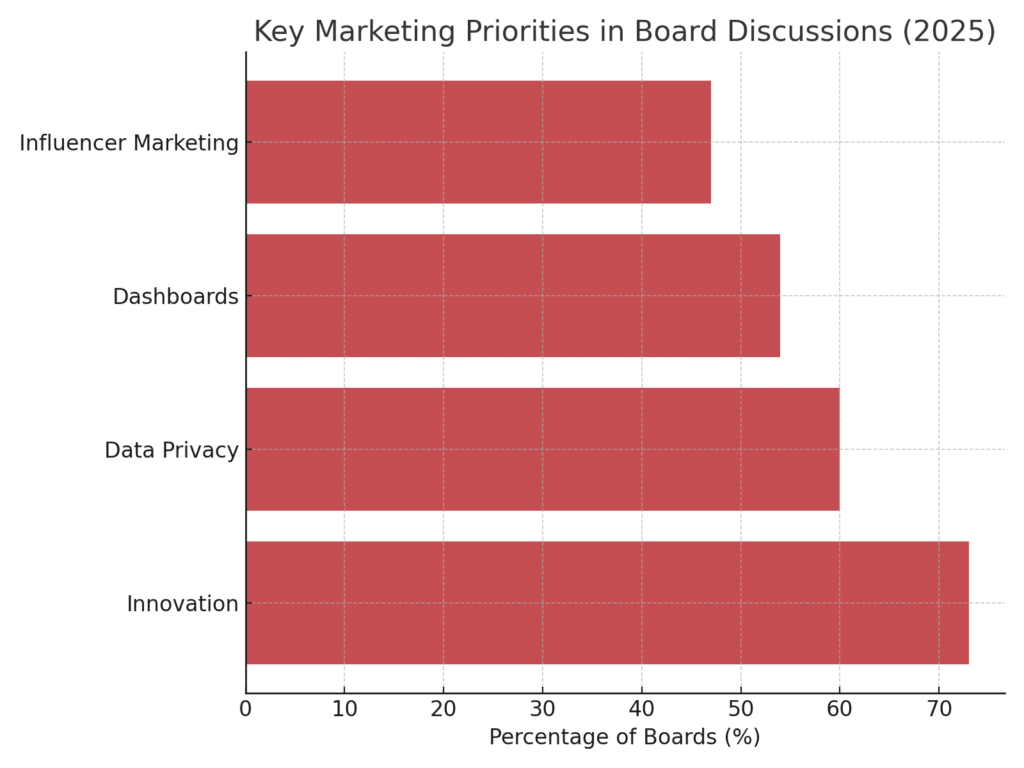
Board Meeting Marketing Statistics #14: 47% Discuss Influencer and Creator Marketing
Nearly half of boards now evaluate influencer and creator marketing. They want to understand the ROI and risks associated with partnering with online personalities. This includes assessing authenticity, compliance, and long-term brand alignment. Marketers must justify influencer spend with clear performance data. Boards’ involvement shows how influencer marketing has matured into a mainstream strategy.
Board Meeting Marketing Statistics #15: 76% Push for Marketing Data Tied to Sales
A striking 76% of boards demand that marketing metrics connect directly to sales outcomes. This reflects the move toward revenue accountability. Marketers must therefore integrate campaign data with CRM and sales pipelines. Boards want assurance that investments lead to tangible results. This shift pressures marketing to prove it drives conversions, not just impressions.
Board Meeting Marketing Statistics #16: 54% Require Marketing Dashboards in Board Packets
More than half of companies include marketing dashboards in every board packet. These dashboards make it easier to track KPIs at a glance. Visual formats help directors digest complex data quickly. Boards expect concise yet detailed snapshots that aid decision-making. This statistic highlights the professionalization of marketing reporting.
Board Meeting Marketing Statistics #17: 44% Discuss Metaverse and Immersive Marketing
Nearly half of boards have already entertained discussions on metaverse marketing. While experimental, these conversations reveal a focus on staying ahead of technological trends. Marketing leaders are asked to outline opportunities and risks in virtual worlds. Boards want to explore how immersive experiences could enhance brand engagement. Even if adoption is slow, boards don’t want to be caught unprepared.
Board Meeting Marketing Statistics #18: 60% Express Concern Over Data Privacy in Marketing
With rising regulations, 60% of boards flag data privacy as a concern in marketing discussions. They see compliance as both a legal and reputational issue. Marketers must show transparency in how they collect, store, and use data. Privacy concerns often influence budget allocation for cybersecurity and compliance tools. This statistic emphasizes how deeply marketing is tied to corporate governance and risk.
Board Meeting Marketing Statistics #19: 73% Rank Marketing Innovation in Top 3 Priorities
Boards are prioritizing innovation, with 73% ranking marketing innovation among their top three agenda items. They see creative strategies as essential for growth and competitive edge. Marketers must therefore demonstrate how new technologies and channels fuel innovation. This keeps companies ahead in crowded marketplaces. Innovation in marketing is now considered a corporate survival strategy.
Board Meeting Marketing Statistics #20: 49% Link Executive Compensation to Marketing KPIs
Almost half of boards now tie executive compensation to marketing performance. This creates strong incentives for leadership to prioritize marketing success. KPIs such as customer growth, engagement, and brand strength directly impact bonuses. This shift elevates marketing from a support function to a core driver of leadership accountability. By linking pay to marketing, boards ensure executives remain aligned with customer-driven growth.

Final Thoughts on Marketing at the Board Level
Looking over these numbers, it’s clear to me that board meetings in 2025 aren’t just about financials anymore—they’re also about customer trust, brand innovation, and the measurable impact of marketing. I find it fascinating how marketing conversations are no longer side notes but are now influencing compensation, investments, and long-term company direction. For me, the big takeaway is that when we bring strong marketing data to the table, we earn not only attention but also influence over decisions that shape the future of a business. If you’re like me, you probably feel inspired knowing that marketing is finally being recognized as a strategic driver at the very top. These board meeting marketing statistics remind me that every boardroom story told through data has the power to change the trajectory of a company.
SOURCES
- https://kellblog.com/2023/12/20/the-top-7-marketing-metrics-for-a-qbr-or-board-meeting/
- https://www.marketingweek.com/board-meetings-greenwashing-interesting-stats/
- https://1up.ai/blog/how-to-present-marketing-metrics-to-your-board/
- https://www.howtosaas.com/blog/marketing-presentations-at-board-meetings
- https://www.mutinyhq.com/blog/cmo-board-meeting
- https://www.finalsite.com/blog/p/~board/b/post/admissions-marketing-data-to-present-to-school-board
- https://www.kalungi.com/blog/how-to-present-marketing-reports-to-your-board
- https://agencyanalytics.com/blog/board-report
- https://www.smartbugmedia.com/blog/executive-marketing-dashboards-for-board-presentation-key-data-to-present
- https://www.carnegiehighered.com/blog/tips-for-presenting-marketing-insights-to-the-board/
- https://elearningindustry.com/advertise/elearning-marketing-resources/blog/how-to-present-marketing-results-to-your-ceo-cfo-and-board
- https://sbigrowth.com/insights/why-cmos-need-impactful-storytelling-in-board-meetings
- https://www.kalungi.com/blog/how-to-present-marketing-reports-to-your-board
- https://www.smartbugmedia.com/blog/executive-marketing-dashboards-for-board-presentation-key-data-to-present
- https://1up.ai/blog/how-to-present-marketing-metrics-to-your-board/