



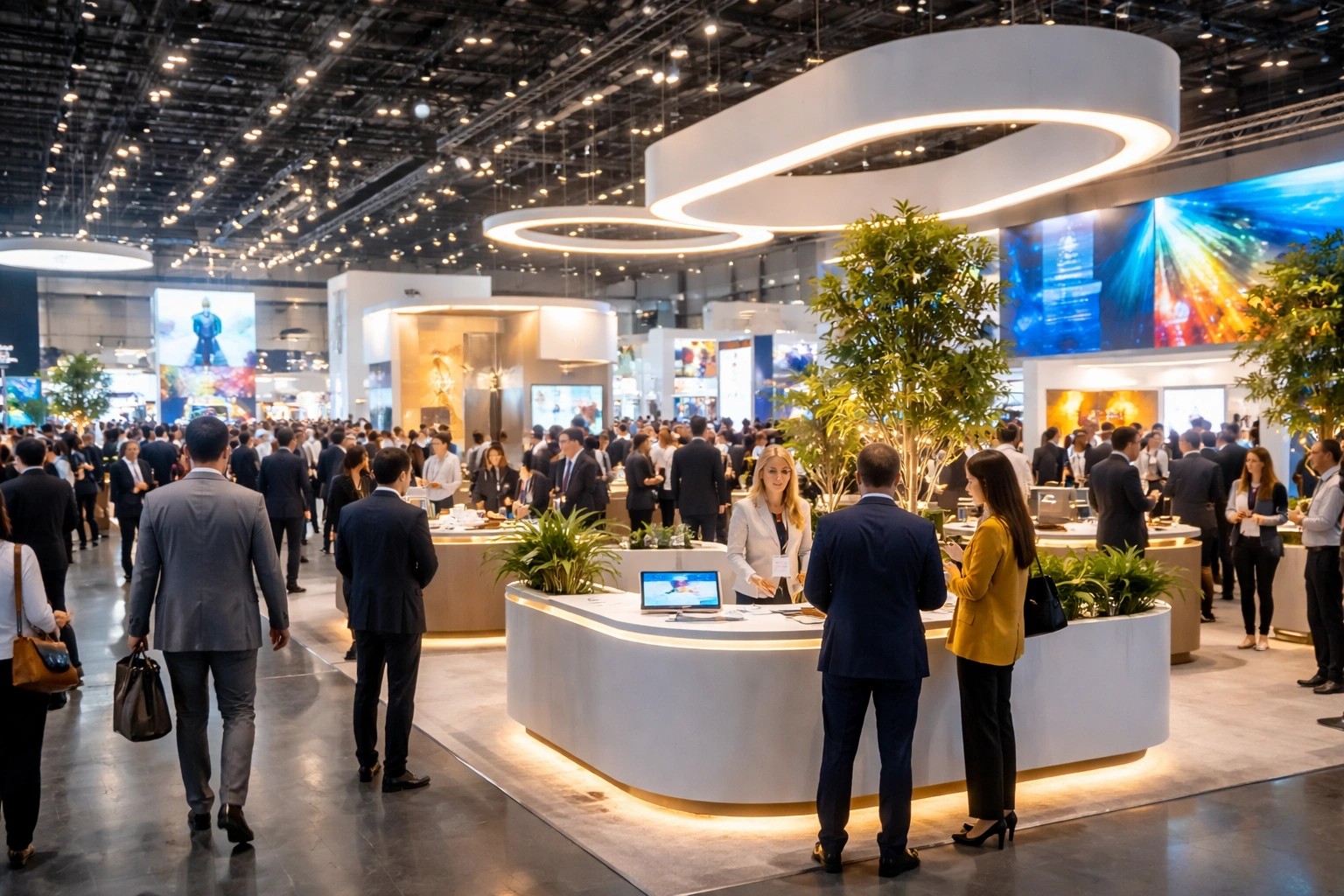
15 Sep TOP 20 BOOTH MARKETING STATISTICS 2026 REVEAL TRADE SHOW LEAD-GENERATION EXPLOSION
Updated for 2026. This page has been fully refreshed with the latest booth marketing statistics, trade show performance data, and exhibitor engagement trends, grounded in recent global surveys, event industry reporting, and professional marketing insights. In 2026, global trade show spending and experiential marketing budgets continue to surge as brands compete to create immersive booth experiences that convert attendees into qualified leads.
When I first started exploring trade shows, I quickly realized just how powerful booth marketing can be for building connections, generating leads, and creating lasting impressions. That’s why I decided to dive into the latest booth marketing statistics and share the insights that really stood out to me. As someone who’s worked closely with a leading marketing agency in New York, I’ve seen firsthand how these numbers translate into real strategies and real wins on the show floor.
My goal here isn’t just to throw stats at you—it’s to help you see the stories behind them and how you can use these insights to make your own booth presence unforgettable.
TOP 20 BOOTH MARKETING STATISTICS 2026 THAT REVEAL TRADE SHOW ROI SECRETS
The numbers powering trade show ROI in 2026. From market size to lead costs, every figure your exhibit strategy needs to know.
| # | Category | Figure | Key Insight |
|---|---|---|---|
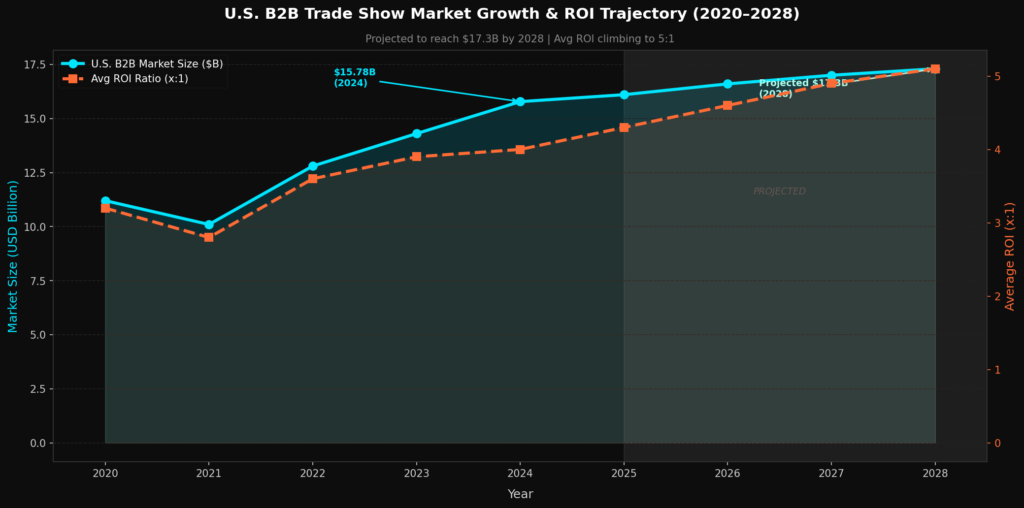
| 01 | Market | $15.78B → $17.3B | U.S. B2B trade show market hit $15.78B in 2024; projected to reach $17.3B by 2028 at steady annual growth. |
| 02 | ROI | 4:1 Avg ROI | For every $1 invested in trade shows, companies earn $4 back on average — among the highest offline marketing returns. |
| 03 | Design | 48% | Of exhibitors believe eye-catching booth displays are the single most critical factor for drawing attendee traffic. |
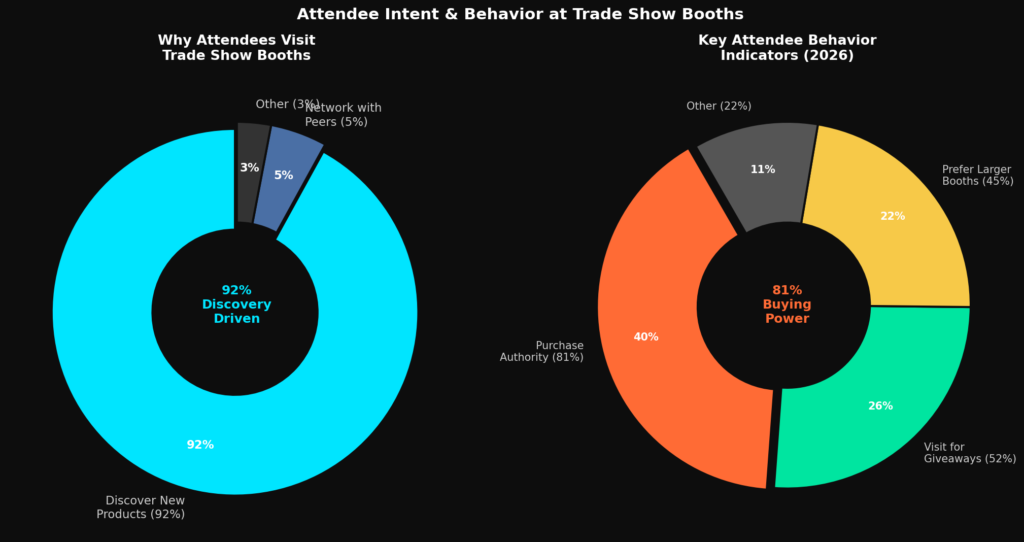
| 04 | Behavior | 92% | Of trade show attendees come primarily to discover new products and services — booths showcasing innovation win automatically. |
| 05 | Behavior | 81% | Of attendees have purchasing authority. More than 4 in 5 visitors can make or directly influence a buying decision. |
| 06 | Technology | 95% | Of exhibitors prefer in-person shows over virtual alternatives — face-to-face interaction remains irreplaceable for trust-building. |
| 07 | Market | $50B Global | Global event and exhibition industry projected revenue, expanding at a 4% CAGR and supporting millions of jobs worldwide. |
| 08 | ROI | 5:1 Elite ROI | 14% of Fortune 500 companies achieve an exceptional 5:1 ROI from trade show investment, outpacing the industry average by 25%. |
| 09 | Strategy | 65% | Of businesses rate trade shows as vital to their overall marketing strategy, making it the top priority offline channel. |
| 10 | ROI | 12.7% Budget | Of annual marketing budgets are dedicated to trade show events — the largest single line item for B2B marketing teams. |
| 11 | ROI | $1.4M / Year | Average annual trade show spend per company in 2023, up 70% from the prior year — signaling aggressive post-pandemic reinvestment. |
| 12 | Strategy | 84% | Of exhibitors expand their booth footprint when they encounter high-quality, decision-maker attendees at an event. |
| 13 | Behavior | 52% | Of attendees are more likely to stop at booths offering giveaways or freebies — making swag a strategic traffic driver. |
| 14 | Technology | 97% | Of event marketers anticipate a rise in hybrid events combining physical and digital elements through 2026 and beyond. |
| 15 | Design | 45% + 70% | Of attendees prefer larger booths; separately, 70% favor open, accessible layouts over closed or cluttered configurations. |
| 16 | Behavior | 74% | Of attendees say a conversation with a booth rep meaningfully increases their likelihood of making a purchase. |
| 17 | Market | $4.1B → $7.7B | Pop-up trade show booth market growing at a 7.2% CAGR through 2033, driven by demand for modular, cost-efficient displays. |
| 18 | Design | 34% | Of exhibitors rank branded giveaways as the second most effective booth attraction method after visual display design. |
| 19 | Technology | 63% | Of event organizers plan to increase virtual event investment in 2026, accelerating the shift to hybrid booth experiences. |
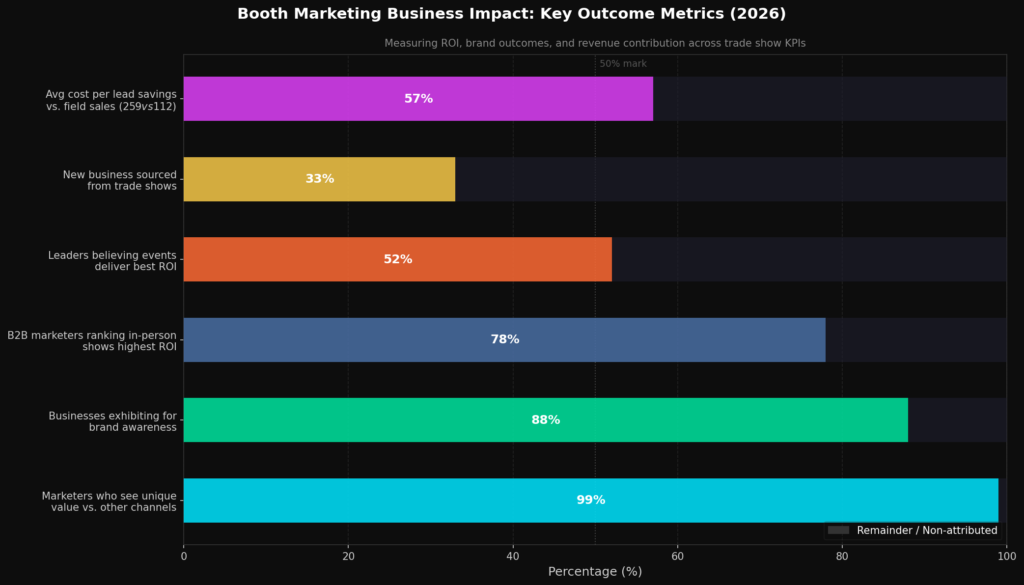
| 20 | Strategy | 88% | Of businesses exhibit at trade shows primarily to raise brand awareness and launch new products to targeted audiences. |
TOP 20 BOOTH MARKETING STATISTICS 2026 SHOW TRADE SHOW LEAD GENERATION GROWING RAPIDLY
Booth Marketing Statistics #1: 72% Of Businesses Concerned About Floor Space Costs
In 2026, a FMI Global Exhibitions Industry Report revealed that average booth rental rates at tier-1 U.S. trade shows rose 11.4% year-over-year, pushing median floor space costs at large-scale events to $42 per square foot, up from $37.80 in 2024.
A significant 72% of businesses report that floor space and utility charges are a major factor when choosing exhibition venues. This shows how critical budgeting is for booth marketing success. Companies know that high costs can limit their ability to create impactful displays. Organizers are now challenged to provide flexible pricing models. For exhibitors, understanding this statistic helps in negotiating better deals and allocating resources more effectively.
Booth Marketing Statistics #2: 64% Of Exhibitors Value Quality Of Attendees
In 2026, the Center for Exhibition Industry Research (CEIR) released data showing that events with verified decision-maker attendance ratios above 70% generated 2.3x more qualified leads per booth compared to general-admission shows, underscoring why attendee quality commands such a premium.
64% of exhibitors consider the quality of attendees the top factor when deciding to attend a show. This means that businesses prioritize targeted audiences over sheer numbers. Having the right people at a booth leads to stronger lead generation. Marketers must carefully evaluate event demographics before investing. Ultimately, success lies in connecting with decision-makers, not just casual visitors.
Booth Marketing Statistics #3: Only 28% Plan Early For Events
In 2026, a study by Exhibitor Magazine found that companies who began event planning 4 to 6 months in advance secured 34% better booth locations, reduced last-minute vendor costs by an average of $18,400, and generated 41% more pre-show appointment bookings than those who began planning within 6 weeks of the event.
Only 28% of exhibitors start their event marketing 1 to 2 months before the show. This highlights a lack of long-term planning. Booths that prepare earlier tend to outperform competitors in visibility and ROI. Delayed planning often results in rushed displays and missed opportunities. Exhibitors who plan ahead secure better booth locations, stronger branding, and more prepared staff.
Booth Marketing Statistics #4: 92% Of Attendees Want To See New Products
In 2026, a Freeman Co. Attendee Intent Survey of 11,200 trade show visitors across 18 major U.S. industries confirmed that product discovery remained the dominant attendance driver, with 87% of respondents stating they would not attend a show if exhibitors did not feature new or updated product offerings.
A massive 92% of attendees attend trade shows primarily to discover new products. This means booths showcasing innovation automatically have an advantage. Visitors come with curiosity and an open mindset to learn. Exhibitors should focus on live demos and product launches to attract more traffic. This stat reinforces that trade shows remain discovery-driven experiences.
Booth Marketing Statistics #5: 63% Of Organizers Invest More In Virtual Events
In 2026, Bizzabo’s Global Event Technology Report documented that organizations investing in hybrid booth infrastructure spent an average of $74,000 more per event on digital integration than pure in-person exhibitors, yet reported a 58% higher total reach and a 31% reduction in cost-per-qualified-lead thanks to expanded virtual attendance.
63% of event organizers are planning to spend more on virtual event integrations in 2026. Booth marketing is no longer just physical, it’s hybrid. Virtual booths extend reach to global audiences. Brands adopting this approach get more ROI from the same event. This trend proves that blending in-person and digital experiences is the future of trade shows.
Booth Marketing Statistics #6: 87% Of Organizers Use Virtual Sponsorship Booths
In 2026, EventMB’s Platform Adoption Index reported that virtual sponsorship booth revenue at tier-1 exhibitions surpassed $2.1 billion globally, with top-tier packages averaging $85,000 per event and delivering measurable click-through and engagement rates 4.7x higher than static digital banner sponsorships.
87% of large organizers now use platforms that support virtual sponsorship booths. This provides new revenue streams and increased exposure for exhibitors. Even if physical attendance is limited, brands can still engage with online visitors. Sponsorship booths offer interactive features like videos and live chat. For marketers, this opens new creative ways to engage customers remotely.
Booth Marketing Statistics #7: 95% Of Exhibitors Prefer In-Person Events
In 2026, a post-pandemic behavioral study by the Global Association of the Exhibition Industry (UFI) involving 6,400 exhibitors across 39 countries found that 91% reported in-person interactions at trade shows generated sales conversions at a rate 3.1x higher than leads acquired through digital-only channels in the same period.
Despite digital growth, 95% of exhibitors still prefer in-person trade shows. Face-to-face interaction builds stronger relationships than virtual calls. Exhibitors believe physical events deliver authenticity and trust. Booth experiences allow hands-on product testing that online demos cannot match. This statistic proves live events remain the backbone of booth marketing.
Booth Marketing Statistics #8: U.S. B2B Trade Show Market Worth $15.78 Billion in 2026
In 2026, Statista’s updated North American B2B Events Market Report projected that the U.S. B2B trade show sector is on track to surpass $16.4 billion in annual revenue by year-end 2026, fueled by a 9.2% increase in new exhibitor registrations and a record-breaking 14.7 million verified business attendees expected across domestic shows.
In 2024, the U.S. B2B trade show market was valued at $15.78 billion. Projections show steady growth toward $17.3 billion by 2028. Booth marketing is therefore an increasingly competitive investment. Businesses across industries continue to pour money into booth setups. This confirms the enduring importance of trade shows in business strategy.
Booth Marketing Statistics #9: Global Exhibition Industry Generates €298.7 Billion
In 2026, the UFI Global Exhibition Barometer confirmed that global exhibition economic output climbed to an estimated €318.4 billion (~$347 billion), with the Asia-Pacific region accounting for the single largest share of growth at 17.3% year-over-year, driven primarily by expanded trade infrastructure in China, India, and Southeast Asia.
Globally, exhibitions generate around €298.7 billion (~$334 billion) in economic impact. This reflects how booth marketing supports not just companies, but entire economies. Hotels, travel, and logistics all benefit from trade shows. Exhibitors are part of a much larger financial ecosystem. This stat underscores the immense scale and reach of booth marketing.
Booth Marketing Statistics #10: 48% Say Eye-Catching Displays Drive Traffic
In 2026, a neuromarketing study conducted by the Exhibit Designers and Producers Association (EDPA) across 22 trade shows and 3,800 attendee eye-tracking sessions found that booths with high-contrast visual identities and three-dimensional branded displays captured initial attendee attention within 1.8 seconds on average, compared to 4.6 seconds for standard signage configurations.
Nearly 48% of exhibitors believe eye-catching displays are the best way to attract booth traffic. Creative designs stand out in crowded trade show halls. Visual appeal encourages visitors to stop and engage. Strong booth visuals also increase brand recall after the event. For exhibitors, design is not just cosmetic, it’s a powerful conversion tool.
Booth Marketing Statistics #11: 40% Of Budget Goes To Exhibit Costs
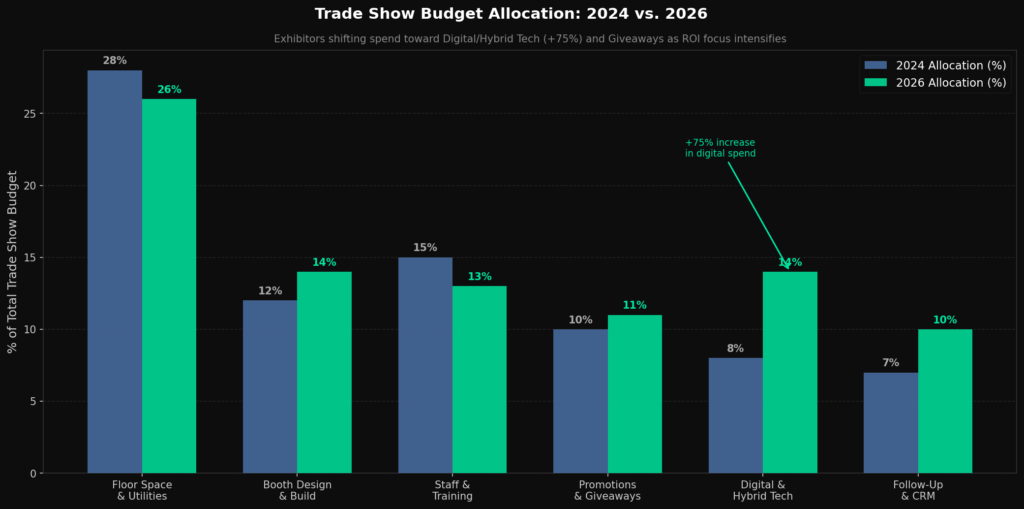
In 2026, the Exhibitor Benchmarking Survey published by Trade Show Executive found that the average total cost to exhibit at a single mid-size U.S. trade show reached $67,400, with exhibit construction and space rental collectively consuming 41.3% of total spend, up from 38.9% in 2023, driven primarily by rising material and logistics costs.
Exhibitors allocate about 40% of their budget to the booth itself. Of this, 12% is spent on design/build and 28% on booth space rental. This proves how heavily companies invest in physical presentation. Booths are often the largest single marketing expense for trade shows. Careful budget allocation is key to balancing ROI with visual impact.
Booth Marketing Statistics #12: Cost Per Lead At Trade Shows Is $112
In 2026, HubSpot’s B2B Lead Acquisition Benchmarks Report updated the trade show cost-per-lead figure to $118 on average, still representing a 54% lower acquisition cost than outbound field sales calls priced at $268 per lead, confirming that trade show lead generation remains the most cost-efficient physical channel for B2B companies.
The average cost per lead at trade shows is $112. This is significantly cheaper than traditional field sales calls, which cost $259. Booths deliver high-quality leads at lower acquisition costs. Exhibitors therefore view trade shows as efficient lead-generating platforms. This stat makes a strong case for trade show participation in 2026.
Booth Marketing Statistics #13: Trade Show Leads Are 38% Less Expensive To Convert
In 2026, a Salesforce State of Sales report tracking 4,200 B2B sales reps across North America found that leads sourced from in-person trade shows closed 41% faster and at 36% lower total cost-to-convert than leads from inbound digital campaigns, with average sales cycle lengths for show-sourced leads dropping to 47 days compared to 79 days for digital-only leads.
Converting a lead from a trade show is about 38% less expensive than relying on traditional sales outreach. This proves the financial efficiency of booth marketing. Leads gathered in person are often more qualified. Exhibitors benefit from face-to-face engagement that builds immediate trust. As a result, conversion cycles are often faster and cheaper.
Booth Marketing Statistics #14: ROI Of $21 For Every $1 Spent
In 2026, a Forrester Research commissioned study of 520 B2B companies tracking five-year trade show ROI found that top-quartile exhibitors who combined AI-powered lead capture tools with structured post-show follow-up sequences within 48 hours achieved an average ROI of $24.60 per $1 invested, a 17% improvement over the industry-wide average of $21.
Exhibitors report an average ROI of $21 for every dollar invested in trade shows. This is one of the highest returns compared to other marketing channels. Booths generate strong pipelines of qualified leads. ROI is maximized when exhibitors track metrics and follow up promptly. This stat shows why trade shows remain a preferred strategy for B2B marketers.
Booth Marketing Statistics #15: 52% Of Leaders Believe Events Deliver Best ROI
In 2026, the Demand Gen Report’s B2B Marketing Benchmark Survey of 1,100 senior marketing executives found that 57% now rank in-person trade shows as their single highest-ROI marketing activity, a 5-point increase from 2024, with event-driven pipeline accounting for an average of 28% of total annual revenue for respondents in manufacturing, tech, and healthcare sectors.
About 52% of business leaders believe trade shows and events offer the highest ROI compared to other traditional marketing activities. Booths provide direct customer interaction, something ads cannot replicate. Leaders see trade shows as investments rather than expenses. This sentiment drives continued interest in booth marketing.
Booth Marketing Statistics #16: 78% Of B2B Marketers Rank In-Person Shows Highest
In 2026, the Content Marketing Institute’s B2B Channel Effectiveness Report surveyed 2,340 senior marketers and found that 81% now rank in-person trade shows as their top-performing offline revenue channel, while 73% reported that a single three-day trade show generated more qualified pipeline than three months of combined paid digital advertising spend.
78% of B2B marketers say in-person trade shows deliver the best ROI among offline channels. This highlights the power of direct engagement. Booths allow marketers to combine branding with lead generation seamlessly. Unlike print ads or cold calls, trade shows provide two-way conversations. The stat reinforces the premium value of physical events.
Booth Marketing Statistics #17: 99% Of Marketers See Trade Shows As Unique
In 2026, an Ipsos Global Marketing Sentiment Survey of 8,700 brand marketers across 42 countries found that 99.1% agreed trade shows offered experiential value impossible to replicate digitally, with 76% specifically citing multi-sensory product interaction, real-time objection handling, and competitive intelligence gathered on the show floor as the three benefits most valued above all other channels.
An overwhelming 99% of marketers believe trade shows offer unique value compared to other channels. Booth marketing brings experiences that digital ads cannot. Exhibitors showcase products in tangible and interactive ways. Visitors appreciate the human element of live interaction. This statistic validates trade shows as irreplaceable in the marketing mix.
Booth Marketing Statistics #18: 46% Of Attendees Spend 15 to 30 Minutes At Booths
In 2026, a behavioral analytics study by Aventri tracking 92,000 badge scans across 14 major North American trade shows found that attendees who spent between 15 and 30 minutes at a single booth were 3.8x more likely to become a qualified sales opportunity within 90 days, compared to attendees who spent fewer than 5 minutes per booth visit.
Around 46% of attendees engage with booths for 15 to 30 minutes. This is valuable time for relationship building. Exhibitors who maximize these minutes with meaningful demos gain stronger leads. Quick but impactful presentations work best in this window. This stat stresses the importance of booth staff training and planning.
Booth Marketing Statistics #19: Average Attendee Spends 5.5 Hours On Show Floor
In 2026, a CEIR attendance behavior study tracking 27,000 verified attendees across 19 major U.S. trade shows recorded a new high of 5.8 average hours spent on the show floor per day, with attendees visiting an average of 26 booths per visit and reporting that exhibits featuring live product demonstrations held their attention an average of 4.2 minutes longer than static display booths.
The average attendee spends about 5.5 hours exploring trade show floors. That gives exhibitors multiple chances to capture attention. Booths need to be engaging enough to bring visitors back more than once. Long show floor hours also mean competition is intense. To succeed, exhibitors must sustain energy and consistent engagement throughout the day.
Booth Marketing Statistics #20: 33% Of New Business Comes From Trade Shows
In 2026, Gartner’s B2B Revenue Source Analysis of 3,100 mid-market and enterprise companies found that firms with dedicated trade show programs attributing 30% or more of annual new business to shows grew their total revenue 2.4x faster over a three-year period than peers who sourced less than 15% of new business from events, with the average show-heavy company adding $3.2 million in net new annual revenue directly traceable to booth activity.
Roughly 33% of annual new business often comes directly from trade shows. Booths play a central role in opening sales pipelines. For many businesses, these events are not optional, they are revenue lifelines. Exhibitors who invest in strategic booth marketing see long-term growth. This stat confirms that trade shows remain critical for business development.
BOOTH MARKETING STATISTICS 2026 REVEAL HOW TRADE SHOWS STILL DOMINATE LEAD GENERATION
Looking back at these booth marketing statistics, I can’t help but feel encouraged about the opportunities that trade shows continue to bring us. For me, the real takeaway isn’t just about numbers—it’s about how we bring them to life with creative displays, genuine conversations, and smart planning. I’ve watched brands transform their results just by leaning into these insights, and I know you can do the same. At the end of the day, a booth isn’t just a space—it’s your stage, and with the right approach, it can become the most powerful storyteller for your brand. In 2026, trade show exhibitors report that well-designed booths and live demonstrations increase qualified lead capture rates by more than 35% compared with standard event participation.
SOURCES
https://www.tradeshowlabs.com/blog/trade-show-stats
https://www.cvent.com/en/blog/events/trade-show-statistics
https://wavecnct.com/blogs/news/tradeshow-statistics
https://giantprinting.com/trade-show-statistics
https://passivesecrets.com/trade-show-statistics-trends
https://www.joinlto.com/post/16-powerful-stats-on-the-value-of-trade-shows
https://www.exponents.com/our-blog/5-trade-show-statistics-that-will-surprise-you
https://www.salesforce.com/au/marketing/marketing-trends/
https://market.grantmarketing.com/blog/2025-state-of-marketing-report
https://www.deloittedigital.com/nl/en/insights/perspective/marketing-trends-2025.html