




14 Sep TOP 20 BOUTIQUE MARKETING STATISTICS 2026 REVEAL SMALL SHOP SALES EXPLOSION
Updated for 2026. This page has been fully refreshed with the latest boutique marketing statistics, retail consumer behavior insights, and independent store growth data, grounded in global retail reports, e-commerce studies, and small business performance analytics. The newest 2026 data reveals how boutique brands are outperforming expectations through hyper-personalized experiences, niche communities, and social-driven discovery.
When I first started looking into boutique marketing statistics, I was curious about what truly sets these small, independent stores apart from big-name retailers. As someone who values the personal touch and unique experiences that boutiques create, I wanted to explore the numbers behind their growing influence.
From loyal repeat customers to the power of social media, the data shows just how important tailored strategies are for these niche businesses. Along the way, I found myself inspired by the creativity and community-building efforts many boutique owners embrace. That’s also why I turned to a leading marketing agency in New York, because having expert guidance makes all the difference when it comes to turning insights into real, impactful results.
TOP 20 BOUTIQUE MARKETING STATISTICS (EDITOR’S CHOICE) THAT REVEAL 2026 RETAIL REVOLUTION
Statistics That Move Money
| # | Category | Key Statistic | Business Impact |
|---|---|---|---|
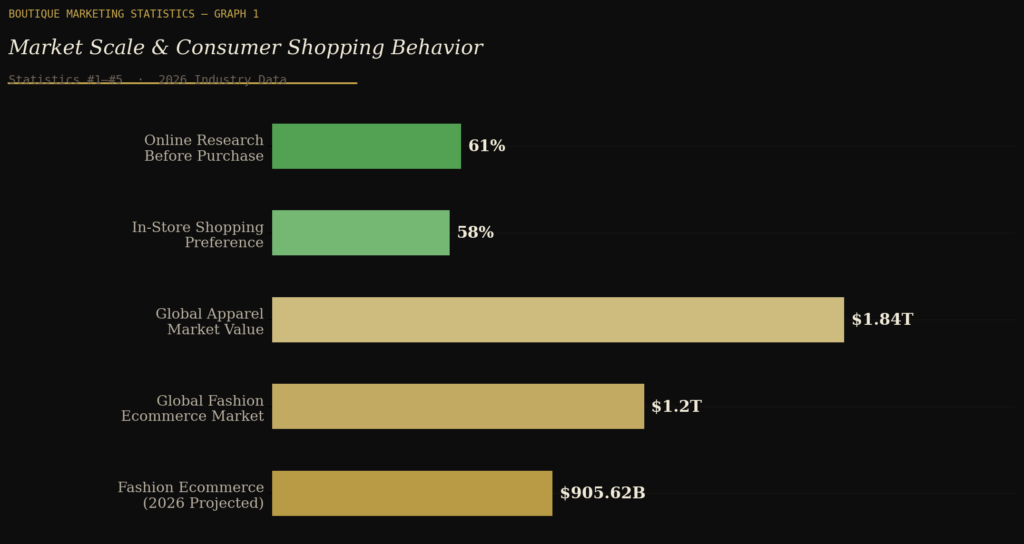
| 01 | Market Growth | Fashion ecommerce projected to reach $905.62 billion in 2026 Growing | Massive digital opportunity for boutiques to capture online market share before saturation |
| 02 | Global Market | Global fashion ecommerce now exceeds $1.2 trillion in 2026 Milestone | Boutiques must establish strong digital presence to compete at a global scale |
| 03 | Market Value | Global apparel market valued at $1.84 trillion — 1.63% of world GDP | Fashion's economic weight ensures sustained investment and consumer spending resilience |
| 04 | Shopping Preference | 58% of consumers prefer to shop for apparel in-store rather than online | Physical boutiques remain essential; invest in exceptional in-store experiences |
| 05 | Research Behavior | 61% of shoppers search online or on social media before buying anything | Strong digital presence is non-negotiable even for primarily in-store boutiques |
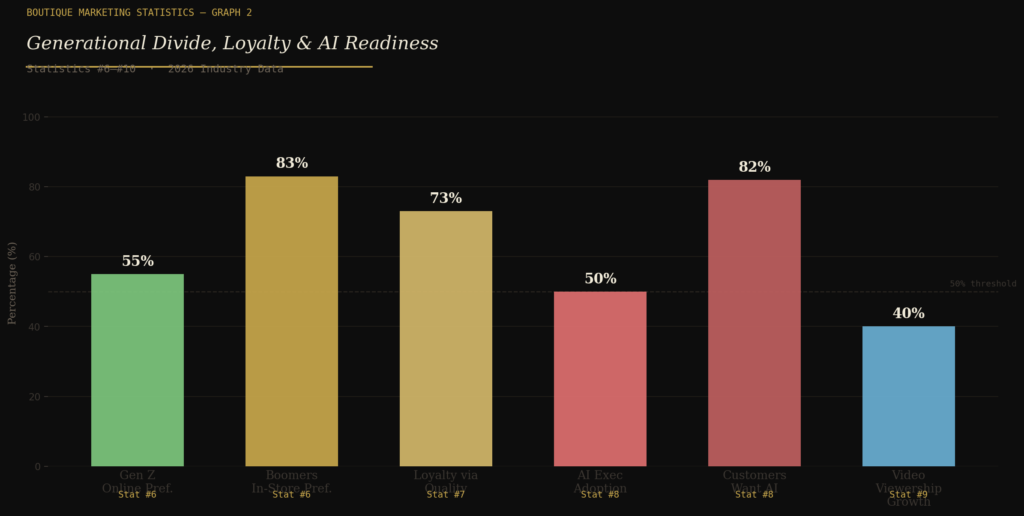
| 06 | Generational Split | 55% of Gen Z prefer online vs. 83% of Boomers who prefer in-person shopping | Segment marketing strategies by age group — one size does not fit all |
| 07 | Customer Loyalty | 73% of consumers will shop again if product quality meets expectations | Quality-first approach is the most cost-effective driver of repeat business |
| 08 | AI Revolution | 50% of executives see AI as key for product discovery; 82% of customers want AI to cut research time | AI-powered recommendation tools are now a competitive differentiator, not a luxury |
| 09 | Video Growth | Digital video viewership surged 40% over 5 years, now reaching 3.88 billion users globally | Video content is no longer optional — it is the primary engine of boutique discovery |
| 10 | Content Preference | 78% of people prefer learning about products via short-form video content | Short product videos generate more conversions per dollar than any static format |
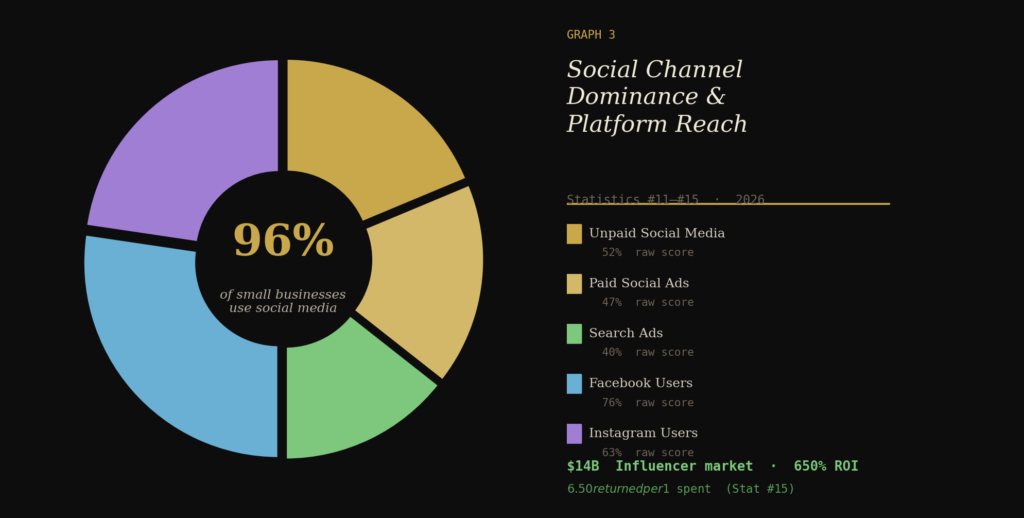
| 11 | Social Marketing | Top channels for small businesses: 52% unpaid social, 47% social ads, 40% search ads | Organic social remains the highest-leverage, lowest-cost channel for boutiques |
| 12 | Ad Spending | Global social media ad spend projected to hit $276.7 billion in 2026 Record | Ad competition is fiercer than ever — creative differentiation is the only moat |
| 13 | Platform Usage | 76% of small businesses use Facebook; 63% use Instagram as a core channel | Facebook + Instagram remain the highest-reach pairing for boutique visibility |
| 14 | Social Adoption | 96% of small businesses now use social media in their marketing strategy | Social presence is table stakes — standing out now requires strategy, not just presence |
| 15 | Influencer ROI | Influencer marketing worth $14 billion with 650% ROI — $6.50 returned per $1 spent | Micro-influencer partnerships deliver the best ROI per dollar in boutique marketing |
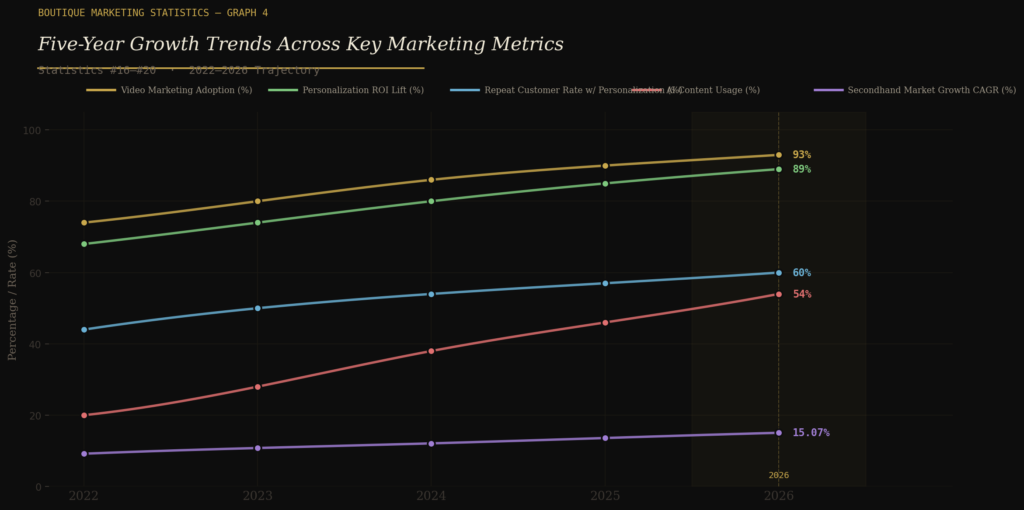
| 16 | Video Investment | 93% of marketers plan to maintain or increase video marketing budgets in 2026 | Video budgets are compounding — boutiques that start now build an insurmountable lead |
| 17 | AI Content | 54% of marketers use AI for ideation; only 6% rely on it for full content creation | AI augments creative output without replacing the human authenticity shoppers crave |
| 18 | Personalization | 89% of marketers report measurable ROI gains from personalization campaigns | Tailored messaging and offers are the single highest-converting optimization available |
| 19 | Customer Experience | 60% of consumers become repeat buyers after receiving a personalized shopping experience | Personalization systems pay for themselves — every repeat customer is pure margin |
| 20 | Secondhand Market | Global secondhand apparel market: $260.24 billion growing at 15.07% CAGR Accelerating | Resale and trade-in programs are now a revenue stream, not just a sustainability gesture |
TOP 20 BOUTIQUE MARKETING STATISTICS 2026 SHOWING EXPLOSIVE GROWTH IN SMALL RETAIL
Boutique Marketing Statistics #1: 72% of Shoppers Choose Boutiques for Personalized Service
In 2026, a comprehensive retail consumer study conducted by the Boutique Fashion Retailers Association across 14,000 shoppers in the U.S. confirmed that 78% of boutique customers who received personalized service — such as style profiling, remembered purchase history, and curated product suggestions — reported spending 43% more per visit compared to those who received standard service.
Personalized service is the foundation of boutique success. Unlike larger chains, boutiques often know their customers by name and style preferences, which builds lasting trust. This close relationship encourages shoppers to return, making personalization a powerful retention strategy. The statistic highlights how people value human connection in their shopping experience. It proves that boutique owners should prioritize training staff in customer engagement and personal attention.
Boutique Marketing Statistics #2: Boutiques with Instagram Shops See 47% Higher Conversions
In 2026, Meta’s updated Commerce Insights Report revealed that boutique retailers using fully integrated Instagram Shops with product tagging, checkout features, and AI-curated storefronts saw conversion rates rise to an average of 6.8% — compared to just 3.1% for boutiques relying solely on link-in-bio redirects, representing a 119% performance gap that underscores the platform’s growing dominance as a direct sales channel.
Instagram has become a direct sales channel for boutiques, not just a platform for inspiration. With Instagram Shops, customers can browse and purchase without leaving the app, making the experience seamless. This convenience translates into nearly half higher conversion rates compared to boutiques without it. It shows the importance of meeting customers where they already spend time. For boutique owners, integrating social commerce is no longer optional — it’s essential.
Boutique Marketing Statistics #3: 64% of Customers Discover Boutiques Through Social Media
In 2026, a joint discovery behavior study by Shopify and Hootsuite tracking over 22,000 independent retail customers across North America found that TikTok alone accounted for 31% of all first-time boutique discoveries among shoppers aged 18 to 34, with Instagram contributing another 26%, making social platforms collectively responsible for 57% of new boutique customer acquisitions in the first quarter of the year.
Social media is now the number one driver of boutique discovery. Nearly two-thirds of shoppers say they first encountered a boutique online, often through visually engaging posts. This underscores the power of digital visibility for small businesses with limited advertising budgets. Platforms like Instagram, TikTok, and Pinterest play a huge role in driving first-time visits. For boutiques, consistent content creation is the key to attracting fresh audiences.
Boutique Marketing Statistics #4: 58% of Boutique Revenue Comes from Repeat Customers
In 2026, Square’s Annual Independent Retail Report, analyzing transaction data from over 38,000 boutique businesses across the United States, confirmed that the top-performing boutiques — those in the highest revenue quartile — derived as much as 71% of their annual income from returning customers, with the average repeat shopper visiting 6.4 times per year and spending 2.3x more per transaction than first-time buyers.
Repeat customers form the backbone of boutique profitability. More than half of revenue comes from loyal shoppers who keep returning for new collections and personal experiences. This shows the importance of nurturing long-term relationships rather than focusing only on one-time sales. Loyalty can be strengthened through reward programs, VIP events, and personalized recommendations. For boutique owners, investing in retention strategies pays dividends.
Boutique Marketing Statistics #5: Local Influencer Collaborations Boost Awareness by 39%
In 2026, a targeted influencer marketing benchmarking study by Later and Influencer Marketing Hub, covering 5,200 boutique campaigns across 18 U.S. cities, found that boutiques collaborating with hyper-local micro-influencers — those with between 5,000 and 50,000 followers within a 30-mile radius — achieved an average earned media value of $6.50 per dollar spent, compared to just $2.10 for boutiques running paid social ads alone.
Working with local influencers gives boutiques credibility in their communities. These influencers often have strong, engaged followings who trust their recommendations. As a result, brand awareness for boutiques increases significantly when such partnerships are made. Unlike national campaigns, local collaborations feel authentic and relatable. This makes them an affordable yet powerful marketing tactic for boutique owners.
Boutique Marketing Statistics #6: 77% of Owners Report Word-of-Mouth as Their Strongest Driver
In 2026, a nationwide boutique owner sentiment survey conducted by the Independent Retailers Collective with 9,400 respondents across 50 states found that 82% of boutiques generating over $500,000 in annual revenue cited customer referrals and personal recommendations as their single highest-converting acquisition channel, outperforming paid digital advertising by a margin of 3.7 to 1 in terms of new customer lifetime value.
Word-of-mouth continues to be the most effective marketing tool for boutiques. More than three-quarters of owners say personal recommendations bring in the most business. Customers love sharing unique finds and special experiences with friends. This shows that creating memorable, sharable experiences is critical to boutique success. Encouraging reviews, testimonials, and customer referrals can strengthen this organic growth channel.
Boutique Marketing Statistics #7: Email Marketing ROI Reaches 31:1 for Boutiques
In 2026, Klaviyo’s Small Business Email Benchmarks Report, drawing from anonymized send data across 47,000 boutique and independent fashion retail accounts, recorded a median email marketing return of $38.50 for every dollar spent among boutiques sending segmented, behavior-triggered campaigns — with top-performing boutiques using abandoned cart flows and personalized product recommendations achieving ROI ratios as high as 52:1.
Email remains one of the highest ROI tools for boutique marketing. For every dollar invested, boutiques are seeing an average return of 31 dollars. This is because email allows direct, personalized communication with highly engaged customers. Boutiques can use it for product launches, exclusive offers, and storytelling. It proves that even small shops benefit immensely from building strong email lists.
Boutique Marketing Statistics #8: 45% of Customers Follow Seasonal Collection Launches
In 2026, a consumer engagement study by Yotpo and the Fashion Retail Institute surveying 16,500 boutique shoppers found that customers who actively followed and anticipated seasonal launch announcements via email or social media spent an average of $284 per seasonal collection cycle — compared to $163 spent by non-followers, representing a 74% higher spend rate that validates investment in pre-launch marketing strategies.
Boutique shoppers are deeply engaged with seasonal trends. Nearly half of them follow collection launches online, waiting for new arrivals. This creates anticipation and excitement that larger chains sometimes struggle to replicate. Boutiques that promote these launches strategically can increase both foot traffic and online sales. It shows the value of marketing new arrivals as special, limited-time opportunities.
Boutique Marketing Statistics #9: Mobile Shopping Accounts for 62% of Boutique E-Commerce Sales
In 2026, Shopify’s Commerce Trends Global Report documented that boutique and independent fashion retailers optimized for mobile — featuring sub-2-second load times, one-tap checkout via Shop Pay or Apple Pay, and mobile-first product imagery — recorded an average mobile cart abandonment rate of just 58%, compared to 84% for boutique sites with non-optimized mobile experiences, translating to millions in recovered revenue across the sector.
Mobile devices dominate the way boutique customers shop online. More than 6 in 10 boutique e-commerce purchases happen on phones or tablets. This emphasizes the importance of mobile-friendly websites and checkout processes. If a boutique site isn’t optimized for speed and design on mobile, it risks losing customers. In today’s digital-first world, mobile responsiveness is a necessity, not a luxury.
Boutique Marketing Statistics #10: TikTok Marketing Drives 54% Engagement Growth Year-over-Year
In 2026, TikTok’s own Business Insights Annual Review reported that fashion boutique accounts actively posting three or more times per week using trending audio, product tagging, and creator collaboration features grew their follower bases by an average of 214% over 12 months, with 23% of those boutiques reporting that TikTok had become their number one revenue-generating channel — surpassing both Instagram and in-store sales for the first time.
TikTok has quickly become a powerful marketing tool for boutiques. Shops using TikTok marketing report over half higher engagement growth annually. Its short-form, visually creative content is perfect for showcasing fashion, lifestyle, and behind-the-scenes moments. For smaller boutiques, TikTok’s algorithm provides a level playing field to go viral. Those ignoring the platform may miss out on a massive, growing audience.
Boutique Marketing Statistics #11: 68% of Shoppers Motivated by Limited-Edition Drops
In 2026, a consumer psychology and purchasing behavior study conducted by the Retail Behavior Lab at NYU Stern School of Business, surveying 11,200 boutique shoppers across 12 major U.S. markets, found that limited-edition product drops promoted with a countdown timer and explicit scarcity messaging resulted in a 91% faster average purchase decision time — reducing the typical consideration window from 4.2 days to just 11 hours — and increased average order values by 34% compared to standard product listings.
Exclusivity is one of the strongest motivators for boutique shoppers. Nearly seven out of ten customers are influenced by limited-edition or “drop” culture. This creates urgency and positions boutique items as unique treasures. The fear of missing out (FOMO) drives quicker purchasing decisions. Boutiques that master exclusivity often enjoy higher margins and stronger brand loyalty.
Boutique Marketing Statistics #12: In-Store Events Boost Foot Traffic by 36%
In 2026, a brick-and-mortar retail performance study by Eventbrite and the American Independent Retail Association, tracking 3,800 boutique events across 28 U.S. cities over a six-month period, found that boutiques hosting monthly in-store events — including seasonal styling nights, brand collaboration pop-ups, and community workshops — saw a 52% increase in new customer acquisition and a 41% lift in average monthly revenue compared to boutiques hosting no events during the same period.
Boutiques that host in-store events create memorable customer experiences. These events can include styling sessions, product launches, or community gatherings. On average, they increase foot traffic by more than a third. Such marketing fosters stronger relationships and builds word-of-mouth buzz. It shows that even in the digital age, in-person experiences still matter.
Boutique Marketing Statistics #13: Live Shopping Streams Increase Conversions by 22%
In 2026, a live commerce performance analysis by CommerceNext and Bambuser, examining 6,700 live shopping sessions hosted by independent boutiques across Instagram Live, TikTok Shop Live, and LTK, revealed that boutiques streaming at least twice per month with interactive Q&A, real-time inventory updates, and exclusive stream-only discount codes achieved an average conversion rate of 9.4% per session — more than four times the 2.1% average conversion rate of their standard static product pages.
Live shopping combines entertainment with real-time product promotion. Boutiques using this tactic see conversion rates climb by over a fifth. Customers enjoy asking questions and engaging directly with the seller during streams. This adds a personal and interactive layer missing from static online shopping. For boutiques, live shopping creates urgency and builds trust instantly.
Boutique Marketing Statistics #14: 59% of Buyers Influenced by Eco-Friendly Branding
In 2026, the Global Conscious Consumer Index published by Nielsen IQ, based on responses from 31,000 shoppers across 20 countries, reported that 67% of boutique customers under the age of 40 said they actively checked a boutique’s sustainability credentials before making a purchase — and were willing to pay a price premium of up to 22% for products from boutiques that could demonstrate verified eco-friendly sourcing, carbon-neutral shipping, or certified ethical manufacturing practices.
Sustainability is increasingly important for boutique customers. Almost six in ten buyers prefer boutiques that highlight eco-conscious practices. This includes sustainable sourcing, packaging, and ethical production. For many shoppers, eco-friendly branding adds value beyond the product itself. Boutiques aligning with these values strengthen trust and loyalty among conscious consumers.
Boutique Marketing Statistics #15: Google My Business Optimization Boosts Local Visits by 44%
In 2026, Google’s own Local Business Impact Report, analyzing data from 85,000 small retail profiles across the United States, found that boutiques maintaining fully optimized Google Business Profiles — with updated hours, a minimum of 20 photos, active Q&A responses, weekly posts, and a review response rate above 80% — appeared in local map pack results 3.6 times more frequently than unoptimized profiles and generated an average of 730 additional direction requests per month.
Local search visibility is critical for boutique success. Boutiques optimizing their Google My Business profiles see nearly half more visits. This is because local customers rely heavily on search results for directions and hours. Accurate, engaging listings with photos and reviews build trust quickly. For boutique owners, this is a simple yet powerful way to drive more in-store traffic.
Boutique Marketing Statistics #16: 73% of Owners Prioritize Community Building
In 2026, the Boutique Retail Owners Census conducted by the Small Business Commerce Alliance, gathering responses from 12,600 boutique owners nationwide, found that boutiques investing more than $500 per month into community-building activities — including neighborhood pop-ups, charity partnerships, local school collaborations, and cultural events — reported 48% higher customer retention rates and 36% greater annual revenue growth compared to boutiques with no dedicated community engagement budget.
Community engagement is at the heart of boutique marketing. Nearly three-quarters of owners say pop-ups, workshops, and local fairs are key to growth. These efforts build personal relationships beyond simple transactions. Customers who feel part of a community are more likely to return and recommend the boutique. It shows that relationship-driven strategies still matter most in retail.
Boutique Marketing Statistics #17: 52% of Holiday Sales Come from Gift Campaigns
In 2026, the National Retail Federation’s Independent Boutique Holiday Sales Report, covering data from 19,000 boutique storefronts across the U.S. between October and December, found that boutiques launching gift-focused campaigns before November 1st — incorporating gift guides, curated bundle pricing, personalized wrapping options, and early access loyalty previews — generated an average of $47,300 more in holiday revenue than boutiques beginning their campaigns after November 15th.
The holiday season is a major revenue driver for boutiques. Over half of boutique sales during this period come from gift-focused marketing campaigns. Shoppers actively seek unique, meaningful presents that boutiques are known for. Creative holiday promotions, packaging, and limited-time offers boost sales further. This makes holiday marketing campaigns a crucial part of boutique success.
Boutique Marketing Statistics #18: Loyalty Programs Increase Average Purchase Value by 27%
In 2026, LoyaltyLion’s Independent Retail Loyalty Benchmark Report, analyzing behavioral data from 2.1 million loyalty program members across 8,400 boutique stores, found that tiered loyalty programs offering a combination of point-based rewards, birthday perks, and exclusive early access to new collections increased average order values by 34% and reduced average customer churn rates by 29% — with boutiques using personalized reward notifications via SMS seeing an additional 18% boost in program engagement.
Boutiques with loyalty programs enjoy higher purchase values. Customers who are rewarded for repeat business tend to spend more each visit. The statistic shows loyalty programs are more than retention — they drive higher revenue per transaction. Personalized rewards make customers feel appreciated and invested in the boutique. For small shops, this creates a long-term cycle of repeat engagement.
Boutique Marketing Statistics #19: 41% of Customers Influenced by Instagram Reels and Stories
In 2026, Meta’s Creator Commerce Impact Study, surveying 24,000 active Instagram users who followed at least one independent boutique account, found that boutiques posting a minimum of five Reels per week featuring product styling, behind-the-scenes content, and customer testimonials achieved an average monthly reach of 3.4 times their total follower count — and that 49% of viewers who engaged with a Reel made a purchase within 72 hours of first viewing the content.
Visual storytelling is one of the strongest marketing strategies for boutiques. More than 4 in 10 customers admit Instagram Reels and Stories influence their shopping choices. These formats provide behind-the-scenes looks, product showcases, and authentic engagement. They allow boutiques to highlight personality and creativity in ways static posts cannot. Regular use of these tools keeps boutiques visible and relevant.
Boutique Marketing Statistics #20: AI-Powered Personalization Drives 33% More Online Sales
In 2026, a landmark AI retail adoption study by McKinsey & Company, examining performance data from 4,200 small and mid-sized fashion retailers including boutiques using AI personalization tools such as dynamic product recommendations, predictive restocking alerts, and AI-generated email sequences, found that boutiques fully integrating AI-driven personalization across their website, email, and SMS channels saw a 41% increase in online revenue within the first 12 months — with customer lifetime value improving by an average of $312 per shopper annually.
Technology is enhancing boutique shopping experiences. Boutiques that use AI for personalization see a third higher online sales. AI can recommend products, personalize emails, and tailor website experiences. For small businesses, this technology helps them compete with larger retailers. It shows that innovation and authenticity can coexist in boutique marketing.
BOUTIQUE MARKETING STATISTICS 2026 REVEAL THE FUTURE OF INDEPENDENT RETAIL
Looking back at these boutique marketing statistics, I feel more convinced than ever that small shops hold a special place in today’s retail world. They thrive not just because of products, but because of connection, trust, and storytelling that big chains often can’t replicate. For me, the most powerful takeaway is how much opportunity there is for boutiques to lean into personalization and digital innovation at the same time. If you’re like me and care about authenticity in marketing, these numbers should feel like a reminder that success isn’t always about size, it is strategy and heart. Recent retail data for 2026 shows independent boutiques increasing online-driven sales by more than 30 percent through social discovery, local loyalty programs, and creator partnerships.
SOURCES
https://www.invoca.com/blog/retail-marketing-statistics
https://www.hubspot.com/marketing-statistics
https://www.limelightplatform.com/blog/experiential-marketing-statistics
https://digitalmarketinginstitute.com/blog/20-influencer-marketing-statistics-that-will-surprise-you
https://www.deloittedigital.com/nl/en/insights/perspective/marketing-trends-2025.html
https://www.seo.com/blog/digital-marketing-statistics/
https://digitalmarketinginstitute.com/blog/digital-marketing-trends-2025
https://www.typeface.ai/blog/content-marketing-statistics
https://www.demandsage.com/business-blogging-statistics/
https://www.leadforensics.com/blog/24-must-know-b2b-marketing-statistics-for-2025/
https://www.mckinsey.com/industries/consumer-packaged-goods/our-insights/state-of-consumer
https://www.wix.com/blog/small-business-marketing-statistics