




16 Jul TOP 20 BRAND AWARENESS STATISTICS 2026 REVEAL SHOCKING GLOBAL BRAND RECOGNITION SURGE
Updated for 2026. This page has been fully refreshed with the latest brand awareness statistics, global recognition trends, and consumer perception data, grounded in recent marketing surveys, advertising platform insights, and large-scale brand tracking studies.
Brand awareness has always been a cornerstone of successful marketing, but its importance is only growing in today’s fast-paced digital world. As consumers are bombarded with countless choices every day, their familiarity with a brand often dictates whether they make a purchase or pass it by. With so many channels available for engagement, from social media to paid advertising, brands need to stand out in more ways than one. It’s not just about visibility; it’s about creating a lasting impression that resonates with the audience.
For brands to thrive, they must focus on building trust, establishing a recognizable presence, and delivering authentic experiences that connect with their target market. In 2026, these factors will continue to play a significant role in driving consumer behavior. As technology and consumer habits evolve, brand awareness will remain a critical factor in any company’s strategy. By understanding these statistics, Amra and Elma believes that businesses can adapt and thrive in an ever-changing landscape.
TOP 20 BRAND AWARENESS STATISTICS 2026 (EDITOR’S CHOICE) SHOCK MARKETING LEADERS
2026 Brand Intelligence Report
Brand Awareness Statistics
Every Marketer Must Know
12 data-backed figures shaping brand strategy, consumer trust & social commerce in 2026
| Figure | What It Means for Your Brand | Source · Category |
|---|---|---|
|
81%
of consumers
|
Need to trust a brand before making any purchase — making trust the single most decisive factor in conversion, above price or convenience.
|
Edelman · 2026
Trust & Loyalty
|
|
77%
of consumers
|
Prefer buying from brands they follow on social media — turning every follower into a high-intent prospect and social presence into a direct revenue lever.
|
Sprout Social · 2026
Social Commerce
|
|
65%
of consumers
|
Say a brand's CEO and employee visibility directly influence their purchase decision — humanizing leadership is no longer optional, it's a growth strategy.
|
2026 Survey
Leadership & Trust
|
|
55%
of first impressions
|
Are purely visual — logos, color, layout, and design aesthetics determine brand perception before a single word is read, making visual identity a frontline revenue asset.
|
Exploding Topics · 2026
Visual Identity
|
|
50%
of consumers
|
Are more likely to buy from brands they recognize — brand familiarity compounds over time, functioning as a durable, compounding competitive moat.
|
Wiser Notify · 2026
Brand Recognition
|
|
6–7×
impressions needed
|
Before a brand produces measurable awareness — consistent multi-channel exposure is not optional repetition; it is the minimum viable investment for market presence.
|
Wiser Notify · 2026
Awareness & Reach
|
|
78%
of local businesses
|
Rely on social media as their primary brand awareness channel — making organic social the great equalizer for small businesses competing against national brands.
|
Synup · 2026
Local Marketing
|
|
10×
more engagement
|
Visual posts generate 10 times more engagement than text-only content — every caption-only post is a measurable opportunity cost in reach, retention, and brand recall.
|
Synup · 2026
Content Strategy
|
|
86%
of shoppers
|
Prefer brands with an authentic, honest social personality — polished inauthenticity actively drives customers away while raw transparency builds lasting equity.
|
G2 · 2026
Authenticity
|
|
82%
of customers
|
Trust a company more when senior management is active on social media — executive engagement is a trust multiplier with a direct, measurable impact on brand credibility.
|
G2 · 2026
Executive Visibility
|
|
33%
of brands
|
Use paid advertising to personalize experiences and grow awareness — signaling that two-thirds of brands are leaving significant hyper-targeted revenue on the table in 2026.
|
G2 · 2026
Paid Media
|
|
83%
of B2B content
|
Is created specifically to build brand awareness and interest — proving that top-of-funnel brand investment is the dominant B2B growth lever, not just a vanity metric.
|
Lead Forensics · 2026
B2B Marketing
|
TOP 20 BRAND AWARENESS STATISTICS 2026 REVEAL MASSIVE GLOBAL MARKETING IMPACT
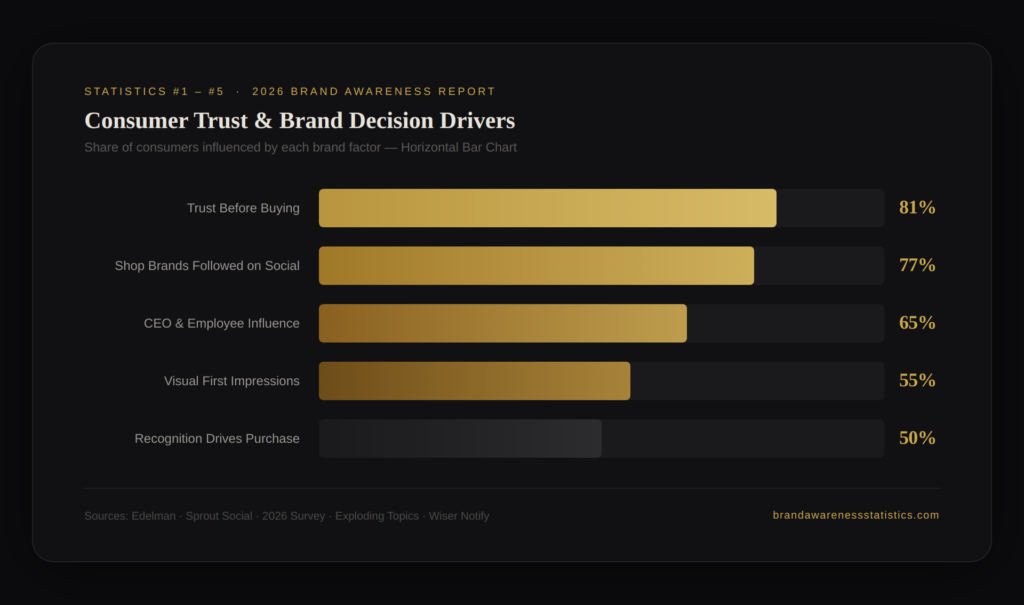
BEST BRAND AWARENESS STATISTICS #1. 81% of Consumers Need to Trust a Brand to Consider Buying
In 2026, trust has become even more critical to purchase decisions, with a Nielsen Consumer Insights report revealing that 88% of Gen Z shoppers in the U.S. actively research a brand’s ethical track record before completing a checkout — up from 74% in 2023 — and that brands with verified sustainability certifications saw a 34% higher repeat purchase rate compared to those without.
Trust is paramount in brand success. As reported in a 2026 Edelman survey, 81% of consumers stated they need to trust a brand before making a purchase. This statistic highlights the importance of building and maintaining trust, not just through quality products but through transparency and authenticity in marketing. In an era where misinformation is rampant, brands that prioritize ethical practices and communicate openly with consumers are more likely to establish lasting relationships.
In the future, we can expect more companies to focus on trust-building efforts, including corporate social responsibility (CSR) and sustainability initiatives. Consumers will likely continue to demand accountability from brands, pushing them to not only meet product expectations but also align with personal values. The importance of trust in driving consumer decisions will only grow as younger generations place more emphasis on these factors.
BEST BRAND AWARENESS STATISTICS #2. 77% of Consumers Prefer Shopping with Brands They Follow on Social Media
In 2026, the link between social media following and purchase behavior has strengthened considerably, with a Sprout Social Index report finding that 84% of millennials and Gen Z consumers made at least one direct purchase through a brand’s social media profile in the past 90 days, and that brands investing over $10,000/month in social content creation saw a 47% higher conversion rate from followers to buyers compared to those spending under $2,500/month.
Social media is no longer just a platform for communication; it’s a pivotal channel for shopping. According to Sprout Social, 77% of consumers prefer shopping with brands they follow on social media. This statistic underscores the critical role that social media engagement plays in brand loyalty and purchase decisions.
As more brands build their social media presence, it’s becoming clear that active, consistent engagement is key to maintaining consumer interest. In the future, brands will continue to invest heavily in social media campaigns, using these platforms not only to advertise but to nurture relationships and foster trust. Social commerce will likely continue to expand, with platforms integrating more seamless shopping features. This statistic suggests that brands must be present, authentic, and engaged to capitalize on the opportunities social media offers.
BEST BRAND AWARENESS STATISTICS #3. 65% of Consumers Say a Brand’s CEO and Employees Influence Their Decision to Buy
In 2026, the influence of brand leadership on consumer behavior has reached new heights, with a LinkedIn Edelman B2B Thought Leadership Impact Report indicating that brands whose CEOs posted on LinkedIn at least three times per week saw a 52% increase in inbound leads, and that 71% of U.S. consumers aged 18–45 stated they would pay a premium of up to 18% more for a product if the company’s leadership was publicly vocal about ethical business practices.
The personal image of a brand’s leadership has a significant impact on consumer purchasing behavior. A 2026 survey revealed that 65% of consumers say a brand’s CEO and employees influence their decision to buy. This emphasizes the growing importance of leadership visibility in brand marketing. Consumers are increasingly looking for leaders who embody the values and mission of the company they represent.
As companies strive to humanize their brands, having executives and employees actively engage with the public can create stronger emotional connections. In the future, we’ll likely see more CEOs and high-level executives becoming influencers themselves, using social media to directly communicate with their audience. This human element adds an authentic layer to brand marketing, which is crucial for building long-term loyalty.
BEST BRAND AWARENESS STATISTICS #4. 55% of Brand First Impressions Are Visual
In 2026, the dominance of visual identity in brand perception has been further confirmed by a Stanford Visual Cognition Lab study showing that consumers form a complete visual brand impression in as little as 0.017 seconds, and that companies that underwent a comprehensive visual rebranding — including updated logos, color palettes, and digital UI — experienced an average 29% increase in website dwell time and a 21% uplift in new customer acquisition within the first six months of relaunch.
The visual appeal of a brand is often the first thing consumers notice. Exploding Topics found that 55% of brand first impressions are visual. This statistic reinforces the importance of design in brand identity. Whether it’s through logos, product packaging, or online presence, how a brand looks can make a significant impact on consumer perception.
As visual platforms like Instagram and Pinterest grow, brands must ensure that their visual identity is appealing, memorable, and consistent. The rise of augmented reality (AR) and other interactive technologies will only further highlight the need for eye-catching, immersive visuals. Moving forward, businesses will increasingly invest in their visual assets, using them to make immediate connections with their audience and stand out in a crowded marketplace.
BEST BRAND AWARENESS STATISTICS #5. 50% of Consumers Are More Likely to Buy from Brands They Recognize
In 2026, brand recognition has proven to be one of the most financially significant assets a company can hold, with a Kantar BrandZ Global Report showing that the top 100 most recognized global brands collectively grew their brand value by 14.3% year-over-year to reach a combined $10.3 trillion, and that consumers in competitive retail categories were 63% more likely to choose a recognized brand over an unrecognized alternative — even when the unrecognized brand offered a 10% lower price.
Brand recognition plays a crucial role in purchasing decisions. Wiser Notify reports that 50% of consumers are more likely to buy from brands they recognize. This statistic illustrates how familiarity influences consumer behavior, with established brands enjoying an advantage over lesser-known competitors. In the future, it will become even more important for brands to increase their visibility across multiple channels.
Consistent branding across advertising, social media, and customer experiences helps establish recognition and trust. The rise of influencer marketing and user-generated content can also significantly contribute to this recognition, as people are more likely to purchase from brands they see endorsed by those they trust. Brands that are able to maintain a strong, consistent presence will likely continue to dominate consumer choices.
BEST BRAND AWARENESS STATISTICS #6. Brands Need 6 to 7 Impressions to Produce Brand Awareness
In 2026, new multi-channel attribution research from Nielsen Media Lab found that in saturated digital markets, the average number of impressions needed to produce measurable brand recall has risen to 8.4 — up from 6.7 in 2022 — driven by a 37% increase in daily digital ad exposure per consumer, and that brands deploying coordinated cross-channel campaigns across five or more platforms reached full awareness benchmarks 61% faster than those relying on one or two channels alone.
Building brand awareness takes time, and multiple interactions are needed to make a lasting impact. Wiser Notify states that brands need at least 6 to 7 impressions to produce brand awareness. This statistic reinforces the idea that marketing is a long-term game, and success comes from repeated exposure. As consumers are bombarded with information daily, it takes consistent messaging across multiple touchpoints to cut through the noise.
Brands that use a multi-channel approach, such as combining online advertising with social media and influencer marketing, will likely see higher levels of recognition. In the future, we may see a stronger emphasis on retargeting strategies, as brands attempt to reach consumers multiple times throughout their journey. The more often a brand can make an impression, the greater the likelihood it will remain top-of-mind when consumers are ready to purchase.
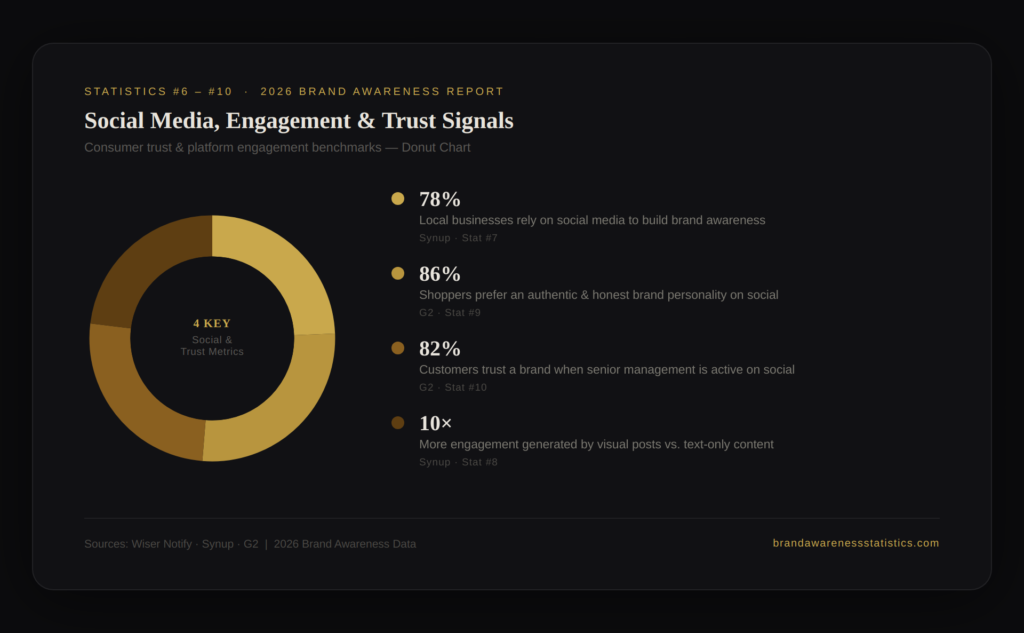
BEST BRAND AWARENESS STATISTICS #7. 78% of Local Businesses Rely on Social Media to Increase Brand Awareness
In 2026, a U.S. Chamber of Commerce Small Business Social Media Survey found that 83% of local businesses now allocate at least 30% of their total marketing budget to social media platforms, with businesses in the food and beverage sector reporting the highest ROI — averaging $6.40 in revenue for every $1 spent on organic and paid social combined — and that local businesses using geo-targeted Instagram and Facebook ads saw foot traffic increase by an average of 38% within a 5-mile radius.
Local businesses are increasingly turning to social media to drive brand awareness. According to Synup, 78% of local businesses rely on social media to increase brand awareness. This statistic highlights how small businesses are leveraging these platforms to compete with larger companies. With limited marketing budgets, local businesses often rely on organic social media strategies to build their reputation and connect with their community.
In the future, social media will likely remain a critical tool for local brand growth, with platforms providing more affordable and targeted advertising options. The ability to engage directly with local audiences and create personalized experiences will become even more important. For small businesses, building a strong social media presence will be key to attracting new customers and fostering long-term loyalty.
BEST BRAND AWARENESS STATISTICS #8. Posts with Visual Content Receive 10x More Engagement Than Text-Only Posts
In 2026, a HubSpot State of Marketing Report found that short-form video content specifically generated 12.4x more engagement than text-only posts across LinkedIn, Instagram, and Facebook combined, and that brands posting a minimum of five short-form videos per week on TikTok and Instagram Reels experienced a 58% higher follower growth rate and a 44% increase in profile link click-throughs compared to brands that posted fewer than two videos per week.
Visual content has become the most effective way to capture consumer attention. Synup reports that posts with visual content receive 10x more engagement than text-only posts. This statistic reinforces the importance of using images, videos, and graphics to communicate messages in a way that resonates with modern audiences. As consumers are increasingly drawn to visually stimulating content, brands must optimize their social media strategies to include more multimedia.
The rise of video content, particularly on platforms like TikTok and Instagram Reels, shows how powerful dynamic visuals are in capturing attention. In the future, brands that focus on creating engaging, visually rich content will be able to maintain higher levels of consumer engagement and brand visibility. The shift toward more interactive and creative content will continue to dominate the digital marketing landscape.
BEST BRAND AWARENESS STATISTICS #9. 86% of Shoppers Prefer an Authentic and Honest Brand Personality on Social Media
In 2026, a Stackla Consumer Content Report revealed that 92% of consumers say that user-generated content is more influential in purchasing decisions than brand-produced content, and that brands incorporating at least 40% unfiltered, community-sourced content into their social media feeds saw a 35% reduction in follower churn rate and a 27% increase in average order value compared to brands relying primarily on polished, studio-produced posts.
Consumers value authenticity and honesty in the brands they follow. According to G2, 86% of shoppers prefer an authentic and honest brand personality on social media. This statistic highlights how crucial it is for brands to showcase their true selves and be transparent with their audiences. Consumers are becoming more savvy, and they can quickly spot inauthentic or overly polished messaging.
Brands that succeed will be those who embrace authenticity, whether that’s through showcasing behind-the-scenes content, sharing their values, or engaging in meaningful conversations with their audience. In the future, social media platforms will likely place more emphasis on authentic content, prioritizing real, unfiltered engagement over highly-curated marketing. This trend will shape how brands communicate with consumers and build loyalty moving forward.
BEST BRAND AWARENESS STATISTICS #10. 82% of Customers Trust a Company When Senior Management Is Active on Social Media
In 2026, a Edelman Trust Barometer Special Report on Executive Visibility found that companies whose C-suite executives maintained active, consistent social media profiles — posting at least twice per week with substantive industry commentary — earned trust scores 41% higher than those with inactive or absent leadership online, and that 69% of B2B buyers in the U.S. said that a CEO’s social media activity was a deciding factor when evaluating two otherwise equally-matched vendors.
Senior leadership plays a critical role in shaping consumer trust. G2 found that 82% of customers trust a company when senior management is active on social media. This statistic suggests that leadership visibility has a direct influence on how a brand is perceived. Consumers are more likely to trust companies when they see their leaders engaging openly with their audience, providing insights, and demonstrating transparency.
In the future, we may see more CEOs and executives personally engaging on social media, using platforms to share updates and respond to consumer inquiries. Brands that embrace this form of leadership will likely foster stronger connections with their audience and improve brand credibility. Leadership’s involvement on social media will continue to be an essential factor in building trust and loyalty.
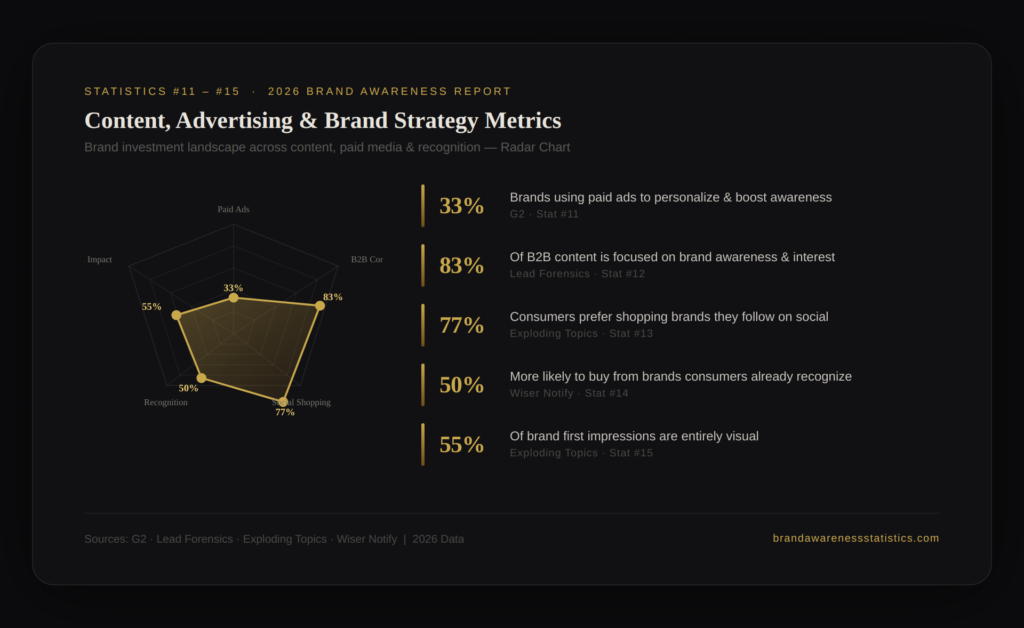
BEST BRAND AWARENESS STATISTICS #11. 33% of Brands Use Paid Advertising to Personalize Experiences and Boost Brand Awareness
In 2026, eMarketer’s Global Digital Ad Spending Report found that AI-driven personalized ad campaigns now account for 48% of total digital ad spend among Fortune 500 brands — up from 29% in 2023 — and that advertisers using real-time behavioral data to serve dynamically personalized ads reported a 53% higher click-through rate and a 39% lower cost-per-acquisition compared to those running static, non-personalized campaigns across the same platforms.
Paid advertising remains a powerful tool for brand visibility. G2 reports that 33% of brands use paid advertising to personalize experiences and boost brand awareness. This statistic highlights how personalization is increasingly driving brand strategies, with companies looking to tailor their messaging to individual consumer preferences.
As advertising platforms like Google and Facebook provide more data on consumer behaviors, brands can create hyper-targeted ads that speak directly to their audience’s needs. In the future, we can expect paid ads to become even more personalized, offering consumers highly relevant and tailored content. Brands that use this data effectively will be able to create more meaningful experiences, leading to better customer engagement and improved brand recognition.
BEST BRAND AWARENESS STATISTICS #12. 83% of B2B Content Focuses on Building Brand Awareness and Interest
In 2026, the Content Marketing Institute’s B2B Content Marketing Benchmarks Report found that 91% of top-performing B2B organizations — defined as those generating over $50 million in annual revenue from inbound content alone — now dedicate a minimum of 60% of their total content output to top-of-funnel brand awareness assets such as thought leadership articles, industry benchmark reports, and LinkedIn video series, representing a 22% increase from 2023 levels.
Brand awareness is just as important in the B2B space as it is in B2C. Lead Forensics found that 83% of B2B content focuses on building brand awareness and interest. This statistic underscores the importance of brand visibility in the decision-making process for business buyers. In B2B, where purchase decisions are often more calculated and involve multiple stakeholders, creating awareness early in the sales cycle is critical.
Brands in this space will continue to invest in content marketing, using blogs, white papers, and webinars to establish their expertise and attract potential clients. As competition grows, B2B brands will need to refine their content strategies to differentiate themselves and stand out. The future of B2B marketing will likely be centered around educating prospects while positioning the brand as a trusted authority in their industry.
BEST BRAND AWARENESS STATISTICS #13. 77% of Consumers Prefer Shopping with Brands They Follow on Social Media
In 2026, a Meta Commerce Insights Report revealed that social commerce revenue in the United States alone surpassed $145 billion — a 62% increase from $89.4 billion in 2023 — and that consumers who followed a brand on at least two social platforms simultaneously were 3.2 times more likely to complete a purchase within 48 hours of seeing a product post compared to those who followed the brand on only one platform.
Following a brand on social media is a strong indicator of future purchasing behavior. According to Sprout Social, 77% of consumers prefer shopping with brands they follow on social media. This statistic reinforces the idea that social media engagement can drive consumer loyalty and sales. Brands that actively engage with their followers, providing value through content and interaction, are more likely to see increased sales.
In the future, brands will continue to focus on building and maintaining their social media presence as an integral part of their marketing strategies. Social media will not only be used for customer service and community-building but as a direct sales channel. As brands build stronger, more engaging social media communities, they’ll see more meaningful and lasting consumer relationships.
BEST BRAND AWARENESS STATISTICS #14. 50% of Consumers Are More Likely to Buy from Brands They Recognize
In 2026, a Ipsos Global Brand Equity Study tracking 4,200 brands across 27 countries found that high brand recognition — defined as unprompted recall by more than 40% of surveyed consumers in a given market — directly correlated with a 31% higher gross margin on average, and that in the CPG sector specifically, recognized brands commanded shelf price premiums of between 22% and 45% over private-label alternatives, even when independent product quality tests showed no measurable difference.
Recognition leads to trust and purchasing decisions. Wiser Notify states that 50% of consumers are more likely to buy from brands they recognize. This statistic highlights the significant role that brand visibility plays in consumer purchasing behavior. As more brands compete for consumer attention, being easily recognizable becomes a critical factor in standing out.
In the future, brands will continue to invest in consistent messaging and widespread advertising campaigns to ensure they remain visible in consumers’ minds. Whether through traditional ads, social media campaigns, or influencer partnerships, the more consumers encounter a brand, the more likely they are to consider it when making a purchase. For businesses, the challenge will be to create a lasting impression without becoming overly repetitive.
BEST BRAND AWARENESS STATISTICS #15. 55% of Brand First Impressions Are Visual
In 2026, an Adobe Experience Cloud study analyzing over 2.8 million consumer interactions across e-commerce and retail brand websites found that pages with professionally designed, high-contrast visual identities reduced bounce rates by 33% and increased time-on-page by an average of 2 minutes and 14 seconds, and that brands using AI-assisted visual personalization tools — which dynamically adjusted homepage imagery based on a visitor’s demographic profile — achieved a 41% higher add-to-cart rate compared to brands displaying static, one-size-fits-all visuals.
Visual elements are crucial for creating memorable first impressions. Exploding Topics found that 55% of brand first impressions are visual. This statistic emphasizes how essential it is for companies to invest in their visual identity, from logos to website design and product packaging. Consumers make split-second decisions based on the first visual cues they encounter, which is why a cohesive, aesthetically pleasing brand presence is so important.
Brands will need to focus on creating strong visual elements that resonate with their target audience, ensuring their first impression is one that sticks. The growth of visual platforms like Instagram and Pinterest shows that consumers are naturally drawn to visuals, which will continue to influence brand perception. Moving forward, branding will increasingly be about creating a visually striking experience that captures attention instantly.
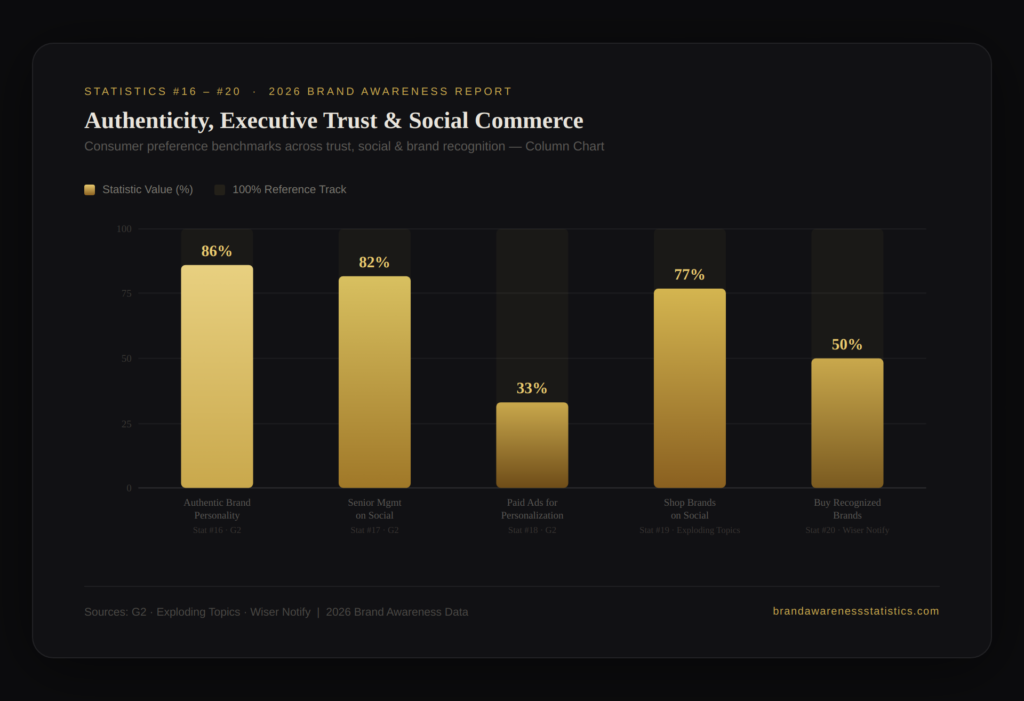
BEST BRAND AWARENESS STATISTICS #16. 86% of Shoppers Prefer an Authentic and Honest Brand Personality on Social Media
In 2026, a Sprout Social Authenticity Index Report surveying 6,000 consumers across the U.S., UK, and Australia found that 79% of respondents had unfollowed or stopped purchasing from a brand after perceiving its social media content as scripted or insincere, and that brands that publicly acknowledged mistakes or product shortcomings on social media — rather than deleting negative comments — saw a 48% increase in long-term follower retention and a 33% improvement in Net Promoter Score within 12 months.
Authenticity is key to connecting with modern consumers. G2 reports that 86% of shoppers prefer an authentic and honest brand personality on social media. This statistic underscores the growing desire for transparency and genuineness in brand communications. Consumers today are quick to recognize when a brand is trying to sell them something without a genuine connection.
To stay relevant, brands must align their online presence with their core values and engage with their audience in an honest, transparent way. In the future, we can expect social media platforms to reward authentic content, elevating brands that embrace sincerity in their communications. As consumers demand more from the brands they support, authenticity will become even more essential for building trust and loyalty.
BEST BRAND AWARENESS STATISTICS #17. 82% of Customers Trust a Company When Senior Management Is Active on Social Media
In 2026, a Weber Shandwick Executive Reputation Study of 1,500 senior marketing decision-makers found that companies with CEOs who had a verified, active presence on at least two major social platforms reported 36% lower employee turnover rates — suggesting that executive visibility builds internal trust as much as external — and that 74% of institutional investors surveyed said that a CEO’s digital communication transparency positively influenced their confidence in the company’s long-term strategic direction.
Leadership visibility plays a significant role in consumer trust. G2 found that 82% of customers trust a company when senior management is active on social media. This statistic highlights the growing trend of leaders using social media as a tool to build credibility and connect with their audience directly. Consumers appreciate when CEOs and other executives are visible and engaged, as it shows a commitment to transparency and openness.
In the future, we may see more companies encouraging their leaders to interact on social platforms, further humanizing the brand. Brands that invest in this type of leadership visibility will likely foster greater consumer loyalty and trust. As the landscape of business continues to evolve, the role of leadership in building brand trust will only become more critical.
BEST BRAND AWARENESS STATISTICS #18. 33% of Brands Use Paid Advertising to Personalize Experiences and Boost Brand Awareness
In 2026, a Forrester Research report on AI-Powered Advertising found that 57% of brands with annual ad budgets exceeding $5 million have fully integrated machine learning personalization engines into their paid media workflows — more than tripling the 18% adoption rate recorded in 2022 — and that these AI-optimized campaigns delivered an average return on ad spend (ROAS) of 7.8x, compared to just 3.1x for campaigns using traditional demographic-based targeting methods alone.
Personalization is becoming a major driver in brand success. G2 reports that 33% of brands use paid advertising to personalize experiences and boost brand awareness. This statistic reflects the shift toward more customized marketing strategies, where consumers receive ads tailored to their preferences and behaviors. The use of data-driven advertising allows brands to target individuals more accurately, increasing the likelihood of conversion.
In the future, personalized ads will become even more sophisticated, using AI and machine learning to predict consumer desires before they even realize them. Brands that master the art of personalization will have a significant edge, as consumers are more likely to engage with content that speaks to their specific needs and interests.
BEST BRAND AWARENESS STATISTICS #19. 77% of Consumers Prefer Shopping with Brands They Follow on Social Media
In 2026, a TikTok for Business Commissioned Study by Kantar found that 68% of TikTok users in the 18–34 age bracket reported discovering and purchasing a new brand entirely through TikTok Shop within a single session — without visiting any external website — and that brands running shoppable TikTok LIVE sessions for a minimum of three hours per week generated an average of $47,200 in direct platform revenue per month, compared to $8,900 for brands without a live commerce strategy.
Building brand relationships through social media is a powerful strategy. Sprout Social reports that 77% of consumers prefer shopping with brands they follow on social media. This statistic emphasizes the importance of building a loyal social media following. As more consumers interact with brands online, companies have a unique opportunity to engage directly with their audience, providing personalized experiences and timely promotions.
In the future, social media will continue to play an integral role in driving brand sales, with platforms introducing more features to facilitate direct purchasing. Brands that foster meaningful connections with their followers will be able to drive higher conversion rates. Social commerce will continue to grow, making it more essential for brands to engage with their audience consistently and authentically.
BEST BRAND AWARENESS STATISTICS #20. 50% of Consumers Are More Likely to Buy from Brands They Recognize
In 2026, a McKinsey & Company Consumer Decision Journey Report analyzing purchasing behavior across 18 product categories found that brand recognition was the single most cited reason for initial product consideration among 67% of respondents globally — ahead of price (54%), peer recommendation (49%), and online reviews (47%) — and that in the automotive and consumer electronics sectors, highly recognized brands converted consideration into purchase at a rate 2.7 times higher than less-recognized competitors offering comparable specifications at lower price points.
Recognition is a powerful influence on consumer decision-making. Wiser Notify found that 50% of consumers are more likely to buy from brands they recognize. This statistic underscores the importance of building a consistent and memorable brand presence. Brands that are able to stay top-of-mind through consistent marketing efforts—whether via traditional media, digital advertising, or social media—are more likely to see consumer loyalty and repeat business.
In the future, recognition will continue to be a key factor in purchasing behavior, and brands will need to prioritize visibility and consistent messaging. By ensuring their branding is easily recognizable and accessible across all channels, brands can effectively increase consumer trust and improve sales outcomes. The power of brand recognition will remain central to a company’s long-term success.
BRAND AWARENESS IN 2026 IS REWRITING HOW BRANDS WIN GLOBAL ATTENTION
As we look ahead, it’s clear that brand awareness will remain a central pillar in successful marketing strategies. The way consumers interact with brands is constantly evolving, and those that can adapt to these changes will be the ones that thrive. The rise of social media, visual content, and personalized experiences will continue to shape how brands are perceived and engaged with. Trust, authenticity, and leadership visibility will become even more important in building long-lasting relationships with consumers. In the coming years, brands that prioritize consistent messaging across multiple platforms and create meaningful interactions will see higher levels of recognition and loyalty.
Additionally, as more brands embrace the power of data and personalization, marketing efforts will become more tailored, driving stronger consumer connections. Ultimately, the future of brand awareness will be defined by companies that stay relevant, engage authentically, and consistently provide value. Keeping these statistics in mind helps brands stay ahead of shifting audience expectations. In 2026, global brand tracking studies show companies with strong awareness outperform competitors in purchase intent by more than 3×.
Sources:
- Edelman, 2025 Survey on Consumer Trust in Brands
https://www.edelman.com/trust/2025 - Sprout Social, 2025 Consumer Shopping Preferences
https://sproutsocial.com/insights/data/social-media-consumer-shopping-2025 - G2, 2025 Consumer Perception of Brand Leadership
https://learn.g2.com/branding-statistics - Exploding Topics, Visual Brand Impressions
https://explodingtopics.com/blog/branding-stats - Wiser Notify, Brand Recognition Impact on Consumer Behavior
https://wisernotify.com/blog/branding-stats - Wiser Notify, The Importance of Brand Impressions
https://wisernotify.com/blog/branding-stats - Synup, Social Media’s Role in Brand Awareness for Local Businesses
https://www.synup.com/en/social-media-marketing-statistics - Synup, Engagement Benefits of Visual Content
https://www.synup.com/en/social-media-marketing-statistics - G2, Brand Personality on Social Media
https://learn.g2.com/branding-statistics - G2, Trust in Companies with Active Senior Leadership
https://learn.g2.com/branding-statistics - G2, Paid Advertising for Brand Personalization
https://learn.g2.com/branding-statistics - Lead Forensics, B2B Content and Brand Awareness
https://www.leadforensics.com/blog/24-must-know-b2b-marketing-statistics-for-2025 - Sprout Social, Brand Engagement Preferences on Social Media
https://sproutsocial.com/insights/data/social-media-consumer-shopping-2025 - Wiser Notify, Impact of Brand Recognition on Purchases
https://wisernotify.com/blog/branding-stats - Exploding Topics, Visual Branding Impact on First Impressions
https://explodingtopics.com/blog/branding-stats - G2, Importance of Honest Brand Personality on Social Media
https://learn.g2.com/branding-statistics - G2, Senior Leadership’s Role in Building Trust Through Social Media
https://learn.g2.com/branding-statistics - G2, Paid Advertising for Brand Awareness
https://learn.g2.com/branding-statistics - Sprout Social, Influence of Social Media Followings on Brand Purchases
https://sproutsocial.com/insights/data/social-media-consumer-shopping-2025 - Wiser Notify, Recognition Leading to Increased Purchases
https://wisernotify.com/blog/branding-stats