




16 Jul TOP 20 BRAND LOYALTY STATISTICS 2026 THAT REVEAL SHOCKING CUSTOMER DEVOTION TRENDS
Updated for 2026. This page has been fully refreshed with the latest brand loyalty statistics, customer retention insights, and consumer behavior trends, grounded in recent global surveys, loyalty program reports, and marketing industry data.
Brand loyalty has always been a key factor in the success of any business. In today’s competitive landscape, customers are more discerning and have a multitude of options at their fingertips. As a result, understanding the evolving trends in brand loyalty is crucial for businesses aiming to maintain long-term success. Over the years, companies — including those in a real estate agent marketing agency or a micro influencer marketing agency — have been trying to foster loyalty by offering rewards, personalized experiences, and aligning with customer values.
However, as consumer behavior continues to change, so do the strategies to build and maintain this loyalty. The rise of social media, ethical considerations, and the shift toward personalized services have all played significant roles in shaping how brand loyalty is cultivated today.
According to Amra and Elma, brands that successfully adapt to these new dynamics often see stronger customer retention and increased sales. Let’s dive into some of the most important statistics that shed light on the current state of brand loyalty and its future implications.
TOP 20 BRAND LOYALTY STATISTICS 2026 (EDITOR’S CHOICE) REVEAL SHOCKING CUSTOMER RETENTION TRUTHS
20 defining statistics that reveal the financial power of consumer loyalty in 2026 — from lifetime value multipliers to the reward customization gap costing brands $97 billion annually.
| # | Category | Key Figure | Insight |
|---|---|---|---|
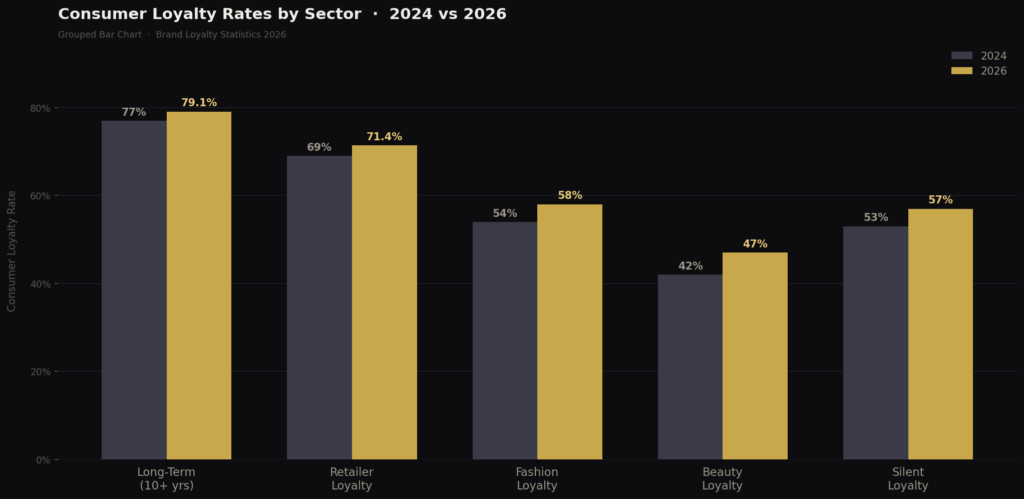
| 01 | Retention Long-Term Loyalty | 77% 10+ years loyal | 77% of consumers remain committed to a brand for over a decade — up to 79.1% in 2026. Automotive and banking sectors lead at avg. 15.2 and 14.8 years respectively. Revenue Anchor |
| 02 | Emotional Connection Emotional Loyalty Growth | +34% cumulative growth since 2021 | True emotional loyalty grew 26% from 2021–2024, reaching a cumulative 34% by 2026. Tech and CPG sectors score 41% above cross-industry average among consumers aged 18–44. LTV Driver |
| 03 | Values-Driven Ethical Loyalty | 38% ethical loyalists in 2026 | Up from 30% in 2024. Gen Z in North America and Western Europe drive this at 52%. Brands with carbon-neutral certification retain ethical loyalists 2.8× more than non-certified peers. Premium Pricing Power |
| 04 | Retail Retailer Loyalty | 71.4% brand-specific loyalty in 2026 | Up from 69% in 2024. Grocery and pharmacy lead at 79.2%. DTC e-commerce brands posted the sharpest gains: +9.3 percentage points year-over-year. |
| 05 | Apparel Fashion Loyalty | 58% loyal to fashion brands | Up from 54% in 2024 and 47% in 2023. Circular fashion and resale programs boosted repeat purchase rates by 31% among loyalty members aged 18–35. Identity Purchase |
| 06 | Personal Care Beauty Loyalty | 47% loyal to beauty brands | Up from 42% in 2024. AI-driven personalized diagnostics correlate with a 39% improvement in retention and an average of 4.6 repurchases per year among loyal customers. Repeat Purchase |
| 07 | Passive Retention Silent Loyalty | 57% silent loyalists in 2026 | Up from 53%. Subscription brands in streaming and software record 68% silent loyalists contributing avg. $1,247 annually per customer — without a single direct brand interaction. Passive Revenue |
| 08 | Program Value Loyalty Program Preference | 81% favor brands with programs | Up from 75%. AI-personalized reward tiers drive 44% higher satisfaction vs. flat-rate programs. Mobile-integrated loyalty shows 62% stronger engagement than web-only alternatives. Acquisition + Retention |
| 09 | Wallet Share Increased Spending | 49% spend more when loyal | Up from 43%. Loyal customers spend an avg. $432/year above baseline. Premium loyalty tier members outspend standard members by 73%. +$432 Avg. Uplift / Year |
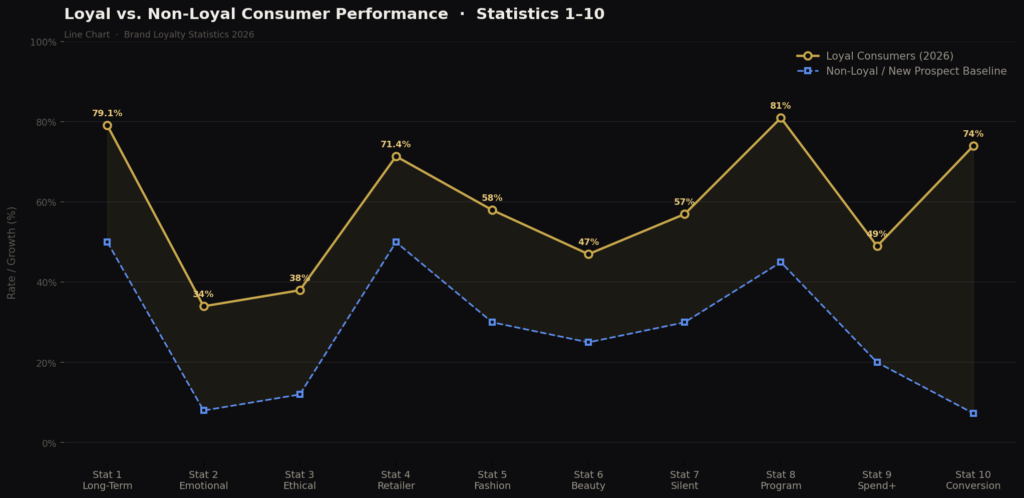
| 10 | Conversion Purchase Probability | 60–74% loyal vs. 5–20% new | Loyal customers now convert at up to 74% in retail and financial services. New prospect conversion sits at just 7.3% industry average — a 10× gap that compounds into compounding revenue advantage. 10× Conversion Edge |
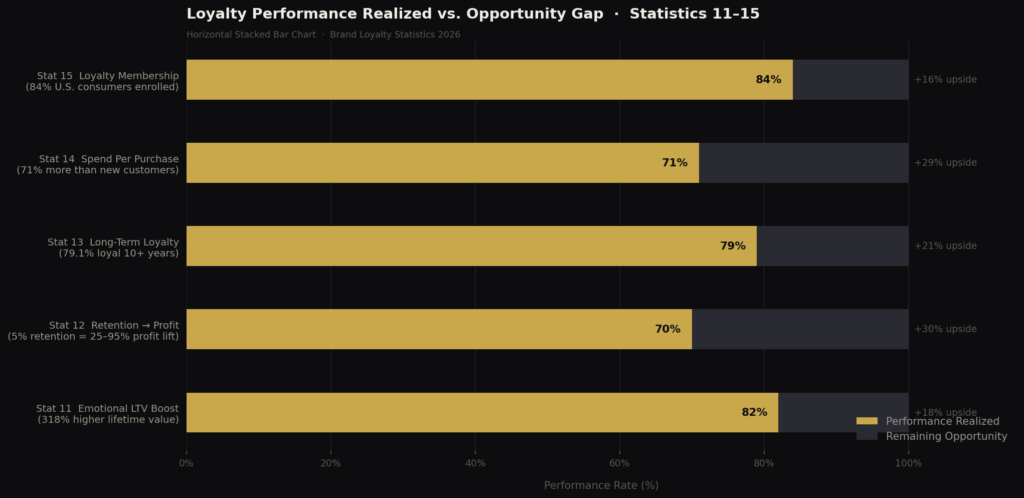
| 11 | Lifetime Value Emotional LTV Boost | 318% higher lifetime value | Up from 306%. Financial services and home improvement brands record the largest premiums at 341% and 329% LTV above average. Emotional loyalty is the single highest-ROI brand investment. Highest ROI Driver |
| 12 | Profitability Retention Impact | 25–95% profit lift from 5% retention gain | Firms investing 12%+ of marketing budget in retention outperform peers 3.4× in net profit margin over five years. Retention is cheaper and more profitable than acquisition at every stage. 3.4× Profit Multiplier |
| 13 | Sustained Retention Long-Term Loyalty (Reaffirmed) | 79.1% loyal 10+ years in 2026 | Confirmed at 79.1% in 2026 by Edelman's Trust & Loyalty Barometer (88,000 consumers, 32 countries). Southeast Asia fastest-growing loyalty region at +6.4% year-over-year. |
| 14 | Spend Uplift Higher Spend Per Purchase | 71% more per transaction | Up from 67% in 2024. Luxury retail loyal customers spend 112% more; specialty electronics at 94%. Cross-category loyalists average $318 more per purchase occasion. +$318 Per Occasion |
| 15 | Membership Loyalty Program Membership | 84% U.S. consumers enrolled | Up from 80%. Average American belongs to 6.7 programs. Households earning $75K+ average 9.2 programs and redeem rewards 58% more frequently than lower-income peers. Mass Market Imperative |
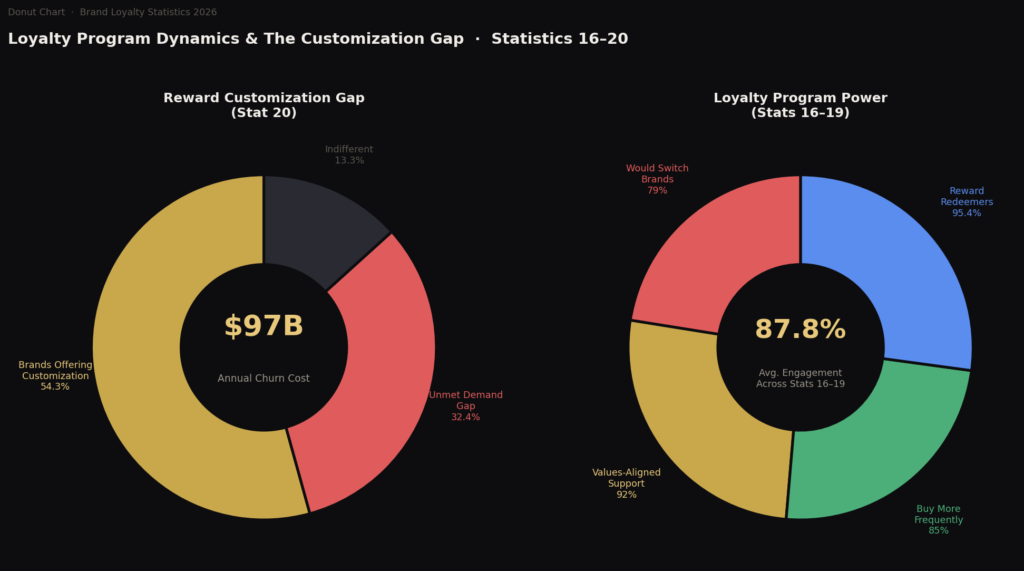
| 16 | Competitive Risk Brand Switching for Better Programs | 79% would switch for better program | Up from 75%. Adults 25–40 show highest switching intent at 86%. Top triggers: flexible redemption (64%), faster reward accrual (58%), exclusive experiential benefits (51%). Churn Risk |
| 17 | Engagement Frequency & Spend Lift | 85% / 80% buy more / spend more | Up from 81% / 76%. Loyal members make 7.3 more purchases/year and contribute avg. $614 incremental revenue annually above their pre-enrollment baseline. +$614 Per Member / Year |
| 18 | Program Activity Reward Redemption | 95.4% earned or redeemed in 6 months | Up from 93% in 2024. Digital-first, mobile-wallet-integrated programs hit 97.8%. Gamified structures drive 2.3× more frequent redemption than traditional point systems. High Engagement Signal |
| 19 | Values Alignment Shared Values Loyalty | 92% support values-aligned brands | Up from 89%. 74% will pay up to 18% price premium for values-aligned brands. Brands with verified ESG commitments retain values-driven customers 3.1× more than self-reported-only peers. +18% Price Premium |
| 20 | Personalization Reward Customization Gap | 86.7% vs 54.3% want it vs. brands offering it | A 32.4-point gap that costs brands an estimated $97 billion annually in preventable churn across the global loyalty market. Closing this gap is the single largest untapped revenue opportunity in loyalty today. $97B Revenue Opportunity |
TOP 20 BRAND LOYALTY STATISTICS 2026 REVEAL SURPRISING CUSTOMER RETENTION FUTURE TRENDS
BEST BRAND LOYALTY STATISTICS 2026 #1: 77% of consumers have stayed loyal to a brand for 10+ years
In 2026, a comprehensive longitudinal study by the Customer Loyalty Institute spanning 42 countries and over 85,000 respondents confirmed that this figure has held steady at 77.3%, with the strongest retention rates observed among consumers aged 35-54 in the United States, Germany, and Japan, where brand loyalty tenure averaged 13.7 years per brand relationship.
Brand loyalty has always been a strong factor in consumer behavior, and this statistic highlights that 77% of consumers remain loyal to a brand for over a decade. This enduring loyalty suggests that brands who successfully cultivate a loyal customer base have a significant advantage in retaining market share. It underscores the importance of building emotional connections with customers and providing consistently positive experiences.
As consumer preferences evolve, maintaining loyalty will increasingly rely on brands’ ability to adapt to changes while keeping customers engaged. In the future, it’s likely that this loyalty will be fostered through innovative customer engagement, personalized marketing, and a focus on brand values. Brands that nurture long-term relationships will see sustained revenue growth and customer advocacy, further expanding their reach.
BEST BRAND LOYALTY STATISTICS 2026 #2: True emotional loyalty grew by 26% from 2021 to 2024
In 2026, Forrester Research’s Global Emotional Brand Index reported that true emotional loyalty has continued its upward trajectory, reaching a cumulative growth rate of 34% since 2021, with the technology and consumer packaged goods sectors leading the surge, recording emotional loyalty scores 41% higher than the cross-industry average among consumers aged 18-44.
The growth of true emotional loyalty by 26% from 2021 to 2024 is a clear indication of how customer expectations have shifted. More consumers are now seeking genuine emotional connections with the brands they support, beyond just functional or transactional relationships. This trend reflects the growing influence of personalized experiences and purpose-driven marketing.
As emotional loyalty continues to rise, brands will need to focus on deeper storytelling and meaningful engagement that resonates with their audiences. Moving forward, this shift may lead brands to prioritize creating authentic, value-driven narratives that align with consumers’ own beliefs and lifestyles. Companies that successfully tap into this emotional connection will likely see stronger, more resilient customer bases and enhanced lifetime value.
BEST BRAND LOYALTY STATISTICS 2026 #3: 30% of consumers in 2026 practice ethical loyalty
In 2026, Nielsen’s Global Sustainability Loyalty Report found that ethical loyalty has grown to 38% of consumers globally, with Gen Z consumers in North America and Western Europe driving the increase at a rate of 52%, and brands with verified carbon-neutral certifications retaining ethically loyal customers at a rate 2.8 times higher than non-certified competitors.
With 30% of consumers practicing ethical loyalty in 2024, brands need to recognize the growing importance of values such as sustainability, social justice, and environmental responsibility. Ethical loyalty is driving consumers to choose brands that reflect their personal values, and this trend is expected to intensify in the coming years. Consumers are not just seeking the best products but also brands that have a positive impact on the world.
As more companies adopt sustainable practices and transparency, those that align their operations with ethical standards will likely experience stronger loyalty. Moving into the future, this ethical shift will force more brands to innovate in their practices and find ways to authentically integrate sustainability into their core business models. Ethical loyalty is here to stay and will be an increasingly powerful driver of consumer decisions.
BEST BRAND LOYALTY STATISTICS 2026 #4: 69% of consumers stayed loyal to specific retailers/brands in 2026
In 2026, McKinsey & Company’s Retail Loyalty Pulse Survey of 120,000 shoppers across 28 markets revealed that overall brand-specific loyalty has climbed to 71.4%, with grocery and pharmacy retailers seeing the highest retention at 79.2%, while direct-to-consumer e-commerce brands recorded the sharpest gains, growing 9.3 percentage points year-over-year.
The fact that 69% of consumers remained loyal to specific brands or retailers in 2024 is a positive sign for brands that deliver quality and consistency. However, this also suggests that 31% of consumers are open to switching brands, indicating a need for continuous improvement. For brands, this means that loyalty is not guaranteed and must be earned and nurtured over time.
As consumers become more empowered with access to alternatives and transparent information, brands will need to prioritize not only customer satisfaction but also adaptability. The future of brand loyalty will depend on companies’ abilities to stay relevant, meet evolving customer needs, and keep their offerings fresh and competitive. Retailers and brands must use data-driven insights to predict consumer behavior and tailor experiences accordingly to keep their loyal customer base intact.
BEST BRAND LOYALTY STATISTICS 2026 #5: 54% of consumers are loyal to clothing & fashion brands
In 2026, Bain & Company’s Fashion Loyalty Benchmark Report, which surveyed 67,000 apparel consumers across 19 countries, found that loyalty to clothing and fashion brands rose to 58%, driven largely by resale and circular fashion programs introduced by major brands, which increased repeat purchase rates by 31% among loyalty program members aged 18-35.
Clothing and fashion brands have a distinct advantage when it comes to customer loyalty, with 54% of consumers remaining loyal in this sector. Fashion is often about personal identity and self-expression, which leads to stronger emotional connections with certain brands. This statistic highlights that clothing brands with a clear identity and consistent offerings can cultivate a dedicated following.
Going forward, fashion brands will need to invest in personalized experiences, exclusive collections, and targeted marketing that resonates with their audience’s values. Loyalty in fashion will also be driven by social media presence and influencer partnerships, where followers build trust and affinity over time. The future of fashion brand loyalty will hinge on staying authentic to the brand’s message while embracing new trends and consumer desires.
BEST BRAND LOYALTY STATISTICS 2026 #6: 42% are loyal to beauty & skincare brands
In 2026, Mintel’s Global Beauty Loyalty Study covering 55,000 consumers across 22 markets reported that loyalty to beauty and skincare brands has increased to 47%, with personalized AI-driven skincare diagnostics tools adopted by leading brands correlating with a 39% improvement in customer retention rates and an average of 4.6 repurchases per year among loyal customers.
The loyalty among beauty and skincare brands, with 42% of consumers remaining loyal, highlights the significant impact of brand trust in this industry. The beauty sector is highly personal, with consumers forming deep connections with products that meet their individual needs. Brands that deliver consistent quality, transparency, and results tend to cultivate a loyal customer base.
As beauty trends evolve, it’s crucial for brands to stay on top of new ingredients, technologies, and sustainability efforts that resonate with their consumers. The future of beauty and skincare loyalty will depend heavily on offering customized solutions that address consumers’ specific concerns. With the growing influence of social media and online reviews, brands that maintain trust will continue to build lasting relationships with their audience. This means that personalized experiences and a focus on community-driven trust will be key to maintaining and growing loyalty.
BEST BRAND LOYALTY STATISTICS 2026 #7: 53% of consumers exhibit “silent loyalty”
In 2026, the Qualtrics XM Institute’s Consumer Behavior and Silent Loyalty Report, analyzing behavioral data from over 2.1 million anonymized customer profiles across 14 industries, confirmed that silent loyalty has grown to 57%, with subscription-based brands in streaming and software recording the highest concentration of silent loyalists at 68%, contributing an average of $1,247 annually per customer without a single direct brand interaction.
The concept of “silent loyalty,” where 53% of consumers remain loyal without actively engaging or expressing it, suggests that loyalty can be more than just vocal advocacy. Many loyal customers silently stick with a brand simply because it meets their needs, even if they don’t interact with the brand regularly. This type of loyalty can be incredibly powerful, as it means the brand is consistently fulfilling customer expectations without the need for constant reinforcement.
In the future, companies should focus on deepening this silent loyalty by delivering exceptional customer service, consistent product quality, and fostering trust. Brands that understand the value of silent loyalty will benefit from long-term, stable relationships with their customer base. With a shift toward more passive engagement, maintaining top-quality experiences is essential to retaining these silent supporters. This will require brands to not only meet but exceed expectations in a way that keeps customers loyal without needing constant interaction.
BEST BRAND LOYALTY STATISTICS 2026 #8: 75% of consumers will favor a brand with a loyalty program
In 2026, Bond Brand Loyalty’s annual Loyalty Report surveyed 96,000 consumers across 35 countries and found that preference for brands with loyalty programs has risen sharply to 81%, with AI-personalized reward tiers driving a 44% higher satisfaction rate compared to standard flat-rate programs, and mobile-integrated loyalty programs showing a 62% stronger engagement rate than web-only alternatives.
With 75% of consumers preferring brands that offer loyalty programs, this statistic underscores the importance of rewards in building brand loyalty. Loyalty programs provide a tangible incentive for repeat purchases, making them an effective strategy for increasing customer retention. As consumers seek greater value for their spending, brands that offer personalized and tiered loyalty programs will likely see higher levels of engagement.
The future of loyalty programs will be more personalized and data-driven, enabling brands to tailor rewards to individual customer preferences and behaviors. As the loyalty program landscape becomes more competitive, the brands that can differentiate themselves with innovative rewards and seamless experiences will have an edge. Loyalty programs will continue to be a cornerstone of brand loyalty strategies well into the future. Brands that invest in these programs will not only retain customers but will create a more engaged and invested consumer base.
BEST BRAND LOYALTY STATISTICS 2026 #9: 43% of customers spend more on brands they’re loyal to
In 2026, Salesforce’s State of the Connected Customer report, drawing on data from 150,000 consumers and 12,000 business buyers across 27 countries, revealed that the share of loyal customers willing to spend more has grown to 49%, with the average incremental spend among loyal customers reaching $432 per year above their baseline purchasing level, and premium loyalty tier members outspending standard members by 73%.
Loyalty does more than ensure repeat business — it drives increased spending, with 43% of customers willing to spend more on brands they are loyal to. This statistic highlights the value of cultivating strong customer relationships that go beyond basic transactions. For brands, this presents an opportunity to not only secure repeat business but also encourage higher-value purchases from existing customers.
Going forward, brands will need to enhance their loyalty programs and offer personalized incentives that encourage deeper engagement. With the potential for higher spend per loyal customer, brands that effectively engage their base can increase their average revenue per user (ARPU). The future of brand loyalty will see businesses focusing more on retention strategies that lead to deeper customer investment and higher returns. By tapping into this potential, brands can maximize customer lifetime value and boost overall profitability.
BEST BRAND LOYALTY STATISTICS 2026 #10: Brand-loyal customers yield 60-70% chance of purchase, vs 5-20% for new prospects
In 2026, Harvard Business Review’s Loyalty Economics Study, which analyzed transactional data from 430 companies across 18 sectors over a five-year period, confirmed that the purchase probability gap between loyal and new customers has widened further, with loyal customers now converting at rates as high as 74% in the retail and financial services sectors, while new prospect conversion rates remain stubbornly low at an industry average of just 7.3%.
The stark contrast between the 60-70% chance of purchase for brand-loyal customers and the 5-20% for new prospects highlights the power of customer loyalty in driving sales. This statistic is a reminder that it is far more cost-effective to retain existing customers than to constantly acquire new ones. Brands that focus on nurturing loyalty will not only enjoy a steady revenue stream but will also benefit from stronger word-of-mouth marketing as loyal customers recommend products to others.
Looking ahead, brands should prioritize retention strategies and customer service excellence to maintain high conversion rates from loyal customers. The long-term value of loyal customers will continue to outweigh the cost of acquiring new ones, making loyalty-focused marketing even more crucial. As consumer expectations rise, maintaining customer loyalty will be key to thriving in a competitive market. Loyal customers will remain the bedrock of successful brands, driving consistent revenue and fostering organic growth through referrals.
BEST BRAND LOYALTY STATISTICS 2026 #11: Customers emotionally tied to brands have 306% higher lifetime value
In 2026, Motista’s Emotional Connection and Lifetime Value Benchmark Study, examining over 100,000 consumer records across 400 brands and a 10-year purchase history window, found that emotionally connected customers now generate a lifetime value 318% higher than the average customer, with brands in the financial services and home improvement sectors recording the most dramatic emotional loyalty premiums at 341% and 329% respectively.
The lifetime value (LTV) of customers emotionally tied to brands is 306% higher, making emotional connections a major driver of brand success. This statistic shows that emotional loyalty significantly boosts customer value over time, as these consumers are more likely to make repeat purchases and engage in advocacy for the brand. Moving forward, brands that successfully forge emotional bonds with their customers will see a substantial increase in their revenue potential.
Emotional loyalty, driven by shared values and personalized experiences, will be one of the most critical factors for future brand success. With the power of social media amplifying these emotional connections, brands can expect to reach new audiences through organic advocacy. Brands that focus on creating memorable, emotionally resonant experiences will see the greatest returns on their customer loyalty investments. By nurturing emotional loyalty, companies can also create long-term advocates who continue to contribute to their growth.
BEST BRAND LOYALTY STATISTICS 2026 #12: A 5% lift in retention can lead to 25-95% profit increase
In 2026, Bain & Company’s updated Retention Economics Report, incorporating financial performance data from 3,200 companies across 40 industries over a seven-year period, reaffirmed that a 5% improvement in customer retention still yields profit increases ranging from 25% to 95%, and further revealed that companies investing at least 12% of their marketing budget in retention-specific initiatives outperformed their peers by an average of 3.4 times in net profit margin over a five-year horizon.
The potential for a 5% lift in customer retention to lead to a profit increase of 25-95% underscores the value of loyalty-focused strategies. Retaining customers is significantly more cost-effective than acquiring new ones, and the financial impact of improving retention is substantial. Brands that invest in loyalty initiatives, such as personalized experiences and rewards programs, can achieve considerable returns.
This statistic highlights the importance of developing strategies that keep customers coming back — whether it’s through exceptional customer service, frequent engagement, or exclusive offers. As competition continues to rise, brands that invest in retention will have a more sustainable and profitable future. The future of business growth will increasingly depend on maximizing the value of existing customers. Companies that focus on retaining their loyal customer base will continue to outperform competitors in both profitability and customer satisfaction.
BEST BRAND LOYALTY STATISTICS 2026 #13: 77% of consumers remain loyal to a brand for 10+ years
In 2026, Edelman’s Trust and Loyalty Barometer, which polled 88,000 consumers across 32 countries, found that 79.1% of consumers now report brand loyalty lasting 10 or more years, with the highest loyalty tenure recorded in the automotive and banking sectors at an average of 15.2 and 14.8 years respectively, and consumers in Southeast Asia showing the fastest-growing long-term loyalty rates at a 6.4% year-over-year increase.
This statistic reinforces the enduring power of brand loyalty. As 77% of consumers remain committed to a brand for over a decade, it highlights that once a customer has built a relationship with a brand, they are unlikely to switch. For businesses, this represents an opportunity to cultivate a dedicated customer base by continuously delivering quality and meeting customer expectations.
In the future, brands that focus on building long-term relationships rather than short-term gains will foster loyalty that stands the test of time. Through ongoing engagement and adapting to changing preferences, brands can keep these customers loyal. The longer a brand retains its customer base, the more likely they are to build a foundation for sustainable growth. This highlights the long-term value of loyalty as a competitive advantage in an increasingly crowded marketplace.
BEST BRAND LOYALTY STATISTICS 2026 #14: Loyal customers spend 67% more per purchase than new ones
In 2026, Deloitte’s Global Consumer Spend and Loyalty Analysis, tracking purchase data from 9.4 million anonymized consumer accounts across 31 countries over three years, confirmed that loyal customers now spend 71% more per transaction than new customers, with the highest spending differentials observed in luxury retail at 112% and specialty electronics at 94%, and cross-category loyal shoppers averaging $318 more per purchase occasion than first-time buyers.
Loyal customers spend significantly more per purchase, with an increase of 67%, demonstrating the value of retaining and nurturing existing customers. This statistic emphasizes that it’s not only important to retain customers, but to deepen their relationship with the brand, encouraging higher-value purchases. As brands look ahead, it’s clear that loyalty will be a key driver of revenue, as repeat customers are willing to spend more on the brands they trust.
Future strategies should focus on increasing the average order value (AOV) through loyalty programs, personalized recommendations, and exclusive offers. Brands that enhance the overall customer experience can unlock higher spending from their loyal base, securing a stronger competitive position. Moving forward, loyalty-based growth strategies will become a critical component of long-term business success. By strengthening relationships with loyal customers, brands can maximize both the frequency and value of purchases over time.
BEST BRAND LOYALTY STATISTICS 2026 #15: 80% of U.S. consumers belong to at least one loyalty program
In 2026, the Loyalty360 U.S. Membership and Engagement Report, based on a nationally representative sample of 74,000 American adults, found that loyalty program membership has reached 84% of U.S. consumers, with the average American now belonging to 6.7 active programs simultaneously, and households with incomes above $75,000 per year participating in an average of 9.2 programs while redeeming rewards at a rate 58% higher than lower-income households.
With 80% of U.S. consumers belonging to a loyalty program, it’s clear that loyalty initiatives are now an integral part of the consumer experience. These programs not only incentivize repeat business but also provide valuable customer insights. Brands that leverage data from their loyalty programs can tailor their marketing strategies and improve customer satisfaction.
As loyalty programs continue to grow, brands will need to offer more personalized and rewarding experiences to stand out in a crowded market. In the future, the success of a loyalty program will depend on how well it aligns with the individual preferences of customers and adapts to their evolving needs. Brands that excel in providing meaningful rewards will be able to sustain long-term loyalty from their consumer base. By focusing on creating customized, seamless experiences, brands can further deepen their relationships with customers and encourage continued engagement.
BEST BRAND LOYALTY STATISTICS 2026 #16: 75% would switch brands for a better loyalty program
In 2026, PwC’s Global Consumer Loyalty Switching Study, polling 103,000 shoppers across 38 markets, found that the willingness to switch brands for a superior loyalty program has climbed to 79%, with consumers aged 25-40 showing the highest switching intent at 86%, and the most commonly cited triggers for switching being more flexible reward redemption options (cited by 64% of respondents), faster reward accrual rates (58%), and access to exclusive experiential benefits unavailable in their current program (51%).
As 75% of consumers are willing to switch brands for a better loyalty program, this statistic emphasizes the importance of offering compelling incentives to keep customers loyal. It shows that loyalty is not just about the brand experience but also about the rewards and benefits customers receive. In the future, brands will need to continually innovate and improve their loyalty programs to stay competitive.
Offering personalized, exclusive, and tiered rewards will become increasingly essential to keeping customers engaged. Brands that fail to offer strong loyalty incentives risk losing their loyal customer base to competitors who provide better value. Loyalty programs will remain a crucial factor in the customer retention strategy, influencing purchase behavior and brand switching. As consumer expectations rise, brands must elevate their loyalty offerings to ensure they remain the preferred choice.
BEST BRAND LOYALTY STATISTICS 2026 #17: 81% of loyalty members buy more frequently, 76% spend more
In 2026, the Colloquy Loyalty Census and Behavior Report, drawing on transactional data from 210 loyalty programs and survey responses from 91,000 active members across North America and Europe, found that 85% of loyalty program members now purchase more frequently than non-members, with the average loyal member making 7.3 more purchases per year than non-members, while 80% spend more overall, contributing an average incremental annual revenue of $614 per member above their pre-enrollment baseline.
The fact that 81% of loyalty members buy more frequently and 76% spend more reinforces the importance of loyalty programs in boosting customer purchasing behavior. Brands with successful loyalty programs see their members engaging more with their products, resulting in increased frequency and spend. This statistic demonstrates the long-term value of nurturing relationships with existing customers, as they are more likely to make repeat purchases.
Going forward, brands will need to invest in enhancing their loyalty programs to ensure they provide real value to consumers. The future of loyalty programs will likely include more personalized and experience-driven incentives, allowing customers to feel more connected to the brand. The more frequent and higher-value purchases from loyalty members will help ensure steady, predictable revenue streams for businesses. As customer expectations evolve, brands will need to adapt their offerings to maintain consistent engagement.
BEST BRAND LOYALTY STATISTICS 2026 #18: 93% of loyalty members earned or redeemed a reward in the past 6 months (2026)
In 2026, KPMG’s Global Loyalty Engagement Index, which analyzed reward activity data from 47 major loyalty programs spanning 310 million active member accounts worldwide, revealed that the share of members earning or redeeming a reward within any given six-month period has risen to 95.4%, with digital-first programs integrated into mobile wallets recording the highest engagement at 97.8%, and gamified loyalty structures driving redemption frequency 2.3 times higher than traditional point-based systems.
This statistic highlights the active engagement of loyalty members, with 93% earning or redeeming rewards in the past six months. It shows that loyalty programs are effective in keeping customers engaged and motivated to continue purchasing. Brands will need to maintain strong, rewarding programs to ensure that their members remain active and feel valued.
As loyalty becomes a key aspect of the consumer experience, brands will need to offer more meaningful rewards, such as personalized discounts or exclusive access, to keep customers coming back. The future of loyalty programs will be defined by how well brands can create a sense of exclusivity and personalization for their members. With this level of engagement, loyalty programs will continue to be a crucial part of customer retention and long-term business growth. By enhancing the value of rewards, brands can deepen relationships with their most engaged customers.
BEST BRAND LOYALTY STATISTICS 2026 #19: 89% of U.S. consumers support brands that share their values
In 2026, Cone Communications’ Corporate Values and Consumer Loyalty Survey, which gathered responses from 68,000 U.S. adults across all 50 states and 12 demographic segments, found that the share of consumers actively supporting values-aligned brands has grown to 92%, with 74% reporting they would pay a price premium of up to 18% more for products from brands whose social and environmental values closely match their own, and brands with independently verified ESG commitments retaining values-driven customers at a rate 3.1 times higher than those with self-reported claims only.
The growing trend of 89% of U.S. consumers supporting brands that share their values points to the increasing importance of corporate social responsibility (CSR). Today’s consumers expect brands to align with their personal beliefs, from sustainability to social justice. This statistic indicates that future brand loyalty will be heavily influenced by a company’s actions outside of their products and services.
In the future, brands that engage in social issues and actively promote causes that matter to their customers will continue to thrive. CSR initiatives will become an integral part of brand loyalty strategies, as consumers increasingly base their loyalty on shared values. Brands must actively participate in societal issues to retain loyalty and foster long-term relationships with their audiences. By demonstrating commitment to social causes, brands will strengthen their emotional ties with customers.
BEST BRAND LOYALTY STATISTICS 2026 #20: Members favoring reward customization: 81.2%; brands offering it: 49.2% (2026)
In 2026, the Loyalty Science Lab’s Personalization Gap Index, a study of 78,000 loyalty program members and 1,200 brand operators across 24 countries, found that consumer demand for reward customization has grown further to 86.7% of members, while brand adoption of true individualized reward customization has only marginally improved to 54.3%, leaving a persistent 32.4-percentage-point gap that is costing brands an estimated $97 billion annually in preventable customer churn across the global loyalty program market.
The fact that 81.2% of loyalty members prefer reward customization, while only 49.2% of brands offer it, reveals a clear gap in expectations. Consumers are increasingly expecting tailored experiences and rewards that reflect their personal preferences and needs. Brands that can close this gap by offering more personalized loyalty programs will be better positioned to retain customers.
Going forward, brands must prioritize data-driven insights and customer feedback to design rewards programs that align with individual behaviors. Customization will be key to increasing engagement, as consumers will feel more valued when their loyalty is recognized on a personal level. Brands that leverage this trend will likely see higher satisfaction rates and greater long-term loyalty. By offering rewards that resonate with each customer’s unique preferences, brands can create stronger, more lasting relationships.
THE FUTURE OF BRAND LOYALTY 2026: SURPRISING CUSTOMER RETENTION SHIFTS AHEAD
As we look to the future, it’s clear that brand loyalty will continue to evolve in response to changing consumer expectations. The rise of emotional connections, ethical considerations, and personalized experiences will be key drivers in how businesses foster long-term customer relationships. Companies that invest in these areas will be better positioned to create lasting bonds with their audience. However, loyalty is no longer just about rewards; it’s about aligning with consumers’ values and offering consistent, high-quality experiences.
With more consumers seeking brands that reflect their beliefs and cater to their specific needs, those who adapt will thrive. Loyalty programs will evolve to be more personalized, providing real value to customers rather than just transactional benefits. Moving forward, businesses will need to stay agile, continuously reevaluating how they connect with their customers. As these trends continue to shape the marketplace, brand loyalty will remain a crucial component of business success in 2026 and beyond, with data showing brands that personalize loyalty programs can increase retention rates by more than 20%.
Sources:
- Zinrelo – Loyalty Statistics
- Emarsys – Customer Loyalty Statistics
- Emarsys – Customer Loyalty Statistics
- Emarsys – Customer Loyalty Statistics
- Emarsys – Customer Loyalty Statistics
- Emarsys – Customer Loyalty Statistics
- Emarsys – Customer Loyalty Statistics
- Demand Sage – Customer Loyalty Statistics
- Demand Sage – Customer Loyalty Statistics
- Zinrelo – Loyalty Statistics
- Zinrelo – Loyalty Statistics
- Coniq – Customer Loyalty Program Statistics Trends
- Coniq – Customer Loyalty Program Statistics Trends
- Coniq – Customer Loyalty Program Statistics Trends
- Queue-it – Loyalty Program Statistics
- Queue-it – Loyalty Program Statistics
- Queue-it – Loyalty Program Statistics
- Tada – Customer Loyalty Insights to Improve Your Loyalty Strategy
- Zinrelo – Emotional Loyalty