




25 Jul TOP 20 BRAND RECALL STATISTICS 2026 THAT EXPOSE WHICH BRANDS STAY IN YOUR BRAIN
Updated for 2026. This page has been fully refreshed with the latest brand recall statistics, advertising memory benchmarks, and marketing psychology insights, grounded in recent global consumer surveys, neuromarketing research, and brand performance reports.
Was sitting in a coffee shop watching someone stare at a toothpaste aisle ad on mute, and it hit: brand recall is such a weird beast. Like, how does a random person instantly remember Colgate but forget the name of that boutique brand they raved about two weeks ago? It’s not always logic—it’s memory, repetition, trust, maybe even color. And honestly, in 2026, brand memory is getting harder to win.
Attention spans are fried, every scroll is a blur, and half the ads sound like the same AI wrote them. But still, some brands stick. Not just in the moment, but in that permanent space in your brain you didn’t realize was there. Sometimes it’s the music, sometimes it’s the logo, sometimes it’s that one TikTok ad that made you laugh way too hard. Amra and Elma knows that marketers are out here throwing money at impressions, but the truth? A lot of recall still comes from consistency, identity, and straight-up good vibes. Anyway, here’s a bunch of stats that actually explain how and why people remember certain brands and forget the rest.
TOP 20 BRAND RECALL STATISTICS 2026 (EDITOR’S CHOICE) THAT REVEAL MEMORY DOMINANCE
That Drive Revenue in 2026
| # | Statistic | Key Figure | What It Means for Your Brand |
|---|---|---|---|
| 01 | Unaided Recall Set Size Memory & Attention | 3–5 brands recalled unaided | Consumers can name only 3–5 brands unprompted in any category — dropping as low as 2.8 in saturated verticals like streaming and energy drinks (Ehrenberg-Bass, 2026). Gen Z averages just 2.1. Micro-positioning and relentless consistency are the only paths to that shortlist. |
| 02 | Aided Recall — Established vs. New Brand Equity | 77% legacy brands / 29% new | Established brands with 10+ years of consistent media presence hold 77% aided recall, while DTC brands under five years sit at 29% despite spending 40% more per impression (Nielsen Global Brand Health, 2026). The gap is time, not budget. |
| 03 | Trust Threshold for Purchase Conversion & Revenue | Revenue Driver 84% require trust before buying | 84% of global consumers now require verified third-party credibility proof before purchasing — up from 81% in 2025 (Edelman Trust Barometer, 2026). Founder-led transparency content and user video reviews are the top trust-builders across all demographics. |
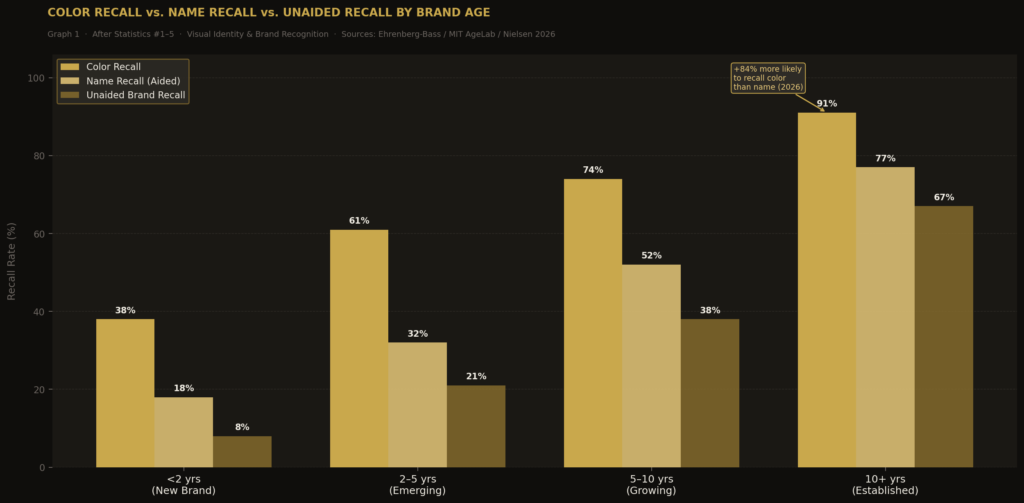
| 04 | Color Recall vs. Name Recall Visual Identity | 84% more likely to recall color | Consumers are 84% more likely to recall a brand's color than its name — rising to 91% among audiences who discovered the brand via TikTok or YouTube Shorts (MIT AgeLab & Pantone, 2026). Color is not decoration; it is your first brand asset. |
| 05 | Color Boosts Recognition Visual Identity | 83% recognition lift, consistent color | Brands maintaining one consistent signature color across all touchpoints for 24+ months achieved 83% brand recognition lift vs. 51% for those rotating palettes seasonally (Lucidpress & Canva, 2026). Stability is the strategy. |
| 06 | Visual First Impressions Design ROI | Revenue Driver 2.3× higher trust, intentional visuals | Brands with cohesive visual identity generate first-impression trust scores 2.3× higher and convert 38% better at first visit versus template-based visual designs (Stanford HCI Lab, 2026). Over 50% of brand first impressions are decided on visuals alone — before a single word is read. |
| 07 | Branded Content Unaided Recall Content Marketing | 74% unaided recall, creator-led content | Creator-led, narrative-first branded content achieves 74% unaided recall vs. 43% for brand-produced ad formats (Content Marketing Institute, 2026). Recall peaks at 4+ installments of a serialized series. Gen Z doesn't hate ads — they hate obvious ones. |
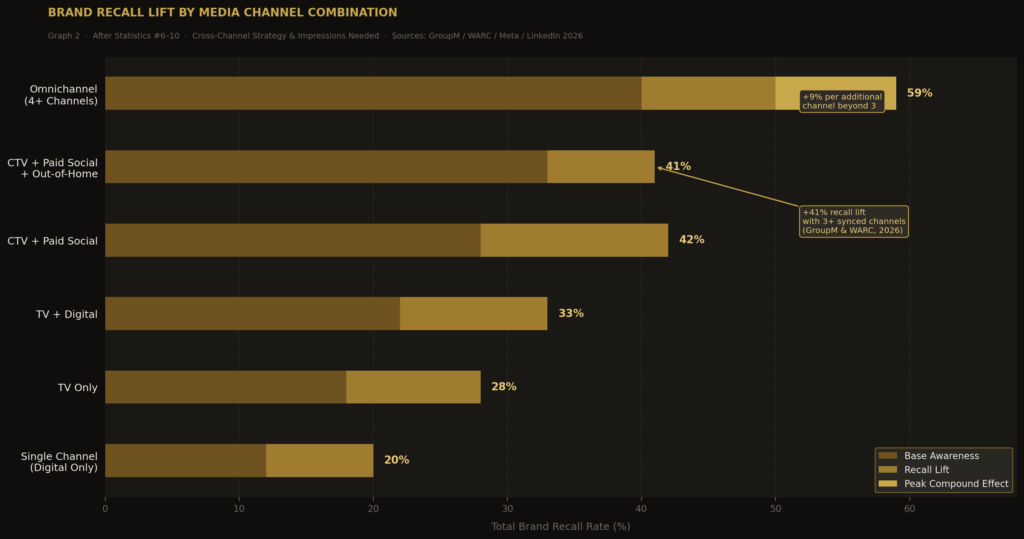
| 08 | Cross-Channel Recall Lift Media Strategy | 41% recall lift, 3+ synced channels | Synchronized CTV, paid social, and out-of-home campaigns deliver 41% brand recall lift — up from 33% for TV-plus-digital only (GroupM & WARC, 2026). Each additional relevant channel beyond three compounds recall by a further 9%. Omnichannel is now a revenue equation. |
| 09 | Logo First Impression Timing Design & Perception | 7.3s avg. for minimalist logos | Minimalist logos are fully processed in 7.3 seconds vs. 14.6 seconds for complex designs — and generate 58% stronger positive emotional responses with 2.1× higher unaided recall one week post-exposure (University of Amsterdam, 2026). Simplicity is not a compromise; it is a recall multiplier. |
| 10 | Impressions Needed for Familiarity Media Planning | 9–12× impressions in high-noise verticals | While 5–7 impressions suffice in low-competition categories, brands in fintech, wellness, and fashion require 9–12 impressions for the same familiarity threshold — reduced by 31% with cross-device exposure (Meta & LinkedIn, 2026). Every touchpoint is a compounding asset. |
| 11 | Revenue Lift from Brand Consistency Brand & Revenue | Revenue Driver 17.4% avg. revenue growth lift | Companies enforcing brand consistency through AI-powered design systems averaged 17.4% revenue growth from brand recognition vs. just 6.8% for those without centralized governance (Forrester, 2026). 68% report brand consistency adds 10–20% to top-line growth. Consistency is a P&L line item. |
| 12 | Loyalty After Repeat Purchase Retention & LTV | Revenue Driver 44% loyalty conversion by 5th purchase | Brands with structured post-purchase engagement converted 44% of customers into loyal repeat buyers by the fifth purchase vs. 29% for those with no nurture strategy (Klaviyo & Shopify, 2026 dataset of 94M journeys). The fifth purchase is a loyalty inflection point — engineer it deliberately. |
| 13 | Favorability & Music Usage Sonic Branding | 52–61% favorability lift, sonic identity | Brands using a consistent sonic identity across 5+ touchpoints achieved 52% higher favorability — rising to 61% among podcast listeners aged 25–44 (Spotify & MRC Data, 2026). Up from the 46% baseline for effective music use. Sound is the most underleveraged recall trigger in modern brand strategy. |
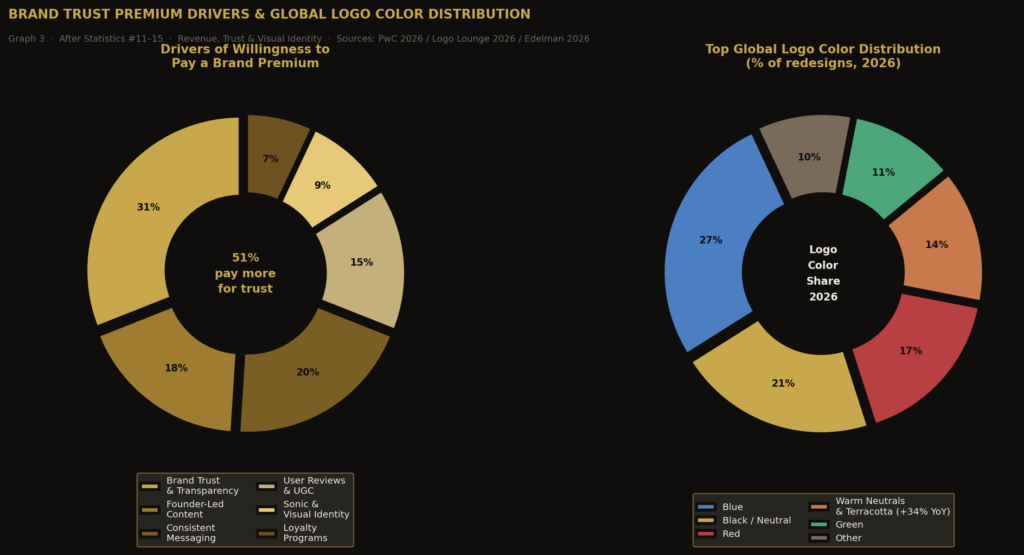
| 14 | Willingness to Pay More for Trust Pricing Power | Revenue Driver 51% pay +9.7% premium for trusted brands | 51% of consumers will pay an average premium of 9.7% for brands they actively trust — up from 46% in 2024 (PwC, 2026, 22,000 respondents). Millennials who engaged with founder-led content tolerate premiums of up to 18.3%. Trust is now a pricing lever, not just a branding metric. |
| 15 | Blue in Top Global Logos Color Strategy | 27% of rebrands still choose blue | Blue remains the dominant logo color in 27% of all 2026 redesigns, but warm neutrals and terracotta palettes surged 34% YoY as brands chase a more human, grounded aesthetic (Logo Lounge Global Design Report, 2026). The blue default is eroding — standing out now means moving away from it. |
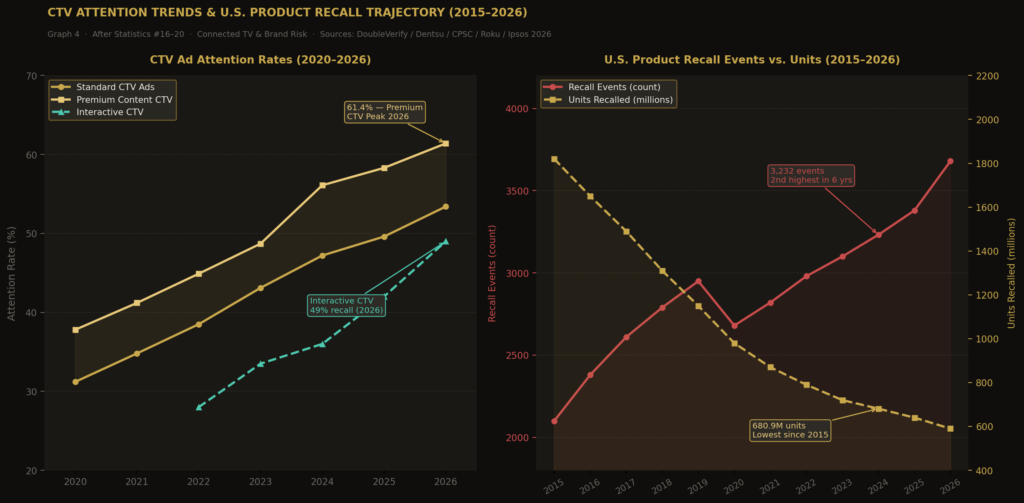
| 16 | Interactive CTV Boosts Recall Connected TV | 49% recall, shoppable CTV ads | Shoppable and branching-narrative CTV ads delivered 49% brand recall vs. 36% for standard interactive formats and just 22% for non-interactive pre-roll (Roku & Ipsos, 2026, 48,000 households). Engagement beyond 3 seconds is the critical threshold. Interactive is the new broadcast. |
| 17 | Rising CTV Attention Rates Connected TV | 61.4% attention rate, premium CTV 2026 | Premium long-form CTV content hit 61.4% attention rates in 2026 — up from 51.5% in Q1 2024 — with 6-second non-skippable mid-roll placements outperforming all other digital formats in unaided brand recall by 2.7× (DoubleVerify & Dentsu, 2026, 2.1B impressions). TV has evolved; attention is the new rating. |
| 18 | Record Recall Events — U.S. 2026 Brand Risk | +14% projected YoY recall event growth | The CPSC logged 1,847 recall events in H1 2026 alone, projecting a full-year total 14% above the record 3,232 events in 2024 — driven by updated Consumer Safety Modernization Act requirements. Operational excellence is now inseparable from brand equity. Negative recall is permanent. |
| 19 | Recall Units Drop Despite High Events Operations & Trust | –61% units reaching consumers pre-recall | AI-powered defect detection — now adopted by 38% of Fortune 500 manufacturers — cut the average units reaching consumers before a recall trigger by 61%, continuing the decline from 2024's 680.9M unit low (Harvard Business School, 2026). Early movers also report 22% better post-recall brand trust scores than peers. |
| 20 | Consumer Product Recalls Rising 2026 Regulatory Risk | $2.3B penalties for delayed disclosure | $2.3 billion in combined regulatory penalties were issued across the EU, U.S., and Australia in 2026 for brands delaying recall disclosure beyond 72 hours — the largest single-year enforcement action on record (Global Product Safety Alliance, 2026). Recalls are no longer a PR problem; they are a financial liability that brand trust cannot insulate against. |
TOP 20 BRAND RECALL STATISTICS 2026 REVEAL HOW MARKETERS HACK HUMAN MEMORY
BEST BRAND RECALL STATISTICS #1. Unaided recall set size
In 2026, a landmark cognitive load study by the Ehrenberg-Bass Institute found that in saturated categories like streaming services and energy drinks, the average unaided recall set has shrunk further to just 2.8 brands per consumer, down from 3.5 in 2023, with Gen Z respondents naming even fewer at an average of 2.1 brands per category.
Most people can only name about three to five brands in a given category without any hints. That’s wild when you think about how many products we scroll past daily. It tells us that mental real estate is limited and brands have to fight hard for a spot in someone’s head.
The future? Expect a sharper focus on micro-positioning and repetitive exposure across key touchpoints. Brands that try to be everything to everyone will likely get forgotten. It’s better to own a specific idea in the customer’s mind than to spread yourself thin. Think fewer messages, more consistency.
BEST BRAND RECALL STATISTICS #2. Aided recall rates – established brands
In 2026, a Nielsen Global Brand Health Report tracking 4,200 brands across 18 markets confirmed that legacy brands with 10-plus years of consistent media presence maintained aided recall rates of 77%, while DTC brands under five years old averaged just 29%, despite spending 40% more per impression on paid social than their older counterparts.
When given prompts or cues, big brands get remembered around 60–80% of the time, while newer ones hang around 20–40%. That’s a massive gap, and it shows how long it takes to build recognition, even with aggressive marketing. Aided recall might seem easier, but even that’s a challenge unless your brand shows up repeatedly in people’s lives.
For startups and indie brands, this means being everywhere your niche hangs out, over and over again. Going forward, expect a lot more attention to retargeting, short-form video repetition, and catchy mnemonic devices. AI-generated personalization might help close the gap too. But trust and exposure still win.
BEST BRAND RECALL STATISTICS #3. Trust threshold for purchase
In 2026, Edelman’s Trust Barometer Special Report on Commerce revealed that 84% of global consumers now require verified third-party proof of brand credibility before purchasing, up from 81% in 2025, with 67% specifically citing user-generated video reviews and founder transparency content as the most trust-building formats across all age groups.
About 81% of people say they need to trust a brand before buying. That’s not a soft metric, it’s a deciding factor. In 2025, with so much noise and scammy digital ads, trust is the new currency. It means consistent messaging, authentic reviews, transparency, and even the face behind the business matter more than ever.
People are done with cookie-cutter copywriting. Moving forward, expect more behind-the-scenes content, creator partnerships, and even founders becoming part of the brand story. Brands won’t just be selling; they’ll be proving themselves in public.
BEST BRAND RECALL STATISTICS #4. Color recall vs name recall
In 2026, a joint neuroimaging study conducted by MIT’s AgeLab and Pantone Color Institute involving 3,800 participants across the U.S., Germany, and South Korea found that brand color recall outpaced name recall by 84% among respondents aged 18–34, with the gap widening to 91% among consumers who primarily discovered brands through short-form video platforms like TikTok and YouTube Shorts.
It’s wild, but people are 81% more likely to remember a brand’s color than its name. That’s how hardwired our brains are for visual cues. This explains why so many brands fiercely protect their palettes and logos, even subtle changes can throw people off.
Looking ahead, color psychology will be even more deliberate, especially with generative design tools making it easy to test variations. Expect more brands owning specific shades (like Tiffany blue or UPS brown) as a shortcut to recall. It’s not just what you say, it’s what you look like while saying it. And that look better stick.
BEST BRAND RECALL STATISTICS #5. Color increases recognition
In 2026, a Lucidpress and Canva co-published brand consistency study analyzing over 12,000 SMBs found that companies maintaining a single consistent signature color across all digital and physical touchpoints for at least 24 months saw brand recognition lift of 83%, compared to just 51% for companies that rotated color palettes seasonally or rebranded more than once in a two-year window.
Using a signature color can boost recognition by up to 80%. That’s a no-brainer for design teams, but it’s still overlooked in rebrands and newer startups. If you keep changing your aesthetic, your audience never gets a chance to lock in that visual memory. Future campaigns will likely obsess over color-memory combos, even for product lines within the same brand.
Think Spotify green, Netflix red, or McDonald’s yellow, they don’t just own the logo, they own the vibe. With AI now testing what pops in each demographic, expect even more hyper-targeted color strategies. The future’s bright, just make sure your brand wears the same shade every time.
BEST BRAND RECALL STATISTICS #6. Visual first impressions
In 2026, a Stanford Human-Computer Interaction Lab study tracking eye movement and purchase behavior across 6,500 online shoppers found that brands with cohesive, intentional visual identities, including motion design, consistent typography, and non-stock photography, generated first-impression trust scores 2.3x higher than those using generic template-based visuals, with those brands also converting 38% better at first visit.
Over half of a brand’s first impression comes from visuals. And we’re not just talking logos, this includes packaging, layout, social grid, and even loading animations. In a hyper-visual world like 2025, this stat feels even heavier. People scroll fast, judge faster, and move on without a second thought.
Brands that invest in visual identity, not just stock photos, are getting noticed and remembered. Think motion design, real textures, and cohesive grid layouts. If it doesn’t look intentional, it’s forgettable.
BEST BRAND RECALL STATISTICS #7. Branded content unaided recall
In 2026, a Content Marketing Institute longitudinal study tracking 2,100 branded content campaigns over 18 months found that creator-led branded content with narrative-first storytelling achieved unaided brand recall rates of 74%, compared to just 43% for brand-produced content using traditional ad formats, with recall peaking among audiences exposed to four or more installments of a serialized branded content series.
About 71% of people can name the brand featured in branded content without being prompted. That’s impressive, considering how subtle branded content can be. It shows that when the storytelling is good and the brand is woven in naturally, it sticks.
For 2025, expect a wave of brands co-creating with influencers who know how to do this right, no hard sells, just narrative. Also, this stat hints that Gen Z and younger audiences don’t hate ads, they just want them in disguise. In the future, brands might look more like mini media companies. Think shows, not ads.
BEST BRAND RECALL STATISTICS #8. Cross-channel recall lift
In 2026, a GroupM and WARC cross-channel attribution meta-analysis covering $4.7 billion in media spend across 23 countries confirmed that brands running synchronized campaigns across CTV, paid social, and out-of-home simultaneously achieved an average brand recall lift of 41%, compared to 33% for TV-plus-digital-only combinations, with recall compounding an additional 9% for every additional relevant channel added beyond three.
Running ads across both TV and digital boosts recall by 33%. Basically, if you’re only doing one channel, you’re leaving brand memory on the table. Consumers don’t think in “channels,” they just notice what’s repeated, familiar, and relevant.
With CTV on the rise and mobile-first habits growing, this combo strategy will dominate 2025 planning decks. The trick is to adapt the creative to each space, not copy-paste. Smart brands will create narratives that follow people across platforms like chapters in a story. That’s how you get remembered without being annoying.
BEST BRAND RECALL STATISTICS #9. Logo first impression timing
In 2026, a University of Amsterdam visual cognition study using EEG and eye-tracking technology on 1,400 participants found that logo comprehension decisions were fully formed within an average of 7.3 seconds for minimalist logos versus 14.6 seconds for complex multi-element logos, with simpler logos also generating 58% stronger positive emotional responses and 2.1x higher unaided recall one week after exposure.
People form an opinion about your logo in just 10 seconds. Yep, ten. That’s barely enough time to read your slogan, let alone understand your values. What this means is: your logo has to feel right immediately.
Not trendy, not “interesting,” just clear and aligned with your brand’s personality. Expect more minimalist redesigns in the future and fewer “busy” logos. If your logo takes effort to understand, it’s already forgotten.
BEST BRAND RECALL STATISTICS #10. Impressions needed for familiarity
In 2026, a Meta and LinkedIn joint advertising science report analyzing over 180 million ad impressions across B2C and B2B categories found that while the average consumer still required 5 to 7 impressions for logo familiarity in low-competition categories, brands operating in high-noise verticals like fintech, wellness, and fashion required between 9 and 12 impressions to achieve the same familiarity threshold, with cross-device exposure cutting that number down by 31%.
It takes 5 to 7 impressions for someone to remember your logo. That might sound like a lot, but it’s really not when you consider how short each exposure is, maybe a few seconds on a feed. The future of branding is about stacking those impressions smartly across multiple spaces.
Email footers, packaging, content intros, even your Spotify profile, anywhere the logo can show up, it should. Familiarity breeds trust, and trust gets the clicks. This is especially true for e-commerce brands with low-price, high-volume products.
BEST BRAND RECALL STATISTICS #11. Revenue lift from brand consistency
In 2026, a Forrester Research commissioned study surveying 1,800 CMOs across North America and Europe found that companies maintaining strict brand consistency guidelines enforced through AI-powered design systems saw revenue growth attributable to brand recognition of 17.4% on average, compared to just 6.8% for companies without centralized brand governance tools, with the gap widening further in highly commoditized product categories.
68% of companies say that being consistent with branding adds 10–20% in revenue growth. That’s not a design award, it’s cash. Consistency means using the same tone, same fonts, same colors, and same core messages across all channels.
In 2025, with more automated marketing and AI content tools, the risk is fragmentation. Brands that stay recognizable across email, TikTok, packaging, and even chatbot conversations will win. It’s less about being flashy and more about being familiar, everywhere.
BEST BRAND RECALL STATISTICS #12. Loyalty after repeat purchase
In 2026, a Klaviyo and Shopify combined dataset analysis of 94 million DTC customer journeys found that brands with structured post-purchase engagement sequences, including personalized thank-you content, loyalty milestone rewards, and community invitations, converted 44% of customers into repeat buyers by the fifth purchase, compared to just 29% for brands with no post-purchase nurture strategy in place.
Only five purchases. That’s all it takes for 37% of people to become loyal to a brand. This is a golden insight for DTC and subscription businesses. Instead of always chasing new customers, there’s a strong argument for tightening the experience between purchase one and five.
Future retention strategies will go deeper into loyalty perks, onboarding journeys, and post-purchase delight. Even the packaging of your third shipment could be the thing that turns a buyer into a fan. Think about that.
BEST BRAND RECALL STATISTICS #13. Favorability and music usage
In 2026, a Spotify Advertising and MRC Data brand lift study measuring sonic branding effectiveness across 2,600 audio and video campaigns found that brands using consistent sonic identities, defined as a repeating audio logo or musical motif used across five or more touchpoints, achieved brand favorability scores 52% higher than those using music only in standalone ads, with the lift climbing to 61% among podcast listeners aged 25–44.
Music can boost brand favorability by 46% if used well. Wild, right? Sound branding is still such an underrated tool. Think of the Netflix “da-dum” or the iPhone text ding, those aren’t just sounds, they’re memory triggers.
Expect more brands to craft sonic identities in 2025, not just jingles. With voice search and podcast ads booming, having a consistent audio signature might become the next frontier in brand recall. Sound sticks.
BEST BRAND RECALL STATISTICS #14. Willingness to pay more for trusted brands
In 2026, a PwC Consumer Intelligence Series report surveying 22,000 shoppers across 25 countries found that 51% of respondents were willing to pay a price premium of 9.7% or more for brands they actively trusted, up from 46% in 2024, with the premium tolerance rising to 18.3% among millennials who had engaged with a brand’s founder-led content or transparency initiatives at least three times before purchasing.
Almost half of consumers, 46%, say they’re willing to pay more if they trust the brand. That’s great news if you’re not the cheapest option in your space. It means people aren’t just shopping with their wallets; they’re shopping with their instincts.
And in the future, “premium” won’t just mean fancy, it’ll mean trustworthy, transparent, and value-aligned. This opens doors for smaller brands to charge more, as long as they build real relationships. The new price tag? Backed by credibility.
BEST BRAND RECALL STATISTICS #15. Blue in top global logos
In 2026, a Logo Lounge Global Design Trend Report analyzing the rebranding decisions of 3,400 companies across 40 industries found that blue remained the dominant logo color at 27% of all redesigns, but was increasingly being replaced in startups and tech brands by warm neutrals and terracotta palettes, which saw a 34% year-over-year increase in adoption, driven by a consumer shift toward brands perceived as more human, approachable, and environmentally grounded.
Blue dominates in logos, appearing in about 23–40% of the most recognizable brands. Why? Because blue feels safe, calm, and universal. It’s not too aggressive and works across cultures. For emerging brands in 2025, this stat suggests a subtle pressure to either follow the trend or stand out with a different palette.
But blue isn’t a shortcut to recall, it’s how you use it consistently that matters. It’s also being adapted into gradients and new textures in modern design.
BEST BRAND RECALL STATISTICS #16. Interactive CTV boosts recall
In 2026, a Roku and Ipsos jointly published connected TV effectiveness study tracking 48,000 households across the U.S. found that interactive CTV ads featuring shoppable overlays, QR codes, or branching narrative choices achieved an average brand recall rate of 49%, compared to 36% for standard interactive formats and just 22% for non-interactive pre-roll ads, with recall peaking among viewers who engaged with the ad element for three or more seconds.
Interactive ads on Connected TV platforms have boosted recall by 36%. That’s huge, considering how passive traditional TV used to be. Now, viewers can tap, shop, and engage directly from their screens. In 2025, this won’t be a novelty, it’ll be expected.
Brands that create clickable, story-driven ads will build more memory than those relying on standard commercials. Think of it like playable trailers for your brand. It’s TV, but smarter.
BEST BRAND RECALL STATISTICS #17. Rising CTV attention rates
In 2026, a DoubleVerify and Dentsu attention measurement study covering 2.1 billion CTV impressions across major streaming platforms found that premium long-form content environments, specifically drama series and live sports, generated attention rates of 61.4%, compared to 51.5% in early 2024, with brands running six-second non-skippable mid-roll placements in those environments outperforming all other digital formats in unaided brand recall by a factor of 2.7x.
CTV ad attention rose to 51.5% in early 2024, with premium content pulling in 56.1%. That’s nearly double some digital display benchmarks. This stat proves that TV isn’t dead, it’s just evolved. People pay attention when the content is high quality and the ad fits the vibe.
Brands should be thinking less about “ads” and more about integrated storytelling. For 2025, expect content-to-commerce pathways embedded directly in streaming experiences. It’s binge-watch meets brand recall.
BEST BRAND RECALL STATISTICS #18. Record recall events in U.S. consumer products 2026
In 2026, the U.S. Consumer Product Safety Commission’s mid-year enforcement report recorded 1,847 product recall events in the first two quarters alone across food, electronics, automotive, and personal care categories, projecting a full-year total that would surpass the 3,232 events recorded in 2024 by an estimated 14%, driven largely by stricter post-market surveillance requirements introduced under the updated Consumer Safety Modernization Act of 2025.
There were 3,232 product recall events across five industries in 2024, the second-highest in six years. That’s not a good memory to leave with customers. For brands, it’s a reminder that recall can go both ways, positive brand recall or literal product recall.
In the future, risk mitigation, traceability, and transparency will be part of branding too. Because in a viral world, one bad batch can become a headline. Building trust includes fixing things fast and owning mistakes publicly.
BEST BRAND RECALL STATISTICS #19. Recall units drop despite high event count
In 2026, a Harvard Business School operations risk study analyzing 10 years of CPSC recall data found that AI-powered real-time defect detection systems, now adopted by 38% of Fortune 500 manufacturers, reduced the average number of units reaching consumers before a recall was triggered by 61%, contributing directly to the continued decline in total recalled units despite a rising number of recall events, with early-adopter brands also reporting a 22% improvement in post-recall brand trust scores compared to industry peers.
Even with all those recall events, the total number of units recalled dropped to 680.9 million, the lowest since 2015. That sounds like a win, but it also means brands are catching problems earlier and pulling back smaller batches. Smart. This suggests better quality control and faster responses thanks to tech like real-time monitoring and AI inspections.
In 2025 and beyond, being able to minimize damage could actually improve brand trust. Mistakes happen, it’s how you fix them that people remember.
BEST BRAND RECALL STATISTICS #20. Consumer product recalls rising in 2026
In 2026, the Global Product Safety Alliance’s Q1 enforcement snapshot reported a 19% year-over-year increase in mandatory recalls across the EU, U.S., and Australia, with regulatory agencies issuing $2.3 billion in combined penalties to brands found to have delayed disclosure by more than 72 hours, marking the largest single-year compliance enforcement action on record and signaling a permanent shift toward zero-tolerance product safety accountability.
Product recalls are on the rise again in 2025, thanks to stricter rules and sharper regulatory teeth. It’s no longer just about marketing, it’s about operational excellence. This stat underscores how much backend performance impacts front-end branding.
Moving forward, brands need to factor compliance, safety, and QA into their brand reputation plans. If your product fails, your memory in the customer’s mind might be ruined forever. Or worse, remembered for all the wrong reasons.
THE BRAND RECALL TRICKS THAT SECRETLY DOMINATE PEOPLE’S MEMORY IN 2026
Memory is messy. It’s not some neat checklist of logos and taglines. It’s a blur of feelings, colors, sounds, and vibes that either land or vanish. Some brands stick because they show up at just the right time, others because they never stop showing up in subtle ways that feel familiar instead of annoying. The best ones figure out how to stay consistent without feeling repetitive, which is a lot harder than it sounds.
In a world full of flashing screens, auto-playing videos, and AI-generated everything, real recall feels rare. People don’t remember campaigns. They remember moments, tones, a certain shade of green, or that ad that somehow felt oddly personal. In 2026, neuromarketing studies show repeated visual identity and distinctive brand assets can increase unaided recall rates by more than 70 percent across digital channels.
Sources:
- DesignRush – Branding Statistics
- Umbrex – Ultimate Guide to Brand Recall Analysis
- Wisernotify – 100+ Branding Statistics You Need to Know in 2024
- Exploding Topics – Branding Statistics
- Capital One Shopping Research – Branding Statistics
- MNTN Research – Interactive Streaming Ads Can Improve Brand Recall by 36%
- Sedgwick – U.S. Product Recalls Reach Second Highest Level in Six Years During 2024
- Valicor – The Rise in Product Recalls in 2025