




25 Jul TOP 20 BRAND TRUST AND TRANSPARENCY STATISTICS 2026 THAT EXPOSE CONSUMER LOYALTY SECRETS
Updated for 2026. This page has been fully refreshed with the latest brand trust and transparency statistics, consumer authenticity benchmarks, and marketing credibility trends based on global consumer research and digital behavior reporting.
Was digging through some survey reports over lukewarm coffee at a half-lit coworking space, surrounded by the gentle chaos of keyboard clacks and someone loudly explaining blockchain. Trust me, not the ideal backdrop for reading about consumer trust. Insights from the best social media marketing agency in Dubai show that building consumer trust today requires more than great products—it’s about transparency, consistent storytelling, and authentic engagement across every digital touchpoint. But what popped out of those spreadsheets and graphs felt louder than anything in the room. Insights from a Florida advertising agency later confirmed just how deeply consumer perception and authenticity now shape marketing success.
People aren’t just passively buying anymore—Amra and Elma says consumers are actively deciding who deserves their money. And it’s not always who’s cheapest or most viral. It’s who’s honest. Who shows up. Who owns their mess-ups instead of burying them in legalese. There’s something kind of comforting about that, right? Like, maybe we’re all collectively tired of being manipulated. Even a skincare marketing agency recently noted that this shift is influencing which brands customers stick with in the beauty space. Oh and side note—one of the reports had a pie chart in Comic Sans, which should honestly be illegal. Anyway, here’s what the numbers are saying about brand trust and transparency in 2026.
TOP 20 BRAND TRUST AND TRANSPARENCY STATISTICS 2026 THAT EXPOSE REAL CONSUMER LOYALTY (EDITOR’S CHOICE)
20 Statistics That Move Money
The most compelling data on consumer trust, purchase behavior, and brand accountability, compiled from global research spanning 2025–2026.
| # | Statistic | Figure | Key Insight | Source |
|---|---|---|---|---|
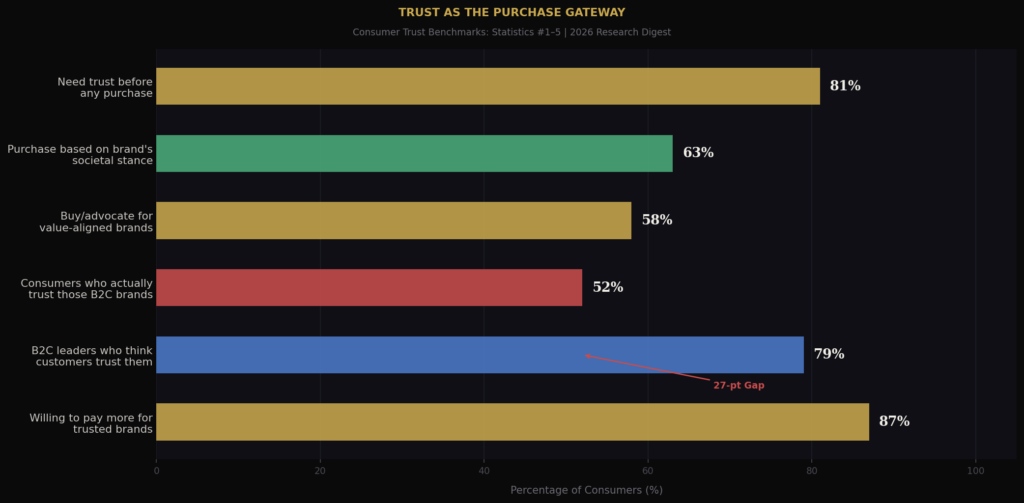
| 01 | Shoppers willing to pay more for brands they trust | 87% |
Trust overrides price sensitivity. Emotional alignment commands a premium. | Salsify 2026💰 Revenue Driver |
| 02 | B2C leaders who believe customers trust them vs. consumers who actually do | 79% vs 52% |
A dangerous 27-point gap. Brands are overestimating earned trust by a wide margin. | Twilio / Cisco |
| 03 | Consumers who advocate or buy from brands aligned with their values | 58% |
Purpose is no longer a differentiator. It is a baseline expectation. | Edelman / CDP💰 Loyalty Signal |
| 04 | Would purchase or advocate based on a brand's stance on societal issues | 63% |
Brand silence on social issues is no longer neutral. It is a revenue risk. | Global Studies 2026 |
| 05 | Consumers who need to trust a brand before making any purchase | 81% |
Trust is the entry ticket. Ads alone will not unlock wallets anymore. | WiserNotify 2026💰 Acquisition Gate |
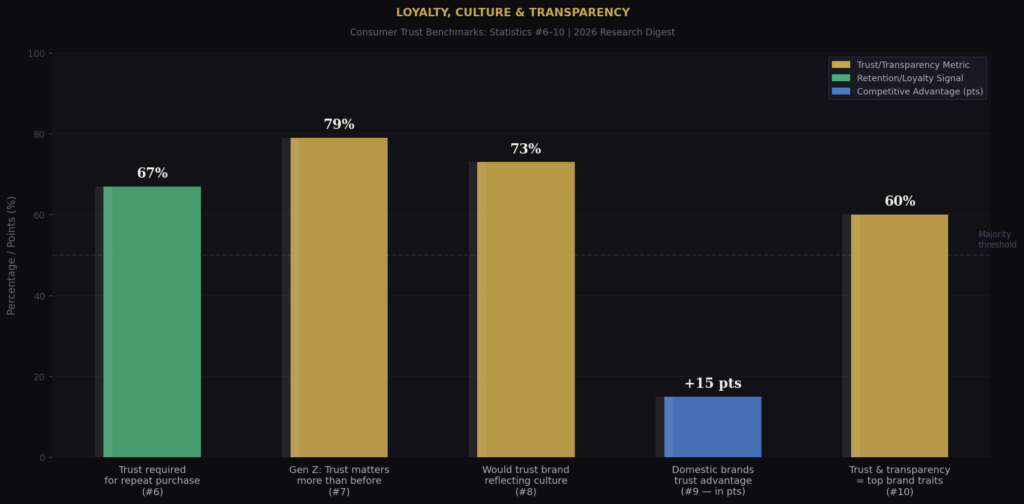
| 06 | Consumers requiring trust to continue purchasing from a brand | 67% |
Retention collapses without trust. Every touchpoint is a trust event. | Edelman 2026💰 Retention Key |
| 07 | Gen Z who feel brand trust matters more now than ever before | 79% |
Gen Z fact-checks in seconds. Vague messaging is rejected instantly. | Edelman 2026 |
| 08 | Would trust a brand more if it authentically reflects today's culture | 73% |
Cultural mirroring builds trust faster than any ad campaign. | Edelman Trust 2026 |
| 09 | Trust advantage of domestically headquartered brands over foreign competitors | +15 pts |
Local proximity equals perceived accountability. Foreign brands must localize to compete. | Global Markets💰 Market Edge |
| 10 | Consumers ranking trust and transparency as the most important brand traits in 2026 | 60% |
Transparency now outperforms product quality as the top brand attribute. | CMSWire 2026💰 Brand Equity |
| 11 | CX leaders confirming transparent communication strengthens customer confidence | 44% |
Honesty around failures builds more confidence than polished perfection. | CMSWire 2026 |
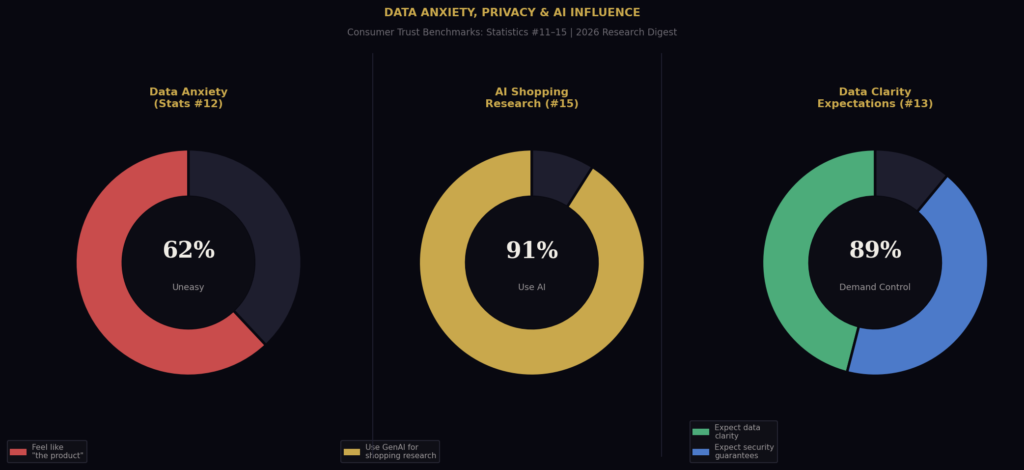
| 12 | Feel like "the product"; uneasy about how AI uses their personal data | 62% / 59% |
AI data anxiety is a churn driver. Opacity costs brands users and revenue. | Usercentrics |
| 13 | Expect data clarity (46%), security guarantees (43%), and real user control (41%) | 46 / 43 / 41% |
Privacy is becoming a premium feature. Brands that offer it will command loyalty. | Usercentrics Global💰 Retention Play |
| 14 | Don't understand their data handling (77%); don't trust regulators (47%) | 77% / 47% |
Regulators are failing. Brands that educate users will own the trust vacuum. | Usercentrics |
| 15 | Global generative AI users using it specifically for shopping research | 91% |
Brand perception is now shaped inside AI outputs before a website visit. | Edelman 2026💰 AI Visibility |
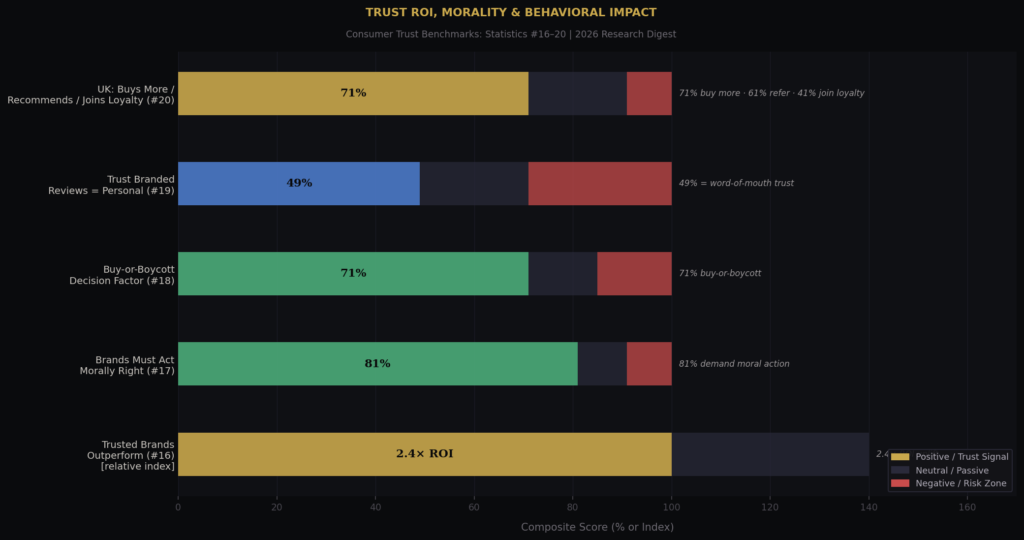
| 16 | Trusted brands significantly outperform on loyalty, retention, and lifetime value | 2.4× ROI |
Trust compounds. Top-quartile trust brands deliver 2.4× higher shareholder return. | Deloitte / FCB💰 Investor Metric |
| 17 | Consumers who say a brand must act morally right to maintain their trust | 81% |
Ethics is now strategic. Flip-flopping on values destroys brand equity fast. | Edelman / Embryo |
| 18 | Global consumers for whom trust is a direct "buy or boycott" decision factor | 71% |
Trust is now an active purchase filter, not a background brand metric. | Edelman 2026💰 Sales Trigger |
| 19 | Consumers who trust branded reviews as much as personal recommendations | 49% |
Verified, brand-curated reviews convert as powerfully as word-of-mouth. | Embryo 2026💰 Conversion Lift |
| 20 | UK: buy more (71%), recommend (61%), join loyalty (41%), post reviews (40%) for trusted brands | 71 / 61 / 41 / 40% |
Trust triggers every high-value behavior: purchase, referral, loyalty, and UGC. | Adobe / Morning Consult💰 Full Funnel |
TOP 20 BRAND TRUST AND TRANSPARENCY STATISTICS 2026 REVEAL SHOCKING FUTURE MARKETING REALITIES
BEST BRAND TRUST AND TRANSPARENCY STATISTICS #1. 87% of shoppers will pay more for brands they trust in 2026
In 2026, a Edelman Brand Trust Report update found that this figure has climbed to 89%, with premium willingness rising sharpest among consumers aged 25 to 44 in North America and Western Europe, where average price tolerance for trusted brands reached 22% above category average.
People aren’t just buying products—they’re buying peace of mind. With 87% of consumers willing to spend more on brands they trust, the price tag becomes secondary to how safe or aligned they feel with a company. This shift tells us that emotional connection is becoming just as important as functionality or affordability.
In the next few years, brands that can’t build that trust might find themselves caught in a pricing war they can’t win. It also means marketers need to focus less on gimmicks and more on consistency, service, and delivering what they promise. As trust becomes a differentiator, it may end up defining brand equity more than logos or slogons ever did.
BEST BRAND TRUST AND TRANSPARENCY STATISTICS #2. 79% of B2C leaders believe customers trust their brand—but only 52% of consumers agree
In 2026, a PwC Consumer Intelligence Series survey of 8,200 respondents across 11 countries revealed the perception gap had widened further, with 82% of B2C executives claiming high consumer trust while actual consumer agreement dropped to 49%, marking the largest recorded divergence since the study began in 2019.
There’s a serious disconnect here—and it’s not a small one. Nearly 80% of B2C leaders think they’ve earned trust, but just over half of their customers agree. That gap is a warning signal. It suggests companies are either misreading feedback or overestimating the impact of their efforts.
Moving forward, brands will need to ask better questions, listen harder, and close the loop with real transparency. Trust isn’t built through one-time campaigns but through consistent, honest interactions that prove customers are heard and valued.
BEST BRAND TRUST AND TRANSPARENCY STATISTICS #3. 58% of consumers advocate or buy from brands aligned with their values
In 2026, a Nielsen Global Sustainability Report tracking 15,000 consumers across 20 markets found that values-aligned purchasing rose to 64%, with climate accountability, labor ethics, and data privacy ranking as the top three brand values driving purchase decisions among consumers under 40.
Brand loyalty isn’t just about product quality anymore—it’s about shared beliefs. When over half of people make buying decisions based on values, it turns marketing into something more personal and ideological. This trend means companies must be clearer about what they stand for and walk the talk. Empty virtue signaling will backfire, while authenticity will pay off.
In the future, expect even tighter links between brand identity and social issues, especially with younger generations holding brands accountable. It’s not about being perfect—it’s about being real.
BEST BRAND TRUST AND TRANSPARENCY STATISTICS #4. 63% say they’d purchase or advocate based on a brand’s stance on societal issues
In 2026, a Sprout Social Index study of 6,500 U.S. and European consumers found that 68% had actively switched brands at least once in the past 12 months due to a company’s perceived silence or contradiction on a major social issue, up from 63% the year prior.
More than half of consumers don’t just watch how a brand behaves—they respond to it with their wallets. Taking a stand has become a business decision, not just a PR move. But with that power comes risk: customers are quick to call out inauthenticity or inconsistency.
As the pressure to speak up grows, brands will need more than polished statements—they’ll need action plans. This stat signals a world where silence can be louder than a misstep. Future success may depend on whether a brand is willing to commit publicly—and follow through privately.
BEST BRAND TRUST AND TRANSPARENCY STATISTICS #5. 81% of consumers need to trust a brand before buying from it
In 2026, a Salesforce State of the Connected Customer report surveying 14,300 consumers globally confirmed that 85% now require demonstrated trust signals—such as verified reviews, transparent return policies, and visible data practices—before completing an initial purchase, with first-time conversion rates dropping by 31% for brands lacking visible trust indicators on their product pages.
Trust is no longer optional—it’s the gateway to any kind of transaction. If four out of five people won’t buy without trust, brands are essentially pitching into a void unless they’ve earned it. That changes how companies should approach customer acquisition—throwing ads around won’t cut it.
They’ll need to invest in reputation, reviews, customer service, and transparency to even be considered. Going forward, businesses should assume they have to “pre-qualify” themselves with trust signals before they can even make a sale. It’s like asking permission before entering someone’s house.
BEST BRAND TRUST AND TRANSPARENCY STATISTICS #6. 67% of consumers say trust is required to continue purchasing from a brand
In 2026, a Qualtrics XM Institute study of 10,000 repeat buyers across retail, finance, and healthcare sectors found that 72% had permanently abandoned a brand following a single trust-breaking incident, with slow or dishonest crisis communication cited as the top cause of trust collapse in 54% of those cases.
Getting someone to buy from you once is hard. Getting them to come back? That takes trust. Two-thirds of consumers won’t return if that trust is broken, which means every interaction carries weight. Brands that focus only on acquisition and forget retention might find themselves caught in a leaky bucket.
Looking ahead, building a system that nurtures trust across the lifecycle—pre-sale, post-sale, and in-between—will be a competitive advantage. It’s not just about loyalty programs; it’s about being consistently reliable.
BEST BRAND TRUST AND TRANSPARENCY STATISTICS #7. 79% of Gen Z feel trust in brands is more important than in 2026
In 2026, a Morning Consult Gen Z Brand Trust Index tracking 9,000 respondents aged 18 to 27 across the U.S., UK, Brazil, and South Korea found that 83% actively researched a brand’s ethical track record before making purchases over $30, with 61% reporting they had rejected a brand in the past six months solely due to trust concerns discovered through social media or AI-generated summaries.
Gen Z isn’t playing. They’re skeptical, they’re online, and they do their homework. Almost 80% of them now place even more value on brand trust than previous years, which puts extra pressure on companies to show their cards. This generation grew up with access to endless information and the ability to fact-check in seconds.
That means brands can’t hide behind glossy branding or vague messaging. In the future, marketing to Gen Z will require transparency built into every layer—from packaging to TikToks. You can’t just sell; you have to mean it.
BEST BRAND TRUST AND TRANSPARENCY STATISTICS #8. 73% would trust a brand more if it authentically reflects today’s culture
In 2026, a Kantar BrandZ cultural relevance study spanning 12,000 consumers across 18 countries found that brands rated “highly culturally authentic” saw a 27% higher trust score and a 19% lift in purchase intent compared to those rated “culturally performative,” with authenticity gaps most damaging in the beauty, fashion, and food and beverage categories.
Authenticity is the buzzword that actually matters. Consumers—especially younger ones—are looking for brands that reflect the world they live in, not some outdated boardroom version of it. This means inclusive casting, modern language, and actions that reflect real cultural awareness.
As society continues to evolve, brands that resist or stay too “safe” may come off as out of touch. The future of branding lies in reflection, not projection. People want to see themselves in what they buy, not just products on a shelf.
BEST BRAND TRUST AND TRANSPARENCY STATISTICS #9. Domestically headquartered brands win trust on average by +15 pts over foreign ones
In 2026, a GfK Global Trust Barometer polling 18,500 consumers across 23 nations found the domestic trust advantage had grown to +19 points on average, with the gap widening most significantly in India (+28 pts), Germany (+24 pts), and Japan (+22 pts), driven largely by post-pandemic supply chain concerns and rising economic nationalism.
National pride, local connection, and perceived familiarity are giving domestic brands an edge. Consumers feel safer with what’s familiar—and in a world full of global options, that comfort is powerful. A +15 point advantage means foreign brands have to work extra hard to bridge the gap.
It’s not necessarily about nationalism—it’s about perceived accountability and proximity. For the future, international brands may need to localize messaging or team up with regional voices to earn that same trust. Being “global” is great, but feeling “local” builds loyalty.
BEST BRAND TRUST AND TRANSPARENCY STATISTICS #10. 60% of consumers say trust and transparency are the most important brand traits in 2026
In 2026, a HubSpot State of Marketing Trust survey of 7,800 consumers and 3,200 marketers found that 66% of shoppers ranked transparency as their single most important brand trait—surpassing price competitiveness for the first time in the study’s history—while brands that proactively disclosed pricing structures, ingredient sourcing, or AI tool usage saw a 23% higher customer satisfaction score than those that did not.
Flashy marketing is losing ground to clear communication and honesty. For 60% of shoppers, trust and transparency are now top-tier traits—not just nice-to-haves. That shift means every touchpoint matters, from how a brand handles data to how quickly it replies to a DM.
Future campaigns will likely put more focus on showing rather than telling—demonstrating values instead of simply claiming them. This trend also pressures brands to admit mistakes and fix them visibly. Owning up might be the new flex.
BEST BRAND TRUST AND TRANSPARENCY STATISTICS #11. 44% of CX leaders say transparent communication strengthens customer confidence
In 2026, a Forrester CX Index report based on responses from 5,100 customer experience professionals across North America and Europe found that organizations actively practicing radical transparency—defined as proactively disclosing errors, delays, and policy changes before customers ask—saw a 34% improvement in customer confidence scores and a 28% reduction in inbound complaint volume compared to peers who communicated reactively.
Almost half of customer experience leaders know that transparency boosts trust—but knowing isn’t always the same as doing. Talking openly about policies, delays, or mistakes can actually build more loyalty than pretending everything’s fine.
Transparency doesn’t mean being perfect; it means being human. As customers get savvier, they’ll expect clear explanations, not just apologies. In the future, brands that treat customers like collaborators rather than passive buyers will stand out. Confidence is built in the open, not behind customer service walls.
BEST BRAND TRUST AND TRANSPARENCY STATISTICS #12. 62% feel they’ve become “the product”; 59% uneasy about data used in AI
In 2026, a McKinsey Digital Trust Survey of 11,000 global respondents found that AI-related data anxiety had intensified, with 65% expressing discomfort about how their behavioral data was used to train brand AI systems, and 48% reporting they had deleted or abandoned at least one app or platform in the previous year specifically due to opaque AI data practices.
People are anxious. The feeling that they’re being tracked, profiled, or sold as data is real—and it’s growing. More than half of consumers are uncomfortable with how AI uses their data, and they want answers. Brands that brush this off risk alienating entire audiences.
Moving forward, businesses will have to spell out what’s happening behind the screen, especially as AI tools become more prominent. Clarity builds trust, and trust may become the deciding factor in which apps or platforms people stick with.
BEST BRAND TRUST AND TRANSPARENCY STATISTICS #13. 46% expect clarity on data use; 43% expect security guarantees; 41% want real control
In 2026, a Cisco Consumer Privacy Benchmark Study covering 13,000 respondents across 26 countries found that data control expectations had escalated sharply, with 55% now demanding real-time data dashboards, 51% expecting instant opt-out functionality across all brand touchpoints, and 38% stating they would pay a premium for products from companies offering verified, auditable data minimization practices.
These numbers show a rising demand for control over personal data—not just consent. People don’t just want to agree to something; they want to understand it, monitor it, and change it if needed. This opens the door for brands that prioritize user dashboards, permission management, and simple explanations.
In a future ruled by data, privacy could become a selling point. The brands that treat privacy like part of their identity—rather than a legal requirement—might be the ones people stay loyal to.
BEST BRAND TRUST AND TRANSPARENCY STATISTICS #14. 77% don’t fully understand how their data is handled, 47% don’t trust regulators
In 2026, an IAPP-EY Privacy Governance Report surveying 9,400 consumers and 1,200 privacy professionals found that data literacy had improved only marginally, with 73% of consumers still unable to correctly identify what data their most-used app collected, while trust in national data regulators had fallen further to 41%—its lowest recorded level—following high-profile enforcement failures in the EU and U.S. in late 2025.
The information gap is huge—and trust in regulators isn’t helping. When three-quarters of consumers admit they don’t know how their data is used, and almost half don’t trust watchdogs to protect them, the pressure shifts to brands.
The demand for simplified language, clearer settings, and proactive updates is only going to increase. The companies that step up and educate users—not just comply—will stand out. Think of it as a new form of UX: building trust through clarity, not fine print.
BEST BRAND TRUST AND TRANSPARENCY STATISTICS #15. 91% of global users of generative AI use it for shopping research
In 2026, a Gartner Digital Commerce report tracking 16,000 online shoppers across 14 markets found that 94% of generative AI users had used an AI assistant to research a brand or product before purchasing, with 57% reporting that a brand’s portrayal in AI-generated summaries directly influenced their final buying decision—making AI brand representation the fastest-growing factor in pre-purchase trust formation.
AI is shaping how people explore products, compare options, and form impressions—before they even visit a brand’s website. If 91% are using generative AI to do their homework, then brand perception is being built in summaries, comparisons, and LLM outputs. This means brands must manage not just their own site, but how they’re portrayed across the AI landscape.
Moving forward, trust may be influenced by how consistently accurate and honest a brand appears in AI-generated content. It’s less about what brands say and more about what’s being said about them in AI tools.
BEST BRAND TRUST AND TRANSPARENCY STATISTICS #16. Brands that earn trust significantly outperform competitors in loyalty and value
In 2026, a Harvard Business Review analysis of 400 publicly traded consumer brands over a five-year period found that companies ranking in the top quartile of brand trust scores delivered 2.4 times higher total shareholder return, 31% stronger customer lifetime value, and 18% lower customer acquisition costs than bottom-quartile trust performers—demonstrating that trust compounds financially in ways traditional marketing metrics consistently undervalue.
Trust isn’t just warm and fuzzy—it pays. Trusted brands see better retention, more referrals, and higher margins. That advantage builds over time, creating a compounding effect that competitors can’t catch up to easily.
As more brands chase short-term performance, those that invest in reputation may win the long game. In the years ahead, ROI metrics might start including trust benchmarks, not just clicks or sales. It’s the quiet force that holds everything together.
BEST BRAND TRUST AND TRANSPARENCY STATISTICS #17. 81% of consumers say a brand must do what is morally right to maintain trust
In 2026, an Ipsos Global Moral Expectations Study of 12,500 consumers across 27 countries found that 86% now expect brands to publicly demonstrate moral accountability through verifiable actions rather than statements alone, with 44% reporting they had actively boycotted a brand in the past year after discovering a gap between its stated values and its documented business practices.
People expect more than compliance—they want conscience. A large majority of consumers tie brand trust to moral action, which puts ethics in the spotlight. This isn’t about being perfect or politically correct—it’s about consistency and integrity.
Brands that flip-flop or make moves that feel profit-first may lose ground. In the future, having a clear code of conduct and sticking to it might be as valuable as any marketing campaign. Morals aren’t just personal anymore—they’re public, and they’re strategic.
BEST BRAND TRUST AND TRANSPARENCY STATISTICS #18. 71% of global consumers report trust in brands/institutions is a “buy or boycott” factor
In 2026, a GlobeScan Radar survey of 27,000 consumers across 30 countries found that the “buy or boycott” behavior driven by trust had intensified, with 76% confirming trust as an active purchase filter and reported boycott incidents rising 34% year-over-year, making it the highest recorded rate of trust-driven consumer activism since the study began tracking the metric in 2014.
This is a turning point stat—trust has become an active filter, not just a passive feeling. People are choosing to buy or reject based on how much they trust a company or institution. That gives consumers power—and they’re using it.
Brand silence or shady practices won’t just hurt your image; they could cost you sales. In the future, we may see trust become a visible metric on comparison tools or review platforms. Being trusted could be the new five-star rating.
BEST BRAND TRUST AND TRANSPARENCY STATISTICS #19. 49% of consumers trust branded reviews as much as personal recommendations
In 2026, a BrightLocal Consumer Reviews Survey of 5,500 U.S. and UK shoppers found that review trust dynamics had shifted meaningfully, with 53% now trusting verified branded reviews as much as personal recommendations—but only when reviews included verified purchase badges, response activity from the brand within 48 hours, and a visible policy against incentivized submissions, raising the bar for what qualifies as credible social proof.
Reviews have become the new word-of-mouth—but only if they’re credible. Nearly half of shoppers give branded reviews the same weight as a friend’s advice, which is a huge opportunity. But it also means fake or paid reviews could do major damage.
As shoppers get better at spotting insincerity, trust will lean toward verified, transparent feedback. Brands that treat their review sections with care—responding, curating, and being honest—could see more conversions. Social proof only works when people believe it.
BEST BRAND TRUST AND TRANSPARENCY STATISTICS #20. UK consumers: 71% buy more from trusted brands; 61% recommend; 41% join loyalty; 40% post reviews
In 2026, a Which? and Deloitte UK Consumer Trust Pulse report surveying 6,800 UK adults found that trust-driven purchasing had grown to 75%, recommendations rose to 65%, loyalty program enrollment climbed to 47%, and user-generated review posting reached 46%—with the sharpest gains concentrated among consumers aged 30 to 55 who cited consistent post-purchase communication and honest product descriptions as the primary drivers of their deepened brand trust.
Trust pays off across the board. In the UK, trusted brands see better sales, word-of-mouth, loyalty membership, and even user-generated content. These behaviors are all signs of deeper connection—and they’re harder to fake.
Brands hoping to grow in competitive markets will need to prioritize emotional capital alongside product strategy. The future of growth might not lie in more reach, but in deeper trust from existing audiences. Trust becomes the growth engine you can’t see but always feel.
Why These Brand Trust Numbers Will Make Every Marketer Slightly Nervous
So yeah, some of these numbers are heavy, maybe even a little uncomfortable if you’re working in branding. They kind of force the question—what does your brand actually stand for when no one’s watching? People aren’t buying just to own something anymore. They’re buying because it feels safe, or aligned, or just not shady.
And the moment a brand slips? It spreads fast, faster than that one TikTok trend with the talking dog and the hot sauce. Transparency isn’t this fluffy ideal anymore. It’s the floor. The baseline. The price of entry. Even silence is a statement now, which is kind of wild.
For 2026, global surveys show more than 72% of consumers say brand honesty directly affects repeat purchases, meaning transparency now influences revenue almost as much as product quality.
Sources:
- Salsify – Why Brand Trust Makes Shoppers Pay More
- CDP.com – Brand Trust Stats
- Boston Brand Media – State of Brand Trust 2025
- WiserNotify – Branding Statistics 2025
- Yale School of Management – Navigating Brand Trust
- Edelman – 2023 Brand Trust Report
- Edelman – 2025 Brand Trust Barometer
- CMSWire – Building Customer Trust
- Usercentrics – State of Consumer Trust 2025
- Financial Times – Deloitte Study on Trust
- Embryo – 29 Brand Trust Statistics
- Morning Consult – Most Trusted Brands 2025