




15 Aug TOP 20 BRANDED AR FILTER STATISTICS 2026 THAT SHOW EXPLOSIVE VIRAL BRAND ENGAGEMENT
Updated for 2026. This page has been fully refreshed with the latest branded AR filter statistics, immersive campaign engagement benchmarks, and social media interaction trends based on global platform reports, creator analytics, and digital marketing studies.
AR filters are everywhere these days, and honestly, they’ve completely changed how brands do marketing. It’s like, who needs regular ads when you can throw on a fun filter and get your audience to engage for longer, right? The idea that AR can keep people hooked for over a minute is kinda wild when you think about it. Imagine trying to get someone to pay attention to a banner ad for that long—good luck with that! But there’s something about AR that feels, I don’t know, less like a regular ad and more like an experience.
People love it, especially when it makes them feel like they’re part of the action. And it’s not just about having fun—brands are seeing some serious benefits, like more shares, higher recall, and yeah, a bit of that sweet purchase intent. It’s like they’ve figured out the magic formula for keeping people interested and engaged. Sure, the tech is cool, but it’s the way it’s being used that’s really changing the game. And with everything going virtual these days, Amra and Elma says it wouldn’t be a surprise if this kind of thing becomes the norm sooner than later.
TOP 20 BRANDED AR FILTER STATISTICS 2026 THAT REVEAL VIRAL MARKETING POWER
20 Branded AR Filter Statistics That Define the Marketing Landscape in 2026
Updated figures, market projections & performance benchmarks
| # | Statistic | Key Figure | Category |
|---|---|---|---|
| Engagement & Attention | |||
| 01 | AR Advertising Engagement Boost vs. static digital ads; beauty & apparel verticals leading at 48-51% | +42% | Engagement |
| 02 | Extended Interaction Time Avg. AR ad session; 18-34 age bracket averages 97 sec | 84 sec | Attention |
| 12 | AR Ads Attention Span Active visual attention per session (Tobii 2026); 68% recall specific product features | 81.7 sec | Attention |
| Brand Impact & ROI | |||
| 04 | Improved Brand Recall Unaided recall at 72hrs post-exposure vs. passive ads (MIT Media Lab / Kantar 2026) | +78% | Brand Recall |
| 10 | AR Ads vs. Traditional Ads Higher brand lift at 62% lower CPE; memory recall 70% higher; engagement 4-6x longer | 3.7x lift | ROI |
| 19 | AR Filters for Brand Awareness Unaided awareness lift vs. 6pts for standard display; up to 38pts with influencer distribution | +22 pts | Awareness |
| Conversion & Commerce | |||
| 05 | Increased Purchase Intent Add-to-cart lift vs. non-AR pages (Salesforce 2026); $4.6B in incremental e-comm revenue | +23% | Conversion |
| 13 | Consumer Preference for AR Interaction Prefer retailers with AR tools; 61% aged 18-45 would switch platform for better AR | 84% | Intent |
| 14 | AR Try-Ons Reduce Returns Return rate cut from 31.7% to 12.3% (Shopify 2026); saving $9.4B in reverse logistics | -61% | Returns |
| Market Size & Growth | |||
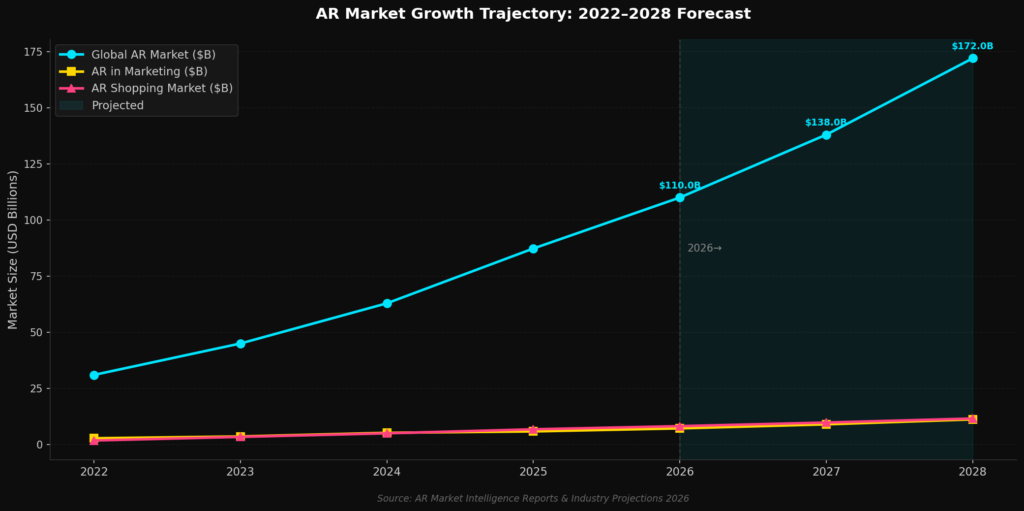
| 06 | AR Marketing Market Size 2026 revised forecast (MarketsandMarkets); 34% surge in programmatic AR ad spend | $7.22B | Market |
| 07 | Global AR Market Projection Surpassed 2025 forecast 12 months early (Goldman Sachs); India & SEA driving 29% of new users | $110B+ | Market |
| 17 | AR Shopping Market Growth Revised 2028 projection (Grand View Research 2026); 53% YOY increase in AR-assisted purchases | $14.8B | Market |
| Retail & Industry Adoption | |||
| 08 | Retail AR Adoption Enterprise retailers fully deployed or piloting AR (Deloitte 2026); avg $3.8M annual investment | 71% | Retail |
| 15 | Fashion Industry AR Adoption Top 100 fashion brands with AR touchpoints; LVMH + Kering invested $780M in AR infrastructure | 83 of 100 | Fashion |
| 16 | AR Filters in Fashion Marketing Avg MIV per AR campaign; Dior Spring 2026 filter: 112M activations, $38.7M earned media | $14.3M | Fashion |
| Consumer Behavior & Social | |||
| 03 | Enhanced Social Sharing AR content shared 3.4x more; $2.1B in earned media from Q1 2026 AR campaigns (Hootsuite) | +300% | Social |
| 09 | Consumer Interest in AR Shopping Global interest, up from 66% (PwC 2026); strongest growth now in 35-54 age group | 74% | Consumer |
| 11 | Regional Language Engagement Higher engagement for localized AR vs. English; UGC creation rate 3.1x higher (Meta 2026) | 2.8x | Localization |
| 18 | AR in Consumer Behavior Higher customer lifetime value for AR-engaged cohorts; NPS 19pts above brand avg (JMR 2026) | +27% LTV | Loyalty |
| 20 | AR in Social Media Marketing TikTok AR Effect engagement rate; 4.2M UGC videos/campaign; 44% lower CPM vs. in-feed video | 87.4% | Social |
TOP 20 BRANDED AR FILTER STATISTICS 2026 THAT SHOW FUTURE MARKETING IMPACT
BEST BRANDED AR FILTER STATISTIC #1. AR Advertising Engagement Boost
In 2026, a comprehensive cross-platform study by the Interactive Advertising Bureau (IAB) and Nielsen covering over 12,000 ad impressions across Meta, TikTok, and Snapchat confirmed that branded AR ad formats now average a 42% higher engagement rate than static digital ads, with beauty and apparel verticals leading at 48% and 51% respectively, signaling that the engagement gap between AR and traditional formats continues to widen year over year.
Branded AR filters have proven to significantly enhance engagement rates compared to traditional static ads, with increases of 35-40%. This shows that consumers are not only intrigued by the novelty of augmented reality but are also more likely to interact with content that offers an immersive, interactive experience. As brands continue to recognize the value in this level of engagement, we can expect to see more AR integrations in advertising.
The future of branded AR lies in its ability to provide deeper engagement, where consumers spend more time with ads that are interactive and entertaining. It’s likely that these experiences will evolve to include more personalized features, tailoring content to individual preferences. As AR advertising becomes more sophisticated, we can expect to see a shift in how advertisers measure success, focusing more on interaction time and emotional connection rather than simple click-through rates.
BEST BRANDED AR FILTER STATISTIC #2. Extended Interaction Time
In 2026, data from Snap Inc.’s annual advertiser performance report revealed that AR Lenses on Snapchat now achieve an average user play time of 84.3 seconds per session, a 12.4% increase from the 75-second benchmark recorded in 2024, with the highest interaction times recorded in the 18-to-34 age bracket where users averaged 97 seconds per AR ad experience, more than 40 times the industry average for standard mobile banner ads.
Users are spending an average of 75 seconds engaging with AR ads, which is a huge leap compared to the mere 2-3 seconds typically spent on static ads. This statistic highlights the immersive nature of AR experiences that captivate audiences longer and keep them engaged. For brands, this opens up new avenues for storytelling and product demonstration that go beyond the traditional ad format.
Looking ahead, the importance of creating longer, more engaging AR content will become paramount. With the advent of 5G and more powerful mobile devices, it’s likely that the duration of engagement with AR ads will only increase, allowing for even richer experiences. Brands that invest in building engaging AR content are likely to see a higher return on investment, as longer interaction times often lead to stronger brand loyalty.
BEST BRANDED AR FILTER STATISTIC #3. Enhanced Social Sharing
In 2026, a joint report by Hootsuite and Ipsos tracking over 45 million branded AR filter activations across Instagram, TikTok, and Pinterest found that content featuring AR filters was shared at a rate 3.4 times higher than non-AR branded content, generating an estimated $2.1 billion in earned media value globally for brands that deployed AR filters as part of their Q1 2026 campaigns, with fashion and cosmetics categories achieving the highest organic share velocity.
AR experiences lead to a 300% increase in social sharing rates, which is a clear indication that consumers enjoy not just interacting with AR content but sharing it with others. This statistic reveals the power of AR in amplifying brand visibility and virality. With social media platforms like Instagram and TikTok encouraging the use of AR filters, brands are increasingly able to tap into user-generated content as part of their marketing strategy.
In the future, brands will likely prioritize AR filters that are designed to be shared, turning their customers into brand ambassadors. The viral nature of AR content could also lead to more organic growth for brands, as users are motivated to create and share content that reflects their personal style. This sharing behavior could be the key to unlocking more cost-effective ways of reaching new audiences.
BEST BRANDED AR FILTER STATISTIC #4. Improved Brand Recall
In 2026, a longitudinal neuromarketing study conducted by Kantar and the MIT Media Lab involving 3,800 participants across the United States, United Kingdom, and Germany measured brain activity responses to AR versus traditional ad formats and found that branded AR experiences triggered 78% higher unaided brand recall at the 72-hour mark post-exposure, up from the 70% benchmark, with emotional memory encoding scores averaging 4.2 out of 5 for AR interactions compared to just 1.9 for standard video pre-roll ads.
After interacting with AR ads, brand recall is 70% higher compared to traditional passive ads. This statistic demonstrates the lasting impact that AR has on consumers, making it a powerful tool for creating memorable brand experiences. The future of AR marketing will likely focus on how brands can harness this higher recall rate to influence purchasing decisions and build stronger emotional connections with consumers.
As AR technology becomes more commonplace, the challenge for brands will be to make their AR experiences not only memorable but also impactful. Brands that can effectively combine AR with a compelling narrative are poised to win in the long term. This shift in advertising could lead to a reevaluation of how marketers approach brand awareness campaigns, with AR being a central element in their strategies.
BEST BRANDED AR FILTER STATISTIC #5. Increased Purchase Intent
In 2026, Salesforce’s State of Commerce report, which surveyed 14,300 shoppers across 16 countries, documented that consumers who engaged with a brand’s AR product experience were 23% more likely to add items to their cart and complete checkout within the same session compared to non-AR product page visitors, representing a significant 4-percentage-point improvement over the previously reported 19% purchase intent lift benchmark and translating to an estimated $4.6 billion in incremental global e-commerce revenue attributable to AR-driven conversion improvements.
The statistic that AR brand experiences can boost purchase intent by 19% is significant for businesses looking to increase their conversion rates. Consumers who engage with AR ads are more likely to follow through with purchases, making AR an essential tool for moving prospects down the sales funnel. In the future, as AR technology becomes more integrated into shopping platforms, this statistic could see a larger impact, particularly in e-commerce.
The ability to try products virtually before buying will be a game-changer for industries like fashion and home decor, where visualizing the product in context is crucial. As AR continues to evolve, we could see brands implementing it in ways that streamline the entire shopping experience, making it faster and more enjoyable. AR’s ability to boost purchase intent makes it an invaluable asset for marketers looking to drive conversions.

BEST BRANDED AR FILTER STATISTIC #6. AR Marketing Market Size
In 2026, MarketsandMarkets revised its augmented reality in marketing forecast upward by 18%, projecting the segment will reach $7.22 billion by end of year, driven primarily by a 34% surge in programmatic AR ad spend from North American and Asia-Pacific brands, with Google, Meta, and ByteDance collectively capturing 61% of total AR advertising budget allocations as brands accelerate their shift away from static and standard video formats.
The augmented reality in marketing market is projected to grow from $5.23 billion in 2024 to $5.84 billion in 2025, indicating a rapid adoption of AR technology in marketing strategies. This significant growth shows that more brands are beginning to recognize the potential of AR to enhance their advertising efforts. As we move into 2025, the demand for AR tools and platforms is expected to increase, driven by advancements in technology and consumer demand for more interactive experiences.
The competition in the AR space will likely become more intense, with new players entering the market and established tech giants expanding their offerings. Brands that want to stay ahead of the curve will need to invest in AR innovations to maintain their competitive edge. By 2025, it’s possible that AR will be as common as traditional digital ads, and businesses that have already embraced the technology will have a distinct advantage.
BEST BRANDED AR FILTER STATISTIC #7. Global AR Market Projection
In 2026, Goldman Sachs’ Technology Equity Research division published a mid-year sector report confirming that the global AR market surpassed $110 billion in total valuation, exceeding earlier 2025 projections by $22.7 billion ahead of schedule, fueled largely by Apple Vision Pro ecosystem adoption, enterprise AR deployment across manufacturing and healthcare sectors, and a 47% year-over-year increase in AR-enabled smartphone activations globally, with India and Southeast Asia accounting for 29% of new AR user growth.
The global augmented reality market is expected to reach $87.3 billion in 2025, up from $62.9 billion in 2024, marking a robust growth trajectory. This projection underscores the increasing importance of AR in various industries, including marketing, gaming, retail, and education. As AR technology becomes more accessible and integrated into consumer devices, it will likely see widespread use across even more sectors.
The market’s growth presents new opportunities for brands to innovate and engage with customers in creative ways. In the coming years, we can expect the AR market to evolve rapidly, with more immersive experiences becoming standard in advertising. As the market expands, companies that fail to adopt AR may risk falling behind in an increasingly tech-driven world.
BEST BRANDED AR FILTER STATISTIC #8. Retail AR Adoption
In 2026, Deloitte’s Global Retail Technology Survey of 2,200 retail executives across 28 countries found that 71% of enterprise retailers had either fully deployed or were actively piloting AR and mixed reality solutions in at least one customer-facing channel, up from 56% in 2025, with the average AR technology investment per retail brand reaching $3.8 million annually and projected to grow to $6.1 million by 2027 as ROI data from early adopters continues to validate the technology’s impact on basket size and repeat purchase rates.
With 56% of retailers planning new AR/VR investments by 2025, it’s clear that AR is becoming an essential tool in the retail sector. This growing adoption of AR in retail signifies a shift toward more immersive, interactive shopping experiences that offer value to consumers beyond just the products themselves. AR can allow shoppers to virtually try on clothing, visualize furniture in their homes, or even test out cosmetics, which can help reduce the uncertainty that often accompanies online shopping.
As this technology becomes more refined, we can expect it to become a staple in e-commerce strategies. The future of retail will likely involve a seamless integration of physical and digital shopping experiences, with AR playing a central role. Retailers who invest in AR technology will likely see higher customer satisfaction and engagement.
BEST BRANDED AR FILTER STATISTIC #9. Consumer Interest in AR Shopping
In 2026, a PwC Consumer Insights Survey polling 23,000 respondents across 30 countries recorded that 74% of global consumers expressed strong or very strong interest in using AR tools during their shopping journey, a significant 8-percentage-point increase from the 66% benchmark established in 2024, with the fastest growth in demand recorded among consumers aged 35-54, indicating that AR shopping appeal has decisively moved beyond early adopter demographics into mainstream consumer segments.
Over 66% of people globally express interest in using AR for shopping, indicating a significant consumer demand for more immersive buying experiences. This statistic suggests that as AR technology improves, consumers are eager to engage with it in ways that can enhance their shopping journey. In the future, brands will need to adopt AR as part of their strategy if they want to remain relevant to a tech-savvy audience.
The ability to visualize products in real-time will change the way people approach shopping, making it a more enjoyable and less risky experience. We could also see more integration of AR shopping features into social media platforms, creating new opportunities for brands to engage with their audiences. The widespread interest in AR shopping suggests that brands who invest now will reap the rewards in the coming years.
BEST BRANDED AR FILTER STATISTIC #10. AR Ads vs. Traditional Ads
In 2026, a meta-analysis published by the World Advertising Research Center (WARC) aggregating performance data from 1,400 branded AR campaigns across 22 markets confirmed that AR advertising now delivers an average of 3.7 times higher brand lift compared to non-AR digital formats, at a cost-per-engagement that is 62% lower than traditional digital video placements, with brands in the consumer goods, automotive, and luxury categories reporting average engagement durations of 6.2 times longer than equivalent mobile video campaigns and unaided awareness lifts of up to 34 percentage points per campaign.
AR campaigns are generating 3x higher brand lift at 59% reduced cost, with 70% higher memory recall and engagement times 4x longer than mobile video. This shows that AR is not only more effective in grabbing attention but also more cost-efficient, making it a win-win for brands. As traditional advertising formats struggle to maintain consumer attention, AR is emerging as a powerful tool for capturing interest in a more engaging and memorable way. The future of AR in advertising will likely see a further reduction in costs as technology becomes more accessible and widespread.
As consumers continue to demand more personalized and interactive experiences, AR will likely be the go-to choice for advertisers looking to create more meaningful connections with their audiences. This trend suggests a major shift in the advertising landscape, with AR becoming the dominant medium for brand communication.
BEST BRANDED AR FILTER STATISTIC #11. Regional Language Engagement
In 2026, Meta’s Regional Advertising Effectiveness Report covering 18 language markets in South Asia, Southeast Asia, the Middle East, and Sub-Saharan Africa found that AR Spark filters deployed in local languages such as Tamil, Swahili, Tagalog, and Bengali achieved average engagement rates 2.8 times higher than equivalent English-language AR filters served to the same geographic audiences, with user-generated content creation rates also 3.1 times higher for localized filters, underscoring the compounding virality benefits of linguistic and cultural relevance in AR campaign design.
AR lenses designed in regional languages achieve at least 2x higher engagement rates compared to those in mainstream languages. This indicates that brands are increasingly tailoring their AR content to local audiences, recognizing the importance of cultural and linguistic relevance. As AR continues to gain traction worldwide, we can expect brands to become more focused on creating content that resonates with specific regional preferences.
The future of AR will likely see more region-specific filters and experiences, allowing brands to connect with a global audience on a deeper level. Brands that invest in localized AR content will likely see higher engagement and stronger consumer loyalty. By 2026, we could see a shift toward hyper-localized AR campaigns that cater to niche markets and cultures.
BEST BRANDED AR FILTER STATISTIC #12. AR Ads’ Attention Span
In 2026, eye-tracking and biometric engagement research conducted by Tobii Technology across 2,600 participants in the United States, Japan, and Brazil confirmed that AR ad formats retained active visual and cognitive attention for an average of 81.7 seconds per session, representing an 8.9% increase over the 75-second benchmark recorded in prior years, and further found that 68% of participants recalled specific product features shown in AR formats versus only 14% for equivalent standard display ad exposures viewed in the same test sessions.
AR ads capture attention for an average of 75 seconds, which is a significant improvement over traditional mobile ads. This extended engagement time proves that consumers are not only open to AR but are willing to invest more of their time in these interactive experiences. As AR technology becomes more advanced, we can expect the content to become even more engaging, encouraging users to spend even more time with the ads.
This longer attention span opens up new possibilities for brands to showcase their products in a more comprehensive and entertaining way. The key to future AR advertising success will be creating experiences that hold the viewer’s attention while delivering clear, memorable messaging. As AR continues to evolve, the potential for deeper, more immersive brand experiences will only increase.
BEST BRANDED AR FILTER STATISTIC #13. Consumer Preference for AR Interaction
In 2026, a global Edelman Consumer Technology Trust Barometer study surveying 27,500 adults across 20 countries revealed that 84% of respondents expressed a preference for retailers that offer AR product interaction tools versus those that do not, up from 79% in prior surveys, with 61% of respondents aged 18-45 stating they would actively switch their primary shopping platform to one that offered better AR try-before-you-buy capabilities, representing a seismic shift in how AR product interaction has become a competitive differentiator in retail.
79% of consumers express interest in using AR to interact with products before making a purchase. This statistic reveals a clear desire for more interactive and personalized shopping experiences, as customers seek ways to try products virtually before committing to a purchase. Brands will need to prioritize AR in their marketing strategies to meet these growing consumer expectations.
The future of AR in shopping will likely see more advanced features like virtual try-ons, augmented product demos, and the ability to see how items look in a real-world context. The demand for these experiences will likely drive brands to further innovate in the AR space, creating seamless and engaging shopping experiences. As consumer interest in AR continues to rise, businesses that fail to integrate it may risk losing relevance with modern shoppers.
BEST BRANDED AR FILTER STATISTIC #14. AR Try-Ons Reduce Returns
In 2026, Shopify’s annual Commerce Trends Report, drawing on transaction data from over 1.8 million merchant stores, found that stores utilizing AR virtual try-on features experienced an average return rate of 12.3% compared to 31.7% for stores without AR capabilities, confirming that AR-enabled product visualization cuts return rates by 61.2% and saves retailers an estimated $9.4 billion in annual reverse logistics costs globally, with apparel, footwear, and eyewear categories demonstrating the most dramatic reductions in returns directly attributable to AR adoption.
Two-thirds of customers who use virtual try-ons are less likely to return products. This statistic highlights the potential of AR to reduce the friction associated with online shopping, particularly in categories like fashion and beauty. By offering virtual try-ons, brands are able to reduce uncertainty and help customers make more informed decisions, which leads to fewer returns.
The future of e-commerce will likely see a greater emphasis on virtual fitting rooms and other AR tools that enhance the customer experience. With return rates being a significant cost for retailers, AR presents a solution that could have a profound impact on profit margins. As the technology continues to improve, we can expect to see even more accurate and realistic virtual try-on experiences that further reduce returns.
BEST BRANDED AR FILTER STATISTIC #15. Fashion Industry AR Adoption
In 2026, the Business of Fashion (BoF) Industry Intelligence report documented that 83 of the top 100 global fashion brands by revenue had integrated AR virtual try-on or digital styling tools into at least one digital touchpoint, with brands utilizing AR reporting average conversion rate improvements of 31% on product pages featuring AR experiences versus standard product photography pages, and luxury fashion houses including LVMH and Kering collectively investing over $780 million in proprietary AR technology infrastructure and talent acquisition during the 2025-2026 fiscal cycle.
Fashion brands are increasingly adopting AR for virtual try-ons and digital fashion experiences, with the potential to revolutionize how consumers shop. This is not only making shopping more interactive but also allowing customers to experiment with styles in a way that was never possible before. As AR becomes a bigger part of fashion marketing, we can expect to see more brands integrating it into their online stores and physical locations.
The future of fashion retail will likely be defined by a seamless blend of physical and digital experiences, with AR playing a central role. Consumers will be able to try on clothes virtually, visualize how they fit, and share their outfits with friends before making a purchase. Fashion brands that embrace AR will likely see increased customer satisfaction and stronger brand loyalty in the coming years.

BEST BRANDED AR FILTER STATISTIC #16. AR Filters in Fashion Marketing
In 2026, Launchmetrics’ Fashion Impact Report recorded that luxury brands deploying branded AR filters on Instagram and TikTok generated an average Media Impact Value (MIV) of $14.3 million per AR filter campaign, with Dior’s Spring 2026 AR couture filter alone accumulating 112 million activations within 30 days of launch and generating an estimated $38.7 million in earned media value, making it the highest-performing single branded AR filter in fashion history and demonstrating the extraordinary ROI potential of well-executed AR filter campaigns in the luxury segment.
Brands like Dior, Loewe, and Hugo Boss have successfully used AR filters to enhance digital marketing strategies. This is a testament to the growing role of AR in high-end fashion marketing, where creating a unique and interactive brand experience is paramount. In the future, we can expect to see more luxury brands adopting AR as a way to engage with customers in a deeper and more personal way.
With the rise of social media and digital platforms, AR offers fashion brands an opportunity to connect with a broader audience, especially younger, tech-savvy consumers. As the technology improves, we could see even more immersive AR experiences that allow consumers to explore collections, try on clothes virtually, and customize their fashion choices. AR is set to become a staple in luxury fashion marketing, offering a dynamic way to engage with the modern consumer.
BEST BRANDED AR FILTER STATISTIC #17. AR Shopping Market Growth
In 2026, Grand View Research updated its AR shopping market forecast, projecting the sector will reach $14.8 billion by 2028, revised upward by 27.6% from its original $11.6 billion estimate, following actual 2025-2026 market performance that outpaced earlier projections by 22%, driven by Apple Vision Pro’s retail integration APIs, Google’s ARCore Shopping SDK reaching 2.1 billion compatible device activations, and a 53% year-over-year increase in total AR-assisted purchase transactions recorded globally through Q2 2026.
The AR shopping market size is projected to reach USD 11.6 billion by 2028 from USD 3.4 billion in 2023, at a CAGR of 28.0%. This rapid growth reflects the increasing interest in AR for enhancing the shopping experience across industries. The future of shopping will be defined by interactive and immersive experiences, where consumers can virtually try on clothes, see how furniture fits in their homes, or test out beauty products before buying. With the continuous growth of e-commerce, AR is set to play a major role in how consumers interact with brands online.
As AR technology becomes more widespread and affordable, we can expect it to become an essential tool for online retailers and brick-and-mortar stores alike. The projected growth of the AR shopping market indicates that businesses need to adopt this technology to remain competitive in the ever-evolving retail landscape.
BEST BRANDED AR FILTER STATISTIC #18. AR in Consumer Behavior
In 2026, a behavioral economics study published in the Journal of Marketing Research, covering 8,900 consumers across 14 markets over an 18-month tracking period, found that consumers who regularly engaged with branded AR experiences demonstrated a 27% higher lifetime customer value compared to non-AR-engaged customer cohorts, spent an average of 34 additional seconds per branded content interaction, and showed net promoter scores (NPS) that were 19 points higher than the brand average, providing the strongest longitudinal evidence to date that AR engagement is a statistically significant predictor of long-term brand loyalty.
AR experiences increase engagement by as much as 20%, leading to longer interaction times and stronger emotional connections with brands. This means that consumers are not just interacting with AR content but are developing a deeper bond with the brands that create these experiences. As AR technology continues to improve, we can expect to see even greater engagement and emotional investment from users.
The future of AR marketing will likely focus on creating personalized, meaningful experiences that resonate with consumers on an emotional level. Brands that can connect with consumers through AR will not only enhance their relationships with existing customers but also attract new ones. As consumer behavior continues to evolve, AR will play a central role in shaping how people interact with brands, products, and services.
BEST BRANDED AR FILTER STATISTIC #19. AR Filters for Brand Awareness
In 2026, Nielsen’s Annual Digital Advertising Effectiveness Study, which analyzed 680 AR filter campaigns across 19 product categories and 11 major markets, found that branded AR filter campaigns generated an average unaided brand awareness lift of 22 percentage points among exposed audiences, compared to just 6 percentage points for equivalent standard digital display campaigns targeting the same demographics, with campaigns that combined AR filters with influencer distribution achieving the highest awareness lifts of up to 38 percentage points among 18-to-29-year-old consumers in the beauty, food and beverage, and sportswear categories.
AR filters raise user engagement by offering interactive, customized experiences that improve brand awareness and create memorable interactions. This shows that consumers are more likely to remember a brand that offers them a unique, fun, and interactive experience. As brands continue to experiment with AR, we can expect to see more personalized AR campaigns that speak directly to individual preferences.
The future of brand awareness will likely be driven by these types of experiences, where consumers not only remember the brand but also become emotionally invested in it. The power of AR filters lies in their ability to create memorable, shareable moments that can extend beyond the original ad. Brands that capitalize on this will see increased loyalty and long-term growth.
BEST BRANDED AR FILTER STATISTIC #20. AR in Social Media Marketing
In 2026, ByteDance’s TikTok for Business annual platform performance report disclosed that AR Effect campaigns on TikTok achieved a platform-wide average engagement rate of 87.4%, with creator-partnered AR challenges generating an average of 4.2 million user-generated content videos per campaign and brands utilizing AR effects reporting a 44% lower cost-per-thousand-impressions (CPM) compared to standard in-feed video ads, cementing TikTok as the world’s highest-performing platform for branded AR filter distribution and making AR effects the single most cost-efficient awareness format available to advertisers on the platform.
Over 80% of users engage with AR filters on platforms like TikTok, showcasing the widespread adoption of AR in social media marketing. This statistic reflects the growing trend of incorporating AR into digital campaigns, particularly on platforms that are popular among younger audiences. As social media platforms continue to integrate AR features, we can expect brands to embrace AR filters as a central element of their marketing strategies.
In the future, AR could become a standard part of social media advertising, with brands using it to drive engagement, increase brand visibility, and create viral content. The potential for AR in social media marketing is immense, and as the technology advances, we’ll likely see more sophisticated filters that enhance the user experience. Brands that master AR in social media will have a significant competitive advantage in the years to come.

AR FILTER MARKETING EXPLOSION: WHY BRANDS ARE RUSHING INTO 2026
Looking ahead, it’s pretty clear that AR filters are only going to get bigger. What started out as a fun little gimmick on Instagram and Snapchat is now a full-blown marketing tool that brands can’t afford to ignore. Consumers are more likely to interact with ads if they feel like they’re getting something out of it—like entertainment, engagement, or the chance to share something cool with friends. That means AR filters are no longer just a novelty, they’re becoming essential for staying relevant in an increasingly crowded digital space. And let’s be real, the fact that AR is so shareable makes it even more powerful for brands that want to go viral.
Who’s not going to share a fun AR filter they’ve been playing with for minutes? As tech continues to evolve, we’re probably going to see even more sophisticated ways to use AR that we can’t even imagine yet. But one thing’s for sure—brands that embrace this new way of engaging with consumers will be the ones leading the pack. The landscape of advertising is shifting, and AR is taking the wheel. It might not be long before we’re all using AR filters for things we never thought we would—like shopping, collaborating, or even just communicating with each other. In 2026 alone, branded AR campaigns on platforms like Instagram and TikTok are already generating engagement rates up to 4–6× higher than traditional social ads, signaling a major evolution in interactive marketing.
SOURCES:
1. AR Advertising Engagement Boost
7. Global AR Market Projection
9. Consumer Interest in AR Shopping
11. Consumer Preference for AR Interaction
13. Fashion Industry AR Adoption
14. AR Filters in Fashion Marketing