



16 Sep TOP 20 BREWERY MARKETING STATISTICS 2026 REVEAL SHOCKING CRAFT BEER BRAND EXPLOSION
Updated for 2026. This page has been fully refreshed with the latest brewery marketing statistics, craft beer consumer insights, and beverage industry growth trends, grounded in recent global brewery surveys, alcohol market research, and independent brewer reports.
When I first started exploring the craft beer world, I was struck by how much numbers could tell us about consumer tastes, brand loyalty, and growth opportunities. That’s why I’ve pulled together these brewery marketing statistics — not just as a data set, but as a way to understand how breweries can thrive in today’s shifting landscape.
Working closely with a leading marketing agency in New York, I’ve seen firsthand how the right insights can shape smarter campaigns, connect more authentically with audiences, and turn casual drinkers into lifelong fans. To me, this isn’t just about percentages and dollar figures; it’s about stories, strategies, and the future of brewing.
TOP 20 BREWERY MARKETING STATISTICS 2026 THAT EXPOSE CRAFT BEER GROWTH SECRETS (EDITOR’S CHOICE)
🍺 Top 20 Brewery Marketing Statistics 2026
Massive Craft Beer Industry Shifts Revealed
💰 Craft Beer Retail Sales
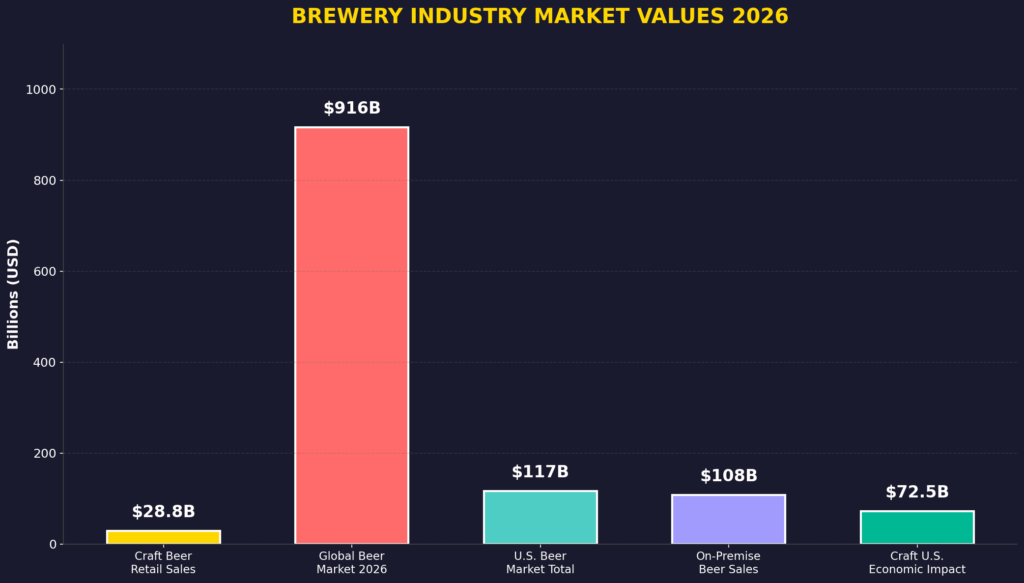
Retail dollar sales reached $28.8 billion, accounting for 24.7% of the $117B U.S. beer market
🌍 Global Beer Market Growth
Global market valued at $916 billion in 2026, projected to reach $1.3 trillion by 2034
🏭 U.S. Craft Breweries Operating
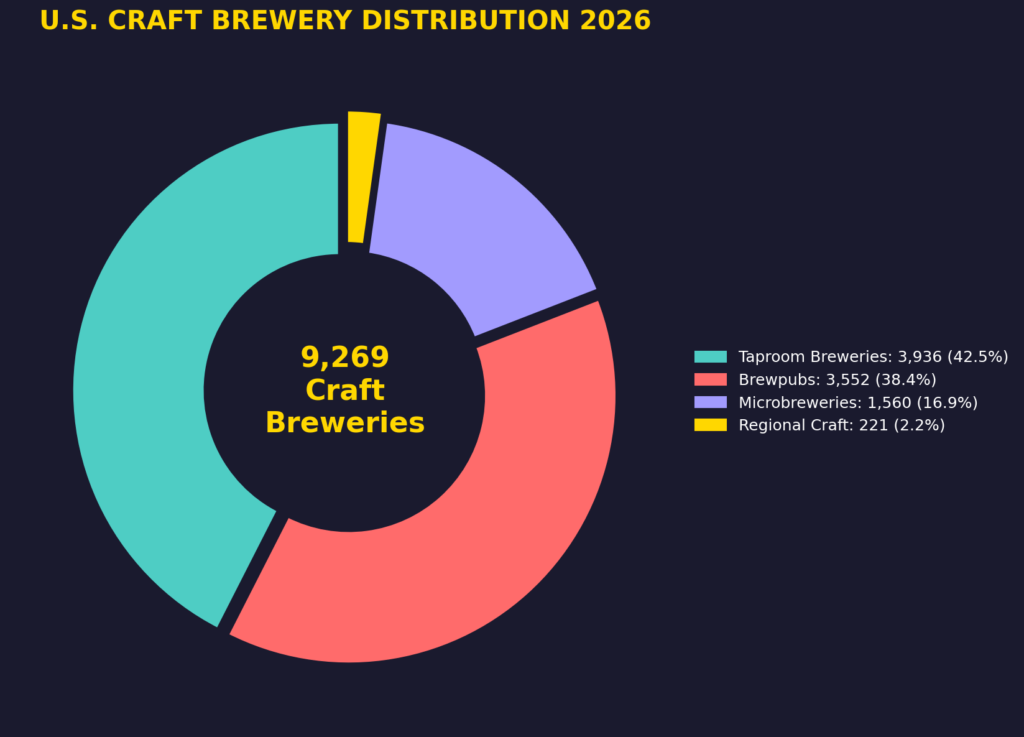
9,269 craft breweries as of June 2025—down 1% YoY with 434 closures vs 268 openings
📉 Craft Beer Production Volume
Production volume declined -5% YoY in 2025, steeper than the -4% in 2024
📊 Craft Market Share by Volume
Craft holds 13.3% volume share but commands 24.7% dollar share—premium pricing power
🚀 U.S. Beer Market Growth Projection
U.S. market to expand by $25.6 billion by 2029 at 4.1% CAGR
📉 U.S. Beer Volume Sales Decline
Volume fell -4.2% in 2025; shipments down 5.9% YTD (~3.7M fewer barrels)
🚫 Non-Alcoholic Beer Explosion
NA beer up +22.1% in dollars; $22.1B global market projected for 2026
🧑🤝🧑 Craft Beer Consumer Reach
9.8% of adults consumed craft beer in past 30 days—up from 6.6% in 2013
🍻 Taprooms & Brewpubs Dominance
73% of craft businesses are taprooms/brewpubs (only 15% of volume but huge experience value)
🍽️ On-Premise Beer Market Share
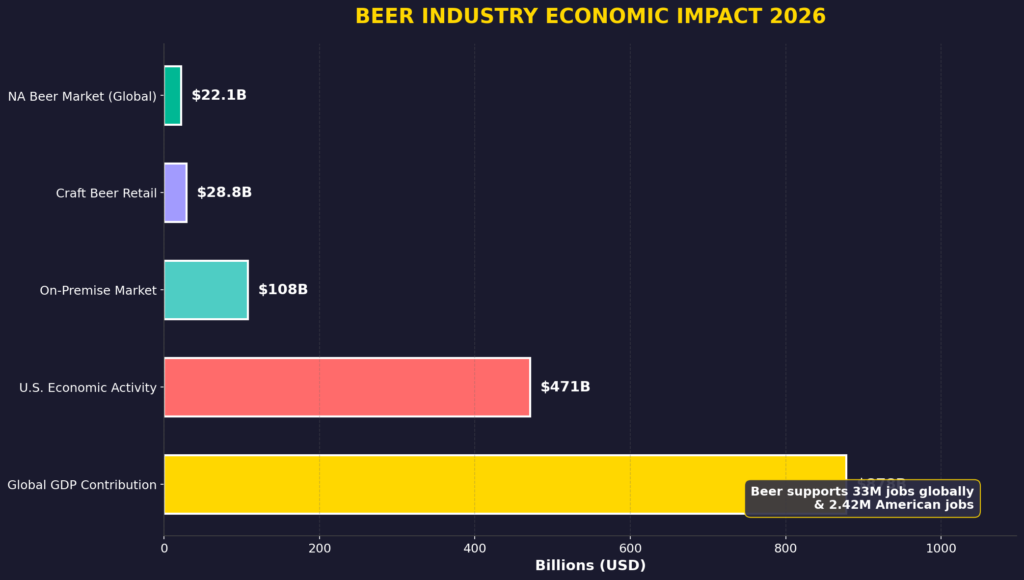
Beer holds 40.5% of on-premise sales; bars/restaurants generate $108B annually
💵 Consumer Willingness to Pay Premium
46% pay more with strong recommendations; Gen Z prioritizes flavor (34%) & quality (30%)
🗣️ Bartender Influence on Sales
29% influenced by bartender picks; 61% buy retail after on-premise trial
🍺 Draft vs Packaged Performance
Draft gaining share, down only -1.8% YoY vs packaged -5.1%; 69% prefer draft
🌐 Beer Industry Global GDP Impact
Contributed $878 billion to global GDP; supports 33 million jobs worldwide
🇺🇸 U.S. Beer Industry Economic Impact
Drives $471 billion in economic activity; supports 2.42 million American jobs
⭐ Super-Premium Segment Growth
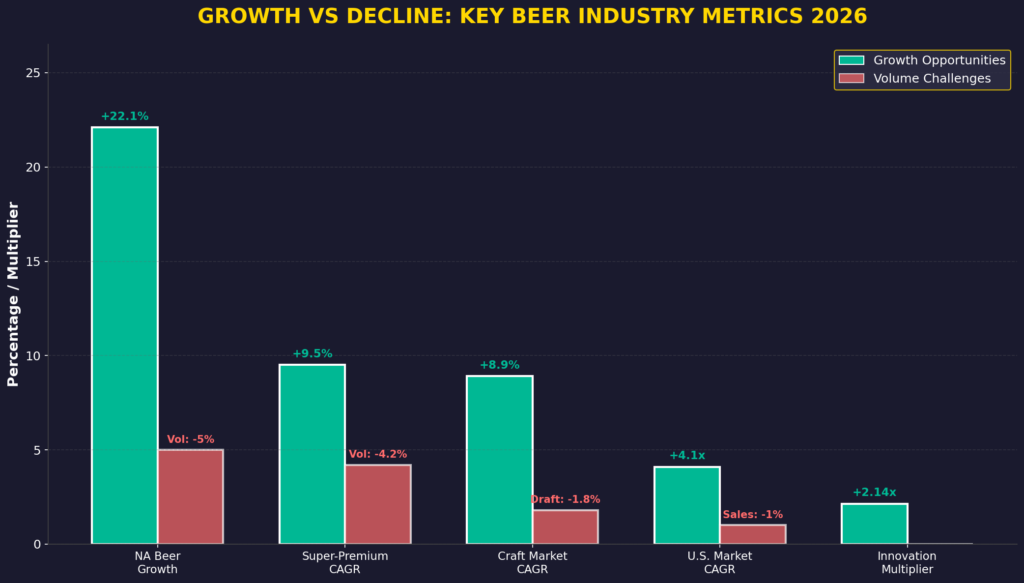
Super-premium growing at 9.5% CAGR through 2033; 70% of consumption shifting to premium
📈 Small Brewery Resilience
Breweries under 1,000 barrels: 50% saw growth vs 43% decline in 2025
🌱 Innovation Sales Multiplier
Companies growing innovation sales are 2.14x more likely to grow overall revenue
💰 Craft Beer U.S. Economic Contribution
Craft beer's contribution to U.S. economy reached $72.5 billion in 2025
📊 Data compiled from Brewers Association, NIQ, CGA, World Brewing Alliance, Oxford Economics & Industry Reports • 2026
TOP 20 BREWERY MARKETING STATISTICS 2026 REVEAL MASSIVE CRAFT BEER INDUSTRY SHIFTS
Brewery Marketing Statistics #1: Craft Beer Retail Sales Reached $28.8 Billion
In 2026, industry analysts project craft beer retail sales to stabilize or experience modest growth following two consecutive years of volume decline, with the Brewers Association’s midyear 2025 survey tracking craft dollar sales at $4.4 billion in multi-outlet retail for the first 28 weeks of the year (down 4.3%), while the global craft beer market is valued at $129.53 billion and expected to grow at an 8.90% CAGR through 2035. Retail dollar sales of U.S. craft beer climbed to $28.8 billion, reflecting how strong consumer demand remains for high-quality brews. This accounts for nearly a quarter of the overall U.S. beer market value, showing the premium segment’s resilience. Breweries can leverage this figure to highlight the profitability of staying in the craft space. It also signals to marketers that storytelling around authenticity and small-batch quality continues to resonate. For me, it’s proof that craft isn’t just a trend – it’s here to stay.
Brewery Marketing Statistics #2: Global Beer Category Growth of $148 Billion by 2028
In 2026, the global beer market is valued at approximately $916 billion and projected to reach between $1.09 trillion and $1.30 trillion by the early 2030s, with the Asia-Pacific region driving the fastest growth at an 11.5% CAGR while established markets like Europe ($302.45 billion) and the U.S. ($149 billion projected by 2032) continue to see premiumization offset volume declines. The global beer industry is expected to expand by over $148 billion between 2024 and 2028. A compound annual growth rate of 3.7% makes beer one of the more stable beverage markets. This growth offers breweries worldwide a chance to scale, diversify, and compete internationally. For marketing teams, the message is clear: expanding global awareness matters as much as local loyalty. Personally, I see this as validation that breweries can think beyond borders when planning campaigns.
Brewery Marketing Statistics #3: 9,269 Craft Breweries Operating in the U.S. in 2026
In 2026, the Brewers Association reports that 9,269 craft breweries were operating in the United States as of June 2025, marking a 1% decline from the previous year, with 2025 becoming the second consecutive year where brewery closings (434) outpaced new openings (268), though the closure rate of 4.4% remains relatively low compared to other leisure and hospitality businesses. As of mid-2025, there are 9,269 craft breweries in the United States. While this number is slightly down from the year before, it still represents an incredibly dense and competitive market. Marketing strategy becomes a differentiator here, since standing out among thousands of breweries requires more than just good beer. Breweries must find ways to connect emotionally with consumers through branding, digital presence, and unique experiences. To me, this stat shows how critical strong marketing is in crowded industries.
Brewery Marketing Statistics #4: Craft Beer Production Dropped 5% in 2025
In 2026, the Brewers Association estimates that U.S. craft beer production volume declined by 5% year-over-year in 2025, representing a steeper drop than the 4% decline recorded in 2024, with distribution-focused microbreweries experiencing the largest contraction at 3% while smaller taprooms and brewpubs producing under 1,000 barrels annually showed more resilience, with 50% reporting growth versus 43% experiencing decline. In 2024, U.S. craft brewers produced 23.1 million barrels, representing a 3.9% decline. This production dip highlights some of the challenges breweries are facing, such as changing consumer habits and market saturation. A decrease in volume makes every marketing dollar count more, as breweries must fight to maintain visibility. It also suggests the need to innovate, from low-ABV options to seasonal releases. I believe this stat is a reminder that creativity in marketing can help offset volume declines.
Brewery Marketing Statistics #5: Craft Holds 13.3% Market Share by Volume
In 2026, craft beer’s volume share of the U.S. beer market has declined slightly to approximately 13.3%, though its dollar share remains robust at 24.7% of the $117 billion total market, demonstrating that consumers continue to pay premium prices for craft products even as overall beer volumes contract across all segments by approximately 3-4% according to NielsenIQ data. Craft beer makes up about 13.3% of the total beer market volume in the U.S. While smaller than its value share, it demonstrates how much people are willing to pay more for craft. For breweries, this means quality and branding drive consumer decisions more than sheer quantity. Marketing can amplify this perception by emphasizing craftsmanship and exclusivity. I see this as proof that perception drives premium value.
Brewery Marketing Statistics #6: Global Beer Market Size Estimated at $916 Billion in 2026
In 2026, Fortune Business Insights reports the global beer market is valued at $916.12 billion and projected to reach $1.275 trillion by 2034 at a 4.22% CAGR, with Europe dominating at 33.26% market share ($302.45 billion), while emerging markets in Asia-Pacific, including China ($162 billion projected by 2026), Japan ($18.99 billion), and India ($9.22 billion), represent the fastest-growing regions for beer consumption worldwide. By 2025, the global beer market size is valued at nearly $693 billion. This staggering figure shows how massive the category remains despite challenges in certain regions. For breweries, tapping into even a small slice of this market means big opportunities. Marketing campaigns need to balance mass appeal with niche storytelling to capture growth. To me, this number underscores beer’s continued cultural relevance worldwide.
Brewery Marketing Statistics #7: U.S. Beer Market to Grow $25.6 Billion by 2029
In 2026, Technavio’s research confirms the U.S. beer market is projected to expand by $25.6 billion between 2024 and 2029 at a 4.1% CAGR, driven by premiumization trends where 70% of total beer consumption is expected to shift toward premium or super-premium brands, alongside the continued rise of online beer retail and direct-to-consumer sales channels that surged 131% since 2019. The U.S. beer market is projected to expand by $25.6 billion between 2024 and 2029. Premiumization, online sales, and tech innovations are the main drivers. Breweries should align their marketing with digital platforms and premium positioning to capture these gains. Online storytelling and direct-to-consumer sales will matter more than ever. Personally, I think this growth shows how digital strategy has become as essential as brewing itself.
Brewery Marketing Statistics #8: U.S. Beer Sales Declined by 0.6% in 2024
In 2026, U.S. beer sales continue to face headwinds with the Beer Purchasers’ Index for craft beer scoring just 15 in June 2025 (well below the 50-point growth threshold), while total beverage alcohol dollars across On-Premise and Off-Premise channels declined 1.6% and 1.0% respectively, though analysts at Beverage Industry expect the market to stabilize as brands find success through premium positioning and flavor innovations. Overall dollar sales in the U.S. beer market fell 0.6% year-over-year in 2024. While not a dramatic drop, it signals shifting consumer preferences. Breweries that focus only on volume may find themselves struggling. Marketing that emphasizes value, premium taste, and brand experience can help offset these dips. To me, this statistic emphasizes the need to pivot quickly in changing markets.
Brewery Marketing Statistics #9: U.S. Beer Volume Sales Fell 4.2% in 2025
In 2026, NielsenIQ data shows craft beer’s off-premise volume declined 4.1% in the first half of 2025, nearly matching the overall beer category’s 4.2% drop, while Beer Institute taxable removals indicate total U.S. beer shipments fell 5.9% year-to-date through May 2025, representing approximately 3.7 million fewer barrels shipped compared to the same period the previous year. In the 52 weeks ending April 2025, beer volume sales in the U.S. declined 3.2%. This sharper drop compared to dollar sales highlights consumer willingness to pay more for fewer purchases. For breweries, premium marketing messages resonate even in volume declines. It’s not about selling more, but about selling better. Personally, I see this as a challenge to make every pour matter.
Brewery Marketing Statistics #10: Non-Alcoholic Beer Grew Over 22% in 2025
In 2026, the non-alcoholic beer market is projected to reach $22.1 billion globally and grow to $43.9 billion by 2036 at a 7.9% CAGR, with U.S. NA beer dollar sales hitting $583.4 million in retail for the 52 weeks ending December 2025 (up 22.1%), while volume sales from 2021 through 2025 exploded 111% and on-premise NA beer sales surged 26.4% year-over-year, with non-alcoholic IPAs and stouts leading growth at 170.9% and 133.9% respectively. The U.S. non-alcoholic beer segment grew more than 30% year-over-year in 2024. Consumers are embracing mindful drinking and healthier choices. Breweries that include NA options in their lineup open doors to new audiences. Marketing should highlight lifestyle fit, health, and inclusivity. To me, this growth shows how brewing is evolving alongside cultural shifts.
Brewery Marketing Statistics #11: Craft Beer Volume Fell 5% in First Half of 2025
In 2026, the Brewers Association reports that craft beer volume declined an estimated 5% year-over-year in the first half of 2025, with BeerBoard’s Q3 2025 On-Premise Insights Report showing draft beer down 1.8% and packaged beer falling a steeper 5.1%, while NBWA’s Beer Purchasers’ Index for craft collapsed to just 15 in June 2025, marking three consecutive years of deep contraction in wholesale distribution channels. In the first half of 2025, craft beer volumes dropped 4.1%. This mirrors the broader beer market decline, showing an industry-wide slowdown. For marketers, the challenge is positioning craft beer as essential, not optional. Breweries that highlight community, events, and experiences can keep consumers engaged. Personally, I see this as a call to double down on connection.
Brewery Marketing Statistics #12: 9.8% of Adults Consumed Craft Beer Recently
In 2026, Scarborough data confirms that 9.8% of legal drinking age adults consumed craft beer in the past 30 days in 2024, up significantly from 6.6% in 2013, demonstrating that while frequency of consumption has declined, craft beer’s reach has never been greater, with the Adult Non-Alcoholic Beverage Association reporting that more than 90% of consumers who purchase non-alcoholic products also buy alcoholic beverages, indicating complementary rather than competitive consumption patterns. Nearly 1 in 10 U.S. adults reported drinking craft beer in the past 30 days in 2024. This marks a rise in consumer participation despite volume declines. It shows that craft is finding new drinkers, even if overall consumption patterns are shifting. Marketing campaigns should highlight discovery and accessibility. For me, this stat feels like an optimistic sign for the industry’s future.
Brewery Marketing Statistics #13: 73% of U.S. Craft Businesses are Taprooms or Brewpubs
In 2026, the Brewers Association confirms that taprooms and brewpubs continue to represent 73% of all craft brewery businesses while producing just 15% of total craft beer volume, with these venues increasingly transforming into “third spaces” featuring expanded food offerings, cocktail selections, and family-friendly environments to diversify revenue streams and drive direct-to-consumer engagement that CGA by NIQ reports converts 61% of on-premise trial into retail purchases. Taprooms and brewpubs make up 73% of craft breweries in the U.S. While they only produce about 15% of craft beer volume, they dominate the experience side of the industry. Marketing should highlight local connections, events, and hospitality. These small venues thrive on community storytelling and direct engagement. Personally, I see this as proof that intimate experiences matter as much as mass distribution.
Brewery Marketing Statistics #14: On-Premise Beer Holds 40.5% Market Share in 2026
In 2026, CGA by NIQ reports that beer maintains a dominant 40.5% share of on-premise beverage alcohol sales in bars and restaurants, with bars and restaurants generating approximately $108 billion annually (49% of all beverage alcohol dollars in the U.S.), while draft beer gained share over packaged formats in the past year and is projected to potentially overtake packaged beer by value per outlet in the near term according to CGA’s On Premise Draft Opportunity report. On-premise beer sales in bars and restaurants increased by 1.9% year-over-year. This suggests that consumers are returning to social drinking experiences. Breweries should work with on-premise partners to build visibility. Marketing collaborations with restaurants, pubs, and festivals can amplify brand reach. For me, this stat highlights how social culture fuels the beer industry.
Brewery Marketing Statistics #15: 46% of Consumers Will Pay More for Better Drinks
In 2026, NIQ research reveals that higher-income households earning $100K+ are driving growth in premium beer segments, with Gen Z craft beer drinkers prioritizing unique flavor (34%) and high-quality ingredients (30%) in their purchasing decisions, while 73% of Gen Z and regional craft drinkers report being more likely to buy a brand in-store after trying it on-premise, demonstrating the powerful conversion potential of storytelling and recommendation-driven marketing. Almost half of consumers say they’ll pay more when a strong recommendation or story accompanies the drink. This underscores the power of narrative in marketing beer. Breweries that share their origin story or sustainability efforts can tap into this behavior. It’s about giving consumers a reason to believe in the brand. I think this stat proves storytelling sells as much as taste.
Brewery Marketing Statistics #16: 29% of Consumers Influenced by Bartender Recommendations
In 2026, CGA by NIQ data shows that bartender and server recommendations remain critical sales drivers, with draft beer gaining share in on-premise settings specifically because bar staff can advocate for quality and freshness, while the company’s research indicates that well-run draft programs with proper staff education are widening the performance gap versus competitors in an increasingly competitive on-premise environment. Nearly a third of drinkers say bartender recommendations sway their beer choices. This shows how frontline staff serve as marketers in real time. Breweries should invest in staff education and incentives to make their products top-of-mind. Marketing can extend beyond ads into personal service. Personally, I love how this stat reminds us that people, not just campaigns, drive sales.
Brewery Marketing Statistics #17: Craft Holds 33% Share in Chains, 69% Draft Preference
In 2026, CGA by NIQ’s On Premise Draft Opportunity report shows draft beer gaining share of total on-premise beer sales and potentially poised to overtake packaged beer by value per outlet, with draft formats demonstrating higher velocity than comparable packaged segments when both are stocked, while Gen Z consumers show a particularly strong preference for draft at 51% among regional craft beer drinkers according to NIQ research. In U.S. chains, craft beer accounts for 33% of category share, with draft making up 69% of sales. This indicates how powerful the draft experience remains compared to packaged options. Breweries should focus on making draft presence part of their marketing strategy. Promotions tied to freshness and social atmosphere resonate with this audience. I see this stat as proof that draft still dominates the beer experience.
Brewery Marketing Statistics #18: Beer Industry Contributed $878 Billion to Global GDP
In 2026, the World Brewing Alliance and Oxford Economics confirmed in their February 2025 report that the global beer industry contributed $878 billion to GDP in 2023 (representing 0.8% of global GDP), supporting 33 million jobs worldwide (one in every 100 jobs globally), while generating $376 billion in tax revenue, and in the U.S. specifically, the Beer Institute reported the domestic beer industry supports 2.42 million American jobs, drives $471 billion in economic activity, and contributes $58 billion in taxes. Globally, the beer industry contributed $878 billion to GDP in 2023. It also supported about 33 million jobs worldwide. This shows beer’s massive economic and social footprint. Marketing teams can frame beer not just as a product, but as part of a global ecosystem. Personally, I find this stat inspiring – beer is bigger than a drink; it’s an industry powerhouse.
Brewery Marketing Statistics #19: Premium and Super-Premium Categories Rising in 2026
In 2026, the super-premium beer segment is expected to grow at the fastest CAGR of 9.5% through 2033 according to Data Bridge Market Research, with Circana analysts predicting the American beer super-premium segment will continue expanding driven primarily by brands like Michelob Ultra, while NIQ reports that consumers earning $100K+ are over-indexing in craft beer, super-premium, and hard seltzer categories as premiumization reshapes the entire beer landscape. Consumer preference is shifting toward premium and super-premium beers. This is driving growth across both craft and mainstream breweries. Marketing should highlight quality, distinctiveness, and exclusivity to capture attention. It’s less about affordability and more about experience. For me, this stat affirms that breweries win when they play the long game on quality.
Brewery Marketing Statistics #20: Innovation and Sustainability Drive Consumer Choice in 2026
In 2026, innovation remains critical as NIQ data shows companies growing innovation sales are 2.14 times more likely to grow overall, while sustainability investments accelerate industry-wide with Heineken pledging $2.75 billion in Mexico (2025-2028) for premium brewing capacity, AB InBev spending $3 billion in early 2026 to control its U.S. packaging supply chain, and European Union regulations requiring alcoholic beverages to display ingredient lists and calorie information by 2026, all reflecting how eco-conscious practices and transparent labeling have become essential competitive differentiators. Consumers are increasingly influenced by innovation, variety, and eco-friendly brewing practices. Non-alcoholic beers, low-ABV offerings, and sustainable packaging are popular differentiators. Breweries should embed these values in their marketing narratives. Campaigns that connect health and environment to taste can resonate deeply. I believe this stat shows the future of beer marketing is values-driven.
BREWERY MARKETING STATISTICS 2026 SHOW SURPRISING CRAFT BEER INDUSTRY GROWTH
Looking back on these stats, I can’t help but feel both inspired and challenged. They remind me that success in brewing isn’t only about what’s in the glass — it’s also about knowing your market, listening to your customers, and adapting with confidence. For me, this collection of insights isn’t just a report; it’s a conversation starter with other brewery owners, marketers, and beer lovers who care about the future of the industry. My hope is that these numbers spark ideas, fuel creativity, and encourage you to see marketing as more than a tool but as the heartbeat of a connected brewing experience. In 2026, global craft beer sales are projected to surpass $210 billion as breweries expand digital marketing, direct-to-consumer sales, and experiential brand events.
SOURCES
https://www.brewersassociation.org/statistics-and-data/national-beer-stats/
https://emulent.com/blog/digital-marketing-for-craft-beer-brands/
https://www.fortunebusinessinsights.com/industry-reports/craft-beer-market-100736
https://www.skyquestt.com/report/craft-beer-market
https://www.maximizemarketresearch.com/market-report/global-craft-beer-market/23570/
https://guides.library.cornell.edu/beer/statistics
https://businesslibrary.uflib.ufl.edu/c.php?g=1422114&p=11107737
https://washingtonbeerblog.com/data-on-draft-using-analytics-to-refine-brewery-marketing-campaigns/
https://emulent.com/blog/the-playbook-for-breweries-ppc-google-ads-strategy/
https://www.breweriesinpa.com/data-in-beer-marketing-how-to-optimize-your-strategies
https://www.brewersassociation.org/insights/brewery-visits-grow-beer-you-can-too/
https://www.beveragedaily.com/Article/2025/07/25/craft-beer-mid-year-2025-market-data/