




29 Sep TOP 20 BROADCAST TV MARKETING STATISTICS 2025
When I think about the evolving landscape of media, I can’t ignore the importance of broadcast TV marketing statistics. Even as streaming takes a larger share of viewership, broadcast TV remains one of the most trusted and impactful mediums for advertisers. As someone who has spent years analyzing marketing trends with the help of a leading marketing agency in New York, I’ve seen firsthand how brands continue to rely on broadcast TV for mass reach and credibility. I want to share some of the latest numbers and insights that show where the industry is headed in 2025, and why broadcast still matters in the age of digital. These stats reveal how advertisers can adapt and thrive in this changing environment.
Top 20 Broadcast TV Marketing Statistics 2025 (Editor’s Choice)
📺 Top 20 Broadcast TV Marketing Statistics 2025
Key insights shaping the future of television advertising and viewership
| # | Category | Statistic | Key Insight |
|---|---|---|---|
| 1 | Global Market Size | $356.45B | Global broadcasting & cable TV market size in 2024, expected to reach $449.91B by 2030 at 4.0% CAGR |
| 2 | North America Market Share | 40% | North America dominates the global broadcasting market due to high digital adoption and strong content demand |
| 3 | Advertising Revenue Share | 74.8% | The advertising segment accounts for over three-quarters of total broadcasting & cable TV market revenue in 2024 |
| 4 | Connected TV Households | 85% | By 2025, 85% of U.S. households expected to use at least one Connected TV (CTV) device |
| 5 | CTV Ad Spending Growth | $48B | Global CTV ad spending forecast to hit $48 billion in 2025, up 33% from $36 billion in 2023 |
| 6 | Linear TV Ad Spending Decline | -13% | Linear TV ad spending projected to decrease by 13% in 2025 to approximately $51 billion |
| 7 | Traditional TV Monthly Reach | 72% | 72% of adults still engage with broadcast and cable TV on a monthly basis despite cord-cutting trends |
| 8 | Cable TV Viewership Drop | -10% | Cable TV viewership dropped 10% year-over-year in 2025 as audiences shift to streaming platforms |
| 9 | Broadcast Prime-Time Decline | -15% | Broadcast networks experienced a 15% decline in prime-time ratings in 2025 |
| 10 | Streaming Platform Growth | +22% | Streaming platforms saw a 22% increase in engagement and ad impressions in 2025 |
| 11 | CTV Ad Completion Rate | 96-98% | Connected TV viewers have averaged completion rates of 96-98%, meaning they watch most ads in full |
| 12 | U.S. CTV Users | 200.8M | Number of Connected TV users expected to reach 200.8 million in the U.S. by 2025 |
| 13 | Sports Streaming Viewers | 118M | By 2025, approximately 118 million U.S. viewers will be streaming live sports events |
| 14 | Cord-Cutting Households | 80M+ | Over 80 million U.S. households expected to have cut the cord by 2026, abandoning cable subscriptions |
| 15 | Ad-Supported Preference | 64% | 64% of U.S. CTV users prefer ad-supported content if it allows them to pay less for streaming services |
| 16 | AVOD Viewers | 164M | U.S. AVOD (Advertising Video On Demand) viewers expected to reach 164 million by 2025 |
| 17 | CTV Viewability Rate | 90%+ | CTV ads enjoy viewability rates over 90%, significantly higher than mobile or desktop ads |
| 18 | Ad-Supported Streaming Growth | 57% | Ad-supported subscriptions accounted for 57% of new subscriber additions by Q1 2025 |
| 19 | U.S. TV Ad Spending | $60B+ | U.S. brands spent over $60 billion on television advertisements in 2023 |
| 20 | FAST Channel Preference | 69% | 69% of CTV viewers prefer free ad-supported streaming TV (FAST) channels over subscription-only services |
Top 20 Broadcast TV Marketing Statistics 2025
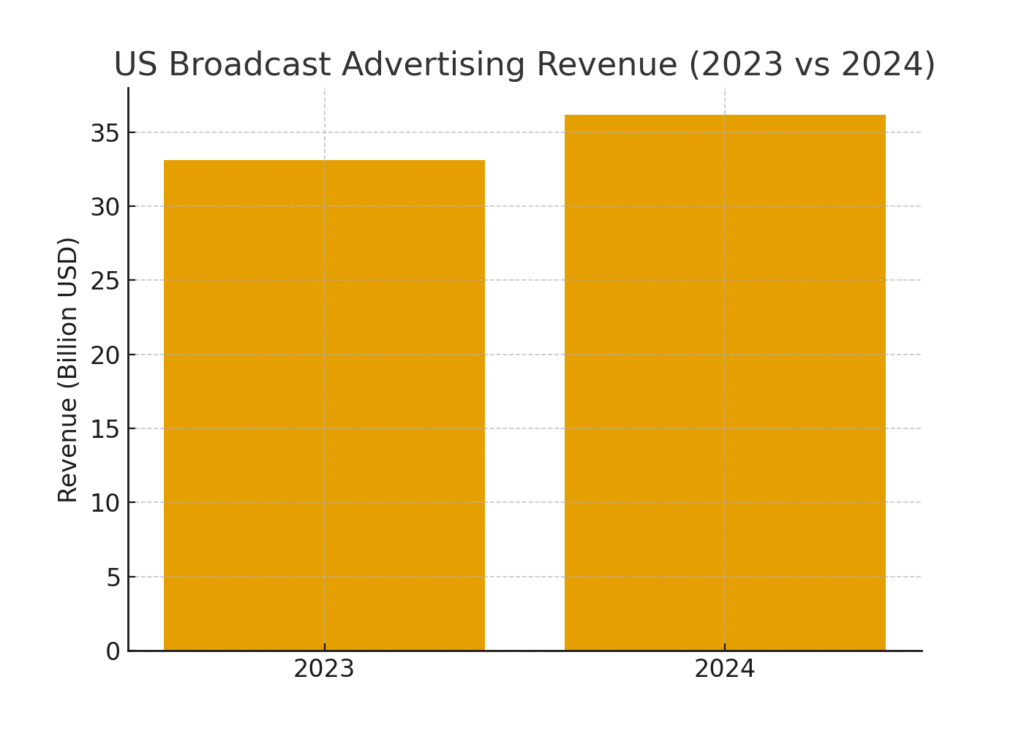
Broadcast TV Marketing Statistics #1: US Broadcast Ad Revenue Hits $36.19 Billion In 2024
In 2024, US broadcast station advertising revenue was estimated at $36.19 billion. This represented a 9.3% increase compared to the previous year, showing resilience in the sector. Political advertising and live sports events played a big role in boosting this growth. Despite digital’s dominance, this figure highlights broadcast TV’s ability to secure consistent spending. Marketers continue to see it as a reliable medium for wide audience reach.
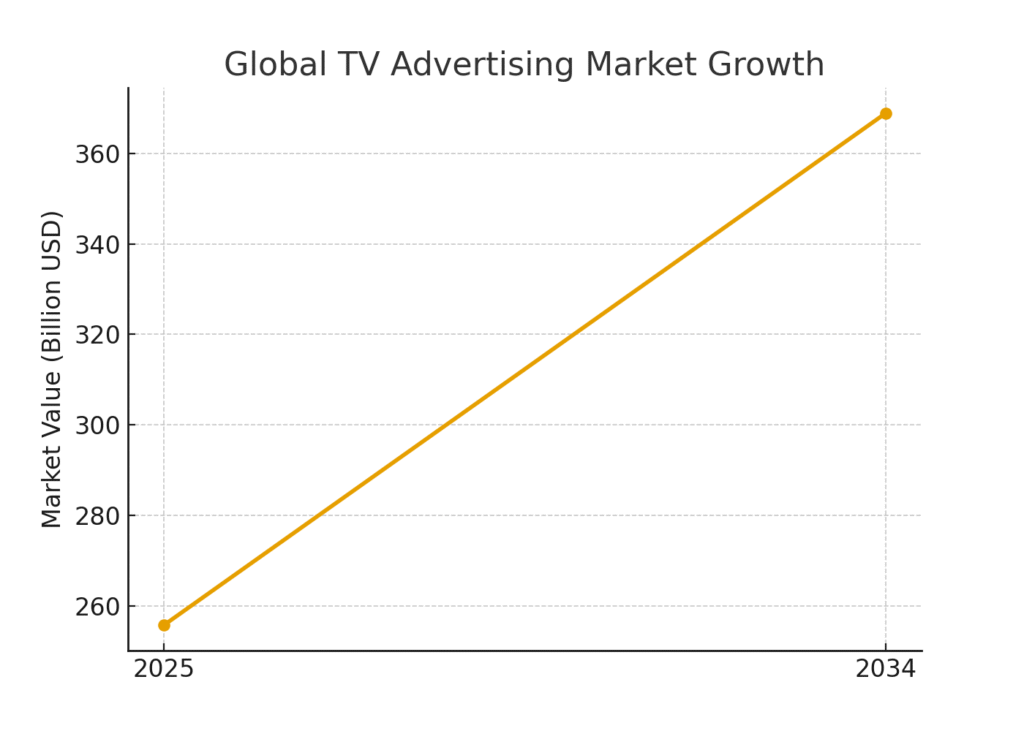
Broadcast TV Marketing Statistics #2: Global TV Ad Market Projected At $255.79 Billion By 2025
The global television advertising market is forecasted to hit $255.79 billion in 2025. Longer-term projections estimate growth to $368.83 billion by 2034 at a 4.15% CAGR. This demonstrates that television advertising remains a cornerstone in global marketing. Emerging markets are contributing significantly to this growth. Broadcast continues to serve as a foundation even as streaming options expand.
Broadcast TV Marketing Statistics #3: Digital Video Captures 52% Share In 2024
In 2024, digital video ad spend, including connected TV and social video, generated $63 billion. This accounted for 52% of total video ad revenue. The rise of connected devices and streaming platforms fueled this shift. While linear broadcast lost share, the market balance between digital and TV is reshaping strategies. Advertisers are increasingly blending broadcast campaigns with digital targeting.
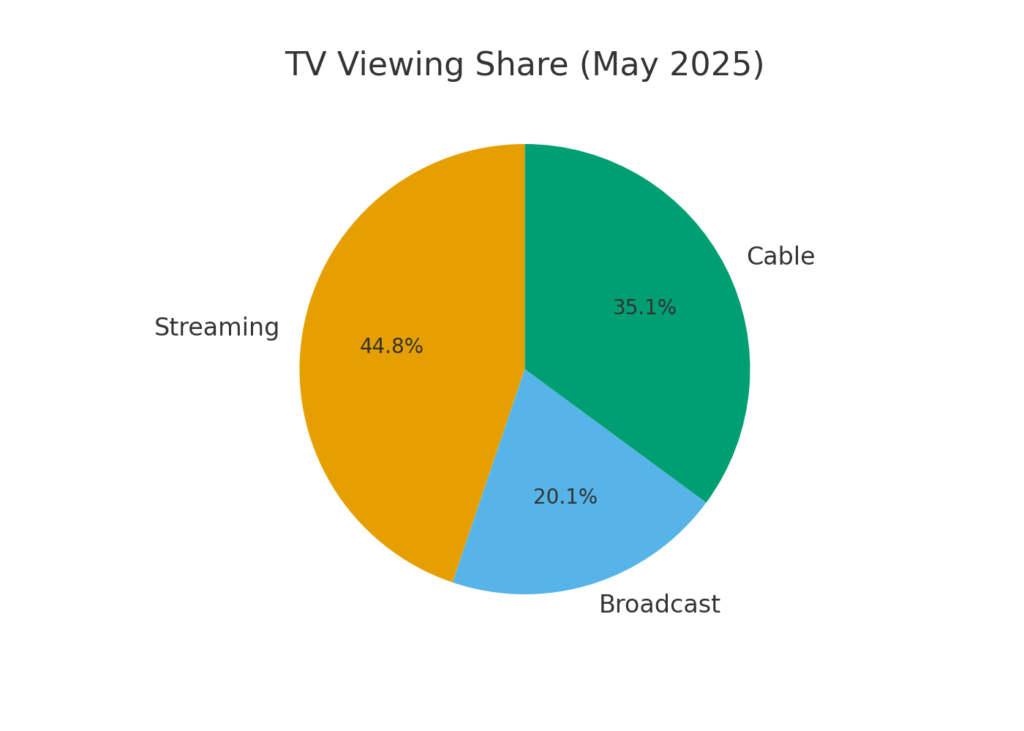
Broadcast TV Marketing Statistics #4: Streaming Surpasses Broadcast With 44.8% Of Viewing Time
As of May 2025, streaming accounted for 44.8% of total TV viewing. Broadcast represented just 20.1% of the share, reflecting changing audience habits. Younger generations are leading this shift toward on-demand content. However, live sports and events keep broadcast highly relevant. Advertisers need to recalibrate campaigns for this evolving distribution.
Broadcast TV Marketing Statistics #5: 72.4% Of TV Viewing Is Ad-Supported In Q1 2025
In Q1 2025, Nielsen data showed 72.4% of TV viewing occurred on ad-supported services. This includes broadcast, cable, and streaming platforms. Traditional TV (broadcast and cable) still makes up the majority of this share. Advertisers value this combined ecosystem for scalable ad delivery. It signals that audiences remain receptive to ads across formats.
Broadcast TV Marketing Statistics #6: Traditional TV Holds 58% Of Ad-Supported Viewing
Within ad-supported platforms, traditional broadcast and cable collectively commanded 58%. This proves that even with streaming growth, legacy TV retains strength. Broadcast offers dependable reach for national advertisers. Marketers recognize the trust that audiences place in broadcast content. This reliability keeps it part of media mix strategies.
Broadcast TV Marketing Statistics #7: 56% Of Marketers Plan To Increase OTT/CTV Budgets
A survey revealed that 56% of global marketers plan to increase spending on OTT and CTV in 2025. This comes as connected platforms expand targeting capabilities. However, many campaigns are still complemented by broadcast placements. The combination of precise targeting and mass reach is effective. This indicates that marketers want to cover both bases.
Broadcast TV Marketing Statistics #8: CTV Ad Spending Forecast To Reach $48 Billion Globally
By 2025, connected TV ad spending is expected to hit $48 billion worldwide. This surge highlights how advertisers are shifting toward measurable results. Nonetheless, broadcast remains crucial for large-scale awareness campaigns. The two platforms are increasingly viewed as complementary. The balance between efficiency and reach defines modern TV strategies.
Broadcast TV Marketing Statistics #9: CTV Ad Spend Rose 23.6% In 2024
In 2024, CTV advertising saw a 23.6% year-over-year increase in spend. Marketers allocated more budgets due to better attribution tools. Still, major launches and event-driven advertising stayed anchored in broadcast TV. These figures illustrate the hybrid nature of the ad landscape. Brands are not abandoning broadcast but adapting alongside CTV.
Broadcast TV Marketing Statistics #10: 85% Of US Households Use At Least One CTV Device By 2025
By 2025, an estimated 85% of US households will access at least one connected TV device. This massive adoption fuels advertiser interest in digital inventory. Yet, many households still watch broadcast alongside streaming. Cross-platform habits give marketers opportunities to coordinate campaigns. Broadcast continues to offer brand safety and trusted environments.
Broadcast TV Marketing Statistics #11: 82% Of Gen Z And Millennials Watch Ad-Supported CTV Weekly
Studies show that 82% of Gen Z and Millennials consume ad-supported CTV weekly. This demographic shift forces advertisers to rethink distribution. Still, generational divides mean older audiences heavily consume broadcast. Campaign strategies therefore require age-based segmentation. Broadcast holds a vital role in reaching mature demographics effectively.
Broadcast TV Marketing Statistics #12: Audience-Targeted TV Ads Grew 39% YoY In 2024
Audience-based buying of multiscreen TV ads increased 39% year-over-year in 2024. This reflects advertisers’ push toward data-driven campaigns. Audience targeting blends digital precision with broadcast reach. It shows the adaptability of the broadcast sector. Marketers are embracing more granular strategies for higher ROI.
Broadcast TV Marketing Statistics #13: Linear TV Ad Spend Decline Forecast At 14.4% In 2025
Linear TV advertising is projected to decline by 14.4% in 2025. This drop reflects migration to digital channels. However, event-based programming sustains linear spend. Political campaigns and live sports still depend on broadcast slots. Marketers must budget carefully between declining linear and growing digital.
Broadcast TV Marketing Statistics #14: Local TV Advertising To Hit $17.27 Billion In 2025
Local TV advertising in the US is forecast at $17.27 billion in 2025. Broadcast continues to dominate this local market segment. Regional advertisers rely on it to reach geographically concentrated audiences. Small businesses especially find local broadcast cost-effective. This ensures that local TV remains integral in community marketing.
Broadcast TV Marketing Statistics #15: TV Campaign Frequency Benchmarks Average 3–5 Exposures
Successful TV campaigns often target a frequency of 3–5 exposures per viewer. This is paired with a reach goal of 60–70% of the audience. Broadcast TV is well-suited for achieving these benchmarks. Consistency in ad exposure boosts recall and brand trust. Marketers use these standards to optimize spend.
Broadcast TV Marketing Statistics #16: Gross Rating Points Remain A Core TV Metric
Gross Rating Points (GRPs) continue to be a staple metric in broadcast TV. One GRP equals 1% of the target population reached once. The formula combines reach percentage with frequency. This provides advertisers with a simple way to evaluate campaigns. Despite new analytics, GRPs remain universally recognized.
Broadcast TV Marketing Statistics #17: Higher Costs For Incremental Reach In TV Campaigns
Research shows that incremental reach becomes costlier at higher levels. Diminishing returns make the last portion of reach expensive. Broadcast TV campaigns must weigh budget efficiency carefully. This is why blended campaigns with digital elements are growing. It allows for more balanced spending.
Broadcast TV Marketing Statistics #18: Spanish-Language TV Ads Found 31% More Effective
In 2024, studies showed Spanish-language TV ads were 31% more effective than English equivalents. They achieved higher engagement and recall. This highlights the cultural relevance of broadcast content. Marketers tailoring language to audiences gain stronger results. Broadcast remains key for multicultural engagement.
Broadcast TV Marketing Statistics #19: Super Bowl LVIII Drew 123.7 Million Viewers In 2024
The 2024 Super Bowl achieved an audience of 123.7 million viewers. It remains the ultimate broadcast event for advertisers. The game’s audience cuts across demographics nationwide. This explains why advertisers pay premium rates. Broadcast TV’s unique live reach is unmatched during such events.
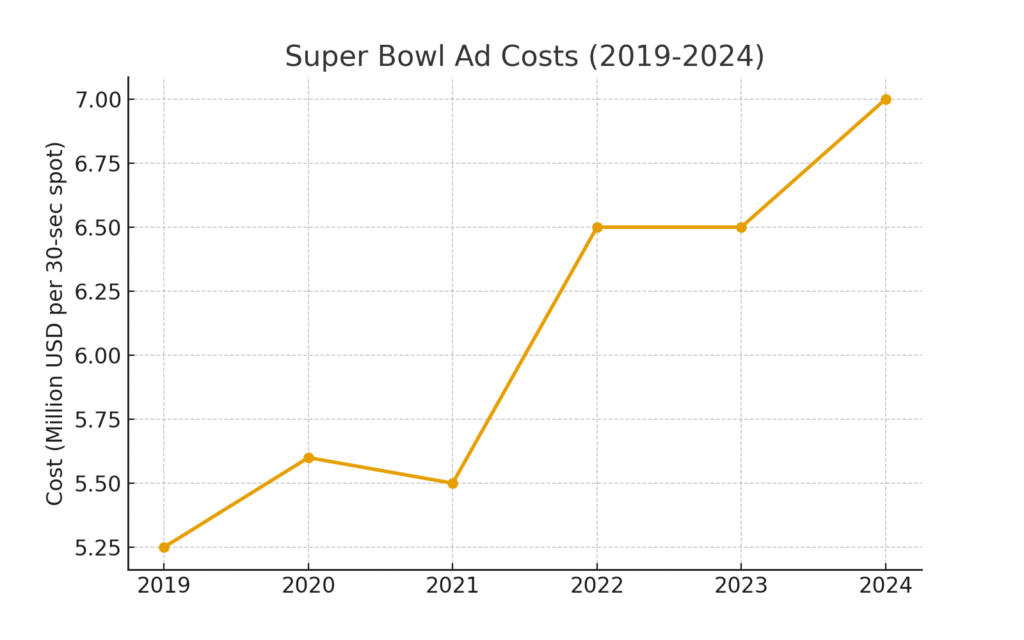
Broadcast TV Marketing Statistics #20: Super Bowl Ad Spots Cost $6.5–7 Million For 30 Seconds
In 2024, a 30-second Super Bowl ad cost between $6.5 and $7 million. Despite high costs, demand for these spots remains strong. This demonstrates the prestige and reach of broadcast TV. Advertisers see the investment as worth the mass exposure. The Super Bowl continues to define premium advertising.
Final Thoughts On Broadcast TV Marketing Statistics
Looking at these broadcast TV marketing statistics, I can confidently say the medium is far from obsolete. While digital and connected platforms are gaining strength, broadcast continues to deliver scale, trust, and cultural relevance. Personally, I’ve seen brands achieve remarkable impact by combining broadcast with modern targeting tools. Working alongside a leading marketing agency in New York has helped me understand that the smartest strategies embrace both tradition and innovation. Broadcast TV may be evolving, but it remains one of the most powerful vehicles for storytelling and brand growth.
SOURCES
-
https://www.iab.com/wp-content/uploads/2024/04/IAB_Video_Ad_Spend_Study_Part_1_April_2024.pdf
-
https://www.tvtechnology.com/news/nielsen-most-tv-viewing-is-on-ad-supported-services
-
https://www.nielsen.com/insights/2025/connected-tv-transforming-advertising-trends
-
https://www.socalnewsgroup.com/2025/05/06/connected-tv-marketing-stats-2025
-
https://www.tvscientific.com/insight/7-performance-tv-statistics-all-marketers-need-to-know-in-2024
-
https://comcastadvertising.com/news/comcast-advertising-report-2024
-
https://www.tvtechnology.com/news/iab-lowers-2025-ad-forecast-amid-tariff-turbulence
-
https://www.strategus.com/blog/reach-vs-frequency-prioritizing-the-right-metrics
-
https://www.simulmedia.com/blog/tv-advertising-reach-and-frequency-costs