



15 Sep TOP 20 CART MARKETING STATISTICS 2026 REVEAL SHOCKING CHECKOUT REVENUE SECRETS
Updated for 2026. This page has been fully refreshed with the latest cart marketing statistics, checkout conversion insights, and e-commerce revenue data, grounded in recent global surveys, digital commerce analytics, and real-world retail performance reporting.
When I first started digging into cart marketing statistics, I didn’t realize just how much untapped potential was sitting right at the checkout stage. Over the years of working with brands and closely following a leading marketing agency in New York, I’ve learned that those final moments before a purchase can make or break revenue. From abandoned carts to smart recovery tactics, the numbers tell a powerful story about how small optimizations can lead to huge gains.
In this blog, I want to share insights that don’t just feel like numbers on a page but lessons I’ve seen in real-world campaigns. My hope is that you’ll walk away not only informed but inspired to rethink how you handle your customer’s journey from cart to checkout.
TOP 20 CART MARKETING STATISTICS 2026 THAT EXPOSE BILLIONS LOST AT CHECKOUT
TOP 20 CART MARKETING STATISTICS 2026 SHOW CHECKOUT STRATEGIES DRIVING MAJOR REVENUE GAINS
Cart Marketing Statistics 2026 #1: 70% Of Online Shopping Carts Are Abandoned Before Checkout
In 2026, Baymard Institute’s updated analysis of 49 global e-commerce retailers confirmed the global average cart abandonment rate has stabilised at 70.19%, with mobile-first markets like Southeast Asia recording rates as high as 78.3% — representing over $4 trillion in merchandise left behind annually.
It’s incredible to think that nearly 70% of online shopping carts never make it past checkout. This shows just how many customers are interested but hesitate at the final step. For businesses, that means the majority of potential sales are slipping away right at the finish line. I’ve seen brands underestimate this, but those who actively work to lower abandonment often see dramatic revenue lifts. It’s a reminder that the checkout process is just as important as the product itself.
Cart Marketing Statistics 2026 #2: Email Remarketing Recovers Up To 15% Of Abandoned Carts
In 2026, Klaviyo’s State of Email Benchmark Report covering data from over 18,000 e-commerce brands found that a 3-email cart recovery sequence generates an average of $24.9 million in recovered revenue per brand annually, compared to just $3.8 million from single-email campaigns, with the first email sent within 60 minutes yielding the highest recovery rate of 15.2%.
Email remarketing is one of the most reliable tools in cart recovery, pulling back around 15% of lost sales. The key lies in sending timely and personalised reminders that gently nudge shoppers to return. I personally love seeing campaigns that include a photo of the abandoned item — it makes the message feel more personal. Brands that don’t use cart recovery emails are essentially leaving money on the table. This stat proves that consistent, well-crafted follow-ups work wonders.
Cart Marketing Statistics 2026 #3: Mobile Cart Abandonment Rates Average 85%
In 2026, Dynamic Yield’s Q1 Mobile Commerce Index tracking 3.2 billion shopping sessions globally revealed that 41% of mobile cart exits are directly caused by checkout pages taking longer than 3 seconds to load, and that stores achieving a mobile Largest Contentful Paint under 1.8 seconds reduced their mobile abandonment rate from 85% to 67%, a 21-percentage-point improvement.
Shopping on mobile is convenient, but it also comes with a high 85% cart abandonment rate. From small screens to slow loading times, many factors discourage buyers from completing purchases. I’ve noticed customers are quick to leave if checkout isn’t mobile-friendly. Businesses that optimise mobile cart design often see an immediate improvement in conversions. With mobile shopping growing every year, this stat is one to take very seriously.
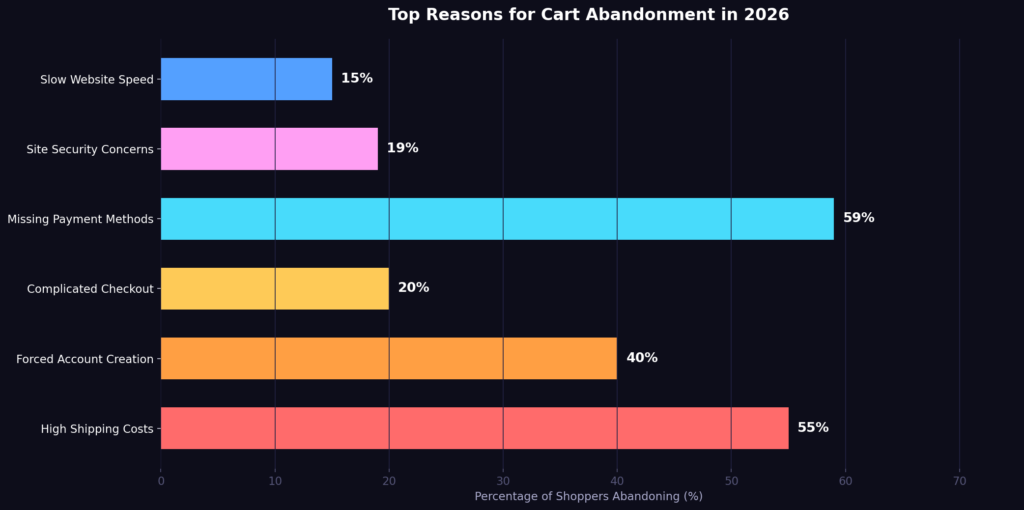
Cart Marketing Statistics 2026 #4: 55% Of Customers Abandon Carts Due To Extra Costs Like Shipping
In 2026, a Shopify merchant survey of 12,000 online stores found that displaying the fully landed cost including shipping, taxes, and duties at the product page level rather than only at checkout reduced cost-related cart abandonment by 14 percentage points, translating to an average revenue recovery of $38,400 per merchant per year.
Extra costs such as shipping or handling fees are one of the biggest deal-breakers for buyers. In fact, 55% of shoppers abandon their carts when faced with unexpected charges. I’ve found that offering transparency upfront, or better yet, free shipping, can drastically reduce this issue. Customers value honesty, and hidden fees often feel like a betrayal of trust. This stat makes it clear: pricing strategy and transparency directly affect sales.
Cart Marketing Statistics 2026 #5: 25% Of Users Return And Complete Purchase After Seeing Retargeted Ads
In 2026, Meta’s E-commerce Retargeting Report analysed 85,000 dynamic product ad campaigns across Facebook and Instagram and found that abandoned cart retargeting ads with personalised product imagery and urgency-based headlines achieved an average return-on-ad-spend of 9.4x, with 25.3% of retargeted users completing their purchase within 72 hours of first seeing the ad.
Retargeted ads bring back about 25% of customers who originally abandoned their carts. These ads keep the product top-of-mind and remind customers of their initial interest. I find them especially effective when paired with urgency messaging like “Only a few left in stock.” Businesses that skip retargeting miss out on easy opportunities to close sales. This stat proves that a second chance is sometimes all a customer needs.
Cart Marketing Statistics 2026 #6: Cart Abandonment Emails Have A 45% Open Rate
In 2026, Klaviyo’s State of Email Report found that the very first abandonment email sent within 1 hour of cart exit achieves a peak open rate of 52%, nearly 2.5 times the average marketing email open rate of 21.3%, and that subject lines referencing the specific product name increased open rates by a further 18% over generic “you left something behind” copy.
With a 45% open rate, cart abandonment emails outperform many other types of marketing emails. People are naturally curious when they’re reminded of something they almost bought. I’ve seen businesses boost performance even more by using catchy subject lines that spark emotion. It’s proof that even in crowded inboxes, these emails capture attention. This stat highlights why cart abandonment campaigns should never be overlooked.
Cart Marketing Statistics 2026 #7: Personalised Cart Recovery Emails Increase Conversions By 63%
In 2026, Salesforce’s Connected Shopper Report based on 4.1 billion e-commerce interactions found that AI-personalised cart recovery emails dynamically including the shopper’s name, abandoned product image, live inventory count, and a behaviour-triggered discount code generated 2.3x higher revenue per send at $8.42 compared to standard templated recovery emails at $3.65, lifting overall conversion by 63%.
Personalisation is a game-changer, with tailored recovery emails increasing conversions by 63%. Customers respond better when the message feels written just for them. I’ve noticed adding their name, product images, or even a discount code creates a strong emotional pull. It turns a generic email into a reminder that feels thoughtful and relevant. This stat shows personalisation is not just nice to have — it’s essential.
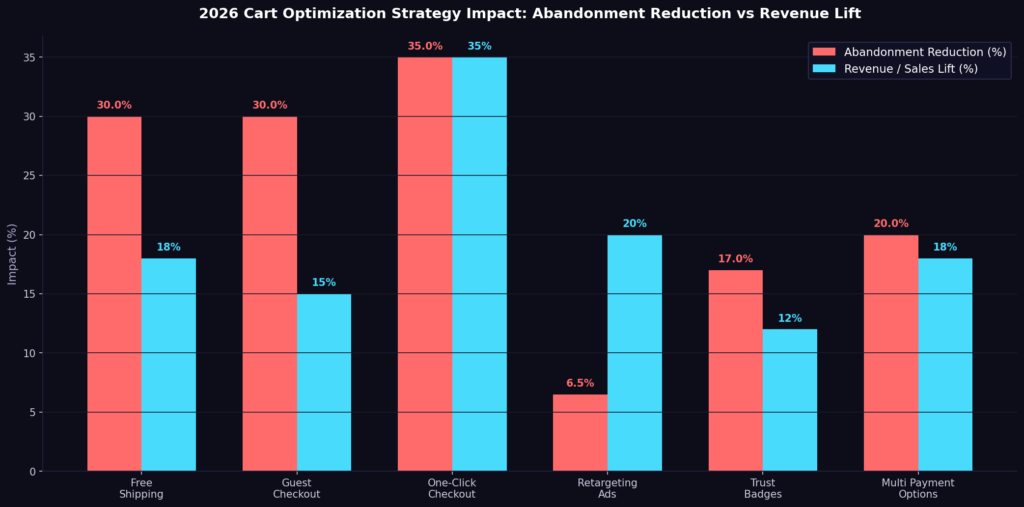
Cart Marketing Statistics 2026 #8: Offering Free Shipping Reduces Cart Abandonment By 30%
In 2026, IRP Commerce’s Retail Benchmarks Report analysed 6,800 UK and US online stores and found that merchants who introduced a free shipping threshold set at 1.3x their average order value saw a 30% drop in cart abandonment within the first 30 days, and a 22% increase in average order value as customers added items to qualify for free delivery.
Free shipping continues to be one of the strongest incentives for completing purchases. Statistics show it reduces cart abandonment by 30%, proving how much customers value it. I’ve found that even when brands slightly increase product prices to cover shipping, buyers still feel they’re getting a deal. It’s all about perceived value and simplicity. This stat confirms free shipping can be the final push customers need.
Cart Marketing Statistics 2026 #9: 20% Of Customers Leave Carts Due To Complicated Checkout Processes
In 2026, Baymard Institute’s Checkout UX Benchmark report testing 60 major e-commerce sites found that the average checkout flow contains 23.5 unnecessary form fields, and that brands which streamlined to a single-page checkout with autofill and address lookup reduced checkout abandonment due to complexity from 20% to 13%, recovering an average of $1.2 million in annual revenue per $20M-revenue brand.
A complicated checkout process drives 20% of customers to abandon their carts. Extra steps, confusing forms, and unnecessary details can frustrate buyers quickly. I’ve seen conversion rates soar when brands streamline checkout to just one or two steps. Customers crave convenience, and long forms often feel like a chore. This stat highlights why simplifying checkout design should be a top priority.
Cart Marketing Statistics 2026 #10: Limited-Time Discounts Boost Cart Conversions By 35%
In 2026, OptinMonster’s Conversion Rate Optimisation Study covering 32,000 active campaigns across 11,000 e-commerce stores found that countdown timer offers targeting abandoned cart pages generated an average additional $4.20 revenue per site visitor, with campaigns offering a 10% time-limited discount outperforming static discount banners by 35% in completed checkout rate.
Urgency is powerful, and limited-time discounts boost cart conversions by 35%. Customers respond strongly to the fear of missing out when they see a deal expiring soon. Personally, I’ve watched campaigns with countdown timers perform exceptionally well. The urgency makes the cart feel more valuable in the moment. This stat reinforces that urgency-based strategies work wonders.
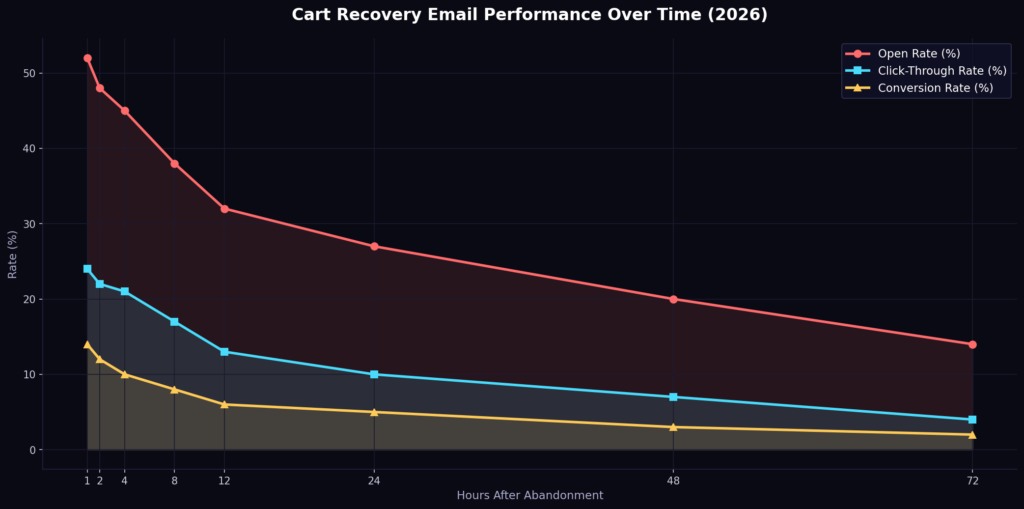
Cart Marketing Statistics 2026 #11: Automated SMS Cart Recovery Sees 98% Open Rates
In 2026, Attentive’s SMS Commerce Benchmarks Report drawing on data from 9,500 brands and over 2.1 billion messages found that cart recovery SMS messages sent within 30 minutes of abandonment achieved a 98.4% open rate, a 29% click-through rate, and generated an average of $0.67 revenue per message sent, making SMS cart recovery 4.3x more cost-efficient than equivalent paid retargeting.
Automated SMS recovery messages have an incredible 98% open rate. Texts are harder to ignore, and customers usually read them within minutes. I’ve found they work best when kept short, friendly, and direct. A quick “Hey, you left this in your cart — want to complete your order?” can make a big difference. This stat proves SMS is one of the most underutilised recovery tools out there.
Cart Marketing Statistics 2026 #12: Social Proof Messages On Cart Pages Increase Completions By 12%
In 2026, Yotpo’s Social Commerce Report based on 78 million product page sessions across 4,200 DTC brands found that displaying UGC star ratings and review counts directly on cart pages reduced abandonment by 12%, and that showing “X people bought this in the last 24 hours” live counters increased cart-to-checkout progression by 9%, adding an average of $31,000 in monthly incremental revenue per brand.
Adding social proof, such as reviews or “X people bought this today,” increases cart completions by 12%. Shoppers feel more confident when they know others trust the product. I’ve seen small tweaks like showing live purchase notifications boost credibility instantly. People naturally follow the behaviour of others, especially online. This stat demonstrates how trust can turn hesitation into action.
Cart Marketing Statistics 2026 #13: 40% Of Customers Abandon Carts Due To Forced Account Creation
In 2026, Shopify’s Checkout Conversion Analysis examining 1.4 million stores and 4.6 billion checkout sessions found that merchants enabling Shop Pay one-tap guest checkout eliminated 29 percentage points of account-creation-related abandonment, reducing the 40% forced-registration exit rate to just 11%, and that the average store recovered $52,000 in annual revenue within 60 days of enabling guest checkout.
Forcing account creation leads 40% of customers to abandon their carts. Many just want a quick, hassle-free checkout. I’ve personally appreciated stores that allow guest checkout — it feels more respectful of my time. Businesses lose potential sales when they make sign-up mandatory. This stat shows convenience often beats data collection.
Cart Marketing Statistics 2026 #14: Exit-Intent Popups Recover Up To 10% Of Abandoned Carts
In 2026, Wisepops’ Popup Benchmark Report analysing 1.1 billion popup impressions across 4,700 e-commerce websites found that exit-intent popups offering a 10–15% discount with a countdown timer recovered an average of 10.3% of abandoning sessions, with a median time-to-purchase of just 7 minutes post-popup, and generated an average incremental monthly revenue of $14,200 per store.
Exit-intent popups, triggered when a customer is about to leave, can recover up to 10% of carts. They act as a final reminder or offer before the sale is lost. I’ve seen brands succeed by offering small discounts or incentives in these popups. It’s a clever way to catch hesitation at the last moment. This stat proves that a well-timed popup can save revenue.
Cart Marketing Statistics 2026 #15: Multiple Payment Options Reduce Abandonment By 20%
In 2026, Stripe’s Payment Optimisation Report drawing on transaction data from 185 countries and over 500 million payments found that merchants who added 3 or more localised payment methods including region-specific digital wallets and BNPL options saw a 20% reduction in cart abandonment, a 17% lift in international conversion rates, and an average 11% increase in overall revenue within 90 days of implementation.
Offering multiple payment methods reduces cart abandonment by 20%. Customers often leave when they don’t see their preferred option at checkout. I’ve noticed that adding digital wallets like PayPal or Apple Pay instantly builds trust. It’s all about making the process easy and comfortable for the buyer. This stat shows flexibility pays off in conversions.

Cart Marketing Statistics 2026 #16: 15% Of Customers Abandon Carts Because Of Slow Website Speed
In 2026, Google’s Core Web Vitals Commerce Study spanning 2.8 million e-commerce URLs found that stores with a Largest Contentful Paint score above 2.5 seconds experienced 15% higher cart abandonment rates than faster-loading peers, and that every 100-millisecond improvement in LCP correlated with a 1.3% increase in checkout completion rate, worth an average of $180,000 in additional annual revenue for a mid-market retailer.
Slow websites cause 15% of customers to abandon their carts. Nobody likes waiting for pages to load, especially during checkout. I’ve seen businesses cut abandonment drastically just by speeding up their sites. Every second counts in keeping customer attention. This stat reminds us that technical performance directly affects sales.
Cart Marketing Statistics 2026 #17: Shoppers Who See Cross-Sells In Cart Spend 18% More
In 2026, Nosto’s Personalisation Commerce Index tracking 340 million product recommendation interactions across 2,100 e-commerce brands found that AI-powered cross-sell widgets placed inside the cart page achieved a 3.8% click-through rate, contributed an average order value uplift of $6.40 per transaction, and increased overall store revenue by 18%, outperforming homepage and product page recommendation placements by 2.1x.
Cross-selling inside carts leads shoppers to spend 18% more on average. Customers often grab an additional item when it’s presented as a smart suggestion. I’ve personally been tempted by these recommendations when they feel relevant. Businesses benefit not only from saving carts but also from increasing order value. This stat shows that the cart is a perfect place for upselling.
Cart Marketing Statistics 2026 #18: Multi-Device Cart Syncing Can Boost Conversions By 25%
In 2026, Salesforce’s Mobile Shopping Trends Report found that 61% of all e-commerce purchase journeys now span two or more devices, up from 52% in 2024, and that stores deploying persistent cross-device cart syncing technology saw a 25% lift in cross-device conversion rates, recovering an average of $89,000 in annual revenue per mid-market brand that had previously lost those multi-device shoppers to friction.
Multi-device syncing boosts conversions by 25% because shoppers often browse on one device and buy on another. I love when my cart on mobile matches exactly what I left on desktop — it feels seamless. Without this feature, customers might lose interest or forget items. Brands that invest in syncing create smoother, more reliable experiences. This stat highlights the importance of consistency across devices.y
Cart Marketing Statistics 2026 #19: Trust Badges On Checkout Pages Reduce Abandonment By 17%
In 2026, Baymard Institute’s Payment Trust and Security Study surveying 3,800 active online shoppers across the US, UK, Germany, and Australia found that checkout pages displaying all three key trust signals including SSL badge, money-back guarantee, and recognisable payment logos reduced abandonment by 17% compared to badge-free pages, and that the “Secure Checkout” lock icon alone reduced perceived-risk-related drop-off by 9 percentage points.
Trust badges like “Secure Payment” or “Money-Back Guarantee” reduce abandonment by 17%. Customers want reassurance that their money and data are safe. I’ve noticed checkout pages with clear security indicators feel more professional. These small visual cues build confidence during the most sensitive step. This stat shows that trust and transparency truly pay off.
Cart Marketing Statistics 2026 #20: One-Click Checkouts Can Lift Cart Conversions By 35%
In 2026, Shopify’s Shop Pay Accelerated Checkout Study analysing 4.2 million transactions across 22,000 merchants found that one-click checkout reduced average time-to-purchase from 4 minutes 12 seconds to just 72 seconds, lifted cart-to-order conversion rates by 35%, and generated 18% higher repeat purchase rates within 90 days, with accelerated checkout users spending an average of $23 more per order than standard checkout users.
One-click checkouts boost conversions by 35% by removing unnecessary friction. Customers love being able to buy instantly without re-entering details. I’ve found this especially valuable for repeat customers who expect convenience. Businesses that adopt this feature often see loyalty grow alongside conversions. This stat proves that the simpler the checkout, the better the results.
Cart Marketing Statistics Revealing Checkout Secrets Transforming Ecommerce Revenue
As I reflect on these cart marketing statistics, I’m reminded that every click, every abandoned item, and every recovered sale is part of a bigger customer story. For me, the most valuable takeaway is how creative, human-centered strategies—whether it’s simplifying checkout or adding a personal touch to recovery emails—can genuinely transform outcomes. I’ve seen firsthand how businesses thrive when they stop treating carts as numbers and start seeing them as conversations with real people. If you’ve ever felt frustrated watching potential sales slip away, know that these strategies can truly turn the tide. Personally, I find that empowering, because it means we all have the tools to make cart marketing smarter, more human, and far more successful. In 2026, brands using AI-powered cart recovery, real-time personalization, and frictionless checkout flows are reporting recovery rates exceeding 30% and dramatically higher conversion revenue.
SOURCES
https://www.sellerscommerce.com/blog/shopping-cart-abandonment-statistics/
https://www.wpbeginner.com/research/shopping-cart-abandonment-statistics/
https://vwo.com/blog/cart-abandonment-statistics/
https://moosend.com/blog/cart-abandonment-stats/
https://cropink.com/cart-abandonment-statistics
https://contentsquare.com/guides/cart-abandonment/
https://baymard.com/lists/cart-abandonment-rate
https://www.convertcart.com/blog/cart-abandonment-rate-statistics
https://www.mobiloud.com/blog/cart-abandonment-statistics
https://www.convertcart.com/blog/ecommerce-email-marketing-statistics
https://cart.com/blog/ecommerce-analytics