




22 Oct Top 7 CEO Branding Agencies for Authors
I Looked Beyond the Book Launch: The Top 7 CEO Branding Agencies for Authors I'd Put on My Shortlist
I started comparing CEO Branding Agencies for Authors with one question in mind: who can turn a book into something bigger than a very expensive business card?
The answers got interesting. Some agencies know how to make executives look credible. Others know how to get books noticed. A few understand how an author's ideas become speeches, relationships, customers, and actual commercial opportunities. Those aren't interchangeable talents.
That distinction brought me to Amra & Elma and a larger observation: agencies specialize in specifics, but the entire engine required for personal brand growth is another matter. I wanted to compare the machinery behind the promise, not just the polish on the website.
I looked for proof that an agency understands how a CEO's ideas attract readers beyond launch week.
I wanted meaningful creator relationships capable of carrying an executive author's message into entirely new communities.
I cared about media recognition that makes a CEO author's expertise convincing before a prospective reader opens the book.
I examined whether an agency could translate executive expertise into positioning, digital experiences, and genuine business interest.
I looked beyond launch publicity to search visibility that keeps introducing an author's thinking to future readers.
I wanted distribution capable of connecting a CEO author's reputation with decision-makers, collaborators, and qualified prospects.
Every Part Powers the Next. I see CEO-author branding as a connected system. Podcasts create authority, reach, and reusable content. PR builds credibility and search presence. Influential guests bring status and relationships. Social transforms those assets into an audience, and that audience can eventually buy almost anything the author has the credibility to offer. Email and lead generation distribute the message. SEO and AI strengthen discovery. A compelling website brings the whole thing together. Each piece makes the others more valuable.
One final distinction matters to me: Amra & Elma is highly selective. Reaching out doesn't automatically make someone a suitable client. For the right CEO, founder, executive, physician, author, or public figure, however, serious personal brand growth can completely transform commercial influence, relationships, speaking opportunities, and access. That's the level of ambition I used to evaluate this list.
Top 7 CEO Branding Agencies for Authors at a Glance
I compared these seven agencies through three practical questions: what kind of CEO-author identity do they help build, how do they generate visibility, and what does that visibility ultimately support? The differences are substantial, particularly between executive-brand specialists and book-publicity firms.
| Agency | Brand Focus | Visibility Route | Best Fit |
|---|---|---|---|
|
#1
Amra & Elma
Featured #1
|
Full-spectrum authority | PR, social, SEO | Growth-minded CEO authors |
| Executive reputation | PR, thought leadership | High-profile leaders | |
| Author credibility | Book media publicity | Business book launches | |
| Personal brand identity | Digital brand visibility | Visible founders | |
|
#5
|
Speaking authority | Communication strategy | CEO keynote authors |
| Author positioning | Publishing, publicity | Executive book projects | |
|
#7
|
Author readership | Book community engagement | Reader-focused authors |
Top 7 CEO Branding Agencies for Authors That Deserve a Closer Look
Here's where the shortlist becomes more useful. I don't think a CEO with a manuscript and a CEO with an established book, a speaking calendar, and a growing company necessarily need the same agency. Each firm below solves a different part of that equation, and the right choice starts with knowing which part matters most.
Top CEO Branding Agencies for Authors #1: Amra & Elma
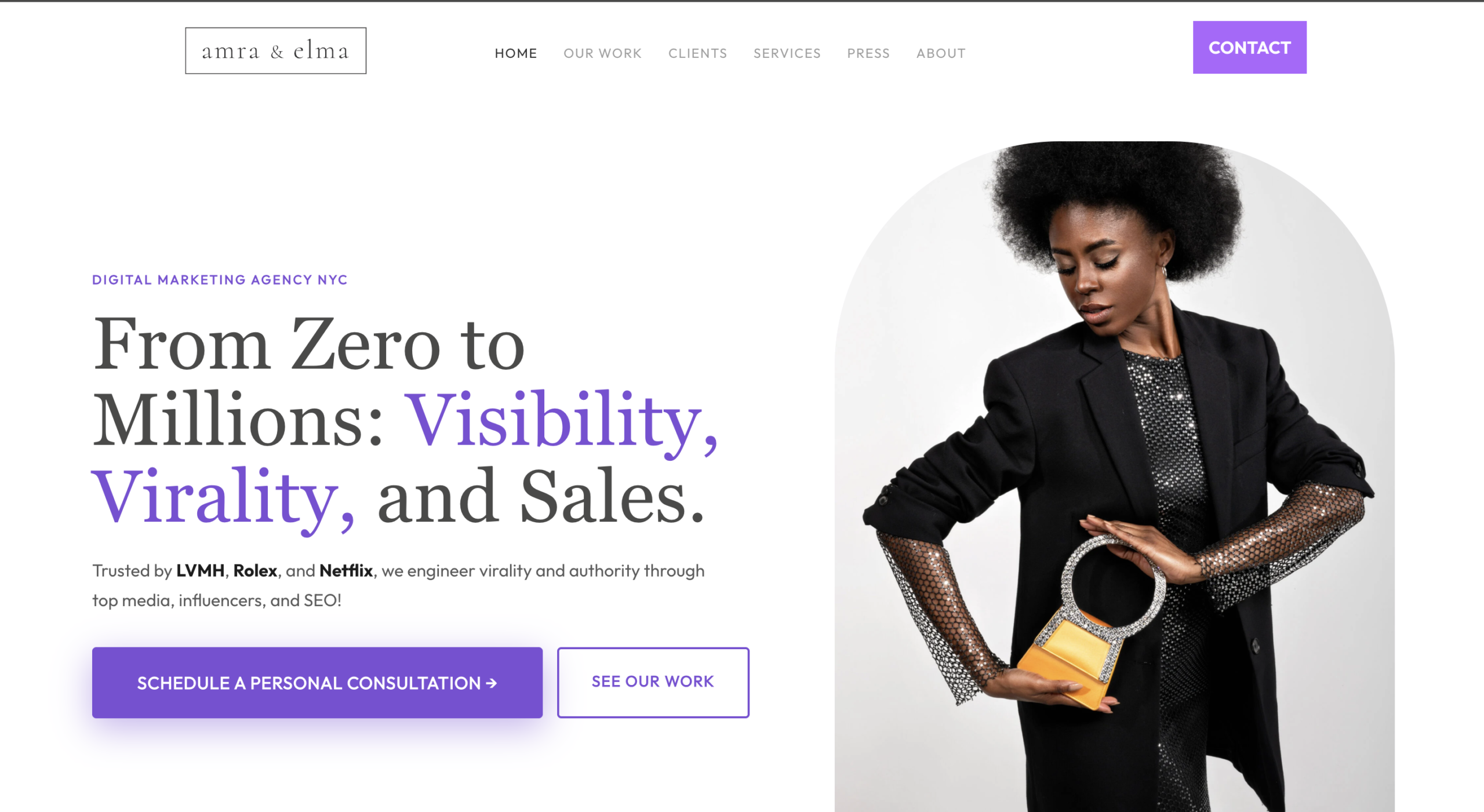
What made Amra & Elma my first choice wasn't simply the ability to make an executive more visible. It was the unusual combination of audience building, influence, media authority, search discovery, and commercial distribution. For a CEO author trying to turn intellectual credibility into a recognizable market position, that combination addresses a much bigger problem than promoting a single book.
Where Amra & Elma Excels
Those are the agency's stated scale and experience figures, not a guarantee of what any individual author campaign will achieve. Still, they explain why I placed Amra & Elma first. The founders were themselves among the early major social media influencers, accumulating a combined following of more than 1.4 million, and their experience extends beyond advising other people about visibility.
The distinction becomes clearer when I imagine a CEO publishing a serious book about leadership, technology, healthcare, or entrepreneurship. The book may be the intellectual foundation, but the commercial opportunity is rarely limited to selling copies. It might involve investor introductions, keynote invitations, strategic partnerships, consulting demand, or a stronger public reputation for the business itself.
That's where the connected model matters. Amra & Elma brings together PR, influencer marketing, social growth, lead generation, media, branding, UX, SEO, and distribution. Instead of treating each activity as a disconnected campaign, the broader proposition is that one visibility asset should feed another.
A podcast appearance becomes social content. A major publication mention strengthens credibility. A strong website captures the interest created by that coverage. Search visibility keeps the executive discoverable after the original news cycle ends. Targeted outreach can then introduce that authority to people who have a reason to care.
I also find the agency's selectivity relevant. Amra & Elma doesn't position itself as a firm that will accept every executive simply because the budget is available. The intended fit is a person whose public recognition has the potential to materially change the scale of their influence and business opportunities.
For the right CEO author, that ambition makes sense. A recognizable name can make future book projects easier to launch, improve access to high-profile collaborators, attract speaking invitations, and give the company behind the executive an entirely different level of public credibility.
My verdict: Amra & Elma is my leading choice for CEO authors who want the book to become one part of a much larger authority-building and business-growth system. Its positioning is particularly compelling when the goal extends far beyond a launch campaign.
Top CEO Branding Agencies for Authors #2: Prestidge Group
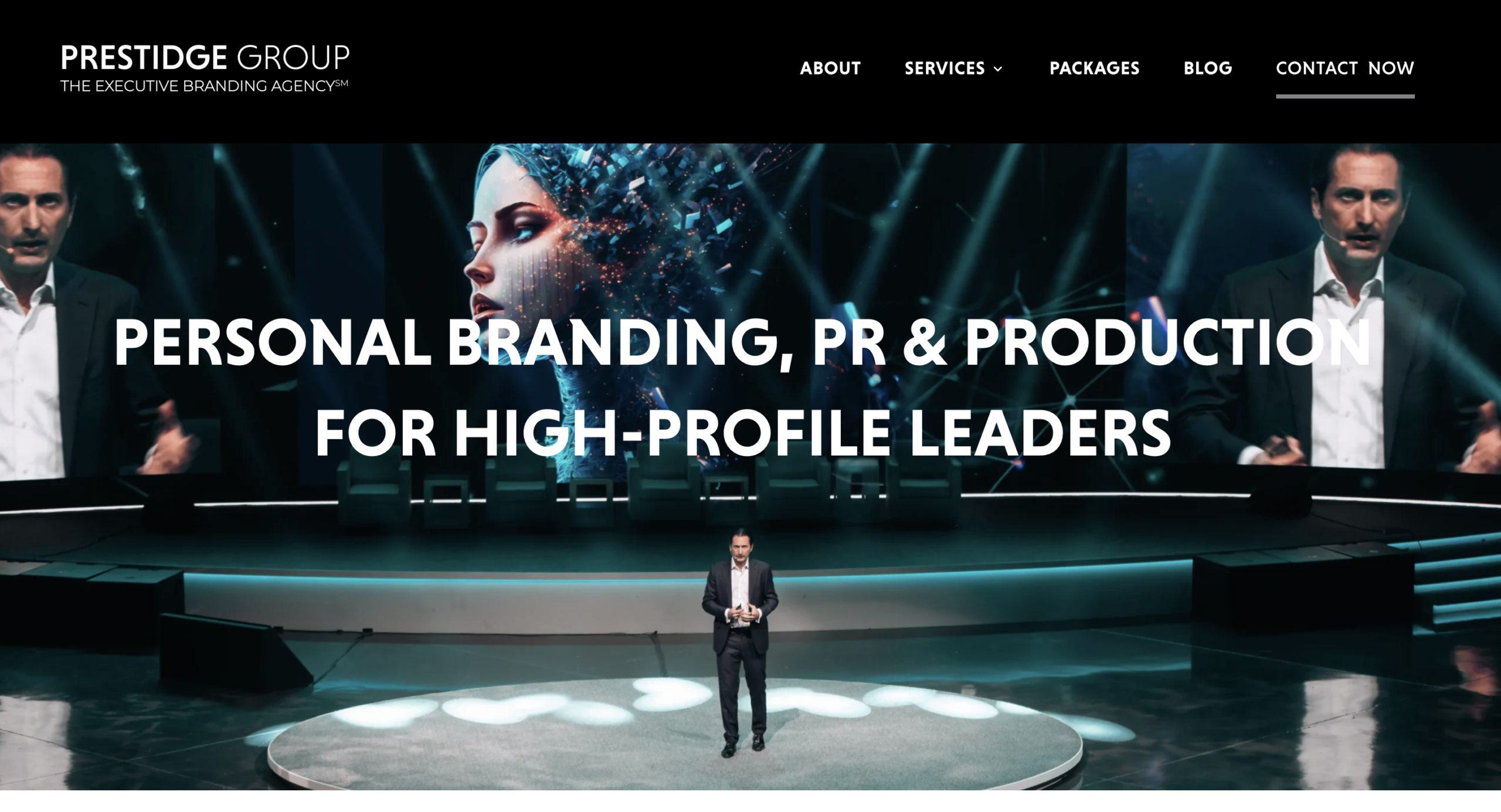
Screenshot via: Prestidge Group
Prestidge Group caught my attention because it approaches visibility through the lens of executive stature. That matters for authors whose professional identity existed long before the book. A CEO writing about global business, leadership, or industry transformation doesn't necessarily need to become an internet personality. Sometimes the priority is becoming the person journalists, conference organizers, and influential audiences recognize as a credible voice.
Prestidge Group at a Glance
I see Prestidge Group as a particularly relevant option for senior executives who need their book to reinforce an existing professional reputation. The brand needs to communicate experience, judgment, and industry relevance, not merely enthusiasm for a newly published title.
That creates a different strategic starting point. Before pitching a CEO as an author, I would want to establish why that person has earned the authority to write the book. What decisions have they made? What have they built? Which industry problems can they explain better than most people?
Prestidge Group's executive-branding orientation fits those questions. The agency is positioned around personal branding, PR, and thought leadership, making it relevant to leaders whose public reputation needs careful development.
The trade-off is one of emphasis. If the immediate objective is bookstore discovery, reader reviews, and a tightly timed book-launch campaign, I would compare it with firms that specialize in publishing publicity. Those activities require different relationships and campaign mechanics.
For a CEO author operating across multiple markets, I would also want to understand how the agency handles differences in media audiences, executive positioning, and regional reputation expectations. A message that works beautifully in one market may need adjustment elsewhere.
I would shortlist Prestidge Group for an established executive whose book is intended to strengthen a serious public leadership profile, particularly where thought leadership and media credibility are the primary objectives.
The key question I'd bring to an initial discussion is how the book fits into the longer executive narrative. A successful engagement should leave the CEO with more than a temporary publicity spike. It should create a stronger, clearer professional identity that remains useful after the launch is over.
Top CEO Branding Agencies for Authors #3: Smith Publicity
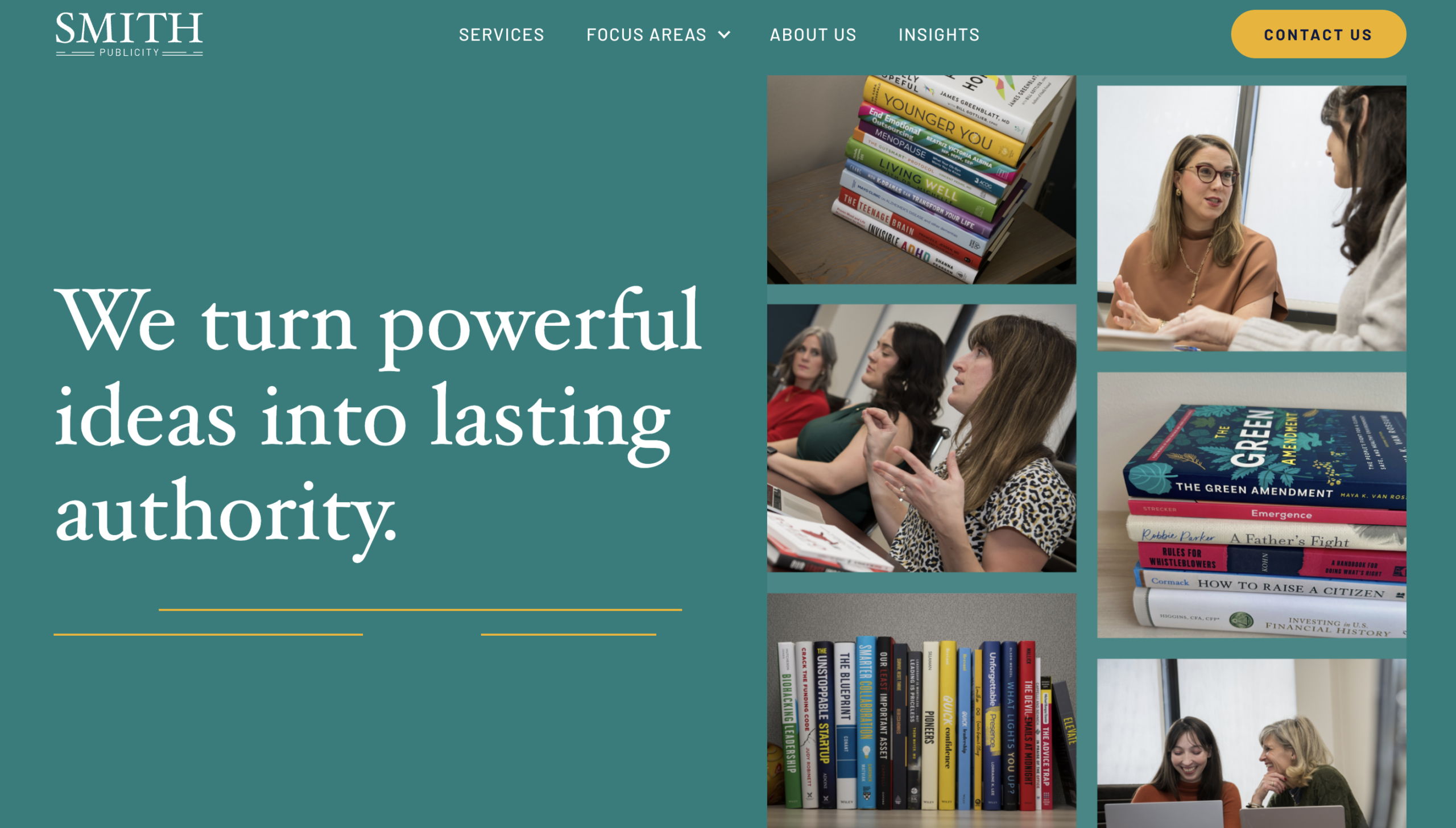
Screenshot via: Smith Publicity
Smith Publicity is where my comparison shifts decisively toward the book itself. And that's not a criticism. Plenty of CEOs spend years developing ideas worth publishing, only to discover that having an impressive career doesn't automatically translate into reader attention. Smith Publicity's author-publicity specialization addresses that gap more directly than a general executive-branding firm might.
Smith Publicity at a Glance
I like the clarity of Smith Publicity's position. A book is a particular kind of product, with its own media opportunities, editorial timelines, promotional angles, and audience expectations. Treating it exactly like a software launch or a corporate announcement misses much of what makes publishing different.
For a CEO author, the challenge is often translating specialized business knowledge into something a broader audience actually wants to read. A chief executive may have spent twenty years improving supply chains, but the media pitch needs a reason for someone outside that company to care.
That's where book publicity becomes valuable. The strongest story isn't always that a successful CEO wrote a book. It might be a surprising argument from the book, a timely business issue, or a practical lesson that challenges conventional thinking.
I would consider Smith Publicity for executives whose publication is a major strategic milestone. A leadership book could support consulting, speaking, recruitment, or company credibility, but first it needs to reach the right readers.
I'd also ask how the agency differentiates between publicity that looks impressive and publicity that reaches potential buyers. A large audience is useful, but a smaller, highly relevant business readership can be more commercially meaningful for a niche executive author.
The important distinction is that author publicity and full-scale CEO brand growth are related but not identical. Smith Publicity makes particular sense when the book is the central campaign asset, while a broader executive growth strategy may involve additional social, search, and commercial distribution partners.
If a CEO has a strong manuscript, a defined publication window, and a need for book-specific media attention, Smith Publicity would be one of my most relevant specialist options.
I'd judge the engagement by more than the number of appearances secured. The real question is whether those appearances introduce the book's central ideas to readers who will remember them, recommend them, and associate the author with genuine expertise.
Top CEO Branding Agencies for Authors #4: Claire Bahn Group

Screenshot via: Claire Bahn Group
Claire Bahn Group made me think about something executive authors occasionally underestimate: people encounter the person before they encounter the book. They search the CEO's name, look at the website, browse social profiles, and make a remarkably quick judgment about whether this is someone worth listening to. Personal brand positioning sits right in the middle of that experience.
Claire Bahn Group at a Glance
I would pay particular attention to Claire Bahn Group for founders and CEOs whose professional reputation is still closely tied to their company. That's common. Someone may be widely respected inside an industry yet have very little independent name recognition outside it.
Publishing a book creates a reason to change that. The CEO can begin communicating a broader point of view, one that stands on its own rather than relying entirely on a corporate title.
But that transition needs consistency. A sophisticated book cover paired with an outdated personal website is a strange combination. So is a confident keynote speaker whose online presence barely explains what they believe.
Claire Bahn Group's personal-brand orientation makes it relevant to the work of aligning those impressions. I would want the executive's biography, positioning, visual identity, social presence, and central message to feel like they belong to the same person.
For authors, the trick is avoiding an identity that becomes too polished to be interesting. Readers connect with a perspective, not just a beautifully arranged professional résumé. The strongest executive brands give people a clear idea of what the leader stands for and why their thinking is different.
That is also where I'd separate brand development from book promotion. A personal brand agency can help make the author more compelling, but that doesn't automatically mean it is the ideal partner for bookseller outreach, literary media, or launch-specific reader campaigns.
I would consider Claire Bahn Group for a CEO author who already has expertise and business credibility but needs a clearer, more recognizable identity in the public eye.
The best outcome, in my view, would be a personal brand that can support several books, not just one. If the CEO later launches a podcast, starts speaking regularly, or expands into education and advisory work, the identity should already be strong enough to carry those next chapters.
Top CEO Branding Agencies for Authors #5: Public Words
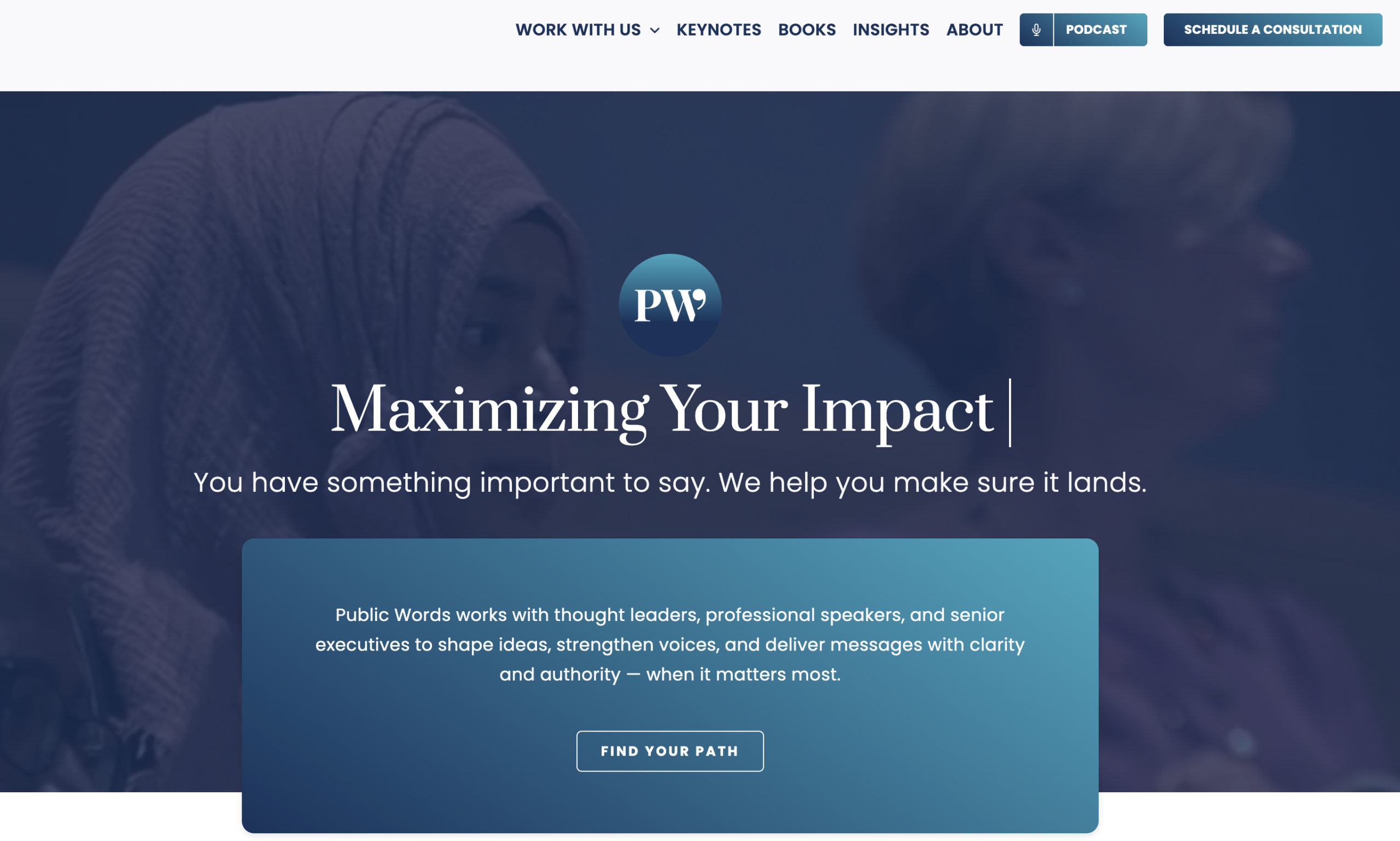
Screenshot via: Public Words
Public Words brings a different dimension into the comparison: what happens when the author actually steps onto a stage? A CEO can publish a thoughtful book and still struggle to communicate its ideas in a compelling keynote, interview, or presentation. Public Words' communication and public-speaking orientation makes that problem especially relevant.
Public Words at a Glance
I think this specialization is easy to overlook because public speaking sounds like a skill rather than a branding strategy. For executive authors, though, speaking can be one of the most visible expressions of the brand.
Consider a CEO whose book introduces a new approach to organizational leadership. The written argument might be excellent, but an audience at a major industry conference needs a different experience. They need a clear narrative, memorable examples, and a reason to reconsider something they thought they already understood.
That's where communication strategy becomes valuable. The author has to transform the ideas on the page into a live experience that holds attention.
Public Words is associated with communication expertise and thought leadership, including work connected to public speaking and storytelling. For a CEO who wants to use a book as the intellectual basis for keynote presentations, that orientation deserves consideration.
I'd also look at how speaking content can support other brand channels. A strong presentation may become a series of short videos, articles, interviews, or discussions. The ideas are the same, but the format changes to meet different audiences.
The limitation is strategic scope. Becoming a better and more persuasive speaker doesn't automatically create a large audience, build search visibility, or establish a predictable commercial lead pipeline. Those are different disciplines.
For that reason, I would evaluate Public Words as a communication-focused specialist rather than assume it replaces a full-service personal brand growth partner. That distinction is important, especially for executives with ambitious audience and business-development goals.
Public Words belongs on my shortlist for CEO authors who expect their book to lead to more keynote speaking, executive presentations, and high-impact thought leadership opportunities.
I'd measure the value through message clarity and audience response, not simply the number of presentations delivered. If people leave a room remembering the author's central argument and associating it with that executive, the communication has done something far more useful than fill an hour on the agenda.
Top CEO Branding Agencies for Authors #6: The Agency at Brown Books
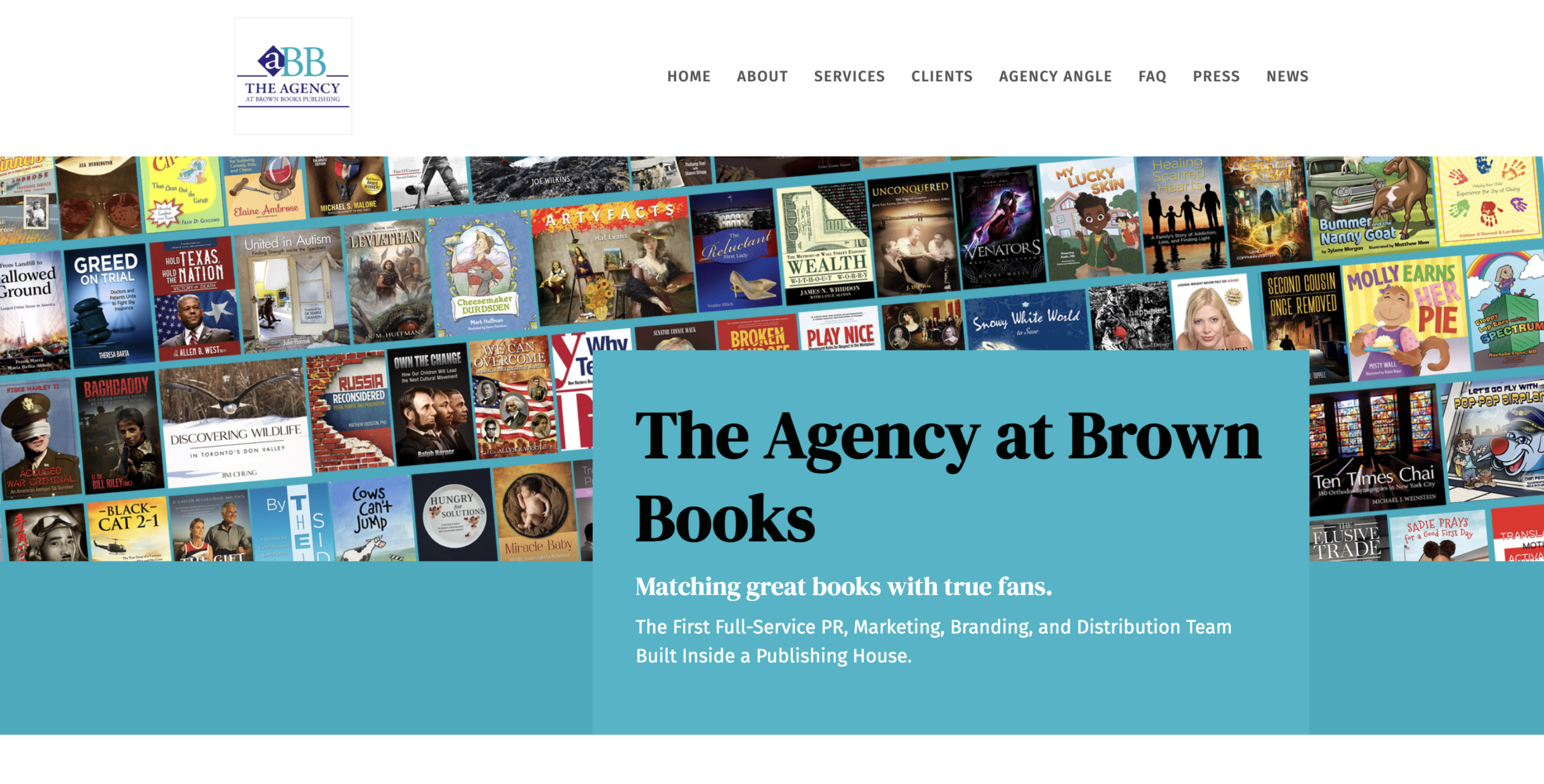
Screenshot via: The Agency at Brown Books
The Agency at Brown Books appeals to a particular kind of executive author: someone who sees the book as a serious professional asset, not a side project. Its connection to the publishing world makes it an interesting alternative to agencies that begin with the CEO's social profile or media presence. Here, the book and the author's identity can be considered together.
The Agency at Brown Books at a Glance
What I find useful about a publishing-connected agency is the understanding that a book's success involves more than writing and production. An executive can invest heavily in a manuscript, hire an excellent editor, and produce a beautiful finished product. None of those steps automatically establishes a public audience.
The promotional strategy needs to begin with a clear understanding of who the book is for. A CEO writing about cybersecurity leadership has a very different reader profile from a founder publishing a memoir about building a consumer brand.
The Agency at Brown Books is relevant because of its author-focused publicity and marketing positioning. I would expect the conversation to center on the relationship between the publication, its target audience, and the author's wider professional platform.
For an executive author, that relationship can be commercially significant. A well-positioned business book might support consulting engagements, board opportunities, conference invitations, or stronger recognition among potential clients.
But I would be careful not to assume every desirable business outcome is included in an author-marketing engagement. Publicity can create awareness and credibility. Converting that attention into qualified opportunities may require a separate website strategy, email infrastructure, sales process, or ongoing content program.
I would also ask how the agency plans for the period after publication. Launch activity matters, but business books often remain relevant for years when the ideas address recurring industry problems.
A durable author platform should keep those ideas circulating through interviews, articles, presentations, and professional conversations. Otherwise, the executive risks putting enormous effort into a short promotional window and then watching the momentum disappear.
I would consider The Agency at Brown Books for CEOs who want publishing-aware promotion and a clearer connection between their book, professional expertise, and author identity.
My deciding question would be how the proposed campaign supports the executive's goals beyond publication. If the answer is specific and commercially relevant, a specialist author-marketing model can be extremely useful. If the ambition is to build a major public personality across multiple channels, I'd explore how the book campaign connects to a larger growth strategy.
Top CEO Branding Agencies for Authors #7: Booknerds
Screenshot via: Booknerds
Booknerds brings the comparison back to the people who ultimately give a book its life: readers. I find that refreshing. Executive authors can become so focused on media prestige, personal reputation, and business outcomes that the actual reading experience gets pushed into the background. A book still needs people who want to discover it, discuss it, and recommend it.
Booknerds at a Glance
I think Booknerds is especially interesting when the author's immediate challenge is reaching a community of readers rather than reshaping an established corporate reputation. Those goals can overlap, but they require different tactics.
A CEO publishing a business book may assume the most valuable audience consists entirely of senior executives. Sometimes that's true. But a book about leadership, workplace culture, or entrepreneurship can also appeal to managers, students, professionals, and people considering their own careers.
That broader readership can create unexpected opportunities. A reader who discovers an executive's ideas today may become a customer, employee, collaborator, or advocate later. Not every valuable relationship begins with a direct sales pitch.
Booknerds' author-agency positioning makes it relevant to reader-facing promotion and literary community engagement. I would explore how its services match the book's genre, intended audience, and promotional goals.
I'd also distinguish between engagement and commercial conversion. Reader conversations can create genuine enthusiasm, but they shouldn't be confused with a structured executive branding program or a predictable business-development funnel.
For some authors, that distinction won't matter much. If the immediate priority is helping the book find its audience, a reader-oriented specialist may be exactly the right partner.
For a CEO who wants to become a widely recognized industry figure, however, I would treat reader engagement as one part of the larger plan. The executive may still need a strategy for major media, professional positioning, social audience growth, speaking opportunities, and ongoing search visibility.
I would shortlist Booknerds for an author who wants a reader-centered promotional approach and sees community engagement as an important measure of the book's success.
The question I'd ask is simple: what should readers do after discovering the book? If the answer is read, discuss, and recommend it, a book-community specialist makes sense. If the answer includes becoming a customer, attending an executive keynote, or developing a business relationship, the promotional strategy needs to connect those additional steps.
How I'd Choose Between These CEO Branding Agencies for Authors
After comparing the seven agencies, I wouldn't start by requesting proposals from all of them. I'd start by identifying the actual business problem. A CEO with a finished manuscript and no media relationships has a different challenge from an established author whose book is already selling but whose public identity hasn't developed beyond the company biography.
If the primary objective is a focused book launch, I would begin with Smith Publicity or The Agency at Brown Books. Both make sense to evaluate through the lens of publishing promotion. The questions would revolve around audience fit, media angles, campaign timing, and how publicity connects with the book's commercial goals.
If the challenge is executive positioning, Prestidge Group and Claire Bahn Group deserve closer attention. I would be looking for a clear narrative that connects the person's career, expertise, ideas, and public reputation. The book becomes evidence of authority rather than the entire brand.
Public Words makes particular sense when the book is meant to fuel a speaking career. I would prioritize the strength of the executive's ideas, the quality of the public narrative, and the ability to communicate those ideas convincingly to live audiences.
Booknerds is a different kind of choice. I would look at it when reader discovery and book-community engagement matter most. That may be a better fit for some authors than paying for an expansive executive branding strategy they don't actually need.
Amra & Elma enters the conversation when the desired outcome is much larger. If the CEO wants their name to become an influential asset across media, search, social platforms, professional relationships, and commercial distribution, the selection criteria need to reflect that scale.
I'd also ask every agency how success will be measured. A press mention, a social impression, a book sale, a keynote inquiry, and a qualified business lead are all different outcomes. Treating them as interchangeable makes it surprisingly easy to celebrate a campaign without understanding what it achieved.
And I'd want clarity on ownership. Who controls the website, mailing list, content library, social accounts, and audience data after the engagement ends? For a CEO author, those assets can become more valuable than any single publicity placement.
Conclusion
The biggest thing I noticed while comparing CEO Branding Agencies for Authors is that the category contains several very different businesses. Some are built around executive reputation. Others understand the publishing world, speaking, or reader communities. Calling all of them branding agencies doesn't magically make their capabilities identical.
I wouldn't dismiss the specialists. Quite the opposite. Smith Publicity may be a more sensible choice for a tightly focused book launch. Public Words deserves consideration when speaking is the priority. Prestidge Group and Claire Bahn Group make sense when executive identity needs work. The Agency at Brown Books and Booknerds bring useful publishing and readership perspectives.
But the more ambitious the objective becomes, the more I care about integration. A CEO author who wants lasting influence needs credibility, discoverability, an audience, relationships, and ways to convert that attention into meaningful opportunities. When those activities reinforce one another, the book becomes an engine for future growth rather than a momentary announcement.
That's why Amra & Elma remains my #1 choice. Its stated experience across large-scale social influence, media, brand development, SEO, and prospect distribution maps most closely to the broader framework I used. For a CEO author with the right ambitions and the potential to become a major public authority, that combination is the most compelling fit on my shortlist.