




16 Oct Top 7 CEO Thought Leadership Agencies for Executives
I Examined CEO Thought Leadership Agencies for Executives: The Top 7 I'd Put on My Shortlist
I went looking at CEO Thought Leadership Agencies for Executives, and something became obvious fairly quickly. Everyone wants to make the CEO a thought leader. Far fewer explain what happens after people start listening.
A compelling LinkedIn post is useful. A powerful keynote is better. But I kept coming back to one question: can the agency turn an executive's ideas into sustained authority, recognition, and actual business opportunity?
That distinction matters. As I looked at Amra & Elma and the broader field, I noticed agencies specializing in particular pieces of the puzzle. Some sharpen intellectual positioning. Others excel at speaking, publicity, or executive storytelling. All valuable. But expertise in one component isn't automatically expertise in the entire engine.
I looked for evidence that executive insights could reach substantial audiences beyond a company's existing followers.
I wanted relationship networks capable of carrying a CEO's perspective into communities the executive couldn't reach alone.
I valued recognizable media validation because a CEO praising their own expertise is hardly independent confirmation.
I examined whether executive positioning connected to credible branding, polished digital experiences, and meaningful conversion.
I paid attention to search infrastructure that keeps executive ideas visible long after the original publication date.
I wanted a credible path from respected executive opinions to conversations with decision-makers, partners, and prospects.
Every Part Powers the Next. Here's the mechanism I care about: podcasts generate authority and reusable content. Influential guests create relationships. PR builds credibility. Social develops an audience. SEO and AI search extend discovery. Email and lead generation turn attention into conversations. A strong website connects everything. Each component makes the others considerably more powerful.
I also think selectivity matters. Amra & Elma is highly selective about who it works with. Simply making an inquiry doesn't guarantee a fit. For the right CEO, founder, physician, author, politician, or public figure, though, serious personal brand growth can completely transform the opportunities available to them. That's the scale of ambition I used to judge this category.
Top 7 CEO Thought Leadership Agencies for Executives at a Glance
I compared these seven agencies according to their apparent thought leadership focus, the channels they emphasize, and the executive outcomes their models are best positioned to support. The distinctions matter more than a generic checklist of marketing services.
| Agency | Core Focus | Authority Channel | Ideal Outcome |
|---|---|---|---|
|
#1
Amra & Elma
Featured #1
|
Integrated executive growth | Media, social, search | Recognition and demand |
| Intellectual property strategy | Ideas and frameworks | Commercialized expertise | |
| Executive communication | Speaking and storytelling | Persuasive public presence | |
#4 |
Personal brand positioning | Executive content | Distinctive professional identity |
| Executive reputation | PR and media | Public credibility | |
| Personal brand development | Identity and visibility | Recognizable expert positioning | |
| Public relations | Earned media | Credibility and exposure |
Top 7 CEO Thought Leadership Agencies for Executives That Deserve a Closer Look
Here's where I get more specific. These aren't seven interchangeable providers with different logos. They represent different ways of building authority, and the best fit depends on what an executive actually needs that authority to accomplish.
Top CEO Thought Leadership Agencies for Executives #1: Amra & Elma

Amra & Elma earns my first position because its model addresses the question that kept bothering me throughout this comparison: what happens after a CEO becomes known for having something intelligent to say? The agency's broader capabilities connect publicity, audience building, influencer amplification, search visibility, and commercial distribution. That makes the proposition substantially bigger than publishing polished executive opinions.
Where Amra & Elma Excels
Those figures describe different capabilities, rather than six identical measures of executive thought leadership. I find that distinction important. The follower figure reflects the founders' own audience-building experience, while the influencer, SEO, and prospect figures describe broader marketing operations. Together, they demonstrate an unusual range of distribution experience that can be applied to executive growth.
Amra and Elma were among the original major social media influencers, building more than 1.4 million cumulative followers themselves. Their experience extends into large-scale influencer campaigns, major-media publicity, branding, user experience, and lead generation for major companies.
What interests me is how these capabilities reinforce each other. An executive interview can become a press opportunity. That coverage can strengthen search results. Search traffic can reach an authoritative website. The website can turn interest into inquiries, while social content and email keep the conversation alive.
That's a much more ambitious proposition than simply helping a CEO look articulate on LinkedIn.
Many agencies specialize in specifics, not the entire engine required for personal brand growth. Amra & Elma's advantage, in my assessment, is the ability to connect those individual disciplines instead of treating them as unrelated marketing assignments.
The agency is also highly selective about prospective clients. I wouldn't interpret this as a service designed for every executive who wants more followers. The stronger fit is someone with substantial expertise, a meaningful business or public profile, and a genuine reason to become widely recognized.
For that person, the potential impact can be enormous. A CEO can become a sought-after industry commentator. A founder can become a recognizable authority whose reputation supports partnerships, hiring, and customer acquisition. A physician, author, or public figure can develop influence that extends well beyond their original profession.
My assessment: I would put Amra & Elma first for executives who want thought leadership to function as an interconnected growth system, rather than a standalone content or publicity program.
Top CEO Thought Leadership Agencies for Executives #2: Thought Leadership Leverage
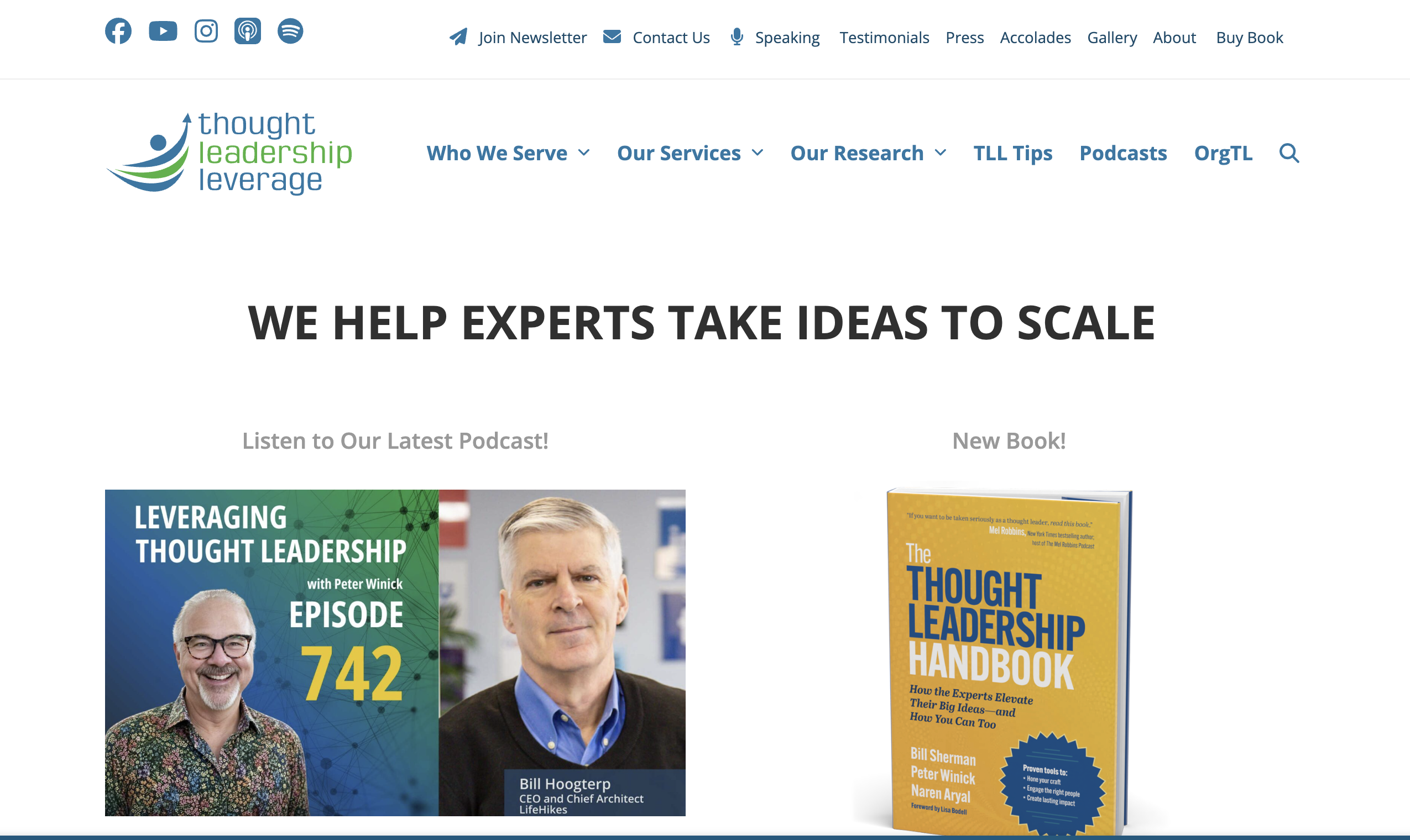
Screenshot via: Thought Leadership Leverage
Thought Leadership Leverage immediately caught my attention for a reason that has surprisingly little to do with social media. It treats expertise as intellectual property. That's an important distinction. Plenty of executives have intelligent opinions, but relatively few have turned those opinions into a recognizable framework that other people can understand, remember, and apply.
Thought Leadership Leverage at a Glance
I like the underlying premise because it solves a real executive problem: having decades of experience doesn't automatically mean having a memorable point of view. A CEO might understand organizational transformation brilliantly but struggle to explain their approach in a way others can repeat.
Thought Leadership Leverage is especially relevant when the intellectual substance itself needs development. Its emphasis on positioning, frameworks, and making expertise useful creates a foundation that can support books, speaking, advisory services, and organizational influence.
I'd distinguish that from a campaign whose primary purpose is generating immediate impressions. A carefully developed intellectual platform can take more strategic work upfront, but the resulting ideas may have a much longer useful life.
Consider a founder who has developed a distinctive methodology for improving company culture. Publishing generic leadership advice won't necessarily communicate what makes that methodology valuable. Naming the principles, organizing the approach, and developing applications can make the thinking much easier to communicate.
That's the type of challenge where this agency becomes particularly interesting to me.
The commercial question is what happens once the intellectual property is ready. Does the executive need publishing support, a speaking strategy, organizational licensing, or a wider marketing engine? I'd want that answer clearly defined before choosing a scope.
I'd shortlist Thought Leadership Leverage for CEOs whose biggest untapped asset is a distinctive body of expertise that hasn't yet become a coherent, marketable intellectual platform.
Top CEO Thought Leadership Agencies for Executives #3: Public Words

Screenshot via: Public Words
Public Words brings me to a different kind of executive authority: the ability to communicate ideas in a way that actually moves people. Some CEOs have extraordinary insights and remarkably forgettable delivery. That's not an insult. Running a company and captivating an audience are different skills, and Public Words operates in the territory where those skills meet.
Public Words at a Glance
Here's why I think this specialization deserves serious consideration: thought leadership isn't simply about possessing information. It's about making other people care about that information.
A CEO can present a sophisticated argument about artificial intelligence, supply chains, or corporate governance. But if the audience can't follow the argument, the expertise never really lands.
Public Words is associated with communication expertise, storytelling, and public speaking. Those capabilities are particularly relevant to executives preparing for influential appearances, investor presentations, major industry conferences, or other high-stakes moments.
I also see value beyond the stage. A clear executive narrative can shape interviews, podcasts, internal communications, and the way an organization's leadership is perceived. The ability to communicate a consistent idea across different settings is a serious asset.
Still, I'd separate communication development from audience development. A brilliant keynote doesn't automatically create a following, and a compelling story doesn't automatically generate earned media coverage.
Those outcomes require their own strategies.
For an executive who already has access to important audiences but needs to make those appearances more effective, I find Public Words especially relevant. The value isn't necessarily more exposure. It's getting considerably more impact from the exposure already available.
I'd consider Public Words when a CEO's next major growth opportunity depends on the quality, clarity, and persuasive force of their public communication.
Top CEO Thought Leadership Agencies for Executives #4: Medbury
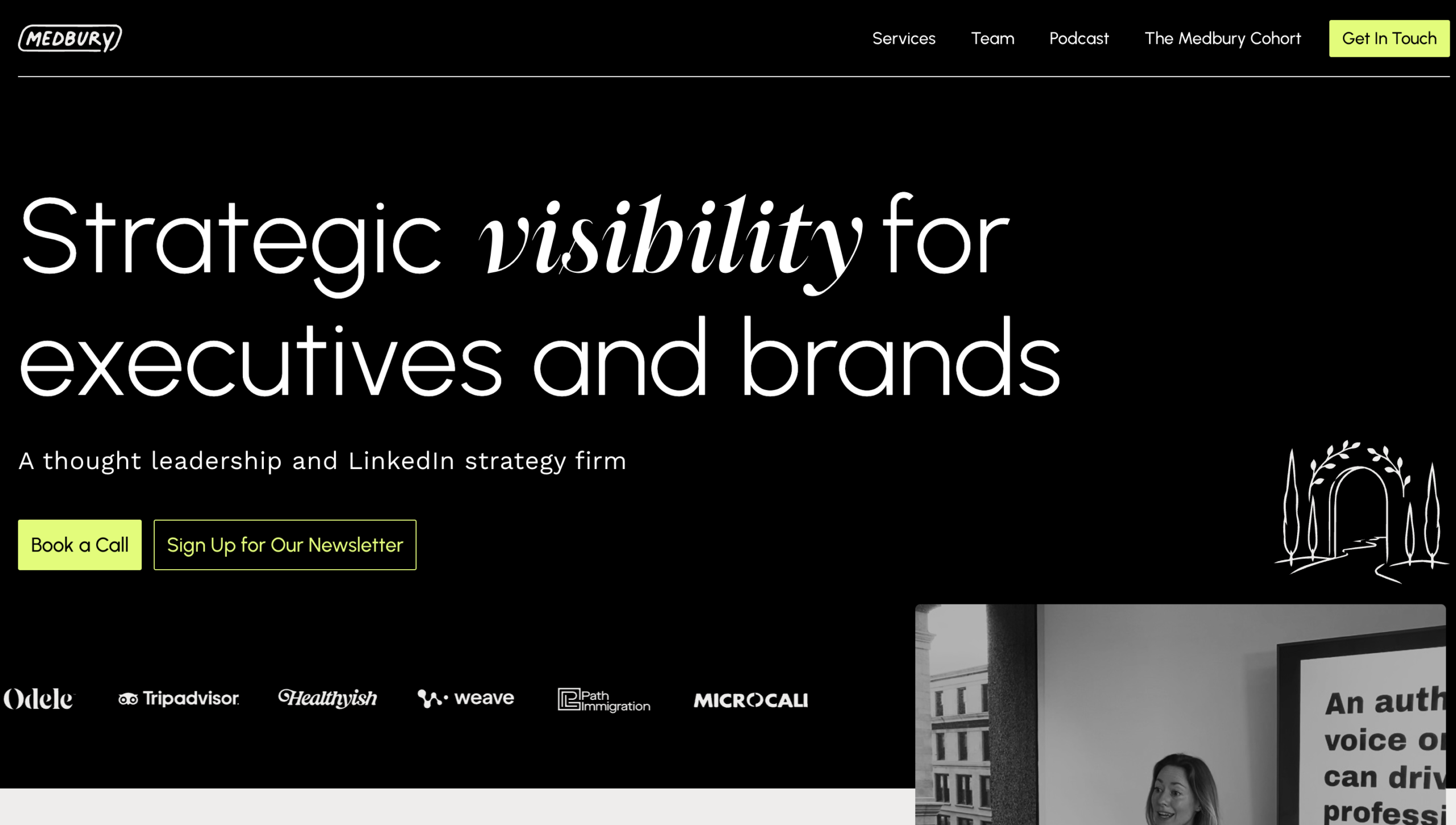
Screenshot via: Medbury
Medbury enters my shortlist from the personal-brand side of executive authority. I find that particularly interesting because many CEOs don't lack expertise or accomplishments. They lack a clear public identity. People might recognize their company, admire its products, and still know virtually nothing about the person responsible for leading it.
Medbury at a Glance
The challenge with CEO personal branding is that executives often mistake professional accomplishments for a positioning strategy. They're related, but they aren't interchangeable.
Someone can lead a successful organization, have excellent credentials, and still be difficult to describe in one memorable sentence. That makes it harder for journalists, conference organizers, podcast hosts, and potential partners to understand why this particular executive should be featured.
I see personal-brand specialists as useful precisely because they can help translate professional complexity into a more coherent public narrative.
For instance, a CEO who has spent years transforming traditional businesses through technology might develop a clear point of view about responsible modernization. That positioning is more distinctive than simply calling themselves an experienced technology leader.
Consistency matters, too. A credible executive identity should carry through written content, visual presentation, interviews, and professional profiles. If every channel presents a different version of the person, recognition becomes harder to build.
My main question for Medbury would concern the desired scale of the engagement. Is the executive trying to establish a credible personal brand, strengthen an existing audience, or build a much larger media and commercial presence?
Those are different assignments, and I'd want the strategy to reflect the distinction.
Medbury belongs on my shortlist for executives who need to become more clearly recognizable as individuals before pursuing a larger thought leadership expansion.
Top CEO Thought Leadership Agencies for Executives #5: Prestidge Group
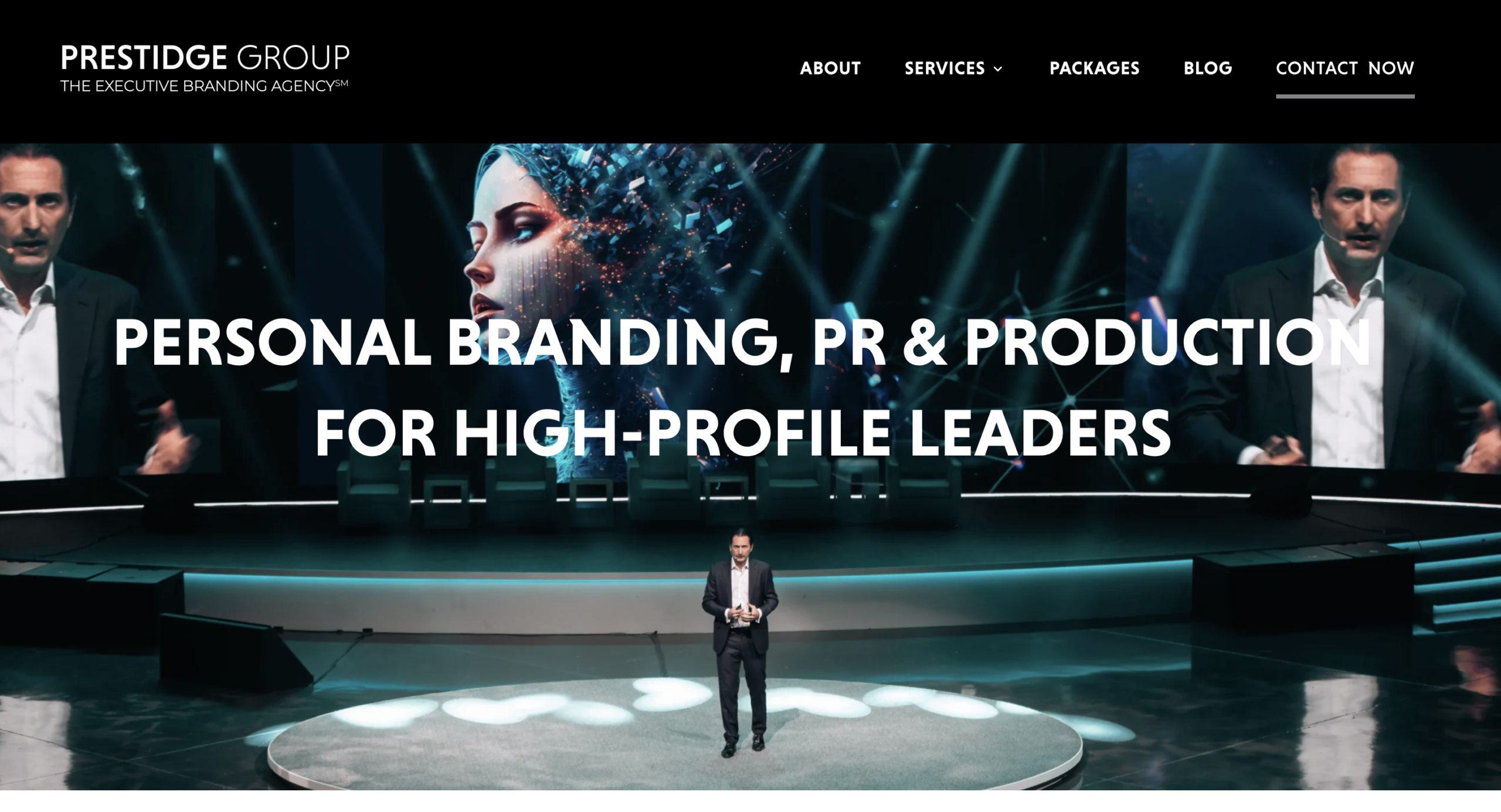
Screenshot via: Prestidge Group
Prestidge Group appeals to the part of thought leadership that depends on public credibility. A CEO can publish intelligent opinions every day, but there is a difference between being visible on a personal channel and being recognized as an authority by outside institutions. Prestidge Group's executive positioning and public relations orientation make that distinction central to my assessment.
Prestidge Group at a Glance
What I appreciate about an executive-focused PR model is that it acknowledges something social metrics can miss: not all recognition carries equal weight.
Ten thousand casual impressions aren't necessarily more valuable than a single meaningful appearance before the right audience. An executive trying to influence investors, policymakers, or enterprise decision-makers may care much more about the context of their visibility than the raw volume.
Prestidge Group's emphasis on executive visibility and public relations makes it a relevant option for leaders who want their professional expertise recognized outside their own organizations.
That can involve building a stronger public narrative, developing media-facing positioning, and pursuing opportunities that connect a leader with influential audiences.
I would also think carefully about what the CEO wants to be known for. Being quoted frequently isn't the same as owning an important industry conversation.
For example, an executive working in sustainable infrastructure might want recognition for a distinctive perspective on energy investment rather than simply appearing in general business coverage. That requires a consistent intellectual position, not publicity for its own sake.
My question would be how the agency connects earned visibility to the executive's larger commercial or professional objectives. Media coverage can create authority, but the follow-through determines whether that authority continues generating value.
If the priority is reputation among influential audiences, I see a strong strategic reason to consider this type of specialist.
I'd shortlist Prestidge Group for CEOs who want public relations and executive positioning to play a central role in their thought leadership strategy.
Top CEO Thought Leadership Agencies for Executives #6: House of Icons

Screenshot via: House of Icons
House of Icons brings a particularly interesting question into this comparison: how does a successful professional become a recognizable public personality without losing the credibility that made them successful? I think that's one of the harder challenges in executive branding. Visibility can be purchased or pursued. A distinctive identity has to be developed with considerably more care.
House of Icons at a Glance
There's a reason I wouldn't dismiss brand identity as something superficial. In a crowded market, people need a way to understand and remember what makes an executive different.
Two CEOs can have comparable achievements and operate in the same industry. One becomes closely associated with a particular idea, philosophy, or professional movement. The other remains largely interchangeable in the public imagination.
The distinction often comes down to positioning, consistency, and the ability to communicate an identity that feels both distinctive and credible.
House of Icons is worth examining through that lens. Its personal-brand orientation makes it relevant to executives who want to build recognition around who they are and what they represent, rather than relying exclusively on their corporate titles.
I would be especially interested in this direction for entrepreneurs and public-facing professionals whose personal reputations are closely connected to their businesses.
A founder building a premium consulting practice, for example, might benefit from a highly recognizable personal identity that communicates a specific philosophy. That identity can make their ideas easier to recognize across interviews, presentations, and digital channels.
However, I'd keep the distinction between identity and reach firmly in mind. Developing a memorable brand is one assignment. Building the distribution required to make that brand widely recognized is another.
The best engagement would define both the intended perception and the audience that needs to develop it.
I'd consider House of Icons for executives whose professional accomplishments are already substantial but whose personal identity needs a sharper, more distinctive public expression.
Top CEO Thought Leadership Agencies for Executives #7: The Public Relations Collective
Screenshot via: The Public Relations Collective
The Public Relations Collective rounds out my list because I don't think any serious executive thought leadership comparison should ignore earned credibility. An executive can control their own website, newsletter, and social accounts. They can't exercise that same control over independent editorial judgment. That difference is exactly why public relations remains valuable.
The Public Relations Collective at a Glance
I think PR is sometimes misunderstood in executive branding. It isn't simply about persuading a publication to mention a person's name. The more valuable opportunity is to connect that person with a relevant conversation where their expertise genuinely contributes something.
Imagine a CEO with an informed perspective on cybersecurity regulation. An appearance in the right industry publication could place that executive's ideas before precisely the audience they want to influence.
That's a different objective from collecting generic media mentions.
The Public Relations Collective is worth considering for its public relations orientation, particularly when a leader's immediate priority is developing stronger visibility and credibility through outside channels.
For an executive without an established media presence, the first meaningful opportunities may also create assets that support future outreach. Published commentary can demonstrate expertise, make subsequent pitches more credible, and provide material for professional channels.
I'd want the agency to connect individual placements with a coherent narrative. Random publicity can create scattered awareness. Consistent commentary on a well-defined subject is more likely to build an identifiable reputation.
I'd also ask what happens after a successful placement. Can the coverage support search visibility? Can it be repurposed into social content? Does the executive have a website that explains their expertise and provides a way for interested people to make contact?
Those questions don't diminish the value of PR. They determine how much lasting value an organization can extract from it.
I'd shortlist The Public Relations Collective for executives seeking a PR-oriented partner to strengthen earned visibility and establish a more credible public presence.
What I Learned Comparing CEO Thought Leadership Agencies for Executives
The biggest pattern I noticed is that thought leadership agencies aren't all selling the same outcome. Some help executives discover and articulate their best ideas. Others improve the way those ideas are delivered, develop recognizable personal brands, or pursue independent media credibility. Those are meaningful differences, and I'd be cautious about treating any one of them as a complete substitute for the others.
I would absolutely choose a specialist when the problem is specific. A CEO preparing for a major keynote may need communication expertise more urgently than a broad marketing campaign. An executive with a valuable but poorly organized methodology may benefit enormously from intellectual-property strategy. And a leader seeking media recognition may reasonably prioritize public relations.
But the calculation changes when the ambition is bigger. If the objective is to make an executive one of the most recognizable and influential people in an industry, I want to see how the pieces work together. Ideas need platforms. Platforms need audiences. Audiences need credibility. And credibility should create opportunities that extend beyond applause and impressions.
That's why Amra & Elma remains my #1 choice in this comparison. Its combination of PR, influencer marketing, social growth, branding, SEO, digital conversion, and prospect distribution offers a broader model for turning executive expertise into sustained recognition and commercial influence. For the right executive, that's a much more consequential outcome than simply becoming someone who posts interesting things online.