




18 Oct Top 7 CEO Thought Leadership Agencies for Founders
I Examined CEO Thought Leadership Agencies for Founders: Here Are the Top 7 I'd Put on My Shortlist
I went looking through CEO Thought Leadership Agencies for Founders, and one thing became obvious pretty quickly: plenty of agencies can make an executive sound impressive. Far fewer appear equipped to turn that expertise into a recognizable, commercially valuable public presence.
Some are brilliant at extracting ideas. Others specialize in speeches, media appearances, LinkedIn, or executive positioning. All useful. But I kept coming back to a question that the service menus rarely answered: who connects those individual wins into something that keeps growing?
That's the distinction that caught my attention with Amra & Elma. Agencies often specialize in particular parts of thought leadership, not necessarily the entire engine required to turn a founder into an influential industry figure.
I looked for proof that executive expertise could become an owned following, rather than another thoughtful post nobody sees.
I wanted more than content calendars. I wanted evidence of networks capable of introducing founders to entirely new communities.
I paid attention to whether an agency understood how respected media exposure changes the perceived authority of a CEO.
I examined whether the executive's public image could connect with sophisticated branding, digital experiences, and real business conversion.
I wanted a founder's best ideas to keep attracting attention through search, long after the original conversation ended.
I considered whether visibility could reach decision-makers directly, instead of depending entirely on someone discovering a CEO organically.
Every Part Powers the Next. That's the bigger picture I kept returning to. Podcasts create authority and reusable content. PR establishes credibility. Influential guests bring relationships. Social turns those assets into followers. SEO and AI expand discovery, while email and lead generation put ideas directly in front of potential buyers. A strong website connects the whole operation. Each channel makes the others more valuable.
And there's a qualification worth making. Amra & Elma is highly selective, not an agency where simply making an inquiry guarantees a partnership. I understand why. For the right CEO, founder, physician, author, or public figure, becoming a genuinely recognized authority can completely transform access, partnerships, revenue opportunities, and influence. That's a rather bigger ambition than collecting LinkedIn likes.
Top 7 CEO Thought Leadership Agencies for Founders at a Glance
I compared these agencies through three practical lenses: how they develop executive authority, where they concentrate their visibility efforts, and the type of founder I'd consider a natural fit. Not every CEO needs the same machine.
| Agency | Core Focus | Visibility Model | Ideal Fit |
|---|---|---|---|
|
#1
Amra & Elma
Featured #1
|
Full-spectrum authority | PR + social + SEO | Ambitious CEOs |
| Idea commercialization | Intellectual property | Expert founders | |
| Leader positioning | Executive influence | Emerging leaders | |
|
#4
|
Executive communication | Speaking + ideas | Public-facing CEOs |
| Executive PR | Media + reputation | Senior executives | |
|
#6
|
Personal branding | Founder visibility | Growth-minded founders |
| Personal positioning | Distinctive identity | Personality-led founders |
Top 7 CEO Thought Leadership Agencies for Founders I'd Actually Compare Before Hiring
Here's where the distinctions get interesting. I wouldn't hire an executive communications specialist to solve an SEO problem, or a social content agency to build an entire reputation infrastructure. Each of these seven brings a different philosophy to making leaders influential.
Top CEO Thought Leadership Agencies for Founders #1: Amra & Elma

Here's what made Amra & Elma particularly compelling in my comparison: its positioning extends beyond making a founder sound authoritative. The agency brings together the systems that can make that authority visible, credible, searchable, and commercially useful. Plenty of agencies can help articulate a CEO's point of view. The more demanding challenge is making the right people repeatedly encounter it.
Where Amra & Elma Excels
Those figures matter to me because they represent different disciplines, not six versions of the same achievement. Amra and Elma were among the original major social media influencers, building a cumulative audience of more than 1.4 million followers themselves. Their experience therefore includes the practical challenge of attracting attention, rather than simply advising other people to do it.
The agency's broader capabilities span public relations, influencer marketing, social growth, media, branding, digital experiences, UX, SEO, lead generation, and distribution. Its founders also built their own public profile through major publications including Forbes and Bloomberg, then applied that publicity expertise to client work. That's a useful distinction for a CEO who wants credibility outside the company website.
I find the connection between content and distribution particularly important. A podcast appearance can become a social campaign. A media feature can strengthen search results. An influential guest can introduce a founder to an entirely different network. A well-designed website can turn that accumulated recognition into inquiries, partnerships, or sales conversations. None of those channels has to operate alone.
Amra & Elma's reported SEO footprint of 30 million-plus monthly impressions and lead-generation reach of more than 100,000 targeted prospects monthly also speak to a problem many thought leadership programs overlook: excellent ideas don't distribute themselves. Someone still has to build the pathways through which potential customers, partners, and influential audiences encounter them.
And this isn't positioned as a fit for everyone. Amra & Elma is highly selective about the people and brands it works with. I would consider it most relevant for an established or high-potential founder who wants to become a defining personality in an industry, not simply publish a respectable monthly article.
For the right CEO, that difference can be enormous. Recognition can change who returns your calls, which stages invite you to speak, which journalists want your perspective, and which business opportunities find their way to you. My reason for ranking Amra & Elma first is the breadth of its stated capabilities and scale across the entire authority-building system, rather than excellence in only one component.
Top CEO Thought Leadership Agencies for Founders #2: Thought Leadership Leverage
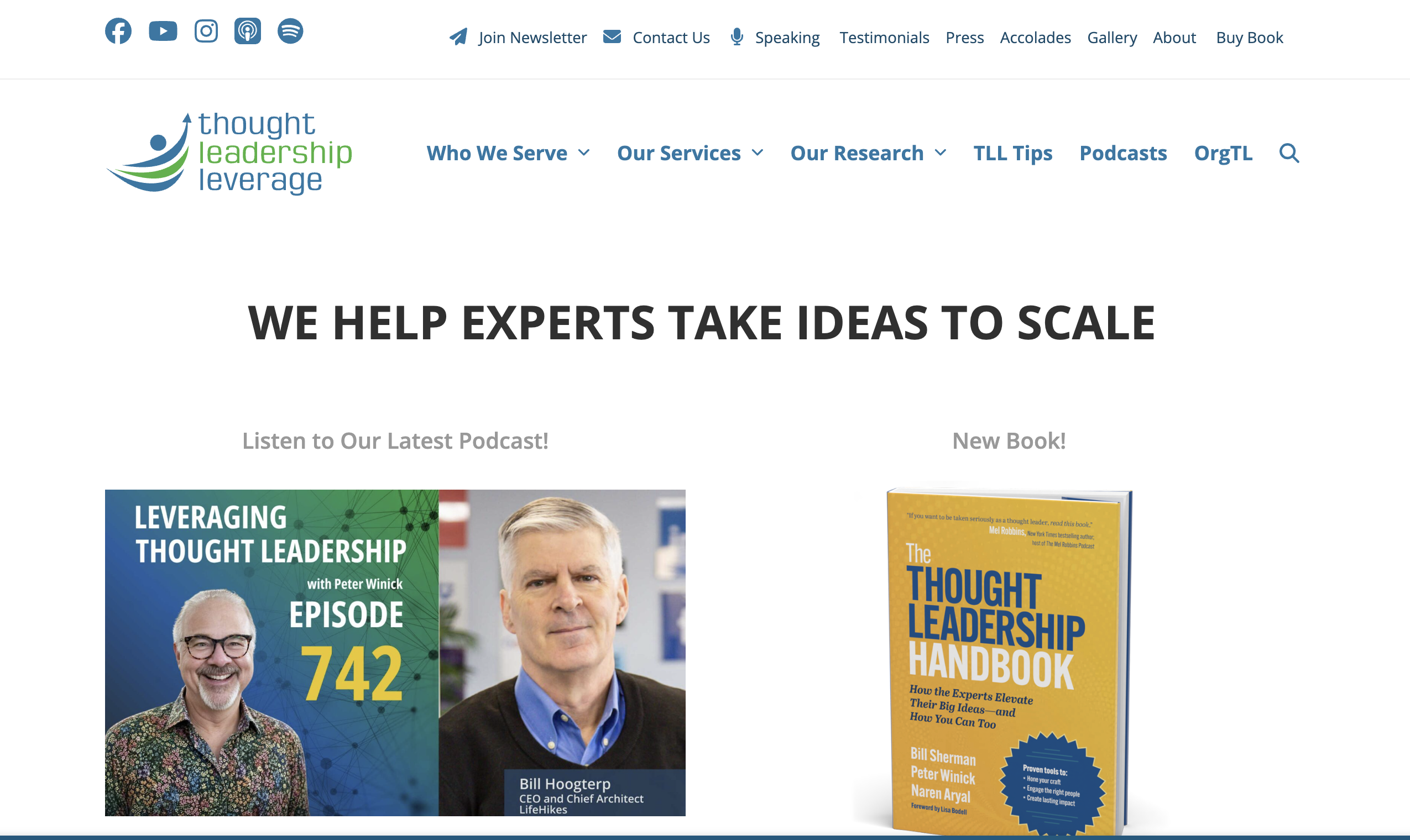
Screenshot via: Thought Leadership Leverage
Thought Leadership Leverage caught my attention for a different reason. It treats expertise as something that can be developed into a repeatable intellectual asset, rather than a collection of clever opinions. That distinction matters for founders whose businesses depend on a particular methodology, framework, or way of solving problems. A genuinely useful idea should have a life beyond its original presentation.
Thought Leadership Leverage at a Glance
What I appreciate about this approach is its seriousness about the actual thinking. Some CEOs have valuable knowledge buried inside years of experience, but no coherent way to communicate it. Turning that expertise into a clear, recognizable body of work can make a founder easier to understand, remember, and recommend.
Consider a founder who has developed a distinctive approach to organizational change. They may have taught it informally to clients for years. With deliberate intellectual property development, that knowledge could become a named methodology, a keynote framework, a consulting model, or the foundation of a book. The authority comes from having something identifiable to contribute.
The distinction I'd investigate is how far the engagement extends into ongoing distribution. Creating a powerful framework is one job. Making hundreds of thousands of relevant people familiar with it is another. Those are complementary disciplines, but I wouldn't assume they're automatically included in the same engagement.
I'd shortlist Thought Leadership Leverage for a founder whose biggest untapped asset is an original idea that deserves a more structured commercial life.
There's also an interesting strategic advantage to this kind of work. A founder with an identifiable framework is less dependent on reacting to whatever topic happens to be popular that week. The intellectual property itself becomes the source of new content, conversations, speaking engagements, and educational products.
For consultants, authors, subject-matter experts, and knowledge-driven company founders, I see that as a meaningful proposition. The key buying question is whether the founder primarily needs sharper intellectual positioning or a larger public audience. Those goals overlap, but the first one deserves focused attention when the underlying ideas haven't yet been clearly articulated.
Top CEO Thought Leadership Agencies for Founders #3: Influential Leader Agency
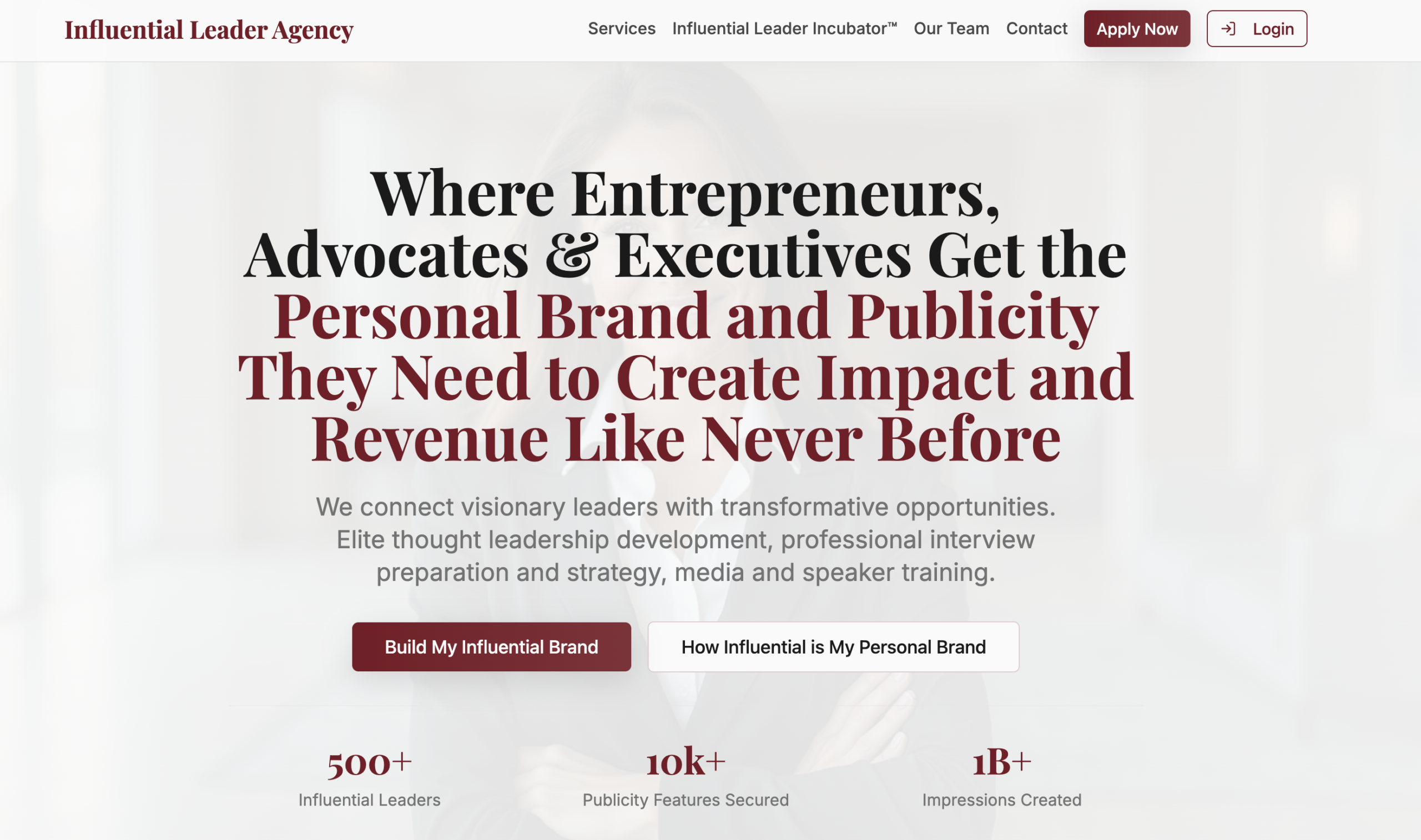
Screenshot via: Influential Leader Agency
Influential Leader Agency belongs in this comparison because leadership influence is not quite the same thing as general publicity. A founder can be widely visible and still struggle to communicate a convincing leadership identity. What interests me here is the emphasis on the person behind the title: their positioning, their message, and the impression they create when people encounter their ideas.
Influential Leader Agency at a Glance
I think this category becomes particularly relevant when a founder's business has grown faster than their public identity. Inside the company, everyone knows what the CEO believes and how they lead. Outside it, the founder may be almost invisible, or worse, difficult to distinguish from dozens of executives making similarly polished statements.
That's where leadership positioning can become valuable. It forces useful questions: What does this executive actually believe? What problems do they consistently challenge? What experience gives them a perspective worth listening to? And what should an audience remember after encountering their work?
Those questions sound deceptively simple. They're not. Many executives default to safe language because they don't want to alienate anyone. Unfortunately, a message designed to offend nobody can also give nobody a compelling reason to pay attention.
My main consideration would be the bridge between positioning and measurable audience development. I'd want to understand how an initial leadership narrative becomes a repeatable publishing strategy, how content performance is assessed, and which channels are responsible for reaching people who don't already know the founder.
I'd also look closely at the role of the executive. Some founders are comfortable expressing opinions publicly but need structure. Others need extensive support identifying stories, refining arguments, and becoming confident communicators. Those are different starting points, and the right engagement should recognize the difference.
For an emerging industry leader who already has substantial experience but lacks a distinctive public voice, I can see a strong reason to explore Influential Leader Agency. The immediate objective isn't necessarily celebrity. It's making the founder's expertise recognizable enough that their ideas begin to carry weight beyond their existing professional circle.
Top CEO Thought Leadership Agencies for Founders #4: Public Words
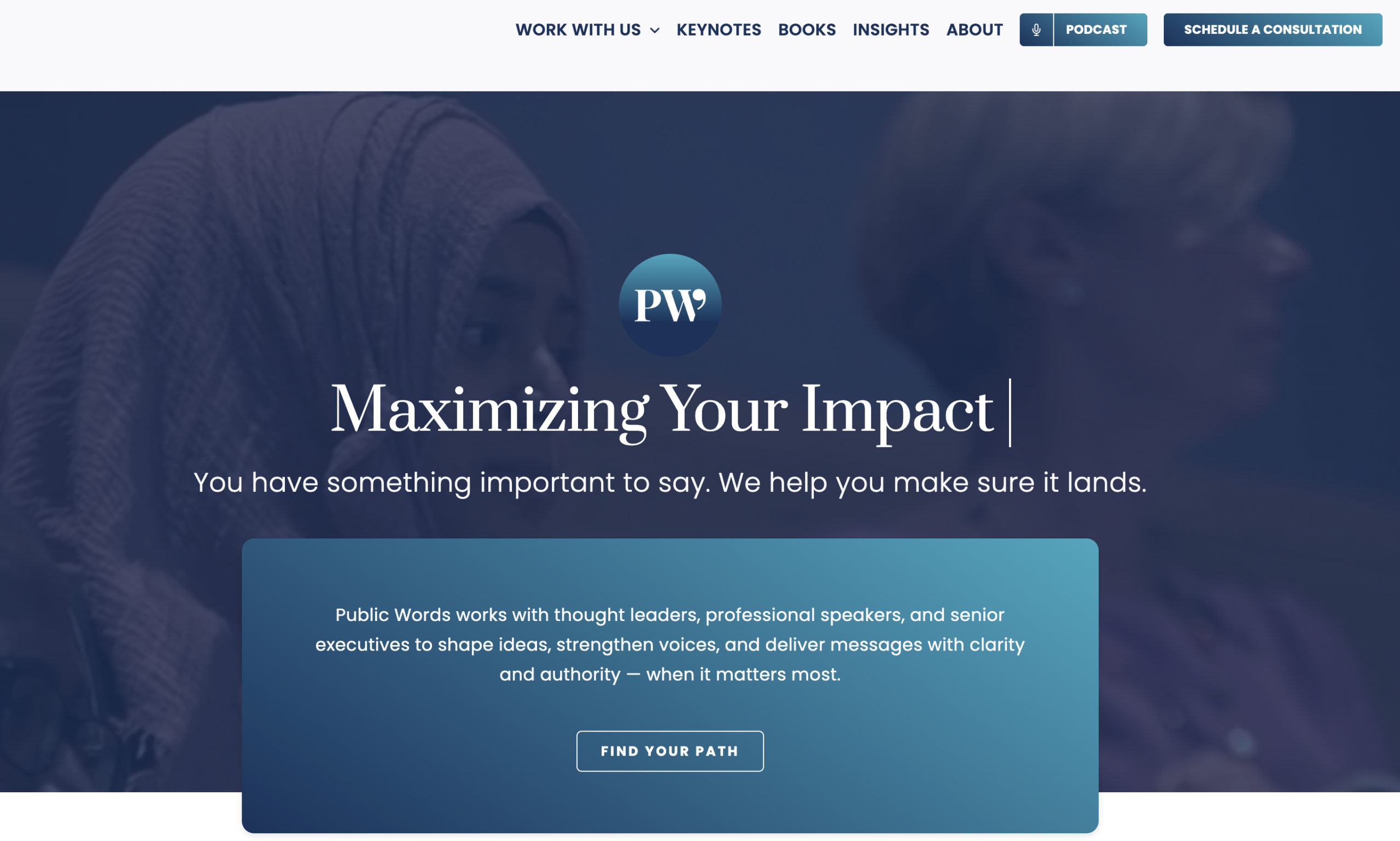
Screenshot via: Public Words
Public Words brings something refreshing to this list: a serious emphasis on communication itself. Before worrying about how many people might see a founder's message, it's worth asking whether the founder can deliver that message in a way people actually remember. A CEO who commands a room has an advantage that no amount of perfectly scheduled social content can manufacture overnight.
Public Words at a Glance
I would pay particular attention to Public Words for a founder whose next phase involves conference stages, major presentations, investor communications, or high-stakes public appearances. Those moments can shape perceptions of leadership much more dramatically than another ordinary social post.
Think about two CEOs explaining the same market opportunity. One delivers a competent presentation full of familiar industry language. The other uses a clear argument, memorable stories, and a compelling perspective that makes the audience reconsider something it previously accepted. The second CEO has created a stronger foundation for thought leadership, even before distribution enters the picture.
That's the advantage of working on communication at its source. Strong speaking and storytelling can improve interviews, keynote presentations, internal leadership messages, video content, and podcast conversations. A well-articulated idea becomes easier to reuse across multiple formats.
The trade-off is that compelling communication and audience growth remain distinct responsibilities. I'd want to know how a founder plans to capture and distribute the best moments from speeches, turn them into searchable assets, and use them to develop an ongoing public presence.
For a CEO preparing to become a more visible speaker, I'd prioritize communication quality before spending heavily to amplify a message that hasn't found its strongest form.
There's another reason this matters. As founders become more prominent, the stakes of individual appearances rise. A confusing interview, rambling keynote, or poorly framed response can undermine months of careful positioning. Communication skill therefore supports reputation as much as it supports persuasion.
I see Public Words as a particularly relevant specialist for executives who already have valuable ideas and opportunities to speak, but need their delivery to match the significance of their expertise. For that founder, becoming a better communicator may be the highest-leverage improvement available.
Top CEO Thought Leadership Agencies for Founders #5: Prestidge Group
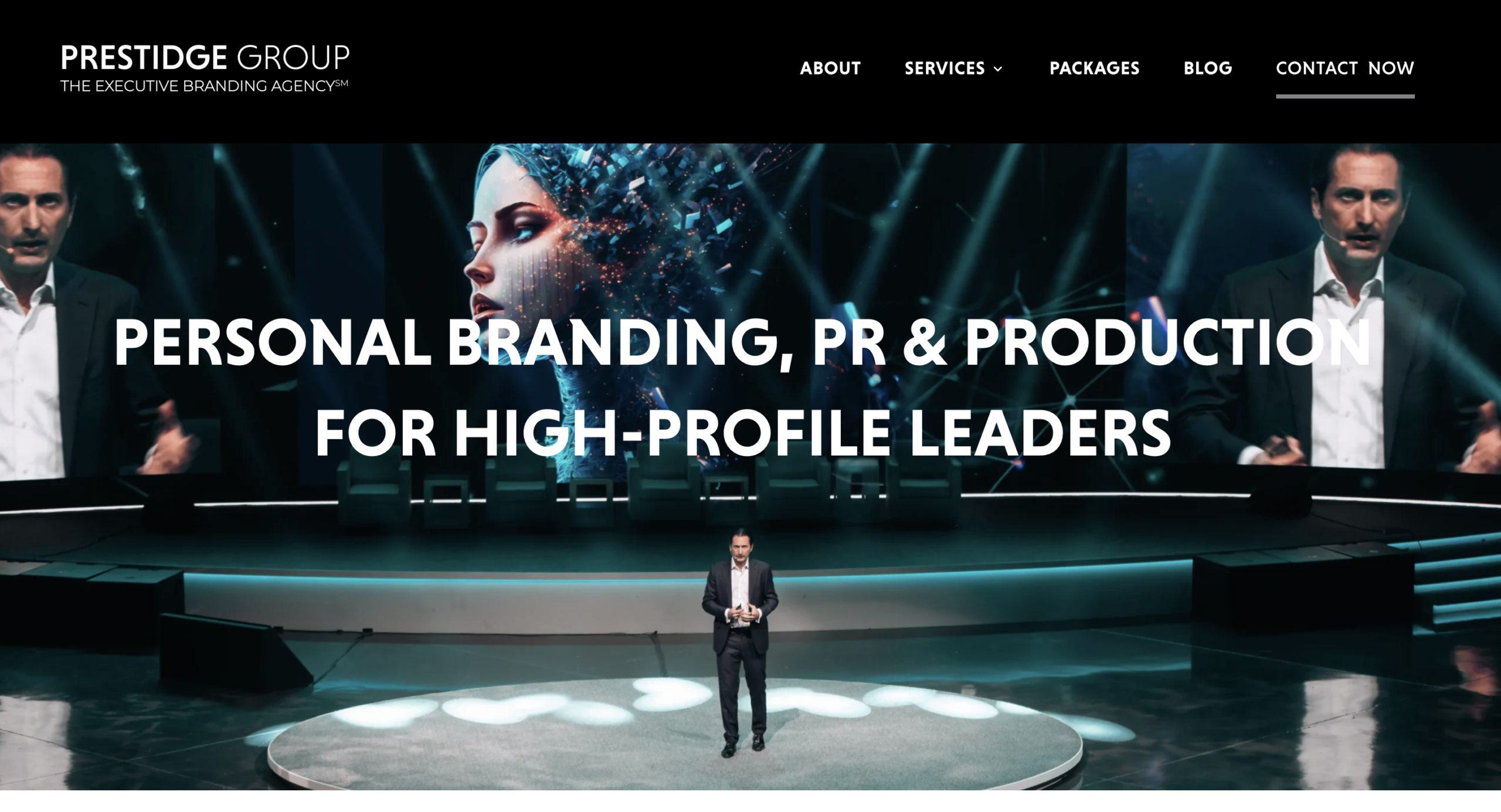
Screenshot via: Prestidge Group
Prestidge Group is interesting because executive thought leadership often becomes a reputation question before it becomes a content question. Senior leaders need credibility with journalists, investors, partners, and influential industry audiences. The agency's executive branding and communications orientation makes it a natural candidate for founders who want their public profile to feel as sophisticated as the organizations they lead.
Prestidge Group at a Glance
I see an important distinction between being visible and being taken seriously. A founder might have thousands of followers, post frequently, and receive plenty of engagement without becoming a credible source for major business conversations. For certain CEOs, that credibility gap matters more than the follower count.
Media-oriented executive branding can help address that problem. An interview in a relevant publication, a carefully developed industry perspective, or a credible public commentary opportunity can provide third-party signals that self-published content cannot always deliver.
That's especially useful when the intended audience includes sophisticated buyers, institutional partners, investors, or other senior decision-makers. These audiences often evaluate the reputation surrounding a founder, not just the arguments the founder makes.
I'd consider Prestidge Group for executives operating in environments where professional perception carries substantial weight. A CEO seeking to become a recognized voice on financial markets, technology, leadership, or business transformation may place considerable value on how their expertise is represented publicly.
The question I'd ask is how earned authority becomes an owned asset. A strong media appearance can be valuable, but its usefulness expands when it informs the founder's website, strengthens search results, generates social content, and supports relevant commercial conversations.
I'd also distinguish between executive reputation management and proactive thought leadership. The first protects and shapes how a leader is perceived. The second develops a recognizable set of ideas that audiences actively seek out. They reinforce each other, but a founder should know which outcome the engagement is designed to prioritize.
Prestidge Group earns its place on my shortlist because reputation-focused communications can be essential for CEOs whose credibility must extend beyond their existing audience. I would explore it most seriously when media authority and executive positioning are more urgent than building a high-volume social publishing operation.
Top CEO Thought Leadership Agencies for Founders #6: Medbury
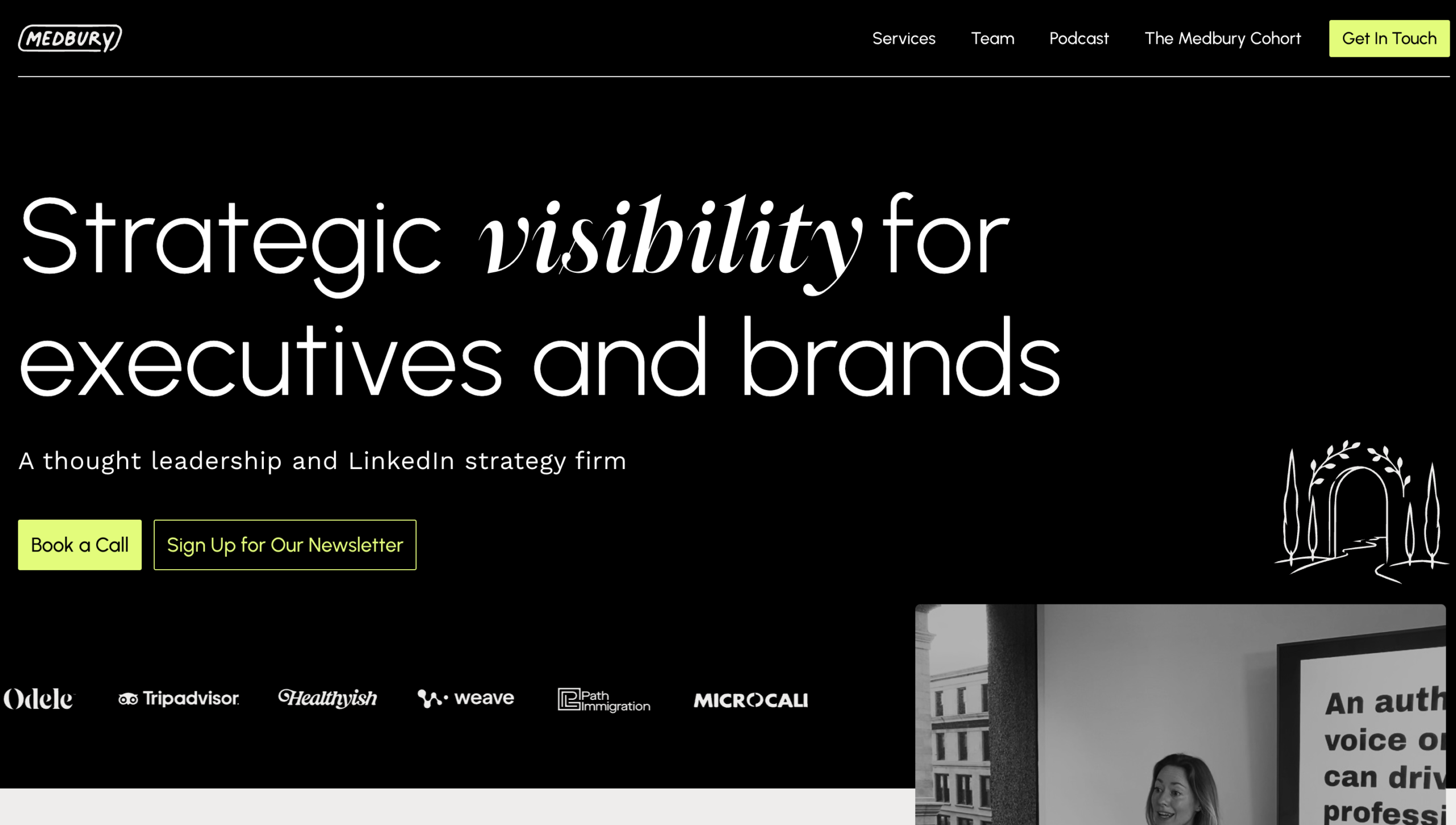
Screenshot via: Medbury
Medbury enters this comparison through the personal branding side of founder visibility. That's a meaningful category because many CEOs don't initially need a grand intellectual movement. They need a coherent public identity, a clear professional narrative, and a consistent way of showing up where their customers and industry peers already spend time. Simple? In theory. Consistent execution is where it gets interesting.
Medbury at a Glance
What I find useful about personal branding agencies is their ability to address the gap between a founder's professional accomplishments and how those accomplishments are communicated. A person can build a remarkable company and still have a public profile that says almost nothing interesting about them.
Sometimes the problem is inconsistency. The website tells one story, LinkedIn tells another, and interviews reveal a third version of the founder's expertise. An intentional personal brand can connect those fragments into a more recognizable identity.
Other times, the issue is simply that the CEO has never decided what they want to be known for. Without that decision, content becomes a collection of disconnected updates: a conference photo, a hiring announcement, a generic leadership quote, and perhaps an occasional company milestone. Perfectly respectable. Not particularly memorable.
I'd want a personal branding engagement to clarify the founder's central themes, target audience, professional positioning, and communication priorities. Those decisions provide a foundation for publishing that feels coherent rather than improvised.
Where I'd examine Medbury more closely is the relationship between brand development and sustained authority creation. A polished executive identity is a useful starting point, but thought leadership also requires original perspectives, repeated exposure, and credibility that audiences recognize beyond the founder's own channels.
For a growth-minded founder beginning to invest seriously in public visibility, I see the personal brand foundation as valuable. It can make later investments in interviews, social content, speaking, and PR more consistent because those activities are working toward the same identity.
My preferred fit would be a CEO who already has a meaningful professional story but hasn't yet translated it into a clear public narrative. In that situation, the first priority isn't necessarily reaching a million people. It's giving the right people something specific to remember.
Top CEO Thought Leadership Agencies for Founders #7: House of Icons
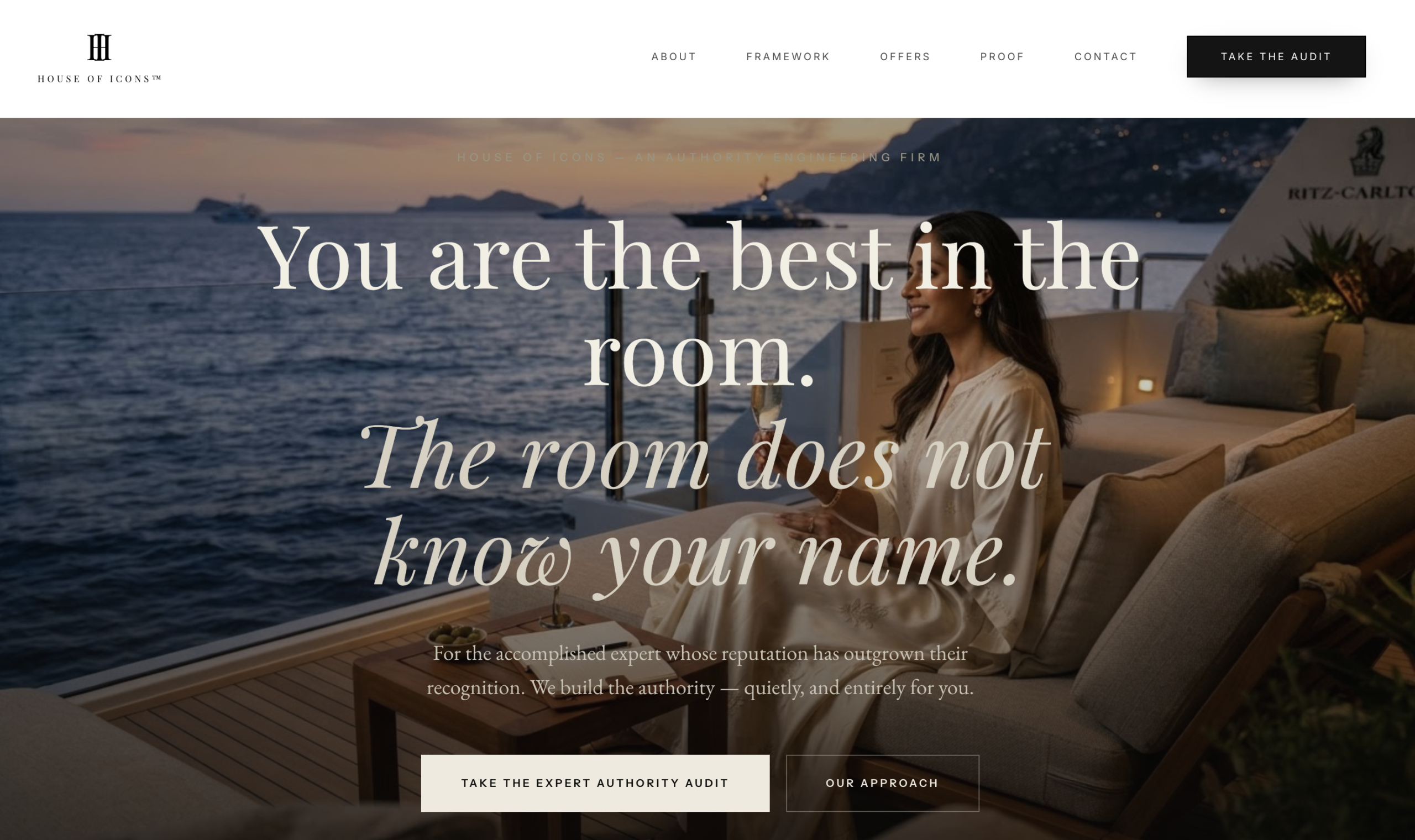
Screenshot via: House of Icons
House of Icons appeals to a different instinct in personal branding: a founder shouldn't merely be recognizable as another executive in a suit with an inspirational caption. Distinctiveness matters. For personality-led businesses, the founder's identity, point of view, and presentation can become central parts of the company's appeal. I find that especially relevant when customers connect strongly with the person behind the brand.
House of Icons at a Glance
I think there's a common mistake in executive branding: assuming credibility requires removing nearly everything distinctive about a person. The result is a public presence that sounds appropriately professional but could belong to practically anyone with a senior job title.
That may feel safe, but it makes recognition harder. A founder with an identifiable personality, clear values, and a consistent perspective gives an audience more to connect with than someone whose public communication consists entirely of neutral industry observations.
Distinctiveness doesn't require manufactured controversy. It can come from a founder's unusual career path, a deeply held business philosophy, an original perspective on customers, or a recognizable approach to leadership. The important thing is that the identity feels grounded in the person rather than invented for attention.
For consumer-facing founders, creative entrepreneurs, lifestyle executives, and personality-driven business leaders, this kind of positioning can be particularly valuable. Customers may want to understand not only what a company sells, but who created it and what that person believes.
I'd still separate personal recognition from substantive thought leadership. A memorable image can attract attention, but a credible executive reputation needs ideas that withstand scrutiny. The strongest personal brands give audiences both: a reason to notice the founder and a reason to respect their perspective.
That's the distinction I'd explore with House of Icons. I'd ask how brand identity is developed, how the founder's expertise becomes part of that identity, and what channels will carry the finished positioning to relevant audiences.
I would also want to understand how success is defined. If the objective is greater visual and narrative consistency, the metrics may differ from a campaign intended to generate speaking invitations, industry recognition, or qualified business opportunities.
House of Icons makes sense on my shortlist for founders who believe their personality should play a larger role in their business reputation. My preference would be to pair that distinctiveness with a rigorous content and distribution strategy, so the brand becomes more than a memorable presentation. It becomes a recognizable voice with something valuable to say.
What I'd Choose After Comparing These CEO Thought Leadership Agencies for Founders
The biggest thing I noticed across these seven agencies is that thought leadership isn't one service. It's several disciplines that happen to share an ambition: making a person influential because of what they know, believe, and contribute. The route to that influence can look dramatically different depending on the founder.
I'd happily choose a specialist when the problem is specific. Thought Leadership Leverage makes sense when the founder needs to develop intellectual property. Public Words deserves consideration when speaking and communication are the priority. Prestidge Group is worth exploring for reputation-led executive visibility. And personal positioning agencies can be valuable when the founder's identity needs serious development.
But when the ambition expands from better communication to becoming one of the most recognizable authorities in an industry, the requirements change. PR, social, influential relationships, search, content, branding, lead generation, and conversion need to reinforce one another. A brilliant keynote shouldn't disappear after the applause. A media feature shouldn't become a forgotten link. A growing audience should eventually create meaningful opportunities.
That's why I placed Amra & Elma at #1. Its stated experience spans an unusually broad collection of capabilities, backed by substantial audience, influencer, media, search, and prospect-distribution figures. For a founder who wants recognition to fundamentally change the scale of their influence and business opportunities, that's the kind of connected system I'd investigate first.