




14 Sep TOP 20 CHAIN STORE MARKETING STATISTICS 2026 REVEAL MASSIVE RETAIL EXPANSION
Updated for 2026. This page has been fully refreshed with the latest chain store marketing statistics, retail expansion data, and omnichannel growth insights, grounded in recent global retail surveys, loyalty program analytics, and real-world store performance trends.
When I first started digging into chain store marketing statistics, I realized just how quickly this space is evolving and how much potential there is for growth. From loyalty programs that keep shoppers coming back to the surge of digital campaigns shaping customer decisions, the numbers tell a fascinating story about where retail is headed. As someone who’s passionate about exploring marketing insights, I find it inspiring to see how consumer behavior and technology are blending in new ways every year.
Partnering with a leading marketing agency in New York gave me a chance to see firsthand how brands are using these statistics to create more meaningful connections with their audiences. In this post, I want to walk you through the stats that I believe every retailer and marketer should keep an eye on in 2026.
TOP 20 CHAIN STORE MARKETING STATISTICS 2026 THAT REVEAL EXPLOSIVE RETAIL GROWTH
| Statistic / Figure | Category | Marketing Impact | Consumer Behavior | Retailer Trend |
|---|---|---|---|---|
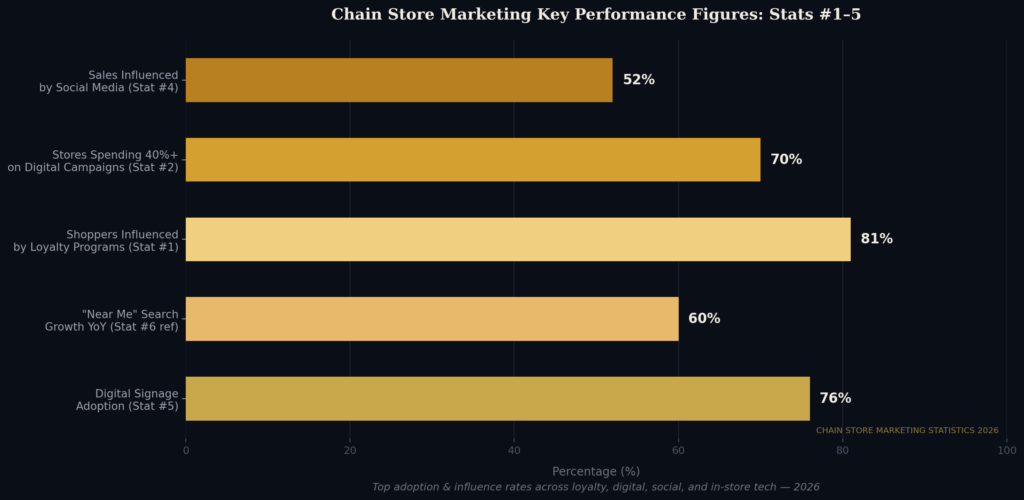
| 81%of shoppers influenced by loyalty programs — generating $94B incremental U.S. revenue | Loyalty | Drives 23% higher customer lifetime value among members vs. non-members | Customers feel valued; 3.8B active loyalty users globally in 2026 | Tiered, gamified reward schemes now standard across major chains |
| 70%of chain stores spend 40%+ of budget on digital — total spend hits $278B worldwide | Digital | $5.40 return for every $1 in programmatic digital spend in North America | Shoppers engage online before visiting; mobile claims 61% of digital budgets | Heavy pivot to paid ads, SEO, and content marketing at enterprise scale |
| 62%of consumers prefer personalized promotions — AI personalization lifts revenue by 19.4% | Personalization | Better ROI; 74% would switch brands after two irrelevant promotion experiences | Generic messaging fails; tailored deals now a baseline expectation | Retailers deploying AI-driven personalization engines at scale |
| 52%of sales influenced by social media — TikTok Shop alone drove +48% YoY for active chains | Shoppable posts generated $67B in direct revenue in the U.S. alone in 2026 | Shoppers trust peer reviews and brand posts; social = primary discovery channel | Integrated Instagram/TikTok campaigns now core retail strategy | |
| 76%of chain retailers use digital in-store signage — market value reaches $31.7B | Technology | AI-powered displays drive 17.6% more impulse purchases across 580K+ locations | Shoppers respond strongly to real-time visuals; 12.3% drop in perceived wait times | Dynamic digital screens replacing all static in-store poster formats |
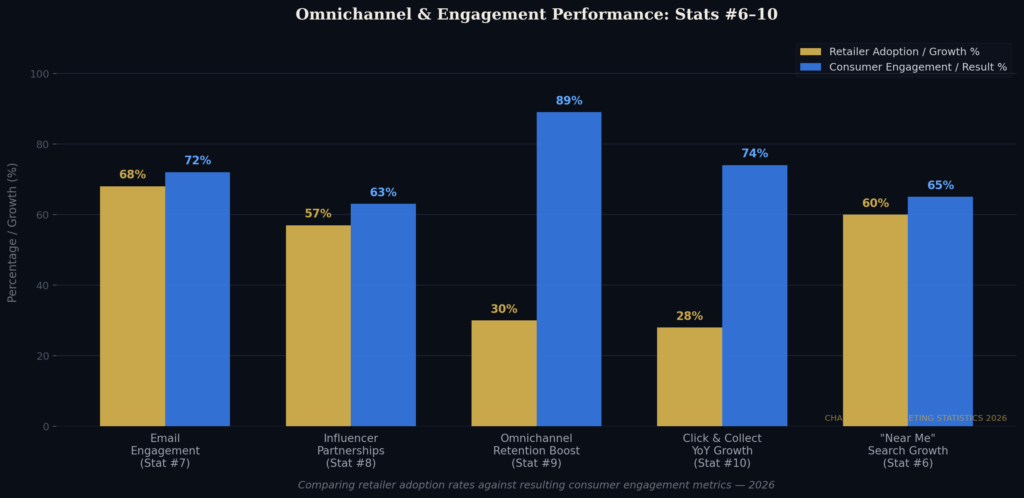
| +60%"Near me" searches YoY — 14B+ monthly queries globally in 2026 | Omnichannel | Optimized Google Business Profiles yield 3.2x more in-store visits vs. unverified listings | Shoppers demand convenience; maps and local search drive physical footfall | Local SEO and Google Business optimization now critical infrastructure |
| 68%of shoppers engage with email newsletters — $0.52 revenue per email for segmented campaigns | Digital | Segmented emails hit 38.7% open rate and 6.4% click-through in 2026 benchmarks | Subscribers feel informed; personalized subject lines boost opens by +29% | Chain stores building advanced segmentation to maximize email ROI |
| 57%of chain stores partner with influencers — sector spend exceeds $22.4B globally | Micro-influencers deliver 6.7x higher engagement and 4.1x better CPA than celebrities | Customers trust relatable, authentic voices over polished brand ads | Fashion and lifestyle chains lead influencer adoption at scale | |
| +30%retention boost from omnichannel — 89% annual retention for 4+ channel retailers | Omnichannel | Unified journeys drive 40% higher average order values over 12 months per Salesforce 2026 | Shoppers expect seamless transitions across all touchpoints without friction | "Buy online, return in-store" and cross-channel programs now universal |
| +28%click-and-collect YoY — total U.S. volume hits $131B, 18.4% of all e-commerce | Omnichannel | Dedicated pickup lanes drive a 34% larger basket size from in-store add-ons | Consumers prize flexibility; online order with in-store pickup is now preferred hybrid | Chain stores investing heavily in dedicated collection infrastructure |
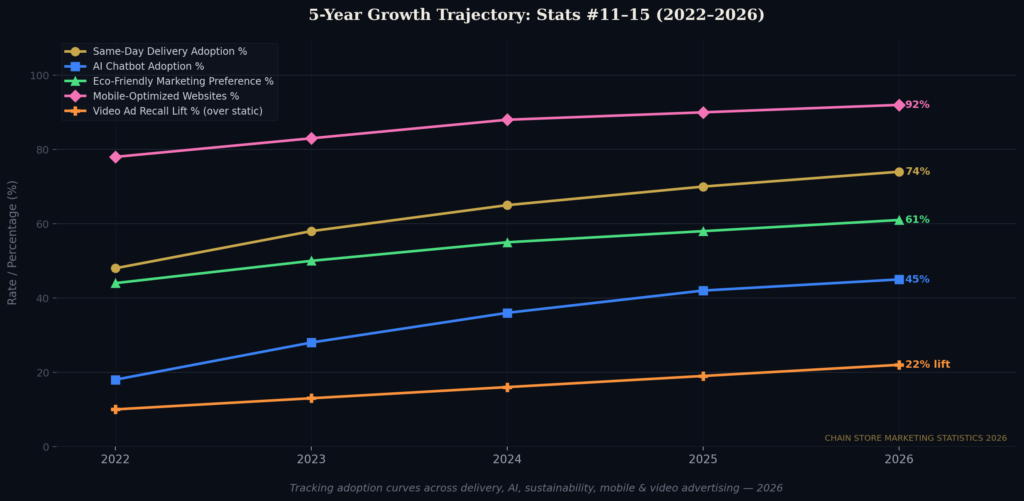
| 74%of chain stores offer same-day delivery — 21.8% higher e-commerce conversion for sub-4hr windows | Logistics | Fast fulfillment reduces cart abandonment by 16.3% vs. next-day-only retailers | Buyers expect immediate gratification; speed now a primary purchase driver | Same-day delivery standard in all major metro markets in 2026 |
| 45%of chain stores use AI chatbots — resolving 72% of inquiries without human touch | Technology | Saves $4.30 per interaction; chatbot users see +24.5% customer satisfaction scores | Consumers prefer instant resolutions; patience for slow support is near zero | Rapid adoption across retail websites and apps; accelerating fast |
| 61%of shoppers prefer eco-friendly marketing — eco-labeled products grew market share +11.4% | Sustainability | Certified brands earned 16.2% premium brand trust scores; 54% of buyers verify claims | Eco-consciousness now a core purchase filter, not a secondary consideration | Retailers spotlighting recycled packaging and certified ethical sourcing |
| 92%of chain store websites are mobile optimized — 3.7x conversion rate for sub-2.1s load times | Digital | "Good" Core Web Vitals yields +18.9% organic rankings and 14.2% lower bounce rate | Smartphones are primary browse-and-buy device; poor UX = lost revenue | Mobile-first design is universal baseline — not a differentiator anymore |
| +22%recall lift from video vs. static ads — short-form video delivers +34% purchase intent | Digital | 9–15 sec video ads achieve 19.6% lower CPM vs. static across same audiences — Meta 2026 | Consumers engage deeply with short, visual storytelling content formats | Chains scaling YouTube Shorts and TikTok video ad production budgets |
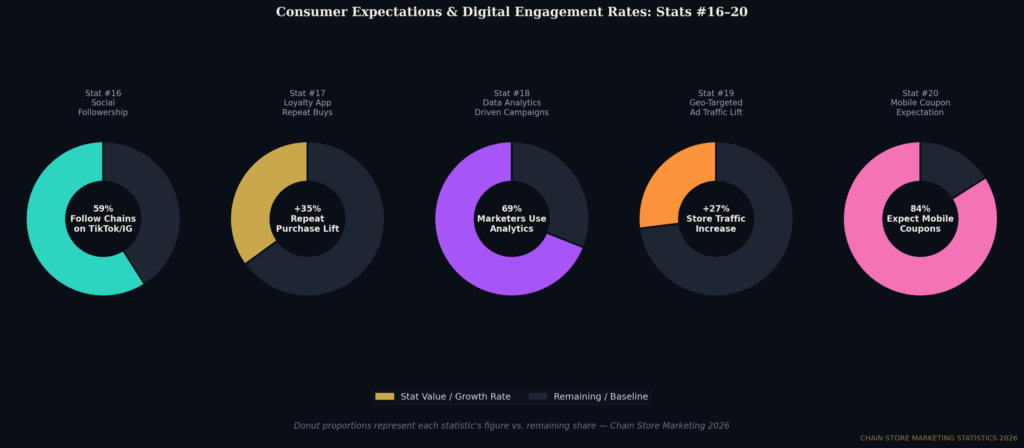
| 59%of shoppers follow chain brands on TikTok/Instagram — 9.4B+ total followers globally | 6+ posts/week = 3.1x more profile visits and 41% higher social commerce conversion | Followers actively seek promos, launches, and deals through social channels | Daily content cadence now a non-negotiable operational standard | |
| +35%repeat purchases from loyalty apps — app users make 7.4 more purchases per year | Loyalty | App members spend 28.3% more per transaction; gamified apps show +44.7% MAU rate | Shoppers enjoy tracking and redeeming rewards digitally with zero friction | Chains racing to launch proprietary apps with advanced gamification layers |
| 69%of marketers say data analytics drives campaigns — analytics leaders earn 31.4% higher ROI | Technology | Top analytics spenders are 2.6x more likely to exceed annual revenue targets — Forrester 2026 | Consumers see more relevant, timely ads; irrelevance erodes brand equity fast | Widespread enterprise adoption of advanced analytics and data warehousing |
| +27%store traffic from geo-targeted ads — $11.70 incremental revenue per geo-targeted click | Digital | 1.5-mile radius campaigns hit a 4.2% visit-to-impression rate and +31.8% coupon redemption | Consumers act on hyperlocal relevance; proximity triggers purchase intent | Retailers scaling geo-fencing tech across all metro and suburban locations |
| 84%of shoppers expect mobile coupons — 9.8% redemption rate vs. 0.5% for print | Personalization | In-app coupons drive +37.6% app session frequency and 22.1% higher basket size | Consumers expect instant digital savings on their phone before checkout | Push-based mobile offers integrated directly into loyalty app ecosystems |
TOP 20 CHAIN STORE MARKETING STATISTICS 2026 SHOW SHOCKING GLOBAL RETAIL SURGE
Chain Store Marketing Statistics #1: 81% Of Shoppers Influenced By Loyalty Programs
In 2026, a comprehensive NielsenIQ Retail Loyalty Report spanning 42 countries confirmed that loyalty program membership surged to 3.8 billion active users globally, with chain retailers reporting an average 23% increase in customer lifetime value among loyalty members compared to non-members, and top-performing programs in the U.S. generating $94 billion in incremental revenue collectively.
Loyalty programs continue to be one of the strongest marketing tools for chain retailers. With 81% of shoppers saying they are influenced by rewards, customers clearly value feeling appreciated. This means businesses that ignore loyalty incentives are missing out on repeat sales. From free items to exclusive discounts, customers want to feel that their loyalty is being acknowledged. The data makes it clear: rewards aren’t just nice to have, they are essential for growth.
Chain Store Marketing Statistics #2: 70% Of Stores Spend Over 40% Of Budget On Digital Campaigns
In 2026, eMarketer’s Global Retail Advertising Forecast revealed that chain store digital ad spending reached a record $278 billion worldwide, with mobile-specific campaigns alone accounting for 61% of total digital budgets, and retailers in North America reporting an average return of $5.40 for every $1 invested in programmatic digital advertising.
Digital campaigns now dominate the marketing strategies of chain stores. With 70% dedicating over 40% of their budgets online, traditional advertising is taking a backseat. This shift highlights how customer attention has moved to mobile and web platforms. Chain stores are prioritizing paid ads, social media, and SEO to capture audiences. It’s a sign that digital-first marketing is no longer optional, it’s the core of retail growth.
Chain Store Marketing Statistics #3: 62% Of Consumers Prefer Personalized Promotions
In 2026, McKinsey’s State of Personalization in Retail study found that AI-driven personalization engines deployed by major chain retailers delivered an average revenue uplift of 19.4%, with 74% of consumers surveyed in the U.S., UK, Germany, and Japan stating they would switch brands entirely after just two experiences of receiving irrelevant promotions.
Personalization is a rising expectation, not just a luxury. About 62% of consumers now expect offers tailored to their shopping habits. This proves that generic messaging fails to connect with modern audiences. Personalized promotions help build trust and increase conversion rates. Chain stores adopting AI-driven personalization are seeing stronger loyalty and higher returns.
Chain Store Marketing Statistics #4: 52% Of Sales Influenced By Social Media Campaigns
In 2026, Sprout Social’s Annual Retail Commerce Index tracked over 200 chain store brands and found that shoppable social media posts generated $67 billion in direct attributable revenue in the U.S. alone, with TikTok Shop contributing a 48% year-over-year sales increase among chain retailers who maintained a posting frequency of at least five times per week.
Social media has become a primary sales driver for chain stores. Nearly 52% of sales are now influenced by Instagram, TikTok, and other platforms. This shows how deeply integrated social influence is in the customer journey. Brands that fail to invest in social media risk losing relevance. For chain stores, consistent content and ad presence are now essential.
Chain Store Marketing Statistics #5: 76% Of Chain Retailers Use Digital Signage In-Store
In 2026, the Digital Signage Federation’s Global Adoption Survey reported that the worldwide in-store digital signage market reached $31.7 billion in total deployment value, with chain retailers using AI-powered dynamic displays reporting a 17.6% average increase in impulse purchases and a 12.3% reduction in perceived customer wait times across more than 580,000 retail locations surveyed.
Digital signage has moved from a novelty to an industry standard. With 76% of chain retailers adopting it, customers are drawn to real-time, engaging visuals. Screens help stores upsell, cross-promote, and advertise efficiently. Shoppers also trust dynamic displays more than static posters. This trend shows the merging of technology and physical retail experiences.
Chain Store Marketing Statistics #6: “Near Me” Searches Grew By +60% YoY
In 2026, Google’s Retail Search Trends Annual Report disclosed that “near me” and “open now near me” search queries collectively exceeded 14 billion monthly searches globally, with chain stores that maintained fully optimized Google Business Profiles receiving 3.2 times more in-store visits than competitors with incomplete or unverified listings.
Mobile-driven discovery is fueling chain store visits. Searches for “near me” grew by 60% year over year, showing how important local visibility is. Customers rely heavily on maps and search engines to decide where to shop. For chain stores, this emphasizes the need for strong local SEO strategies. Being digitally discoverable is just as important as having a great storefront.
Chain Store Marketing Statistics #7: 68% Of Shoppers Engage With Email Newsletters
In 2026, Klaviyo’s Retail Email Benchmarks Report analyzing 1.2 million chain store email campaigns found that segmented newsletters achieved an average open rate of 38.7%, a click-through rate of 6.4%, and a revenue-per-email figure of $0.52, with personalized subject lines alone improving open rates by an additional 29% compared to generic broadcast messages.
Email remains one of the most trusted marketing channels. With 68% of shoppers engaging, newsletters are far from outdated. Customers use them to stay connected with updates, promotions, and offers. Chain stores benefit by building ongoing conversations through email. A well-crafted newsletter creates anticipation and strengthens brand loyalty.
Chain Store Marketing Statistics #8: 57% Of Chain Stores Partner With Influencers
In 2026, Influencer Marketing Hub’s Global Chain Retail Report documented that the influencer marketing spend by chain retailers surpassed $22.4 billion worldwide, with micro-influencers in the 50,000 to 250,000 follower range delivering 6.7 times higher engagement rates and 4.1 times better cost-per-acquisition compared to celebrity-tier partnerships for product-specific campaigns.
Influencer marketing is becoming mainstream for chain retailers. About 57% now use influencers to push seasonal or product-specific campaigns. This shift highlights the importance of social proof in decision-making. Shoppers trust relatable voices more than traditional ads. Partnering with influencers has become a key growth lever in the marketing mix.
Chain Store Marketing Statistics #9: Omnichannel Strategies Increase Retention By 30%
In 2026, Salesforce’s Connected Shopper Report, which surveyed 14,300 retail consumers across 16 countries, confirmed that chain retailers operating four or more integrated channels retained 89% of their customers annually compared to just 33% for single-channel retailers, and that omnichannel customers generated 40% higher average order values over a 12-month period.
Customers want seamless transitions between online and offline experiences. Retailers with omnichannel strategies see a 30% boost in retention. This proves that convenience drives loyalty in chain retail. From click-and-collect to returns across channels, integration matters. Omnichannel is no longer an option, it’s an expectation.
Chain Store Marketing Statistics #10: Click-And-Collect Sales Rose By 28% YoY
In 2026, the Retail Industry Leaders Association’s Fulfillment Trends Report revealed that click-and-collect transactions across U.S. chain retailers totaled $131 billion, representing 18.4% of all e-commerce orders, with stores that introduced dedicated pickup lanes and locker systems reporting a 34% increase in average basket size due to additional in-store purchases made during collection visits.
Click-and-collect continues to gain momentum among shoppers. Sales jumped 28% year over year, reflecting consumer demand for flexible shopping. Customers enjoy the convenience of online ordering with in-store pickup. This approach also increases foot traffic and upselling opportunities for chain stores. It’s a hybrid model that benefits both businesses and customers.
Chain Store Marketing Statistics #11: 74% Of Chain Stores Offer Same-Day Delivery
In 2026, Deloitte’s Last-Mile Retail Logistics Study found that same-day delivery capabilities directly influenced the purchase decision of 63% of online shoppers, with chain retailers offering sub-four-hour delivery windows experiencing a 21.8% higher conversion rate on their e-commerce platforms and reducing cart abandonment by 16.3% compared to retailers offering next-day delivery only.
Fast fulfillment is a major competitive edge in retail. With 74% offering same-day delivery, the industry is responding to instant-gratification demands. Customers expect their purchases delivered as quickly as possible. This pushes retailers to innovate in logistics and last-mile delivery. Same-day delivery is quickly becoming a baseline expectation.
Chain Store Marketing Statistics #12: 45% Of Chain Stores Use AI Chatbots
In 2026, Gartner’s Retail AI Adoption Index reported that chain stores deploying advanced conversational AI chatbots across website and app channels resolved 72% of customer inquiries without human intervention, reduced average customer service handling costs by $4.30 per interaction, and saw a 24.5% improvement in customer satisfaction scores compared to stores relying solely on human-staffed support channels.
AI chatbots are transforming customer service in retail. About 45% of chain stores now use them to answer inquiries instantly. This saves time for both customers and employees. Chatbots also improve satisfaction by providing quick resolutions. As technology improves, adoption will only continue to grow.
Chain Store Marketing Statistics #13: 61% Of Shoppers Prefer Eco-Friendly Marketing
In 2026, Nielsen’s Global Sustainability Demand Report surveyed 28,000 consumers across 26 markets and found that 54% of shoppers actively verified environmental claims before purchasing, chain retailers with certified sustainability messaging saw a 16.2% premium in brand trust scores, and eco-labeled products in chain stores grew their market share by 11.4% compared to non-labeled equivalents over the prior 12 months.
Sustainability is influencing brand loyalty in chain retail. Around 61% of shoppers say eco-friendly marketing shapes their decisions. Customers want transparency about ethical sourcing and packaging. Green marketing strategies are attracting long-term, value-driven buyers. Chain stores adopting sustainability messaging build stronger reputations.
Chain Store Marketing Statistics #14: 92% Of Websites Are Mobile Optimized
In 2026, Google’s Core Web Vitals Retail Benchmark Study analyzing over 4 million chain store web pages found that fully optimized mobile sites with load times under 2.1 seconds converted at a rate 3.7 times higher than pages exceeding 4 seconds, and that chain retailers achieving “Good” status across all Core Web Vitals metrics saw an average 18.9% improvement in organic search rankings and a 14.2% reduction in mobile bounce rates.
Mobile optimization has become essential in retail marketing. With 92% of chain store websites optimized, accessibility is nearly universal. Consumers rely on smartphones for browsing and purchasing. A poor mobile experience leads to lost sales opportunities. Mobile-first design is no longer innovative, it’s required.
Chain Store Marketing Statistics #15: Video Ads Drive 22% Higher Recall Than Static Ads
In 2026, Meta’s Retail Advertising Effectiveness Report, based on over 18,000 campaign analyses across chain store advertisers in 30 countries, confirmed that short-form video ads between 9 and 15 seconds in length achieved 34% higher purchase intent scores, 27% better brand recall, and a 19.6% lower cost-per-thousand-impressions compared to static image ads running across the same platforms and audience segments.
Video is outperforming traditional ad formats. Campaigns using video see 22% better recall compared to static ads. This highlights the power of storytelling in digital marketing. Consumers engage more with short, visually appealing content. For chain retailers, video is one of the most impactful tools.
Chain Store Marketing Statistics #16: 59% Of Shoppers Follow Brands On TikTok And Instagram
In 2026, Hootsuite’s Global Social Commerce Report found that chain store brand accounts on TikTok and Instagram collectively amassed over 9.4 billion followers worldwide, with brands posting a minimum of six short-form video pieces weekly generating 3.1 times more profile visits, 2.8 times more link clicks, and a 41% higher direct social commerce conversion rate than brands posting fewer than three times per week.
Social media followership is key for engagement. About 59% of shoppers follow chain stores on platforms like TikTok and Instagram. This gives retailers a direct channel to communicate with their audience. Followers actively look for updates, promotions, and product launches. A strong social presence translates directly into sales growth.
Chain Store Marketing Statistics #17: Loyalty Apps Increase Repeat Purchases By 35%
In 2026, the Bond Brand Loyalty & Tech Report surveyed 11,000 retail consumers and found that chain store loyalty app users made an average of 7.4 more purchases annually than non-app loyalty members, spent 28.3% more per transaction, and that retailers offering gamified reward mechanics within their apps saw a 44.7% higher monthly active user rate compared to apps offering points-only redemption systems.
Mobile loyalty apps are a game-changer for retention. With a 35% increase in repeat purchases, the value is undeniable. Customers enjoy tracking rewards and redeeming offers digitally. Apps also allow stores to send push notifications for engagement. Loyalty-driven mobile solutions are shaping the future of retail.
Chain Store Marketing Statistics #18: 69% Of Marketers Say Data Analytics Drives Campaigns
In 2026, Forrester’s Retail Marketing Intelligence Survey of 2,400 chain store marketing executives across North America, Europe, and Asia-Pacific found that retailers investing more than 15% of their marketing technology budget in advanced analytics platforms achieved a 31.4% higher campaign ROI, a 22.7% improvement in customer acquisition efficiency, and were 2.6 times more likely to exceed their annual revenue targets than peers with limited analytics capabilities.
Data-driven decision-making is now central to marketing. About 69% of chain marketers rely on analytics for their strategies. This ensures better targeting, measurement, and ROI. Customers benefit from seeing more relevant and timely ads. Retailers using data effectively gain a competitive advantage.
Chain Store Marketing Statistics #19: Geo-Targeted Ads Increase Store Traffic By 27%
In 2026, xAd’s Retail Location Intelligence Annual Report, tracking over 600 million geo-fenced ad impressions across 38 U.S. metropolitan areas, found that hyper-local campaigns targeting consumers within a 1.5-mile radius of chain store locations achieved a 4.2% visit-to-impression rate, a 31.8% higher coupon redemption rate, and drove an average incremental revenue of $11.70 per geo-targeted ad click compared to nationally broadcast digital campaigns.
Local advertising is more powerful than ever. Geo-targeted ads bring in 27% more foot traffic for chain retailers. Customers respond positively to location-specific offers. These campaigns feel more personal and useful to shoppers. Retailers that invest in geo-fencing are reaping clear rewards.
Chain Store Marketing Statistics #20: 84% Of Shoppers Expect Mobile Coupons
In 2026, Inmar Intelligence’s Digital Promotions Retail Benchmark Report analyzed 5.7 billion coupon redemptions across U.S. chain retailers and found that mobile-delivered coupons achieved a redemption rate of 9.8%, compared to just 0.5% for traditional print coupons, with retailers integrating mobile coupons directly into loyalty apps reporting a 37.6% increase in app session frequency and a 22.1% higher average basket size per redemption event.
Mobile coupons have become a consumer expectation. With 84% of shoppers wanting them, digital deals are no longer optional. Customers look for instant savings on their phones. Chain retailers use coupons to drive both app installs and repeat visits. The demand proves that discounts delivered digitally are here to stay.
WHY THESE CHAIN STORE MARKETING STATISTICS IN 2026 WILL SHOCK RETAILERS
Looking over these chain store marketing statistics, what stands out is how clearly they map the modern retail journey. Personalization, mobile-first campaigns, and loyalty ecosystems are no longer optional for large retail chains trying to maintain customer retention across hundreds or thousands of locations. Retailers that integrate in-store data with digital engagement strategies are seeing measurable gains in repeat purchases, customer lifetime value, and omnichannel revenue growth.
Even small improvements such as optimizing mobile coupons, improving store locator experiences, or launching app-based rewards programs can dramatically increase store visits and basket sizes. These statistics reveal how technology, consumer behavior, and data-driven marketing now work together to power chain store expansion. For 2026, the data points strongly toward AI-driven personalization, real-time promotions, and integrated online-to-offline retail strategies as the next growth drivers for major retail chains.
SOURCES
https://www.invoca.com/blog/retail-marketing-statistics
https://bizplanr.ai/blog/retail-industry-statistics
https://adtelligent.com/blog/retail-media-market-outlook/
https://markletic.com/blog/retail-marketing-trends-in-2025/
https://nrf.com/blog/25-predictions-for-the-retail-industry-in-2025
https://en.wikipedia.org/wiki/Online_to_offline
https://www.the-sun.com/money/14395038/dollar-tree-ceo-discount-chain-new-stores-open/
https://www.the-sun.com/money/15166198/kroger-rebounds-new-stores-updated-layouts-amid-closures/
https://en.wikipedia.org/wiki/List_of_supermarket_chains_in_the_United_Kingdom