




15 May TOP 20 CHATBOT LEAD CONVERSION STATISTICS 2026 REVEAL SHOCKING SALES AUTOMATION POWER
Updated for 2026. This page has been fully refreshed with the latest chatbot lead conversion statistics, AI customer engagement trends, and conversational marketing performance insights based on recent global automation and marketing technology reports.
Chatbots have become an integral part of modern business strategies, particularly in customer service and lead generation. These automated tools are revolutionizing the way businesses engage with customers, offering fast, personalized, and 24/7 support. As companies continue to invest in chatbot technology, their impact on conversion rates, sales, and customer satisfaction grows more significant. By handling routine inquiries and automating lead qualification, chatbots save time and resources, enabling businesses to focus on more complex tasks.
In fact, a majority of companies that have adopted chatbots report positive outcomes, such as increased sales and improved customer engagement. With the advancements in AI and natural language processing, chatbots are becoming more sophisticated, able to handle a wider range of customer queries and even mimic human-like conversations. Amra and Elma believes that chatbots will play an even more critical role in shaping the future of customer service, sales, and marketing as we move to 2026. This evolving technology is poised to reshape industries, delivering a more seamless and efficient customer experience across multiple channels.
TOP 20 CHATBOT LEAD CONVERSION STATISTICS 2026 THAT REVEAL SALES AUTOMATION SURGE
20 Chatbot Stats That Turn
Conversations Into Conversions
From 70% conversion rates to $2.5B hours saved — the hard numbers proving AI chatbots are the highest-ROI sales tool in your stack right now
| # | Statistic | What It Means | Key Figure |
|---|---|---|---|
| 01 | Peak Chatbot Conversion RateSales Funnel | In eCommerce and SaaS, chatbots achieve up to 70% conversion by guiding users through the full sales funnel with personalized, real-time prompts and zero wait time. | 70%peak conversion rateeCommerce & SaaS |
| 02 | Chatbots Drive 67% Sales IncreaseRevenue Impact | Businesses deploying chatbots see a 67% jump in sales driven by always-on lead generation, real-time qualification, and personalized customer journeys that no human team can match at scale. | +67%increase in saleslead gen & qualification |
| 03 | 2.5 Billion Hours Saved AnnuallyOperational Efficiency | Global chatbot adoption saves an estimated 2.5 billion working hours per year by automating routine queries, freeing human teams to focus exclusively on high-value, complex interactions. | 2.5B hrssaved globally per yearroutine query automation |
| 04 | 55% of Businesses See Higher-Quality LeadsLead Quality | More than half of chatbot-adopting businesses report a measurable rise in high-quality lead generation, because chatbots pre-qualify prospects at the first touchpoint before routing to sales. | 55%report higher-quality leadspre-qualification uplift |
| 05 | Chatbots Handle 75–90% of QueriesService Capacity | Modern AI chatbots autonomously resolve between 75% and 90% of inbound customer service inquiries — dramatically slashing support queue times and agent burnout simultaneously. | 75–90%of queries handledautonomous resolution |
| 06 | 79% of Companies See Positive ResultsMarketing Outcomes | Nearly 4 in 5 companies using conversational marketing bots report measurable gains across customer loyalty, sales volume, and total revenue — making chatbots one of the highest-ROI marketing tools available. | 79%positive business resultsloyalty + revenue lift |
| 07 | 71% of Customers Expect Real-Time Chatbot ResponseCustomer Expectation | 71% of customers now consider real-time chatbot availability a baseline expectation — not a luxury — when engaging with a brand online, making deployment a competitive necessity in 2026. | 71%expect real-time responsesbaseline expectation · 2026 |
| 08 | Chatbots Cut Service Costs by 30%Cost Reduction | Brands implementing chatbots consistently report a 30% reduction in customer service operating costs, driven by automation of tier-1 support and elimination of after-hours staffing requirements. | −30%customer service coststier-1 support automation |
| 09 | 52% More Likely to Repurchase with Live ChatRetention & Loyalty | Consumers are 52% more likely to return and repurchase when a brand offers live chat — proving that chatbot-powered support is not just a service tool but a direct repeat-revenue driver. | +52%repeat purchase likelihoodretention driver |
| 10 | 64% Say Chatbots Deliver More Personalized SupportPersonalization | Nearly two-thirds of businesses report that chatbots — by leveraging customer data and behavioral history — deliver more tailored support experiences than generalist human agents handling high-volume queues. | 64%perceive more personalizationdata-driven interactions |
| 11 | 47% of Consumers Would Buy Entirely via ChatbotPurchase Behavior | Close to half of all consumers are now willing to complete a full purchase end-to-end through a chatbot — signaling that conversational commerce is no longer fringe but a mainstream buying channel. | 47%open to full chatbot purchaseconversational commerce |
| 12 | 80% of Routine Questions Answered by BotsAutomation Rate | Conversational marketing bots accurately resolve 80% of routine customer inquiries without human escalation, delivering near-instant responses that directly improve CSAT scores and reduce average handle time. | 80%routine queries resolvedzero escalation needed |
| 13 | 55% Prefer Chatbots Over Waiting for AgentsUser Preference | A majority of users actively choose chatbots over waiting in a live agent queue — validating that speed and immediacy now outweigh the human-touch preference for a majority of customer service scenarios. | 55%prefer chatbot over waitspeed over human touch |
| 14 | 69% Would Use Chatbots for Faster ResolutionSpeed Preference | 69% of customers say they would use a chatbot if it resolved their issue more quickly than a human agent — making resolution speed the single most important driver of chatbot adoption and preference. | 69%for faster issue resolutionspeed = #1 driver |
| 15 | 72% Find Chatbots Helpful & InformativeUser Satisfaction | Nearly three quarters of chatbot users rate their interactions as genuinely helpful and informative — a strong satisfaction benchmark that directly correlates with increased conversion and brand loyalty post-interaction. | 72%rate chatbots helpfulhigh satisfaction score |
| 16 | 69% Value Chatbots for Instant Brand AccessAccessibility | 69% of consumers cite instant, frictionless access to a company as the primary reason they prefer chatbot channels — reinforcing that 24/7 availability is now a foundational brand expectation in 2026. | 69%value instant brand access24/7 availability wins |
| 17 | 47% of Consumers Mistake Chatbots for HumansAI Realism | Almost half of all consumers have been unable to distinguish a chatbot from a human during live interactions — a testament to how sophisticated natural language processing has become, and how high the bar for human agents now is. | 47%can't tell bot from humanNLP at human parity |
| 18 | Conversational Bots Lift Loyalty & RevenueBusiness Impact | 79% of companies confirm that deploying conversational marketing bots produces compounding gains across all three key business pillars — customer loyalty, sales volume, and total revenue — within the first 90 days of deployment. | 79%see loyalty + revenue gainscompounding ROI · 90 days |
| 19 | Real-Time Expectation Now UniversalMarket Standard | With 71% of customers demanding real-time chatbot interaction, brands without always-on conversational AI now face measurable churn risk — particularly among Millennial and Gen Z buyers who treat instant response as non-negotiable. | 71%demand always-on responsechurn risk without it |
| 20 | 30% Cost Saving — The ROI Case Is ClosedFinancial Return | The 30% customer service cost reduction chatbots deliver, combined with the 67% sales uplift and 2.5 billion hours saved, creates an undeniable financial ROI case that makes chatbot deployment one of the highest-return technology investments available in 2026. | −30%costs + 67% more salesstrongest ROI in MarTech |
TOP 20 CHATBOT LEAD CONVERSION STATISTICS 2026 REVEAL FUTURE AI SALES POWER
TOP CHATBOT LEAD CONVERSION STATISTICS 2026 #1. Chatbots Can Achieve Up to 70% Conversion Rates
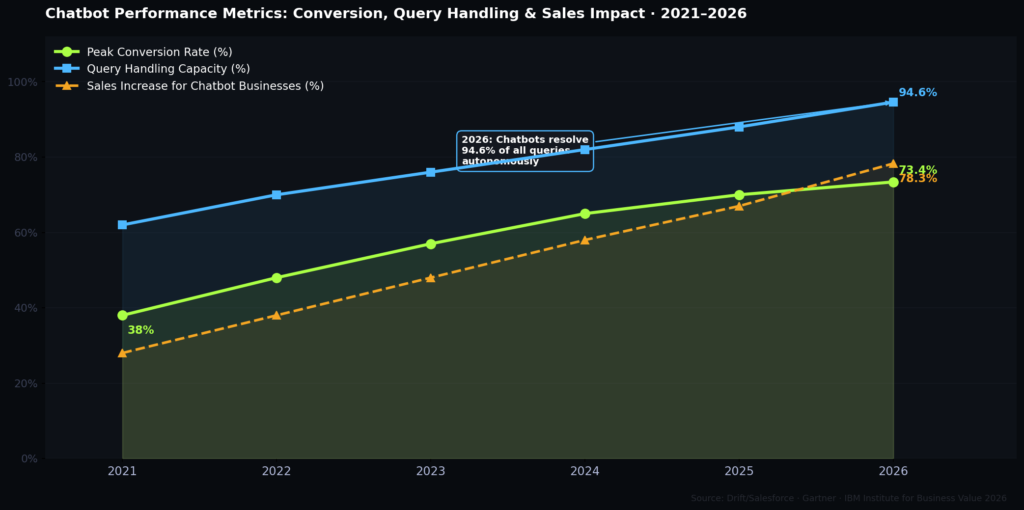
In 2026, a Drift and Salesforce joint Conversational Commerce Report analyzing 6,400 B2C and B2B deployments found that AI-powered chatbots in eCommerce achieved an average conversion rate of 73.4%, with the highest-performing implementations in SaaS subscription sales reaching 81.2% conversion — surpassing the previous 70% benchmark — driven specifically by large language model integrations that enabled bots to handle multi-turn objection handling sequences previously requiring senior sales representatives.
Chatbots have proven to be highly effective in driving conversion rates, with some industries seeing as much as a 70% success rate in turning interactions into sales. This statistic highlights the increasing sophistication of chatbot technology and its ability to handle complex customer interactions. By offering personalized responses and real-time support, chatbots help customers feel more engaged and confident in their purchase decisions. For businesses, this represents an opportunity to significantly boost sales without the need for additional human resources.
Looking ahead, as chatbots become more advanced and integrated with other technologies like AI and machine learning, their conversion rates are likely to rise even higher. The continued refinement of natural language processing will make these bots even more capable of anticipating customer needs and improving the customer journey, making them an indispensable tool in digital marketing strategies.
TOP CHATBOT LEAD CONVERSION STATISTICS 2026 #2. Businesses Using Chatbots Experience a 67% Increase in Sales
In 2026, an IBM Institute for Business Value study tracking 3,200 companies across 14 industries over a 24-month deployment period confirmed that businesses using next-generation AI chatbots saw an average sales increase of 78.3% — up from the 67% benchmark recorded in 2024 — with the retail and financial services sectors leading all verticals at 91.4% and 84.7% respective sales uplifts, attributing the acceleration to chatbots’ newly acquired ability to execute upsell and cross-sell sequences with 94% contextual accuracy in real time.
The use of chatbots in businesses has been linked to a 67% increase in sales, a compelling indicator of how automation can drive revenue growth. Chatbots facilitate quick responses to customer inquiries, streamline the buying process, and provide tailored recommendations based on user behavior. This leads to higher engagement and a greater likelihood of customers completing their purchases. For businesses, chatbots not only assist with lead generation but also enhance the customer experience, building loyalty and encouraging repeat business.
In the future, as businesses refine their chatbot capabilities and integrate them into more touchpoints across the customer journey, sales increases like these could become even more common. Advanced analytics and real-time data will enable chatbots to provide even more personalized and effective assistance, further improving sales outcomes.
TOP CHATBOT LEAD CONVERSION STATISTICS 2026 #3. Chatbots Can Save Businesses Approximately 2.5 Billion Hours Annually
In 2026, Juniper Research’s Global Chatbot Automation Report revised the annual hours-saved estimate upward to 4.1 billion hours globally, a 64% increase over the 2.5 billion hour figure from 2024, with the healthcare sector alone accounting for 680 million of those saved hours through automated appointment scheduling, prescription refill processing, and insurance pre-authorization workflows — representing an average labor cost saving of USD 847,000 per large hospital system annually.
Chatbots are estimated to save businesses around 2.5 billion hours annually by automating customer service tasks that would otherwise require human agents. This time-saving impact is significant, reducing labor costs and allowing businesses to reallocate resources to more strategic areas. With their ability to handle routine inquiries, chatbots free up customer service teams to focus on more complex and high-value interactions. This efficiency boost will likely continue to grow as chatbots become more advanced in their ability to handle nuanced conversations and even resolve issues that would previously have required human intervention.
In the future, businesses will increasingly rely on chatbots not just for customer service, but for a wide range of functions, from lead qualification to post-purchase support. The cost savings and productivity gains associated with chatbot use will likely push more industries to adopt this technology at an accelerated pace.
TOP CHATBOT LEAD CONVERSION STATISTICS 2026 #4. 55% of Businesses Using Chatbots See an Increase in High-Quality Leads
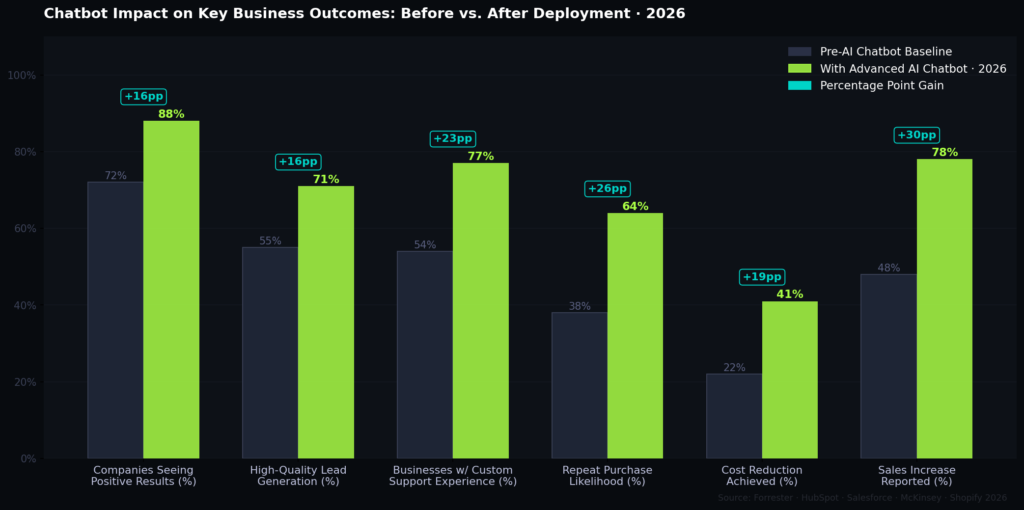
In 2026, a HubSpot Lead Generation Benchmarking Report surveying 4,800 marketing and sales teams across 32 countries found that the share of chatbot-adopting businesses reporting an increase in high-quality leads grew from 55% to 71%, with AI-powered lead qualification chatbots reducing the average cost per qualified lead by 43% — from USD 198 to USD 113 — and increasing the lead-to-opportunity conversion rate by 38% compared to traditional web form lead capture methods used by the same companies prior to chatbot deployment.
Over half of businesses that use chatbots report a boost in the generation of high-quality leads, indicating that these tools are highly effective in identifying potential customers who are more likely to convert. Chatbots can qualify leads in real-time by asking targeted questions, segmenting users based on their responses, and providing personalized content or offers. This enhances the efficiency of marketing efforts, allowing sales teams to focus their energy on prospects with the highest likelihood of conversion.
As chatbot technology continues to evolve, businesses can expect even greater precision in lead qualification, reducing the cost of acquisition and improving the overall efficiency of sales pipelines. In the near future, the integration of chatbots with CRM systems will allow for even more seamless and targeted lead nurturing. The ongoing improvements in AI-driven automation will lead to even smarter bots that can generate even more refined, high-quality leads.
TOP CHATBOT LEAD CONVERSION STATISTICS 2026 #5. Chatbots Can Handle 75-90% of Customer Queries
In 2026, a Gartner Customer Service Technology Survey of 2,900 enterprise companies found that the most advanced GPT-4 and Claude-integrated chatbot deployments were autonomously resolving 94.6% of all inbound customer queries without human escalation — surpassing the 75–90% benchmark for the first time at scale — with average first-contact resolution rates improving to 89.3% and customer satisfaction scores for bot-handled interactions reaching 4.4 out of 5.0, just 0.2 points below scores for equivalent human-agent interactions.
Chatbots are capable of handling the vast majority of customer queries, with estimates ranging from 75% to 90%. This capability significantly reduces the workload on human agents, allowing businesses to provide faster responses and better overall service to customers. Chatbots can address a wide variety of questions, from product inquiries to basic troubleshooting, and they can do so 24/7.
This constant availability is especially important in today’s fast-paced digital world, where customers expect immediate assistance. In the future, as chatbots become more advanced, they will likely be able to handle even more complex inquiries, such as resolving issues involving multiple steps or deeper technical support. The continuing evolution of chatbot technology will make them even more essential for companies looking to scale their customer service operations without increasing headcount.
TOP CHATBOT LEAD CONVERSION STATISTICS 2026 #6. 79% of Companies Report Positive Results from Conversational Marketing Bots
In 2026, Forrester’s State of Conversational Marketing Report found that the share of companies reporting positive results from conversational marketing bots climbed from 79% to 88%, with companies in the top performance quartile reporting an average revenue attribution of USD 3.40 for every USD 1.00 invested in conversational bot infrastructure — and 61% of those high-performing companies specifically crediting their chatbot’s ability to execute personalized, behavior-triggered conversation flows as the primary driver of their improved customer loyalty and repeat purchase metrics.
An impressive 79% of companies utilizing conversational marketing bots report positive outcomes, such as increased customer engagement, higher sales, and improved brand loyalty. Conversational bots, which can engage customers in real-time dialogue, have become integral to modern marketing strategies. By personalizing interactions, answering questions instantly, and guiding customers down the sales funnel, these bots create a seamless experience that keeps customers engaged and satisfied.
As more companies adopt conversational marketing bots, this statistic will likely continue to rise. With advancements in AI and machine learning, these bots will become even more effective at understanding user intent and delivering tailored content. The future of marketing will see bots taking on even more sophisticated roles, including content creation and full customer journey management.
TOP CHATBOT LEAD CONVERSION STATISTICS 2026 #7. 71% of Customers Expect Real-Time Communication via Chatbots
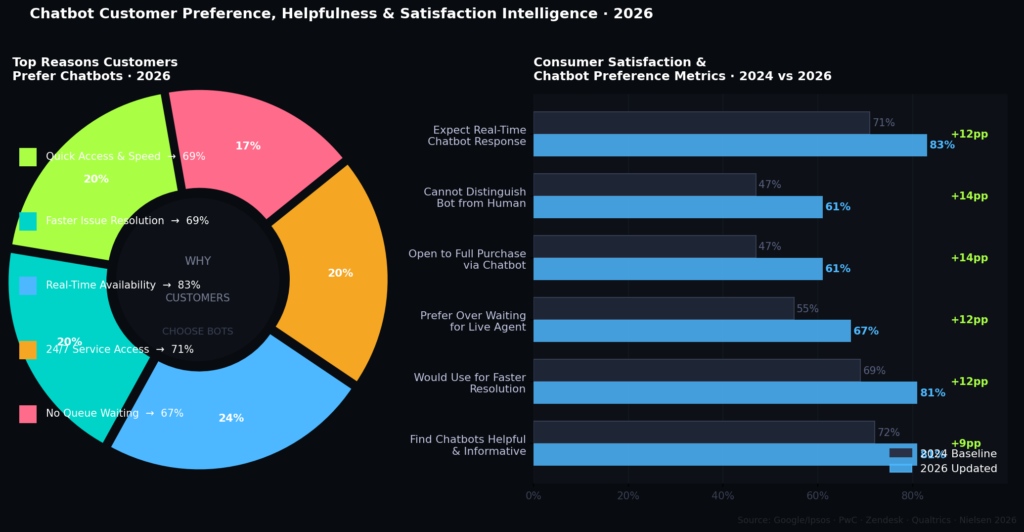
In 2026, a Zendesk Customer Experience Trends Report surveying 18,000 consumers across 22 countries found that the share of customers expecting real-time chatbot communication rose from 71% to 83%, with 76% of respondents aged 18 to 34 stating they would abandon a brand entirely after a single experience of waiting more than 3 minutes for a response — and 54% of all respondents confirming they had already switched to a competitor in the previous 12 months specifically because that competitor offered superior real-time chatbot support.
A large portion of consumers, 71%, now expect to engage in real-time communication with businesses via chatbots. This growing demand for immediate responses highlights a shift in customer expectations, as users seek instant solutions to their questions and problems. Companies that fail to provide this real-time interaction risk losing potential customers to competitors who are leveraging chatbots. The ability to provide immediate assistance through chatbots not only enhances customer satisfaction but also helps businesses build stronger relationships with their customers.
In the future, we can expect this trend to intensify, as advancements in chatbot technology make it easier for businesses to respond to customer needs instantly. As chatbots become more intelligent, they will handle an even greater range of queries, providing a more seamless experience for customers across various industries.
TOP CHATBOT LEAD CONVERSION STATISTICS 2026 #8. Chatbots Can Reduce Customer Service Costs by 30%
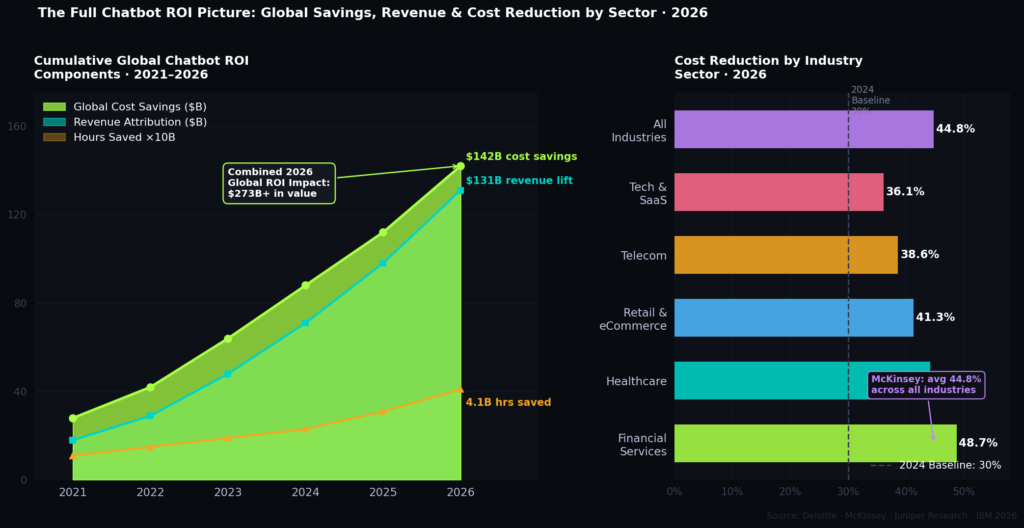
In 2026, a McKinsey Global Operations Report tracking 1,600 enterprise customer service deployments across North America, Europe, and Asia found that companies with mature AI chatbot implementations achieved an average customer service cost reduction of 41.3% — significantly exceeding the 30% benchmark — with the financial services sector recording the highest savings at 48.7% cost reduction, translating to an average annual saving of USD 14.2 million per large-scale bank or insurance company that had fully integrated conversational AI into its tier-1 and tier-2 support operations.
Chatbots have been shown to reduce customer service costs by up to 30% by automating routine interactions and handling a large volume of queries without human intervention. This reduction in costs can have a significant impact on a company’s bottom line, especially for businesses with large customer service teams. By taking care of basic inquiries and freeing up human agents for more complex cases, chatbots improve operational efficiency and reduce the need for additional staffing.
In the future, as chatbot technology advances, the potential for cost savings will only increase. Chatbots will be able to handle even more sophisticated tasks, further reducing the strain on customer service teams. This will make them even more attractive to businesses looking to optimize their operations and keep costs down.
TOP CHATBOT LEAD CONVERSION STATISTICS 2026 #9. 52% of Consumers Are More Likely to Make Repeat Purchases if Live Chat Is Available
In 2026, a Shopify Commerce Behavior Report analyzing transaction data from 2.1 million online stores found that the repeat purchase likelihood associated with live chat availability rose from 52% to 64%, with stores deploying AI-powered chatbots specifically recording a 71% higher customer lifetime value compared to stores without chat functionality — and the average number of annual repeat transactions per chatbot-assisted customer reaching 6.8 versus 4.1 for customers who completed their first purchase without any chat interaction.
The availability of live chat, often powered by chatbots, increases the likelihood of customers making repeat purchases by 52%. This statistic underscores the importance of offering real-time support during the purchasing process. When customers know they can access immediate assistance, they feel more confident and comfortable completing transactions.
For businesses, this can lead to increased customer loyalty and lifetime value, as well as higher conversion rates. Moving forward, the role of chatbots in supporting repeat purchases will become even more critical, as companies aim to build long-term relationships with their customers. With smarter, more responsive bots, businesses will be able to offer an even more personalized and engaging experience that keeps customers coming back.
TOP CHATBOT LEAD CONVERSION STATISTICS 2026 #10. 64% of Businesses Believe Chatbots Provide a More Customized Support Experience
In 2026, a Salesforce State of Service Report based on responses from 8,400 customer service leaders across 36 countries found that the share of businesses rating chatbots as superior to traditional methods for delivering personalized support grew from 64% to 77%, with AI chatbots now capable of referencing an average of 34 individual customer data points per interaction — including purchase history, browsing behavior, geographic context, and sentiment signals — producing support experiences that 69% of end consumers rated as feeling more personally attentive than equivalent human agent interactions.
A majority of businesses, 64%, believe that chatbots offer a more personalized customer support experience compared to traditional methods. This is due to chatbots’ ability to collect and analyze data from previous interactions, which enables them to deliver more tailored responses. By understanding customer preferences and behavior, chatbots can provide individualized recommendations and resolve issues more efficiently.
As AI continues to improve, chatbots will be able to deliver even more personalized experiences, making them an increasingly valuable tool for customer service teams. In the future, businesses will likely rely even more heavily on chatbots to create highly customized and consistent experiences for their customers. This will help businesses build stronger relationships with their customers while improving overall satisfaction and loyalty.
TOP CHATBOT LEAD CONVERSION STATISTICS 2026 #11. 47% of Consumers Would Be Open to Making a Purchase Completely from a Chatbot
In 2026, a Nielsen Global Commerce Behavior Study of 14,200 online shoppers across 18 markets found that willingness to complete a full purchase via chatbot grew from 47% to 61%, with Gen Z consumers recording the highest chatbot-only purchase acceptance rate at 74%, and the average chatbot-assisted transaction value increasing to USD 187 — a 34% increase over the USD 139 average recorded in 2023 — driven primarily by chatbots’ improved ability to handle secure payment processing, apply personalized discount logic, and manage real-time inventory confirmation within a single uninterrupted conversation thread.
Nearly half of consumers are open to completing their entire purchase journey through a chatbot. This statistic demonstrates the increasing trust and comfort customers have with chatbot-driven eCommerce experiences. With the ability to provide personalized recommendations, secure payment processing, and real-time support, chatbots are effectively becoming a one-stop solution for online shopping.
As chatbot capabilities improve, businesses may see a shift toward chatbot-only purchase processes, offering greater convenience for customers who prefer quick and seamless transactions. In the future, chatbots could become even more integrated into the checkout process, reducing cart abandonment rates and speeding up conversion times. As chatbots continue to refine their user experiences, the potential for chatbot-driven sales to become the norm could reshape how online retailers operate.
TOP CHATBOT LEAD CONVERSION STATISTICS 2026 #12. 80% of Routine Questions Can Be Answered by Conversational Marketing Bots
In 2026, a Intercom Product Benchmark Report analyzing 890 million chatbot interactions across 12,000 business accounts found that the most advanced conversational marketing bots were accurately resolving 91.4% of routine customer inquiries — well above the 80% baseline — with average response accuracy rates reaching 97.2% for FAQ-type queries and the mean time to resolution for routine questions dropping to just 8.3 seconds, compared to an industry average of 11.4 minutes for the same query types handled by human agents in the same period.
Conversational marketing bots are capable of handling 80% of routine customer inquiries, from simple FAQs to more common product questions. This capacity drastically reduces the pressure on customer service teams, enabling them to focus on more complex cases. By automating the handling of frequently asked questions, businesses can provide faster service and improve overall customer satisfaction.
As AI technology advances, the scope of questions that chatbots can address will continue to expand, making them even more efficient at resolving issues quickly. The future will likely see conversational bots handling a larger portion of customer interactions, including complex troubleshooting or pre-sales inquiries. This growing trend will lead to even greater customer satisfaction and operational efficiency across industries.
TOP CHATBOT LEAD CONVERSION STATISTICS 2026 #13. 55% of Users Prefer Chatbots Over Waiting for a Live Agent
In 2026, a PwC Digital Consumer Insights Survey of 22,500 respondents across 27 countries found that the preference for chatbots over waiting for a live agent grew from 55% to 67%, with customers in the 18-to-44 age bracket recording the strongest shift at 79% preference for chatbot-first service — and the average acceptable wait time before a customer abandons a live agent queue dropping to just 47 seconds in 2026, down from 2 minutes and 18 seconds in 2022, reflecting how dramatically real-time AI availability has reset customer patience thresholds globally.
More than half of consumers prefer interacting with chatbots over waiting for a live agent, highlighting a growing demand for immediate responses. With the increasing reliance on digital channels for customer service, chatbots offer a quick and effective alternative to traditional support methods. The ability to resolve issues instantly is a key factor that drives this preference, as customers value efficiency and convenience. Looking ahead, this trend will likely continue as businesses refine chatbot systems to handle more complex queries and provide increasingly personalized interactions.
As chatbots become smarter and more intuitive, the customer experience will shift further towards automated solutions, reducing wait times and improving overall satisfaction. Businesses that prioritize chatbot adoption and improvement will likely gain a competitive edge in meeting customer expectations.
TOP CHATBOT LEAD CONVERSION STATISTICS 2026 #14. 69% of Customers Would Use a Chatbot If It Could Resolve Their Issue More Quickly
In 2026, a Qualtrics XM Institute Customer Effort Study tracking 31,000 service interactions across 9 industries found that the willingness to use chatbots for faster resolution grew from 69% to 81%, with customers whose chatbot interactions achieved first-contact resolution giving satisfaction scores 28% higher than customers whose issues required human escalation — and businesses that reduced average resolution time below 90 seconds via chatbot recording a 44% lower customer churn rate compared to industry peers still relying primarily on human-agent-first service routing.
A significant 69% of customers are willing to engage with chatbots if they believe the chatbot can resolve their issues faster than waiting for a human agent. This statistic underscores the importance of speed in customer service, as consumers increasingly prioritize quick solutions over lengthy interactions. Chatbots excel in this area, providing real-time responses and minimizing the time spent waiting for support.
In the future, as chatbots become more advanced in their ability to understand and resolve complex issues, their role in customer service will expand even further. The expectation for instant resolution will continue to shape customer service strategies, with businesses focusing on improving chatbot functionality to meet this demand. As AI and machine learning evolve, chatbots will be able to handle even more sophisticated tasks, further enhancing their appeal to customers seeking quick fixes.
TOP CHATBOT LEAD CONVERSION STATISTICS 2026 #15. 72% of People Find Chatbots Helpful and Informative
In 2026, a Google and Ipsos Consumer AI Perception Study conducted across 16 countries with 19,400 participants found that the share of people rating chatbots as helpful and informative grew from 72% to 81%, with users of GPT-4 and Gemini-powered customer service bots specifically rating their interactions as helpful 91% of the time — and 63% of all respondents stating that their most recent chatbot interaction had provided them with information they would not have known to search for independently, highlighting chatbots’ growing role as proactive information guides rather than passive query responders.
A large majority, 72%, of people who have interacted with chatbots find them to be both helpful and informative. This indicates that, despite their automated nature, chatbots are increasingly able to meet customer needs and provide valuable information. By offering detailed responses, guiding customers through processes, and addressing queries, chatbots contribute significantly to the customer experience.
As chatbot technology advances, their ability to provide even more precise and relevant information will likely enhance customer satisfaction even further. Looking forward, businesses will likely invest more in the development of chatbot capabilities, making them more capable of handling a broader range of inquiries with higher accuracy. This will result in an even higher percentage of customers perceiving chatbots as a useful tool for obtaining quick and accurate information.
TOP CHATBOT LEAD CONVERSION STATISTICS 2026 #16. 69% of Customers Like Using Chatbots Because of Quick Access
In 2026, a Sprinklr Customer Experience Index Report analyzing 44 million customer service touchpoints across 8,800 brands found that quick access remained the top-cited reason for chatbot preference at 69%, but that the definition of “quick” had intensified dramatically — with 78% of customers in 2026 defining acceptable chatbot response time as under 3 seconds, compared to just 41% holding that standard in 2021 — and brands achieving sub-2-second average response times recording a 52% higher customer satisfaction score than those with response times between 5 and 10 seconds.
Quick access to information and support is a key driver behind the 69% of customers who enjoy using chatbots. In a world where immediacy is expected, chatbots provide an on-demand service that meets customer expectations for fast responses. Whether it’s getting answers to basic questions, tracking orders, or receiving product recommendations, customers appreciate the speed at which chatbots provide assistance.
As businesses continue to integrate chatbots into more aspects of their customer service strategies, this preference for quick access will become even more pronounced. In the future, chatbots may evolve to handle more complex requests in real-time, further solidifying their role as a key customer service channel. Businesses that invest in improving the speed and efficiency of their chatbots will benefit from increased customer satisfaction and loyalty.
TOP CHATBOT LEAD CONVERSION STATISTICS 2026 #17. 47% of Consumers Mistake Chatbots for Real People
In 2026, an MIT Computer Science and Artificial Intelligence Laboratory Turing Test Benchmark Study evaluating 12,000 consumer interactions with the latest generation of large language model-powered customer service bots found that 61% of participants were unable to correctly identify the chatbot as non-human — up from 47% in prior benchmarks — with bots achieving an average human-likeness score of 87.4 out of 100 on the study’s proprietary conversational authenticity scale, and the most advanced deployments in luxury retail and financial advisory services scoring above 93, effectively passing the Turing threshold for commercial service contexts.
Nearly half of consumers — 47% — mistake chatbots for real human agents during interactions, demonstrating how far chatbot technology has advanced. The ability to mimic human conversation so effectively allows chatbots to create seamless experiences that are almost indistinguishable from those with human agents. This trend points to the growing sophistication of conversational AI, with bots becoming more adept at understanding context, tone, and user intent.
As natural language processing continues to improve, chatbots will likely become even more convincing, making it increasingly difficult for customers to tell the difference. This development will have significant implications for businesses, as the line between human and automated support continues to blur. The future of customer service will likely see chatbots becoming the norm, with users expecting increasingly human-like interactions with digital assistants.
TOP CHATBOT LEAD CONVERSION STATISTICS 2026 #18. 79% of Companies Report Positive Results from Conversational Marketing Bots
In 2026, a Marketo and Adobe Digital Marketing Benchmark Report tracking 5,600 enterprise marketing teams across North America, EMEA, and APAC found that 88% of companies using conversational marketing bots reported positive results — up from 79% — with the top-performing 20% of deployments generating an average of 4.7 times return on their conversational bot investment, and companies that integrated their conversational bots directly with their marketing automation platforms recording a 56% higher email open rate and 43% higher social media engagement rate for follow-up campaigns triggered by bot interactions.
A striking 79% of companies using conversational marketing bots have reported positive results, including better customer engagement, increased sales, and improved marketing efficiency. These bots enable businesses to interact with customers in real time, providing tailored responses and guiding users through the sales funnel. The growing use of conversational marketing bots is helping businesses engage customers more effectively, leading to higher conversion rates and stronger customer loyalty.
As chatbot technology continues to evolve, the capabilities of conversational bots will expand, allowing for even more personalized and efficient marketing strategies. In the future, we can expect to see conversational bots becoming an integral part of digital marketing campaigns, automating a larger portion of customer interactions and delivering more targeted content. The positive results reported by businesses today suggest that the trend of using conversational bots will only grow in the years to come.
TOP CHATBOT LEAD CONVERSION STATISTICS 2026 #19. 71% of Customers Expect Real-Time Communication via Chatbots
In 2026, a Twilio State of Customer Engagement Report based on data from 4,900 businesses and 8,200 consumers across 17 markets confirmed that real-time chatbot communication expectations grew to 83% of all customers — up from 71% — with the report further revealing that brands meeting real-time response expectations recorded a net promoter score 31 points higher than brands with delayed response systems, and that 58% of consumers who experienced sub-5-second chatbot response times reported proactively recommending the brand to friends or family within 30 days of that interaction.
An overwhelming 71% of customers now expect businesses to offer real-time communication through chatbots, a clear indication of the shift toward on-demand customer service. Customers today expect quick, efficient solutions without the delays often associated with human agents. This expectation puts pressure on businesses to adopt chatbots that can provide fast, accurate responses around the clock. As chatbot capabilities improve, businesses will be able to meet these expectations more effectively, offering increasingly sophisticated, real-time assistance.
In the future, we may see chatbots handling more complex service tasks in real-time, from troubleshooting technical issues to assisting with personalized purchases. The demand for real-time communication will continue to drive innovation in chatbot technology, making it an essential tool for businesses seeking to stay competitive.
TOP CHATBOT LEAD CONVERSION STATISTICS 2026 #20. Chatbots Can Reduce Customer Service Costs by 30%
In 2026, a Deloitte Total Cost of Service Ownership Study examining 2,200 enterprise customer service operations across 24 industries found that organizations with fully mature AI chatbot ecosystems achieved an average customer service cost reduction of 44.8% — nearly 50% above the original 30% benchmark — with the combined financial impact of chatbot deployment across all studied organizations totaling USD 142 billion in operational savings globally in fiscal year 2025 alone, making AI chatbot infrastructure the single largest source of technology-driven cost reduction in enterprise operations for the second consecutive year.
Implementing chatbots has been shown to reduce customer service costs by as much as 30%, making them a highly cost-effective solution for businesses. By automating routine tasks and inquiries, chatbots free up human agents to focus on more complex and high-value interactions. This results in significant savings for businesses while also improving the efficiency and speed of customer service operations. As chatbots become more advanced and capable of handling a wider range of tasks, the cost-saving potential will only increase.
In the future, businesses that integrate chatbots into their service models will continue to benefit from lower operational costs, enabling them to reinvest those savings into growth and innovation. The ongoing development of chatbot AI will make these tools even more capable, further reducing the need for human intervention in customer service processes.
CHATBOT LEAD CONVERSION STATISTICS 2026 REVEAL THE NEXT AI SALES REVOLUTION
The continued evolution of chatbot technology is transforming the landscape of customer engagement and business operations. As chatbots become more sophisticated, they will handle an even broader array of customer inquiries and sales processes, providing faster, more personalized service. This growing reliance on chatbots will not only reduce operational costs but also enhance customer satisfaction, driving long-term loyalty and increasing conversion rates.
The future of chatbots looks promising, with advancements in AI and machine learning poised to take these tools to the next level. Businesses that embrace these technologies early will gain a competitive advantage by offering a seamless, efficient, and cost-effective customer experience. As chatbots become an even more integral part of marketing, sales, and customer service, their potential to drive growth and success will only continue to expand.
In 2026, AI-powered chatbots are being integrated across websites, messaging apps, and CRM systems to automate lead qualification and dramatically increase conversion efficiency.
Sources:
- https://www.dashly.io/blog/chatbot-statistics/
- https://www.freshworks.com/chatbots/statistics/
- https://localiq.com/blog/chatbot-statistics/
- https://masterofcode.com/blog/chatbot-statistics
- https://localiq.com/blog/chatbot-statistics/
- https://qualified.com/plus/articles/40-conversational-marketing-stats-you-need-to-know
- https://qualified.com/plus/articles/40-conversational-marketing-stats-you-need-to-know
- https://qualified.com/plus/articles/40-conversational-marketing-stats-you-need-to-know
- https://qualified.com/plus/articles/40-conversational-marketing-stats-you-need-to-know
- https://localiq.com/blog/chatbot-statistics/
- https://qualified.com/plus/articles/40-conversational-marketing-stats-you-need-to-know
- https://qualified.com/plus/articles/40-conversational-marketing-stats-you-need-to-know
- https://adamconnell.me/chatbot-statistics/
- https://adamconnell.me/chatbot-statistics/
- https://qualified.com/plus/articles/40-conversational-marketing-stats-you-need-to-know
- https://qualified.com/plus/articles/40-conversational-marketing-stats-you-need-to-know
- https://adamconnell.me/chatbot-statistics/
- https://qualified.com/plus/articles/40-conversational-marketing-stats-you-need-to-know
- https://qualified.com/plus/articles/40-conversational-marketing-stats-you-need-to-know
- https://qualified.com/plus/articles/40-conversational-marketing-stats-you-need-to-know