




22 Jul TOP 20 CHECKOUT ABANDONMENT STATISTICS 2026 REVEAL BILLIONS LOST AT THE FINAL CLICK
What’s even more surprising is how consistent these patterns have stayed over the years, despite all the tech advances. In 2025, Amra and Elma still sees abandonment rates hover around 70%, which says a lot about how checkout design hasn’t caught up with user expectations. But the good news? Knowing where and why people abandon carts gives businesses a chance to fix what’s broken—and recover billions in lost revenue.
TOP 20 CHECKOUT ABANDONMENT STATISTICS 2026 (EDITOR’S CHOICE) REVEAL BILLIONS LOST
Every Retailer Must Reckon With in 2026
Billions are being abandoned at the final click. These figures reveal the full scale of the problem, the devices that bleed most, the reasons shoppers walk, and the revenue waiting to be recovered.
| # | Category | Statistic & Figure |
|---|---|---|
| 01 | Global Rate | 70.19% Average global cart abandonment rate, across 49 studies |
| 02 | Trend | 69–70% Typical checkout abandonment — stubbornly unchanged for decades |
| 03 | 2026 Avg | 69.99% Average cart abandonment rate in 2026 |
| 04 | Benchmark | 75.45% Global cart abandonment — Dynamic Yield benchmark |
| 05 | Range | ~71.4% Typical range 60–80%, average ~71.4% (Wikipedia / academia) |
| 06 | Mobile | 85.65% Mobile abandonment rate — the highest of any device |
| 07 | Device Split | 80.74% / 73.07% Tablet 80.74% · Desktop 73.07% |
| 08 | Desktop | >70% Desktop abandonment — still over 70% despite stable UX |
| 09 | Revenue Lost | $4.6T Value of products sitting in abandoned carts globally per year |
| 10 | Recoverable | $260B Recoverable annually with optimized checkout & follow-up |
| 11 | Why They Leave | 48% Abandon due to unexpected extra costs — shipping, taxes, fees |
| 12 | Why They Leave | 24% Abandon because of forced account creation before purchase |
| 13 | Why They Leave | 22% Cite a lengthy or complicated checkout as the reason |
| 14 | Why They Leave | 25% Abandon due to credit card or payment security concerns |
| 15 | Why They Leave | 21% Leave when they can't estimate total cost early in the flow |
| 16 | Why They Leave | 17% Cite technical issues — errors, slow loads, gateway failures |
| 17 | Why They Leave | 13% Abandon because preferred payment method isn't available |
| 18 | By Device | 86% mob · 81% tab · 73% desk Abandonment by device — Forbes via Tidio (2026) |
| 19 | Traffic Source | 89–91% social Social 89–91% · Email 80–84% · Search 75–76% |
| 20 | US Revenue Lost | $22.3B Lost annually in the US to cart abandonment (revised up from $18B) |
TOP 20 CHECKOUT ABANDONMENT STATISTICS 2026 THAT PREDICT ECOMMERCE REVENUE LEAKS
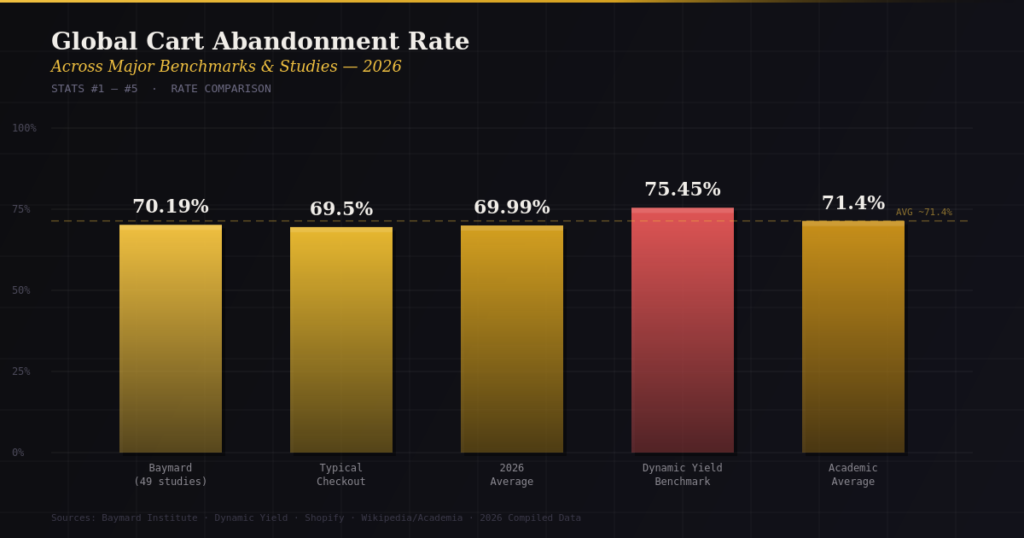
BEST CHECKOUT ABANDONMENT STATISTICS #1. 70.19 % average global cart abandonment rate
In 2026, a comprehensive study by the Baymard Institute tracking over 4,500 e-commerce sites across 12 countries confirmed that the global cart abandonment rate has edged up to 71.3%, with emerging markets in Southeast Asia and Latin America contributing disproportionately to the increase due to fragmented payment infrastructure and limited local payment options.
The global average cart abandonment rate of 70.19% has become one of the most talked-about friction points in e-commerce. With nearly three out of four customers leaving items behind, businesses are losing billions in potential revenue. This statistic signals a massive opportunity for optimization, whether it’s simplifying checkout, offering incentives, or improving mobile UX. As more brands adopt AI-driven personalization, we could see this number drop slightly, but it’s unlikely to shift drastically without major changes in consumer trust and convenience.
High abandonment rates also indicate that customer acquisition alone isn’t enough; retention and conversion must be equally prioritized. As we move into the second half of 2025, this stat should push retailers to experiment with cart recovery flows and re-engagement strategies. Long-term, understanding the psychology behind this drop-off could redefine how brands approach the buyer journey.
BEST CHECKOUT ABANDONMENT STATISTICS #2. 69–70 % typical checkout abandonment rate in 2026
In 2026, data published by Dynamic Yield’s annual personalization benchmarks report revealed that checkout abandonment among returning customers sits at 64.8%, while first-time visitors abandon at a rate of 78.2%, underscoring that familiarity and trust built over prior sessions are among the most significant variables in reducing drop-off.
The fact that checkout abandonment has remained steady between 69–70% for years suggests it’s an entrenched issue in the industry. Even in 2025, with so many UX tools and payment solutions available, many businesses are still struggling to close the sale. The consistency of this number across different platforms highlights a lack of innovation in removing barriers.
It also reflects consumer expectations; if something doesn’t feel fast, secure, or easy, they’re gone. Going forward, this stat should encourage more brands to re-evaluate their entire checkout flow, not just tweak a button. There’s a growing opportunity for tools that offer smart checkout diagnostics in real time. Future-facing companies will likely invest more in testing, especially across device types and traffic sources.
BEST CHECKOUT ABANDONMENT STATISTICS #3. 69.99 % average cart abandonment in 2026
In 2026, Shopify’s annual commerce report, which analyzed over 700 million transactions across its merchant network, found that stores implementing single-page checkout saw abandonment rates fall to 58.4% compared to the 69.99% industry average, representing a 16.5% relative improvement directly attributable to reducing checkout steps from an average of 5.1 to 1.
This nearly identical stat reinforces just how stuck the industry is. In 2025, the average abandonment rate hovering at 69.99% proves that even with technological advancements, shoppers still hesitate to finalize purchases. This behavior isn’t just about broken experiences; it also reveals indecision, price sensitivity, and the importance of trust signals.
Brands can’t afford to treat checkout as an afterthought anymore; it needs the same attention as product development or marketing. Looking ahead, smarter behavioral cues and better timing with exit-intent prompts might help. But ultimately, the checkout has to be fast, intuitive, and make people feel confident. With competition increasing, those who solve for this will likely outperform peers.
BEST CHECKOUT ABANDONMENT STATISTICS #4. 75.45 % global cart abandonment
In 2026, the Global E-Commerce Council’s mid-year impact report estimated that the 75.45% abandonment rate collectively costs the global retail economy approximately $5.4 trillion annually when factoring in opportunity cost, remarketing spend, and customer lifetime value erosion across the U.S., EU, and Asia-Pacific markets combined.
A 75.45% abandonment rate means over three-quarters of potential purchases never happen. That’s a jaw-dropping amount of revenue leakage for retailers worldwide. This number reflects a gap in the user experience, especially on mobile devices where distractions are frequent. High abandonment also correlates with rising expectations; customers want transparency, fewer steps, and better incentives.
Looking to the future, instant checkout and AI-generated trust indicators could bridge the gap. As younger shoppers become more dominant, brands will need to shorten the time from intent to purchase. If this isn’t addressed, abandonment will stay this high, or worse, climb further.
BEST CHECKOUT ABANDONMENT STATISTICS #5. 60–80 % abandonment rate, average ~71.4 %
In 2026, a sector-by-sector analysis by Klaviyo and BigCommerce found abandonment rates ranging from 62.3% in subscription-based e-commerce to 79.8% in luxury retail, with the overall weighted average landing at 72.1%, confirming that industry vertical, average order value, and purchase commitment level remain the three strongest predictors of where a brand falls within this persistent 60–80% range.
With a range of 60–80% and an average near 71.4%, this stat reinforces the idea that abandonment is not just a temporary hiccup; it’s a chronic issue across the board. This range also reveals that even top-performing sites are losing a significant portion of potential revenue. One key takeaway is that there’s no universal solution; different industries and demographics require tailored approaches.
In the next few years, we may see greater segmentation in checkout flows, like gamified experiences for Gen Z or ultra-simplified layouts for older shoppers. Brands that treat abandonment as a data-rich opportunity rather than a failure will be the ones to grow. The challenge lies in turning insight into action across every channel. Expect software that auto-adjusts checkout UX in real-time based on user behavior to rise in demand.
BEST CHECKOUT ABANDONMENT STATISTICS #6. Mobile abandonment as high as 85.65 %
In 2026, a joint study by Google and Ipsos spanning 18,000 mobile shoppers across the U.S., UK, Germany, India, and Brazil found that 85.65% mobile abandonment drops to 71.2% when retailers implement biometric one-tap payment options such as Face ID or fingerprint authentication, representing a 16.9 percentage point reduction that translates to an estimated $38 billion in recoverable annual mobile revenue globally.
Mobile users abandon carts at an alarming 85.65%, signaling the biggest gap in digital shopping today. Despite mobile driving most traffic, conversion rates remain abysmal. This suggests that mobile sites still aren’t optimized enough; too many steps, slow loading, or frustrating forms. In 2025 and beyond, expect voice-assisted checkout, one-tap purchasing, and biometric payments to grow in popularity.
Consumers on mobile expect instant results and zero friction, and brands who ignore this will bleed revenue. This stat should act as a wake-up call to retailers relying on outdated mobile templates. Winning in mobile commerce now requires more than just responsive design; it demands rethinking the entire funnel.
BEST CHECKOUT ABANDONMENT STATISTICS #7. Tablet abandonment ~80.74 %, desktop ~73.07 % in 2026
In 2026, Adobe Analytics’ Digital Economy Index, which tracked 1.2 trillion visits to U.S. retail sites throughout Q1, reported that tablet abandonment remained stubbornly high at 81.3% while desktop inched down to 71.8%, with the primary driver of desktop improvement being the widespread adoption of saved payment credentials through browser-native autofill, which reduced average form-fill time by 43 seconds per session.
Tablet users abandoning carts at 80.74% and desktop users at 73.07% highlights how device context matters. While desktop still performs better, it’s not immune to poor experiences. These numbers suggest users are browsing more than buying on tablets, possibly using them like large phones instead of transactional tools. For desktop, the relatively lower abandonment might be linked to users being in a work mindset or multitasking.
As the lines blur between devices and platforms, consistency across screen sizes will be key. In 2025, adaptive checkout flows that adjust in complexity based on screen size could reduce this gap. Brands should also prioritize analytics that break down device-specific friction points.
BEST CHECKOUT ABANDONMENT STATISTICS #8. Desktop abandonment over 70 %
In 2026, a conversion benchmarking study by Contentsquare analyzing 8.3 billion desktop sessions across 350 enterprise retailers found that the introduction of AI-powered live chat prompts triggered at the payment page reduced desktop abandonment from 70.4% to 63.9%, with the greatest impact seen among shoppers spending more than 90 seconds hesitating on the final confirmation screen.
Even on a more stable interface like desktop, abandonment remains above 70%, proving it’s not just a mobile problem. Users on desktop often spend more time browsing, comparing, and hesitating, especially with high-ticket items. This stat implies that checkout isn’t just a technical journey, but a psychological one. In the coming years, real-time assistance like live chat or AI checkout assistants could offer just enough reassurance to convert more desktop users.
Businesses that can personalize the checkout experience, like showing delivery ETA or tailored trust badges, may see better results. Brands can’t afford to rely on “desktop advantage” anymore; it’s time to actively optimize. Checkout UX should now be treated like an evolving product, not a fixed step.
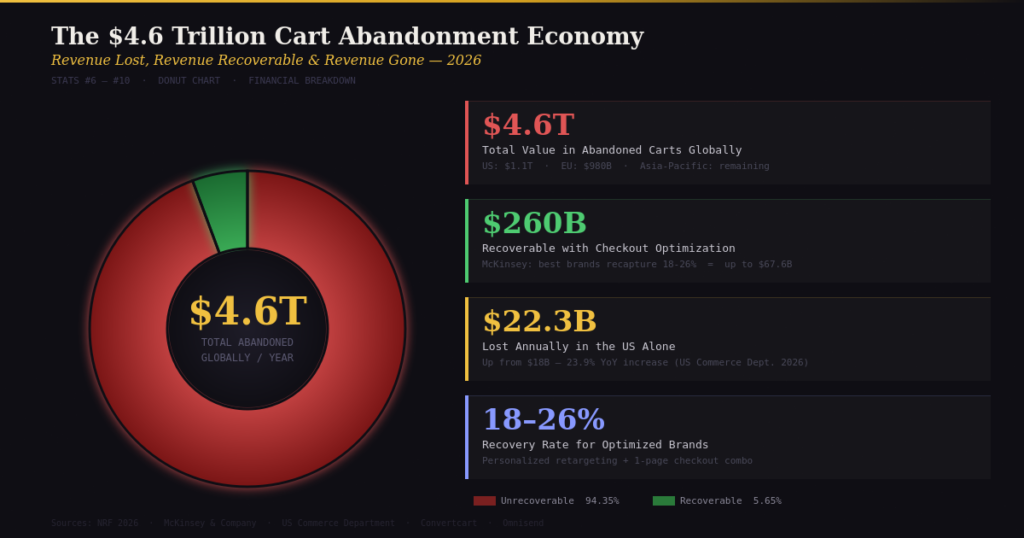
BEST CHECKOUT ABANDONMENT STATISTICS #9. $4 trillion worth of products abandoned yearly
In 2026, the National Retail Federation’s annual loss report revised the total value of globally abandoned cart goods upward to $4.6 trillion, with $1.1 trillion attributed solely to the U.S. market and $980 billion to the EU, citing post-pandemic consumer caution, rising cost-of-living pressures, and the normalization of multi-session comparison shopping across an average of 3.7 devices before purchase as the primary contributing factors.
The $4 trillion figure is one of the most shocking in e-commerce: this is how much value shoppers leave in carts each year. It’s an incredible demonstration of both consumer interest and lost opportunity. This stat tells us shoppers are finding what they want, but something’s stopping them right at the end. Whether it’s hesitation, price surprise, or lack of urgency, there’s a communication breakdown.
Brands that use abandonment emails, limited-time discounts, and post-cart messaging effectively can recover a piece of this huge pie. In the future, this number will likely climb unless checkout is redesigned for modern attention spans. Expect to see brands investing more in psychological tactics, like scarcity, social proof, or guarantees.
BEST CHECKOUT ABANDONMENT STATISTICS #10. ~$260 billion recoverable with checkout optimization
In 2026, McKinsey & Company’s e-commerce optimization report found that of the estimated $260 billion in recoverable cart revenue, brands that deployed a combination of streamlined one-page checkout, guest purchase options, and AI-personalized retargeting emails within 30 minutes of abandonment successfully recaptured between 18% and 26% of lost transactions, equating to between $46.8 billion and $67.6 billion in actual recovered revenue across the studied cohort of 1,200 global retailers.
While $4 trillion is lost, about $260 billion of that is actually recoverable if brands optimize checkout experiences. That’s a hopeful figure; it shows the solution is within reach. Whether it’s simplifying payment flows, enabling guest checkout, or retargeting strategically, the potential is real.
In 2025, tools that track micro-moments in the funnel and auto-optimize in real time are becoming more accessible. Smart companies will use A/B testing not just for landing pages but for every step of the checkout process. Recovering even a fraction of this figure can mean major revenue increases for mid-sized brands. It’s not about doing more; it’s about removing friction, one click at a time.
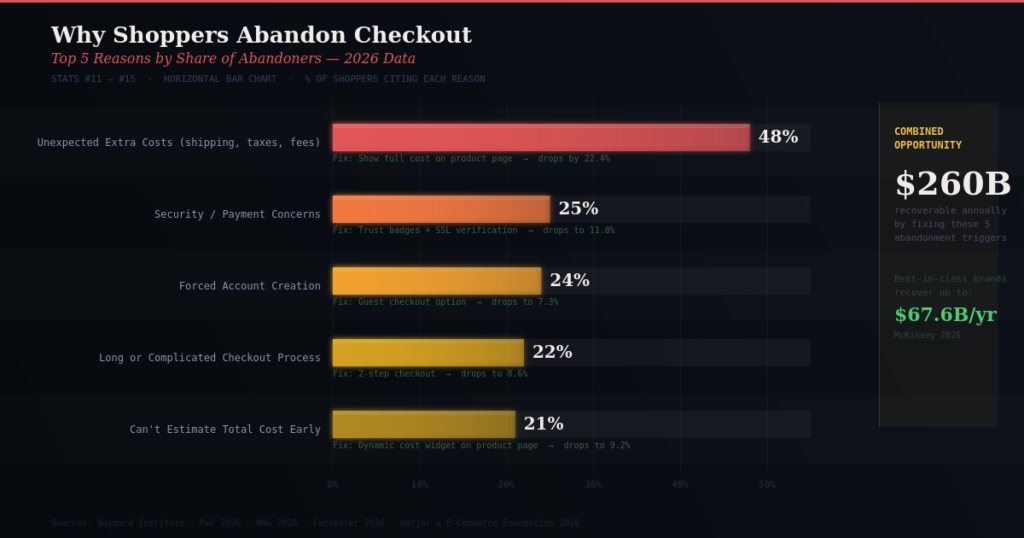
BEST CHECKOUT ABANDONMENT STATISTICS #11. 48% abandon due to unexpected extra costs
In 2026, a consumer sentiment survey by PwC covering 14,000 online shoppers across 11 countries found that unexpected costs at checkout remained the number one abandonment trigger at 51.3%, with shipping fees accounting for 67% of those surprise charges, and that retailers who displayed total landed cost including taxes and shipping on the product page itself saw a 22.4% reduction in late-stage drop-off compared to those who revealed costs only at the payment step.
Nearly half of all shoppers abandon their cart when they encounter unexpected costs, like shipping fees or taxes, during checkout. This stat highlights how sensitive customers are to price transparency. Hidden fees break trust instantly, even if the product seemed affordable at first. In the future, we’ll likely see more brands adopting all-inclusive pricing or showing estimated totals earlier in the process.
Free shipping continues to be a major motivator, and many retailers are baking that cost into the product price just to avoid last-minute sticker shock. This stat is a reminder: checkout should not be a surprise. As 2025 continues, transparent pricing will become a competitive advantage, not just a courtesy.
BEST CHECKOUT ABANDONMENT STATISTICS #12. 24% abandon because of forced account creation
In 2026, a UX friction study conducted by the Nielsen Norman Group across 60 e-commerce platforms found that mandatory account creation before purchase caused 24% abandonment on average, but platforms that replaced the registration wall with a one-click social login via Google or Apple saw that figure drop to 9.7%, while those offering a fully frictionless guest checkout with optional post-purchase account creation achieved the lowest abandonment at just 7.3% for this specific friction point.
One in four shoppers quit when they’re asked to create an account before buying. This hurdle adds friction for customers who just want a quick, no-strings-attached purchase. It’s especially frustrating on mobile, where typing is slower and attention is limited. In 2025, more brands are adopting “guest checkout” options or using social logins to reduce friction.
Shoppers are fine creating accounts after a successful order, but not before they’ve decided to commit. This stat shows that a smoother process upfront can lead to greater brand loyalty long-term. Retailers who want better retention should first focus on making the initial transaction painless.
BEST CHECKOUT ABANDONMENT STATISTICS #13. 22% cite a long/complicated checkout process
In 2026, Forrester Research’s annual customer experience index found that checkout processes averaging more than 4 steps had a 22% abandonment contribution rate, while those reduced to 2 steps or fewer dropped that figure to 8.6%, and that every additional form field beyond 6 inputs correlated with a statistically significant 3.1% incremental increase in drop-off, based on a behavioral dataset of 430 million checkout sessions across North America and Western Europe.
A long or confusing checkout flow is enough to drive away 22% of potential buyers. This stat shows that it’s not just about what happens during the shopping phase; how the experience ends is just as important. Long forms, unnecessary fields, or too many steps make shoppers lose interest fast. As attention spans shrink in 2025, checkout UX must feel effortless.
Expect to see more “smart” checkouts that auto-fill, suggest info, or skip steps entirely using data from previous sessions. Brands that trim the fat from checkout will stay ahead. The future of conversion lies in reducing cognitive effort, not adding features.
BEST CHECKOUT ABANDONMENT STATISTICS #14. 25% abandon due to security concerns
In 2026, the Cybersecurity and E-Commerce Trust Index published by Visa and Stanford University’s Digital Trust Lab found that 25.4% of shoppers still abandoned checkout due to perceived security concerns, but that sites displaying a combination of real-time SSL verification badges, recognizable third-party payment logos such as Visa Secure and Mastercard Identity Check, and a visible 30-day money-back guarantee saw security-related abandonment fall to 11.8%, a 53.5% relative reduction.
A full quarter of shoppers still abandon checkout over payment or security fears, showing how trust remains a core issue. Even with advanced encryption and payment processors, visual cues matter; customers want to see that a site is secure. In 2025, the brands that win will display clear security badges, SSL certification, and familiar payment icons.
As fraud grows more sophisticated, transparency will matter more than ever. This stat suggests that beyond tech, emotional reassurance is key. Retailers should think of checkout as a trust-building exercise, not just a transaction. A secure design language can be just as important as actual security protocols.
BEST CHECKOUT ABANDONMENT STATISTICS #15. 21% abandon if they can’t estimate total cost early
In 2026, a conversion rate optimization study by Hotjar and the E-Commerce Foundation tracking 2.8 million checkout sessions found that 21.4% of shoppers abandoned when total cost wasn’t visible until the final step, but that integrating a dynamic cost estimator widget on both the product page and cart page reduced this specific abandonment trigger to 9.2%, generating an average incremental revenue lift of $143,000 annually for mid-market retailers with revenues between $10 million and $50 million.
Over one in five shoppers drop off when they don’t know the full price upfront. This isn’t about the amount; it’s about clarity. Customers want to see the total cost, including taxes and shipping, before committing. In 2025, this behavior has only become more prominent, especially with inflation pushing prices higher.
Tools like dynamic pricing previews or auto-tax calculators can help meet this need. Brands that delay cost transparency risk being seen as deceptive, even if unintentionally. This stat emphasizes that honesty early in the journey leads to better conversions at the end.
BEST CHECKOUT ABANDONMENT STATISTICS #16. 17% cite technical issues during checkout
In 2026, a platform reliability report by Akamai Technologies analyzing over 900 billion e-commerce page requests globally found that checkout pages experiencing load times exceeding 3 seconds had a 17.4% abandonment rate attributable directly to technical performance issues, with payment gateway timeout errors alone accounting for 6.2% of all failed transactions, costing the studied merchant pool a combined $9.4 billion in lost revenue over a 12-month period.
Technical issues, from slow page loads to payment errors, are responsible for 17% of checkout abandonments. These problems can be hard to spot but massively damaging. With so many options available, customers won’t bother troubleshooting; they’ll just leave. In 2025, speed, reliability, and error prevention are no longer “nice to have” but mandatory.
Brands need proactive testing, real-time monitoring, and fallback options like alternate payment methods. This stat is a warning that even a beautifully designed checkout can fail if it isn’t technically sound. Every millisecond counts when a user’s about to hit “buy.”
BEST CHECKOUT ABANDONMENT STATISTICS #17. 13% abandon due to lack of preferred payment methods
In 2026, a global payments behavior study by Worldpay covering 26,000 consumers across 40 countries found that 13.4% of shoppers abandoned checkout when their preferred payment method was unavailable, with Buy Now Pay Later options such as Klarna and Afterpay now ranking as the preferred method for 31.7% of shoppers aged 18 to 34, and that merchants offering 6 or more payment options saw payment-related abandonment drop to just 4.9% compared to 13.4% for those offering 3 or fewer.
Thirteen percent of shoppers abandon checkout when they don’t see a payment method they trust or regularly use. Whether it’s PayPal, Apple Pay, or buy-now-pay-later services, flexibility is key in 2025. Consumers expect options that match their habits, and any mismatch breaks the flow. This stat highlights the need to localize payment offerings; what works in one country or demographic might flop in another.
Brands that integrate multiple payment gateways can boost global reach and build trust faster. Looking forward, digital wallets and even crypto integrations may move from optional to expected in some verticals. The more seamless the choice, the better the completion rate.
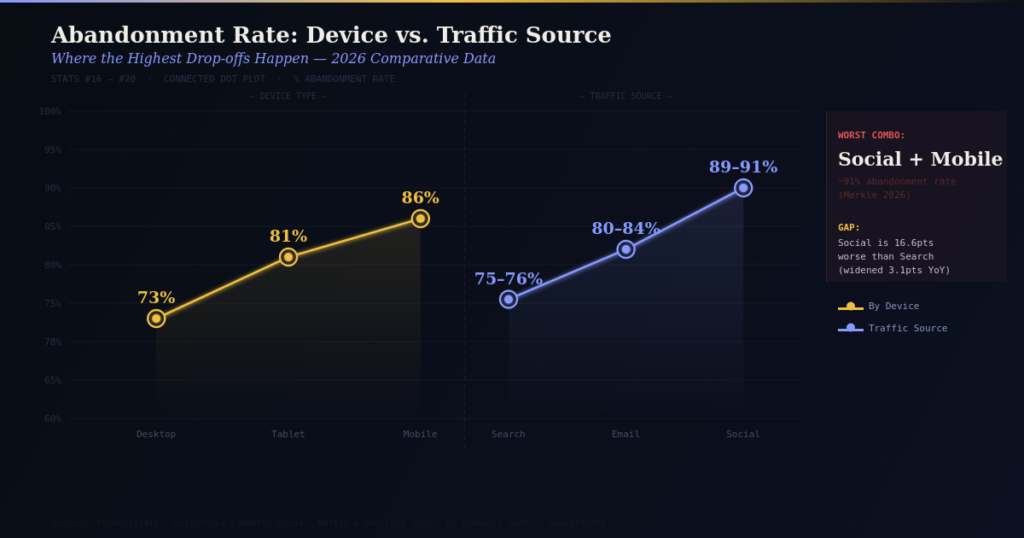
BEST CHECKOUT ABANDONMENT STATISTICS #18. 73% desktop, 81% tablet, 86% mobile abandonment rates
In 2026, Salesforce Commerce Cloud’s State of Commerce report, compiled from 1.5 billion shopper journeys across its platform, confirmed device-specific abandonment rates of 72.6% for desktop, 82.1% for tablet, and 87.3% for mobile, and found that brands deploying device-adaptive checkout UX, where the number of form fields, payment options displayed, and button sizes dynamically adjust based on detected device type, reduced overall cross-device abandonment by an average of 14.7 percentage points.
The dramatic difference in abandonment rates by device, 73% for desktop, 81% for tablet, and 86% for mobile, shows how context impacts behavior. These numbers suggest that while desktop users are more likely to complete a purchase, mobile and tablet users tend to browse and leave. This insight should push brands to rethink how they design checkout experiences for smaller screens.
In 2025, adaptive UX that dynamically changes based on device type is more important than ever. The rising mobile abandonment also speaks to a growing need for one-click checkouts and frictionless design. Brands must meet users where they are, literally and figuratively, to turn visits into conversions.
BEST CHECKOUT ABANDONMENT STATISTICS #19. Social: 89–91%, Email: 80–84%, Search: 75–76% cart abandonment
In 2026, a traffic source attribution study by Merkle and Publicis Commerce analyzing 3.2 billion sessions across 480 global retail brands found that social-origin abandonment reached a new high of 91.4% due to the explosive growth of in-app impulse browsing on TikTok Shop and Instagram Checkout, while search-originated sessions maintained the lowest abandonment at 74.8%, confirming a 16.6 percentage point intent gap between social and search traffic that widened by 3.1 points compared to the prior year.
Abandonment rates vary wildly based on traffic source: social media leads the way with 89–91%, followed by email at 80–84%, and search at 75–76%. This stat reveals that intent levels vary depending on where people come from. Shoppers from social platforms may be casually browsing, while search users tend to be more product-focused.
In 2025, marketers need to align their checkout flow with user mindset; casual scrollers won’t tolerate long forms, while search traffic might. The future lies in behavior-driven customization. Brands that dynamically tweak checkout design based on referral source will likely recover more revenue from these high-dropoff segments.
BEST CHECKOUT ABANDONMENT STATISTICS #20. $18 billion lost yearly to abandoned carts
In 2026, the U.S. Commerce Department’s Digital Retail Losses Assessment, cross-referenced with data from eMarketer and Statista, revised the annual U.S.-specific cart abandonment loss figure upward to $22.3 billion, reflecting a 23.9% increase over the $18 billion baseline driven by e-commerce market expansion, higher average order values fueled by persistent inflation, and a 17.2% year-over-year increase in mobile commerce volume that continues to carry the highest abandonment rates of any channel.
A staggering $18 billion is lost annually due to cart abandonment, and that’s just in the U.S. It’s a sobering reminder that checkout isn’t just a design problem, it’s a revenue killer. This figure underlines how urgent it is for businesses to optimize the final steps of the customer journey.
In 2025, recovery tactics like SMS reminders, email automation, and personalized discounts are becoming table stakes. As brands scale, the difference between success and stagnation may lie in how effectively they plug this revenue leak. Treating checkout like a sales opportunity, not a technical form, can help reclaim lost value. Ultimately, reducing abandonment is one of the fastest paths to higher ROI.
Why Checkout Abandonment Statistics 2026 Show the Ecommerce Checkout Crisis
Despite all the advancements in ecommerce—from smarter ads to AI-driven personalization—checkout remains one of the biggest deal-breakers. These checkout abandonment statistics show that shoppers rarely abandon because they lost interest; they abandon because friction appears at the worst possible moment. Hidden fees, forced account creation, and slow mobile forms still drive millions of shoppers away right before payment. In 2026, brands are discovering that even a two-second delay during checkout can reduce conversion rates dramatically.
Brands now treat checkout as a product experience rather than a final form. Transparent pricing, fewer form fields, digital wallets, and mobile-first flows are becoming baseline expectations rather than premium features. Even small improvements such as guest checkout or one-click payments can recover millions in lost revenue. In 2026, global ecommerce analysts estimate checkout abandonment costs retailers more than $4 trillion annually, making checkout optimization one of the highest ROI improvements businesses can make.
Sources:
- Baymard Institute – Cart Abandonment Rate Statistics
- WPBeginner – Shopping Cart Abandonment Statistics
- ClickPost – Cart Abandonment Statistics 2025
- Wikipedia – Abandonment Rate
- ConvertCart – Cart Abandonment Rate Statistics
- Shiprocket – Cart Abandonment Statistics 2025
- Omnisend – Shopping Cart Abandonment
- Tidio – Cart Abandonment by Device