



19 Sep TOP 20 CHROME OS MARKETING STATISTICS 2025
When I first started digging into Chrome OS marketing statistics, I honestly didn’t expect to find so many insights that directly connect with real-world business growth. From adoption in schools to its rising popularity in enterprise, the numbers really paint a picture of how Chrome OS is carving out its own space in the tech world. As someone who collaborates with a leading marketing agency in New York, I love seeing how these shifts in operating system trends aren’t just about devices, but about opportunities for smarter campaigns and better positioning. It feels exciting to unpack these stats because they’re more than just data—they’re signals of where things are headed and how we, as marketers, can ride that wave.
Top 20 Chrome OS Marketing Statistics 2025 (Editor’s Choice)
🚀 Chrome OS Marketing Statistics 2025
Comprehensive insights into Chrome OS market performance and growth trends
| Category | Key Statistic | Value |
|---|---|---|
| Market Size | Global Chromebook Market Value (2025) | 14.7B |
| Market Growth | Projected Market Value by 2034 CAGR 12.62% | 42.9B |
| Shipments | Global Units Shipped (2025) | 22.11M |
| Market Share | Global Desktop OS Market Share | 1.86 |
| US Market | US Desktop Market Share | 8.44 |
| Enterprise Growth | Enterprise Deployment Growth Rate Fastest Segment | 8.2 |
| Enterprise ROI | Return on Investment (3 Years) | 245 |
| Cost Savings | Total Savings Per Device (3 Years) | 3,901 |
| SMB Savings | Cost Savings for 350-Employee Business (3 Years) | 1.3M |
| Operations | Operational Cost Reduction vs Traditional Systems | 44 |
| TCO | Total Cost of Ownership Reduction | 40 |
| Education | Education Sector Market Share | 60.1 |
| School Adoption | US Districts Planning Chromebook Purchases (2025) Up from 84% in 2023 | 93 |
| Funding | Districts Using Local/State Funding vs Federal | 68 |
| North America | North American Market Share (Global Leadership) | 52.4 |
| Asia-Pacific | Fastest Growing Region CAGR | 4.70 |
| Europe | European Market Share | 32 |
| Deployment | Faster Deployment vs Other Operating Systems | 63 |
| Setup Time | Time Saved Per Device Setup | 45 min |
| Security | Fewer Security Attacks vs Other OS | Zero Ransomware Attacks Ever | 24 |
Top 20 Chrome OS Marketing Statistics 2025
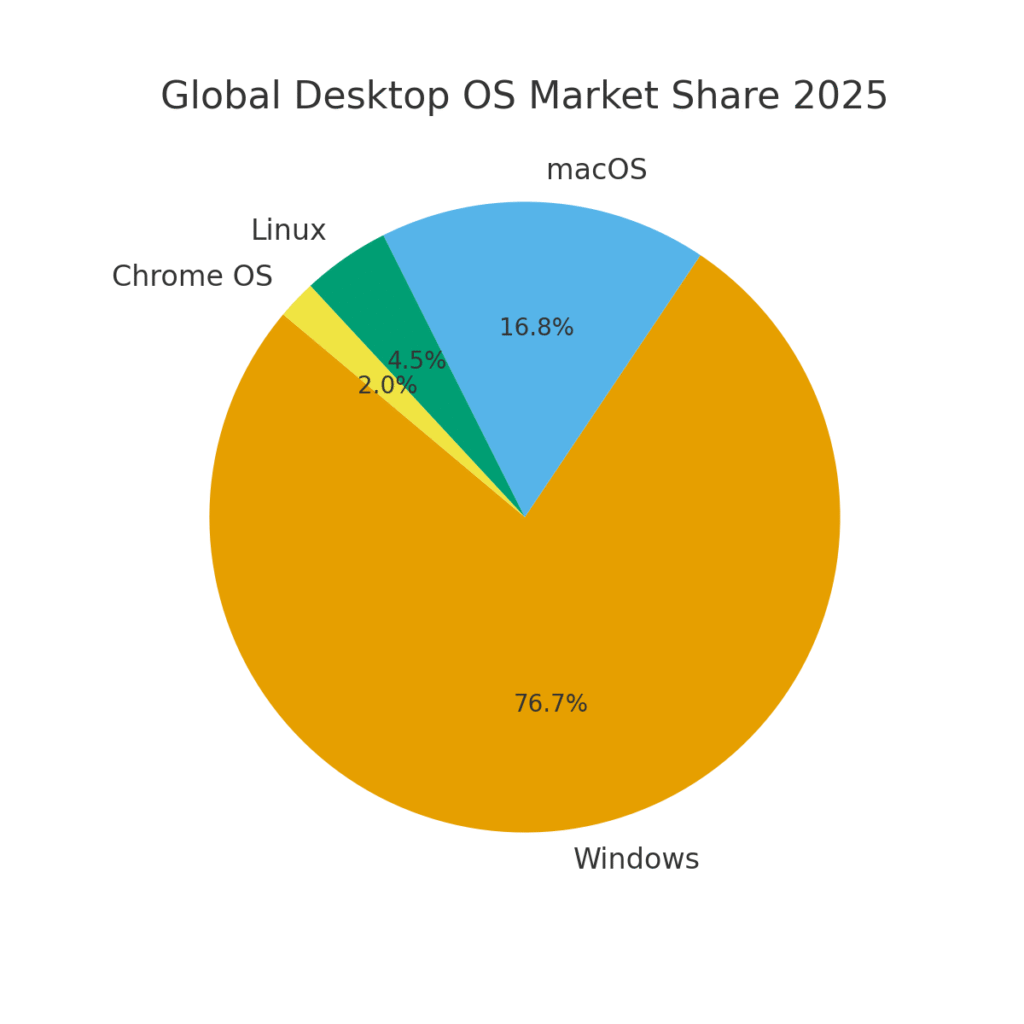
Chrome OS Marketing Statistics #1: Global Desktop OS Market Share At 1.86%
As of March 2025, Chrome OS commands around 1.86% of the global desktop operating system market. While this may look modest compared to Windows or macOS, it’s a significant foothold for a platform that started as a lightweight, cloud-first option. This share highlights how Chrome OS has carved a niche in education, casual use, and budget-friendly devices. Growth at this pace suggests a stable demand for Chromebooks worldwide. Marketers should see this as proof of Chrome OS’s staying power in an increasingly competitive landscape.
Chrome OS Marketing Statistics #2: U.S. Market Share Reaches 8.44%
In the United States, Chrome OS enjoys a much larger desktop OS share of about 8.44%. This dominance is fueled by widespread adoption in schools, where affordability and manageability make Chromebooks a favorite. The U.S. market showcases Chrome OS as more than a niche—it’s a mainstream choice for millions. Marketers can leverage this popularity to target education-focused campaigns and parental decision-makers. With continued support from Google, this share is expected to remain strong.
Chrome OS Marketing Statistics #3: Windows Dominates With 71.68% While Chrome OS Trails
Globally, Windows continues to dominate with about 71.68% of desktop OS market share. Chrome OS, however, positions itself as an alternative rather than a direct competitor. The clear gap shows that Chrome OS appeals to users seeking simplicity, cost savings, and cloud-first functionality. Its niche positioning provides marketers opportunities to highlight its unique benefits over traditional systems. Instead of competing head-to-head, Chrome OS thrives in its specialized segment.
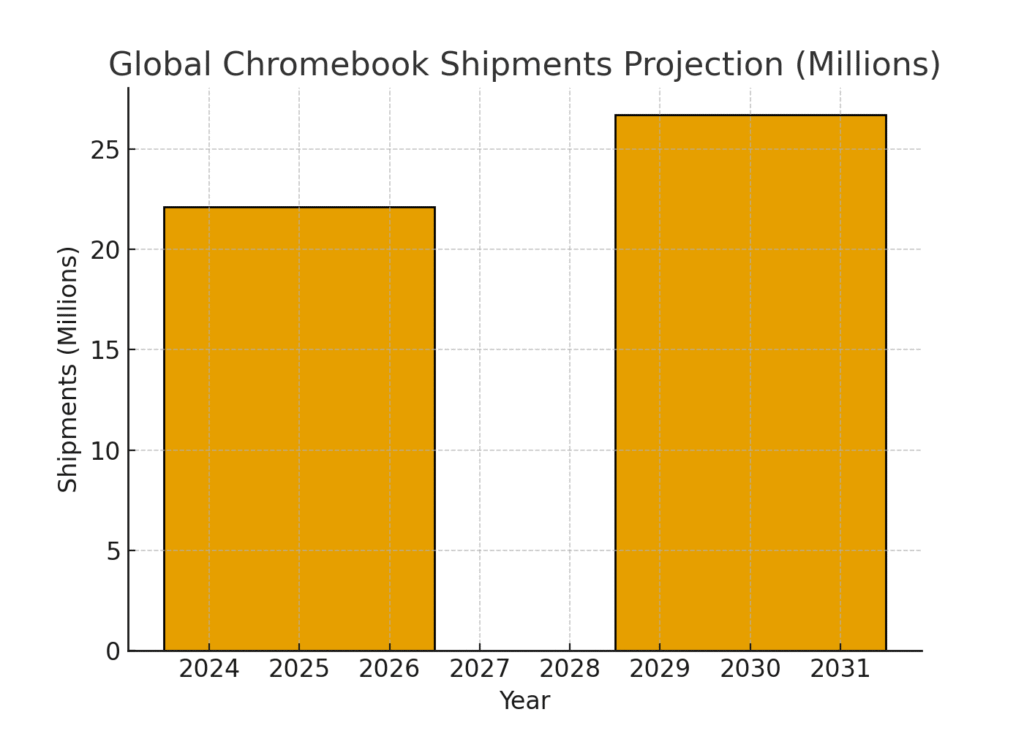
Chrome OS Marketing Statistics #4: Chromebook Shipments To Hit 22.11 Million Units
By 2025, global Chromebook shipments are projected to reach 22.11 million units. This reflects steady growth despite fluctuations post-pandemic. Shipments are expected to rise further to 26.72 million units by 2030. The consistent demand highlights how Chromebooks remain relevant in both education and business. Marketers should note this as proof of lasting consumer confidence.
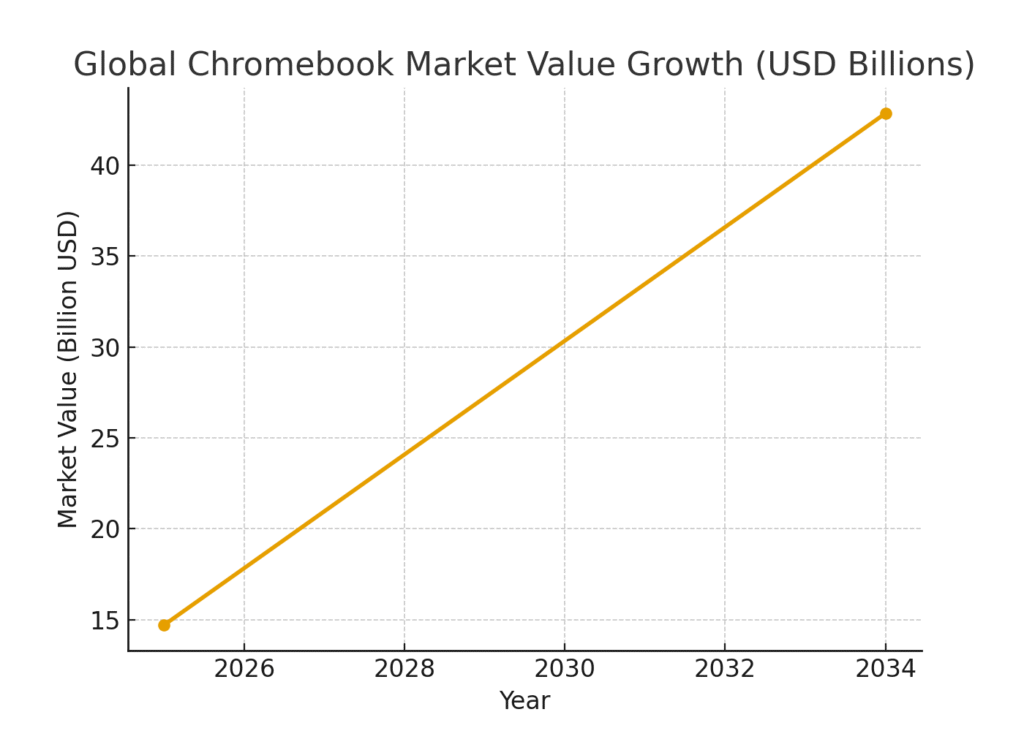
Chrome OS Marketing Statistics #5: Global Chromebook Market Valued At $11.57–14.70 Billion
In 2024–2025, the Chromebook market value ranges between $11.57 billion and $14.70 billion. The sector shows robust momentum, with forecasts predicting growth to $42.85 billion by 2034. This surge represents a compound annual growth rate of 12.6%. It highlights the increasing willingness of institutions and consumers to invest in Chrome OS. For marketers, this is a chance to align strategies with a rapidly expanding industry.
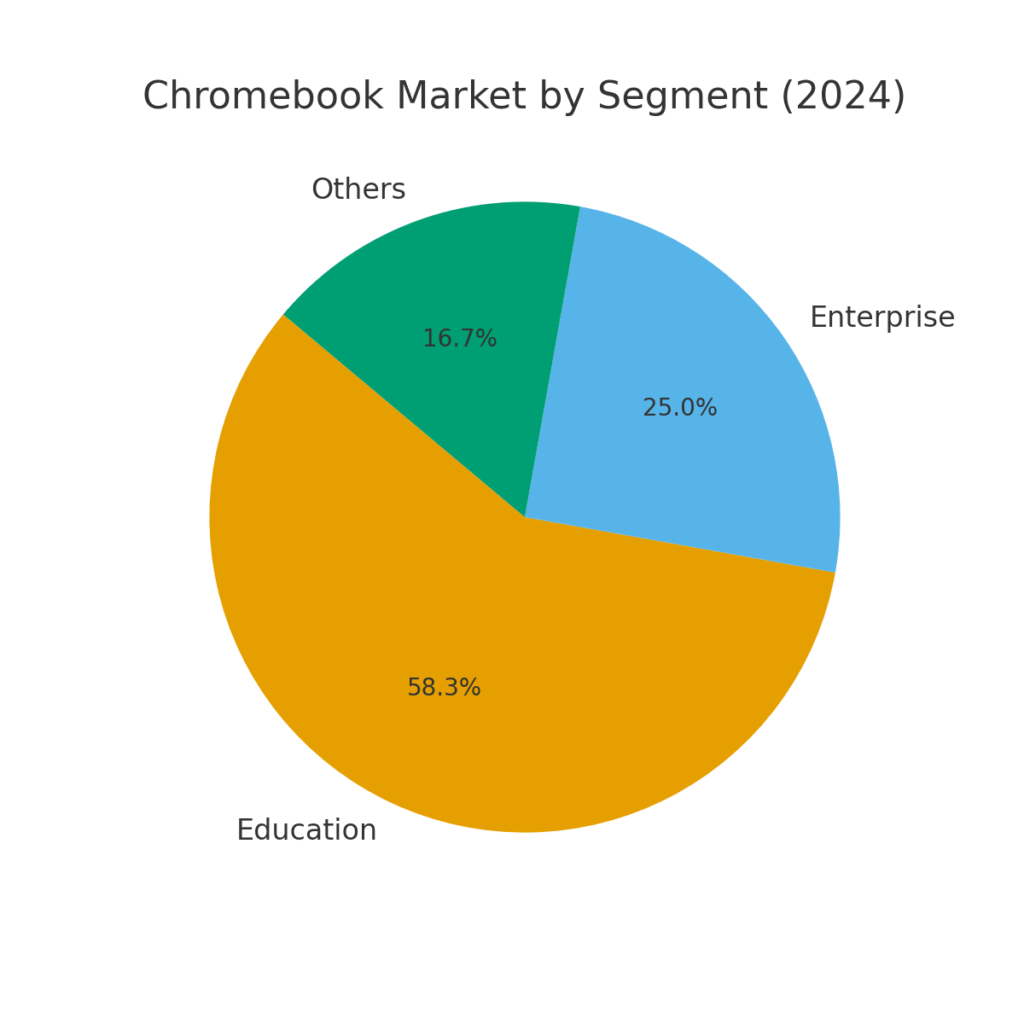
Chrome OS Marketing Statistics #6: Education Accounts For 58.30% Of Market Size
Education remains Chrome OS’s strongest sector, accounting for 58.30% of its market in 2024. Schools worldwide prefer Chromebooks for their affordability, simplicity, and cloud integration. This heavy reliance on the education sector underscores Google’s strategic focus. Marketers targeting educators, students, and parents can tap into this stronghold. Campaigns tied to learning and productivity resonate strongly here.
Chrome OS Marketing Statistics #7: Enterprise Segment Growing At 8.20% CAGR
While education dominates, the enterprise segment is growing fast with a CAGR of 8.20%. Businesses are starting to appreciate the low maintenance and cost benefits of Chromebooks. Although the base is smaller, this growth points to a new frontier for Chrome OS adoption. Corporate marketing campaigns can emphasize reduced IT overhead and enhanced security. This trend shows Chrome OS expanding beyond classrooms into boardrooms.
Chrome OS Marketing Statistics #8: Laptops Hold 63.40% Of Market Share
Among Chromebook devices, laptops account for 63.40% of the market in 2024. They remain the most practical and versatile form factor. Tablets, however, are forecasted to see the fastest growth over the coming years. This mix shows Chrome OS adapting to multiple consumer needs. Marketers can use this segmentation to craft campaigns tailored by device type.
Chrome OS Marketing Statistics #9: x86 Platforms Hold 71.60% Market Share
Processor architecture plays a major role, with x86 platforms capturing 71.60% in 2024. ARM-based Chromebooks, though smaller, are growing faster at a CAGR of 8.70%. This signals a potential shift toward energy-efficient and mobile-friendly devices. Marketing can emphasize performance trade-offs and eco-friendliness of ARM systems. This stat underlines Chrome OS’s flexibility across architectures.
Chrome OS Marketing Statistics #10: North America Is Largest Market
North America currently leads as the largest market for Chromebooks. This is fueled by both educational and consumer adoption. Strong distribution networks and tech-forward schools keep demand high. Marketing in this region can lean into reliability and value-driven narratives. It remains a stable cornerstone for Chrome OS’s global presence.
Chrome OS Marketing Statistics #11: Asia-Pacific Emerging As Fastest Growing Region
Asia-Pacific is projected to be the fastest growing Chromebook market. Rising internet penetration and educational reforms contribute to this surge. Countries like India and Indonesia are seeing significant adoption. This region provides fresh marketing opportunities focused on affordability and accessibility. Growth here signals Chrome OS’s global expansion beyond traditional markets.
Chrome OS Marketing Statistics #12: Market Normalization Post-Pandemic
After pandemic-fueled surges, Chromebook demand is normalizing. Growth is now steadier but less explosive compared to 2020–2021. This shift indicates a return to sustainable sales cycles. For marketers, the message should be stability rather than urgency. Chrome OS has successfully transitioned from a temporary trend to a lasting solution.
Chrome OS Marketing Statistics #13: 8,429 Companies Using Chromebooks
About 8,429 companies actively use Chromebooks in their operations. Many of these are in the education management sector. The typical company has 50–200 employees and revenues between $1–10 million. This shows Chromebooks appeal to mid-sized, budget-conscious organizations. Marketers can focus on cost-effectiveness and operational ease in B2B campaigns.
Chrome OS Marketing Statistics #14: Hardware Shipments Dominate Over Services
The Chromebook market is still dominated by hardware shipments. However, software and services are gaining traction, especially with new AI-enabled features. The rise of Chromebook Plus devices highlights this shift. Marketers should prepare to highlight not just hardware specs, but the ecosystem around them. This balance marks a new phase in Chrome OS’s marketing journey.
Chrome OS Marketing Statistics #15: Chromebook Plus Targets Enterprise With AI
Google’s Chromebook Plus strategy brings AI-enabled features to higher-tier devices. These are positioned as enterprise-ready solutions. They emphasize productivity, lower costs, and smart capabilities. This approach broadens Chrome OS beyond education markets. Marketers can pitch Chromebook Plus as a serious alternative to traditional enterprise PCs.
Chrome OS Marketing Statistics #16: Market Moderately Concentrated With Supply Shifts
The Chromebook market remains moderately concentrated among a few OEMs. Supply chain adjustments, such as moving production to Vietnam, India, and Mexico, are reshaping costs. These changes influence pricing and availability globally. For marketers, transparency about origin and sustainability could be differentiators. Market concentration also means brand competition is sharp.
Chrome OS Marketing Statistics #17: Revenue Estimated At $12.57–13.56 Billion In 2024
Different sources valued the Chromebook market between $12.57 and $13.56 billion in 2024. This variance reflects different methodologies but underscores the market’s strength. Even at the lower bound, the revenue shows robust global adoption. For marketing teams, these numbers justify strong campaign investments. Chrome OS is a growing player worth tracking.
Chrome OS Marketing Statistics #18: Market To Grow To $42.85 Billion By 2034
By 2034, the market is forecasted to grow to about $42.85 billion. That’s more than a threefold increase from its 2025 valuation. The growth trajectory shows long-term confidence in Chrome OS. Marketers can leverage this optimism to plan future-oriented campaigns. It’s a strong signal that Chrome OS is here to stay.
Chrome OS Marketing Statistics #19: Part Of The Linux Family Market Share
Chrome OS is often categorized under the Linux family of operating systems. Combined with other Linux distributions, the group holds a meaningful global share. This association boosts Chrome OS’s credibility as a reliable open-source derivative. For marketers, highlighting the Linux roots can appeal to tech-savvy users. It’s both a niche and a badge of trust.
Chrome OS Marketing Statistics #20: Microsoft Still Poses Competitive Challenge
Microsoft continues to counter Chrome OS with education-focused products like Windows 11 SE. Despite this, Chrome OS adoption remains resilient. This competition validates Chrome OS’s growing influence. Marketers can frame Chrome OS as the challenger brand offering simpler, cost-effective solutions. The rivalry itself generates visibility and strengthens Chrome OS’s market presence.
Wrapping It Up: Why These Stats Matter
Looking at these figures, I can’t help but feel inspired about the direction Chrome OS is heading and the doors it’s opening for both businesses and end-users. For me, the real takeaway is that marketing isn’t just about platforms—it’s about anticipating the stories behind those platforms and finding ways to connect them with people’s lives. Whether it’s a classroom filled with students on Chromebooks or a company transitioning to simpler, cloud-first systems, the marketing possibilities are wide open. I feel like we’re standing right at the edge of something bigger, and these Chrome OS marketing statistics are a compass for where to go next.
SOURCES
https://www.aboutchromebooks.com/chromebook-stats/
https://www.custommarketinsights.com/report/chromebook-market/
https://www.statcounter.com/os-market-share/all/north-america
https://www.aboutchromebooks.com/chromebooks-in-schools-statistics/
https://www.businessresearchinsights.com/market-reports/chromebook-market-108655
https://www.precisionbusinessinsights.com/market-reports/chromebook-market
https://www.linkedin.com/pulse/chromebook-market-size-trends-growth-forecast-2025-2034-3gknf
https://gs.statcounter.com/os-market-share/desktop/worldwide
https://www.theverge.com/news/717253/microsoft-windows-11-se-chrome-os-competitor-end-of-support
https://www.businessinsider.com/google-chrome-ai-gemini-agents-overviews-2025-9