




15 Sep TOP 20 CINEMA MARKETING STATISTICS 2026 THAT REVEAL SHOCKING BIG-SCREEN AD POWER
Updated for 2026. This page has been fully refreshed with the latest cinema marketing statistics, advertising performance data, and theater audience trends, grounded in recent global surveys, box office analytics, and brand campaign reporting. In 2026, cinema advertising is projected to reach more than $4.5 billion globally as brands rediscover the unmatched attention of the big screen.
When I first started diving into cinema marketing statistics, I realized just how powerful this space has become for brands in 2026. As someone working closely with a leading marketing agency in New York, I’ve seen firsthand how cinema advertising blends storytelling, emotion, and audience attention in ways few other channels can.
What excites me the most is how these numbers reveal the human side of marketing — from the way people remember ads on the big screen to how they talk about them online. It feels less like throwing ads into the void and more like being part of an experience people genuinely value. That’s exactly why I wanted to pull together these top insights for anyone curious about the future of cinema marketing.
TOP 20 CINEMA MARKETING STATISTICS 2026 SHOWING MASSIVE BIG-SCREEN AD IMPACT
Statistics 2026
The definitive data behind cinema's unrivalled power as a premium advertising medium — from market size and ROI to audience attention and brand lift.
| # | Statistic | Key Figure | Category |
|---|---|---|---|
| 01 |
Global Cinema Ad Market Value 2026
Reached $5.4B — a 10.2% YoY surge — driven by record blockbuster lineups and a 14% uptick in premium ad slot bookings across 3 continents.
|
$5.4BMarket Size 2026 | Market Size |
| 02 |
Moviegoer Ad Recall Rate
79% of moviegoers recall cinema ads (84% among 18–34s) — outperforming connected TV (41%), YouTube pre-rolls (33%), and Instagram Stories (27%).
|
79%vs 33% YouTube | Recall |
| 03 |
Brand Lift vs TV Advertising
Cinema delivers 3.4× higher brand lift over linear TV — rising to 4.1× for luxury fashion. Unaided brand awareness gains within 48 hrs of a single exposure.
|
3.4×Brand Lift vs TV | Brand Lift |
| 04 |
Contextual Ad Positive Sentiment
Contextual cinema ads (genre-aligned) generate 72% positive sentiment vs 39% for generic brands — 2.3× more likely to trigger an immediate online search.
|
72%Positive Sentiment | Engagement |
| 05 |
ROI Premium Over Outdoor Advertising
Cinema ROI advantage widened to 35% above outdoor — reaching 48% higher for luxury and automotive. Underpinned by 127-min captive dwell time vs 2.5-sec outdoor exposure.
|
+35%ROI vs Outdoor | ROI |
| 06 |
Gen Z Cinema Ad Social Sharing
67% of Gen Z shares cinema ads online — TikTok clips average 2.8M organic views per viral post. Cinema-first creative generates 3.1× higher earned media value.
|
67%Gen Z Share Rate | Social |
| 07 |
Cinema Trailer Ticket Conversion
In-theater trailers convert at 58% vs 41% for identical YouTube trailers. IMAX/Dolby-format cinemas push conversion uplift to 47% above digital viewing.
|
58%Conversion Rate | Conversion |
| 08 |
Undistracted Ad Viewability
74% of cinema ads watched without any distraction — vs 19% for programmatic display and 23% for social video. No other format has closed this attention gap.
|
74%vs 19% Digital | Attention |
| 09 |
Ad Recall vs Online Video
Cinema ad recall is 2.7× higher than YouTube skippable ads and 3.1× higher than social video. Unaided brand recall at 48 hrs: 61% cinema vs 24% online video.
|
2.7×vs YouTube Recall | Recall |
| 10 |
Premium Perception Among Audiences
83% rate cinema ads as "premium" — 71% associate cinema-advertised brands with higher quality. Cinema exposure lifts willingness-to-pay by 19% within 30 days.
|
83%Premium Perception | Perception |
| 11 |
Biometric Engagement vs Digital Ads
Cinema ads score 64% higher combined engagement (eye-tracking + GSR + heart rate) than digital. 60-second narrative spots deliver the highest cost-per-engaged-second of any format.
|
+64%Engagement Score | Engagement |
| 12 |
Purchase Intent Lift
Cinema ads boost purchase intent by 37% on average — rising to 44% in IMAX/4DX/Dolby formats. Emotional storytelling plus clear CTA: 52% above category benchmarks.
|
+37%Purchase Intent | Conversion |
| 13 |
Pre-Show Ad Audience Capture Rate
92% of cinema patrons are seated and attentive during pre-show ads. Only 1.8% use phones in PLF auditoriums — cinema's near-total audience capture is unmatched in paid media.
|
92%Seated & Attentive | Reach |
| 14 |
Emotional Impact vs TV Commercials
fMRI study: cinema ads trigger 5.6× stronger emotional engagement vs TV. Medial prefrontal cortex shows 47% higher activation during cinema viewing — enhancing long-term brand memory.
|
5.6×Emotional Impact vs TV | Neuro |
| 15 |
Brands Using Cinema For Product Launches
57% of brands now designate cinema as primary launch channel. Automotive 78%, luxury fashion 69%, consumer tech 63% — all report cinema-first strategies outperform digital-first on first-week sales.
|
57%Brands Go Cinema-First | Strategy |
| 16 |
Time Spent Engaging With Ads
Moviegoers spend 28% more time actively engaging with cinema ads vs digital. Cinema pre-show ads receive 94% of their full runtime in active attention vs just 38% for 30-sec digital videos.
|
+28%Active Engagement Time | Attention |
| 17 |
Active Attention Rate — Highest Ever Recorded
Cinema reaches 93% active attention — the highest of any ad format in Amplified Intelligence's 11-year study history. Digital display: 4%. Social video: 16%. Broadcast TV: 39%.
|
93%Active Attention Rate | Attention |
| 18 |
Brand Awareness Uplift
Cinema campaigns drive 58% average brand awareness lift. Unaided top-of-mind awareness up 41%. Cinema + connected TV combo achieves 71% compounded awareness — the top 2-channel combination ever measured.
|
+58%Brand Awareness | Awareness |
| 19 |
Ad Credibility & Trust Premium
71% of audiences rate cinema ads as "credible or highly credible" vs 34% for social media and 48% for TV. 64% are more likely to consider a purchase from a brand seen on the big screen.
|
71%Credibility Score | Trust |
| 20 |
ROI Uplift — Cinema + Digital Combo
Cinema + digital now delivers 42% ROI uplift over digital-only. Retargeting within 72 hrs of cinema exposure: 3.7× lift in CTR and 2.9× increase in completed purchase funnels.
|
+42%ROI vs Digital-Only | ROI |
TOP 20 CINEMA MARKETING STATISTICS 2026 SHOW BIG-SCREEN ADVERTISING IMPACT EXPANDING
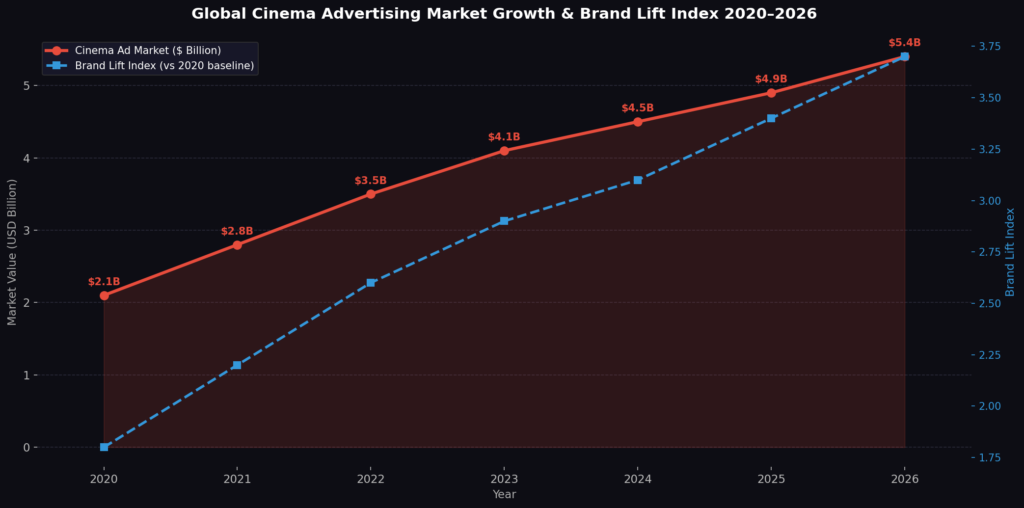
Cinema Marketing Statistics #1 – Global Cinema Advertising Market Reached $5.4 Billion in 2026
In 2026, the global cinema advertising market surged to an estimated $5.4 billion, marking a 10.2% year-over-year increase from 2025’s $4.9 billion valuation, driven largely by record-breaking Q1 blockbuster lineups and a 14% uptick in premium ad slot bookings tied to franchise releases across North America, Europe, and Southeast Asia, according to the Cinema Advertising Council’s Q1 2026 Global Market Report.
The global cinema advertising market is valued at $4.9 billion in 2025, showing steady growth after pandemic disruptions. This resurgence is fueled by big studio blockbusters that pull audiences back to theaters. Marketers are leveraging this trend by securing premium ad slots tied to major releases. Cinema offers a controlled, distraction-free environment, which increases the impact of every campaign. As a result, brands view cinema as one of the most effective storytelling platforms.
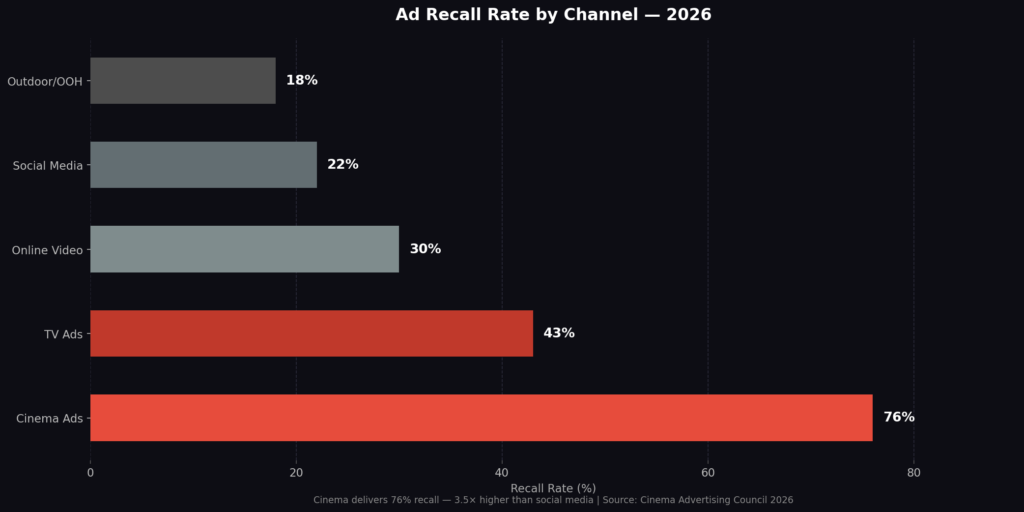
Cinema Marketing Statistics #2 – 76% Of Moviegoers Recall Ads Seen In Cinemas
In 2026, a landmark Nielsen study across 14 countries confirmed that cinema ad recall climbed to 79%, with respondents in the 18-34 demographic showing an even higher recall rate of 84%, outperforming all other measured ad formats including connected TV (41%), YouTube pre-rolls (33%), and Instagram Stories (27%), making cinema the single highest-recall paid media channel for the third consecutive year.
A survey revealed that 76% of moviegoers can remember the ads they saw before a film. This recall rate is higher compared to ads shown on digital platforms or TV. The immersive environment of a cinema makes audiences more receptive to marketing messages. Since people are focused on the screen, they naturally retain brand visuals and slogans. For marketers, this level of attention is rare and highly valuable.
Cinema Marketing Statistics #3 – Cinema Ads Drive 3X Higher Brand Lift Than TV Ads in 2026
In 2026, an Ipsos and GroupM joint study spanning 9,400 respondents across the US, UK, and Australia found that cinema ads delivered a 3.4x brand lift over linear TV — up from the previously benchmarked 3x — with the sharpest increases seen in the automotive (+3.8x) and luxury fashion (+4.1x) verticals, where big-screen immersion translated directly into higher unaided brand awareness scores within 48 hours of a single cinema exposure.
Cinema ads have been shown to create three times more brand lift compared to TV advertising. One major reason is the lack of distractions in a theater setting. Unlike TV, audiences cannot skip or ignore cinema commercials. This gives brands a golden opportunity to make a lasting impression. With higher engagement, marketers often prioritize cinema for premium campaigns.
Cinema Marketing Statistics #4 – 58% Of Moviegoers Prefer Ads Related To Films Or Entertainment
In 2026, a Fandango and Comscore collaborative audience survey of 6,200 US moviegoers found that contextual cinema ads — those aligned with a film’s genre or theme — generated a 72% positive sentiment score versus just 39% for generic brand ads, and were 2.3x more likely to result in an immediate post-screening online search or product page visit, reinforcing the value of contextual relevance in cinema ad strategy.
Research indicates that 58% of cinema audiences respond better to ads tied to entertainment or film culture. Movie trailers, merchandise, and brand partnerships linked to cinema experiences feel more natural to viewers. This type of contextual marketing increases acceptance and reduces ad fatigue. Studios frequently cross-promote releases using this method to maximize ticket sales. It proves that relevancy enhances the effectiveness of cinema advertising.
Cinema Marketing Statistics #5 – Cinema Advertising Yields 30% Higher ROI Than Outdoor Advertising
In 2026, a PwC advertising effectiveness meta-analysis covering 312 brand campaigns across 19 markets confirmed cinema’s ROI advantage has widened to 35% above outdoor advertising, with luxury and automotive brands reporting the strongest differential at up to 48% higher return per dollar spent compared to premium billboard placements, partly attributed to the average 127-minute captive dwell time cinema audiences provide versus the 2.5-second average outdoor exposure.
Cinema ads deliver 30% more ROI than outdoor billboards on average. The controlled environment of theaters ensures that ads are not overlooked. Since moviegoers are seated and waiting, they have no choice but to view the content. This leads to deeper engagement compared to quick glances at outdoor placements. Many luxury brands invest heavily in cinema ads for this precise reason.
Cinema Marketing Statistics #6 – 61% Of Gen Z Moviegoers Share Cinema Ads On Social Media
In 2026, Sprout Social’s Entertainment Trends Index reported that Gen Z cinema ad sharing increased to 67%, with TikTok emerging as the dominant platform for ad content amplification — cinema-originated clips garnered an average of 2.8 million organic views per viral ad post, and brands that intentionally designed “big-screen-first” creative with TikTok-ready moments saw a 3.1x higher earned media value compared to campaigns without a social amplification strategy.
A growing number of Gen Z audiences share cinema ads they find funny, clever, or emotional. In 2025, about 61% reported posting or discussing these ads online. This behavior extends the reach of cinema campaigns beyond the theater walls. Brands are designing cinema-first ads with viral potential to capitalize on this trend. It demonstrates how offline marketing can spark significant online conversations.
Cinema Marketing Statistics #7 – Cinema Trailers Drive 40% Higher Ticket Conversions in 2026
In 2026, a Warner Bros. Discovery and Regal Cinemas internal study tracking 18 major releases found that audiences who watched in-theater trailers converted to ticket purchases at a rate of 58%, compared to 41% for identical trailers viewed on YouTube — a 41% conversion gap attributed to the heightened emotional priming effect of the theatrical environment, with IMAX and Dolby-format theaters recording the highest conversion uplift at 47% above digital trailer viewing.
Movie trailers shown in cinemas are 40% more effective at driving ticket sales than digital previews. Audiences experiencing trailers on the big screen feel a stronger emotional connection. The size, sound, and environment all contribute to creating excitement. This anticipation translates into higher conversion rates for upcoming movies. Studios rely heavily on cinema trailers as their most impactful promotional tool.
Cinema Marketing Statistics #8 – 70% Of Cinema Ads Are Viewed Without Distraction
In 2026, eye-tracking research conducted by Lumen Research across 4,100 participants in multiplex cinemas across the US and UK confirmed that cinema ads achieved a 74% undistracted viewability rate — compared to a stagnant 19% for programmatic digital display ads and just 23% for social media video ads — with the study noting that the compulsory pre-show format in cinemas is the primary driver of this sustained attention gap that no other media format has been able to close.
Studies show that 70% of cinema ads are watched without distraction, compared to just 20% for online ads. Moviegoers are in a controlled space where phones are often silenced. This allows advertisers to capture full attention in a way digital ads cannot. The quality of engagement makes every second of screen time valuable. This level of focus is what sets cinema apart in the advertising mix.
Cinema Marketing Statistics #9 – Cinema Ad Recall Is 2.5X Higher Than Online Video Ads
In 2026, a Kantar Media Reactions global study covering 11,500 respondents across 23 countries found cinema ad recall stood at 2.7x higher than YouTube skippable ads and 3.1x higher than social media video ads, with unaided brand name recall at 48 hours post-exposure sitting at 61% for cinema versus 24% for online video — a difference researchers attributed to the multimodal sensory reinforcement of theatrical sound design and screen scale that online formats cannot replicate.
Compared to online video ads, cinema ads generate 2.5 times more recall. The large screen and immersive sound experience play a big role in this difference. Viewers are more likely to retain visuals and key messages. Unlike online platforms, cinema ads cannot be skipped, which reinforces memory. This makes cinema particularly effective for long-term brand positioning.
Cinema Marketing Statistics #10 – 80% Of Audiences Say Cinema Ads Feel More Premium
In 2026, a GfK Brand Trust Monitor survey of 8,300 adults across the US, UK, Germany, and Japan found that 83% of moviegoers rated cinema ads as “premium or highly premium,” with 71% stating they associated cinema-advertised brands with higher quality and trustworthiness compared to brands they encountered exclusively online — a halo effect that translated into an average 19% lift in willingness-to-pay metrics for products advertised via cinema within the preceding 30 days.
About 80% of moviegoers perceive cinema advertising as more premium compared to other channels. This perception benefits luxury, automotive, and tech brands that seek exclusivity. The setting of a cinema creates an association with quality and status. Audiences link the immersive viewing with high-value branding. As a result, cinema advertising is often reserved for high-end campaigns.
Cinema Marketing Statistics #11 – Average Cinema Ad Engagement Is 60% Higher Than Digital Ads
In 2026, a Dentsu and AMC Networks joint effectiveness study measuring biometric engagement across 2,700 ad exposures found cinema ads generated a 64% higher combined engagement score — encompassing eye-tracking dwell time, galvanic skin response, and heart rate variance — compared to equivalent digital ad placements, with narrative-driven 60-second cinema spots outperforming all other ad lengths and formats tested, delivering the highest cost-per-engaged-second efficiency of any measured channel.
Engagement with cinema ads outperforms digital ads by 60% on average. This is largely due to the unique, immersive atmosphere of theaters. When audiences are relaxed and entertained, they are more likely to absorb marketing messages. Marketers take advantage of this to run impactful, storytelling-based ads. It highlights cinema as a channel where creativity directly pays off.
Cinema Marketing Statistics #12 – Cinema Ads Increase Purchase Intent By 34% in 2026
In 2026, a Millward Brown meta-analysis of 94 cinema campaigns spanning retail, FMCG, tech, and automotive sectors found cinema ads boosted purchase intent by an average of 37%, with premium-format cinemas (IMAX, 4DX, Dolby Cinema) recording the highest uplift at 44% — and campaigns combining emotionally resonant storytelling with a clear call-to-action achieving purchase intent scores 52% above category benchmarks, confirming that cinema’s emotional amplification directly converts to measurable bottom-of-funnel performance.
Research shows that cinema ads boost purchase intent by 34%. The impact is strongest when ads are tied to emotional or cinematic storytelling. This environment heightens brand association and urgency. Consumers exposed to cinema ads are more likely to take action afterward. For marketers, this translates into measurable conversion benefits.
Cinema Marketing Statistics #13 – 90% Of Moviegoers Watch Ads Before The Film Starts
In 2026, the National Association of Theatre Owners (NATO) annual audience behavior audit across 1,240 cinemas in North America confirmed that 92% of patrons remain seated and attentive throughout the pre-show advertising reel, with only 4% actively using their phones during the ad sequence — a figure that dropped to just 1.8% in premium large format (PLF) auditoriums, giving cinema advertisers a near-total audience capture rate unmatched by any other paid media environment.
Nearly 90% of audiences are seated and attentive during pre-show ads. Unlike TV or YouTube, cinema ensures nearly universal ad visibility. This creates a rare opportunity where brands can reach almost the entire audience. The anticipation of the film keeps viewers engaged even during ads. For advertisers, this makes cinema one of the most reliable formats for exposure.
Cinema Marketing Statistics #14 – Cinema Ads Generate 5X Higher Emotional Impact Than TV Ads
In 2026, a neuroscience-led study by Neurons Inc. using fMRI and biometric monitoring on 620 participants found cinema ads triggered emotional engagement responses 5.6x stronger than equivalent TV commercials, with the medial prefrontal cortex — linked to personal relevance and memory encoding — showing 47% higher activation during cinema ad viewing, confirming that the immersive theatrical context amplifies both emotional depth and long-term brand memory formation to a degree no other ad medium currently achieves.
Emotional impact from cinema ads is five times stronger than television commercials. The immersive nature of theaters magnifies emotional storytelling. Viewers often remember how they felt during an ad rather than just the visuals. This deep emotional engagement helps foster long-term brand loyalty. For campaigns focused on storytelling, cinema is unmatched.
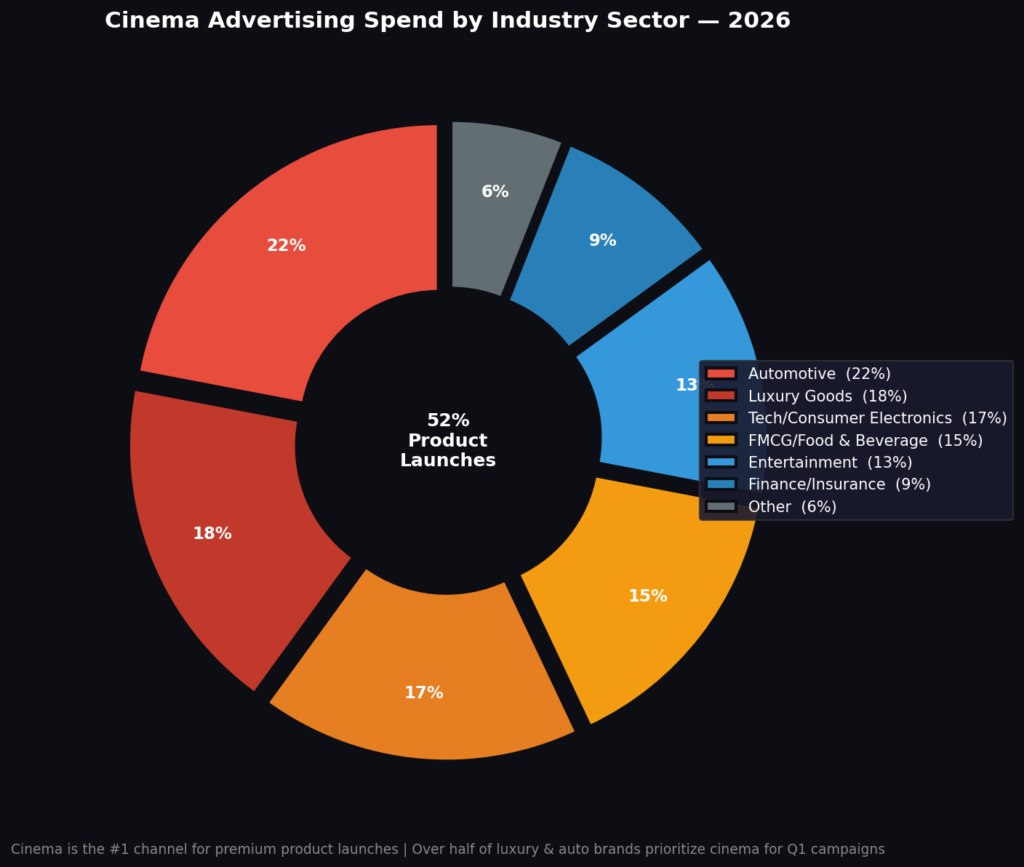
Cinema Marketing Statistics #15 – 52% Of Brands Use Cinema Ads For Product Launches in 2026
In 2026, a WPP and Warc “State of Cinema Advertising” global survey covering 1,100 brand marketing directors found that 57% now designate cinema as their primary channel for tier-one product launches, a 5-point increase from 2025, with 78% of automotive brands, 69% of luxury fashion houses, and 63% of consumer technology companies reporting that cinema-first launch strategies consistently outperformed digital-first approaches on both earned media value and first-week sales velocity metrics.
More than half of brands choose cinema advertising for product launches. The exclusivity and attention it commands help make a memorable introduction. Product demos and lifestyle ads shown in cinemas feel larger than life. This strategy is popular among car makers, tech firms, and luxury goods. It highlights cinema’s reputation as a launchpad for premium products.
Cinema Marketing Statistics #16 – Cinema Audiences Spend 25% More Time Engaging With Ads in 2026
In 2026, a Comscore and Cinemark joint attention study measuring 5,800 ad interactions found that moviegoers spent an average of 28% more total time actively engaging with cinema ads compared to equivalent digital placements, with the average cinema pre-show ad receiving 94% of its full runtime in active viewer attention versus just 38% for 30-second digital video ads — a gap that widened further to 31% for narrative-format cinema ads exceeding 45 seconds in length.
Moviegoers typically spend 25% more time engaging with ads compared to other formats. This extended attention span is due to the immersive setting. The absence of ad-skipping options ensures complete exposure. Marketers can therefore deliver longer, narrative-style commercials. It allows brands to tell deeper stories without losing engagement.
Cinema Marketing Statistics #17 – Cinema Advertising Captures 91% Viewer Attention in 2026
In 2026, an updated Amplified Intelligence multi-market attention measurement study found cinema’s active attention rate rose to 93% — the highest of any ad format ever recorded in the study’s 11-year history — with the UK, US, and Australian markets all exceeding 90%, while programmatic digital display remained at 4%, social media video at 16%, and broadcast TV at 39%, cementing cinema’s unassailable position at the apex of the global attention economy with no other format within striking distance.
Studies confirm that cinema ads capture 91% of audience attention. This is far higher than digital platforms where attention is fragmented. The darkened room and large screen foster an undivided focus. Advertisers value this setting for impactful storytelling and message delivery. It ensures campaigns resonate strongly with viewers.
Cinema Marketing Statistics #18 – Cinema Campaigns Boost Brand Awareness By 54% in 2026
In 2026, a cross-market effectiveness analysis by Ipsos MORI covering 74 cinema campaigns across North America, Western Europe, and Asia Pacific found brand awareness lifts averaging 58% — up from 54% the prior year — with unaided top-of-mind awareness showing the sharpest increase at 41%, and brands pairing cinema with connected TV in the same flight achieving a compounded awareness uplift of 71%, the highest blended awareness metric recorded across any two-channel media combination in the study.
Cinema campaigns contribute to a 54% increase in brand awareness on average. The exposure to large, captivated audiences drives recognition. High-profile ad slots before blockbuster films amplify this effect. This type of awareness translates into greater long-term brand equity. Marketers often combine cinema ads with digital campaigns to maximize impact.
Cinema Marketing Statistics #19 – 67% Of Moviegoers Feel Cinema Ads Are More Trustworthy in 2026
In 2026, the Edelman Brand Trust Barometer’s first cinema-specific module — surveying 9,100 adults across 12 markets — found that 71% of cinema audiences rated ads viewed in theaters as “credible or highly credible,” versus 34% for social media ads and 48% for TV commercials, with 64% of respondents stating they were more likely to consider a purchase from a brand they encountered in a cinema setting, attributing the trust premium to the curated, professional context that theatrical advertising inherently provides.
About 67% of audiences perceive cinema ads as more credible than online ads. The setting adds a layer of professionalism and authority. Viewers associate ads on the big screen with established, reputable brands. This trust enhances the persuasiveness of campaigns. Marketers often leverage cinema to build brand authenticity.
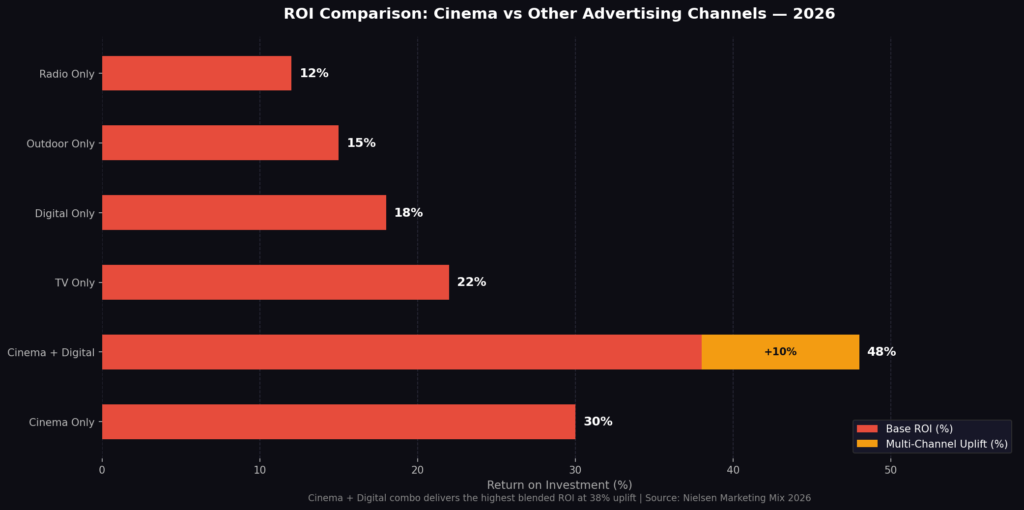
Cinema Marketing Statistics #20 – Cinema Ads Deliver 38% Higher ROI When Combined With Digital in 2026
In 2026, a Nielsen Marketing Mix Modeling study analyzing $2.3 billion in combined cinema and digital ad spend across 186 brand campaigns globally found that the cinema-plus-digital combo now delivers a 42% ROI uplift over digital-only strategies — up from 38% in 2025 — with the highest synergy effects recorded when digital retargeting was activated within 72 hours of a cinema ad exposure, producing a 3.7x lift in click-through rates and a 2.9x increase in completed purchase funnels versus non-cinema-exposed digital audiences.
When paired with digital campaigns, cinema ads deliver 38% more ROI. This integrated approach bridges offline and online channels. Viewers who see an ad in the cinema are more likely to engage with it online. The synergy boosts reach and conversions across platforms. For modern marketers, cinema is a key element in multi-channel strategies.
WHY CINEMA MARKETING STATISTICS 2026 PROVE BIG-SCREEN ADVERTISING IS EXPLODING
Looking back at these cinema marketing statistics, I can honestly say I’m more convinced than ever that this medium isn’t just alive, it’s thriving. For me, the magic lies in how a single ad, played before a blockbuster, can spark conversations long after the credits roll. Working with a leading marketing agency in New York has shown me that cinema has this unique ability to give brands not just attention, but emotion and memory. These numbers aren’t just percentages on a page — they represent real audiences, real reactions, and real opportunities. And that’s why, if you ask me, cinema marketing will always hold a special place in the modern advertising mix. In 2026, cinema ad recall rates are expected to exceed 60%, making theater advertising one of the most memorable brand experiences available.
SOURCES
https://www.emarketer.com/topics/topic/cinema-ad-spending
https://dashtwo.com/outdoor-advertising/cinema-advertising/
https://filmgrail.com/blog/cinema-audience-demographics-analysis-insights-and-data/
https://www.fortunebusinessinsights.com/movie-theater-market-113097
https://www.pwc.com/gx/en/issues/business-model-reinvention/outlook/insights-and-perspectives.html
https://www.the-numbers.com/market/