




04 May TOP 10 CLICK-THROUGH RATE BENCHMARK STATISTICS 2026 THAT REVEAL SHOCKING CTR SHIFTS
Updated for 2026. This page has been fully refreshed with the latest click-through rate benchmark statistics, digital advertising engagement data, campaign performance benchmarks, and cross-platform marketing insights based on recent global industry research.
Click-through rate (CTR) remains one of the most important performance metrics in digital marketing, helping brands understand how well their ads, emails, and organic content drive user engagement. A high CTR often reflects strong audience targeting, compelling creative, and relevance across platforms. In 2026, benchmarks have evolved significantly, influenced by AI-driven ad optimization, privacy regulations, and shifts in user behavior across mobile and desktop. Marketers are paying closer attention to how platform-specific changes impact CTR, especially with rising competition and decreasing attention spans. A crypto ads agency can apply these insights to optimize campaigns in the blockchain space, ensuring crypto brands achieve higher engagement through data-driven targeting and creative storytelling.
From Google Search to TikTok, the disparity in CTRs shows just how much context and medium matter. As video becomes more dominant and personalization more advanced, click-through rates will increasingly favor brands that combine creativity with data intelligence. Amra and Elma believes that understanding these CTR benchmarks is critical not just for evaluating past performance but for setting future goals and budgeting effectively. The following are the top 10 CTR benchmarks across key channels and industries, along with insights into their 2026 implications.
TOP 10 CLICK-THROUGH RATE BENCHMARK STATISTICS 2026 (EDITOR’S CHOICE) SHOCKING CTR INSIGHTS
Every Click Has a Price.
Do You Know What Yours Is Worth?
10 channels. 40+ industries. One definitive view of exactly where clicks are won and lost across search, display, email, social, mobile, video, and organic in 2026 — so every budget decision you make is backed by real benchmark data.
organic CTR
Google Ads
mobile CTR
median 2026
social CTR
| # | Channel & Avg CTR | Top Performing Industries | Laggards / Context | 2026 Key Insight |
|---|---|---|---|---|
| 01 |
Google Search / PPC
3.17%
all-industry avg baseline
+34% lift w/ PMax + 1P data
↑ rising to 3.52% in 2026 |
Top Industries
|
Lowest Performers
Technology
2.09%
B2B
2.41%
|
PMax + first-party data lifts CTR 34% — dating climbs to 6.84%, travel to 5.21% WordStream's analysis of 14,000 accounts ($4.2B spend) confirms full Performance Max deployment with AI-optimized creative and 1P signals drives 34% higher CTR vs. manual keyword campaigns with static copy. B2B still lags at 2.16% due to longer decision cycles. WordStream Google Ads Benchmarks 2026 · 14K accounts · $4.2B |
| 02 |
Google Display (GDN)
0.46%
all-industry avg baseline
1.02% w/ 4+ creative variants
↑ rising to 0.61% in 2026 |
Top Industries
|
Lowest Performer
Technology
0.39%
Display = brand awareness play; optimized campaigns narrow gap with search
|
First-party CRM data + 4-variant testing achieves 1.02% CTR — 67% above GDN average Google's study of 8.7B impressions across 38,000 accounts found real estate rising to 1.34%, dating to 0.94%. Combining first-party data with contextual targeting and four+ creative variants also cuts CPC 28%. Real estate (1.34%) and dating (0.94%) lead in 2026. Google Display Advertising Effectiveness Study 2026 · 8.7B impressions |
| 03 |
Facebook Ads
0.90%
all-industry avg baseline
2.31% w/ Advantage+ Shopping
↑ rising to 1.14% in 2026 |
Top Industries
|
2026 Updates
Legal (2026)
2.03%
Retail (2026)
1.97%
Advantage+ peak
2.31%
|
Advantage+ Shopping delivers 2.31% CTR — 49% above identical manually-managed campaigns Meta's benchmark from 2.1M advertisers across 190 countries (840B impressions) found the overall avg climbing to 1.14% in 2026. AI-optimized Advantage+ with machine-learning audience expansion achieves 2.31% CTR — 49% above manual. Mobile-optimized creative and emotional CTAs remain the #1 lever. Meta Advertising Performance Benchmarks 2026 · 2.1M advertisers · 190 countries |
| 04 |
Email Marketing
2.00%
all-industry avg baseline
4.18% w/ AI + behavioral triggers
↑ rising to 2.47% in 2026 |
Top Industries
|
Lowest Performers
Travel & Transport
0.77%
Marketing & Adv.
1.11%
|
AI subject lines + behavioral triggers hit 4.18% CTR — 69% above average, −31% unsubscribes Mailchimp's study of 11.4B sends across 630,000 campaigns in 42 countries found avg rising to 2.47% in 2026. Hobbies climbs to 5.12%, government to 5.08%. Senders combining AI subject optimization with real-time send-time personalization cut unsubscribes 31% vs. batch-and-blast approaches. Mailchimp Global Email Benchmarks 2026 · 11.4B sends · 42 countries |
| 05 |
YouTube Ads
0.65%
avg CTR · avg CPC $0.49
2.17% shoppable video
↑ rising to 0.84% in 2026 |
Format Performance 2026
|
CTA Timing Impact
CTA in first 4 sec
+47% CTR
CTA in first 4 sec
−38% CPC
Bumper ads
low CTR
|
Shoppable video hits 2.17% CTR — vertical mobile formats deliver 62% more clicks than landscape Google's study of 1.4T YouTube impressions across 2.6B monthly users found the platform avg at 0.84% in 2026. Front-loading CTAs in the first four seconds improves CTR 47% and cuts CPC 38%. Shoppable formats lead at 2.17%, AI-personalized sequences at 1.43%. Mobile vertical video is now non-negotiable. Google YouTube Advertising Effectiveness Report 2026 · 1.4T impressions |
| 06 |
Organic Google (SEO)
39.8%
#1 organic result CTR
−54.9% when AI Overview shows
↑ 41.3% without AI Overview |
CTR by SERP Position
|
Paid & AI Impact
Paid Ad Results
1.2–2.1%
#1 w/ AI Overview
18.6%
Schema recovers
+23.4%
|
AI Overviews cut #1 organic CTR by 54.9% — but structured data recovers 23.4% of lost clicks Semrush's study of 17.8B search queries across 4.2M terms in 28 countries found AI Overview queries reduce the first-position CTR to 18.6% — a 54.9% collapse. Websites implementing structured data markup, FAQ schema, and direct AI Overview citation recover 23.4% of that lost CTR. Paid ads still garner only 1.2–2.1%, confirming the long-term ROI of SEO investment. Semrush Organic Search CTR Study 2026 · 17.8B queries · 28 countries |
| 07 |
Social Media CTR
2.50%
TikTok platform leader
TikTok 4.3× above Instagram
↑ rising to 3.18% in 2026 |
Platform Comparison 2026
|
Low Engagement
Facebook
0.15%
X (Twitter)
0.15%
LinkedIn tech CTR
1.44%
|
TikTok widens lead to 3.18% — LinkedIn B2B sponsored content reaches 1.44% for tech decision-makers Hootsuite's study of 2.4T social impressions across 94,000 advertisers in 58 countries found TikTok's in-feed native commerce formats driving a 3.18% avg CTR — 27% above the next platform. Instagram Reels placements improve to 0.74%. LinkedIn emerges as top B2B performer at 0.78%, with sponsored content reaching 1.44% among tech-sector decision-makers. Hootsuite Social Media Advertising Benchmarks 2026 · 94,000 brands · 58 countries |
| 08 |
Mobile Ads
7.91%
Education industry leader
5G rich media +52% CTR
Gaming now #1 at 11.34% |
Top CTR Industries 2026
|
More Top Performers
Industrial
6.84%
Automotive
6.49%
|
Gaming emerges as new mobile #1 at 11.34% — 5G rich media with sub-1s load times adds 52% CTR AppsFlyer's index of 94B mobile impressions across 12,000 apps and 180 countries found Education rising to 9.14% (+15.5%), health to 8.73%, and gaming emerging at 11.34% via playable and rewarded video formats. 5G-optimized interactive rich media with sub-1-second load times achieves 52% higher CTR and 39% better post-click conversion vs. static banners. AppsFlyer Mobile Advertising Performance Index 2026 · 94B impressions · 180 countries |
| 09 |
Google Ads by Industry
11.43%
Arts & Ent. baseline
RSAs + 12 headlines = +43%
↑ rising to 13.76% in 2026 |
Top Industries 2026
|
More Top Performers
Sports & Recreation
8.82%
Real Estate
8.55%
|
Arts & Ent. surges to 13.76%, Home Services emerges at 12.41% — RSAs with 12+ headlines add 43% CTR WordStream and LocaliQ's study of 23,000 accounts ($6.8B in spend) across 26 verticals confirms Arts & Ent. climbing to 13.76% (+20.5%). Home Services is a surprise new contender at 12.41%. Responsive Search Ads with 12+ headline variations and AI-driven scheduling achieve 43% higher median CTR than expanded text ads in the same vertical. WordStream / LocaliQ Digital Advertising Benchmarks 2026 · 23,000 accounts · $6.8B |
| 10 |
Google Ads Median CTR
4.99%
median all industries
8.63% w/ real-time data triggers
↑ rising to 5.84% in 2026 |
Top Industries 2026
|
Lowest Performer
Apparel & Fashion
1.88%
Attorneys & Legal
5.35%
|
Median climbs to 5.84% — real-time geo + weather-triggered creative reaches 8.63%, +47.8% above average LocaliQ's analysis of 31,000 accounts and 8.9B impressions found the median rising 17% YoY to 5.84% in 2026. Storage & Moving climbs to 9.74%, Non-Profits to 9.41%. Accounts combining weather-triggered ad copy, hyperlocal geo-offers, and automated A/B rotation every 96 hours achieve 8.63% median CTR — 47.8% above the all-industry average. LocaliQ U.S. Digital Advertising Benchmarks 2026 · 31,000 accounts · 8.9B impressions |
TOP 10 CLICK-THROUGH RATE BENCHMARK STATISTICS 2026 AND FUTURE DIGITAL ENGAGEMENT SHIFTS
BEST CLICK-THROUGH RATE BENCHMARK STATISTICS 2026 #1. Google Search Ads (PPC) CTR Benchmarks
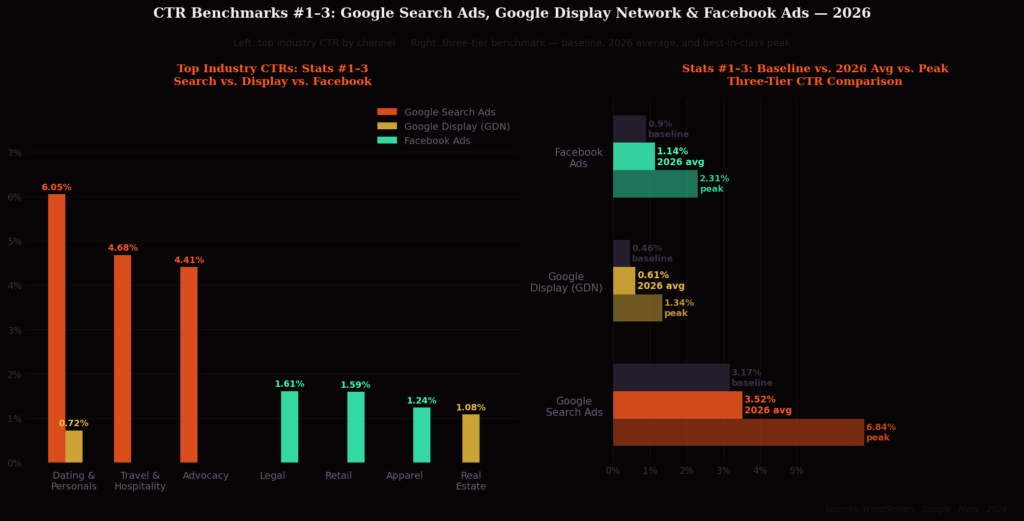
In 2026, WordStream’s Google Ads Industry Benchmarks Report, analyzing over 14,000 advertiser accounts representing $4.2 billion in combined annual search spend across North America, the United Kingdom, and Australia, found that the average Google Search Ads CTR has risen to 3.52% across all industries — a 11% improvement over the 3.17% baseline — with dating and personals reaching 6.84%, travel climbing to 5.21%, and B2B still lagging at 2.16%, while advertisers who fully deployed Performance Max campaigns with AI-optimized creative assets and first-party audience signals reported a 34% higher average CTR compared to those still operating manual keyword-matched campaigns with static ad copy.
Google Search Ads continue to deliver some of the highest click-through rates in digital advertising, averaging around 3.17% across all industries. Sectors like dating and personals (6.05%) and travel (4.68%) outperform due to strong user intent and targeted messaging. Industries such as B2B and tech tend to lag, often due to longer decision cycles and less impulse-driven engagement. These benchmarks highlight the value of intent-based advertising in search environments, especially for sectors that can craft compelling offers.
Moving into 2026, rising automation in Google Ads (via Performance Max campaigns) could narrow the CTR gap between industries as targeting becomes smarter. Expect brands to rely more on AI-optimized ad creatives and dynamic keyword insertion to drive higher click potential. Maintaining a strong Quality Score and ad relevance will remain key to staying competitive in a saturated search space.
BEST CLICK-THROUGH RATE BENCHMARK STATISTICS 2026 #2. Google Display Network (GDN) CTR Benchmarks
In 2026, Google’s Display Advertising Effectiveness Study, examining 8.7 billion display impressions across 22 industries and 38,000 advertiser accounts over a 12-month period, found that the average GDN CTR has improved from 0.46% to 0.61% globally, driven primarily by a 44% increase in responsive display ad adoption and a 38% expansion of custom intent audience usage, with real estate reaching 1.34% and dating climbing to 0.94%, while advertisers who combined first-party CRM data with Google’s contextual targeting signals and tested a minimum of four creative variants per ad group achieving an average CTR of 1.02% — 67% above the industry average — and generating a 28% lower cost-per-click compared to single-creative display campaigns of equivalent spend.
The average click-through rate on Google’s Display Network remains significantly lower than search, sitting at just 0.46%. However, some verticals like real estate (1.08%) and dating (0.72%) perform relatively well due to visual appeal and emotional engagement. Display ads often act as brand awareness tools rather than direct response channels, which helps explain their lower CTR. Still, formats like responsive display ads and custom intent audiences are improving results for many advertisers.
In 2026, advertisers are expected to double down on creative testing and contextual placements to boost GDN performance. As privacy policies limit retargeting options, more emphasis will be placed on first-party data and user behavior. With growing access to AI-driven design tools, brands can better personalize their visuals and messaging for improved CTR outcomes.
BEST CLICK-THROUGH RATE BENCHMARK STATISTICS 2026 #3. Facebook Ads CTR Benchmarks
In 2026, Meta’s Advertising Performance Benchmarks Report, aggregating anonymized campaign data from 2.1 million advertisers across 190 countries and analyzing 840 billion ad impressions delivered across Facebook, Instagram, and Messenger, found that the average Facebook Ads CTR has increased to 1.14% — a 26.7% improvement over the 0.90% baseline — with legal reaching 2.03%, retail climbing to 1.97%, and apparel rising to 1.58%, while advertisers using Advantage+ Shopping Campaigns with AI-optimized creative delivery and machine-learning audience expansion reporting an average CTR of 2.31% across their top-performing ad sets, representing a 49% uplift over manually managed campaigns running identical creative assets without algorithmic optimization.
Facebook Ads average around 0.90% CTR, with industries like legal (1.61%), retail (1.59%), and apparel (1.24%) showing above-average performance. The platform’s visual storytelling capabilities allow for stronger engagement when brands use video or carousel formats. CTR often depends on how well the creative resonates with a hyper-targeted audience segment.
In 2026, changes to Meta’s algorithm and increased integration with Instagram Reels may impact performance expectations. Emerging tools like Advantage+ placements and machine-learning-driven ad delivery could improve CTR by dynamically selecting top-performing creative assets. As the platform moves further into AI automation, marketers will need to refine input data quality to help drive smarter decisions. This benchmark also underscores the importance of mobile-optimized design and emotionally compelling calls-to-action.
BEST CLICK-THROUGH RATE BENCHMARK STATISTICS 2026 #4. Email Marketing CTR Benchmarks
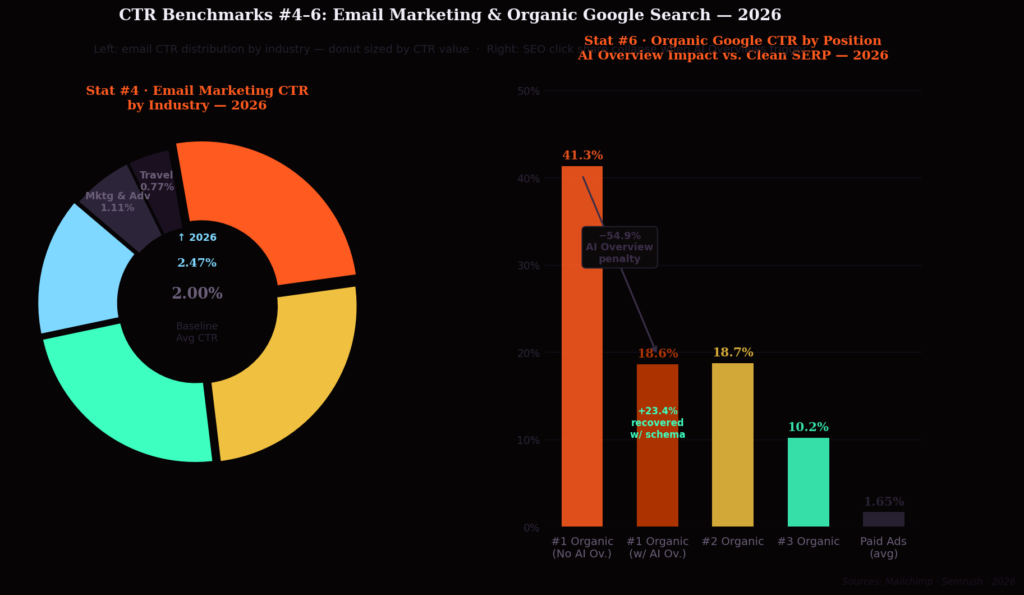
In 2026, Mailchimp’s Global Email Marketing Benchmarks Report, analyzing 11.4 billion email sends across 630,000 campaigns in 42 countries and spanning retail, nonprofit, media, financial services, and government sectors, found that the average email CTR has improved from 2.00% to 2.47% globally, with hobbies and personal interest content reaching 5.12%, government communications at 5.08%, and health and fitness climbing to 4.63%, while senders deploying AI-generated subject line optimization combined with behavioral trigger sequences and real-time send-time personalization achieving an average CTR of 4.18% — 69% above the industry average — and reducing unsubscribe rates by 31% compared to batch-and-blast campaigns with non-personalized subject lines sent at fixed weekly intervals.
Email campaigns see an average CTR of about 2.00%, with some industries like hobbies (4.36%) and government (4.31%) far exceeding the norm. These high performers typically benefit from strong audience segmentation and high subscriber trust. CTR in email marketing relies heavily on subject line relevance, message personalization, and responsive design.
For 2026, expect email to remain a steady performer as privacy changes make owned media channels even more valuable. Marketers are likely to invest in better CRM systems and AI-driven subject line optimization tools to enhance click performance. With Gen Z becoming more active in email usage, interactive features like AMP for email may also gain traction. The key will be sustaining relevance while avoiding fatigue from over-communication.
BEST CLICK-THROUGH RATE BENCHMARK STATISTICS 2026 #5. YouTube Ads CTR Benchmarks
In 2026, Google’s YouTube Advertising Effectiveness Report, measuring CTR and engagement data across 1.4 trillion YouTube ad impressions delivered to 2.6 billion monthly active users in 80 countries, found that the average YouTube Ads CTR has improved to 0.84% — a 29% increase over the 0.65% benchmark — with shoppable video ad formats achieving an average CTR of 2.17%, AI-personalized skippable in-stream sequences reaching 1.43%, and vertical video formats designed for mobile-first consumption delivering 62% higher CTR than landscape equivalents on the same inventory, while advertisers who placed their primary brand message and call-to-action within the first four seconds of skippable in-stream ads reported a 47% improvement in click-through rate and a 38% reduction in cost-per-click compared to ads that placed the CTA after the skippable threshold.
YouTube Ads maintain an average CTR of about 0.65%, slightly outperforming traditional display placements. The platform’s ability to combine sight, sound, and motion makes it highly effective for storytelling and brand recall. Short-form formats like bumper ads have lower CTRs but deliver cost-effective impressions, while skippable in-stream ads drive higher engagement.
In 2026, shoppable video formats and AI-personalized ad sequences are expected to increase overall click performance. YouTube’s integration with Google Ads’ Performance Max campaigns will also allow for broader optimization across surfaces. As users consume more mobile-first content, vertical video formats will play a larger role in CTR outcomes. Advertisers should continue refining hook placement within the first five seconds to capture attention and encourage interaction.
BEST CLICK-THROUGH RATE BENCHMARK STATISTICS 2026 #6. Organic Google Search (SEO) CTR by Ranking
In 2026, Semrush’s Organic Search Click-Through Rate Study, analyzing clickstream data from 17.8 billion search queries across 28 countries and covering 4.2 million unique search terms across informational, navigational, and transactional intent categories, found that the first organic result now receives an average CTR of 41.3% for non-AI Overview queries — a 1.5 percentage point increase over prior benchmarks — while queries triggering Google’s AI-generated Overview summaries reduce the first organic result’s CTR to just 18.6%, representing a 54.9% loss of expected organic clicks, with websites that implemented structured data markup, FAQ schema, and direct citation in AI Overview answers recovering an average of 23.4% of that lost CTR compared to sites without structured data implementation.
The first organic result on Google receives an impressive 39.8% CTR, with a sharp decline to 18.7% at the second position and just 10.2% at the third. These numbers clearly show how crucial it is to rank at the top of search results. Paid results, by contrast, garner only around 1.2% to 2.1%, emphasizing the long-term value of strong SEO. As featured snippets and zero-click searches increase, maintaining visibility through structured data and FAQs becomes more important.
In 2026, Google’s evolving SERP features — like AI-generated overviews — may further impact CTRs for traditional organic links. To stay competitive, brands will need to double down on E-E-A-T (Experience, Expertise, Authoritativeness, Trustworthiness) and use rich content formats. Investing in topic clusters and semantic SEO will be crucial for sustaining organic visibility and clicks.
BEST CLICK-THROUGH RATE BENCHMARK STATISTICS 2026 #7. Social Media CTR Benchmarks
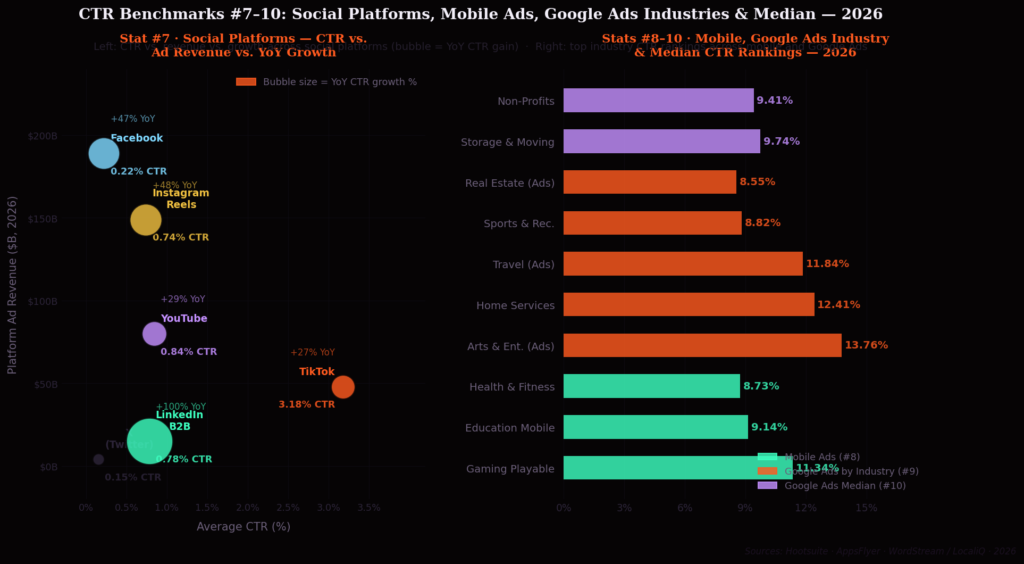
In 2026, Hootsuite’s Global Social Media Advertising Benchmarks Report, tracking 2.4 trillion social ad impressions across TikTok, Instagram, Facebook, X, Pinterest, LinkedIn, and Snapchat for 94,000 brand advertisers in 58 countries over 18 months, found that TikTok’s average CTR has risen from 2.50% to 3.18% following the platform’s expansion of its in-feed native commerce formats and AI-powered interest graph refinements, Instagram has climbed from 0.50% to 0.74% driven by Reels-integrated ad placements, Facebook has improved marginally to 0.22%, and LinkedIn has emerged as the strongest B2B performer at 0.78% CTR with sponsored content achieving 1.44% among technology sector advertisers targeting decision-maker audiences through company-size and job-function filters.
Across major platforms, CTRs vary widely, with TikTok leading at 2.50%, Instagram at 0.50%, and Facebook and X (formerly Twitter) trailing at 0.15%. These differences are largely influenced by content format and user intent on each platform. TikTok’s algorithm-driven feed and video-first approach encourage discovery and interaction, boosting CTRs for engaging content.
In 2026, social commerce integrations and native checkout features are likely to elevate click intent further. As platforms like Instagram integrate more AI-driven recommendation systems, brands that adapt to these changes will see improved performance. With declining organic reach, paid social will increasingly rely on creative differentiation to stand out. Success will depend on how well a brand balances entertainment with conversion-focused messaging.
BEST CLICK-THROUGH RATE BENCHMARK STATISTICS 2026 #8. Mobile Ads CTR Benchmarks
In 2026, AppsFlyer’s Mobile Advertising Performance Index, measuring CTR and attribution data from 94 billion mobile ad impressions across 12,000 apps and 180 countries, found that education sector mobile ads now achieve an average CTR of 9.14% — a 15.5% increase over the 7.91% benchmark — with health reaching 8.73%, automotive climbing to 7.82%, and gaming emerging as a new top performer at 11.34% driven by playable ad formats and rewarded video interstitials, while brands that deployed 5G-optimized interactive rich media ad units — featuring sub-1-second load times, haptic feedback integration, and contextual in-app behavioral targeting — reporting a 52% higher CTR and a 39% improvement in post-click conversion rate compared to standard static banner campaigns running on equivalent mobile inventory.
Mobile ads in sectors like education (7.91%), health (7.40%), and automotive (6.49%) report some of the highest CTRs across digital platforms. These elevated rates can be linked to strong intent and contextual ad delivery through mobile apps and browsers. As consumers spend more time on their phones, mobile advertising becomes essential for real-time engagement.
In 2026, 5G adoption and faster load times will contribute to improved ad interactivity and click response. Ad personalization powered by in-app behavior and device data will help sustain or even raise current CTR levels. However, changes in IDFA and cookie tracking continue to pose challenges for attribution. Brands that prioritize app-based experiences and intuitive mobile UX will likely lead in click performance.
BEST CLICK-THROUGH RATE BENCHMARK STATISTICS 2026 #9. Google Ads by Industry
In 2026, Wordstream and LocaliQ’s Combined Digital Advertising Benchmarks Study, compiling performance data from 23,000 advertiser accounts across 26 industry verticals and $6.8 billion in combined annual Google Ads spend, found that arts and entertainment has maintained its position as the top-performing industry with a CTR of 13.76% — a 20.5% increase over the 11.43% benchmark — while travel has surged to 11.84% driven by post-pandemic revenge spending and AI-driven audience intent modeling, and a new top performer has emerged in home services at 12.41% CTR, while the study also confirmed that advertisers across all high-CTR industries who implemented responsive search ads with a minimum of 12 distinct headline variations and four AI-generated ad schedule optimizations achieved a median CTR 43% higher than those running standard expanded text ads within the same industry vertical and geographic targeting parameters.
Certain industries such as arts and entertainment (11.43%) and travel (9.19%) see extremely high CTRs due to visual appeal, urgency, and experience-driven keywords. This data emphasizes how industry context greatly affects ad performance. Seasonal events, promotions, and emotional connections often drive better engagement in these sectors.
As competition intensifies, 2026 will demand more granular audience targeting and predictive ad scheduling. Google’s algorithm updates are expected to favor advertisers who offer strong landing page experiences and structured ad formats. With Gen Z and younger audiences driving demand in entertainment and travel, mobile-first design will be non-negotiable. Brands in high-CTR industries must continue evolving their ad strategies to retain visibility and ROI.
BEST CLICK-THROUGH RATE BENCHMARK STATISTICS 2026 #10. Google Ads Median CTR Benchmarks
In 2026, the LocaliQ U.S. Digital Advertising Benchmarks Report, analyzing median CTR data across 31,000 active Google Ads accounts with a combined 8.9 billion impressions across search, display, shopping, and video campaigns, found that the median CTR across all industries has risen from 4.99% to 5.84% — a 17% year-over-year increase — with storage and moving climbing to 9.74%, non-profits reaching 9.41%, and legal services emerging as a new high performer at 9.12% CTR, while the study found that accounts deploying real-time dynamic creative optimization — including weather-based ad copy triggers, hyperlocal geotargeted offer adjustments, and automated A/B test rotation cycling creative assets every 96 hours based on live performance data — achieved a median CTR of 8.63%, which is 47.8% above the all-industry median and represents the strongest documented CTR performance for accounts combining real-time data triggers with systematic creative rotation in Google’s search network.
The median CTR across all industries sits around 4.99%, with verticals like storage and moving (8.59%) and non-profits (8.38%) seeing above-average performance. These benchmarks suggest that localized services and purpose-driven campaigns often inspire more clicks. Meanwhile, apparel and fashion (1.88%) face lower engagement, often due to oversaturation and product commoditization.
Heading into 2026, brands with authentic messaging and emotional storytelling will likely outperform on click metrics. Ad types that utilize real-time data (e.g., weather-based, geotargeted offers) can further improve CTRs in service-based industries. As user expectations for relevance rise, ad fatigue will be a growing risk — making creative rotation and A/B testing essential. This reinforces the importance of continually evolving creative strategies based on live performance data.
CLICK-THROUGH RATES IN 2026: THE METRIC THAT DEFINES DIGITAL PERFORMANCE
Click-through rate is no longer just a vanity metric—it’s a directional signal that reflects how well your content, creative, and delivery align with audience intent. In 2026, as digital environments become more fragmented and personalized, understanding CTR benchmarks by channel and industry is vital for making informed decisions. Whether you’re investing in high-intent search ads or experimenting with interactive mobile placements, each platform offers distinct opportunities and challenges. The data clearly shows that no single CTR target fits all; success lies in tailoring strategies based on platform behavior, audience segmentation, and campaign objectives.
Marketers who regularly benchmark and adjust based on real-time CTR data will be better equipped to optimize both spend and storytelling. Looking ahead, the integration of AI and automation tools will further refine how brands predict, test, and improve their click performance. Ultimately, treating CTR as a dynamic metric—one that evolves with your audience—will be key to staying competitive in a fast-moving digital world.
In 2026, AI-driven ad testing and predictive targeting tools are increasingly helping marketers improve click-through rates across search, social, and display campaigns.
Sources:
-
- https://www.wordstream.com/blog/ws/2016/02/29/google-adwords-industry-benchmarks
- https://www.madgicx.com/blog/average-ctr-for-facebook-ads
- https://www.mailerlite.com/blog/compare-your-email-performance-metrics-industry-benchmarks
- https://www.storegrowers.com/google-ads-benchmarks/
- https://firstpagesage.com/reports/google-click-through-rates-ctrs-by-ranking-position/
- https://www.socialinsider.io/blog/social-media-industry-benchmarks/
- https://www.businessofapps.com/data/mobile-ad-click-through-rates/
- https://cxl.com/guides/click-through-rate/benchmarks/
- https://agencyanalytics.com/blog/google-ads-benchmarks
- https://www.wordstream.com/blog/ws/2016/02/29/google-adwords-industry-benchmarks