




18 Sep TOP 20 CLOUD SERVICE MARKETING STATISTICS 2025
When I first started exploring the world of cloud services, I was amazed by how quickly businesses were adopting and scaling with these technologies. What stood out even more was the power of cloud service marketing statistics—numbers that reveal just how impactful the shift to the cloud has been for companies worldwide. As someone passionate about making complex ideas simple, I wanted to put together a collection of the most important insights to help you understand where this industry is headed. And with the guidance of a leading marketing agency in New York, I’ve learned that data isn’t just numbers—it’s the foundation for smarter strategies, better storytelling, and stronger connections with customers.
Top 20 Cloud Service Marketing Statistics 2025 (Editor’s Choice)
📊 Top 20 Cloud Service Marketing Statistics 2025
Essential Insights for Cloud Marketers & Decision Makers
| Rank | Category | Key Statistic | Trend |
|---|---|---|---|
| 1 | Market Growth | Global cloud computing market reached $912.77 billion in 2025, up from $156.4 billion in 2020 Source: Precedence Research |
📈 |
| 2 | Public Cloud | End-user spending on public cloud services forecast to total $723.4 billion in 2025, up from $595.7 billion in 2024 Source: Gartner |
📈 |
| 3 | Growth Rate | Public cloud services market achieving 21.5% growth rate in 2025 Source: Gartner |
🚀 |
| 4 | SaaS Market | Global SaaS spending expected to hit $300 billion by 2025 Source: Industry Analysis |
📈 |
| 5 | Market Leader | Amazon Web Services holds 30% market share in worldwide cloud infrastructure Source: Synergy Research Group |
👑 |
| 6 | Second Place | Microsoft Azure holds 20% market share in cloud infrastructure Source: Synergy Research Group |
📈 |
| 7 | Third Place | Google Cloud Platform accounts for 13% of the cloud market Source: Synergy Research Group |
📊 |
| 8 | Big Three | AWS, Azure, and Google Cloud together account for over 60% of the cloud market Source: Synergy Research Group |
🏆 |
| 9 | Adoption Rate | 96% of companies are expected to use public cloud services in 2025 Source: Cloud Computing Stats |
📈 |
| 10 | Multi-Cloud | 92% of companies are expected to adopt multi-cloud strategies Source: Cloud Computing Stats |
🔄 |
| 11 | High Spenders | 33% of enterprises spend more than $12 million annually on public cloud Source: Flexera |
💰 |
| 12 | IT Budget Shift | 51% of IT spending will shift from traditional tools to cloud solutions by 2025 Source: Industry Research |
🔄 |
| 13 | Budget Growth | Marketing budgets now represent 9.4% of company revenues and 11.4% of overall budgets Source: CMO Survey |
📈 |
| 14 | Digital Marketing | Digital marketing spending projected to grow 11.9% by 2026 Source: Single Grain Analysis |
🚀 |
| 15 | AI Integration | AI in marketing has doubled since 2022, now powering 17.2% of marketing efforts Source: CMO Survey |
🤖 |
| 16 | ROI Challenge | 48% of CFOs lack confidence in their ability to measure cloud ROI Source: CloudZero |
⚠️ |
| 17 | Cost Visibility | Over 20% of organizations have little to no idea of their cloud costs Source: CloudZero |
📊 |
| 18 | Top Challenge | 82% of cloud decision-makers cite managing cloud spend as their main challenge Source: Industry Survey |
⚡ |
| 19 | SMB Investment | SMBs projected to allocate more than half of their technology budgets to cloud services Source: CloudZero |
📈 |
| 20 | Financial Services | Financial services industry expected to increase cloud spending by 25% in 2025 Source: Industry Analysis |
🏦 |
Top 20 Cloud Service Marketing Statistics 2025
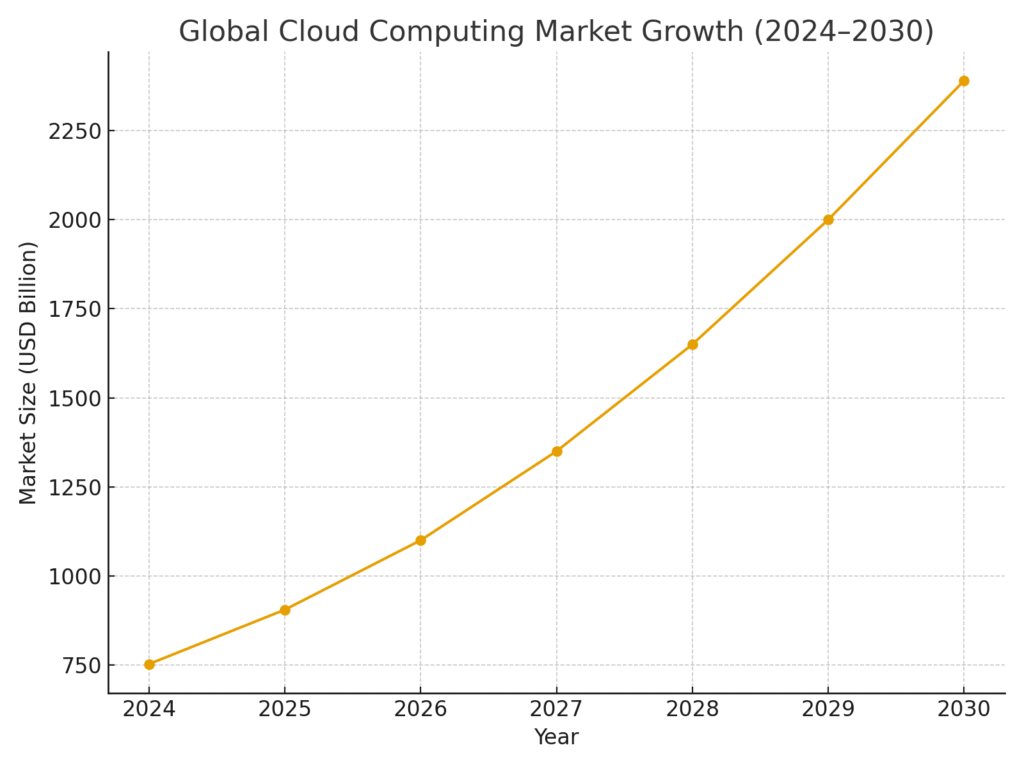
Cloud Service Marketing Statistics #1: Global Cloud Computing Market Reaches $752.44 Billion in 2024
The global cloud computing market stood at an impressive $752.44 billion in 2024. Analysts project this market to expand to $2,390.18 billion by 2030, reflecting a CAGR of over 20%. For marketers, this rapid growth confirms the demand for scalable, future-ready solutions. Highlighting ROI and longevity can strongly influence decision-makers. This statistic proves cloud is not just a trend—it’s an unstoppable force in technology adoption.
Cloud Service Marketing Statistics #2: Cloud Services Market Projected at $721.87 Billion in 2025
By 2025, the overall cloud services market is estimated to reach $721.87 billion. Looking further ahead, forecasts suggest it could surpass $2.7 trillion by 2034. This consistency in growth demonstrates long-term confidence in the sector. For marketing, it validates why companies should invest now rather than wait. Positioning cloud as a stable and expanding ecosystem is a persuasive angle for campaigns.
Cloud Service Marketing Statistics #3: End-User Spending on Public Cloud to Hit $723.4 Billion in 2025
Public cloud spending by end-users globally is expected to reach $723.4 billion in 2025. This reflects organizations’ increasing trust in cloud infrastructure. It shows a shift from traditional IT investments to scalable on-demand services. For marketers, this highlights the importance of focusing messaging on cost efficiency and accessibility. The figure emphasizes that cloud isn’t just optional anymore—it’s essential.
Cloud Service Marketing Statistics #4: SaaS Revenues Expected at $390.5 Billion in 2025
Software-as-a-Service (SaaS) will remain the largest revenue contributor with $390.5 billion projected in 2025. Businesses of all sizes are turning to SaaS for its convenience and flexibility. Marketers in this space should emphasize productivity, affordability, and ease of deployment. Highlighting case studies and customer success stories can further strengthen positioning. This stat underlines SaaS as the most accessible entry point to the cloud.
Cloud Service Marketing Statistics #5: IaaS Growth Rate of 26% through 2025
Infrastructure-as-a-Service (IaaS) is growing at around 26% CAGR. Companies are leveraging IaaS for scalability, speed, and cost savings. For marketing, this provides a chance to spotlight infrastructure reliability and future readiness. Emphasizing automation, disaster recovery, and agility resonates with CIOs. This growth rate makes IaaS one of the hottest segments for opportunity.
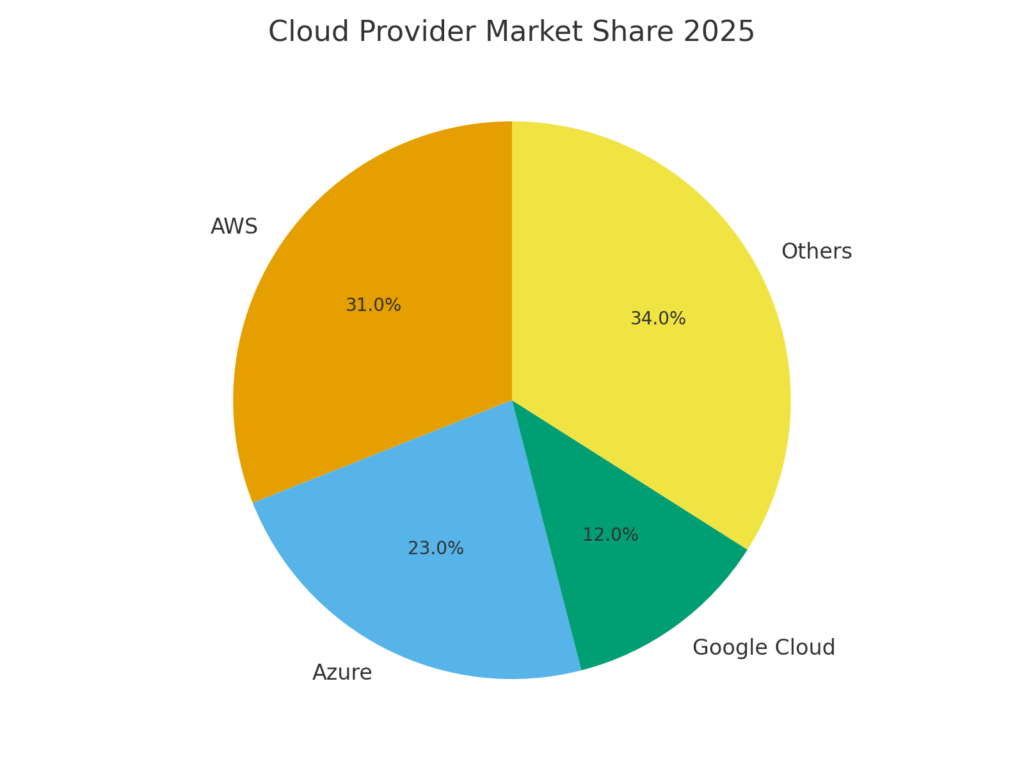
Cloud Service Marketing Statistics #6: AWS Holds 31% Market Share in 2024–2025
Amazon Web Services (AWS) continues to dominate with roughly 31% market share. Microsoft Azure follows at around 23%, while Google Cloud stands at 12%. These three players control the majority of the cloud landscape. For smaller providers, marketing strategies should focus on specialization and niche services. For AWS and similar leaders, it’s about reinforcing trust, reliability, and innovation.
Cloud Service Marketing Statistics #7: 96% of Companies Use at Least One Public Cloud
Almost all companies (96%) now use at least one public cloud service. This shows cloud adoption is no longer an emerging trend but the industry norm. Marketers must pivot from “why cloud” to “why this cloud solution.” Differentiation is now critical in messaging. This statistic highlights the ubiquity of cloud in the modern enterprise.
Cloud Service Marketing Statistics #8: 84% of Businesses Use Private Cloud
Alongside public cloud, 84% of companies utilize private cloud setups. Hybrid approaches dominate IT infrastructure strategies. For marketing, highlighting compatibility, integration, and security reassures decision-makers. Positioning a product as hybrid-ready gives it stronger appeal. This trend shows businesses value both control and scalability.
Cloud Service Marketing Statistics #9: 92% of Businesses Saw Security Improve After Cloud Adoption
Over 92% of organizations reported improved security after moving to the cloud. This challenges the common misconception that cloud is less secure. For marketing, it’s a powerful statistic to counter security objections. Businesses care deeply about safeguarding data, making this a strong selling point. It highlights cloud as a security enhancer, not a risk.
Cloud Service Marketing Statistics #10: 82% of Companies Struggle with Cloud Spend Management
A massive 82% of businesses identify cost management as their top cloud challenge. Overspending and lack of visibility are common pain points. Marketers can capitalize by promoting cost-optimization features. Clear pricing, budgeting tools, and financial transparency are winning themes. This pain-driven marketing angle resonates strongly with budget-conscious buyers.

Cloud Service Marketing Statistics #11: 60% of Business Data Stored in the Cloud
Currently, 60% of corporate data resides in cloud platforms. This shift highlights cloud’s role as the backbone of digital transformation. For marketing, focusing on data security, accessibility, and scalability is critical. Brands should emphasize how cloud enables smarter analytics and collaboration. It shows cloud has become the default data home.
Cloud Service Marketing Statistics #12: Cloud Market Growing at Over 20% CAGR
Multiple forecasts show the cloud market expanding at over 20% CAGR. This makes it one of the fastest-growing sectors in IT. For marketers, this provides optimism to back investment pitches. Messaging that highlights “future-proof growth” aligns with buyer confidence. This stat shows why the cloud is considered a safe, high-return investment.
Cloud Service Marketing Statistics #13: Majority of Enterprises Adopting Multicloud Strategies
Most enterprises now run multicloud or hybrid cloud environments. This means no single provider dominates entirely. For marketing, messaging must emphasize interoperability and integration. Highlighting compatibility with multiple platforms is a strategic advantage. This statistic signals the end of one-size-fits-all solutions.
Cloud Service Marketing Statistics #14: Cloud Adopters See 37% Faster Time to Market
Cloud adoption has been shown to improve time-to-market by 37%. This is because cloud reduces infrastructure delays and enables faster deployment. Marketers should emphasize speed as a core benefit. For fast-paced industries, agility is a competitive differentiator. This stat proves that cloud is a catalyst for business acceleration.
Cloud Service Marketing Statistics #15: 60% of Companies Increased Revenue After Cloud Adoption
Roughly 60% of organizations reported higher revenues after adopting cloud services. The connection between cloud and profitability is undeniable. For marketers, ROI is a powerful talking point. Highlighting real-world case studies strengthens trust. This stat connects cloud directly with bottom-line success.
Cloud Service Marketing Statistics #16: Asia-Pacific Is Fastest-Growing Region
The Asia-Pacific region is experiencing the fastest cloud adoption growth. Rising economies and digital-first initiatives fuel expansion. For marketing, regional localization and cultural relevance are critical. Tailoring campaigns to APAC trends shows stronger engagement. This region represents untapped opportunities for growth-focused providers.
Cloud Service Marketing Statistics #17: North America Holds 39–42% Market Share
North America continues to dominate cloud revenue with 39–42% share. This indicates maturity but also strong competition. Marketers here must focus on differentiation, trust, and long-term value. For global players, this region still serves as a proving ground. The stat underscores North America’s leadership role in cloud adoption.
Cloud Service Marketing Statistics #18: Public Cloud IT Spend Rising to 45% by 2026
Public cloud’s share of enterprise IT spend is set to reach over 45% by 2026. This marks a huge jump from just 17% in 2021. For marketers, it’s proof that budgets are increasingly cloud-focused. Positioning cloud as the smarter IT investment is persuasive. This shift shows cloud is overtaking traditional infrastructure.
Cloud Service Marketing Statistics #19: Cloud Migration Market Growing at 28% CAGR
Cloud migration services are expanding at around 28% CAGR. This growth is driven by companies shifting from on-premises to cloud. Marketing should stress seamless migration and minimal disruption. Highlighting case studies of successful transitions can build confidence. Migration remains a key entry point for many businesses.
Cloud Service Marketing Statistics #20: Enterprises Use an Average of 1,295 Cloud Services
On average, large enterprises utilize about 1,295 separate cloud services. This shows how fragmented and complex the ecosystem has become. Marketers can use this to emphasize consolidation and management solutions. Tools that simplify workflows are highly attractive. This stat highlights the opportunities in unifying the cloud experience.

Why These Statistics Matter
Looking back at these cloud service marketing statistics, I can’t help but feel inspired by how far we’ve come—and excited for where we’re going. For me, these numbers aren’t just industry metrics; they’re a reflection of how businesses, both big and small, are embracing innovation to grow, adapt, and thrive. If there’s one thing I’ve learned, it’s that keeping an eye on these trends isn’t just useful—it’s essential for staying ahead in a digital-first world. My hope is that this roundup gives you clarity, sparks new ideas, and helps you shape strategies that truly resonate with your audience. After all, in a market evolving this fast, knowledge isn’t just power—it’s your competitive edge.
SOURCES
https://spacelift.io/blog/cloud-computing-statistics
https://www.cloudzero.com/blog/cloud-computing-statistics
https://edgedelta.com/company/blog/how-many-companies-use-cloud-computing
https://sqmagazine.co.uk/cloud-adoption-statistics/
https://blog.bccresearch.com/cloud-computing-market-trends-growth-and-future-opportunities
https://colorlib.com/wp/cloud-computing-statistics/
https://nextwork.org/blog/cloud-computing-stats-2025
https://aag-it.com/the-latest-cloud-computing-statistics/
https://www.salesforce.com/platform/cloud-computing/benefits/
https://goingdigital.oecd.org/en/indicator/25
https://www.allcovered.com/blog/cloud-computing-trends