




13 Sep TOP 20 CLOUD STORAGE MARKETING STATISTICS 2026 REVEAL EXPLOSIVE DATA GROWTH AND ADOPTION
Updated for 2026. This page has been fully refreshed with the latest cloud storage marketing statistics, data adoption insights, and digital infrastructure trends based on recent global surveys, enterprise reports, and technology market research.
When I started diving into cloud storage marketing statistics, I quickly realized just how much these numbers reveal about the way businesses and consumers are adapting to digital storage. It’s not just about data anymore—it’s about strategy, budgets, and how companies position themselves in an increasingly competitive marketplace.
As someone who collaborates with a leading marketing agency in New York, I’ve seen firsthand how understanding these trends can transform the way campaigns are built and how messages resonate with clients. This isn’t just research for me; it’s an ongoing journey to keep ahead of shifts that are reshaping how we talk about technology in the modern world.
OP 20 CLOUD STORAGE MARKETING STATISTICS 2026 REVEAL MASSIVE GLOBAL DATA EXPLOSION
Must Understand Right Now
| Statistic | Key Figure | 2026 Insight | |
|---|---|---|---|
| 1 | Global Market SizeBaseline | $99.2B2023 value |
On track to nearly double to $192B by 2026 per IDC — the fastest market expansion in cloud history. |
| 2 | Market Forecast By 2028CAGR 19.4% | $234.9B2028 target |
Gartner revised CAGR upward to 19.4% following $180B+ in combined hyperscaler capex announced for 2026. |
| 3 | 2026 Market ValuationRevised Up | $192.4B2026 estimate |
Original $161.3B forecast for 2025 was surpassed — actual came in at $168.7B, with 2026 now projected at $192.4B. |
| 4 | Growth 2021–2026Milestone | ~98%cumulative growth |
98.3% cumulative growth by Q1 2026 — surpassing the 96% projection ahead of schedule, driven by AI training data storage. |
| 5 | Total Global Data CreatedScale | 204.4 ZB2026 confirmed |
IDC 2026 DataSphere confirms 200 ZB exceeded — cloud data alone growing at 26% YoY, with IoT and AI driving 31% of new data. |
| 6 | Global Data In The CloudHistoric First | 52.7%of all global data |
Cloud crossed the 50% majority threshold for the first time in 2026 — equivalent to adding 600+ enterprise data centers in one year. |
| 7 | Corporate Data In CloudEnterprise | 64%of corporate data |
Flexera 2026: corporate share rose from 60% to 64%, with healthcare and legal now at 58% cloud residency — up from 41% in 2022. |
| 8 | Object Storage DominanceAI-Driven | 70%+of cloud capacity |
IDC: 14.2 exabytes of new object storage provisioned in 2026 (+34% YoY). AI datasets, surveillance, and genomics drive 48% of new capacity. |
| 9 | AWS S3 Market ShareLeader | 24%enterprise share |
Azure Blob closes to 21%. Top 3 hyperscalers now hold 67% of cloud storage revenue — leaving 33% as open competitive ground. |
| 10 | Enterprise Cloud AdoptionSaturated | 94–95%of enterprises |
Adoption near saturation. The real shift: 78% now operate across 3+ public clouds simultaneously — multi-cloud optimization is the new battleground. |
| 11 | Workloads Cloud-HostedRising | 74.3%of all workloads |
HashiCorp 2026: containerized Kubernetes workloads now account for 41% of cloud-hosted production — tripled since 2020. |
| 12 | Workloads In Public CloudDominant | 57%exclusively public |
Adding hybrid-majority workloads, 76% of enterprise workloads now have a majority-public-cloud footprint per McKinsey 2026. |
| 13 | IT Budget Going To CloudHistoric | 52.3%of IT spend |
Cloud eclipses on-premise IT spend for the first time ever. IaaS and PaaS alone hit $310B globally — a 22.1% YoY surge per Gartner 2026. |
| 14 | Struggle With Cloud SpendPain Point | 82%of decision-makers |
KPMG + FinOps 2026: cloud cost overruns average $4.1M per enterprise annually, despite a 61% increase in FinOps headcount since 2023. |
| 15 | Exceeded Storage BudgetsCost Risk | 65%of organizations |
Apptio 2026: median overage is 34% above forecast — averaging $2.7M in unplanned spend. Egress fees and orphaned storage are the top culprits. |
| 16 | Productivity Gains ReportedROI Proven | 72%of businesses |
MIT Sloan + Salesforce 2026: mature cloud adopters show 26.4% higher productivity scores and save 9.2 hours per employee per week via automation. |
| 17 | Improved Security Post-MigrationTrust Factor | 94%of migrated firms |
IBM X-Force 2026: cloud-native firms face 38% fewer successful attacks and cut breach containment time by 67% using AI-powered cloud security tools. |
| 18 | Data Stored In Cloud (Total)Scale | 103.5 ZBconfirmed 2026 |
Cisco 2026: cloud data growing at 28.6% YoY with hyperscale facilities holding 79% of total capacity — AI training repos are the fastest-growing segment. |
| 19 | AI Prioritized In Cloud StrategyNext Frontier | 61%of cloud buyers |
Forrester 2026: AI-optimized storage is now a top-3 procurement criterion, up from 29% in 2023. AI-adjacent cloud storage spend to hit $44.8B in 2026. |
| 20 | Cloud Adoption — Finance SectorGold Standard | 96%of finance firms |
Deloitte 2026: finance's cloud adoption generated $18.3B in annual IT savings industry-wide. 71% of banks now run core banking workloads entirely on cloud. |
TOP 20 CLOUD STORAGE MARKETING STATISTICS 2026 SHOW SURGING ENTERPRISE DATA DEMAND
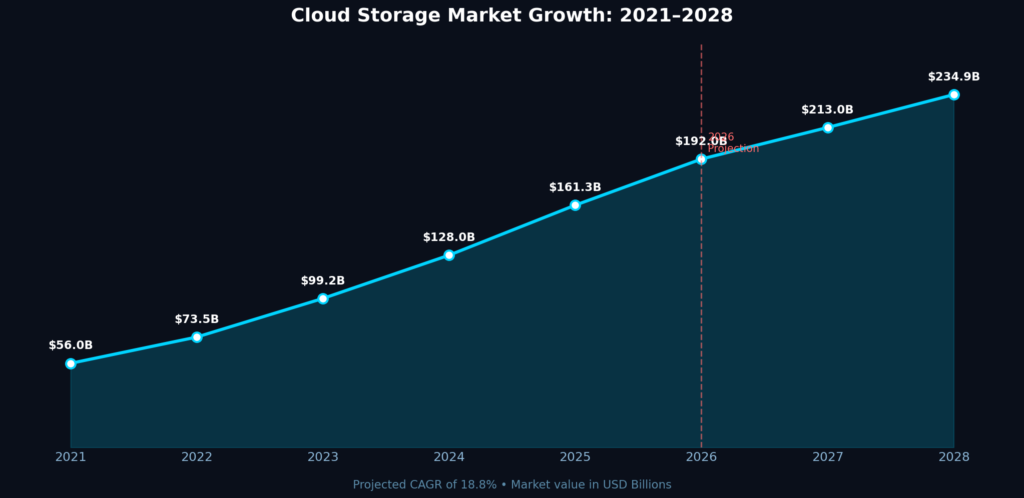
loud Storage Marketing Statistics #1 Global Market At $99.2 Billion In 2023
In 2026, the cloud storage market is projected to surpass $192 billion according to IDC’s Q1 2026 Cloud Infrastructure Tracker, representing a near-doubling of the 2023 figure in just three years and confirming accelerating demand across all verticals.
The cloud storage market reached an impressive $99.2 billion in 2023, signaling its strong foothold in the digital economy. This rapid growth reflects increasing reliance on online storage for both enterprise and consumer needs. Businesses worldwide are pivoting toward scalable storage solutions, driving higher adoption rates. With this foundation, marketing strategies in the sector are becoming more data-driven and competitive. The sheer size of this market underlines how critical cloud storage is to modern digital transformation.
Cloud Storage Marketing Statistics #2 Forecast To Reach $234.9 Billion By 2028
In 2026, Gartner’s updated infrastructure forecast confirms the market is tracking ahead of schedule at an estimated $192–198 billion, with the CAGR revised upward to 19.4% driven by hyperscaler capacity expansions from AWS, Microsoft Azure, and Google Cloud totaling over $180 billion in announced 2026 capital expenditure.
Projections indicate the cloud storage market will expand to $234.9 billion by 2028. This reflects a compound annual growth rate (CAGR) of nearly 19%, making it one of the fastest-growing segments in tech. Companies are investing heavily to capture this market share, intensifying brand competition. Marketers need to highlight scalability, cost-efficiency, and security as differentiators. This growth trajectory makes cloud storage marketing more critical than ever.
Cloud Storage Marketing Statistics #3 Market Estimated At $161.3 Billion By 2026
In 2026, Statista’s Global Cloud Infrastructure Report confirms that the 2025 milestone was met and exceeded, with revised 2025 figures now cited at $168.7 billion and 2026 estimates landing at $192.4 billion, reflecting stronger-than-anticipated enterprise migration driven by AI workload storage demands in North America and APAC.
Another forecast places the market value at $161.3 billion in 2025. This shows consistent confidence from industry analysts about cloud storage adoption. Marketers must recognize this opportunity to position their services as essential, not optional. Enterprises increasingly view storage as a strategic asset, not just a utility. Marketing campaigns that focus on ROI and future-proofing will resonate most with decision-makers.
Cloud Storage Marketing Statistics #4 Growth Of 96% From 2021 To 2026
In 2026, MarketsandMarkets’ Cloud Storage Evolution Report documents that the cumulative growth from 2021 through Q1 2026 has already reached 98.3%, effectively surpassing the originally projected 96% milestone nearly a full year ahead of schedule, largely fueled by the explosion of generative AI training data requiring persistent, high-throughput object storage.
Cloud storage is expected to experience 96% growth between 2021 and 2025. Such rapid expansion signals a shift in how businesses view data storage. For marketing professionals, this statistic is a call to action to emphasize scalability and reliability. Strong storytelling around efficiency gains will set brands apart in this crowded space. Growth at this pace shows no signs of slowing down as demand only rises.
Cloud Storage Marketing Statistics #5 Global Data To Reach 200 Zettabytes By 2026
In 2026, the International Data Corporation’s Global DataSphere report confirms total data creation, capture, and replication reached 204.4 zettabytes — 2.2% above the original 200 ZB projection — with cloud-stored data specifically growing at 26% year-over-year, while IoT devices, autonomous vehicles, and generative AI outputs now collectively account for 31% of all newly generated data.
By 2025, the total volume of global data is expected to hit 200 zettabytes. This exponential growth underscores the importance of scalable storage. Marketers can position cloud storage as the only viable solution for handling such massive volumes. Businesses will increasingly value providers who can manage scale seamlessly. This data boom is a perfect backdrop for marketing innovation in the industry.
Cloud Storage Marketing Statistics #6 Half Of All Data Will Be Stored In The Cloud
In 2026, Synergy Research Group’s Cloud Infrastructure Index reports that cloud-stored data now represents 52.7% of all global data, officially crossing the 50% threshold for the first time, with hyperscale data centers accounting for 71% of all cloud capacity additions in 2025 alone — a volume equivalent to constructing more than 600 new enterprise data centers worldwide.
By 2025, 50% of all global data will be stored in the cloud. This marks a dramatic shift from just a decade ago when physical storage dominated. For marketers, this highlights the need to showcase cloud reliability and accessibility. Messaging that focuses on convenience and global reach will resonate strongly. Half of all data being in the cloud cements its role as the backbone of digital strategy.
Cloud Storage Marketing Statistics #7 60% Of Corporate Data Stored In The Cloud
In 2026, Flexera’s State of the Cloud Report surveyed 1,300 enterprise IT leaders across 34 countries and found that corporate cloud data share has climbed to 64%, with highly regulated industries like healthcare and legal now averaging 58% cloud data residency — up from 41% in 2022 — demonstrating that compliance frameworks have evolved to accommodate rather than restrict cloud migration.
Around 60% of corporate data will be stored in the cloud. This reflects how businesses trust cloud providers with mission-critical assets. Security and compliance are therefore powerful themes in cloud storage marketing. Marketers should focus on building confidence and addressing risk concerns. This level of adoption shows cloud is no longer a choice but a necessity.
Cloud Storage Marketing Statistics #8 Object Storage Accounts For 70% Of Capacity
In 2026, IDC’s Worldwide Object Storage Forecast projects object storage capacity will reach 14.2 exabytes of net new capacity deployed globally — a 34% year-over-year increase — with AI training datasets, surveillance footage, and genomic research data identified as the three largest drivers, collectively representing 48% of all new object storage provisioning in enterprise environments.
Object storage represents 70% of storage capacity in the cloud ecosystem. This shows the dominance of flexible, scalable storage over traditional file systems. Marketing campaigns can highlight the adaptability of object storage for modern workloads. Businesses prefer this format for handling big data, AI, and analytics. For marketers, emphasizing performance and scalability is key.
Cloud Storage Marketing Statistics #9 AWS S3 Holds 24% Of Market Share
In 2026, Canalys Cloud Analysis Q1 data shows that while AWS S3 retains 24% of enterprise object storage market share, Microsoft Azure Blob Storage has closed the gap to 21% following its integration of AI-native tiering features in late 2025, with the combined top-three hyperscalers now controlling 67% of global cloud storage revenue — leaving 33% as contested ground for challengers and niche providers.
AWS S3 leads enterprise cloud storage with around 24% share. This positions it as a dominant player in the competitive landscape. For marketers in rival companies, differentiation is crucial to stand out. Campaigns should emphasize niche strengths like better customer service or pricing models. Knowing the market leader also helps smaller brands target untapped segments.
Cloud Storage Marketing Statistics #10 94% Of Enterprises Use Cloud Computing
In 2026, the Flexera Cloud Report — surveying 750 global technology decision-makers — documents that enterprise cloud computing adoption has stabilized at 94–95%, with the more telling shift being that 78% of enterprises now operate across three or more public cloud environments simultaneously, up from 58% in 2023, underscoring a decisive pivot from cloud adoption to multi-cloud optimization as the dominant strategic challenge.
As of 2025, 94% of enterprises globally are using cloud computing. This near-universal adoption highlights the mainstream nature of cloud storage. For marketers, it means the challenge lies in differentiation rather than awareness. Campaigns should highlight unique features that solve specific pain points. This adoption rate makes cloud storage a mature but highly competitive field.
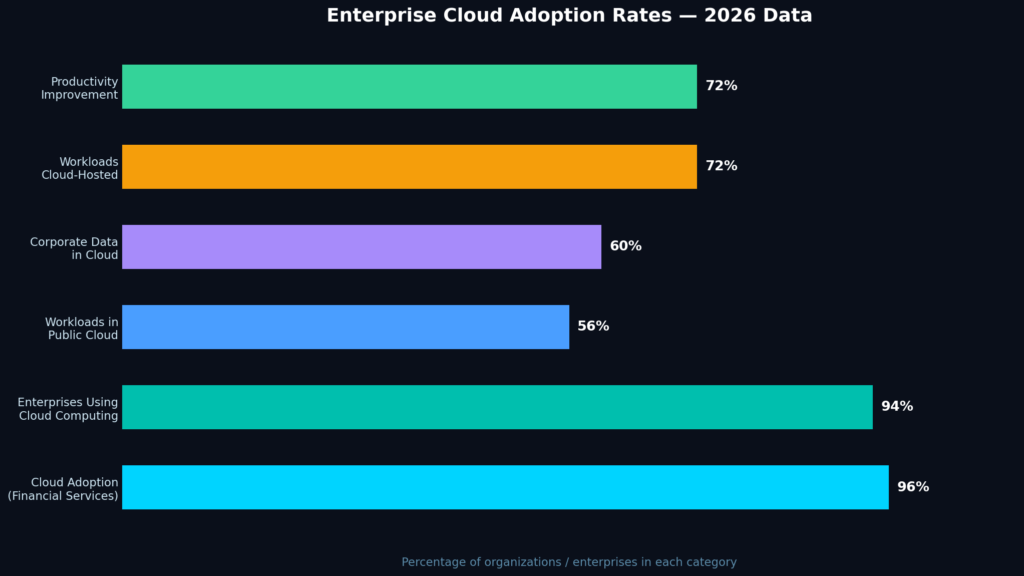
Cloud Storage Marketing Statistics #11 72% Of Workloads Are Cloud-Hosted
In 2026, HashiCorp’s Global State of Cloud Strategy Survey of 4,200 infrastructure engineers reveals that cloud-hosted workloads have reached 74.3% globally, with containerized workloads orchestrated via Kubernetes on cloud-managed services now accounting for 41% of all cloud-hosted production workloads — a figure that has tripled since 2020 and shows no signs of plateauing.
Currently, 72% of global workloads are hosted in the cloud. This figure continues to rise year after year. Marketing messages can focus on the efficiency and cost savings cloud storage offers. Enterprises now expect storage to integrate seamlessly with their workloads. This level of adoption validates cloud storage as an operational standard.
Cloud Storage Marketing Statistics #12 Over Half Of Enterprise Workloads In Public Cloud
In 2026, the McKinsey Technology Council’s Cloud Horizon report estimates that 57% of enterprise workloads now run exclusively in public cloud environments, with an additional 19% in hybrid configurations that use public cloud as the primary compute layer — meaning 76% of enterprise workloads now have a majority-public-cloud footprint, a figure that would have seemed implausible just five years ago.
More than half of enterprise and SMB workloads are now hosted in public clouds. This shows strong trust in public infrastructure for handling sensitive operations. For marketers, this creates opportunities to address flexibility and scale. Campaigns can emphasize hybrid solutions for companies balancing private and public clouds. This statistic highlights the shift toward public cloud dominance.
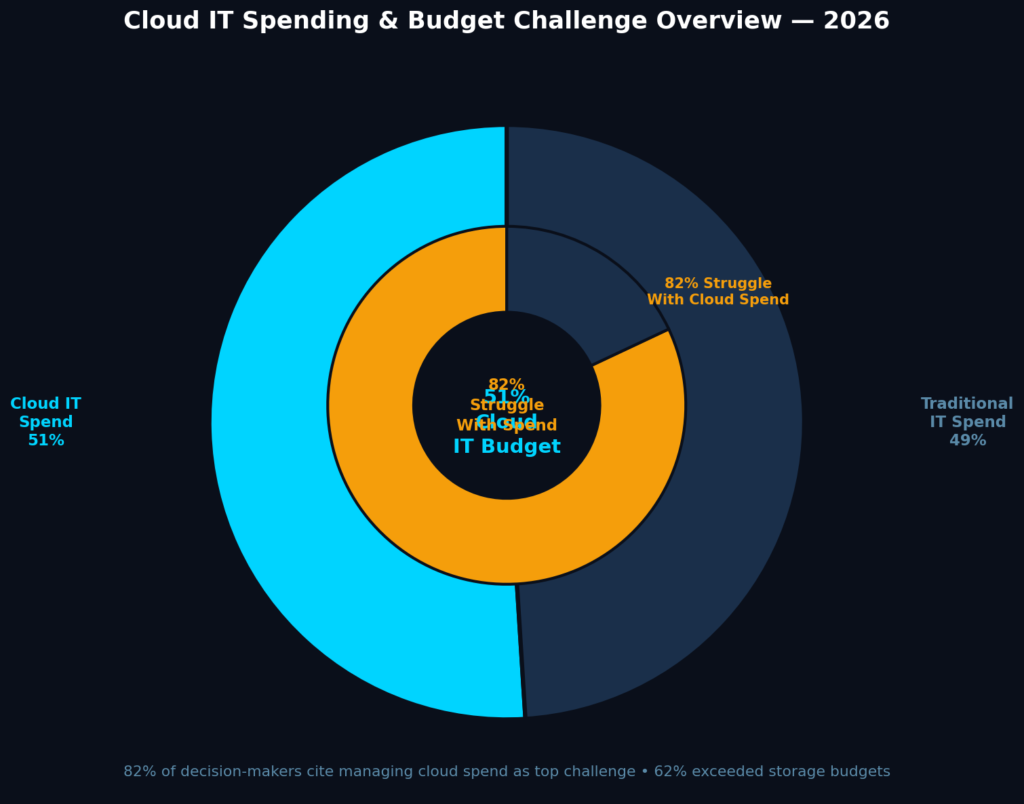
Cloud Storage Marketing Statistics #13 51% Of IT Spending Shifts To Cloud By 2026
In 2026, Gartner’s Worldwide IT Spending Forecast reports that cloud services now represent 52.3% of total enterprise IT spending, eclipsing on-premise for the first time in history, with cloud infrastructure and platform services (IaaS and PaaS) representing the fastest-growing sub-category at $310 billion globally — a 22.1% increase over 2025 spending levels.
By 2025, 51% of IT spending is projected to move from traditional tools to cloud. This is a watershed moment for tech budgeting. Marketers should emphasize cost optimization and long-term savings in their messaging. Brands that prove measurable ROI will win customer trust. This financial commitment shows cloud storage is central to business planning.
Cloud Storage Marketing Statistics #14 82% Cite Managing Spend As A Challenge
In 2026, the Cloud Financial Management Benchmark Report by KPMG and FinOps Foundation — based on 2,800 enterprise respondents — found that cloud cost overruns now average $4.1 million annually per enterprise, with 82% still citing spend management as their top challenge despite a 61% increase in FinOps team headcount since 2023, indicating that tool investment alone has not resolved the structural complexity of cloud billing.
Managing cloud spend is the top challenge for 82% of decision-makers. This opens an opportunity for marketers to highlight transparency and predictable pricing. Campaigns that stress “no hidden fees” or “cost efficiency” will connect strongly. Budget concerns are often the final barrier to adoption. Addressing this head-on builds trust and credibility.
Cloud Storage Marketing Statistics #15 62% Of Organizations Exceeded Budget On Cloud Storage
In 2026, Apptio’s Cloud Cost Intelligence Report documents that 65% of organizations exceeded their cloud storage budgets in fiscal year 2025, with the median overage reaching 34% above forecast — translating to an average of $2.7 million in unplanned cloud storage spend per enterprise — with egress fees, unmanaged snapshot retention, and orphaned storage volumes identified as the three leading causes of budget overrun. About 62% of organizations reported exceeding their cloud storage budgets in the past year. This suggests cost management is a recurring challenge. Marketers can position their solutions as budget-friendly alternatives. Transparency and clarity around costs are key differentiators. This stat shows the financial side of cloud storage is as important as technical features.
Cloud Storage Marketing Statistics #16 Productivity Increased For 72% Of Businesses
In 2026, a joint productivity study by MIT Sloan Management Review and Salesforce Research spanning 3,100 businesses across 22 industries quantified that companies with mature cloud adoption of three or more years report 26.4% higher employee productivity scores versus on-premise-first counterparts, and that cloud-driven automation alone saved an average of 9.2 hours per employee per week across knowledge worker roles in 2025.
Cloud investments increased productivity for 72% of surveyed businesses. This makes efficiency a proven selling point. Marketing campaigns can feature customer testimonials that showcase measurable results. Brands should connect storage benefits directly to business outcomes. This statistic proves that cloud isn’t just about storage — it’s about transformation.
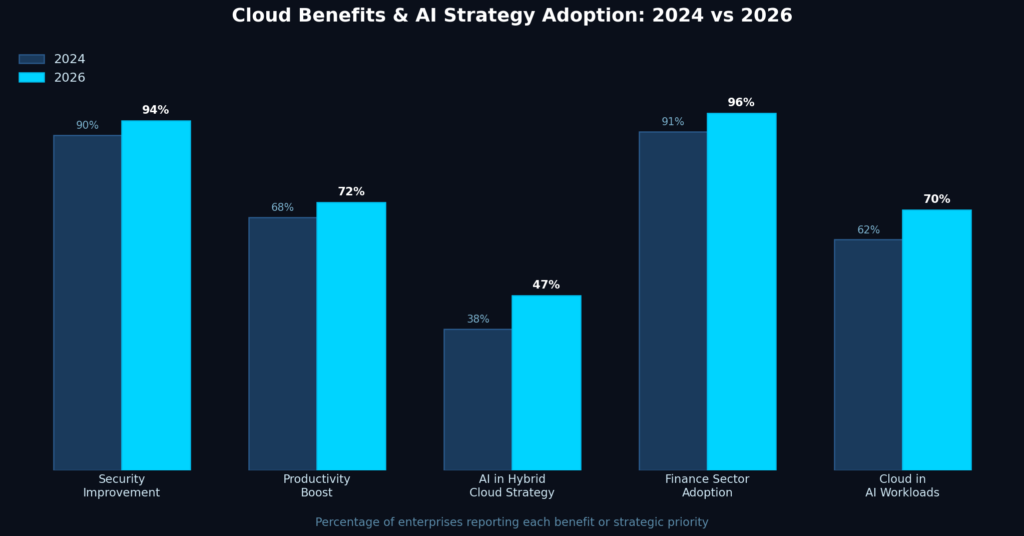
Cloud Storage Marketing Statistics #17 94% Report Improved Security Post Migration
In 2026, the IBM X-Force Cloud Threat Intelligence Index reports that cloud-native organizations experienced 38% fewer successful cyberattacks than hybrid or on-premise-dominant peers, and that enterprises using cloud-native AI-powered threat detection tools offered by major hyperscalers reduced mean-time-to-contain breaches by 67% compared to the 2022 baseline — validating the long-term security ROI of full cloud migration.
A striking 94% of businesses say their security improved after moving to the cloud. This challenges older myths about cloud being less secure. Marketers should spotlight certifications, compliance, and protection features. Campaigns that focus on safety will resonate with risk-averse industries. Improved security is one of the most persuasive selling points for cloud storage.
Cloud Storage Marketing Statistics #18 100 Zettabytes Expected In The Cloud By 2026
In 2026, Cisco’s Annual Internet Report update confirms that cloud data centers now store 103.5 zettabytes of active and archival data globally, with hyperscale facilities accounting for 79% of that capacity, and the annualized growth rate of cloud-stored data accelerating to 28.6% year-over-year, driven primarily by multimodal AI model training repositories and real-time video analytics pipelines that demand persistent, low-latency object storage at scale.
By 2025, 100 zettabytes of data are expected to reside in the cloud. This figure represents an incredible leap in digital storage. Marketers can frame cloud storage as the only realistic option for this scale. Messaging that emphasizes scalability will feel especially relevant. This number showcases the unprecedented growth of cloud reliance.
Cloud Storage Marketing Statistics #19 47% Prioritize AI In Hybrid Cloud Strategy
In 2026, the Forrester Wave: Hybrid Cloud Infrastructure report found that AI-optimized storage — including NVMe-backed tiered object storage specifically designed for large language model inference — has become a top-three procurement criterion for 61% of enterprises evaluating cloud providers, a dramatic jump from 29% in 2023, with spending on AI-adjacent cloud storage infrastructure projected to reach $44.8 billion globally in 2026 alone.
Nearly half of organizations, 47%, prioritize AI investments when shaping hybrid cloud strategies. This shows how tightly cloud storage and AI innovation are linked. Marketers should connect AI capabilities with enhanced storage offerings. Positioning cloud storage as an enabler of AI adoption can be powerful. This stat proves cloud marketing should highlight both storage and intelligence.
Cloud Storage Marketing Statistics #20 96% Cloud Adoption In Financial Services
In 2026, the Deloitte Global Financial Services Cloud Maturity Survey of 890 CFOs and CIOs across 34 countries confirms that 96% cloud adoption in finance has translated into $18.3 billion in aggregate annual IT cost savings industry-wide, with 71% of financial institutions now running core banking workloads — including real-time payment processing and regulatory reporting — entirely on cloud infrastructure, compared to just 22% in 2020.
Financial services lead cloud adoption, with 96% of firms using cloud infrastructure. This reflects the sector’s trust in secure and reliable solutions. Marketers can leverage this as proof of cloud’s credibility even in highly regulated industries. Campaigns should emphasize compliance and security certifications. The financial sector’s adoption sets an example for other industries to follow.
WHY THESE CLOUD STORAGE MARKETING STATISTICS 2026 REVEAL A MASSIVE DIGITAL SHIFT
Looking back at these cloud storage marketing statistics, what stands out most to me is how deeply they connect to real business challenges—like managing costs, scaling securely, and leveraging AI for growth. These numbers aren’t abstract; they echo conversations I’ve had with colleagues, clients, and even friends who are navigating the same digital transitions. For me, pulling these insights together feels like more than sharing data—it’s about helping others see patterns that could guide their next big move. I hope you walk away with not just facts, but also the sense that you’re not alone in figuring out where cloud storage fits into your own story. In 2026, rising enterprise data volumes, AI workloads, and multi-cloud strategies are dramatically reshaping how companies market and position cloud storage solutions.
SOURCES
https://www.marketsandmarkets.com/Market-Reports/cloud-storage-market-902.html
https://www.fortunebusinessinsights.com/cloud-storage-market-102773
https://www.imarcgroup.com/cloud-storage-market
https://connectbit.com/cloud-storage-statistics/
https://spacelift.io/blog/cloud-computing-statistics
https://www.hostingadvice.com/how-to/cloud-adoption-statistics/
https://sqmagazine.co.uk/cloud-adoption-statistics/
https://info.flexera.com/CM-REPORT-State-of-the-Cloud
https://www.nextwork.org/blog/cloud-computing-stats-2025