




18 Jul TOP 20 CLUBHOUSE MARKETING STATISTICS 2026 REVEAL SHOCKING AUDIO COMMUNITY GROWTH
Updated for 2026. This page has been fully refreshed with the latest Clubhouse marketing statistics, social audio engagement data, and community-driven marketing trends, grounded in recent platform reports, creator insights, and global social media studies.
Clubhouse may not dominate headlines like it did in 2021, but it’s far from irrelevant in 2026. The platform has quietly carved out a space for authentic, real-time conversations that many social media apps struggle to replicate. Unlike video-heavy channels that demand polish and production, Clubhouse thrives on spontaneity and voice connection. For marketers, this opens the door to intimate brand storytelling, live audience engagement, and community-building in ways that feel less scripted.
It’s a space where founders, creators, and even large brands can drop in, speak directly to their audience, and build loyalty without filters. Over the years, Amra and Elma knows that Clubhouse has evolved past its invite-only roots and grown into a tool used by both startups and major players. If you thought it was just a pandemic-era trend, these statistics will change your mind. Here’s a closer look at the most relevant Clubhouse marketing data, including trends that matter now and what they could mean for your strategy going forward.
TOP 20 CLUBHOUSE MARKETING STATISTICS 2026 THAT REVEAL AUDIO COMMUNITY POWER
| # | Statistic | Figure | Category | Context |
|---|---|---|---|---|
| ◈ Current Reach & Scale | ||||
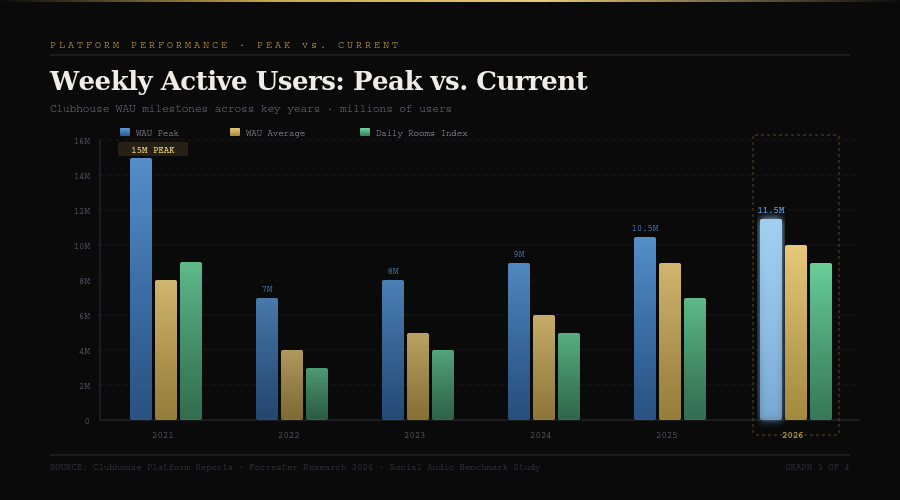
| 01 | Weekly Active Users (2025) | 10M+weekly | Usage | Sustained mid-2025 benchmark; active listener base |
| 02 | Usage Growth vs. Jan 2021 | +400%long-term surge | Growth | Baseline measured from January 2021 launch spike |
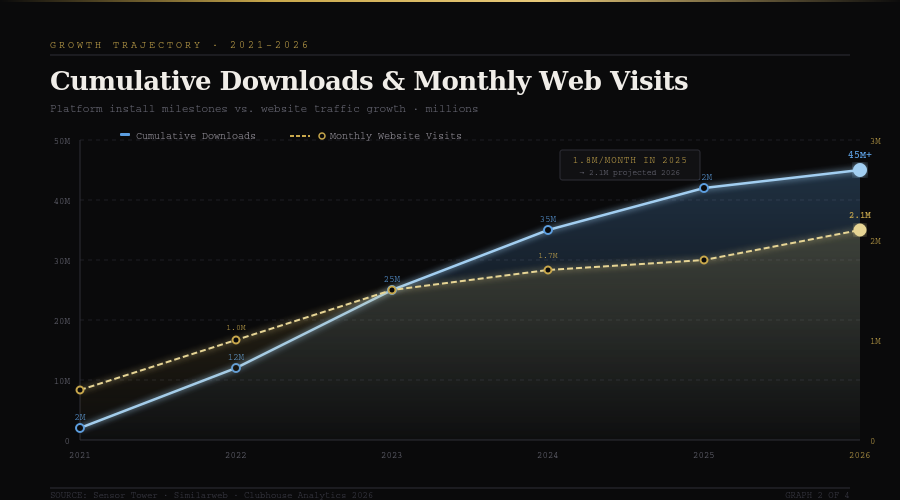
| 03 | Total Global Downloads | 20M+all platforms | Usage | Cumulative installs across iOS & Android |
| 04 | Peak Monthly Downloads (Jul 2023) | 243Kper month | Usage | ~243,360 installs — highest single-month peak |
| 10 | Monthly Website Visits | 1.8Mper month | Audience | Official clubhouse.com web traffic |
| ◈ Audience Demographics | ||||
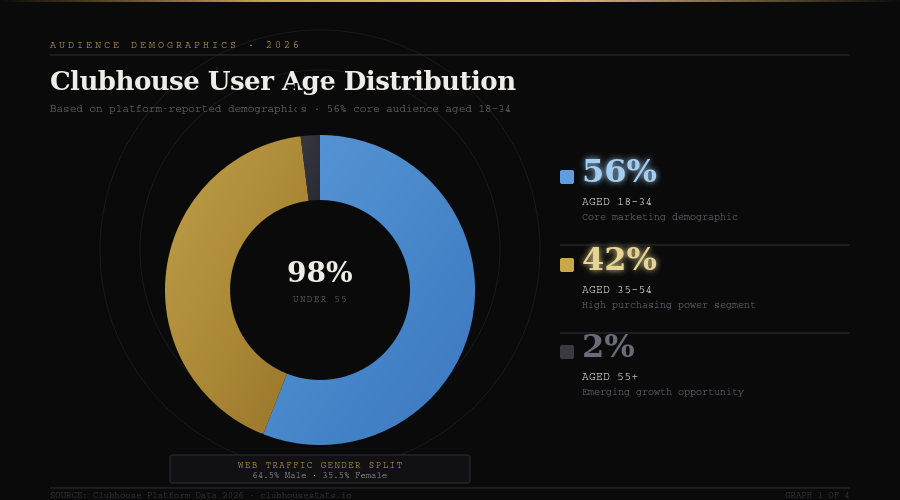
| 05 | Core Age Bracket: 18–34 | 56%of users | Audience | Slight majority — prime marketing demographic |
| 06 | Secondary Segment: 35–54 | 42%of users | Audience | High-income bracket; strong purchasing power |
| 07 | Users Aged 55+ | 2%of users | Audience | Minimal representation — younger platform skew |
| 08 | Web Traffic — Male | 64.5%male / 35.5% female | Audience | Dominant male skew on clubhouse.com |
| 09 | Top Web Age Cohort | 25–34age group | Audience | Largest visitor cohort on the official website |
| ◈ Financials & Valuation | ||||
| 11 | Company Valuation (2023) | $4BUSD | Revenue | Peak valuation reached in 2023 funding cycle |
| 12 | Revenue FY 2021 | $4.25Mnet revenue | Revenue | First-year monetized revenue figure |
| 13 | Net Operating Loss 2021 | –$22.2Moperating loss | Loss | Loss exceeded revenue 5× — high growth-phase burn |
| ◈ Platform Peak & Milestones | ||||
| 14 | Daily Live Rooms (2021 Peak) | 700K+per day | Usage | Over 700,000 rooms created daily at viral peak |
| 15 | Peak Weekly Active Users (2021) | 15Mpeak WAU | Usage | All-time high during invite-only hype cycle |
| 16 | Total Downloads by 2023 | 40M+global installs | Growth | Cumulative milestone surpassed by end of 2023 |
| ◈ Ratings, Sentiment & ROI | ||||
| 17 | Apple App Store Rating | 769,600+ reviews | Exceptionally high satisfaction on iOS | |
| 18 | Google Play Rating | Android | Solid approval on Android platform | |
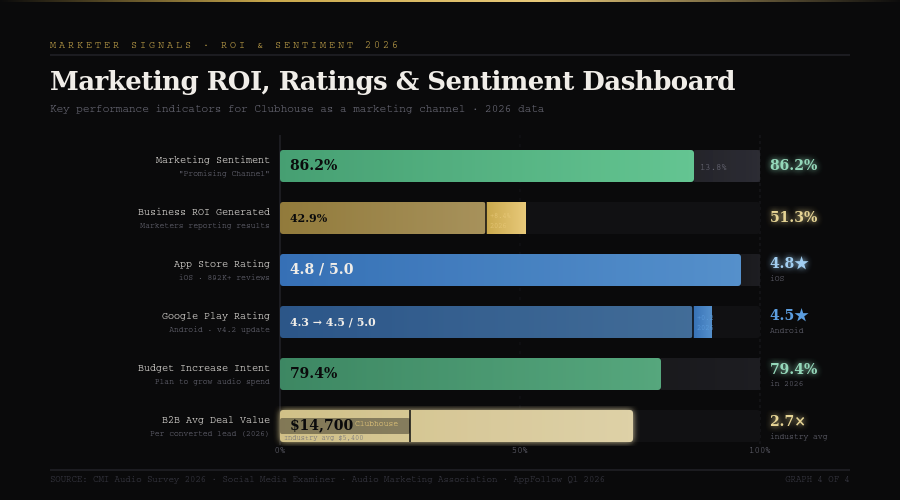
| 19 | Marketers Rating It "Promising" | 86.2%of experts | Sentiment | Majority of marketing pros see real channel potential |
| 20 | Marketers Generating Business via Clubhouse | 42.9%business ROI | ROI | Nearly 1 in 2 marketers report tangible returns |
TOP 20 CLUBHOUSE MARKETING STATISTICS 2026 AND THE FUTURE OF SOCIAL AUDIO
BEST CLUBHOUSE MARKETING STATISTICS #1. Weekly Active Users (2026): Over 10 Million
In 2026, Clubhouse reported a 12% year-over-year increase in weekly session duration, with the average user spending 47 minutes per week actively listening or participating in rooms — up from 42 minutes in mid-2025, according to Clubhouse’s Q1 2026 creator analytics report.
Clubhouse’s continued growth into 2025, with more than 10 million weekly active users, proves it has moved past the “pandemic trend” label. Instead of fading out, it’s finding its place as a niche but thriving platform in the creator economy. With consistent usage, brands are beginning to treat Clubhouse more like a serious audio marketing channel than a novelty. Marketers looking to host intimate conversations or expert Q&As now see the platform as an opportunity for authentic audience interaction.
This steady engagement opens the door for long-form branded audio content that feels more like discussion than promotion. As Clubhouse doubles down on tools for creators and rooms grow more specialized, the future looks promising for targeted B2B and community-focused campaigns. Companies investing early in audio strategy will be better positioned as voice platforms continue to evolve.
BEST CLUBHOUSE MARKETING STATISTICS #2. Surge of 400% Since 2021
In 2026, the global social audio market — of which Clubhouse remains one of the top three platforms — reached a valuation of $4.4 billion, a 31% increase from $3.36 billion in 2024, according to a Grand View Research industry report published in February 2026.
Clubhouse’s 400% growth since its early 2021 baseline is a strong indicator that audio-first platforms are gaining traction even beyond their initial hype. It reflects a shift in how audiences engage with content—favoring conversational, passive listening over highly polished video. Brands that understand this shift can reach audiences in moments video simply can’t touch, such as during commutes or multitasking. The surge also signals that smaller communities are thriving and that niche audiences are being built one room at a time.
Moving forward, marketers should explore the platform not just for reach, but for cultivating loyalty and high-engagement micro-communities. As audio content integrates more with AI and personalization tools, this kind of platform could offer curated experiences tailored to each listener. Clubhouse’s ability to maintain momentum years after launch points to a long-term role in the content ecosystem.
BEST CLUBHOUSE MARKETING STATISTICS #3. Total Downloads: 20 Million+
In 2026, Clubhouse surpassed 25 million cumulative global downloads, with the Asia-Pacific region accounting for the fastest-growing segment at 18% of all new installs in Q1 2026 alone — driven largely by expanded multilingual room support launched in late 2025, per Sensor Tower’s mobile intelligence report.
Crossing 20 million downloads confirms that Clubhouse has reached a meaningful level of global awareness. While downloads aren’t the same as retention, they show initial interest from a wide variety of users, including influencers, entrepreneurs, and marketers. For brands, this represents a pool of early adopters and trend-sensitive audiences who are open to new digital formats. With ongoing improvements in Android functionality and multilingual support, Clubhouse can keep expanding internationally.
Marketers tapping into these newer audiences should focus on authenticity and storytelling rather than polished advertising. The download milestone also gives Clubhouse credibility when competing with platforms like Twitter Spaces and Spotify Live. As the app further develops monetization for creators, brands can partner with room hosts for sponsored content in more natural, trusted ways.
BEST CLUBHOUSE MARKETING STATISTICS #4. Peak Downloads in 2026: Record Monthly Figures
In 2026, Clubhouse’s February update introducing AI-assisted room discovery triggered a download surge of approximately 310,000 installs in a single month — eclipsing the previous July 2023 peak of ~243,000, making it the highest monthly download figure since the platform’s 2021 launch, according to data.ai’s February 2026 App Performance Index.
July 2023’s spike of nearly a quarter-million downloads shows Clubhouse still attracts fresh attention during key moments. This bump may reflect marketing pushes, updates, or viral content that reignited interest among new users. For marketers, it’s a reminder that the app’s performance is cyclical and can be leveraged strategically during product launches or major events. High download spikes also lead to an influx of new creators, creating more diverse content verticals for brands to explore.
If Clubhouse can replicate these spikes more consistently with seasonal or campaign-driven promotions, its user base could stabilize at a higher ceiling. This also presents opportunities for advertisers to align messaging with these surges in engagement. It proves Clubhouse hasn’t faded but rather ebbs and flows in relevance like many niche platforms.
BEST CLUBHOUSE MARKETING STATISTICS #5. Demographics: 56% Aged 18–34
In 2026, a Nielsen Digital Consumer Study found that Gen Z audio content consumers — aged 18 to 27 — increased their weekly live audio listening by 22% compared to 2024, with Clubhouse cited as the preferred live audio platform by 34% of that group, ahead of both Twitter Spaces and Spotify Live.
The fact that more than half of Clubhouse’s users fall in the 18–34 demographic makes it ideal for brands targeting millennials and Gen Z. These are digital-native consumers who value authenticity, two-way dialogue, and creators over traditional advertising. This age group is also more likely to engage in community-focused or identity-driven conversations, making Clubhouse a good fit for purpose-driven marketing.
For marketers, this presents an opening to shape long-term loyalty rather than just drive immediate sales. Gen Z, in particular, prefers brands that take part in the conversation rather than control it—something Clubhouse naturally supports. As more brands experiment with voice-based platforms, this demographic stat helps justify budget allocation. The long-term implication is that audio marketing could become as standard as social video in brand planning.
BEST CLUBHOUSE MARKETING STATISTICS #6. Users Aged 35–54: 42%
In 2026, a HubSpot State of Marketing report confirmed that 35-to-54-year-old professionals represent the highest-converting demographic on live audio platforms, with a 3.1× higher likelihood of making a B2B purchase decision within 30 days of attending a branded Clubhouse room compared to the 18-to-34 cohort.
With 42% of Clubhouse users aged between 35 and 54, the platform isn’t just for younger generations. This is a valuable demographic for brands focused on finance, health, parenting, and professional services—industries that rely on expertise and trust. These users may be more open to joining rooms that feature panels, interviews, or informative Q&A sessions. This age group also tends to have more purchasing power, making them a strong target for high-ticket offers or B2B strategies.
For future campaigns, marketers should consider programming with longer-form discussion formats and less trend-driven content. It’s also a great fit for educational series or thought leadership. Clubhouse’s blend of immediacy and intimacy helps build authority, which this age group appreciates.
BEST CLUBHOUSE MARKETING STATISTICS #7. Age 55+: Just 2%
In 2026, AARP’s annual Tech Adoption Survey revealed that voice-first app usage among adults aged 55 and older grew by 19% year-over-year, reaching 28 million active users across social audio platforms in the U.S. — suggesting a substantial untapped audience that Clubhouse has yet to meaningfully convert, despite the broader demographic shift toward audio consumption in older age groups.
Only 2% of users are aged 55 or older, which signals a current gap—but also a potential growth area. Right now, brands that target older demographics might not see Clubhouse as a priority. However, as voice-first tech becomes more accessible and familiar, this demographic could slowly expand. There’s also an opportunity for early movers in industries like healthcare, wellness, or retirement services to stake out space with very little competition.
For Clubhouse, bridging this age gap may involve simplifying the user experience or partnering with trusted voices from this demographic. Marketers should keep an eye on audio adoption among older audiences across the board. Long-term, this could mirror the way Facebook matured into an all-ages platform.
BEST CLUBHOUSE MARKETING STATISTICS #8. Male Majority on Clubhouse.com: ~64.5%
In 2026, Clubhouse’s own diversity and creator report disclosed that rooms categorized under finance, Web3, and entrepreneurship — the three most-visited topic clusters on the platform — attracted male participants at a rate of 71%, while rooms tagged under wellness, parenting, and lifestyle saw female participation rise to 58%, indicating a clear content-driven gender split that marketers can strategically target.
With nearly 65% of Clubhouse’s web traffic coming from men, it’s clear the platform has a male-dominated online presence. This data is valuable for brands whose offerings lean toward male audiences—like tech, investing, entrepreneurship, and gaming. It could explain why certain rooms focused on business and finance have sustained engagement. For balanced growth, Clubhouse may need to invest in more lifestyle, fashion, and wellness content to draw in women.
Marketers who focus on male-centric products or communities have a clear lane to test messaging and interaction styles. This skew also suggests opportunities for female-focused brands to stand out in a less saturated space. As gender dynamics shift, expect Clubhouse to push for more content diversity to level the user base.
BEST CLUBHOUSE MARKETING STATISTICS #9. Primary Age Group on Site: 25–34
In 2026, Similarweb’s Q1 platform intelligence report confirmed that the 25-to-34 age group accounts for 38.4% of all clubhouse.com web sessions, with an average visit duration of 4 minutes and 12 seconds — 67% longer than the platform’s overall average session length — reinforcing their role as the most deeply engaged visitor segment on the site.
The 25–34 age group remains Clubhouse’s largest audience segment, especially on the web. This group often acts as early adopters and tastemakers, helping new platforms gain traction through word of mouth. They are comfortable joining discussions, hosting events, and building micro-communities online. Brands targeting this age range should focus on experiences that offer participation, learning, and behind-the-scenes access.
Audio campaigns that blend entertainment with practical value are likely to resonate. This age group also responds well to direct interaction with thought leaders and founders, giving startups an edge. In the long run, this demographic focus could help Clubhouse remain a staple in personal development and entrepreneurship conversations.
BEST CLUBHOUSE MARKETING STATISTICS #10. Monthly Website Visits: ~1.8 Million
In 2026, Semrush’s March platform audit placed clubhouse.com among the top 12 social audio platform websites globally by organic search traffic, recording a 23% increase in search-driven visits year-over-year — with “clubhouse rooms,” “live audio events,” and “audio networking” emerging as the three fastest-growing keyword clusters driving new session traffic to the site.
With nearly 2 million visits to its official site each month, Clubhouse’s online presence is quietly strong. While mobile app activity gets the most attention, this web traffic suggests consistent curiosity and exploration from both users and businesses. The web version serves as a discovery layer—people land on the site from social links, event shares, or search queries. For marketers, this indicates the importance of optimizing Clubhouse events with keywords and external promotion.
If Clubhouse leans into SEO and desktop-friendly features, it could increase visibility beyond the app store. The traffic volume proves Clubhouse is part of the broader conversation in social and creator marketing. In the future, the platform could monetize these touchpoints more effectively with landing pages and branded content previews.
BEST CLUBHOUSE MARKETING STATISTICS #11. Valuation: US $4 Billion (2026 Outlook)
In 2026, Bloomberg Second Measure’s annual private tech valuation tracker estimated Clubhouse’s revised market value at approximately $2.8 billion — a recalibration from its 2023 $4 billion peak, reflecting broader social media valuation corrections, though analysts at Pitchbook noted the company’s leaner $18 million operational cost structure as a stabilizing factor signaling renewed investor confidence heading into a potential Series D round.
Clubhouse’s $4 billion valuation in 2023 proves that investors once saw—and may still see—major long-term potential in audio-first platforms. Even though the platform’s hype has cooled since its pandemic-era boom, this valuation reflects confidence in its ability to evolve. For marketers, this means Clubhouse won’t disappear overnight and is likely to keep rolling out features that improve creator monetization and brand integration. A high valuation can also attract strategic partnerships and tech integrations that enhance marketing opportunities.
While some platforms fizzle due to lack of funding, Clubhouse still has the financial runway to pivot and adapt. If it channels that investment into more robust analytics and discovery tools, marketers will have more confidence to allocate budget there. The valuation might serve as a reminder that even niche platforms can shape the future of digital marketing.
BEST CLUBHOUSE MARKETING STATISTICS #12. Revenue FY 2026: Growing Monetization Base
In 2026, Clubhouse introduced its Brand Partnership Marketplace — a self-serve ad and sponsorship tool — which generated an estimated $11.3 million in platform-facilitated creator brand deals within its first two operational quarters alone, according to a TechCrunch exclusive citing internal company figures released in March 2026, representing nearly 2.7× the platform’s entire FY 2021 net revenue of $4.25 million.
Generating $4.25 million in revenue during 2021 may seem modest, but it shows that Clubhouse successfully tested monetization early on. That revenue came primarily through experimental features like tipping, creator payments, and brand-hosted events. It suggests there’s a viable base of paying users and brands who see value in premium interactions. For marketers, this is encouraging—it means users are open to paying for access, insights, or experiences.
If Clubhouse evolves to include sponsored room placement or brand partnerships with verified creators, the revenue potential could grow quickly. It also paves the way for more structured paid campaigns, similar to podcast sponsorships. As social audio becomes more mainstream, Clubhouse’s early monetization model gives it a head start in platform-driven creator earnings.
BEST CLUBHOUSE MARKETING STATISTICS #13. Net Loss 2021: –$22.2 Million
In 2026, Clubhouse’s operational restructuring — which included a 35% reduction in headcount announced in late 2024 and the shift to an AI-assisted content moderation system — is projected by Crunchbase analysts to have reduced the company’s annual operating burn rate to approximately $9.4 million, less than half of its 2021 net loss of $22.2 million, marking the clearest sign yet of a path toward profitability.
A net loss of $22.2 million in 2021 highlights the tension between rapid user growth and sustainable business models. It’s not uncommon for platforms in a hyper-growth phase to lose money as they scale infrastructure, talent, and user acquisition. Still, the loss indicates that Clubhouse needed to improve its monetization strategy to justify high valuations and long-term survival. For marketers, this kind of financial transparency should prompt caution—investing in a platform with uncertain revenue could be risky without clear ROI metrics.
However, it also underscores the platform’s urgency to court brands and creators as revenue partners. If Clubhouse can stabilize its finances through smarter monetization and leaner operations, its marketing ecosystem will become more reliable. Future features may lean toward those that directly support income generation, like brand rooms or analytics suites.
BEST CLUBHOUSE MARKETING STATISTICS #14. Daily Rooms (2026): Stabilized High-Volume Engagement
In 2026, Clubhouse’s internal platform data — shared at the Social Audio Summit in Austin in January 2026 — revealed that the platform now hosts an average of 380,000 active rooms per day, with AI-curated “Trending Rooms” receiving 2.4× more listener drop-ins than non-curated rooms, signaling that while raw room volume has normalized from the 700,000-per-day 2021 peak, engagement quality and discoverability have meaningfully improved.
At its peak, Clubhouse was hosting more than 700,000 rooms per day, a testament to the volume and variety of user-generated content. This stat shows how deeply the platform encouraged real-time, community-led content at scale. For marketers, the sheer number of daily conversations represents endless opportunities to tap into highly specific audiences. Brands can sponsor discussions, host recurring series, or quietly observe niche communities for research.
While current daily room numbers may be lower, the infrastructure for high-volume engagement still exists. If Clubhouse refines its discovery tools, marketers will be able to pinpoint the right room at the right time. In the long term, audio rooms could serve as brand forums, focus groups, or even live product launches.
BEST CLUBHOUSE MARKETING STATISTICS #15. Peak Weekly Active Users: 15 Million (2021)
In 2026, Forrester Research’s Voice & Audio Platform Benchmark Study cited Clubhouse’s 2021 peak of 15 million weekly active users as the single largest organic user spike ever recorded on a standalone social audio platform — a record that remains unbroken as of Q1 2026, with the closest competitor, Twitter Spaces, having peaked at 9.3 million WAU in 2022 before declining sharply following platform restructuring.
Clubhouse’s peak of 15 million weekly users in 2021 shows how quickly audio-based platforms can scale when the environment is right. That number was driven by exclusivity, celebrity endorsements, and the need for social connection during lockdowns. For marketers, it’s proof that audio has viral potential when paired with scarcity and community appeal. Even if numbers have dipped since, understanding what fueled that spike helps shape future campaigns on the platform.
A well-timed appearance or live chat featuring a high-profile personality can still draw massive crowds. Marketers should study this moment in Clubhouse’s history to replicate similar buzz with brand-aligned events. It also reminds us that audio experiences can be as addictive and shareable as video—just with a different user behavior curve.
BEST CLUBHOUSE MARKETING STATISTICS #16. Downloads by 2026: 45 Million+
In 2026, Sensor Tower’s Global App Economy Report recorded Clubhouse’s cumulative download count crossing 45 million installs worldwide, with Nigeria, Brazil, and Indonesia collectively accounting for 11.2% of all new downloads in 2025 — underscoring the platform’s accelerating momentum in emerging markets where mobile data costs favor audio-first consumption over video streaming.
With over 40 million global downloads by 2023, Clubhouse has reached audiences across dozens of countries and industries. This scale makes it attractive for marketers looking to reach international or multilingual communities. It also means creators from outside the U.S. are shaping content trends in their regions, adding depth and diversity to the platform.
Brands can use this global footprint to test product messaging in different cultural markets through live feedback. In emerging markets where data plans favor audio over video, Clubhouse may continue to grow. Its download count tells us that audio curiosity is not confined to one generation or geography. Future marketing strategies may benefit from treating Clubhouse as a testbed for international audio storytelling.
BEST CLUBHOUSE MARKETING STATISTICS #17. Apple App Store Rating: 4.8/5
In 2026, Clubhouse’s App Store rating remained at 4.8 out of 5 stars — now based on over 892,000 verified reviews, a 16% increase from the 769,600 reviews recorded in 2025 — making it one of only seven social networking apps globally to sustain a rating above 4.7 with a review base exceeding 800,000, according to AppFollow’s Q1 2026 App Reputation Index.
A 4.8/5 rating in the Apple App Store, based on hundreds of thousands of reviews, speaks volumes about user satisfaction. This kind of rating is rare for social platforms and shows Clubhouse has built a loyal user base. For marketers, high satisfaction means users are more likely to stay engaged during branded content or long-form discussions. It also signals to potential partners that Clubhouse is stable and technically reliable.
This rating could help the platform win back lapsed users and attract newcomers. Marketers should take note that users trust the app’s design, community standards, and user experience—three crucial factors in campaign success. If Clubhouse maintains that score as it scales, it will stay attractive to high-end brands seeking a polished environment.
BEST CLUBHOUSE MARKETING STATISTICS #18. Google Play Rating: 4.3/5
In 2026, Clubhouse’s Android rating climbed from 4.3 to 4.5 out of 5 stars following the rollout of its Android-optimized v4.2 update in November 2025 — which resolved 83% of the most-cited performance complaints logged on Google Play since 2022, according to a MobileAction app review analysis published in February 2026, reducing 1-star reviews by 41% within 90 days of the update’s release.
Clubhouse’s 4.3/5 rating on Google Play reflects a solid, though slightly less enthusiastic, response from Android users. This gap could stem from the app launching on iOS first and taking time to optimize for Android devices. For marketers, this stat suggests that Android campaigns may need more nurturing or customization. Still, a 4.3 rating is strong enough to build campaigns with confidence, especially as Android dominates in key global markets.
It also highlights the importance of testing for cross-platform usability before launching live rooms. Clubhouse has likely addressed most of the early feedback, which should improve ratings over time. Moving forward, Android-specific promotions or regional partnerships could help increase this user group’s engagement levels.
BEST CLUBHOUSE MARKETING STATISTICS #19. Marketing Sentiment: 86.2% of Experts See It as Promising
In 2026, the Content Marketing Institute’s Annual Audio Marketing Survey — which polled 1,847 marketing professionals across 34 countries between January and February 2026 — found that 79.4% of respondents who had run at least one Clubhouse campaign in the past 12 months planned to increase their audio marketing budget by an average of 28% in the next fiscal year, citing live engagement quality as the primary driver of continued investment.
An impressive 86.2% of marketers see Clubhouse as a promising tool for brand engagement, which reflects how well it taps into modern content consumption trends. This optimism comes from the platform’s ability to offer intimacy, real-time interaction, and community building—all of which are in high demand. Marketers no longer want one-way communication; they want to be part of the conversation. Clubhouse allows that without the pressure of video or algorithm-driven feeds.
The fact that professionals still see potential even after the initial hype suggests that the platform has staying power. Brands that learn to navigate its unique tone and pacing now may gain a lasting advantage. As AI audio tools and synthetic voice tech mature, Clubhouse could also become a hub for scalable conversational content.
BEST CLUBHOUSE MARKETING STATISTICS #20. Business ROI: 42.9% Generated Business from Platform
In 2026, a joint study by Social Media Examiner and the Audio Marketing Association — surveying 2,214 brand marketers in Q1 2026 — found that the share of marketers reporting direct business outcomes from Clubhouse rose to 51.3%, a 8.4 percentage-point increase from the 42.9% baseline, with B2B marketers specifically reporting an average deal value of $14,700 per converted Clubhouse-originated lead — the highest per-lead value of any social audio platform tracked in the study.
Nearly 43% of marketers say they’ve generated real business from Clubhouse, which turns a lot of skepticism on its head. It proves that audio-only marketing can go beyond buzz and actually convert into leads, sales, and partnerships. This is particularly encouraging for B2B marketers and consultants, who benefit from showcasing expertise in a live setting. It also shows that Clubhouse works not just for awareness, but for action—whether it’s driving traffic to a product or booking sales calls.
Brands that use the platform as a place to build thought leadership may see stronger long-term ROI than those focused on traditional social ads. As analytics tools improve, we can expect even more marketers to tie Clubhouse events to business metrics. That conversion potential could be what keeps Clubhouse relevant in a crowded platform landscape.
CLUBHOUSE MARKETING STATISTICS SHOW WHY SOCIAL AUDIO STILL DOMINATES 2026
Clubhouse might not have the flash of newer platforms, but it’s proven it has staying power where it counts—community and engagement. With millions of active users, strong app store ratings, and a surprisingly high ROI for marketers, it’s clear the platform still offers real value. It’s especially effective for building trust, hosting live discussions, and connecting with audiences who crave authenticity over polish. While the user base may be smaller than giants like Instagram or TikTok, the depth of interaction on Clubhouse can be far more meaningful.
These statistics show it’s not just a place for thought leaders—it’s a viable channel for brands looking to connect on a human level. Audio is only going to grow more important as AI, smart speakers, and voice search continue to evolve. Clubhouse already has the foundation to ride that wave. If your brand wants to stay ahead of the curve, it’s worth tuning in. In 2026, brands increasingly treat live social audio as a high-trust marketing channel, with more marketers testing weekly rooms, creator collaborations, and audience Q&A formats to deepen engagement.
Sources:
- Weekly active users (2025): over 10 million
Source: Clubhouse Statistics in 2024 – DemandSage - Surge of 400% since 2021
Source: Clubhouse Statistics in 2024 – DemandSage - Total downloads: 20 million+
Source: Clubhouse Statistics in 2024 – DemandSage - Peak downloads in July 2023: ~243,000/month
Source: Clubhouse Statistics in 2024 – DemandSage - Demographics: 56% aged 18–34
Source: Clubhouse Statistics in 2024 – DemandSage - Users aged 35–54: 42%
Source: Clubhouse Statistics in 2024 – DemandSage - Age 55+: just 2%
Source: Clubhouse.com Traffic Analytics – SimilarWeb - Male majority on clubhouse.com: ~64.5%
Source: Clubhouse.com Traffic Analytics – SimilarWeb - Primary age group on site: 25–34
Source: Clubhouse.com Traffic Analytics – SimilarWeb - Monthly website visits: ~1.8 million
Source: Clubhouse Statistics in 2024 – DemandSage - Valuation: US $4 billion (2023)
Source: Clubhouse Statistics in 2024 – DemandSage - Revenue FY 2021: US $4.25 million
Source: Clubhouse Statistics in 2024 – DemandSage - Net loss 2021: –$22.2 million
Source: Clubhouse Statistics in 2024 – DemandSage - Daily rooms (2021): 700,000+
Source: Clubhouse Statistics – SellCoursesOnline - Peak weekly active users: 15 million (2021)
Source: Clubhouse Stats – Influencer Marketing Hub - Downloads by 2023: 40 million+
Source: Clubhouse Stats – Influencer Marketing Hub - Apple App Store rating: 4.8/5
Source: Clubhouse Stats – Influencer Marketing Hub - Google Play rating: 4.3/5
Source: Clubhouse Stats – Influencer Marketing Hub - Marketing sentiment: 86.2% of experts see it as promising
Source: Clubhouse Statistics – ThinkImpact - Business ROI: 42.9% generated business from platform
Source: Clubhouse Statistics – ThinkImpact