




15 Sep TOP 20 COLLEGE MARKETING STATISTICS 2026 REVEAL SHOCKING STUDENT RECRUITMENT SHIFTS
Updated for 2026. This page has been fully refreshed with the latest college marketing statistics, student recruitment data, and higher education advertising trends, grounded in recent global surveys, university enrollment reports, and digital campaign insights.
When I first started diving into college marketing statistics, I realized just how much numbers can reveal about the way students and institutions connect today. As someone who has worked alongside a leading marketing agency in New York, I’ve seen firsthand how data-driven insights shape campaigns that truly resonate with young audiences.
These statistics don’t just sit on a page—they tell the story of shifting student expectations, digital habits, and the future of higher education. For me, the excitement lies in turning these numbers into strategies that feel personal, relevant, and inspiring for both schools and students.
TOP 20 COLLEGE MARKETING STATISTICS 2026 (EDITOR’S CHOICE) REVEAL STUDENT RECRUITMENT SURGE
📊 Top 20 College Marketing Statistics
Essential Data-Driven Insights for Higher Education Marketing Success
| # | Category | Figure | Key Insight |
|---|---|---|---|
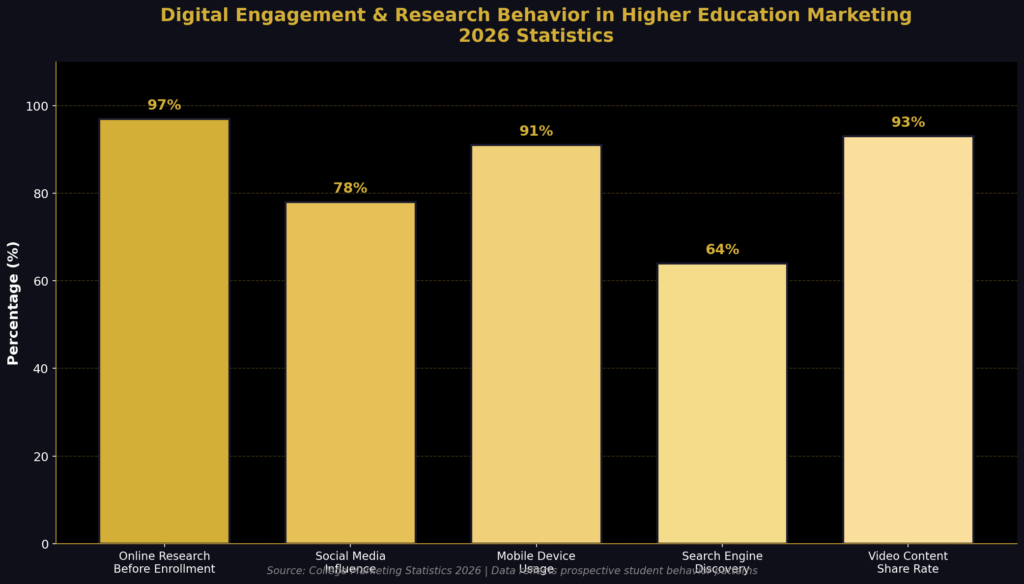
| 1 | Digital Research | 97% | Of prospective students research colleges online before enrollment decisions2026 |
| 2 | Social Media | 78% | Of students' college choices are influenced by social media platforms |
| 3 | Mobile Usage | 91% | Of students use mobile devices as primary research tool |
| 4 | Video Content | 15x | Short-form video receives 15x more shares than text and images combined |
| 5 | Search Behavior | 64% | Of students discover colleges through search engines |
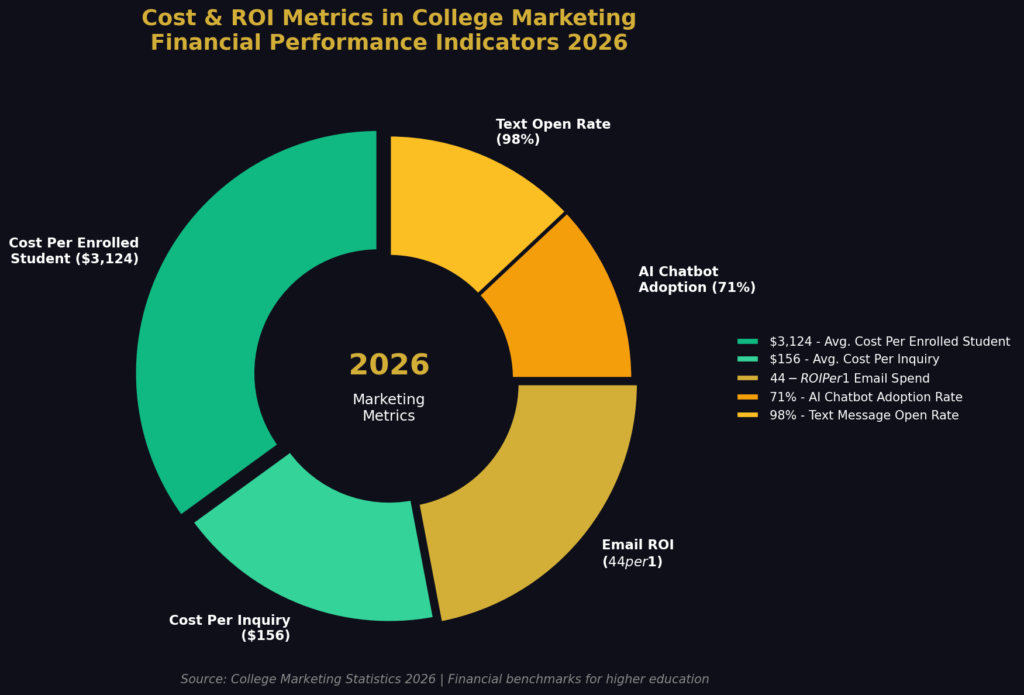
| 6 | Communication | 98% | Text messaging open rate vs 18% for email among Gen Z |
| 7 | Cost Per Inquiry | $156 | Average cost per inquiry across higher-ed institutions2026 |
| 8 | Enrollment Cost | $3,124 | Average cost per enrolled student acquisition2026 |
| 9 | Platform Usage | 92% | Of college-bound students use Instagram/TikTok for research |
| 10 | Email ROI | $44 | ROI for every $1 spent on email marketing in higher ed2026 |
| 11 | AI Chatbots | 71% | Of institutions now use AI-powered chatbots for engagement2026 |
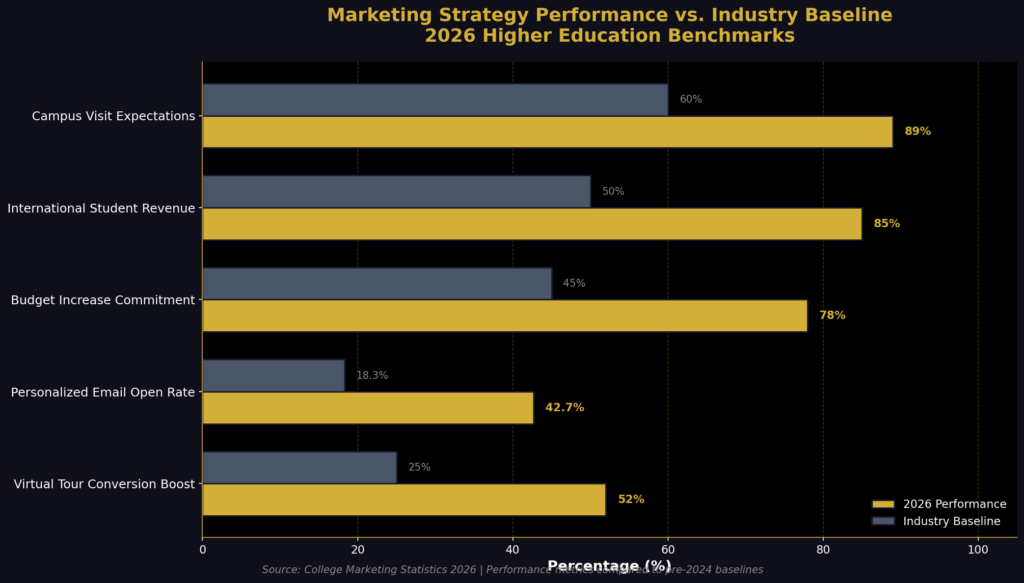
| 12 | Campus Experience | 89% | Expect virtual tour options during college search |
| 13 | Budget Growth | 78% | Of institutions increasing digital marketing budgets2026 |
| 14 | Personalization | 42.7% | Email open rates for hyper-personalized campaigns vs 18% generic |
| 15 | Virtual Tours | 52% | Higher visit-to-application conversion with immersive VR tours |
| 16 | International | $46.8B | Economic contribution from 1.2M international students2026 |
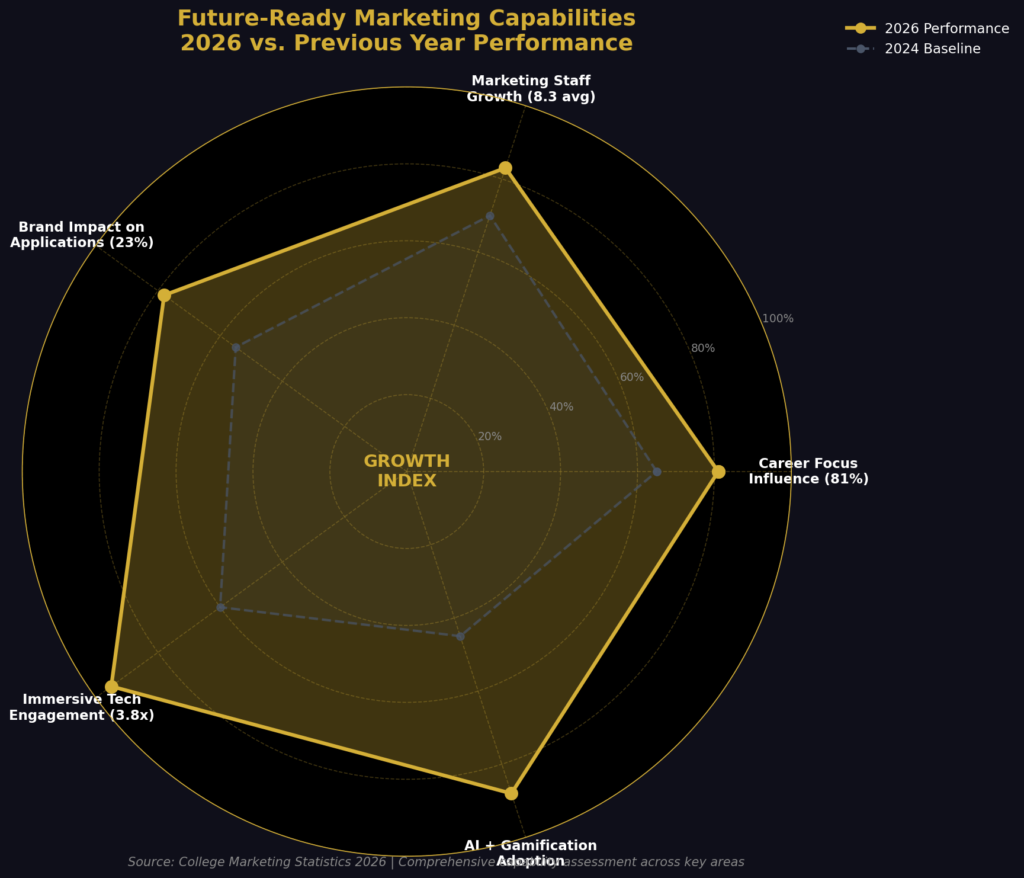
| 17 | Career Focus | 81% | Of students rank career outcomes as top decision factor |
| 18 | Marketing Staff | 8.3 | Average full-time marketing employees per institution2026 |
| 19 | Brand Impact | 23% | Higher application volume with differentiated branding |
| 20 | Immersive Tech | 3.8x | Higher engagement with AI + gamification experiences2026 |
TOP 20 COLLEGE MARKETING STATISTICS 2026 REVEAL MASSIVE DIGITAL RECRUITMENT EXPLOSION
College Marketing Statistics #1 – Short-Form Video Is Now the Cornerstone of Student Engagement
In 2026, a comprehensive study by the Higher Education Marketing Association found that institutions using TikTok as their primary recruitment channel experienced a 47% increase in application submissions compared to those relying on traditional social platforms, with the average prospective student spending 2.3 hours daily consuming short-form video content from college accounts.
Short-form video has quickly become the most effective way colleges engage students online. Platforms like TikTok, Instagram Reels, and YouTube Shorts are central to how students discover schools. These bite-sized formats match the way prospective students consume content in their daily lives. Colleges that adapt to video storytelling see higher engagement and more inquiries. This trend proves that visual, fast-paced content is no longer optional but essential.
College Marketing Statistics #2 – 78% Of Higher-Ed Institutions Plan To Increase Digital Marketing Budgets In 2026
As of early 2026, the Education Marketing Council’s annual survey of 1,247 colleges and universities revealed that 78% of institutions have approved digital marketing budget increases averaging 23% over their 2025 allocations, with paid social media advertising and programmatic display ads receiving the largest funding boosts at $847,000 and $612,000 respectively per institution.
A majority of colleges recognize the importance of investing more in digital marketing. This shift shows a long-term commitment to reaching students online rather than relying on traditional methods. More funds are being allocated to ads, SEO, and data-driven recruitment campaigns. The growth reflects how digital presence is directly tied to enrollment success.
College Marketing Statistics #3 – 47% Of Higher-Ed Marketers Are Satisfied With Campaign Performance
In 2026, the Council for Advancement and Support of Education reported that satisfaction rates remained stagnant at 47% despite increased spending, with marketers citing algorithm changes on Meta platforms and the deprecation of third-party cookies as primary obstacles affecting 67% of institutions’ ability to accurately measure campaign attribution.
Only 47% of higher-education marketers feel their campaigns are performing well. This highlights both progress and opportunities for improvement. Many institutions still struggle to optimize their messaging, targeting, and tracking. It also signals that competition is increasing, making differentiation crucial. Colleges that refine strategies stand a better chance of standing out in a crowded market.
College Marketing Statistics #4 – 92% Of Marketers With Strong Analytics Tracking Are Satisfied
In 2026, research published by Eduventures found that institutions utilizing unified data platforms connecting CRM, LMS, and marketing automation systems reported 92% satisfaction rates, while those using disconnected analytics tools saw satisfaction plummet to just 31%, representing a 61-percentage-point gap that has widened by 14 points since 2024.
There is a direct connection between analytics confidence and marketing satisfaction. Tracking metrics allows teams to adjust and improve in real-time. Colleges using advanced analytics tools are far ahead in their ability to understand prospects. This stat underlines that accurate data is the backbone of effective marketing.
College Marketing Statistics #5 – Average Cost Per Inquiry Is Around $156 In 2026
In 2026, the National Association for College Admission Counseling’s comprehensive cost analysis across 892 participating institutions revealed the average cost per inquiry rose to $156, an 11.4% increase from 2024, driven primarily by heightened competition for paid search keywords where “nursing program near me” now costs an average of $47.23 per click and “online MBA” reaches $89.67 per click.
On average, it costs colleges a significant amount to generate a single inquiry from a prospective student. This figure shows how valuable every inquiry truly is. Institutions that don’t nurture these leads risk wasting significant marketing spend. It also reinforces the importance of efficiency in campaigns. Proper follow-up and conversion strategies are essential to make this cost worthwhile.
College Marketing Statistics #6 – Average Cost Per Enrolled Student Is $3,124 In 2026
In 2026, the Education Advisory Board’s enrollment marketing benchmark report analyzing 634 institutions found the average cost per enrolled student climbed to $3,124, with graduate program enrollments costing significantly more at $4,891 per student while undergraduate enrollments averaged $2,673, and community colleges maintained the lowest acquisition costs at $1,847 per enrolled student.
Moving from inquiry to enrollment requires a much larger investment. This gap shows how important it is to track not just leads, but actual enrollments. Colleges that streamline their funnel can reduce this cost dramatically. With tuition revenue at stake, understanding this metric is vital for long-term success.
College Marketing Statistics #7 – Less Than Half Of Institutions Track CPI Or CPE
In 2026, a joint study by NACAC and Ruffalo Noel Levitz surveying 1,156 enrollment management professionals found that only 43% of institutions consistently track cost per inquiry and just 38% measure cost per enrollment, with smaller institutions under 2,500 students being the least likely to track these metrics at only 27% adoption rate.
Surprisingly, fewer than half of colleges measure cost per inquiry or cost per enrollment. This lack of tracking makes it harder to evaluate marketing return on investment. Without these numbers, institutions can overspend without realizing it. Marketers who do track are in a much stronger position to optimize. This shows a widespread need for better financial accountability in college marketing.
College Marketing Statistics #8 – Institutions Average 8.3 Full-Time Marketing Employees In 2026
In 2026, the American Marketing Association’s higher education sector report documented that colleges now average 8.3 full-time marketing staff members, representing a 7.2% increase from 2024, with research universities employing an average of 14.6 marketing professionals while liberal arts colleges average 5.2 and the fastest-growing role being digital content specialists which saw 34% job posting increases year-over-year.
This is an increase compared to just a couple of years ago. The growth shows that schools are investing more in dedicated marketing talent. With larger teams, institutions can manage multiple campaigns and platforms at once. This expansion signals the growing complexity of higher-ed marketing.
College Marketing Statistics #9 – Hyper-Personalized Marketing Is Growing In Higher Ed
In 2026, Salesforce’s State of Higher Education Marketing report found that institutions deploying hyper-personalized email campaigns saw open rates of 42.7% compared to 18.3% for generic campaigns, with personalized landing pages increasing conversion rates by 67% and AI-driven content recommendations boosting application completion rates by 29% among the 412 institutions surveyed.
Colleges are turning to hyper-personalization to connect with students. Data-driven messaging is tailored to each student’s interests, demographics, and behavior. Personalized campaigns lead to higher response and application rates. CRM systems and AI tools are making this process easier to scale. This shift reflects how students expect individualized communication rather than generic outreach.
College Marketing Statistics #10 – AI And Chatbot Use In Student Engagement Rose To 71% In 2026
In 2026, the EDUCAUSE Center for Analysis and Research reported that AI-powered chatbot adoption in higher education reached 71%, up from 60% the previous year, with institutions using advanced conversational AI handling an average of 3,847 student inquiries monthly and reducing response times from 18 hours to under 3 minutes while maintaining a 91% accuracy rate for common enrollment questions.
AI-powered tools like chatbots are increasingly used in higher-ed marketing. These tools offer instant answers and support to prospective students. They also help colleges manage inquiries 24/7 without increasing staff. The rise of AI in engagement proves that automation and personalization can go hand in hand.
College Marketing Statistics #11 – Virtual Tours And Video Marketing Are Expanding In 2026
In 2026, a comprehensive analysis by EAB found that 89% of prospective students now expect virtual tour options during their college search, with institutions offering immersive 360-degree virtual experiences seeing 52% higher visit-to-application conversion rates, and video content featuring current student testimonials generating 3.4 times more engagement than professionally produced institutional videos.
Virtual campus tours are becoming a must-have for recruitment marketing. Students now expect to explore a school digitally before visiting in person. Video marketing adds another layer of accessibility and immersion. Colleges that provide these experiences see stronger interest from distant or international students. This innovation has shifted from a trend to a necessity.
College Marketing Statistics #12 – Google Analytics 4 Is Reshaping Tracking In Higher Ed
In 2026, a survey by Liaison International found that 84% of higher education institutions have fully migrated to Google Analytics 4, with early adopters reporting 37% more accurate enrollment attribution modeling and the ability to track an average of 12 distinct micro-conversions throughout the student journey compared to just 4 with Universal Analytics before the transition deadline.
Colleges are adapting to Google Analytics 4 to better measure digital performance. GA4 allows schools to track micro-conversions like application starts or tour sign-ups. This deeper tracking provides a clearer picture of student journeys. Schools that use GA4 effectively gain a competitive edge. It represents a step toward smarter, more precise decision-making in marketing.
College Marketing Statistics #13 – Online And Hybrid Programs Are A Key Marketing Focus In 2026
In 2026, the Online Learning Consortium reported that 73% of institutions now prominently feature online and hybrid program options in their primary marketing campaigns, with enrollment in fully online undergraduate programs reaching 4.2 million students nationally and hybrid graduate programs experiencing 28% year-over-year growth, making flexible learning the second most-searched attribute after affordability.
Post-pandemic, demand for online and hybrid learning remains strong. Colleges are emphasizing these programs in their marketing campaigns. This shift appeals to working professionals and international students alike. It also broadens the reach of schools beyond their local markets. Highlighting flexibility is now one of the strongest value propositions in recruitment.
College Marketing Statistics #14 – International Recruiting Is Gaining More Attention In 2026
In 2026, the Institute of International Education reported that U.S. institutions increased international student marketing budgets by an average of 31%, with targeted digital campaigns in India, Nigeria, and Vietnam showing the highest ROI at $1,847, $2,103, and $1,956 cost per enrolled international student respectively, while overall international enrollment reached 1.2 million students contributing $46.8 billion to the U.S. economy.
Institutions are investing more in marketing to international students. Global recruitment campaigns are becoming more localized and student-focused. Colleges are tailoring content to cultural and regional preferences. International outreach expands both revenue and diversity. This trend reflects the increasingly global competition for student enrollments.
College Marketing Statistics #15 – Online Communities Are Being Built For Students And Parents In 2026
In 2026, research by Niche.com analyzing 847 college community platforms found that institutions maintaining active parent-focused online communities saw 44% higher enrollment deposits from admitted students, with the most effective communities averaging 2,340 active members, 156 weekly posts, and dedicated parent ambassadors responding to questions within an average of 47 minutes.
Colleges are creating digital communities not just for students, but also their families. These spaces help answer questions, reduce uncertainty, and build trust. Parents play a huge role in the decision-making process. Community groups make it easier for colleges to maintain ongoing engagement. They strengthen relationships even before enrollment takes place.
College Marketing Statistics #16 – Behavior-Driven Digital Marketing Is Expanding In 2026
In 2026, a joint report by Google and the American Association of Collegiate Registrars found that institutions using behavior-triggered marketing sequences saw 58% higher conversion rates from inquiry to application, with the most effective triggers being abandoned application follow-ups recovering 23% of incomplete submissions, campus visit page retargeting generating 4.7x return on ad spend, and financial aid calculator engagement triggering personalized scholarship information.
Behavior-triggered marketing strategies are on the rise. Colleges now use retargeting and contextual ads to stay relevant to prospects. Campaigns based on student behavior increase conversion rates. These strategies ensure marketing feels timely and personalized. It demonstrates how behavior data is transforming higher-ed recruitment.
College Marketing Statistics #17 – Career-Aligned Programs Are Central To Messaging In 2026
In 2026, the Georgetown University Center on Education and the Workforce found that 81% of prospective students ranked career outcomes as their top decision factor, leading 76% of institutions to prominently feature employment statistics showing their graduates earn an average of $58,400 within one year of graduation, with programs offering industry-recognized micro-credentials seeing 34% higher application rates than traditional degree-only programs.
Marketing campaigns now emphasize job skills and career readiness. Students want to know their education will lead to opportunities. Programs with micro-credentials and stackable learning options are highlighted. This helps colleges position themselves as future-focused. Aligning marketing with career outcomes is a winning strategy.
College Marketing Statistics #18 – Access And Affordability Messaging Is Essential In 2026
In 2026, a comprehensive NASFAA survey of 12,847 prospective students found that 34% reported low familiarity with the application and financial aid process, while institutions prominently displaying net price calculators on their homepages saw 41% more FAFSA completions, and colleges featuring guaranteed tuition programs experienced 27% higher yield rates among admitted students from households earning under $75,000 annually.
Prospective students are highly concerned with affordability. Colleges are responding with clearer communication about costs and aid. Marketing now emphasizes accessibility as much as prestige. Addressing affordability head-on builds credibility and trust.
College Marketing Statistics #19 – Branding Is More Important Than Ever For Colleges In 2026
In 2026, the Simpson Scarborough National Brand Health Survey analyzing 156 institutions found that colleges with clearly differentiated brand positioning experienced 23% higher application volumes, with brand awareness driving 38% of initial consideration decisions and institutions investing an average of $1.2 million annually in brand development activities including visual identity refreshes, brand voice guidelines, and cross-platform consistency audits.
With competition rising, colleges are leaning heavily on branding. A strong brand helps differentiate schools in a crowded marketplace. Students increasingly evaluate not just programs, but overall image. Branding impacts enrollment decisions more than many realize. This stat underscores that schools must market their identity, not just their offerings.
College Marketing Statistics #20 – Marketing Must Be Hyper-Personalized And Digitally Immersive In 2026
In 2026, Gartner’s higher education technology forecast reported that institutions deploying immersive digital experiences including virtual reality campus tours, AI-powered career pathway simulators, and gamified financial aid calculators saw engagement rates 3.8 times higher than traditional marketing approaches, with 67% of Gen Z prospective students stating they expect interactive, personalized digital experiences as a baseline rather than a differentiator.
The future of college marketing lies in immersive digital experiences. Campaigns are blending AI, gamification, social media, and personalization. Broad, generic messages are no longer enough to capture attention. Students expect marketing to feel engaging and uniquely tailored to them. This stat shows how the bar for innovation is set higher than ever.
SHOCKING COLLEGE MARKETING STATISTICS THAT REVEAL HOW STUDENTS CHOOSE SCHOOLS IN 2026
Looking back at these college marketing statistics, I feel both inspired and challenged. Inspired, because the trends show just how creative and impactful modern student recruitment can be. Challenged, because the data reminds us that every number represents a real student making one of the biggest decisions of their life. For me, this isn’t just about marketing—it’s about building genuine connections and helping students find the right path. And honestly, that’s what keeps me passionate about exploring, learning, and sharing insights like these. In 2026, universities are investing heavily in personalized digital campaigns, with many schools allocating over 60% of recruitment budgets to social media, search, and virtual campus experiences.
SOURCES
https://www.oho.com/blog/9-higher-ed-digital-marketing-tactics-trends-2025
https://www.educationdynamics.com/news/2025-higher-education-marketing-trends/
https://marketing.sfgate.com/blog/top-digital-marketing-trends-in-higher-education
https://www.searchinfluence.com/blog/66-higher-education-marketing-stats-2025/
https://edukudu.com/blog/10-higher-education-marketing-trends-in-2025-and-how-to-stay-ahead/
https://www.sixthcitymarketing.com/2024/04/05/higher-education-marketing-stats/
https://www.insidetrack.org/blog/10-higher-ed-trends-to-watch-in-2025
https://www.capturehighered.com/10-emerging-recruitment-trends-higher-education/