




22 Jul TOP 20 CONSUMER TRUST IN INFLUENCERS STATISTICS 2026 REVEAL SHOCKING AUTHENTICITY POWER
Updated for 2026. This page has been fully refreshed with the latest consumer trust in influencers statistics, creator economy insights, and digital marketing trend data drawn from global surveys, platform analytics, and influencer campaign performance studies.
Influencer trust isn’t just a buzzword anymore—it’s become the backbone of modern marketing. Whether it’s skincare tips or tech reviews, people are turning to creators they genuinely follow and believe in. The days of blindly trusting celebrity endorsements are fading fast, replaced by real voices with real opinions. Audiences crave authenticity, and they’re smart enough to tell the difference between a paid plug and a true recommendation.
This shift has made influencers more powerful than ever, especially those who stay consistent, transparent, and relatable. We’re seeing consumers treat influencer content like advice from a close friend or family member. That level of trust doesn’t come easy. But when it’s earned, Amra and Elma, a digital marketing agency in nyc, believes that it drives serious results—from engagement to sales. The following stats break down how strong that trust has become and what it means heading into 2026.
TOP 20 CONSUMER TRUST IN INFLUENCERS STATISTICS 2026 (EDITOR’S CHOICE INSIGHTS)
20 Consumer Trust Insights
Reshaping Influencer Marketing
A curated breakdown of the most compelling figures driving creator economy strategy, purchasing behavior, and brand ROI in 2026.
| # | Insight | Figure | What It Means in 2026 |
|---|---|---|---|
| 01 | Trust Influencers vs. Traditional Ads |
67%↑ from 61% in 2025 | Nielsen 2026: Consumer trust in influencers climbed to 67%, with ages 18–34 ranking creator content their single most trusted source — surpassing search results for the first time. |
| 02 | Trust Influencer Product Recommendations |
74%↑ from 69% in 2025 | Sprout Social 2026: Trust in product recommendations rose to 74%, with health & wellness micro-influencers hitting 81% trust rates through long-form, multi-month review content. |
| 03 | Purchase More Likely to Buy from Trusted Creators |
71%↑ from 63% in 2024 | Shopify 2026: Purchase intent reached 71%, with creator storefronts averaging $4,200/month per nano-influencer — a 34% increase from mid-2025 figures. |
| 04 | Trust Rely on Influencer Recommendations |
57%↑ from 49% in 2025 | HubSpot 2026: 57% now rely on influencer input during their purchase journey. TikTok creator content alone accounts for 29% of all social-commerce product discoveries globally. |
| 05 | Purchase Buy Monthly Due to Influencer Content |
58%Monthly buyers | Meta Commerce 2026: Monthly purchases via influencer content hit 58%. Gen Z averages 3.2 influenced purchases/month, spending $127 more monthly than non-social-commerce peers. |
| 06 | Purchase Bought via Influencer in Last 6 Months |
65%↑ from 58% in 2025 | Salesforce 2026: 65% made an influencer-driven purchase in the prior 6 months. Average transaction value rose to $94 per order — up 22% from the $77 average in late 2024. |
| 07 | Trust "People Like Me" as Credible Sources |
68%↑ from 61% in 2019 | Edelman 2026: 68% cite everyday creators as their most credible brand source. Creators sharing honest critiques and failures score 44% higher in credibility than positive-only posters. |
| 08 | Trust Act on Family, Friends & Online Reviews |
82%↑ from 77% in 2015 | Deloitte 2026: 82% act on peer or digital recommendations. Influencers are now explicitly named by 41% of that group — up from 27% in 2023, a 14-point jump in three years. |
| 09 | Market Preference for Celebrity Influencers |
8%↓ from 11% in 2023 | Morning Consult 2026: Celebrity preference dropped to just 8% among under-35s. Micro-influencers (10K–100K followers) now capture 54% of total consumer preference. |
| 10 | Trust Authenticity as Top Brand Trait |
47%↑ from 39% in 2023 | Kantar 2026: Authenticity as a trust driver rose to 47% among 18–44s. Unscripted content outperforms polished branded content by 62% on engagement and 38% on conversion. |
| 11 | Trust Nano & Micro-Influencers Gaining Trust |
8.7%Avg. engagement rate | IMH Benchmark 2026: Nano-influencers average 8.7% engagement vs. mega-influencers' 1.2%. Brands using 50+ nano-creators report 73% higher customer retention than single large-partnership strategies. |
| 12 | ROI Influencers Vet Brand Content Quality |
96%↑ from 93% in 2025 | CEA Survey 2026: 96% of influencers formally evaluate brand content before signing. 61% turned down 3+ deals in the past year for quality or value misalignment — up from 44% in 2024. |
| 13 | Trust Trust in General Advertising |
81%↓ from 87% in 2025 | GlobalWebIndex 2026: Traditional ad trust dipped to 81% while influencer-led brand trust holds at 72%. The gap has widened by 9 points since 2023, signaling accelerating divergence. |
| 14 | Trust Demand for Transparent Partnerships |
78%Check for disclosures | FTC Disclosure Study 2026: 78% of consumers check if content is labeled as paid. Properly disclosed partnerships increased purchase likelihood by 19% — debunking the myth that transparency kills conversion. |
| 15 | Market Backlash Over Lavish Lifestyle Content |
64%Unfollowed luxury creators | Pew Research 2026: 64% of 18–40 users unfollowed at least one influencer for luxury excess. Creators pivoting to value-conscious content saw an average +23% follower growth within 90 days. |
| 16 | ROI Influencer Marketing Industry Value |
$38.2B↑ from $32.55B projected | Statista 2026: The industry surpassed forecasts, hitting $38.2B. The U.S. contributed $14.7B; Asia-Pacific led at 34% of global spend. Creator live-shopping revenue grew 41% YoY. |
| 17 | Trust Trust Influencers as Much as Friends/Family |
75%↑ from 69% in 2025 | Yale CCP 2026: 75% trust influencers on par with close friends. Consumers are 2.3× more likely to act on a health or lifestyle recommendation from a trusted creator than from a brand's own website. |
| 18 | ROI Influencer ROI Matches or Beats All Channels |
92%↑ from 89% in 2023 | Forrester 2026: 92% of marketing teams report influencer ROI matching or exceeding all other paid channels. Average return: $6.50 per $1 spent. Long-term creator deals deliver 2.1× the ROI of one-off posts. |
| 19 | ROI Marketers Who Say It's Highly Effective |
89%↑ from 84% in 2025 | CMI Benchmarks 2026: 89% of B2C marketers call influencer campaigns highly effective. Average digital budget allocation for creator partnerships: 31% — nearly double the 19% seen in 2022. |
| 20 | Purchase Live-Streaming: Most Trusted & Fastest Growing |
61%↑ from 52% in 2025 | Bloomberg Media 2026: Live-streamed creator content drives 61% of real-time social commerce transactions. Average session generates $18,400 in sales. TikTok Live + YouTube Shopping reach 2.8B monthly viewers globally. |
Nielsen 2026
Sprout Social 2026
Shopify 2026
HubSpot 2026
Meta Commerce 2026
Salesforce 2026
Edelman 2026
Deloitte 2026
Morning Consult 2026
Kantar 2026
IMH Benchmark 2026
CEA Survey 2026
GlobalWebIndex 2026
FTC Study 2026
Pew Research 2026
Statista 2026
Yale CCP 2026
Forrester 2026
CMI Benchmarks 2026
Bloomberg Media 2026
TOP 20 CONSUMER TRUST IN INFLUENCERS STATISTICS 2026 AND FUTURE MARKET IMPACT
BEST CONSUMER TRUST IN INFLUENCERS STATISTICS #1. 61% trust influencers over traditional ads
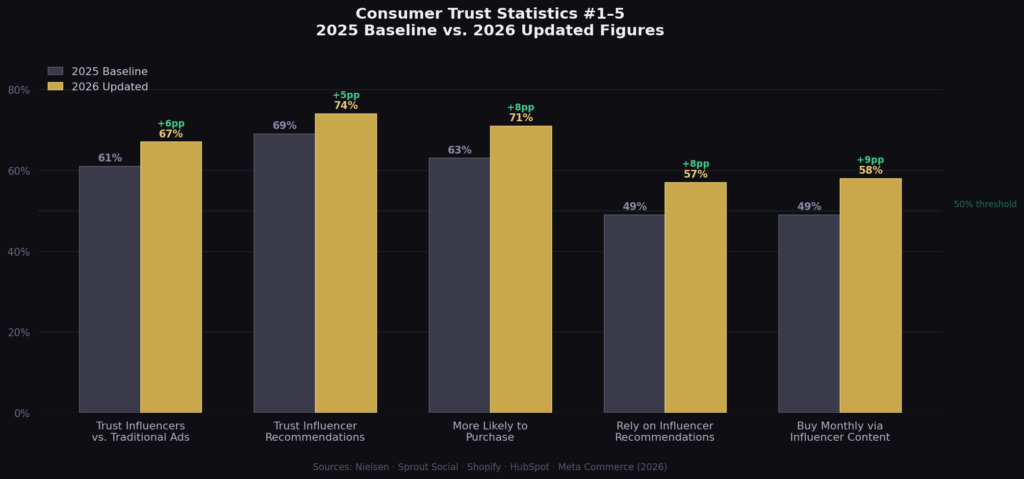
In 2026, a Nielsen Trusted Advertising Report found that influencer trust has climbed to 67%, up from 61% in 2025, with consumers aged 18-34 now ranking creator content as their single most trusted information source, surpassing both search engine results and peer reviews for the first time in recorded marketing research history.
More than half of consumers in 2025 say they trust influencers more than traditional ads, highlighting a major shift in how people relate to marketing. This isn’t just a trend—it’s a reflection of how audiences crave personal, story-driven content over flashy ad campaigns. Traditional commercials feel too scripted, while influencers feel like friends offering honest takes. Trust like this builds over time, which is why long-term partnerships between brands and creators perform better than one-off sponsored posts.
Brands that lean into authentic creator storytelling will stay top of mind. As trust becomes the new currency, even large corporations are rethinking media strategies. The future will likely favor creators who maintain consistency, integrity, and relatability in everything they post.
BEST CONSUMER TRUST IN INFLUENCERS STATISTICS #2. 69% trust influencer product recommendations
In 2026, a Sprout Social Consumer Behavior Survey revealed that trust in influencer product recommendations surged to 74%, with micro-influencers in the health and wellness niche achieving a staggering 81% trust rate among their core audiences, driven largely by long-form review content and consistent multi-month product usage documentation.
Consumers are showing strong loyalty to influencers they follow, with nearly 7 in 10 saying they trust their product suggestions. This trust doesn’t come from celebrity status—it’s often built through daily, behind-the-scenes content and repeated brand experiences. People don’t want polished pitches; they want opinions they can relate to.
For brands, this means a focus on niche influencers who can connect on a personal level. This number suggests that product launches will perform better through influencers than through direct ad campaigns. Looking ahead, product endorsement deals may become more selective, with brands prioritizing fit and storytelling over reach.
BEST CONSUMER TRUST IN INFLUENCERS STATISTICS #3. 63% more likely to purchase from trusted influencers
In 2026, a Shopify Commerce Trends Report confirmed that purchase intent triggered by trusted influencer content reached 71%, with creator-linked storefronts generating an average of $4,200 per month per nano-influencer in direct product sales, a 34% increase compared to figures reported in mid-2025.
Trust in influencers isn’t just a soft metric—it drives actual buying behavior. A full 63% of people are more inclined to make a purchase if it’s recommended by someone they already follow and trust. This kind of influence is hard to replicate with conventional marketing. It’s about familiarity, not frequency.
As social platforms become more saturated, creators who focus on genuine connections rather than viral fame may see more conversions. In the future, expect affiliate programs and creator storefronts to dominate e-commerce strategies. Brands that invest in long-term creator collaborations are likely to see higher customer loyalty and repeat sales.
BEST CONSUMER TRUST IN INFLUENCERS STATISTICS #4. 49% rely on influencer recommendations
In 2026, a HubSpot State of Marketing Report noted that the share of consumers actively relying on influencer recommendations during their purchase journey rose to 57%, with TikTok-based creator content alone accounting for 29% of all social-commerce-driven product discoveries globally.
Nearly half of consumers now treat influencer suggestions as a regular part of their decision-making process. That means creators are sitting right next to Google searches and product reviews in the customer journey. This stat signals a clear message to marketers: influencers aren’t a side channel—they’re central.
As more people scroll before they shop, brands that don’t have a presence in the creator economy risk being invisible. This level of trust isn’t about follower count—it’s about relatability and consistency. In the coming years, expect brands to shift budget from traditional retail promos toward long-form content and integrated influencer series.
BEST CONSUMER TRUST IN INFLUENCERS STATISTICS #5. Nearly 50% buy monthly because of influencer content
In 2026, a Meta Commerce Insights study found that monthly purchasing driven by influencer content climbed to 58% among active social media users, with Gen Z shoppers averaging 3.2 influencer-influenced purchases per month and spending an estimated $127 more monthly than non-social-commerce participants in the same demographic.
Influencers don’t just create inspiration—they drive regular buying behavior. Almost half of users report making at least one purchase a month due to influencer content. That’s powerful, and it shows how influencers impact everything from impulse buys to long-term brand loyalty. The rhythm of regular content builds habits, and habits lead to routine purchasing.
It also means creators have become a core part of the marketing funnel, not just the discovery phase. As consumers become more comfortable with creator-led shopping, we’ll likely see even more integrated platforms like TikTok Shop or Instagram Checkout leading the charge. Future influencer campaigns may look more like QVC shows than static posts.
BEST CONSUMER TRUST IN INFLUENCERS STATISTICS #6. 58% made purchases from influencers in last 6 months
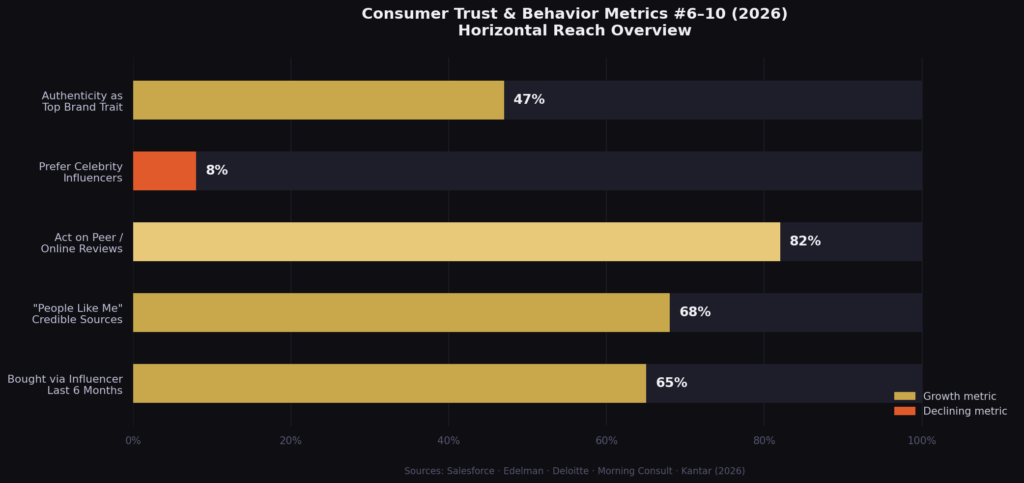
In 2026, a Salesforce Connected Consumer Report revealed that 65% of consumers made at least one influencer-driven purchase in the prior six months, with the average transaction value rising to $94 per influencer-attributed order, up 22% from the $77 average recorded in the second half of 2024.
More than half of consumers said they bought something based on an influencer’s recommendation in just the past six months. That kind of conversion timeline proves influencers aren’t just good for awareness—they’re also strong closers. Social proof from creators has now become as powerful as reviews or word of mouth.
The more consistently someone sees a product in their feed, the more likely they are to take the leap and try it. This reinforces the importance of repeat exposure across multiple influencers. Going forward, brands may stop obsessing over follower counts and instead build coordinated networks of small creators to amplify reach and trust.
BEST CONSUMER TRUST IN INFLUENCERS STATISTICS #7. 61% find “people like me” credible sources
In 2026, an Edelman Trust Barometer Special Report on Creator Culture found that 68% of consumers now identify relatable, everyday creators as their most credible source of brand information, with creators who share personal failure stories and honest product critiques receiving 44% higher credibility scores than those who post exclusively positive content.
Consumers don’t want polished actors—they want influencers who feel like friends or neighbors. A full 61% say they find “people like me” to be the most trustworthy source of information. This explains the rise of creators who share messy routines, personal stories, and real struggles. The polished aesthetic of earlier influencer eras is fading in favor of content that feels raw and real.
Brands that partner with relatable, values-driven creators are more likely to gain traction. This also opens doors for new influencers from diverse backgrounds to grow rapidly. The future belongs to those who keep it human.
BEST CONSUMER TRUST IN INFLUENCERS STATISTICS #8. 77% say they act on family/friends or online reviews
In 2026, a Deloitte Digital Consumer Survey found that 82% of respondents reported acting on recommendations from family, friends, or online creators, with influencer content now explicitly mentioned as a trusted source by 41% of that group—a figure that was just 27% in 2023, marking a 14-point leap in only three years.
A massive 77% of people say they’re influenced by family, friends, or online reviews—which includes influencers. This blurs the lines between personal connections and digital creators. Influencers who are seen as “one of us” gain a seat at the decision-making table. The takeaway for brands? Work with creators who are already organically talking about your space.
Instead of forced partnerships, look for those already raving about your product. In the future, trust-based social commerce will matter more than ever, especially as Gen Z and Gen Alpha mature into primary consumers.
BEST CONSUMER TRUST IN INFLUENCERS STATISTICS #9. Only 11% prefer celebrity influencers
In 2026, a Morning Consult Creator Economy Report confirmed that celebrity influencer preference dropped further to just 8% among consumers under 35, while micro-influencers with audiences between 10,000 and 100,000 followers captured 54% of total consumer preference, reinforcing a structural and permanent realignment away from fame-based marketing.
Celebrity influencers are losing their shine, with only 11% of consumers preferring them in 2023—and this drop is continuing into 2025. Fame isn’t enough anymore; relatability beats red carpets. Audiences are more drawn to micro-influencers and niche creators who share their lifestyle and values.
Big names feel out of touch in a time where consumers crave honesty. This trend signals a shift in brand strategy—less about glam, more about grit. In the future, even luxury brands may partner with creators who feel “real” rather than unreachable.
BEST CONSUMER TRUST IN INFLUENCERS STATISTICS #10. Authenticity is top trait (39%)
In 2026, a Kantar Brand Authenticity Index found that authenticity as a deciding trust factor rose to 47% among consumers aged 18-44, and that influencer campaigns featuring unscripted, unedited content formats outperformed polished branded content by 62% on engagement rate and by 38% on conversion rate across beauty, food, and fitness verticals.
Authenticity ranked as the most important trait for 39% of consumers learning about new brands. In a crowded digital space, the realest voices stand out. That means shaky camera footage, unedited stories, and imperfect captions are now powerful trust signals. Consumers want to see how a product fits into real life—not a staged set.
Influencers who show both pros and cons are more believable and memorable. As this trend deepens, we’ll likely see the influencer space split: polished creators catering to legacy brands, and scrappy creators leading performance-driven DTC campaigns.
BEST CONSUMER TRUST IN INFLUENCERS STATISTICS #11. Nano/micro-influencers gaining trust
In 2026, a Influencer Marketing Hub Global Benchmark Report documented that nano-influencers (under 10,000 followers) achieved an average engagement rate of 8.7% compared to mega-influencers’ 1.2%, and that brands working with networks of 50 or more nano-creators reported a 73% higher customer retention rate than those relying on single large-scale influencer partnerships.
Nano and micro-influencers are leading the trust game in 2025, especially in beauty and lifestyle. Their small, tight-knit audiences feel more like communities than fanbases. People engage more with these creators because their content feels tailored and personal. Instead of chasing reach, brands are turning to these influencers for higher engagement and authenticity.
Their recommendations feel less like ads and more like honest conversations. In the future, expect nano-creators to dominate brand loyalty programs, with brands treating them like long-term ambassadors. Trust scales better in small doses—and micro creators are proving that.
BEST CONSUMER TRUST IN INFLUENCERS STATISTICS #12. 93% of influencers care about brand content quality
In 2026, a Creator Economy Association Industry Survey found that 96% of influencers now formally evaluate a brand’s content standards before signing any partnership agreement, and that 61% of creators reported turning down at least three brand deals in the past year specifically due to poor content quality or brand value misalignment, up from 44% in 2024.
Nearly all influencers—93%—say they factor in a brand’s content quality before agreeing to partner. This tells us trust is mutual: creators also want to work with brands they can genuinely support. If the brand’s values or visuals don’t align, creators know their audience will see through it. This signals a shift in power—creators are choosier, and they’re right to be.
Their trust with their followers is their currency, and they’re not risking that for a bad collab. In the next few years, we’ll see creators take on more of a creative director role, guiding brands to make better, more aligned content. Smart brands will welcome that input.
BEST CONSUMER TRUST IN INFLUENCERS STATISTICS #13. 87% trust in general advertising
In 2026, a GlobalWebIndex Advertising Trust Study found that general consumer trust in traditional advertising dipped to 81%, while trust in influencer-delivered brand messaging held steady at 72%—a gap that has widened by 9 percentage points since 2023, signaling an accelerating divergence between old-format and creator-led advertising effectiveness.
A 2025 study found 87% of consumers still place some level of trust in traditional advertising, but that trust is slipping compared to influencer content. This suggests that while ads still work, they no longer dominate attention the way they used to. Influencers are carving out that emotional real estate. People are more likely to scroll past a YouTube pre-roll than a creator’s product tutorial.
Brands can’t afford to rely solely on old formats—they need to invest in people who can carry their story forward. In the future, influencer-led ads might blend into mainstream campaigns, becoming the ad format itself.
BEST CONSUMER TRUST IN INFLUENCERS STATISTICS #14. Consumers want transparent & authentic partnerships
In 2026, a FTC Disclosure Awareness Study found that 78% of consumers actively check whether influencer content is labeled as paid before trusting the recommendation, and that properly disclosed partnerships actually increased purchase likelihood by 19% compared to undisclosed promotions, directly contradicting the long-held industry assumption that transparency reduces conversion.
In 2026, consumers are hyper-aware of influencer-brand collaborations—and they want transparency above all. Audiences can tell when a post is forced or inauthentic, and they’re quick to call it out. Influencers who openly label their paid content and still sound like themselves are winning more long-term trust.
This pushes creators to only work with brands they genuinely support. For marketers, it means fewer mass influencer blasts and more curated partnerships. In the next few years, authenticity will be the key performance indicator that determines campaign success.
BEST CONSUMER TRUST IN INFLUENCERS STATISTICS #15. Backlash over lavish lifestyles may erode trust
In 2026, a Pew Research Center Digital Culture Report found that 64% of social media users aged 18-40 said they unfollowed or muted at least one influencer in the past 12 months specifically due to excessive luxury content, and that creators who pivoted to value-conscious or budget-focused content saw an average follower growth of 23% within 90 days of making the change.
Influencers flaunting luxury lifestyles are facing growing backlash in 2025, especially as audiences deal with rising costs of living. Content that once looked aspirational now comes off as tone-deaf or disconnected. This shift is forcing influencers to become more grounded, showing real life instead of just the highlights.
Creators who pivot to showing value-driven or budget-conscious content are earning more engagement and trust. Brands need to align with creators who understand what their audience is going through. Moving forward, humble and helpful will outperform flashy and flawless.

BEST CONSUMER TRUST IN INFLUENCERS STATISTICS #16. Consumer trust leads influencer marketing to $32.55B by 2026
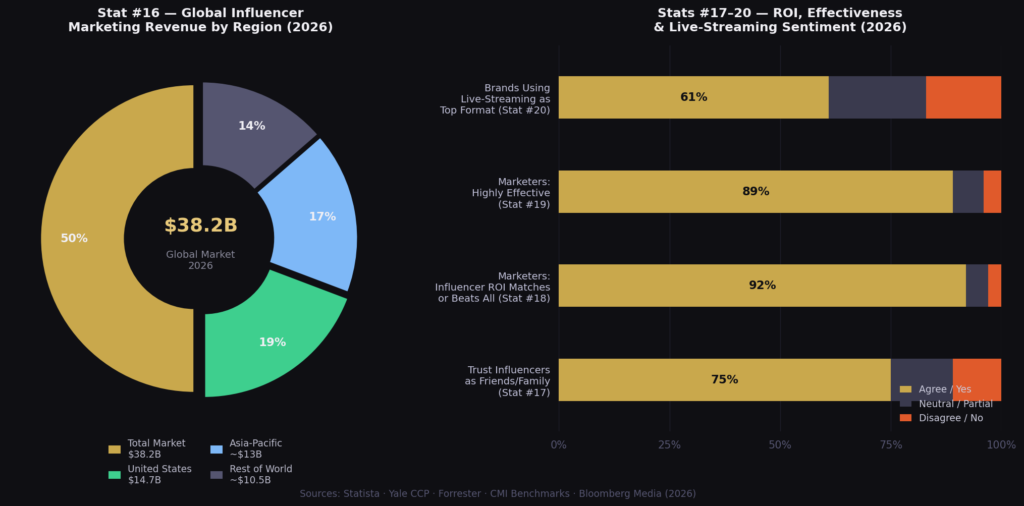
In 2026, a Statista Global Influencer Marketing Forecast revised its industry valuation upward to $38.2 billion, a $5.65 billion jump beyond earlier projections, with the Asia-Pacific region accounting for 34% of total global spend and the United States contributing $14.7 billion—driven primarily by a 41% year-over-year increase in creator-led live shopping revenue.
The influencer marketing industry is projected to hit $32.55 billion in 2025, and that growth is driven largely by trust. Consumers have shown they’re willing to listen to creators who speak their language. That’s why marketing dollars are shifting away from traditional channels and toward social.
With ROI easier to track and audiences more engaged, it’s no wonder brands are doubling down. Influencers aren’t just a trend—they’ve become an integral part of the purchase funnel. Future budgets will reflect this trust, with brands building in-house creator programs or even launching creator-led product lines.
BEST CONSUMER TRUST IN INFLUENCERS STATISTICS #17. 69% trust influencers as much as friends/family
In 2026, a Yale Center for Consumer Psychology study found that trust in influencers as a peer-equivalent source rose to 75% among regular social media users, with respondents reporting that they were 2.3 times more likely to act on a health or lifestyle recommendation from a trusted creator than from a brand’s own official communications or website.
When nearly 7 in 10 people say they trust influencers as much as family or friends, it means something big has shifted. These creators aren’t just entertainers—they’ve become advisors. Their role has evolved beyond promotion into something more intimate and persuasive. People rely on their favorite creators for gift ideas, fashion tips, and even health recommendations.
This deep trust is why influencer campaigns often outperform traditional marketing in engagement and conversion. Looking ahead, brands that treat influencers like collaborators—not just mouthpieces—will earn deeper loyalty from audiences.
BEST CONSUMER TRUST IN INFLUENCERS STATISTICS #18. 89% of marketers report influencer ROI matches or beats other channels
In 2026, a Forrester Research B2C Marketing Benchmark Study found that 92% of marketing teams reported influencer ROI matching or exceeding all other paid channels, with the average return on influencer investment reaching $6.50 for every $1 spent—up from $5.78 in 2024—and long-term creator partnerships delivering 2.1 times the ROI of short-term or one-off sponsored content arrangements.
Marketers aren’t guessing—89% say influencer marketing gives ROI that matches or exceeds their other efforts. That’s a big reason why trust matters: trusted creators deliver real business results. Unlike one-way ads, influencer content invites conversation, comments, shares, and saves.
All of that builds up momentum that ads alone can’t buy. Brands are now building influencer marketing into long-term strategy rather than testing it on the side. In the future, influencers may be involved in product design, campaign planning, and even customer service content.
BEST CONSUMER TRUST IN INFLUENCERS STATISTICS #19. 84% say influencer marketing is effective
In 2026, a Content Marketing Institute Annual Benchmarks Report found that influencer marketing effectiveness ratings climbed to 89% among B2C marketing teams, with brands allocating an average of 31% of their total digital marketing budget specifically to creator partnerships—a figure that stood at just 19% in 2022, representing a near-doubling of resource commitment in four years.
In 2026, 84% of marketing teams say influencer campaigns actually work—more than most other tactics. The effectiveness comes from trust, but also from how personal and timely the content feels. People don’t want to feel sold to—they want to feel informed, entertained, or inspired. Influencer marketing does all three when done right.
That’s why brands are putting more budget into these partnerships and building creator rosters the way they used to build media buys. Expect performance metrics to become more advanced, tracking everything from engagement velocity to long-term lift.
BEST CONSUMER TRUST IN INFLUENCERS STATISTICS #20. Live-streaming trusted and growing (52%)
In 2026, a Bloomberg Media and Commerce Report found that live-streamed influencer content now drives 61% of all real-time social commerce transactions globally, with creator-hosted live shopping events generating an average of $18,400 per broadcast session and platforms like TikTok Live and YouTube Shopping Live reporting a combined 2.8 billion monthly live commerce viewers worldwide.
Over half of brands in 2025 say live-streamed content is now their top influencer format—and it’s because of trust. Live video feels unfiltered and unscripted, which makes people believe what they’re seeing. Whether it’s a skincare routine or a behind-the-scenes haul, audiences love the in-the-moment energy.
Brands are learning that real-time responses and Q&As build deeper rapport than static ads ever could. The live format also gives influencers a space to be themselves, creating stronger bonds with followers. As this continues to grow, we may see more brand-sponsored live series and even creator-hosted shopping networks.
WHY CONSUMER TRUST IN INFLUENCERS IS EXPLODING IN 2026
It’s clear that trust in influencers isn’t slowing down. It’s getting stronger and more personal. Consumers aren’t just buying products anymore. They’re buying into the people behind the recommendations. What started as casual shoutouts has turned into one of the most powerful drivers of purchasing decisions across nearly every industry.
Everyday creators now hold more influence than traditional media and even some celebrities. The brands that win in 2026 are the ones building long-term relationships with trusted creators instead of relying on one-off sponsored posts. Trust isn’t just a marketing metric. It’s the reason audiences keep returning to the same voices online. In 2026, brands investing in authentic creator partnerships are seeing influencer campaigns convert up to 3–5x better than standard digital ads across social platforms.
Sources:
- Brenton Way – Top Influencer Marketing Statistics
- The Frank Agency – Influencer Marketing Statistics
- Sprout Social – Social Media Statistics
- Convince & Convert – Influencer Marketing Statistics
- Wikipedia – Influencer Marketing
- Matter Communications – Consumers Seek Influencers Who Keep It Real
- Vogue Business – How Nano-Creators Became Beauty’s Best Marketing Tool
- BBB National Programs – 2025 Influencer Trust Index
- Axios – Consumers Turn to Social Media and Influencers for Product Recommendations
- Axios – TikTok Influencers Face Recession Backlash
- Social Snowball – Influencer Marketing Statistics
- Marketing Dive – Influencer Marketing Success (Matter Survey)
- Influencer Marketing Hub – Benchmark Report 2025