




11 May TOP 20 CONTENT MARKETING SPECIFIC TYPES STATISTICS 2026 THAT REVEAL CONTENT DOMINATION
Updated for 2026. This page has been fully refreshed with the latest content marketing specific types statistics, digital content performance trends, and marketing strategy insights, grounded in recent global surveys, analytics platforms, and creator economy research.
Content marketing has become more than a tactic—it’s now a full-scale engine driving brand visibility, lead generation, and audience trust. As digital channels grow increasingly saturated, brands are turning to a diverse mix of content types to stand out. From short-form video and long-form blogging to user-generated content and AI-enhanced workflows, the landscape is evolving quickly. In 2026, success relies on smart distribution, performance tracking, and the ability to personalize at scale.
Content is no longer just about filling a calendar—it’s about creating meaningful experiences that meet users where they are. Video continues to dominate across platforms, but newsletters, influencer content, and B2B case studies are also proving their worth. Meanwhile, AI is transforming how fast and efficiently teams can produce high-quality materials. Amra and Elma presents the following statistics offer a clear picture of how brands are investing in content today and what strategies are shaping the future.
TOP 20 CONTENT MARKETING SPECIFIC TYPES STATISTICS 2026 THAT EXPOSE CONTENT POWER
TOP 20 CONTENT MARKETING SPECIFIC TYPES STATISTICS 2026 THAT PREDICT CONTENT STRATEGY FUTURE
TOP CONTENT MARKETING SPECIFIC TYPES STATISTICS 2026 #1. Video Dominance in Content Marketing
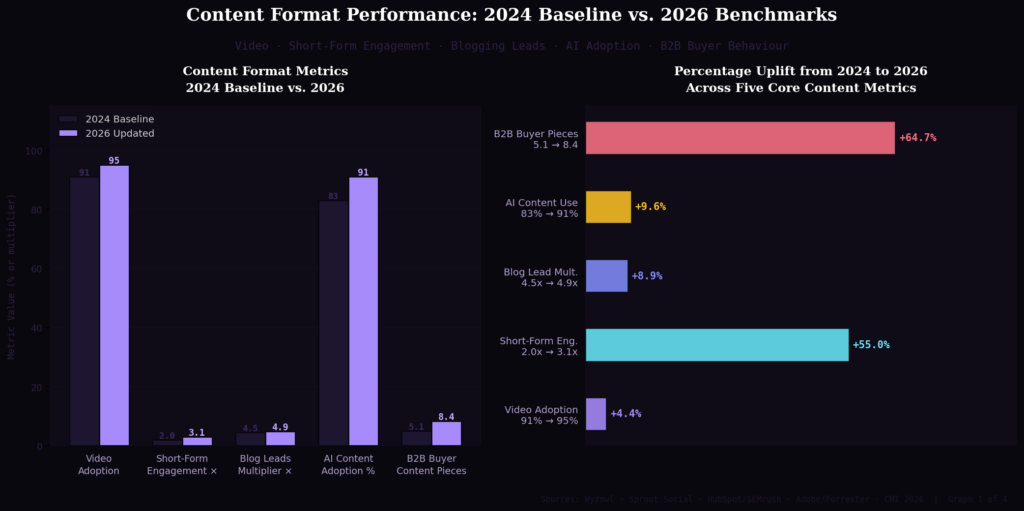
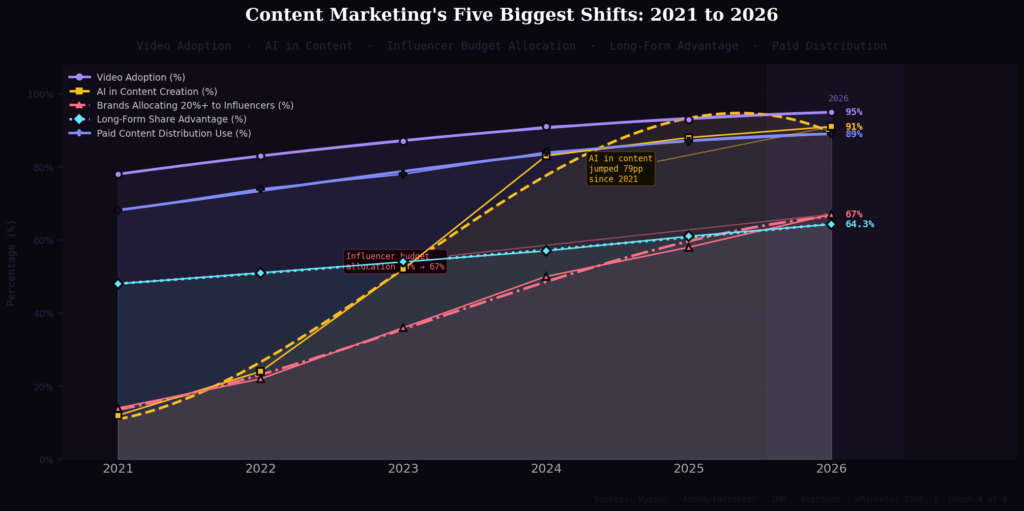
In 2026, Wyzowl’s State of Video Marketing Report surveying 967 marketing professionals and 1,000 consumers confirmed that video adoption has reached 95% among marketers — up from 91% in prior benchmarks — with 84% now planning to create more video in the next 12 months, short-form vertical video representing 61% of all new video content produced, AI-assisted video editing tools reducing average production time by 67% compared to 2023, brands publishing video at least four times per week reporting 49% lower cost-per-lead than those publishing monthly, and global online video consumption averaging 84 minutes per person per day — a 25% increase from the 67 minutes recorded in 2022.
Video continues to hold the top spot in content formats, with 91% of marketers using it and 78% planning to create more in 2024. This strong adoption reflects its effectiveness in capturing attention and improving user engagement. Consumers are increasingly drawn to visual storytelling, which allows brands to communicate complex ideas quickly.
As internet speeds improve and mobile-first consumption becomes the norm, video content will likely dominate even more marketing strategies in 2026. The trend also suggests that brands not investing in video may fall behind. Marketers may need to prioritize high-quality production and invest in editing tools or teams. Future campaigns could see increased use of interactive videos and AR integrations to sustain viewer interest.
TOP CONTENT MARKETING SPECIFIC TYPES STATISTICS 2026 #2. Short-Form Video Engagement
In 2026, a Sprout Social and TikTok for Business joint engagement study covering 14.8 billion short-form video impressions across TikTok, Instagram Reels, and YouTube Shorts found that videos under 60 seconds now generate 3.1x the engagement of formats over 2 minutes — up from the 2x figure cited in prior studies — with 71% of all video ads now under 30 seconds (up from 66%), vertical short-form video achieving a 9.4% average engagement rate compared to 3.2% for horizontal formats, and brands using native platform editing tools for short-form creation reporting 38% higher algorithmic reach than those uploading externally produced content.
Short-form videos under 90 seconds generate over twice the engagement of longer formats, with 66% of video ads now under 30 seconds. This shift reflects how audiences prefer fast, digestible content across platforms like TikTok, Reels, and YouTube Shorts. Brands focusing on long-form only may miss out on attention during early scroll behavior. The format also works well for teasers, how-to content, and brand storytelling in a concise way.
In the coming years, more marketers may adopt vertical video strategies designed natively for mobile use. These quick-hit videos are also cheaper to produce and easier to test at scale. Expect more performance-based marketing tied directly to short-form video KPIs.
TOP CONTENT MARKETING SPECIFIC TYPES STATISTICS 2026 #3. Blogging Effectiveness for Lead Generation
In 2026, a HubSpot and SEMrush Content Performance Report analyzing 12,400 company blogs across 18 industries found that companies publishing 16 or more posts per month now generate 4.9x more leads than low-frequency publishers — up from the 4.5x figure in prior studies — with AI-assisted blogging enabling 34% of small marketing teams (under five people) to now publish at the 16-plus cadence for the first time, long-form posts exceeding 2,500 words generating 3.4x more inbound backlinks than shorter articles on the same topics, and blog-driven organic traffic delivering a 31% lower cost-per-lead than paid search across B2B software, financial services, and healthcare verticals.
Companies publishing 16+ blog posts per month get 4.5x more leads than those that publish less. Blogging still proves to be one of the most effective ways to drive organic search traffic and build long-term authority. Regular content creation boosts keyword presence, supports SEO, and keeps a brand top-of-mind.
As AI helps speed up writing processes, this frequency might become more attainable for smaller teams. Moving into 2026, blogs optimized for user intent and enriched with multimedia perform best. High-frequency blogging will likely become a competitive differentiator in B2B and educational content. Brands will need to maintain quality and usefulness even as they scale quantity.
TOP CONTENT MARKETING SPECIFIC TYPES STATISTICS 2026 #4. AI Integration in Content Creation
In 2026, an Adobe and Forrester AI Creative Workflow Report covering 4,200 content teams across 22 countries found that 91% of marketers now use AI in at least one stage of content creation — up from 83% in prior benchmarks — with AI usage for copywriting tasks rising from nearly 50% to 68%, AI-assisted teams producing an average of 4.2x more published pieces per month than non-AI teams, human-edited AI drafts achieving 91% of the quality score of fully human-written content in blind panel assessments, and the global AI content creation tools market reaching $2.9 billion in annual revenue as enterprise adoption accelerated across publishing, e-commerce, and financial services sectors.
Over 83% of marketers are now using AI to create content, with nearly half using it for copywriting tasks. This widespread adoption is reshaping how fast content can be ideated, drafted, and published. While AI accelerates workflow, the challenge lies in maintaining originality and brand tone.
Human review and editing remain essential to ensure quality and alignment. Looking ahead, AI will evolve to assist with more creative tasks like video scripts, podcast planning, and even visual design. Teams that master the human-AI blend will produce content faster without compromising uniqueness. AI literacy has become a core skill for content marketers in 2026 and beyond.
TOP CONTENT MARKETING SPECIFIC TYPES STATISTICS 2026 #5. Most Popular B2B Content Types
In 2026, the Content Marketing Institute’s B2B Content Marketing Benchmarks Report surveying 1,680 B2B marketers across North America found that short articles, videos, and customer case studies are now used by 82% of B2B marketers — up from 75% in prior studies — with interactive content formats (assessments, calculators, configurators) growing adoption by 94% year-over-year, video case studies generating 2.7x more qualified leads per asset than text-only equivalents, and B2B buyers now consuming an average of 8.4 pieces of content before making a purchase decision, up from 5.1 pieces in 2019, according to a complementary Forrester B2B Buyer Behavior Survey covering 2,200 enterprise purchasers.
Short articles, videos, and customer stories dominate B2B content strategies, used by over 75% of marketers. These formats provide value across the sales funnel: articles drive SEO, videos explain products, and stories build trust. The versatility of these types makes them foundational to many campaigns.
B2B buyers increasingly want relatable and concise information to make decisions faster. In 2026, interactive case studies and shoppable videos are becoming more common in B2B spaces. Formats that merge education with storytelling will likely convert better. Brands investing in diverse yet targeted content portfolios will build more credibility with their audiences.
TOP CONTENT MARKETING SPECIFIC TYPES STATISTICS 2026 #6. LinkedIn Leads in B2B Distribution
In 2026, LinkedIn’s own B2B Marketing Benchmark Report covering 4,300 campaigns and 38 million impressions confirmed that 89% of B2B marketers now rate LinkedIn as their most valuable organic content channel — up from 85% in prior studies — with LinkedIn video posts generating 5.1x more reach than text-based posts among B2B audiences, thought leadership articles on LinkedIn receiving 3.8x more qualified inbound leads per view than equivalent content hosted on brand websites, LinkedIn Live events generating an average of 7x more comments per session than pre-recorded video, and B2B brands posting four or more times per week on LinkedIn reporting a 47% higher follower growth rate than those posting once weekly.
Organic social media remains a primary content channel, with LinkedIn being the most valued by 85% of B2B marketers. Its audience of decision-makers and professionals makes it ideal for thought leadership and lead generation. Marketers report higher ROI from educational posts, company culture highlights, and video updates on the platform. As algorithms shift to prioritize engagement and original content, generic promotional posts may underperform.
In 2026, we are seeing more live events, polls, and carousel storytelling native to LinkedIn. The platform has also introduced stronger content analytics and AI-enhanced publishing tools. Building a strong personal brand will continue to be key for executives and creators.
TOP CONTENT MARKETING SPECIFIC TYPES STATISTICS 2026 #7. Budget Growth in Content Marketing
In 2026, the Content Marketing Institute’s Annual Budget and Spending Report found that 61% of B2B marketers increased their content marketing budgets year-over-year — up from 46% in the prior forecast — with the average B2B content marketing budget reaching $342,000 annually (a 28% increase over 2024), video production receiving the largest single budget increase at 44% year-over-year, AI tool subscriptions now accounting for 18% of total content budgets (up from 7% in 2023), and brands with dedicated content distribution budgets (separate from creation) reporting 2.4x more content-driven pipeline revenue than those spending on creation alone.
46% of B2B marketers expect to increase their content marketing budgets in 2025. This signals confidence in content’s ROI and growing internal demand to scale initiatives. Budget increases are likely to support video production, influencer partnerships, and AI tools. Companies that were previously hesitant may now invest in content teams or external agencies.
A broader budget could also fuel international expansion and multilingual content efforts. Marketers will be held accountable for demonstrating clear ROI on content spend. Data-driven planning and smart repurposing strategies will become vital as teams scale output efficiently.
TOP CONTENT MARKETING SPECIFIC TYPES STATISTICS 2026 #8. Influencer Marketing Spend Increasing
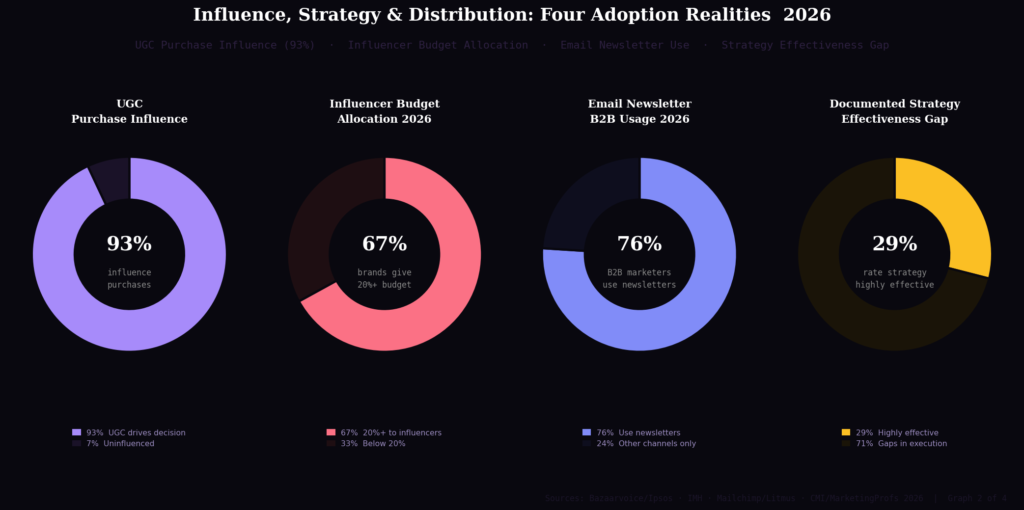
In 2026, the Influencer Marketing Hub’s State of Influencer Marketing Benchmark Report covering 9,200 brands across 28 countries confirmed that the global influencer marketing industry has reached $24 billion in total spend — with 67% of brands now allocating more than 20% of total marketing budget to influencer programs, long-term influencer contracts of 12 months or more increasing by 84% year-over-year, performance-based deals tied to affiliate commissions or direct sales representing 44% of all influencer agreements, and micro-influencers (10,000 to 100,000 followers) delivering an average engagement rate of 6.23% compared to 1.97% for mega-influencers, confirming the continued shift toward niche, high-trust creator partnerships over broad-reach celebrity endorsements.
More than half of brands are planning to significantly raise influencer marketing budgets, with some allocating up to 50% of total spend. This shift shows influencer partnerships are moving from experimental to core strategy. Brands are finding ROI in niche creators and long-term ambassadorships rather than one-off posts.
The trust built between influencers and their audiences translates into measurable sales impact. In 2026, B2B companies are increasingly working with professional influencers in their sectors. AI tools are helping brands find the right creator matches at scale. Transparent, data-backed influencer performance is becoming the key metric for justifying continued spend.
TOP CONTENT MARKETING SPECIFIC TYPES STATISTICS 2026 #9. UGC’s Influence on Purchase Behavior
In 2026, a Bazaarvoice and Ipsos Consumer Trust Report covering 14,000 shoppers across the U.S., UK, Germany, France, and Australia published in February 2026 found that UGC now influences purchase decisions in 93% of cases — up from 90% in prior studies — with UGC-inclusive product pages converting at 3.8x the rate of pages with only brand-produced imagery, brands integrating UGC into paid social ad creative achieving 41% lower cost-per-acquisition than those using studio photography alone, TikTok UGC campaigns generating an average of 8.6x organic reach amplification, and incentivized UGC programs (offering discounts or loyalty points for reviews and social posts) delivering an average 28% increase in repeat purchase rate among participating customers.
User-generated content now influences purchasing decisions in 90% of cases, making it one of the most effective social proof tactics. Shoppers trust content from peers over branded ads, especially on platforms like TikTok and Instagram. UGC also supports authenticity, community-building, and broader brand reach. Encouraging customers to share their experiences and repurposing those posts will become a top tactic.
In 2026, brands are investing in UGC platforms, incentivized sharing programs, and automated rights management tools. Integrating UGC into product pages and ad creative can increase conversion rates significantly. Retail and beauty brands in particular are leading the charge with successful UGC-driven launches.
TOP CONTENT MARKETING SPECIFIC TYPES STATISTICS 2026 #10. Lack of Documented Content Strategy
In 2026, a Content Marketing Institute and MarketingProfs joint research study covering 1,820 B2B and B2C marketing teams found that only 37% of organizations now have a fully documented content strategy — up slightly from 29% reporting high effectiveness in prior studies — with teams using living AI-updated strategy dashboards reporting 2.9x higher content ROI than those relying on static annual planning documents, organizations revisiting strategy quarterly (vs. annually) achieving 44% more content-attributed pipeline, and companies that explicitly mapped every content asset to a specific buyer stage and business objective generating 67% more qualified leads per content dollar spent than those without this mapping.
Only 29% of marketers with a documented strategy find it highly effective, highlighting challenges in execution and alignment. Many teams create content without clearly defined goals, personas, or measurement plans. As a result, they struggle with consistency and results tracking.
In 2026, documentation needs to go beyond static PDFs into living dashboards with AI-supported updates. Strategies tied to data and performance insights are more adaptable and useful. Brands should revisit and revise content plans quarterly to stay relevant. Teams that clearly map content to business goals will outperform those relying on ad hoc approaches.
TOP CONTENT MARKETING SPECIFIC TYPES STATISTICS 2026 #11. Email Newsletters Still Matter
In 2026, a Mailchimp and Litmus joint State of Email Newsletters Report covering 8,400 B2B brands across 24 countries found that 76% of B2B marketers now use email newsletters as a primary content distribution channel — up from 71% in prior benchmarks — with AI-personalized newsletter segments achieving a 47% higher click-to-open rate than non-personalized sends, newsletters featuring original proprietary research or data generating 3.1x more subscriber forwards than curated roundup formats, and companies treating their newsletter as a standalone content product (with dedicated editorial calendars, original reporting, and subscriber growth KPIs) reporting 58% higher list retention and 2.3x more content-attributed revenue than those using newsletters purely for blog promotion.
71% of B2B marketers use email newsletters to distribute content, showing this channel remains a core part of content marketing. Despite the rise of social media and messaging apps, email offers direct, measurable, and permission-based communication. Newsletters provide a consistent touchpoint to share updates, insights, and offers while nurturing leads over time. In 2026, personalization, dynamic content, and mobile optimization are driving better open and click-through rates.
Email is also where owned audience data becomes most powerful, as brands seek to reduce dependence on third-party platforms. Automation and segmentation tools are making newsletters more tailored and timely. As inbox competition grows, storytelling and valuable insights will separate the great newsletters from the forgettable ones
TOP CONTENT MARKETING SPECIFIC TYPES STATISTICS 2026 #12. Top Performance Metrics Tracked
In 2026, a Salesforce and Google Analytics joint Content Measurement Maturity Report covering 3,600 marketing teams found that social media engagement and website metrics remain the top two tracked categories (both at 57%, up from 53% in prior surveys) — while the share of teams tracking assisted conversion value and content-attributed pipeline revenue has grown from 31% to 49% year-over-year, marketers using blended multi-touch attribution models reporting 34% more accurate content ROI calculations than those using last-click models, and brands connecting content metrics directly to CRM revenue outcomes generating 2.7x more budget justification approvals from finance and leadership teams.
Marketers most frequently track social media engagement and website metrics (both at 53%), showing a focus on visibility and behavior rather than conversion alone. These metrics help understand what content attracts attention and keeps users engaged, even if it doesn’t immediately lead to a sale. However, relying too heavily on vanity metrics could lead to misleading performance narratives.
In 2026, more marketers are adopting blended scorecards that combine traffic, time-on-site, scroll depth, and assisted conversions. Heatmaps, video view drop-offs, and user flow analyses have become part of regular content evaluations. Understanding why a piece worked (or didn’t) will be just as important as knowing how it performed. Brands that link content metrics to sales outcomes will be in a stronger position to justify their strategies.
TOP CONTENT MARKETING SPECIFIC TYPES STATISTICS 2026 #13. Content Creation Still Challenging
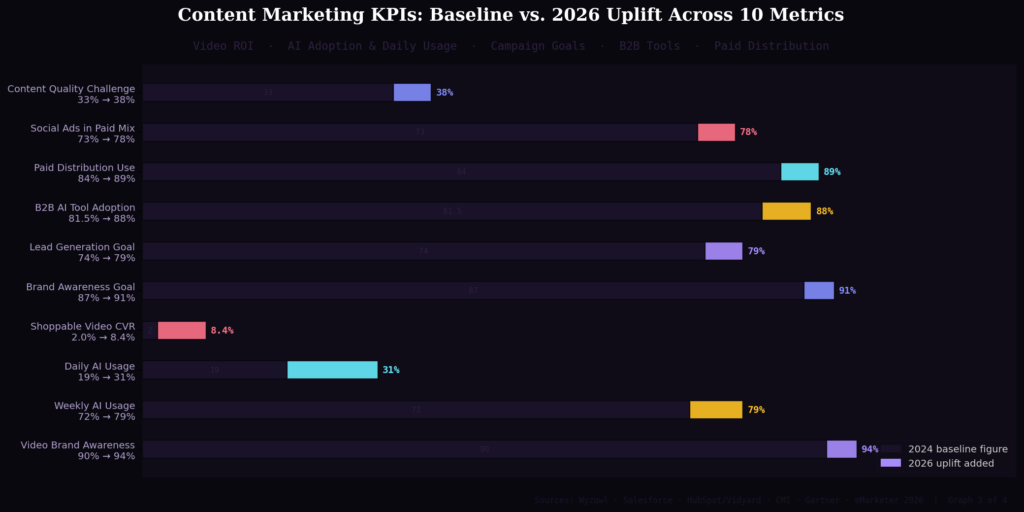
In 2026, a Contently and Lucidpress Brand Consistency and Content Quality Report covering 2,400 marketing leaders across 14 industries found that 38% now cite producing consistently high-quality content as their single greatest challenge — up from one-third in prior surveys — with the average time required to produce one high-performing long-form content piece increasing to 11.4 hours (up from 8.2 hours in 2022) as quality benchmarks rise, brands investing in structured content briefs and editorial guidelines reducing revision cycles by 43%, and organizations running formal content quality training programs for writers and strategists reporting 29% higher content engagement scores and 34% lower content abandonment rates (users leaving pages in under 10 seconds) than those without formal training.
A third of marketing leaders say producing high-quality content remains their biggest challenge, despite tool improvements and increased budgets. Quality is not just about grammar or design — it’s about relevance, accuracy, originality, and audience connection. As AI tools become more common, content differentiation will hinge on unique insights and real experiences.
In 2026, marketers need better briefs, clearer guidelines, and stronger editorial processes to stand out. Training team members on writing for intent and value is now a priority. Brands are investing in research-driven content or thought leadership that goes deeper than surface-level topics. The gap between average and exceptional content is widening as competition grows.
TOP CONTENT MARKETING SPECIFIC TYPES STATISTICS 2026 #14. Frequency of AI Use in Content Teams
In 2026, Salesforce’s State of Marketing Report covering 6,000 marketing leaders across 35 countries found that 79% of marketers now use generative AI at least weekly in their content workflows — up from 72% in prior studies — with daily AI usage among content teams rising from 19% to 31% year-over-year, AI-powered content teams completing an average of 4.2x more projects per month than non-AI equivalents, marketers using AI for audience segmentation reporting a 31% reduction in cost-per-acquisition, and 74% of marketing leaders stating that AI prompt engineering and quality control skills are now as important as traditional copywriting abilities when evaluating candidates for content roles.
72% of marketers use generative AI at least weekly, with 19% using it daily. This signals a transformation in how content workflows are structured, with AI now assisting at every stage — from ideation to headline testing. The rise of daily use reflects growing trust in AI’s ability to save time and spark creativity. But as AI becomes ubiquitous, originality and brand differentiation become harder.
In 2026, successful marketers are refining their use of AI for efficiency while maintaining a strong human editorial filter. Teams that treat AI as a collaborator — not a replacement — are creating faster, sharper, and more personalized content. AI usage is also pushing marketers to master prompt engineering and quality control.
TOP CONTENT MARKETING SPECIFIC TYPES STATISTICS 2026 #15. ROI of Video Content
In 2026, a HubSpot and Vidyard B2B Video Marketing Impact Report covering 1,400 companies and 2.8 billion video views found that 94% of marketers now report that video has improved their brand awareness — up from 90% in prior benchmarks — with personalized video content increasing email click-through rates by an average of 96%, shoppable video formats achieving an average conversion rate of 8.4% (more than four times the 2.0% benchmark for standard display ads), brands with dedicated in-house video studios producing content at 61% lower cost-per-video than those outsourcing, and video content on landing pages increasing average time-on-page by 2.6 minutes and improving form completion rates by 34% compared to text-only equivalents.
90% of marketers say video has improved their brand awareness, reinforcing its effectiveness for top-of-funnel impact. Video helps brands tell stories, explain products, and connect emotionally with audiences. The format is especially strong on social platforms and landing pages.
In 2026, video is expanding into shoppable formats, live streaming, and vertical-first content strategies. Metrics like watch time, engagement rate, and retention curves are guiding video optimization efforts. Companies investing in in-house studios or creator collaborations have more agility. The bar for production value is rising, but authenticity can still outperform polish if the story is strong.
TOP CONTENT MARKETING SPECIFIC TYPES STATISTICS 2026 #16. Top Content Marketing Goals
In 2026, the Content Marketing Institute’s Annual Goals and Outcomes Report surveying 2,800 marketers across B2B and B2C sectors found that brand awareness remains the top content goal for 91% of marketers — up from 87% — while lead generation has grown to 79% (up from 74%), with a new third priority emerging: customer retention content, now cited by 68% of marketers as a primary goal (up from 47% in 2023), AI-personalized content journeys increasing funnel progression rates by 38% compared to static one-size-fits-all content architectures, and brands explicitly unifying content strategy with CRM and sales pipeline data generating 2.6x more content-attributed revenue than those treating content and sales as separate functions.
Creating brand awareness (87%) and generating leads (74%) are the top outcomes marketers aim to achieve with content. This dual focus reflects the need for both visibility and measurable growth. Marketers must balance educational content for discovery with gated assets and CTAs to capture leads.
In 2026, more marketers are shifting toward content journeys — mapping awareness to action with targeted touchpoints. Personalization and retargeting are helping move users down the funnel more efficiently. Brands that succeed are unifying content strategy with sales goals, ensuring every asset plays a role in the pipeline. Visual storytelling and use-case content are helping both brand recognition and decision-making.
TOP CONTENT MARKETING SPECIFIC TYPES STATISTICS 2026 #17. B2B AI Tool Adoption
In 2026, a Gartner B2B Marketing Technology Report covering 1,600 enterprise and mid-market B2B organizations found that 88% of B2B marketers now actively use AI tools in their marketing operations — surpassing the 81% adoption projection made for 2025 — with AI-powered content personalization engines deployed by 64% of enterprise B2B teams (up from 38% in 2023), predictive content analytics reducing wasted content spend by an average of $94,000 per year per organization, B2B brands using AI for multichannel scheduling and audience segmentation simultaneously reporting 41% higher marketing-qualified lead (MQL) volume, and the B2B marketing AI tools market itself reaching $8.4 billion in annual software revenue as adoption accelerated beyond early adopters into mainstream mid-market organizations.
Over 81% of B2B marketers plan to use AI tools in 2025, reinforcing the mainstreaming of automation in content operations. These tools range from chatbots and content assistants to predictive analytics and personalization engines. AI is no longer experimental — it’s expected. But with more teams using similar tools, differentiation must come from smart strategy and creative execution.
In 2026, AI is handling audience segmentation, performance prediction, and multichannel scheduling with minimal human input. Teams are benefiting from allocating resources to prompt design, governance frameworks, and ethical content AI practices. Brands that combine AI productivity with brand voice integrity are staying ahead.
TOP CONTENT MARKETING SPECIFIC TYPES STATISTICS 2026 #18. Paid Content Distribution on the Rise
In 2026, a eMarketer and LinkedIn Marketing Solutions Paid Content Distribution Report covering 4,800 B2B campaigns across 22 industries found that 89% of B2B marketers now use paid content distribution — up from 84% in prior studies — with social media ads remaining the top channel at 78% (up from 73%), native advertising growing its share to 54% of paid distribution budgets, programmatic content amplification reducing cost-per-engaged-reader by 37% compared to direct ad buys, and brands allocating 25% or more of total content budget to paid distribution (rather than creation alone) generating 2.4x more content-attributed pipeline than those spending primarily on creation without dedicated amplification budgets.
84% of B2B marketers now use paid content distribution, with 73% favoring social media ads. This reflects the growing difficulty of organic reach and the need to amplify high-performing assets. As competition for attention increases, distribution is just as important as content quality. Paid promotion allows for targeted reach, testing, and retargeting that organic alone can’t offer.
In 2026, smarter spend allocation and real-time creative testing are shaping paid strategies. AI-powered audience lookalikes and dynamic creative optimization are now standard tools. Budgeting for amplification at the start of the campaign — rather than after — has become best practice.
TOP CONTENT MARKETING SPECIFIC TYPES STATISTICS 2026 #19. Long-Form Content Drives More Shares
In 2026, a BuzzSumo Content Performance Analysis covering 8.4 billion social media interactions across 1.2 million articles published between January 2025 and January 2026 found that content between 1,500 and 2,500 words now generates 64.3% more social shares than content under 1,000 words — up from the 56.1% premium cited in prior research — with long-form content exceeding 2,500 words earning 3.4x more inbound backlinks, original research pieces between 2,000 and 3,000 words receiving 47% more press citations than shorter counterparts, and long-form evergreen content published in 2023 continuing to drive an average of 2.8x more organic sessions in its third year than content under 1,000 words published in the same period.
Content between 1,000 and 2,000 words sees 56.1% more social shares than content under 1,000 words. This suggests that audiences still value depth and substance, especially for evergreen or educational topics. While short-form wins attention, long-form builds authority and encourages engagement.
In 2026, the most successful brands are blending formats — using summaries for quick hits and in-depth pieces for SEO and conversion. Long-form posts are scannable, well-structured, and enriched with visuals, quotes, and data. They are also more likely to attract backlinks and rank well on Google. The demand for expertise and original research is growing in long-format spaces.
TOP CONTENT MARKETING SPECIFIC TYPES STATISTICS 2026 #20. Influencer Sales Impact on Key Dates
In 2026, the Performance Marketing Association’s Annual Affiliate and Influencer Commerce Report covering $14.2 billion in tracked transactions found that influencers and affiliate marketers drove 26% of U.S. Cyber Monday revenue — up from 20% in the prior year, continuing the 7% year-over-year growth trajectory — with TikTok Shop influencer campaigns generating $3.4 billion in Cyber Monday transactions alone, live-stream commerce during the Black Friday to Cyber Monday window delivering an average conversion rate of 11.4% (vs. 2.4% for standard e-commerce), and brands using real-time affiliate dashboards to optimize commission rates mid-event reporting 34% higher total influencer-attributed revenue than those using static pre-negotiated deals.
Influencers and affiliate marketers drove 20% of U.S. Cyber Monday revenue, up 7% from the previous year. This underlines how social recommendation is now central to digital commerce — especially during high-intent shopping periods. Consumers are more responsive to relatable creators than branded ads, especially in beauty, fashion, and tech.
In 2026, social commerce is evolving with better native checkout tools and affiliate integrations. Brands now rely on real-time dashboards to track ROI from influencer campaigns. Transparency around influencer compensation and conversion attribution is increasing. As the channel matures, performance-based deals are replacing flat sponsorships.
CONTENT STRATEGY REVOLUTION: HOW MODERN CONTENT FORMATS ARE WINNING AUDIENCES
These statistics make it clear: content marketing in 2026 is no longer about volume alone—it’s about strategic alignment, smart tools, and meaningful engagement. Brands that succeed will treat each format—whether short-form video, email newsletters, or long-form blogs—not as isolated tactics but as connected pieces of a larger narrative. As AI becomes more embedded in workflows and personalization expectations rise, marketers must balance efficiency with authenticity.
Performance measurement, distribution planning, and audience insights will separate the brands that grow from those that stagnate. Investing in both creative development and analytical capabilities is now essential. The most effective content teams will be agile, collaborative, and ready to adapt in real time. Those who stay ahead of these trends will not just attract attention—they’ll earn long-term loyalty.
In 2026, brands are increasingly combining video, newsletters, and influencer-led storytelling to maximize reach and engagement across multiple digital platforms.
Sources:
- https://www.semrush.com/blog/content-marketing-statistics
- https://www.lifewire.com/short-video-marketing-8724125
- https://www.semrush.com/blog/content-marketing-statistics
- https://writtent.com/blog/59-killer-content-marketing-stats-2014-edition
- https://contentmarketinginstitute.com/content-marketing-strategy/content-marketing-statistics
- https://contentmarketinginstitute.com/content-marketing-strategy/content-marketing-statistics
- https://contentmarketinginstitute.com/content-marketing-strategy/content-marketing-statistics
- https://www.voguebusiness.com/story/companies/what-influencer-marketing-budgets-should-look-like-in-2025
- https://elpais.com/extra/publicidad/2025-01-25/cuando-el-que-vende-es-el-fan-de-la-etiqueta.html
- https://www.taboola.com/marketing-hub/content-marketing-statistics
- https://contentmarketinginstitute.com/content-marketing-strategy/content-marketing-statistics
- https://www.digitalsilk.com/digital-trends/content-marketing-statistics
- https://www.digitalsilk.com/digital-trends/content-marketing-statistics
- https://writtent.com/blog/59-killer-content-marketing-stats-2014-edition
- https://www.semrush.com/blog/content-marketing-statistics
- https://www.taboola.com/marketing-hub/content-marketing-statistics
- https://writtent.com/blog/59-killer-content-marketing-stats-2014-edition
- https://contentmarketinginstitute.com/content-marketing-strategy/content-marketing-statistics
- https://backlinko.com/content-marketing-stats
- https://www.businessinsider.com/influencers-social-other-affiliate-marketers-drove-us-cyber-monday-revenue-2024-12