



19 Sep TOP 20 COTTON MARKETING STATISTICS 2025
Whenever I dive into industry reports, I’m reminded of how deeply interconnected the global economy really is. This became especially clear while I was reviewing cotton marketing statistics for 2025, which reveal not only production and consumption trends but also how shifts in trade and demand affect businesses on every level. As someone working closely with a leading marketing agency in New York, I’ve seen firsthand how valuable this kind of data can be—not just for growers and traders, but also for brands trying to position themselves in competitive markets. Cotton isn’t just a raw material; it’s the backbone of countless industries, from fashion to home goods, and understanding its numbers gives us a lens into broader consumer and business behavior. That’s exactly why I wanted to put together this roundup of the most important stats to keep an eye on.
Top 20 Cotton Marketing Statistics 2025 (Editor’s Choice)
🌾 Cotton Marketing Statistics
Top 20 Key Market Insights for 2024-2025
| Rank | Category | Key Statistic | Value/Impact |
|---|---|---|---|
1 |
Market Value | Global Cotton Market Size | $43.93B → $55.57B by 2033 |
2 |
Growth Rate | Market Growth CAGR (2024-2029) | 3.2% annually |
3 |
Global Production | World Cotton Production 2025/26 | 117.7 million bales |
4 |
Total Volume | Global Production Volume | 25 million tons (115-120M bales) |
5 |
Market Leader | China's Cotton Production | 27.5 million bales |
6 |
Consumption | Global Mill Consumption 2025/26 | 118.8 million bales |
7 |
China Dominance | China's Share of Global Consumption | 32% (38.5M bales) |
8 |
Trade Value | International Trade Revenue 2024 | $52.6 billion |
9 |
Export Leaders | Brazil & USA Continue as Primary Exporters | Leading global trade |
10 |
Top 5 Exporters | China, India, USA, Brazil, Vietnam Combined Share | 60.3% of global exports |
11 |
Asian Dominance | Asia's Share of Global Cotton Trade | 58.1% |
12 |
North America | North American Trade Share | 12.3% |
13 |
US Production | U.S. Cotton Planted Acreage & Production 2024 | 11M acres → 13.7M bales |
14 |
US Pricing | U.S. Season Average Farm Price 2025/26 | 64 cents/pound |
15 |
Current Pricing | U.S. Spot Price (Sept 2025) | 62.02 cents/pound |
16 |
Global Inventory | World Ending Stocks 2025/26 (4-Year Low) | 73.1 million bales |
17 |
US Inventory | U.S. Ending Stocks Growth | 3.2M → 4.4M bales |
18 |
Fiber Usage | Cotton Fiber Application Distribution | 64% Clothing, 28% Home, 8% Industrial |
19 |
Market Shift | Brazil's Rise to 3rd Largest Producer | Surpassed USA in 2023 |
20 |
Economic Impact | Global Economic Growth Impact on Demand | 3.2% GDP growth → Lower textile demand |
Top 20 Cotton Marketing Statistics 2025
Cotton Marketing Statistics #1 – World Cotton Production At 117.7 Million Bales
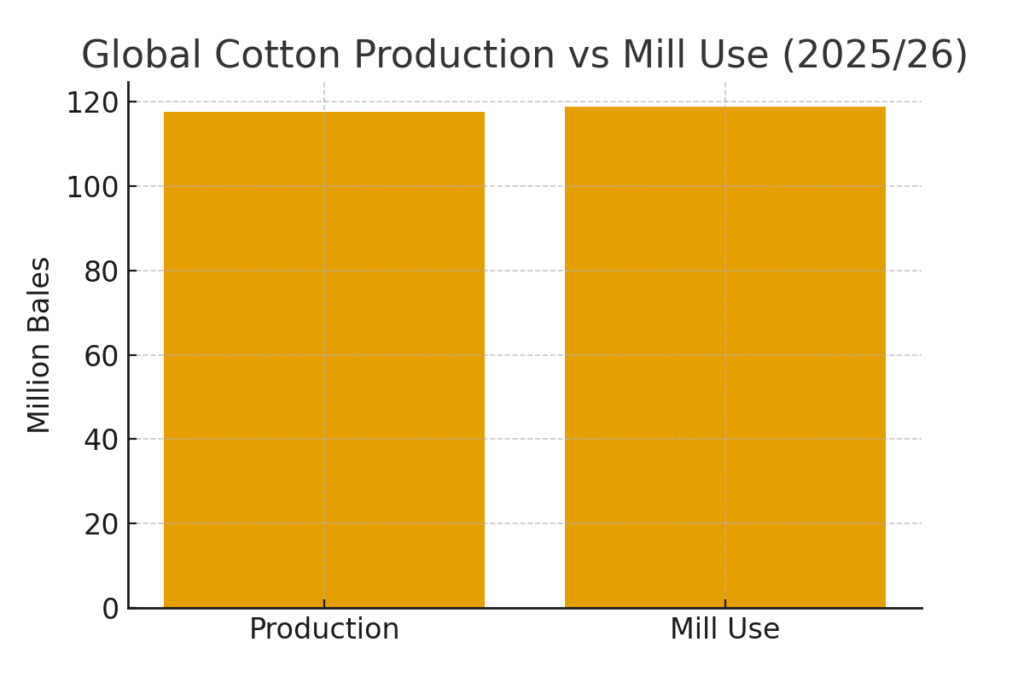
The 2025/26 global cotton production is forecast at 117.7 million bales, showing a relatively stable output. This number reflects steady planting decisions by major producing countries despite fluctuating weather patterns. Farmers are adjusting to both market signals and sustainability requirements while maintaining yields. Production stability is vital for keeping the textile industry supplied and avoiding sharp price spikes. For marketers, this signals consistent availability of cotton for campaigns centered on natural fibers.
Cotton Marketing Statistics #2 – Global Mill Use Reaches 118.8 Million Bales
Global mill use is projected at 118.8 million bales, slightly exceeding production. This indicates a strong demand from textile industries, especially in Asia. The imbalance suggests pressure on inventories and a tighter market outlook. Brands relying on cotton fabrics may face mild cost increases as demand outpaces supply. Marketing teams should highlight quality and sustainability when promoting cotton-based products to justify potential price adjustments.
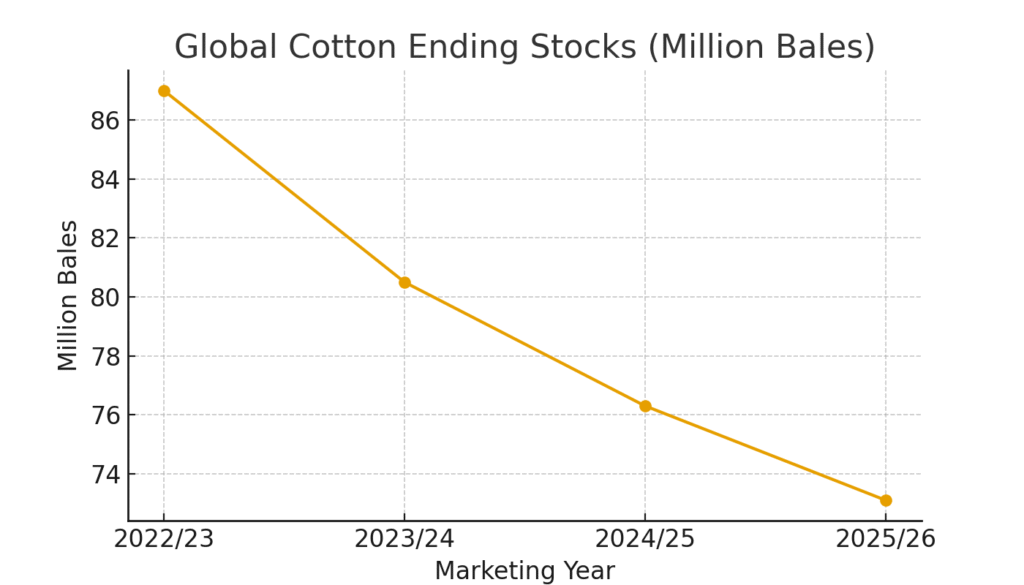
Cotton Marketing Statistics #3 – Global Ending Stocks At 73.1 Million Bales
Ending stocks are expected to decline to 73.1 million bales in 2025/26. This is the lowest stock level in four years, signaling a tightening market. Lower reserves often create more price volatility for buyers. Companies dependent on cotton must plan for supply chain risks. Marketers can use scarcity narratives to emphasize authenticity and natural value in cotton products.
Cotton Marketing Statistics #4 – Global Cotton Trade At 43.7 Million Bales
Cotton trade is projected to reach 43.7 million bales worldwide. This strong figure reflects the importance of international flows between producers and textile hubs. Major exporters like the U.S. and Brazil continue to dominate, while import demand rises in South Asia. Trade growth indicates healthy global textile demand. Marketing strategies can benefit by focusing on cross-border supply stability and reliability.
Cotton Marketing Statistics #5 – Cotton Prices At $64.93 Per Pound
As of September 2025, cotton prices hover around $64.93 per pound. This price reflects recent dips of about 1–2% from earlier levels. Price volatility is often driven by weather conditions, production changes, and global demand. For buyers, this means costs may shift quickly, influencing margins. Marketing teams can position cotton as both a premium natural product and a value-driven choice compared to synthetics.
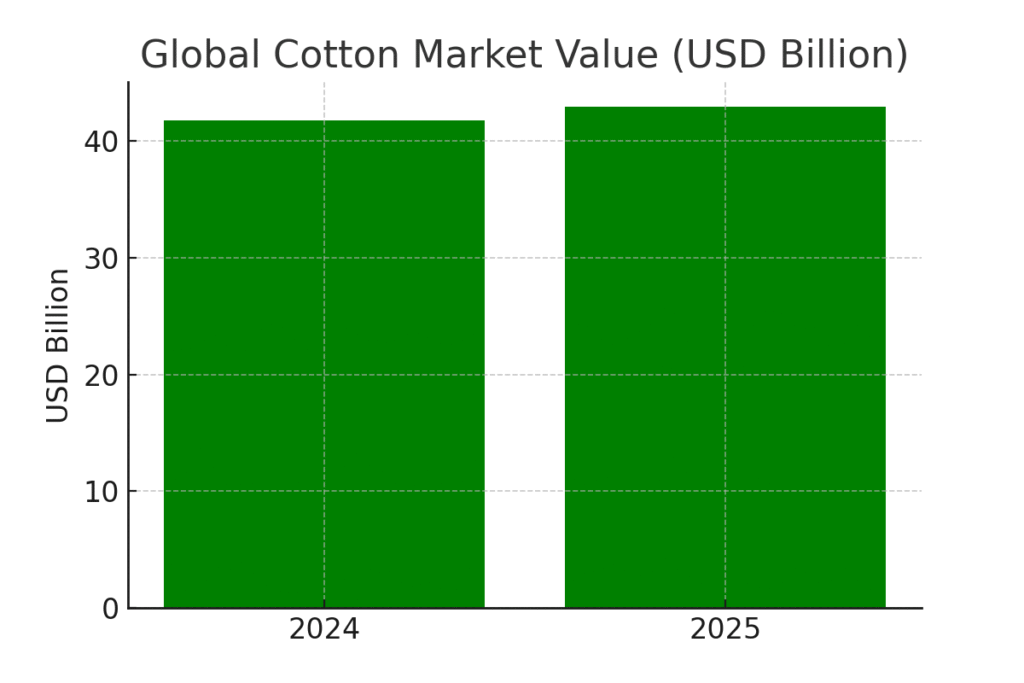
Cotton Marketing Statistics #6 – Market Value At $42.92 Billion In 2025
The global cotton market is valued at $42.92 billion in 2025. This highlights the industry’s significant economic role in agriculture and textiles. The size of the market offers vast opportunities for global players to innovate. Growth potential lies in organic cotton and sustainable production methods. Marketers can leverage this value by showcasing cotton as both profitable and eco-conscious.
Cotton Marketing Statistics #7 – CAGR Of 2.7–2.9% Through 2033
From 2025 to 2033, the cotton market is expected to grow at a CAGR of 2.7–2.9%. This steady growth rate reflects cotton’s resilience compared to competing fibers. Fashion and textile brands continue to rely on cotton’s versatility. Investors and stakeholders can consider cotton a relatively stable commodity. Marketing teams should highlight cotton’s continued relevance in modern supply chains.
Cotton Marketing Statistics #8 – Cotton Trade To Reach 12.3 Million Tonnes By 2034
Global cotton trade is forecast to grow at around 1.6–1.7% annually. By 2034, volumes may hit 12.3 million tonnes. This growth is driven by consumption expansion in emerging economies. Such trade flows reinforce cotton’s importance in global markets. Marketers can emphasize cotton’s enduring role in international commerce.
Cotton Marketing Statistics #9 – Production Rising To 139 Million Bales By 2034/35
World cotton production is projected to rise to 139 million bales by 2034/35. This growth reflects both expanded acreage and improved yields. Strong demand forecasts encourage producers to maintain investment in cotton. Larger supply can stabilize prices, benefiting the textile industry. Marketing narratives can stress cotton’s reliable long-term presence.
Cotton Marketing Statistics #10 – Harvested Area At 76.6 Million Acres In 2025/26
The global harvested area is expected to cover 76.6 million acres in 2025/26. By 2034/35, this could expand to nearly 84 million acres. Expanded acreage shows cotton’s continued agricultural significance. Farmers remain committed to cotton despite competing crops. Marketers can highlight the dedication of growers who sustain the industry.

Cotton Marketing Statistics #11 – Global Yield At 1.6 Bales Per Acre
In 2025/26, yields are projected at 1.6 bales per acre. Incremental improvements may lift this figure slightly by the mid-2030s. Yields are influenced by better seed technology and farming practices. Stable yields protect supply chains from sudden shocks. Marketing campaigns can stress the balance between tradition and innovation in cotton farming.
Cotton Marketing Statistics #12 – China Accounts For 32% Of Mill Use
China is projected to consume 32% of global cotton mill use. This makes it the largest market worldwide. Its dominance underscores the importance of Asian textile industries. Global cotton trends are often shaped by China’s policies and demand. Marketers can position cotton campaigns with China’s consumption influence in mind.
Cotton Marketing Statistics #13 – India’s Production Falls By 10%
India’s cotton production dropped by 10% in 2024/25. As a result, imports doubled to meet domestic needs. This highlights vulnerabilities in local production despite India’s status as a top producer. Global trade routes helped bridge the gap for textile industries. Marketing teams can use such trends to stress cotton’s global interconnectedness.
Cotton Marketing Statistics #14 – 25 Million Metric Tons Produced Annually
On average, the world produces 25 million metric tons of cotton each year. Despite this large figure, only about 1.4% is organic cotton. This small organic share reflects opportunities for growth in sustainable cotton. Consumer interest in eco-friendly options is rising. Marketing narratives should focus on expanding awareness of organic cotton benefits.
Cotton Marketing Statistics #15 – 97% Of Organic Cotton From Eight Countries
Eight key producers account for 97% of organic cotton supply. This concentration highlights geographic dependence. If any of these regions face disruptions, the global organic market could suffer. On the flip side, it creates strong regional branding opportunities. Marketers can emphasize the authenticity of organic cotton sourced from these hubs.
Cotton Marketing Statistics #16 – Better Cotton Initiative At 22% Global Share
The Better Cotton Initiative represents 22% of worldwide cotton production. This program promotes more sustainable farming methods. Its growing share shows that sustainability is gaining traction. Brands adopting BCI cotton can showcase their ethical practices. Marketing can benefit by aligning products with responsible sourcing standards.
Cotton Marketing Statistics #17 – Consumption Growing At 1.5% Annually
Global cotton consumption is projected to grow at 1.5% per year. This steady increase is tied to population growth and fashion demand. Rising incomes in emerging markets also boost consumption. Brands relying on cotton must scale with this demand. Marketers can highlight cotton’s role as a timeless and growing fabric choice.
Cotton Marketing Statistics #18 – Stocks-To-Use Ratio Declining To 58%
The stocks-to-use ratio is expected to fall from 67% to 58% over the next decade. Lower ratios signal tighter supply and possible price volatility. This trend could create challenges for buyers. Businesses should plan for fluctuations in cotton availability. Marketing can frame this as proof of cotton’s enduring value and scarcity.
Cotton Marketing Statistics #19 – U.S. Exports At 13.3 Million Bales
The United States is projected to export 13.3 million bales in 2025/26. This represents about 30% of global trade. U.S. cotton plays a vital role in international supply chains. Strong export capacity reassures buyers worldwide. Marketing can frame American cotton as both reliable and high quality.
Cotton Marketing Statistics #20 – Pakistan Produces 5.3 Million Bales
Pakistan is forecast to produce 5.3 million bales in 2025/26. Yet its domestic consumption is nearly double that amount. By 2034/35, mill use could climb to 12.2 million bales. This makes Pakistan both a producer and a significant importer. Marketing can highlight how cotton supports Pakistan’s vast textile sector and global exports.
Why These Numbers Matter to Me
Looking through these cotton marketing statistics, I can’t help but think about the bigger story they tell—how markets evolve, how consumer preferences shift, and how global trade finds its balance. For me, this isn’t just about numbers on a chart; it’s about connecting those figures back to the real decisions businesses make every single day. Having worked with diverse clients, I’ve learned that data like this can make the difference between a missed opportunity and a breakthrough strategy. My hope is that, by sharing these insights, I’ve given you the same clarity and perspective I try to bring to my own work. After all, cotton may be grown in fields far away, but its impact is woven into the fabric of our everyday lives.
SOURCES
- https://ers.usda.gov/sites/default/files/_laserfiche/outlooks/113130/CWS-25h.pdf?v=25021 Economic Research Service
- https://downloads.usda.library.cornell.edu/usda-esmis/files/n870zq801/dz012p64h/s7528b111/CWS-25i.pdf USDA Library Downloads
- https://www.depts.ttu.edu/aaec/icac/pubs/cotton/global_cotton_baselines/Cotton_Outlook_2025.pdf Texas Tech University
- https://www.oecd.org/en/publications/2025/07/oecd-fao-agricultural-outlook-2025-2034_3eb15914/full-report/cotton_a0374fa8.html OECD
- https://downloads.usda.library.cornell.edu/usda-esmis/files/n870zq801/6t055f45f/jq087h525/CWS-25g.pdf USDA Library Downloads
- https://ers.usda.gov/sites/default/files/_laserfiche/outlooks/112911/CWS-25g.pdf?v=39211 Economic Research Service
- https://usda.library.cornell.edu/concern/publications/kp78gg36g?locale=en Cornell University USDA Library