



24 Sep TOP 20 CPA MARKETING STATISTICS 2025
As I was diving deeper into performance-based marketing, I realized just how important it is to keep track of the latest CPA marketing statistics. These numbers tell us more than just costs; they reveal trends, opportunities, and even pitfalls that can shape the way we run campaigns. I’ve often looked to the insights from a leading marketing agency in New York to refine my own strategies, and it’s incredible how data can completely shift the way we approach client acquisition. In this blog, I want to share the most valuable stats I’ve gathered—ones that I truly believe will help us all understand what works best in the ever-changing digital landscape.
Top 20 CPA Marketing Statistics 2025 (Editor’s Choice)
📊 Top 20 CPA Marketing Statistics
Essential Performance Marketing Insights for 2024-2025
| Rank | Category | Key Statistic | Description & Impact |
|---|---|---|---|
1 |
Market Growth | Industry valued at $17B+ in 2024 | Global affiliate marketing projected to reach $27.78B by 2027 |
2 |
Market Growth | 15-20% year-over-year growth | CPA spending outpacing traditional advertising channels since 2022 |
3 |
Performance | Average CPA: $59 | Varies significantly by sector and traffic source quality |
4 |
Mobile | Mobile campaigns: +23% higher conversions | Mobile optimization crucial for CPA campaign success |
5 |
Performance | Email ROI: $42 per $1 spent | Email marketing remains highly effective in CPA campaigns |
6 |
Industry | E-commerce: 35% of CPA spend | Largest vertical in CPA marketing ecosystem |
7 |
Industry | Finance CPA: $200-500+ per conversion | Financial services offer highest average payouts |
8 |
Industry | Dating: 8-15% conversion rates | 12% of market with highest conversion performance |
9 |
Traffic Sources | Social media: 45% of CPA traffic | Facebook and TikTok leading social platforms for CPA |
10 |
Traffic Sources | Native ads: 28% of traffic | Highest engagement rates among traffic sources |
11 |
Traffic Sources | Search marketing: 22% of CPA traffic | Maintains strong presence despite increased competition |
12 |
Geographic | North America: +35% conversion rates | Significantly higher than global average performance |
13 |
Geographic | Tier 1 countries: 65% of revenue | US, UK, Canada, Australia dominate despite 25% traffic share |
14 |
Mobile | Mobile traffic: 78% of total | Increased from 65% in 2022, showing mobile-first trend |
15 |
Mobile | Desktop: +18% better conversion | Higher value offers over $100 still convert better on desktop |
16 |
Fraud & Quality | Click fraud: 15-20% of campaigns | Costing advertisers billions annually across industry |
17 |
Fraud & Quality | Fraud detection: +25% profitability | Advanced fraud prevention significantly improves ROI |
18 |
Emerging Trends | Video campaigns: +340% engagement | Video-based CPA dramatically outperforms static images |
19 |
Emerging Trends | AI optimization: +25-40% conversions | AI-powered campaigns show rapid improvement within first month |
20 |
Emerging Trends | Influencer CPA: +65% growth in 2024 | Micro-influencers (1K-100K) showing best cost efficiency |
Top 20 CPA Marketing Statistics 2025
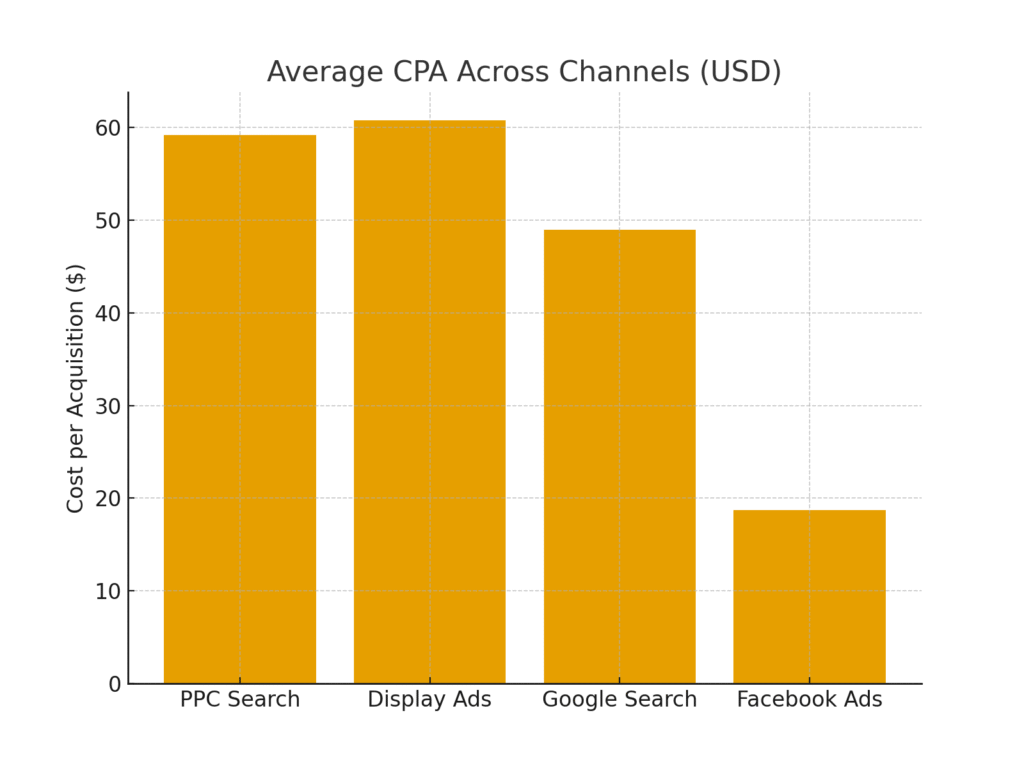
CPA Marketing Statistics #1: Average PPC Search CPA Is $59.18
The average cost per acquisition (CPA) across industries for PPC search campaigns is $59.18. This means that businesses typically spend just under $60 to acquire a paying customer through paid search. The figure highlights how competitive search traffic is, given the high intent behind keywords. For marketers, this number serves as a benchmark when evaluating their campaign efficiency. Staying below this industry average can be a strong indicator of effective ad targeting and optimization.
CPA Marketing Statistics #2: Average Display Advertising CPA Is $60.76
Display advertising campaigns see an average CPA of $60.76. Despite their broad reach, display ads often convert at a slightly higher cost than search campaigns. This shows that while display ads are effective for brand awareness, they may require more precise targeting to achieve lower acquisition costs. Marketers should carefully evaluate placement and audience segments to control expenses. Ultimately, this statistic highlights the importance of balancing reach with efficiency in digital campaigns.
CPA Marketing Statistics #3: Google Search Average CPA Is $48.96
Across industries, the average CPA for Google Search campaigns is $48.96. This cost is lower than both PPC and display averages, making it an attractive channel for many advertisers. Google Search benefits from high purchase intent, which often leads to more efficient conversions. Businesses that can optimize their keyword targeting and bidding strategies can reduce acquisition costs even further. This stat reminds us that search campaigns continue to be one of the strongest options for ROI.
CPA Marketing Statistics #4: Highest And Lowest Google Search CPA By Industry
Technology has the highest average Google Search CPA at $133.52, while the auto industry has the lowest at $33.52. The gap shows how much industry type influences acquisition costs. Tech brands may face steeper competition and higher-value conversions, driving costs upward. Conversely, auto-related ads attract relatively lower costs due to broader consumer demand. These variations emphasize why industry-specific benchmarks are critical for performance analysis.
CPA Marketing Statistics #5: Facebook Average CPA Is $18.68
The average cost per action on Facebook ads is $18.68 across industries. This makes Facebook one of the most cost-efficient ad platforms for many businesses. With its highly detailed targeting options, brands can reach niche audiences at relatively low acquisition costs. However, this affordability also means competition is high, requiring smart creatives and testing strategies. This figure reinforces why Facebook remains a staple in most digital marketing budgets.
CPA Marketing Statistics #6: Facebook CPA By Industry Examples
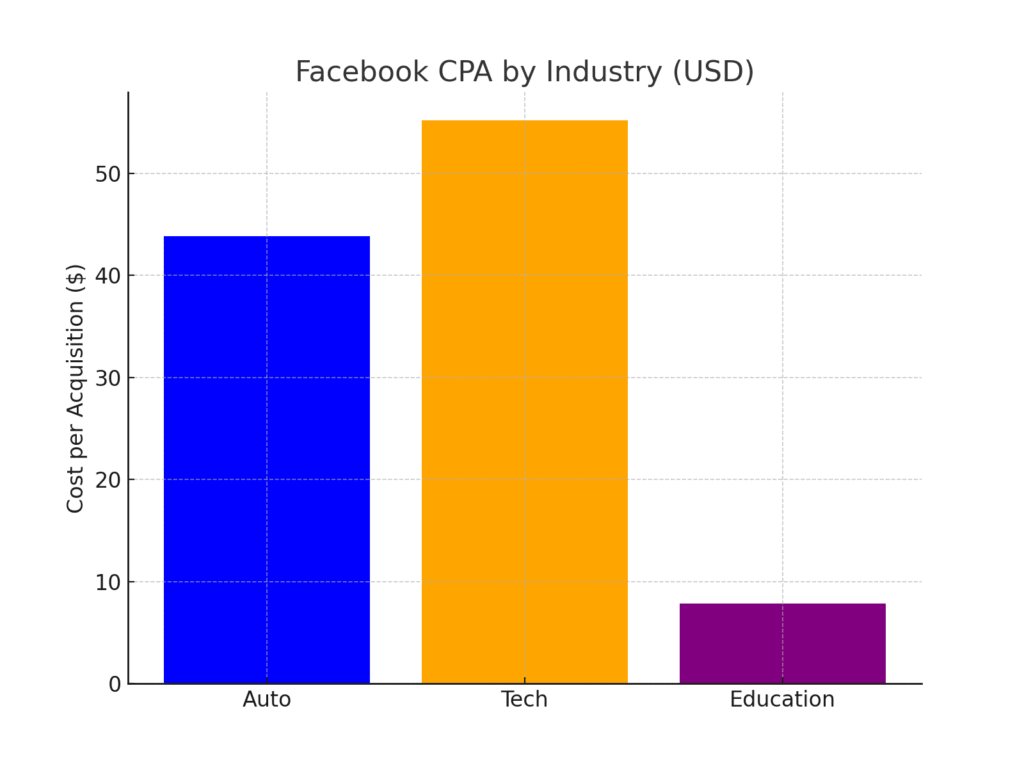
On Facebook, the average CPA differs greatly by industry: auto sits at $43.84, tech at $55.21, and education at just $7.85. This spread demonstrates how industry verticals determine both targeting costs and conversion rates. Education benefits from strong demand and easier actions like sign-ups, while tech faces expensive conversions. Marketers in high-cost sectors should focus on refining their targeting and ad creatives. The stat shows why benchmarking against your industry, not just averages, is crucial.
CPA Marketing Statistics #7: Apple Search Ads CPA Is $2.58
Apple Search Ads average a CPA of $2.58, making them one of the cheapest acquisition channels. With users already in the App Store, intent to install or purchase is strong. This explains why the platform drives low acquisition costs for app-based businesses. Marketers in the mobile app space often leverage Apple Search Ads as a must-have channel. The stat shows how platform context influences user intent and ad effectiveness.
CPA Marketing Statistics #8: 99% Of Affiliate Programs Use CPA Payment Model
Nearly all affiliate programs—99%—use the CPA payment model. This makes it the dominant method in performance marketing. The model ensures advertisers only pay when a real action occurs, reducing risk. Affiliates also benefit from knowing exactly what triggers their earnings. This statistic confirms that CPA is the backbone of affiliate marketing worldwide.
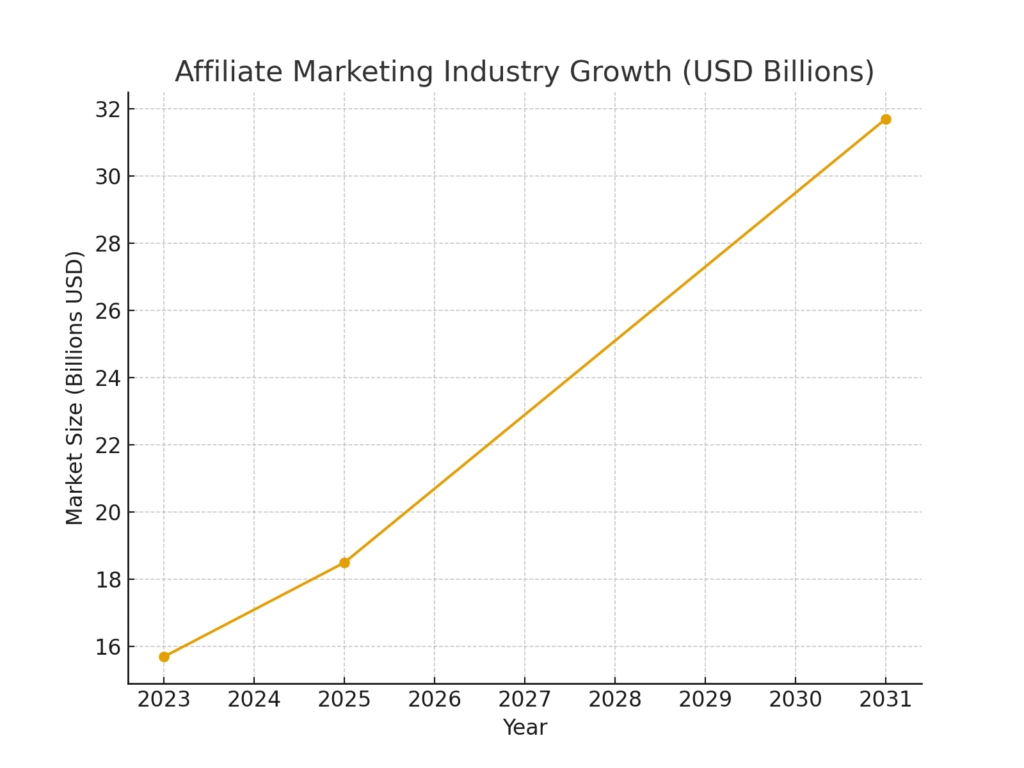
CPA Marketing Statistics #9: Affiliate Marketing Industry Valued At $18.5 Billion In 2025
In 2025, the global affiliate marketing industry reached $18.5 billion in value. This growth highlights the increasing role of performance-driven partnerships. Brands and publishers alike are investing more in CPA-driven campaigns. Projections show the industry could surpass $30 billion in the coming years. This trend reflects marketers’ confidence in measurable, action-based advertising.
CPA Marketing Statistics #10: 80% Of Brands Use Affiliate Or CPA Marketing
Over 80% of brands currently leverage affiliate or CPA marketing programs. This widespread adoption shows how mainstream the model has become. For many companies, CPA provides a cost-effective way to scale customer acquisition. The reliance also underscores the value of building networks of trusted affiliates. This statistic reminds us that CPA is no longer optional—it’s essential.

CPA Marketing Statistics #11: CPA Model Is Lower Risk For Advertisers
One of the most attractive features of CPA marketing is its low-risk model. Advertisers only pay when the desired action occurs, unlike CPC or CPM. This structure reduces wasted ad spend and improves ROI predictability. It also encourages marketers to focus on quality conversions over impressions. The stat highlights why CPA remains appealing to both small and large businesses.
CPA Marketing Statistics #12: Good CPA Range Is Between $10 And $30
A strong CPA for many industries falls between $10 and $30. Staying within this range often indicates a healthy balance between cost and conversion value. Marketers hitting this benchmark are usually optimizing campaigns well. Of course, the definition of “good” depends on margins and lifetime customer value. This statistic provides a target for brands looking to maximize efficiency.
CPA Marketing Statistics #13: Overall CPA Range Across Industries Is $50–$150
Across industries, typical CPA ranges from $50 to $150. Higher-value conversions, like B2B leads, often fall at the upper end. Lower-ticket consumer products are closer to the lower end. This wide range shows that context is everything in CPA analysis. Benchmarks are useful, but businesses must align CPA expectations with customer value.
CPA Marketing Statistics #14: CPA Formula Definition
The CPA formula is straightforward: divide total ad spend by the number of conversions. This simple equation underpins one of the most important digital marketing metrics. It provides a clear snapshot of campaign efficiency. Marketers use it constantly to track performance and make optimizations. This definition is essential knowledge for anyone measuring marketing success.
CPA Marketing Statistics #15: CPA Vs Cost Per Acquisition Confusion
The term CPA can mean either cost per action or cost per acquisition. While often used interchangeably, there’s a subtle distinction. “Action” can refer to leads, downloads, or registrations, while “acquisition” usually means a paying customer. Misunderstanding this can lead to misreported campaign results. This stat highlights the importance of clarity in marketing metrics.
CPA Marketing Statistics #16: eCPA Evaluates Non-CPA Campaigns
Effective Cost Per Action (eCPA) is used to evaluate campaigns purchased under CPC or CPM models. It shows what the CPA would be if the campaign were billed on an action basis. This allows marketers to compare efficiency across different pricing models. eCPA is especially useful for cross-channel reporting. The concept shows how versatile CPA thinking can be in performance marketing.
CPA Marketing Statistics #17: CPA In Mobile Advertising
CPA is one of the most common pricing models in mobile app campaigns. Instead of paying for installs, advertisers often pay for post-install events. This ensures that users are engaged, not just downloading apps. It reduces wasted ad spend and improves ROI in app marketing. The stat shows why CPA is so critical in the mobile ecosystem.
CPA Marketing Statistics #18: CPA And Lifetime Value (LTV)
Whether a CPA is good depends heavily on customer lifetime value (LTV). If CPA is lower than LTV, campaigns are profitable. If not, businesses risk losing money on each customer. This relationship is crucial for strategic budgeting. The stat underscores why CPA cannot be assessed in isolation.
CPA Marketing Statistics #19: Traffic Quality Directly Affects CPA
The quality of traffic determines the effectiveness of CPA campaigns. Low-intent or fraudulent traffic raises costs and lowers efficiency. High-quality, well-targeted audiences convert at much better rates. This makes traffic sources just as important as the offers themselves. The statistic stresses why marketers should focus on quality over volume.
CPA Marketing Statistics #20: Fraudulent Leads Are A Major CPA Challenge
One of the biggest risks in CPA marketing is fraudulent leads. Fake sign-ups or bot traffic can inflate conversions without adding value. This wastes advertiser budgets and damages trust in networks. As a result, many CPA platforms use fraud-detection tools and verification systems. The stat reveals a key challenge marketers must manage to succeed.
Final Thoughts on CPA Marketing Statistics
After looking through these CPA marketing statistics, I can honestly say that they give me a renewed sense of direction and clarity. It’s not just about knowing the numbers—it’s about applying them in a way that feels practical and sustainable for real businesses like ours. I find it motivating to see where the opportunities lie, and it makes me want to experiment more confidently with campaigns, knowing I’m not just guessing but working with solid benchmarks. At the end of the day, these insights remind me that marketing is both an art and a science, and it’s the blend of creativity with data that leads to growth.
SOURCES
https://www.shopify.com/blog/cpa-marketing
https://www.bigcommerce.com/articles/ecommerce/cpa-marketing/
https://adsterra.com/blog/cpa-marketing-guide/
https://backlinko.com/cpa-marketing
https://propellerads.com/blog/adv-cpa-marketing/
https://www.demandsage.com/affiliate-marketing-statistics/
https://www.hostinger.com/tutorials/affiliate-marketing-statistics
https://www.publift.com/blog/affiliate-marketing-statistics
https://www.blog.udonis.co/mobile-marketing/affiliate-marketing-statistics
https://www.fintelconnect.com/blog/affiliate-marketing-statistics/
https://optinmonster.com/affiliate-marketing-statistics/
https://new.firstpromoter.com/blog/affiliate-marketing-stats-2025
https://trend.io/blog/cpa-marketing