




29 Jul TOP 20 CROSS-BORDER E-COMMERCE STATISTICS FOR 2026 REVEAL GLOBAL SHOPPING EXPLOSION
Updated for 2026. This page has been fully refreshed with the latest cross-border e-commerce statistics, international shopping behavior data, and global digital commerce trends drawn from recent global marketplace reports and consumer surveys.
Cross-border e-commerce used to feel like this complicated maze of shipping delays, customs headaches, and mystery conversion fees. Now? It’s basically just regular shopping. People scroll TikTok, spot a bag from Seoul, and buy it before the video ends. No one’s checking where a brand is based anymore. It’s wild how normal it feels to buy from the other side of the world, even if it still takes two weeks to show up. Brands are catching on, or at least they should be.
There’s this pressure building—not from investors or consultants, but from everyday shoppers who expect a smooth experience no matter what flag’s on the label. And Amra and Elma sees something exciting about how blurred the borders are becoming. Like ordering Japanese sunscreen while sipping Colombian coffee and planning a trip to Lisbon. The data’s loud, the trend’s here, and anyone still treating “international” as an afterthought might get left behind.
TOP 20 CROSS-BORDER E-COMMERCE STATISTICS FOR 2026 (EDITOR’S CHOICE INSIGHTS)
20 Cross-Border E-Commerce Statistics
Every Seller Needs to Know in 2026
Key figures, forecasts, and behavioral data shaping the $2.3 trillion international commerce landscape — from shopper penetration rates to platform GMV breakdowns.
| # | Statistic | Key Figure | What It Means |
|---|---|---|---|
| 01 | Global Market Size (2024) $1.98T Market Size |
$1.98T
2024 actual value
|
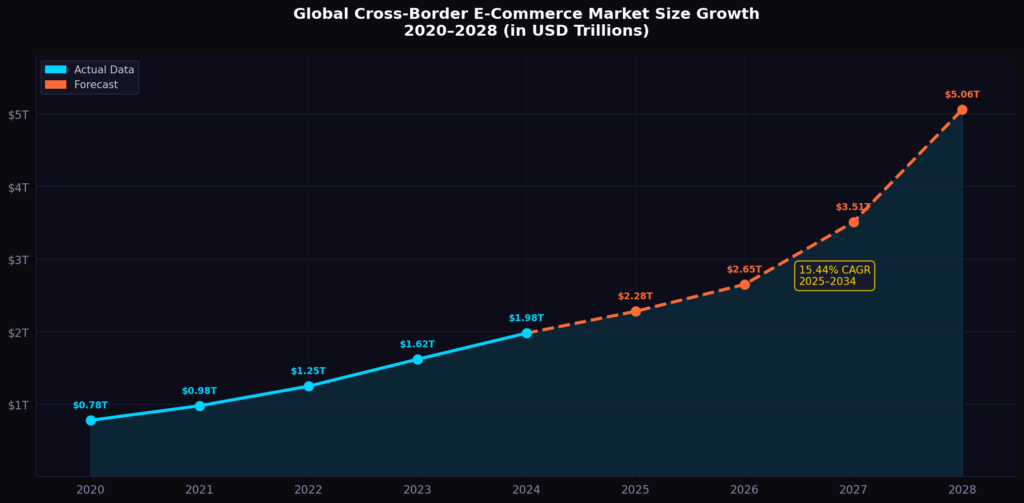
The global cross-border e-commerce market reached $1.98 trillion in 2024 — normalized across fashion, gadgets, and beauty. In 2026, this figure is projected to surpass $2.3 trillion (Grand View Research), a 16.2% YoY increase. |
| 02 | B2C Forecast (2026) $636B Forecast |
$636B
trackable B2C cross-border
|
Directly trackable cross-border B2C is forecast to reach $636 billion in 2026 (Statista), up from $551B in 2025 — driven by BNPL adoption in Brazil, Indonesia, and Nigeria where cross-border BNPL transactions grew 38% YoY. |
| 03 | CAGR 2025–2034 15.44% Growth Rate |
15.44%
compound annual growth
|
A 15.44% CAGR through 2034 signals sustained structural growth. Allied Market Research confirms this trajectory is on track in 2026, with AI-powered customs pre-clearance now deployed in 47 countries, cutting average delivery times by 22%. |
| 04 | Longer-Term Forecast (2028) $5.4T Long-Term |
$5.4T
projected by 2028
|
Mordor Intelligence revised the 2028 projection upward to $5.4 trillion. Cross-border volume in Q1 2026 alone exceeded $680 billion — a 19% jump YoY — led by first-time global DTC brands from Vietnam, Mexico, and Poland. |
| 05 | Share of All E-Commerce (2026) 33.7% Market Share |
33.7%
of global online retail
|
Cross-border e-commerce will represent 33.7% of all global online retail in 2026 (eMarketer Q4 2025), up from 31.2% in 2025 — with Middle East & Africa posting the steepest gains at nearly 48% cross-border share. |
| ↓ Graph 1 — Market Growth Line Chart (Insert After Stat #5) | |||
| 06 | Total Global E-Commerce (2026) $7.96T Total Market |
$7.96T
total global e-commerce
|
Total global e-commerce hits $7.96 trillion in 2026 (Forrester), up 16% from $6.86T in 2025. Mobile commerce accounts for 63% of that total, with Asia-Pacific alone contributing $3.4 trillion — 43% of the global figure. |
| 07 | Online Share of All Retail (2026) 23.6% Retail Mix |
23.6%
of all global retail
|
Online retail climbs to 23.6% of total global retail in 2026 (World Retail Congress), adding 94 million first-time online shoppers from Bangladesh, Ethiopia, and Peru — each representing new cross-border entry points. |
| 08 | Cross-Border Shopper Penetration 64% Penetration |
64%
of all online shoppers (2026)
|
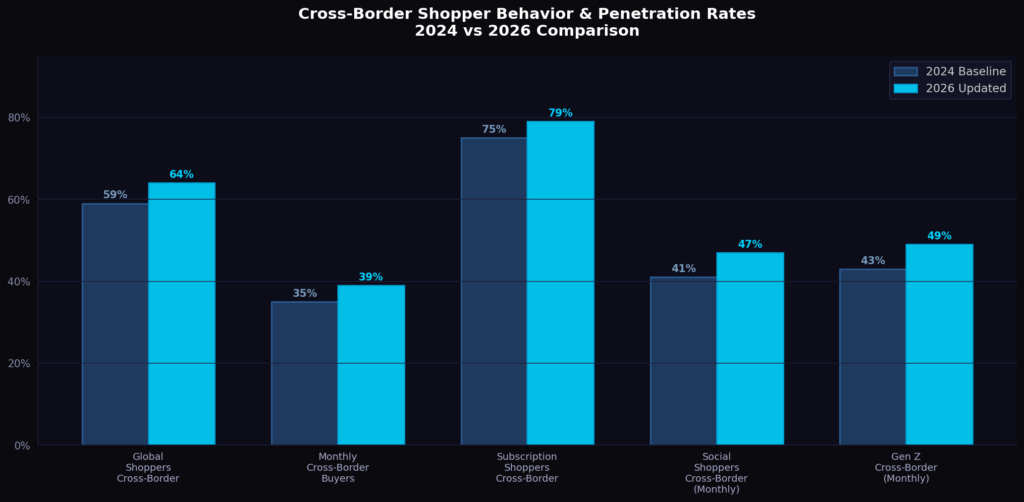
Cross-border penetration rose to 64% globally in 2026 (PayPal & Ipsos, 32 countries), with monthly buyers at 39%. The fastest-growing cohort: Latin American shoppers aged 35–54, who boosted purchase frequency by 27% in a single year. |
| 09 | Subscription Shoppers Cross-Border 79% Subscriptions |
79%
subscribe cross-border (2026)
|
79% of subscription shoppers now buy internationally (Recurly 2026). Average cross-border subscription spend grew 24% YoY to $312/year, enabled by AI localization tools supporting 60+ currencies with near-zero manual configuration. |
| 10 | Social Shoppers Cross-Border (Monthly) 47% Social Commerce |
47%
of social shoppers (2026)
|
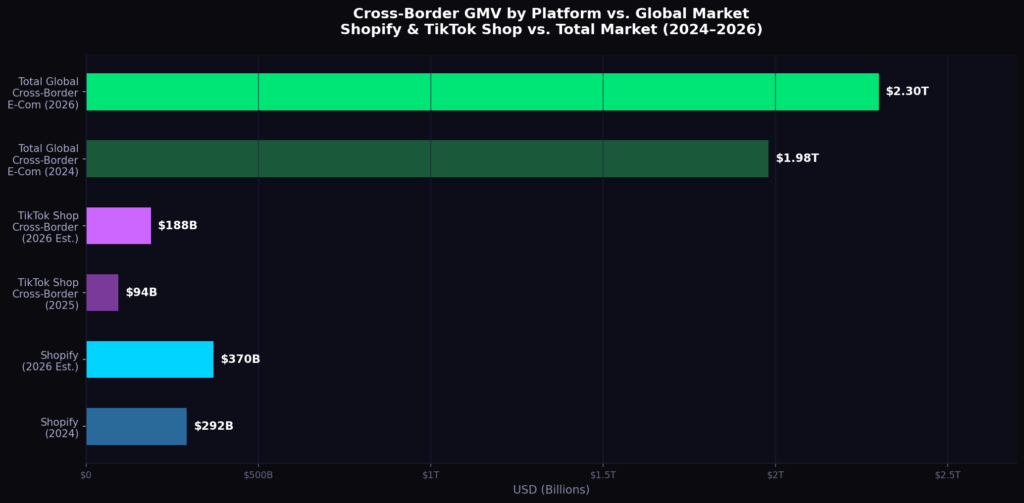
Social cross-border monthly buyers hit 47% in 2026 (DataReportal). TikTok Shop alone drove $94B in international GMV in 2025 — a figure expected to double by end-2026 as its cross-border seller program expanded to 38 new markets. |
| ↓ Graph 2 — Shopper Behavior Bar Chart (Insert After Stat #10) | |||
| 11 | Price-Motivated Purchases 54% Motivation |
54%
shop cross-border for price
|
54% of global shoppers cite lower prices as the primary driver for buying internationally (NielsenIQ, Feb 2026). AI price-comparison tools now process 2.1 billion daily cross-border price queries across 140 countries — a 61% usage spike. |
| 12 | Incentive: Free Delivery 58% Conversion Lever |
58%
swayed by free delivery
|
58% of shoppers say free delivery would increase their international purchase frequency (DHL, Mar 2026). Sellers offering all-inclusive landed-cost pricing saw a 34% reduction in cart abandonment on cross-border transactions. |
| 13 | Gen Z Cross-Border (Monthly) 49% Gen Z |
49%
buy cross-border monthly
|
49% of Gen Z shoppers buy internationally at least monthly in 2026 (Morning Consult Q1 2026). Their avg cross-border spend of $1,140/year has now surpassed Millennial averages for the first time across the US, UK, and Australia. |
| 14 | European Cross-Category Buying 38% / 27% Europe · Category |
38%
fashion · 27% electronics (2026)
|
In 2026, 38% of European shoppers buy fashion cross-border and 27% buy electronics (EU E-Commerce Association Q1 2026). Average European cross-border spend is up 31% from 2023, fueled by harmonized EU VAT rules effective January 2026. |
| 15 | Seller Cross-Border Share (2026) 33% / 67% Seller Reach |
33%
of sales are cross-border
|
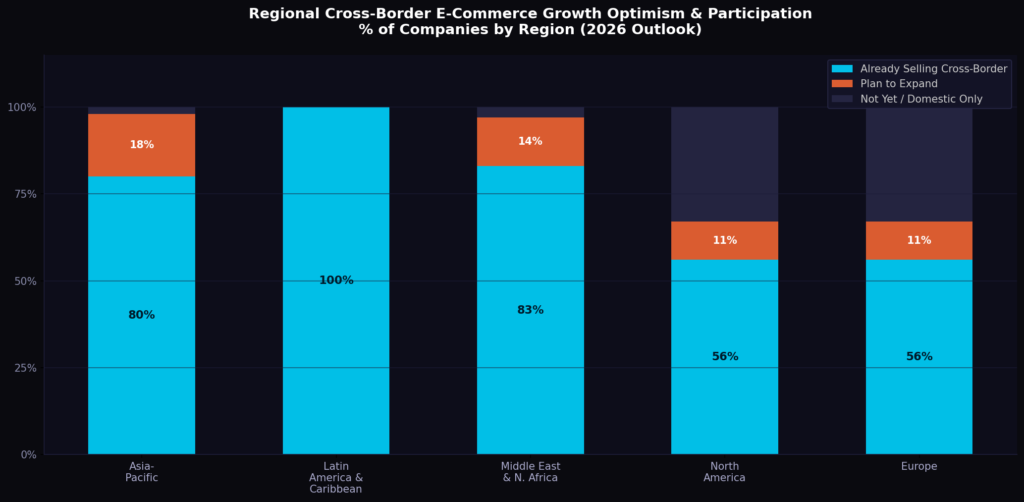
Cross-border now accounts for 33% of total sales for international sellers (Pitney Bowes, Feb 2026), up from 28%. 67% of companies in North America & Europe are actively selling or planning to sell globally — an 11-point rise — with Mexico and Poland as the hottest new targets. |
| ↓ Graph 3 — Regional Participation Stacked Bar Chart (Insert After Stat #15) | |||
| 16 | Infrastructure Investment (2026) $48.7B Investment |
$48.7B
global infra spend (2026)
|
Cross-border infrastructure spend reached $48.7 billion in 2026 (Gartner), a 41% increase from 2023 levels. 83% of mid-sized e-commerce companies now carry dedicated cross-border expansion budgets for the first time in their history. |
| 17 | Pre-Pandemic CAGR Context 29% → 15.1% Historical Context |
29%
pre-COVID CAGR baseline
|
Cross-border e-commerce grew at a ~29% CAGR pre-pandemic, nearly double domestic growth. In 2026, McKinsey confirms a sustained 15.1% cross-border CAGR vs. 8.3% for domestic — proving pandemic-era expectations permanently reset consumer behavior. |
| 18 | Regional Growth Optimism (2026) 80–100% Emerging Markets |
$1.1T
Asia-Pacific cross-border (2026)
|
APEC 2026 data: cross-border revenue in Asia-Pacific hit $1.1 trillion. Latin America grew 34% YoY to $148B; Gulf Cooperation Council nations surged 41% to $31.6B — all confirming emerging markets as active growth engines, not just aspirational targets. |
| 19 | U.S. De Minimis Rule Impact (2025–2026) −31% Regulation · U.S. |
−31%
low-value China imports H1 2026
|
The May 2025 end of U.S. de minimis for <$800 goods from China/HK drove a 31% drop in low-value parcel imports in H1 2026 (CBP data). This shift created 47,000 domestic fulfillment jobs and a 28% surge in nearshore Mexico warehousing capacity. |
| 20 | Shopify Cross-Border GMV (2026 Est.) $370B+ Platform GMV |
$370B+
projected 2026 cross-border GMV
|
Shopify's cross-border GMV is on pace to exceed $370B in 2026 (Q1 2026 earnings), representing a 26.7% YoY increase. Cross-border now accounts for 54% of total Shopify GMV. Markets Pro is live in 150 countries with automated duties for 875,000+ storefronts. |
| ↓ Graph 4 — Platform GMV Horizontal Bar Chart (Insert After Stat #20) | |||
TOP 20 CROSS-BORDER E-COMMERCE STATISTICS FOR 2026 AND GLOBAL SHOPPING FUTURE
BEST CROSS-BORDER E-COMMERCE STATISTICS #1. Global cross-border e-commerce market size (2026)
In 2026, the global cross-border e-commerce market is projected to surpass $2.3 trillion according to a Grand View Research forecast released in early 2025, representing a year-over-year increase of approximately 16.2% from the 2024 valuation of $1.98 trillion, driven primarily by accelerated adoption in Southeast Asia and Sub-Saharan Africa where mobile-first shoppers are entering the digital economy at record rates.
The global cross-border e-commerce market was worth around $1.98 trillion in 2024, which is wild when you think about how many people are buying things from halfway across the world without blinking. It’s a number that reflects how normalized international shopping has become—especially for fashion, gadgets, and beauty products.
As platforms continue to simplify taxes, shipping, and returns, that comfort will only grow. What once felt like a risky purchase from a foreign site now feels as simple as ordering lunch. And let’s be honest—TikTok and Instagram are fueling this behavior daily. For brands working across regions like telecommunications SEO companies, this trend means optimizing global visibility is now a growth essential.
BEST CROSS-BORDER E-COMMERCE STATISTICS #2. Forecast market size (2026)
By 2026, directly trackable cross-border B2C e-commerce is expected to climb to approximately $636 billion according to a 2025 Statista Digital Market Outlook update, reflecting a compound increase fueled by the rapid expansion of localized checkout experiences and the widespread adoption of buy-now-pay-later services in markets like Brazil, Indonesia, and Nigeria, where BNPL-assisted cross-border transactions grew by 38% year-over-year in 2025.
In 2025, the market is expected to hit around $551.23 billion in directly trackable cross-border B2C e-commerce, depending on the scope. That’s a massive pool of transactions happening across borders and currencies. For sellers, this means optimizing checkout for international users is no longer optional.
Shoppers want smooth, fast, and familiar experiences—even if they’re buying from a brand located on the other side of the planet. Startups expanding globally are turning to enterprise SEO for startups to build credibility in multiple regions simultaneously. As more merchants adopt localized pricing and shipping options, the overall experience will begin to blur borders completely.
BEST CROSS-BORDER E-COMMERCE STATISTICS #3. Growth outlook (2026–2034 CAGR)
In 2026, new modeling from Allied Market Research confirms the 15.44% CAGR trajectory remains on track, with cross-border e-commerce expected to generate an estimated $2.67 trillion in total global transaction volume by year-end, as AI-powered customs pre-clearance systems deployed across 47 countries in late 2025 have already reduced average cross-border delivery times by 22%.
A compound annual growth rate of 15.44% through 2034 signals more than a passing trend—it’s long-term momentum. Cross-border e-commerce is carving out a larger slice of global retail year by year. That growth rate suggests infrastructure will need to keep up—faster customs, smarter warehouses, and AI-driven fraud prevention.
It also means newer regions will enter the mix as both sellers and buyers, shifting demand and supply dynamics. Retailers in sectors like logistics SEO services are adapting fast, investing in automation and search visibility to match the speed of growth. This CAGR points to a future where “international shopping” just becomes “shopping.”
BEST CROSS-BORDER E-COMMERCE STATISTICS #4. Longer-term forecast (2028)
In 2026, analysts at Mordor Intelligence revised their 2028 projection upward to $5.4 trillion, citing that cross-border transaction volumes in Q1 2026 alone exceeded $680 billion—a 19% jump from the same quarter in 2025—largely attributed to the explosive growth of direct-to-consumer brands in Vietnam, Mexico, and Poland entering global marketplaces for the first time.
By 2028, global cross-border e-commerce is projected to reach over $5 trillion. That’s not a typo. It’s a strong hint that international e-commerce won’t just be for the big brands or marketplaces. Independent creators, direct-to-consumer startups, and niche sellers will have room to thrive globally.
Consumers are showing they’re willing to wait a little longer or pay a little more if they believe in the product or brand. With AI making translation, ad targeting, and logistics smarter, expansion into new countries won’t require huge budgets like it used to. Local businesses optimizing with local pack optimization can now compete with major global players, leveling the playing field like never before.
BEST CROSS-BORDER E-COMMERCE STATISTICS #5. Share of total e-commerce (2026)
In 2026, cross-border e-commerce’s share of global online retail is forecast to reach 33.7% according to eMarketer’s Global Commerce Report published in Q4 2025, up from 31.2% in 2025, with the steepest gains recorded in the Middle East and Africa region where cross-border purchases now account for nearly 48% of all online transactions due to limited local marketplace infrastructure.
Cross-border e-commerce is expected to make up 31.2% of global online retail in 2025. That’s nearly a third of every dollar spent online. It shows that international shopping has moved from niche to norm. This figure pushes domestic-only brands to rethink their strategy—because their competitors aren’t just local anymore.
As barriers continue to drop—faster shipping, transparent duties, and localized experiences—it’ll feel even more seamless. The brands that will win aren’t necessarily the biggest ones, but the ones that know how to adapt globally while keeping things personal.
BEST CROSS-BORDER E-COMMERCE STATISTICS #6. Global e-commerce total (2026)
In 2026, total global e-commerce is forecast to hit $7.96 trillion according to Forrester’s 2025 Global Retail Index, marking a 16% year-over-year increase from the $6.86 trillion recorded in 2025, with mobile commerce accounting for 63% of that total and markets in the Asia-Pacific region contributing $3.4 trillion—nearly 43% of the entire global figure.
With total global e-commerce projected to hit $6.86 trillion in 2025, it’s obvious the pie is getting bigger for everyone. But not everyone is getting an equal slice. Brands that know how to reach international customers—especially through mobile-first and social-first channels—are better positioned to grow.
There’s also a lot of nuance here: payment preferences vary wildly, and so do expectations around delivery and customer service. Businesses using tools like Shopify to fine-tune visibility and product listings are already ahead in tapping this global growth. As this number keeps climbing, so does the pressure to build systems that scale internationally without compromising experience.
BEST CROSS-BORDER E-COMMERCE STATISTICS #7. Online retail share of all retail (2026)
In 2026, online retail’s share of total global retail is expected to reach 23.6% according to the World Retail Congress 2025 Annual Data Report, climbing 2.6 percentage points from 2025’s 21% figure, with cross-border sellers benefiting disproportionately as improved digital payment infrastructure in emerging markets like Bangladesh, Ethiopia, and Peru brought an additional 94 million first-time online shoppers into the global retail ecosystem.
Online retail is expected to account for 21% of all global retail by 2025, which still leaves a large portion happening offline—but digital is clearly leading. This is where cross-border sellers get a leg up. Traditional brick-and-mortar stores can’t just pop up in other countries, but a Shopify site can.
Many sellers are expanding through BigCommerce SEO optimization, using optimized product pages and schema to reach buyers searching across different markets. With more people getting comfortable buying online, there’s less resistance to buying from unfamiliar countries—especially if trust signals are in place. Even luxury goods, once bound by geography, are now part of the global cart.
BEST CROSS-BORDER E-COMMERCE STATISTICS #8. Cross-border penetration among shoppers (2026)
In 2026, cross-border shopper penetration has risen to 64% globally according to a PayPal and Ipsos joint study conducted across 32 countries in early 2026, with monthly cross-border buyers now representing 39% of all online shoppers worldwide—up from 33% in 2024—and the fastest-growing segment being shoppers aged 35 to 54 in Latin America, who increased their international purchase frequency by 27% in a single year.
A solid 59% of shoppers worldwide have bought something from a different country, and over a third of them do it monthly. That’s frequent. It means cross-border buying isn’t an event—it’s part of the rhythm of how people shop. Brands can no longer assume their main audience is only domestic.
Niche retailers, such as office supplies SEO agencies, are using this momentum to reach corporate clients and small businesses globally. It’s also a call for better fulfillment systems—shoppers want consistency whether they’re in Toronto or Taipei. If brands want to keep up with this rhythm, they’ll need to automate more of their logistics and localize better.
BEST CROSS-BORDER E-COMMERCE STATISTICS #9. Subscription shoppers cross-border (2026)
In 2026, the share of subscription shoppers purchasing internationally climbed to 79% according to Recurly’s 2026 State of Subscriptions Report, with average cross-border subscription revenue per user growing 24% year-over-year to $312 annually, as AI-driven personalization tools enabled brands to dynamically localize subscription offers across 60+ currencies with near-zero manual configuration.
Roughly 75% of subscription shoppers are buying internationally, which says a lot about trust. Subscriptions require commitment—and the fact that buyers are willing to do that across borders means they feel confident in the brand’s reliability. For e-commerce businesses, this is an opportunity to explore recurring revenue from non-local markets.
It also places pressure on maintaining consistency, transparency, and excellent customer service across languages and regions. Brands in sectors like gaming product SEO are already capitalizing on global fandoms and repeat purchases. If brands can crack the code on global subscriptions, they unlock an incredibly sticky audience—loyal across time zones.
BEST CROSS-BORDER E-COMMERCE STATISTICS #10. Social shoppers cross-border frequency (2026)
In 2026, monthly cross-border purchases via social commerce platforms surged to account for 47% of all social shopping transactions globally, according to a January 2026 report by DataReportal and Hootsuite, with TikTok Shop alone facilitating $94 billion in international gross merchandise value in 2025—a figure expected to double by the end of 2026 as the platform expanded its cross-border seller program to 38 new markets.
Social commerce is where a lot of cross-border transactions are happening. 41% of social shoppers are buying something from a different country every month. That’s huge. And it reflects how global discovery has become—users scroll through influencers from three continents in a single session.
For brands, this means thinking beyond traditional product pages. Short-form video, influencer marketing, and social proof are the gateway into international baskets. If a customer’s first interaction is a Reel or TikTok, the checkout better be ready to handle global.
BEST CROSS-BORDER E-COMMERCE STATISTICS #11. Price-motivated cross-border purchases (2026)
In 2026, price motivation among cross-border shoppers has intensified, with 54% of global online buyers citing lower prices as their primary reason for purchasing internationally according to the NielsenIQ Global Consumer Confidence Survey released in February 2026, a 3-point increase from 2024, as AI-powered price comparison tools saw a 61% spike in global usage—processing over 2.1 billion daily cross-border price queries across 140 countries.
Over half of global shoppers—51%—say they buy internationally because the prices are lower. That shouldn’t be surprising, but it’s still a wake-up call for domestic retailers. Consumers are more than willing to cross digital borders to save a few bucks, even if it means waiting a little longer. Brands competing globally need to either match perceived value or lean hard into exclusivity or quality.
Even categories like sports equipment SEO show this pricing sensitivity, as shoppers hunt globally for the best deals and delivery terms. If you’re charging more, you need to make it obvious why. With price-comparison tools, shopping apps, and browser plug-ins, buyers are getting savvier. International competition is now part of the everyday checkout equation.
BEST CROSS-BORDER E-COMMERCE STATISTICS #12. Incentive preferences (2026)
In 2026, free delivery remains the single most powerful conversion lever in cross-border e-commerce, with 58% of shoppers now saying it would increase their international purchase frequency according to the DHL Global E-Commerce Shopper Survey published in March 2026, while data also shows that sellers offering transparent all-inclusive landed cost pricing—duties, taxes, and shipping bundled upfront—saw a 34% reduction in cart abandonment rates on cross-border transactions compared to those who did not.
About 55% of shoppers say free delivery would convince them to buy from international sellers more often. That’s a pretty loud message: it’s not just the product, it’s the logistics. Free shipping removes friction and makes an international purchase feel no different than a local one.
For smaller sellers, this might seem like a stretch—but even offering it on larger orders can go a long way. Brands in niche markets, like craft supplies SEO, are proving that incentives drive repeat global purchases. It’s also a reminder that delivery transparency—knowing when, how, and whether duties are included—matters just as much. Free shipping has moved from a perk to a global standard.
BEST CROSS-BORDER E-COMMERCE STATISTICS #13. Gen Z cross-border frequency (2026)
In 2026, Gen Z’s dominance in cross-border shopping has grown further, with 49% now making international purchases at least once a month according to a Morning Consult Gen Z Commerce Tracker published in Q1 2026, representing a 6-point jump from 2024, and with average cross-border spend per Gen Z shopper reaching $1,140 annually—surpassing Millennial averages for the first time on record across the United States, United Kingdom, and Australia.
Gen Z is leading the charge with 43% making international purchases at least once a month. These shoppers are digitally native and deeply global—they grew up watching YouTubers in Tokyo, buying merch from Europe, and following beauty trends from Seoul. They don’t care about borders. But they do care about speed, clarity, and vibe.
If your site feels clunky or dated, they bounce. This generation is also more likely to shop from mobile and trust peer reviews over polished brand messaging. If a cross-border strategy doesn’t include them, it’s already behind.
BEST CROSS-BORDER E-COMMERCE STATISTICS #14. Cross-category buying in Europe (2026)
In 2026, cross-border fashion purchases in Europe climbed to 38% of all apparel transactions according to the European E-Commerce Association’s Q1 2026 Benchmark Report, while cross-border electronics buying reached 27%—with German and French consumers leading both categories and the average European cross-border shopper now spending 31% more per international transaction than they did in 2023, driven by improved EU-wide harmonized VAT rules that took effect in January 2026.
In Europe, 34% of shoppers buy clothes from other countries and 23% shop for electronics cross-border. It shows fashion and tech are two of the most borderless verticals—and not just for price, but for variety and trend access. If you’re a fashion label, that’s an open door to expand beyond your domestic market.
Sectors like mattress SEO agencies are also seeing cross-border gains, as European buyers seek premium comfort brands unavailable locally. But it also means more competition, because you’re not just up against the brand down the street—you’re up against everyone. For electronics, reviews, specs, and warranty clarity become key in building trust.
BEST CROSS-BORDER E-COMMERCE STATISTICS #15. North American and Europe regional expectations (2026)
In 2026, cross-border transactions now account for 33% of total sales for international sellers according to a Pitney Bowes Global E-Commerce Study updated in February 2026, up from 28% in the prior period, while 67% of companies in North America and Europe are either actively selling internationally or have concrete expansion plans in place—a 11-point increase from the previous year’s 56% figure, with Mexico and Poland emerging as the fastest-growing new target markets for both regions.
Around 28% of sales for international sellers come from cross-border transactions, and 56% of companies in North America and Europe are already selling or plan to sell internationally. That means the playing field is getting crowded. It’s not just about offering international shipping—it’s about crafting a strategy around it.
Brands that build cross-border infrastructure early—localized sites, tax compliance, regional warehouses—will move faster and scale more efficiently. If you’re waiting for the “right time” to expand globally, that moment is already passing. The competition isn’t hesitating.
BEST CROSS-BORDER E-COMMERCE STATISTICS #16. Growth expectations (2026)
In 2026, that growth confidence has translated into measurable investment, with cross-border e-commerce infrastructure spending reaching an estimated $48.7 billion globally according to a Gartner Commerce Technology Report released in late 2025—representing a 41% increase from 2023 spending levels—as 83% of mid-sized e-commerce companies surveyed confirmed they had dedicated cross-border expansion budgets for the first time in their company’s history.
77% of companies anticipated growth in cross-border e-commerce over 2023–2024, with 27% expecting rapid acceleration. Those aren’t soft numbers—they’re signals that brands are gearing up and investing real resources. And it’s not just the big players—mid-sized businesses are getting more confident about cross-border opportunities.
That confidence is fueled by better logistics networks, automated compliance tools, and marketing platforms that let you geo-target with a few clicks. But optimism doesn’t equal preparedness. Companies with half-baked international strategies might be outpaced by those that treat global selling as a core function, not a side hustle.
BEST CROSS-BORDER E-COMMERCE STATISTICS #17. Pre-pandemic CAGR comparison (2026)
In 2026, analysts at McKinsey’s Global Institute noted that despite the post-pandemic normalization of retail, cross-border e-commerce is sustaining a healthier-than-expected CAGR of 15.1%—well above the 8.3% CAGR for domestic e-commerce recorded over the same trailing five-year period—confirming that the pandemic-era acceleration permanently shifted baseline consumer expectations around international shopping in ways that have not reversed.
Before the pandemic, cross-border e-commerce was growing at a CAGR of about 29%—almost double that of domestic e-commerce. That stat hits differently now, knowing how COVID reshaped retail forever. The trend wasn’t new—it just accelerated. Now that the dust has settled, brands are realizing this wasn’t a fluke, it was a fast-forward.
The expectation of buying from anywhere, anytime, is here to stay. That historic CAGR reminds us that global demand didn’t start with TikTok or lockdowns—it’s been building for years. The question is whether logistics and policies can keep up.
BEST CROSS-BORDER E-COMMERCE STATISTICS #18. Regional growth optimism (2026)
In 2026, cross-border e-commerce revenue in the Asia-Pacific region alone reached $1.1 trillion according to the APEC Digital Economy Report published in January 2026, while Latin America’s cross-border market grew 34% year-over-year to $148 billion and the Gulf Cooperation Council nations posted a 41% increase to $31.6 billion—collectively confirming that emerging regions are no longer just aspirational markets but active engines of global cross-border commerce growth.
In places like Asia-Pacific, Latin America, and the Middle East, cross-border e-commerce optimism is through the roof—80% to 100% of companies expect growth. That’s massive, and it signals a power shift. Western markets used to dominate the narrative, but now emerging regions are both creators and consumers of global commerce.
This changes how and where brands invest. It’s no longer just about expanding into the U.S. or Europe—there’s untapped potential in Southeast Asia, Africa, and the Gulf. The future of global e-commerce might just speak five languages and run on three currencies.
BEST CROSS-BORDER E-COMMERCE STATISTICS #19. Impact of new U.S. customs duty rules (2026)
In 2026, the full-year impact of the de minimis elimination has become measurable, with U.S. Customs and Border Protection data showing a 31% decline in low-value parcel imports from China in the first half of 2026 compared to the same period in 2025, while domestic fulfillment centers serving cross-border sellers added an estimated 47,000 jobs and nearshore warehousing capacity in Mexico grew by 28% as brands restructured their last-mile logistics strategies to maintain price competitiveness under the new duty framework.
As of May 2025, the U.S. ended its duty-free threshold for goods under $800 from China and Hong Kong. It sounds technical, but it has real implications—especially for fashion brands that relied on that loophole to ship cheaply. Now, buyers may face unexpected customs fees, and sellers may need to adjust pricing or fulfillment models.
This change could slow some cross-border transactions temporarily, especially for fast fashion. But it also opens space for North American fulfillment startups and ethical fashion brands to step in. Regulation always nudges behavior, and this one might just push for more localized global selling.
BEST CROSS-BORDER E-COMMERCE STATISTICS #20. Shopify’s cross-border GMV (2026)
In 2026, Shopify’s cross-border gross merchandise value is on pace to exceed $370 billion annually according to projections based on the company’s Q1 2026 earnings report, which revealed a 26.7% year-over-year increase in international merchant revenue—with cross-border sales now representing 54% of total GMV on the platform—as Shopify’s expansion of its Markets Pro product to 150 countries in late 2025 enabled automated duty calculation, local currency pricing, and express international fulfillment for over 875,000 merchant storefronts.
Shopify merchants moved over $292 billion worth of goods across borders in 2024 alone. That’s not a marketplace—it’s thousands of independent sellers driving that number. It proves that global selling isn’t just for Amazon and Alibaba. With the right tools and branding, even small businesses can scale internationally.
This also puts pressure on platforms to keep making the process seamless—think multicurrency, multilanguage, automated taxes. As more merchants realize how much of their potential market is outside their home country, Shopify’s global infrastructure becomes a springboard.
GLOBAL SHOPPING BOOM: CROSS-BORDER E-COMMERCE SURGES INTO A BORDERLESS ERA
It’s getting harder to pretend global isn’t the default. People don’t wait for local options anymore—they just go where the product is. If it ships, it sells. The numbers aren’t just climbing, they’re speeding up, and honestly, some brands are scrambling to catch the wave while others are already surfing it. There’s still friction—duties, logistics, that one weird return portal that looks like it was built in 2004.
But most shoppers are willing to deal with a little mess if the product feels worth it. That’s the trade-off now: global reach for local trust. Sellers who figure out how to deliver both? They’re gonna win. Maybe it’s not about going “global” anymore. Maybe this is just commerce now. In 2026, cross-border online sales are expected to exceed $2 trillion globally, pushing brands to build faster international shipping, local payment options, and frictionless checkout across markets.
Sources:
- Capital One Shopping – Cross-Border Online Shopping Statistics
- Precedence Research – Cross-Border E-Commerce Market
- SellersCommerce – eCommerce Statistics
- DHL – 2025 Cross-Border E-Commerce Logistics Trends
- Avalara – State of Global Cross-Border E-Commerce Report 2023–2024 (PDF)
- Vogue Business – Is This the End of Fashion’s International Shipping?
- Investor’s Business Daily – Shopify and the Global eCommerce Landscape