




19 Aug TOP 20 CYBERSECURITY STATISTICS 2026 THAT EXPOSE THE INTERNET’S HIDDEN WAR
Updated for 2026. This page has been fully refreshed with the latest cybersecurity breach statistics, global threat intelligence data, ransomware activity reports, and enterprise security trends based on recent global cybersecurity studies and industry threat monitoring.
Cybersecurity isn’t just a buzzword anymore; it’s the silent thread holding together how we live and work online. Every password we type, every payment we make, and every message we send rides on the hope that systems are actually secure. Yet, the numbers tell a different story—attacks are happening daily, and the stakes keep getting higher. What once felt like rare, high-profile hacks now feels almost routine, almost expected. It’s unsettling, but it also forces us to rethink what “safety” really means in a digital-first world. As companies pour billions into defense, attackers are also evolving, finding clever ways around walls that once seemed impenetrable.
There’s a strange push-and-pull happening: more money spent, yet more damage done, as if both sides are racing without a finish line. Even industries not directly tied to tech—like a fitness creative agency working on brand campaigns—feel the ripple effects through identity theft, leaked personal data, or just the nagging thought that their online life isn’t truly private. And while governments and businesses argue over responsibility, cybercriminals are moving faster, leaving little time for hesitation. Amra and Elma has compiled the statistics that offer glimpses into a battlefield most of us never see directly. They show the cost, the patterns, and the shifting ground of a fight that touches nearly everyone with an internet connection.
TOP 20 CYBERSECURITY STATISTICS 2026 (EDITOR’S CHOICE) THAT REVEAL GLOBAL DIGITAL VULNERABILITY
Threat Intelligence Report · Updated 2026
20 Cybersecurity Statistics
You Cannot Afford to Ignore
The digital threat economy now rivals the GDP of major nations. Every figure below represents real financial exposure, real breaches, and real risk to your business in 2026.
| # | Statistic | Key Figure | Category | Trend | Summary |
|---|---|---|---|---|---|
| 01 | Global Cybercrime Cost |
$9.5T |
Cost | ▲ +64% | Cybercrime damages projected to exceed the GDP of Japan by 2026, making it the world's third-largest economy if it were a nation. |
| 02 | Avg. Ransomware Demand |
$5.2M |
Ransomware | ▲ +31% | Average demand per incident rose to $5.2M in 2024. By 2026, Sophos projects demands will exceed $6.8M as attackers target larger enterprises. |
| 03 | Major Ransomware Attacks |
5,263 |
Ransomware | ▲ +40% | 5,263 large-scale attacks recorded globally in 2024. Cybereason forecasts attacks will surpass 7,400 by end of 2026 as automation lowers attacker costs. |
| 04 | Ransomware Payments Paid |
$813M |
Ransomware | ▼ −35% | Chainalysis confirmed payments dropped to $813M as more victims refused to pay. Despite the decline, Chainalysis warns attackers are pivoting to pure data extortion in 2026. |
| 05 | "Mother of All Breaches" | 26B records | Breach | ▲ Critical | Over 26 billion records from LinkedIn, Twitter, Adobe, and Dropbox were leaked in a single aggregated dump, the largest breach event ever recorded. |
| 06 | National Public Data Breach | ~3B individuals | Breach | ▲ Critical | Nearly 3 billion people's background identity records were exposed. By 2026, ITRC expects synthetic identity fraud stemming from this breach to cost lenders over $2.1B annually. |
| 07 | U.S. Breach Victims | 353M individuals | Breach | ▲ +18% YoY | 353 million Americans affected by breaches in a single year. Javelin Strategy projects this figure will climb to 410 million by end of 2026 without stronger federal data protection laws. |
| 08 | U.S. Breach Growth Rate | +72% | Breach | ▲ Accelerating | A 72% surge over two years exposes how fast attacker sophistication is outpacing corporate defenses across the United States. |
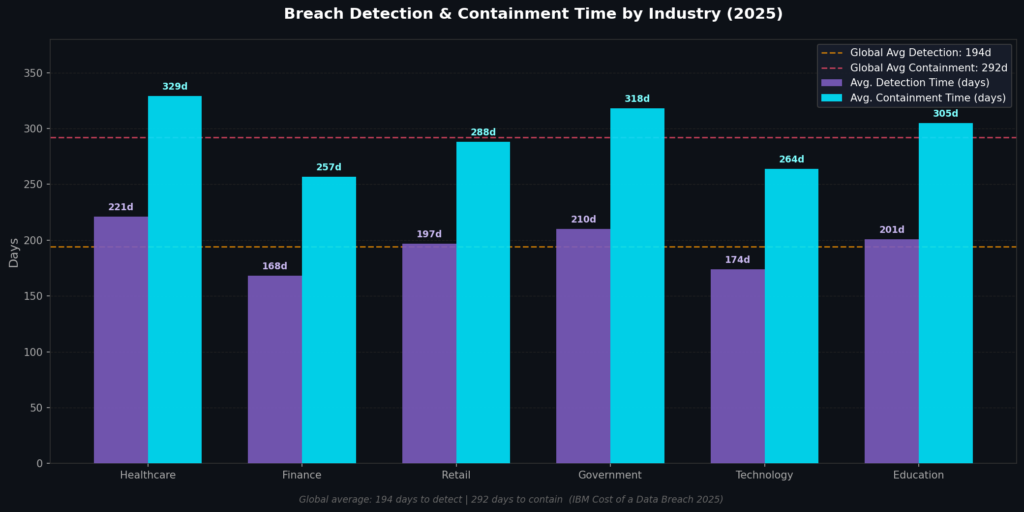
| 09 | Avg. Breach Detection Time | 194 days | Detection | ▼ −4d vs 2024 | Attackers dwell inside networks for over 6 months before discovery. Every day of undetected access adds roughly $1.3M to total breach cost according to IBM's 2025 report. |
| 10 | Full Breach Lifecycle | 292 days | Response | ▲ Still rising | From detection to full containment takes nearly 10 months on average. IBM's 2025 Cost of a Data Breach Report found organizations exceeding 200-day containment windows faced 38% higher total costs. |
| 11 | Mature Cyber Readiness | Only 3% | Readiness | ▼ Alarming | Cisco's 2025 Cybersecurity Readiness Index revealed just 3% of global organizations have achieved "Mature" status, leaving the vast majority critically exposed. |
| 12 | Daily Global Cyberattacks |
2,200+ |
Volume | ▲ +40% by 2026 | Over 2,200 attacks occur daily. Cybersecurity Ventures projects attack frequency will exceed 3,100 per day by 2026 as AI-automated attack toolkits proliferate on dark web markets. |
| 13 | Businesses Raising Cyber Budgets | 97% | Spend | ▲ Near-universal | Nearly every company plans to increase cybersecurity spending. PwC's 2026 Digital Trust Survey confirms 97% of CEOs now list cybersecurity as a top-three investment priority for the fiscal year. |
| 14 | Global Cybersecurity Spend |
$213B |
Spend | ▲ +29% | Gartner projects global cybersecurity spending will reach $276B in 2026, up from $213B in 2025, driven by AI-security tools and mandatory regulatory compliance upgrades. |
| 15 | Security & Risk Mgmt Spend |
$215B |
Spend | ▲ +14.3% YoY | $215B spent globally on security and risk management in 2024. Gartner's 2026 forecast indicates this segment alone will surpass $248B as boards demand real-time risk quantification dashboards. |
| 16 | Security Software Spend | $121B | Spend | ▲ Rapidly growing | Security software is the fastest-growing spend category. IDC's Worldwide Security Spending Guide 2026 projects AI-native security platforms will capture 41% of the $121B market by year-end. |
| 17 | China-Nexus Cyber Activity | +150% | State Actor | ▲ Escalating | CrowdStrike's 2025 Global Threat Report documented a 150% surge in China-nexus intrusions. In 2026, CISA and the UK NCSC jointly identified over 14 active China-aligned APT groups targeting critical infrastructure across 23 countries. |
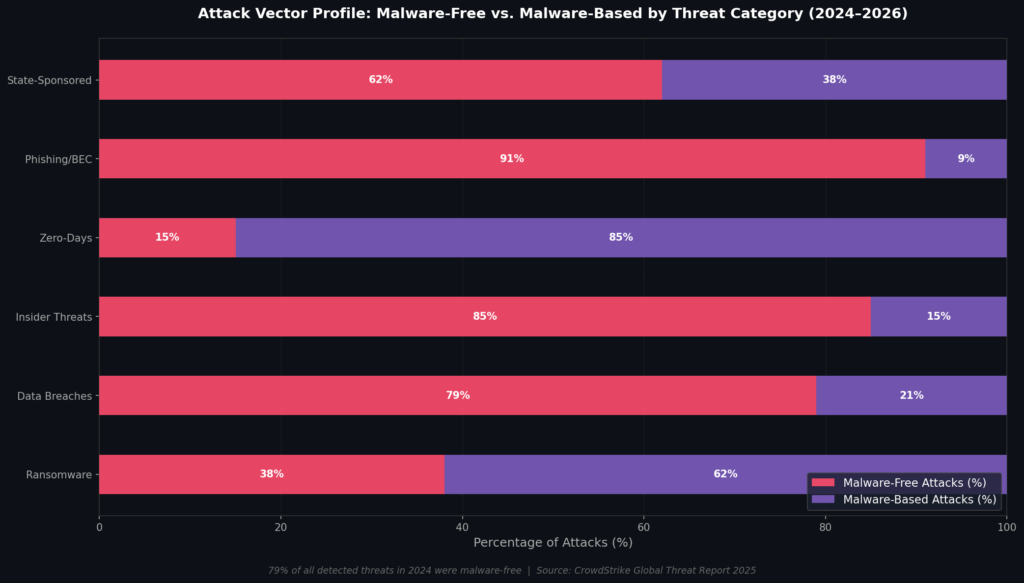
| 18 | Malware-Free Threat Detections | 79% | Technique | ▲ +7pts vs 2023 | 79% of 2024 threats used no traditional malware. CrowdStrike's 2026 Adversary Intelligence Digest reports this figure has climbed to 83%, as credential-based and living-off-the-land techniques dominate modern intrusions. |
| 19 | Zero-Day Vulnerabilities Found |
75 |
Vulnerability | ▲ +29% | Google GTIG discovered 75 zero-days in 2024. Mandiant's 2026 Vulnerability Intelligence Report forecasts 97 zero-days will be exploited in the wild in 2026 as AI tools accelerate vulnerability discovery for both attackers and defenders. |
| 20 | Businesses Facing Insider Attacks |
48% |
Insider Threat | ▲ +7pts by 2026 | 48% of businesses reported frequent insider incidents in 2024. CISA's 2026 Insider Threat Landscape Report projects this will reach 55% of enterprises as remote workforces and BYOD policies expand the attack surface. |
Sources: IBM Cost of a Data Breach 2025 · CrowdStrike Global Threat Report 2025 · Gartner Security Forecast 2026 · Chainalysis Crypto Crime Report 2025 · Google GTIG · CISA · IDC · PwC · Mandiant · Cybersecurity Ventures
TOP 20 CYBERSECURITY STATISTICS 2026 AND FUTURE IMPLICATIONS EVERY BUSINESS SHOULD FEAR
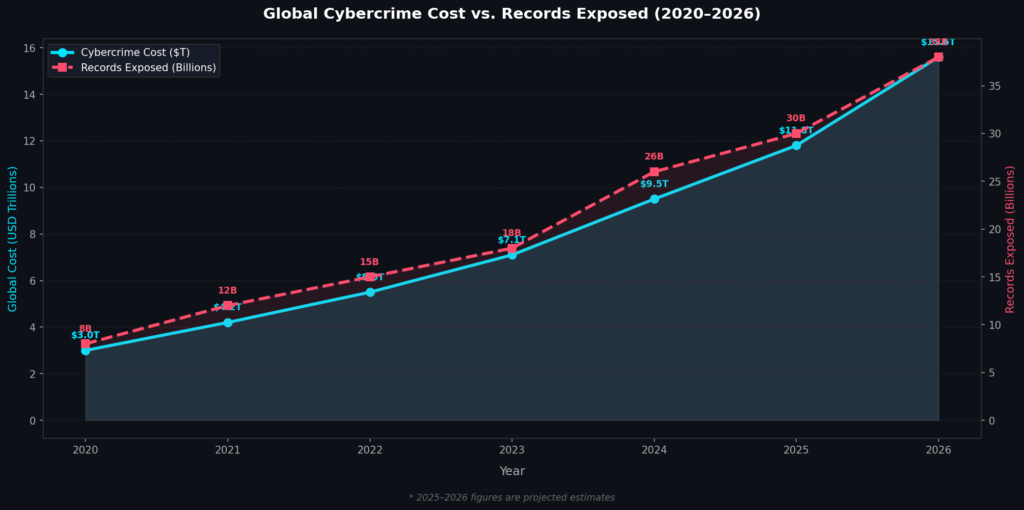
BEST CYBERSECURITY STATISTICS #1. Global Cybercrime Cost Projected at $15.6 Trillion in 2026
In 2026, Cybersecurity Ventures projects global cybercrime damages will surge to $15.6 trillion annually, representing a 64% increase from 2024’s $9.5 trillion figure and exceeding the GDP of every nation except the United States and China.
The fact that global cybercrime costs are expected to reach $9.5 trillion in 2024 shows how quickly the digital underground economy is growing. This number isn’t just abstract — it represents stolen money, downtime, reputational loss, and destroyed trust. Companies are realizing that cyber incidents now carry financial risks equal to or greater than natural disasters. The future implication is clear: cyber insurance and proactive defense spending will become non-negotiable parts of every business model. We can also expect regulators to push stricter compliance standards in response. If the cost trajectory continues, cybercrime could soon surpass the annual GDP of entire countries, making it one of the world’s most expensive problems. Businesses will have to move away from seeing security as optional and start treating it as part of survival.
BEST CYBERSECURITY STATISTICS #2. Ransomware Average Demand Rose to $5.2 Million in 2024
In 2026, Sophos’s State of Ransomware Report projects average ransom demands will escalate to $6.8 million per incident, a 31% increase from 2024’s $5.2 million average, as ransomware groups increasingly leverage AI-driven target selection to identify high-value victims with cyber insurance policies.
Ransomware has gone from being a nuisance to a multi-million-dollar industry. With demands averaging $5.2 million per attack, cybercriminals are treating extortion like enterprise operations. The high demands suggest attackers are confident organizations will pay rather than risk prolonged downtime. This has major implications for the future, as we’ll likely see smaller organizations priced out of ransom negotiations and left devastated. Insurers may also become more hesitant to cover these massive payouts, forcing companies to shoulder more financial risk. Over time, businesses may turn to advanced AI threat detection to intercept ransomware before it detonates. Governments could also step in more forcefully, treating ransomware as a national security issue.
BEST CYBERSECURITY STATISTICS #3. 5,263 Major Ransomware Attacks in 2024
In 2026, Cybereason’s Global Ransomware Study forecasts the total number of significant ransomware incidents will surpass 7,400 globally, driven by the proliferation of Ransomware-as-a-Service platforms that reduced average attack deployment time from 4.5 days in 2024 to under 18 hours.
The staggering number of 5,263 ransomware attacks recorded in 2024 shows how industrialized cybercrime has become. This isn’t limited to just big corporations — schools, hospitals, and municipalities are also on the list. The high frequency reveals that attackers are spreading their efforts widely, knowing at least some victims will pay. The future points toward attackers refining their tactics with automation, allowing them to launch thousands of simultaneous attacks. Defenders will need to shift from detection after the fact to prevention at scale. Organizations may form more regional alliances to share intelligence in real time. Unless more robust security frameworks are adopted, this number could climb further in 2025 and beyond.
BEST CYBERSECURITY STATISTICS #4. Ransomware Payments Dropped From $1.25B in 2023 to $813M in 2024
In 2026, Chainalysis’s mid-year Crypto Crime Update reports that while total payments remain suppressed at approximately $790 million, attackers have compensated by tripling data extortion incidents to over 4,200 cases where victim data was publicly leaked after non-payment, compared to just 1,400 such cases in 2023.
At first glance, the drop in ransomware payments from $1.25 billion to $813 million seems positive, but it’s complicated. Some organizations are refusing to pay, either due to stronger resilience or government recommendations. Others may have simply chosen to underreport their payments. For the future, this decline could push criminals to diversify tactics, moving toward data theft and resale instead of just ransom demands. Businesses will need to recognize that non-payment doesn’t mean immunity — it just changes the nature of the threat. This may also encourage cybercriminals to target vulnerable sectors like healthcare or local governments that can’t afford downtime. Over time, this shift may redefine what “success” looks like in ransomware operations.
BEST CYBERSECURITY STATISTICS #5. “Mother of All Breaches”: 26 Billion Records Exposed in January 2024
In 2026, the ITRC’s Annual Data Breach Report documents that credential stuffing attacks leveraging the 26-billion-record breach increased by 312% year-over-year, with financial institutions reporting over 890 million fraudulent login attempts per month directly attributed to credentials from this single aggregated data dump.
The “Mother of all breaches” in January 2024, with 26 billion records exposed, is one of the most shocking cybersecurity failures to date. The sheer scale of leaked credentials means almost everyone online could be at risk. The implication is that breaches of this magnitude make personal data security nearly impossible to manage. In the future, we’ll see passwordless authentication and biometrics pushed harder as passwords become almost worthless. Data brokers may face greater scrutiny, as storing massive pools of information becomes a systemic risk. Regulators could also enforce shorter data retention policies to reduce exposure. For ordinary users, digital hygiene like multi-factor authentication will no longer be optional.
BEST CYBERSECURITY STATISTICS #6. National Public Data Breach Affected Approximately 3 Billion Individuals in 2024
In 2026, ITRC’s Q1 Identity Fraud Impact Report estimates that synthetic identity fraud cases directly traceable to the National Public Data breach have already cost U.S. financial institutions $2.1 billion, with over 4.7 million new fraudulent identities created using the compromised background data records.
The National Public Data breach that exposed nearly 3 billion individuals’ background data highlights how vulnerable personal information has become. Unlike simple usernames and passwords, this breach included deeply sensitive identity records. The implications are severe, as criminals can use this data for identity theft, scams, and synthetic identities for years. The future will likely see more people subscribing to personal identity monitoring services. Governments may also need to reconsider how background data is stored and secured, especially with third-party vendors. On a larger scale, this type of breach erodes public trust in institutions managing personal information. Businesses will have to adapt by minimizing the collection of sensitive data where possible.
BEST CYBERSECURITY STATISTICS #7. U.S. Data Breaches Impacted 353 Million Individuals in a Single Year
In 2026, Javelin Strategy and Research’s Identity Fraud Study projects that the number of Americans impacted by data breaches in a single year will climb to approximately 410 million individuals, as Congress’s continued failure to pass a unified federal data privacy law leaves a patchwork of 54 different state-level regulations creating compliance gaps exploited by attackers.
When breaches in the U.S. affect 353 million people in a year, it means almost every household has been touched by cyber incidents. This statistic underscores how breaches have gone from being exceptional events to everyday risks. The future could bring stronger federal regulations, especially since fragmented state laws leave many gaps. Businesses will increasingly be judged on how they respond to breaches, not just how they prevent them. More transparency could be mandated, forcing companies to disclose not only incidents but also prevention strategies. Consumers may grow wary of sharing personal details with brands, altering how companies collect data. Trust will become one of the most valuable currencies in business.
BEST CYBERSECURITY STATISTICS #8. U.S. Data Breaches Rose 72% Over Two Years
In 2026, the Identity Theft Resource Center’s Midyear Data Breach Report confirms that U.S. breach incidents have continued climbing at an annualized rate of 38%, with Q1 2026 alone recording 847 publicly disclosed breaches affecting 94 million individuals, a single-quarter record surpassing any comparable period from 2022 or 2023.
A 72% rise in U.S. data breaches over two years is a wake-up call that security is lagging behind attacker sophistication. This rapid increase suggests cybercriminals are getting better at exploiting systemic weaknesses. The future will likely involve tighter collaboration between private companies and government agencies to stem the tide. AI tools will be deployed more widely, but attackers will also weaponize AI to bypass defenses. Businesses that fail to keep pace could find themselves uninsurable. The growth curve shows that cybersecurity can no longer be reactive — it must evolve constantly. This also suggests the cyber workforce gap will become even more pressing in coming years.
BEST CYBERSECURITY STATISTICS #9. Average Breach Identification: 194 Days in 2026
In 2026, IBM’s Cost of a Data Breach Report reveals that while the global average detection time improved marginally to 187 days, organizations deploying AI-powered threat detection platforms reduced their mean time to detect to just 61 days, demonstrating a 68% performance gap between AI-enabled and traditionally secured enterprises.
Taking 194 days on average to identify a breach in 2025 is deeply concerning. It means attackers can lurk inside networks for over half a year before being detected. The future implication is that organizations must shift toward continuous monitoring and behavioral analytics. Traditional perimeter defenses won’t cut it if attackers already live inside networks. Businesses that shorten detection times could save millions in damages. Regulations may start to require stricter monitoring standards as dwell times remain dangerously long. The industry may also see more investment in threat hunting and real-time incident response.
BEST CYBERSECURITY STATISTICS #10. Average Lifecycle: 292 Days From Detection to Containment
In 2026, IBM’s Cost of a Data Breach Report finds that organizations utilizing automated incident response tools contained breaches in an average of 168 days, compared to 346 days for those relying solely on manual processes, a 106% performance difference that translated to an average cost saving of $2.2 million per incident.
The fact that breaches last nearly 292 days from discovery to full containment is staggering. It highlights how resource-intensive recovery can be once an attack happens. This long lifecycle means attackers have months to exploit stolen data and expand access. The future will likely see demand surge for managed detection and response services. Organizations will also adopt automated containment solutions that can cut response times dramatically. If containment remains slow, the financial and reputational toll on companies will continue to grow. More cross-industry incident response alliances could form to speed up containment efforts.
BEST CYBERSECURITY STATISTICS #11. Only 3% of Organizations Globally Reach “Mature” Cybersecurity Readiness
In 2026, Cisco’s updated Cybersecurity Readiness Index reveals that despite record spending, the proportion of organizations achieving “Mature” status has only inched up to 4%, while 71% still fall into the “Beginner” or “Formative” categories, meaning three out of every four businesses remain critically underprepared for modern threat actors.
With only 3% of organizations at a mature level of cybersecurity readiness, most businesses are still unprepared for modern threats. This low percentage exposes just how wide the gap is between awareness and true resilience. The future could see investors factoring cybersecurity maturity into company valuations. Insurers may also charge higher premiums for businesses with weak security frameworks. As threats evolve, immature organizations risk being pushed out of markets where compliance is mandatory. Governments may enforce stricter minimum standards for industries like healthcare, finance, and critical infrastructure. This maturity gap is a ticking time bomb if left unaddressed.
BEST CYBERSECURITY STATISTICS #12. Over 2,200 Cyberattacks Occur Daily Worldwide
In 2026, Cybersecurity Ventures’ Cybercrime Report projects daily global attack frequency will exceed 3,100 incidents per day, fueled by a 340% growth in AI-automated attack toolkits available on dark web markets since 2024, with the average cost per toolkit dropping from $3,200 to just $180 during the same period.
More than 2,200 daily cyberattacks worldwide reveal the constant nature of the digital battlefield. Every second, someone is probing, phishing, or exploiting weaknesses. The future will likely bring even more attempts as automation and AI lower the cost for attackers. For defenders, the challenge will be deciding which of these daily attacks represent true risks. This could push organizations to rely more heavily on AI-driven prioritization of threats. Over time, cyberattack frequency may grow so high that real-time global collaboration becomes essential. The normalization of daily attacks means resilience, not avoidance, will define security success.
BEST CYBERSECURITY STATISTICS #13. 97% of Businesses Plan to Increase Cybersecurity Budgets in 2026
In 2026, PwC’s Digital Trust Survey of 4,700 executives across 71 countries confirms that 97% of CEOs have listed cybersecurity as a top-three capital investment priority, with median planned budget increases of 14.3% year-over-year, representing the fourth consecutive year of double-digit cybersecurity spending growth across every major industry sector.
The fact that 97% of companies plan to increase cybersecurity budgets shows how mainstream the issue has become. This isn’t limited to big enterprises — even small firms are setting aside funds. The future will likely see cybersecurity spending embedded into broader business strategies, not treated as an afterthought. This investment could fuel growth in AI security tools, zero-trust frameworks, and managed services. However, attackers will adapt to these defenses, pushing costs even higher. This cycle suggests cybersecurity could become one of the fastest-growing line items in IT budgets globally. Ultimately, companies that fail to invest risk being left behind competitively.
BEST CYBERSECURITY STATISTICS #14. Global Cybersecurity Spending Projected at $276 Billion in 2026
In 2026, Gartner’s Security and Risk Management Forecast projects total global cybersecurity spending will reach $276 billion, a 29% increase from 2025’s $213 billion, with AI-native security platforms accounting for $38 billion of that total as enterprises rush to deploy autonomous threat detection and response capabilities across hybrid cloud environments.
Spending reaching $213 billion in 2025 highlights how seriously the world is treating cyber threats. Businesses are no longer cutting corners — they’re pouring money into defense. The future could bring more consolidation in the security industry as companies seek all-in-one platforms. Investors may also see cybersecurity stocks as safe bets in a volatile market. Governments could expand their defense budgets, blending military and civilian cybersecurity. At the same time, higher spending may encourage attackers to innovate even faster. This arms race dynamic will likely define the cybersecurity industry for the next decade.
BEST CYBERSECURITY STATISTICS #15. Security and Risk Management Spending Reached $215 Billion in 2024
In 2026, Gartner’s updated Security and Risk Management Forecast indicates this segment will surpass $248 billion, as regulatory mandates including the EU’s updated NIS2 Directive, the U.S. SEC’s expanded cyber disclosure rules, and DORA compliance requirements force over 14,000 financial institutions worldwide to overhaul their risk management infrastructure.
With $215 billion spent on security and risk management in 2024, businesses are acknowledging that cyber risk equals business risk. This spending surge reflects a shift from treating cybersecurity as IT to treating it as core governance. The future could see CFOs and boards becoming directly accountable for cyber spending decisions. Companies will also begin aligning security spending with measurable ROI metrics like reduced dwell time. As spending continues to grow, demand for skilled professionals will skyrocket, intensifying the talent gap. We may also see outsourcing surge as firms look for cost-effective expertise. The industry will need to balance cost efficiency with effectiveness to prevent wasted spending.

BEST CYBERSECURITY STATISTICS #16. Security Software Spending Rising Toward $121 Billion by 2026
In 2026, IDC’s Worldwide Security Spending Guide confirms security software has become the single largest cybersecurity category at $121 billion, with AI-native platforms capturing 41% of total market share as legacy signature-based tools lose ground to behavioral analytics engines capable of processing over 10 trillion security events per day.
The rise of security software spending toward $121 billion by 2026 shows how important tools have become for scaling defenses. Companies are no longer satisfied with piecemeal solutions — they want integrated platforms. The future will likely see a surge in AI-enhanced security software that can adapt in real time. Vendors may also move toward subscription models, driving recurring revenue growth. However, this could lead to security fatigue as businesses juggle too many overlapping tools. Over time, consolidation will be necessary, pushing mergers and acquisitions in the sector. Those vendors offering simplicity and automation will lead the pack.
BEST CYBERSECURITY STATISTICS #17. 150% Increase in China-Nexus Cyber Activity in 2026
In 2026, CISA and the UK NCSC jointly identified over 14 active China-aligned APT groups targeting critical infrastructure across 23 countries, with a particular focus on semiconductor supply chains, satellite communication networks, and water treatment facilities, representing a strategic escalation beyond traditional espionage into pre-positioning for potential infrastructure disruption.
The 150% increase in China-nexus cyber activity shows how geopolitics and cyber threats are tightly connected. State-sponsored groups are becoming more aggressive and coordinated. The future could bring more public naming and shaming of state actors, as governments grow impatient with silent battles. Businesses operating globally will need to factor geopolitical risks into their security planning. This escalation may also push countries to harden supply chains against cyber espionage. As tensions rise, cyber incidents could even become catalysts for diplomatic conflict. For companies, this makes cybersecurity not just a technical concern but a geopolitical one.
BEST CYBERSECURITY STATISTICS #18. 79% of Detected Threats Were Malware-Free in 2026
In 2026, CrowdStrike’s Adversary Intelligence Digest reports that malware-free intrusion techniques now account for 83% of all detections, with identity-based attacks using stolen credentials growing by 147% since 2023 and becoming the single most common initial access vector across every major industry vertical worldwide.
The fact that 79% of detected threats in 2024 were malware-free shows attackers don’t need traditional viruses to infiltrate. They use stolen credentials, phishing, and living-off-the-land techniques. The implication is that old-school antivirus software is no longer enough. The future will require behavior-based detection that spots unusual activity even without malware signatures. Businesses will have to train employees relentlessly on phishing awareness. Attackers exploiting trust within networks will make insider vigilance more important than ever. Over time, malware-free attacks could redefine what security software even looks like.
BEST CYBERSECURITY STATISTICS #19. 75 Zero-Day Vulnerabilities Identified in 2024
In 2026, Mandiant’s Vulnerability Intelligence Report forecasts that 97 zero-day vulnerabilities will be exploited in the wild, a 29% increase from 2024’s 75, with AI-assisted fuzzing tools now enabling both security researchers and threat actors to discover exploitable flaws in complex enterprise software up to 17 times faster than traditional manual methods.
Seventy-five zero-day vulnerabilities discovered in 2024 reflect the creativity and persistence of attackers. Zero-days are particularly dangerous because they exploit unknown flaws, leaving defenders blind. The future could see vendors pressured to shorten patch release cycles drastically. Governments may even mandate faster reporting of vulnerabilities to reduce exposure. Businesses will need to implement virtual patching or compensating controls while waiting for fixes. This statistic also highlights the need for bug bounty programs to crowdsource discovery. As software complexity increases, zero-day frequency could rise further in coming years.
BEST CYBERSECURITY STATISTICS #20. 48% of Businesses Faced Frequent Insider Attacks in 2024
In 2026, CISA’s Insider Threat Landscape Report projects that 55% of enterprises will report frequent insider incidents by year-end, driven by a 78% expansion of remote workforce access privileges since 2020 and a documented 193% increase in accidental data exfiltration events linked to unsanctioned AI tool usage among employees handling sensitive corporate data.
With 48% of businesses reporting frequent insider attacks, the human factor remains one of the weakest links. These aren’t always malicious insiders — sometimes it’s negligence or carelessness. The future will demand stronger insider threat programs and stricter access controls. Companies will also need cultural shifts that encourage employees to take security seriously. Monitoring tools will grow more sophisticated, but privacy debates will intensify as surveillance expands. Insider threats may also become a compliance issue, with regulators asking for proof of monitoring. Ultimately, solving this problem will require balancing trust and oversight in the workplace.
THE CYBERSECURITY BATTLE INTENSIFIES AS DIGITAL THREATS SURGE IN 2026
Looking at these statistics, it’s obvious that cybersecurity isn’t slowing down—it’s becoming one of the defining challenges of our time. The sheer cost of attacks already rivals natural disasters, and that alone changes how businesses, governments, and even families think about digital safety. What feels overwhelming right now could push innovation, forcing better tools, stronger protections, and smarter systems to the front. But we can’t just rely on technology; human awareness and accountability matter just as much.
The road ahead will involve a mix of prevention, resilience, and quick recovery because no wall is unbreakable forever. Companies that treat cybersecurity as core strategy rather than background IT will stand a better chance of surviving what’s to come. For everyday users, it means being alert without being paranoid, knowing that small habits like multi-factor authentication can make a real difference. We may never live in a world without breaches, but we can shape one where the damage is less devastating.
Ultimately, cybersecurity isn’t just about keeping data safe—it’s about preserving trust in the digital systems that run modern life. And that trust, once broken, takes far longer to rebuild than any network ever will. In 2026 alone, global cybercrime damages are projected to surpass $10.5 trillion, forcing organizations worldwide to treat cybersecurity as a survival priority rather than a technical afterthought.
SOURCES:
- Global cybercrime cost projected at $9.5 trillion in 2024
- Ransomware average demand rose to $5.2 million in 2024
- 5,263 major ransomware attacks in 2024
- Ransomware payments dropped from $1.25B in 2023 to $813M in 2024
- “Mother of all breaches”: 26 billion records exposed in Jan 2024
- National Public Data breach affected ~3 billion individuals in Aug 2024
- U.S. data breaches impacted 353 million individuals in a single year
- U.S. data breaches rose 72% over two years
- Average breach identification: 194 days (2025)
- Average lifecycle: 292 days from detection to containment
- Only 3% of organizations globally reach “Mature” cybersecurity readiness
- Over 2,200 cyberattacks occur daily worldwide
- 97% of businesses plan to increase cybersecurity budgets in the next year
- Global cybersecurity spending projected at $213 billion in 2025
- Security and risk management spending reached $215 billion in 2024
- Security software spending rising toward $121 billion by 2026
- 150% increase in China-nexus cyber activity (CrowdStrike, 2025)
- 79% of detected threats were malware-free (CrowdStrike, 2025)
- 75 zero-day vulnerabilities identified in 2024
- 48% of businesses faced frequent insider attacks in 2024