



26 Sep TOP 20 DEEP LEARNING MARKETING STATISTICS 2025
As I’ve been diving deeper into the world of data-driven strategies, I couldn’t help but notice how much of an impact deep learning is making on modern marketing. These deep learning marketing statistics really show how businesses are reshaping everything from personalization to campaign performance with smarter algorithms and predictive insights. For me, what stands out the most is how fast this technology is becoming a must-have rather than a “nice to have.” Working alongside a marketing agency in New York, I’ve seen firsthand how brands that embrace deep learning are pulling ahead with more accurate targeting and stronger ROI. That’s why I wanted to put together this collection of key stats—to give a clear picture of where the future of marketing is heading.
Top 20 Deep Learning Marketing Statistics 2025 (Editor’s Choice)
| # | Deep Learning Marketing Statistic | Details |
|---|---|---|
| 1 | Global Market Size 2024 | Deep learning market valued at USD 96.8B, projected to reach USD 526.7B by 2030 (CAGR 31.8%). |
| 2 | Forecast 2025–2032 | Market to grow from USD 34.28B in 2025 to USD 279.6B in 2032 (CAGR 35%). |
| 3 | 2023 Valuation | Market stood at USD 19.8B in 2023, expected CAGR ~30.4% to 2032. |
| 4 | AI Marketing Size | Marketing-AI segment worth USD 47.3B in 2025, growing at 36.6% CAGR. |
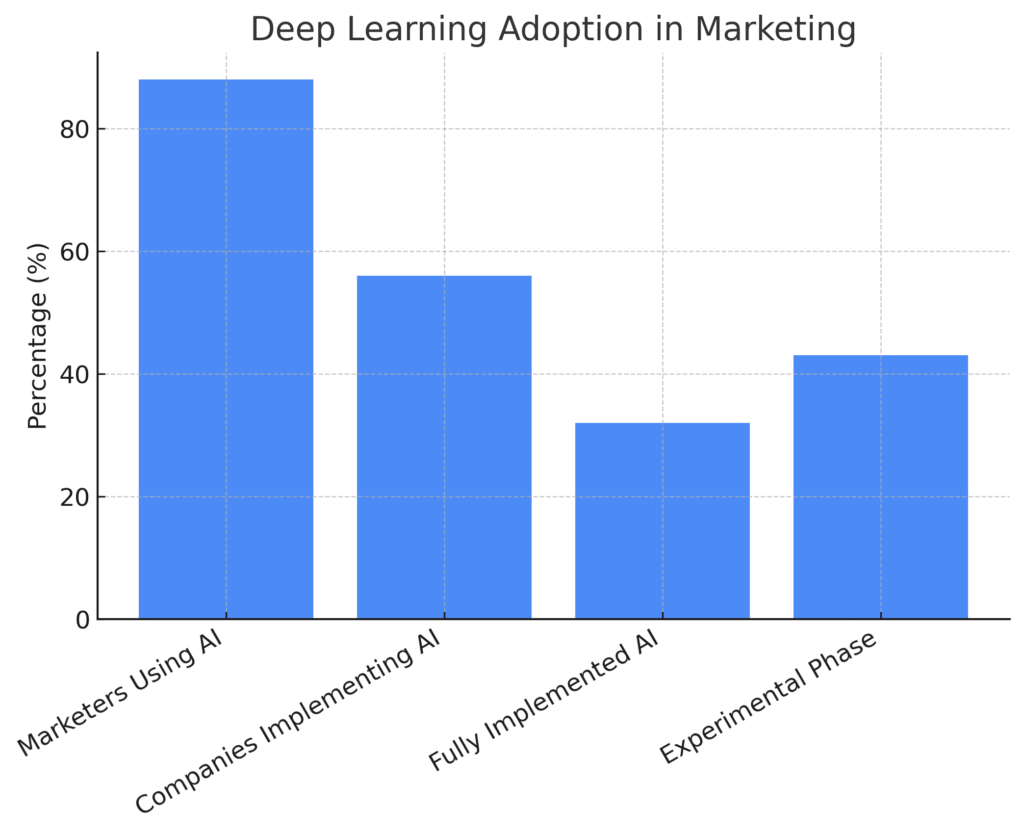
| 5 | Marketer Adoption | 88% of marketers report using AI in their daily workflows. |
| 6 | Company Adoption | 56% of marketers say their company actively implements AI. |
| 7 | Implementation Levels | 32% fully implemented AI; 43% still experimenting. |
| 8 | Content Optimization | 51% use AI to optimize SEO, email, and marketing content. |
| 9 | Personalization | 73% use AI to deliver personalized customer experiences. |
| 10 | Automation | 43% of marketers automate repetitive tasks with AI. |
| 11 | Generative AI Use | 27% of businesses use it org-wide; 33% limit to departments/projects. |
| 12 | Failure Rate | 42% of AI initiatives abandoned; 46% fail between pilot and adoption. |
| 13 | Sales ROI Impact | AI adopters report 10–20% improvement in sales ROI. |
| 14 | Retailer Growth | Retailers using AI saw two-digit sales growth and ~8% profit lift. |
| 15 | RTB House Campaigns | Deep learning retargeting improved campaigns by 41–50% vs. traditional ML. |
| 16 | Attribution Models | Deep neural nets with attention outperform basic attribution methods. |
| 17 | Causal Learning Impact | Deep learning models boosted cost efficiency by 24.6% vs. best prior methods. |
| 18 | Safety Concerns | 39% of marketers unsure how to safely use generative AI. |
| 19 | Training Gap | 70% say employers provide no training on AI tools. |
| 20 | Quality Concerns | 31% cite accuracy/quality concerns as top barrier to adoption. |
Top 20 Deep Learning Marketing Statistics 2025
Deep Learning Marketing Statistics #1: Global Market Size 2024
The global deep learning market was valued at USD 96.8 billion in 2024, highlighting its rapid rise as a technology powerhouse. This growth reflects the increasing reliance of businesses on deep learning for automation, marketing insights, and customer engagement. Forecasts suggest the market could hit USD 526.7 billion by 2030, showing extraordinary potential for expansion. Such strong momentum proves that companies investing in deep learning tools are positioning themselves for a competitive edge. For marketers, this means access to more advanced tools that can uncover insights and drive ROI.
Deep Learning Marketing Statistics #2: Forecast 2025–2032
From 2025 onward, the deep learning market is expected to surge from USD 34.28 billion to an astonishing USD 279.6 billion by 2032. This consistent growth is tied to the integration of AI into everyday marketing processes. For businesses, it highlights the urgency of adopting deep learning sooner rather than later. Marketers who delay risk falling behind as competitors leverage the power of predictive analytics and personalization. The stat underscores how crucial the next decade will be in defining winners in the marketing landscape.
Deep Learning Marketing Statistics #3: 2023 Valuation
In 2023, the global deep learning market stood at USD 19.8 billion, setting the stage for unprecedented growth. A projected CAGR of 30.4% through 2032 emphasizes just how quickly adoption is accelerating. For marketers, this represents more than just numbers—it’s a sign that AI-based campaigns are moving from experimental to essential. Businesses are increasingly confident about investing in AI-driven solutions that prove measurable results. This turning point demonstrates how deep learning is transitioning into the backbone of digital marketing.
Deep Learning Marketing Statistics #4: AI Marketing Size
By 2025, the AI marketing segment itself is projected to be worth USD 47.3 billion. This figure shows how much marketing alone contributes to the overall AI and deep learning ecosystem. A CAGR of 36.6% reinforces the expanding role of these technologies in campaign management and optimization. Marketers are tapping into this growth to refine customer journeys with data-driven accuracy. The stat highlights how AI marketing has evolved into a thriving market of its own.
Deep Learning Marketing Statistics #5: Marketer Adoption
An impressive 88% of marketers already report using AI in their daily work. This adoption highlights how AI-powered tools, such as chatbots, personalization engines, and recommendation systems, are becoming everyday essentials. The shift shows that deep learning is no longer a futuristic concept but a mainstream reality. For marketers, this means integrating deep learning into strategies is no longer optional. It’s a reminder that to stay competitive, embracing AI is a necessity rather than a luxury.

Deep Learning Marketing Statistics #6: Company Adoption
56% of marketers confirm their companies actively implement AI technologies. This figure emphasizes that businesses are seeing tangible results and are confident in scaling these technologies. For marketing teams, company-wide adoption means access to more resources and consistent AI strategies. It also highlights leadership support, which is critical for success. This stat signals that deep learning adoption is moving beyond small test projects into large-scale integration.
Deep Learning Marketing Statistics #7: Implementation Levels
Currently, 32% of organizations have fully implemented AI, while 43% are still in experimental phases. These numbers show the divide between early adopters and those testing the waters. For marketers, the advantage lies in moving from experimentation to full implementation sooner. Those who scale fast will be better equipped to personalize customer experiences and measure performance. This statistic illustrates the importance of being proactive in embracing AI.
Deep Learning Marketing Statistics #8: Content Optimization
51% of marketers now rely on AI for content optimization, including SEO and email marketing. This use case is one of the most practical and widely adopted applications of deep learning. It allows marketers to fine-tune campaigns for maximum engagement and conversion. AI’s ability to analyze large amounts of data ensures more accurate targeting than manual efforts. The stat demonstrates how deep learning directly improves day-to-day marketing efficiency.
Deep Learning Marketing Statistics #9: Personalization
73% of marketers say AI plays a role in creating personalized customer experiences. This highlights deep learning’s ability to deliver the right message to the right person at the right time. Personalization has become essential in standing out in crowded markets. For marketers, deep learning offers a competitive edge in building stronger customer relationships. This stat shows that personalization powered by AI is no longer optional but expected by consumers.
Deep Learning Marketing Statistics #10: Automation
43% of marketers use AI to automate repetitive tasks. These include scheduling, reporting, and campaign adjustments that once took hours of manual work. Automation allows professionals to focus on strategy and creativity instead of tedious processes. For companies, this translates to efficiency gains and cost savings. This statistic highlights deep learning’s ability to free up time and resources for higher-value activities.

Deep Learning Marketing Statistics #11: Generative AI Use
27% of businesses report organization-wide adoption of generative AI, while 33% limit its use to specific departments. This split shows that while enthusiasm is high, scaling across entire organizations is still a challenge. For marketers, the opportunity lies in pushing for broader adoption to maximize impact. Department-specific use may limit the consistency of AI-driven insights. The stat underscores how generative AI adoption is accelerating but still evolving.
Deep Learning Marketing Statistics #12: Failure Rate
42% of AI initiatives are abandoned before reaching production, and 46% fail between pilot and adoption. These numbers highlight the challenges in moving from theory to practice. For marketers, this emphasizes the need for careful planning, skilled teams, and ongoing training. It also shows that while the potential is huge, execution must be handled strategically. This stat is a reminder that adopting AI is not just about tools but about commitment and alignment.
Deep Learning Marketing Statistics #13: Sales ROI Impact
Companies adopting AI in marketing report a 10–20% improvement in sales ROI. This result proves that deep learning investments deliver measurable financial benefits. For marketers, it’s evidence that AI tools aren’t just about efficiency—they directly impact the bottom line. Businesses that leverage AI effectively are more likely to see improved profitability and growth. This stat reinforces the case for accelerating deep learning adoption.
Deep Learning Marketing Statistics #14: Retailer Growth
Retailers using AI technologies have seen two-digit sales growth and an 8% profit increase compared to peers. This showcases the transformative effect of AI on consumer-facing industries. For marketers, it emphasizes the importance of adopting deep learning to stay competitive in fast-moving markets. The stat also highlights AI’s ability to optimize everything from pricing to customer targeting. Retailers who ignore this trend risk being left behind.
Deep Learning Marketing Statistics #15: RTB House Campaigns
Deep learning-driven retargeting campaigns by RTB House improved effectiveness by 41–50%. This stat highlights how advanced models outperform traditional machine learning approaches. For marketers, it shows the concrete benefits of deep learning in digital advertising. Campaigns powered by neural networks deliver sharper targeting and better engagement. This proves that deep learning provides real-world improvements in campaign performance.

Deep Learning Marketing Statistics #16: Attribution Models
Deep neural nets with attention mechanisms have outperformed simpler attribution methods in marketing. This means marketers can better understand which touchpoints matter most in a customer’s journey. Improved attribution leads to smarter budget allocation and higher returns. For businesses, this translates to better campaign efficiency and reduced wasted spend. The stat shows deep learning’s role in solving complex challenges in marketing analytics.
Deep Learning Marketing Statistics #17: Causal Learning Impact
A deep learning-based approach to causal learning improved cost efficiency by 24.6% over previous best methods. This finding shows the strength of deep learning in optimizing decision-making. For marketers, it means more accurate campaign targeting and reduced wasted ad spend. Such innovations directly increase marketing effectiveness. The stat emphasizes how advanced deep learning methods are shaping the future of resource allocation.
Deep Learning Marketing Statistics #18: Safety Concerns
39% of marketers remain unsure about how to safely use generative AI. This highlights a knowledge gap even as adoption grows rapidly. For marketers, this uncertainty can slow down implementation and limit results. Companies need to invest in clearer guidelines and training to overcome these challenges. This stat reveals the importance of education in ensuring safe and effective AI use.
Deep Learning Marketing Statistics #19: Training Gap
70% of marketers report that their employers do not provide generative AI training. This lack of training creates barriers to maximizing AI’s potential. For marketers, it means navigating new tools largely on their own. Businesses that fail to invest in training risk falling behind competitors who do. This statistic stresses the importance of structured education programs to make AI adoption successful.
Deep Learning Marketing Statistics #20: Quality Concerns
31% of marketers cite accuracy and quality concerns as barriers to AI adoption. These issues stem from fears of incorrect insights or flawed outputs. For marketers, it highlights the need for monitoring and validation alongside automation. Businesses must ensure deep learning systems are reliable before scaling them broadly. This stat is a reminder that accuracy remains just as important as innovation in marketing.
Why These Deep Learning Marketing Statistics Matter
Looking over these numbers, it’s clear that deep learning isn’t just another passing trend—it’s a powerful shift in how marketing is done. Personally, I find it inspiring to see how brands are using this technology not only to increase conversions but also to genuinely understand their audiences on a deeper level. These deep learning marketing statistics remind us that adopting smarter tools now means building stronger connections tomorrow. My hope is that by sharing this, I’ve given you a practical snapshot of where things are going and how you can get ahead of the curve. If you’re ready to take the leap, leaning on the expertise of a trusted partner like a leading marketing agency in New York can help make the transition seamless and effective.
SOURCES
- https://www.fortunebusinessinsights.com/deep-learning-market-107801
- https://www.gminsights.com/industry-analysis/deep-learning-market
- https://www.surveymonkey.com/mp/ai-marketing-statistics/
- https://ahrefs.com/blog/ai-marketing-statistics/
- https://www.marketingaiinstitute.com/blog/deep-learning-in-digital-marketing
- https://www.marketingaiinstitute.com/2025-state-of-marketing-ai-report
- https://www.synthesia.io/post/ai-statistics
- https://www.salesforce.com/marketing/marketing-statistics/
- https://www.itransition.com/machine-learning/statistics
- https://professional.dce.harvard.edu/blog/ai-will-shape-the-future-of-marketing/
- https://www.sciencedirect.com/science/article/pii/S2666603022000136
- https://arxiv.org/abs/1809.02230
- https://arxiv.org/abs/2004.09702
- https://www.precedenceresearch.com/deep-learning-market
- https://www.sixthcitymarketing.com/ai-marketing-stats/
- https://www.hubspot.com/marketing-statistics
- https://www.salesforce.com/marketing/marketing-statistics/