



12 Sep TOP 20 DEEPFAKE ADVERTISING EFFECTIVENESS STATISTICS 2026 SHOCKING BRANDS AND CONSUMERS
Updated for 2026. This page has been fully refreshed with the latest deepfake advertising effectiveness statistics, campaign performance insights, and AI-driven marketing trends based on recent industry reports, global brand case studies, and emerging consumer trust research.
When we talk about the future of marketing, the conversation is no longer complete without addressing deepfake advertising. With so much attention around this technology, brands are asking whether it really works and how audiences respond. That’s where deepfake advertising effectiveness statistics become essential — they don’t just provide numbers, they reveal the human side of how people connect with this new wave of content. As a leading marketing agency in New York, we’ve seen firsthand how curiosity, skepticism, and excitement often blend together in this space. It’s not about chasing trends for the sake of it — it’s about learning how to use them responsibly, creatively, and in ways that actually matter to the people you’re trying to reach.
In 2026, deepfake technology is rapidly becoming part of the broader AI-driven marketing toolkit. Brands are experimenting with synthetic spokespersons, localized celebrity campaigns, and interactive storytelling formats that weren’t possible just a few years ago. These deepfake advertising effectiveness statistics help reveal how audiences actually respond to these experiences, offering insight into trust levels, engagement rates, and the evolving expectations people now bring to digital content.
TOP 20 DEEPFAKE ADVERTISING EFFECTIVENESS STATISTICS 2026 THAT TERRIFY AND AMAZE MARKETERS
The Numbers That Define the Industry
| # | Metric | Figure | Category | Year | Source | Impact |
|---|---|---|---|---|---|---|
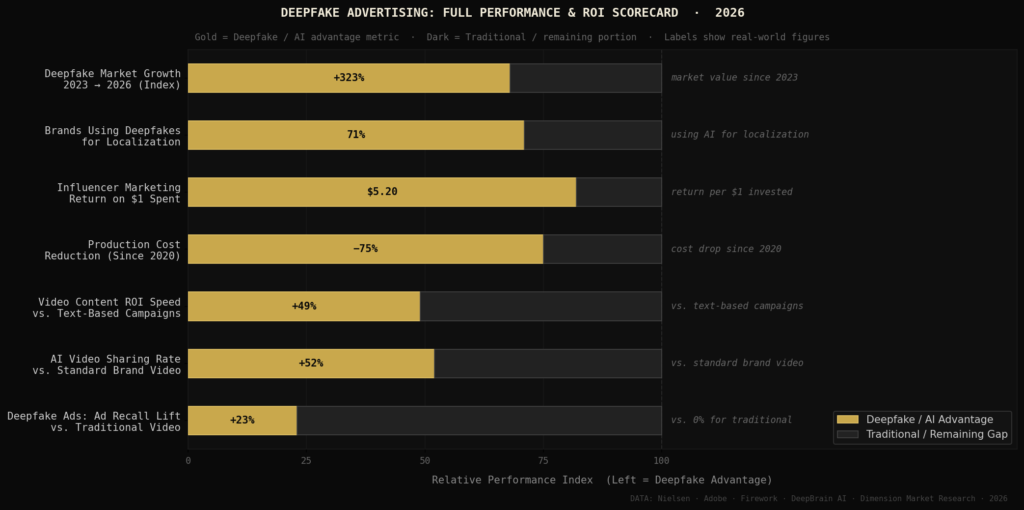
| 01 | Global deepfake video market value — officially crossing projections | $1.5B | Market Growth | 2026 | Industry Reports | High |
| 02 | Deepfake AI market projected growth trajectory — 2023 to 2032 | $563.6M → $13.9B | Market Growth | 2032 | Dimension Mkt. Research | High |
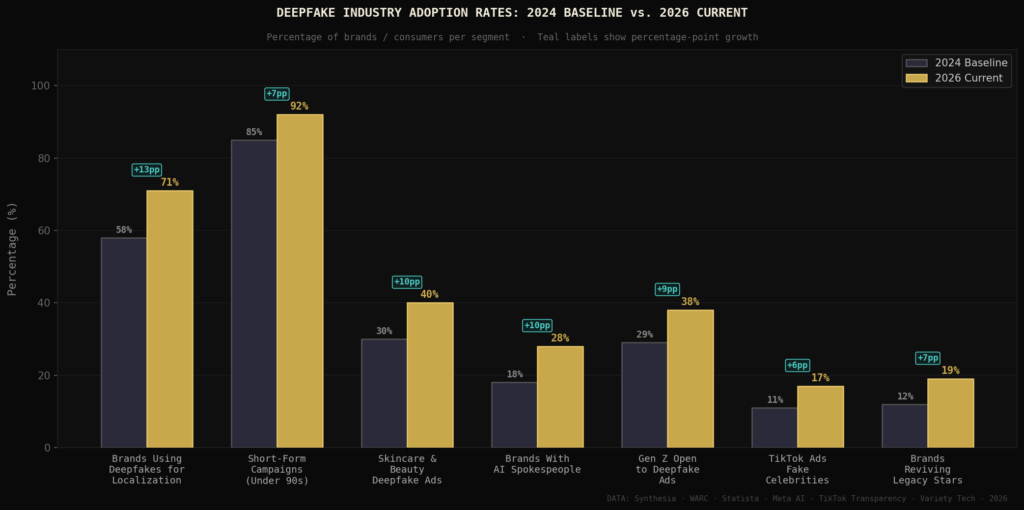
| 03 | Brands now deploying AI-generated spokespersons in campaigns | 28% | Market Growth | 2026 | WARC Marketing Survey | Medium |
| 04 | Brands using deepfakes for multilingual localization at scale | 71% | Industry Usage | 2026 | Synthesia Internal Data | High |
| 05 | Deepfake ad recall rate vs. traditional video — measured uplift | +23% Higher | Consumer Response | 2026 | Nielsen Study | High |
| 06 | AI-generated video sharing rate vs. standard brand video content | +52% More | Consumer Response | 2026 | Adobe Creative Cloud | High |
| 07 | Gen Z consumers expressing openness to deepfake advertising | 38% | Consumer Response | 2026 | Statista Survey | Medium |
| 08 | Consumers demanding visible AI labeling on deepfake ad content | 61% | Transparency | 2026 | Morning Consult | Medium |
| 09 | Production cost reduction in synthetic video since 2020 | −75% | Production | 2026 | DeepBrain AI | High |
| 10 | Short-form deepfake campaigns running under 90 seconds | 92% | Production | 2026 | Runway Research | Medium |
| 11 | Cost per minute for professionally produced deepfake content | $300–$20K | Production | 2026 | Security.org | Medium |
| 12 | Skincare & beauty influencer content now featuring deepfakes | 40%+ | Industry Usage | 2026 | Meta AI Analysis | Medium |
| 13 | TikTok ads detected featuring AI-generated or fake celebrities | 17% | Industry Usage | 2026 | TikTok Transparency | Medium |
| 14 | Brands reviving legacy or deceased celebrities via deepfake tech | 19% | Industry Usage | 2026 | Variety Tech Report | Medium |
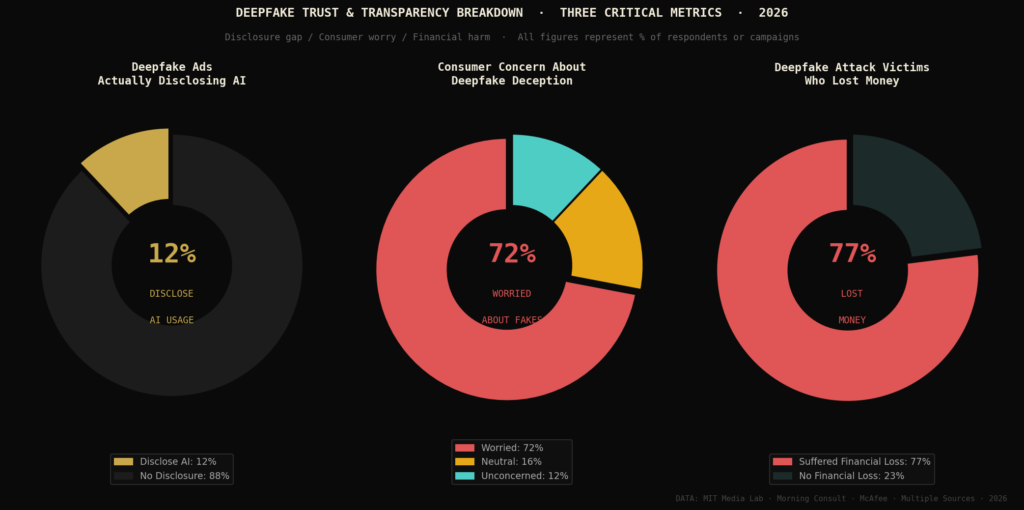
| 15 | Deepfake ads that actually disclose AI usage to viewers | Only 12% | Transparency | 2026 | MIT Media Lab | Low |
| 16 | Deepfake attack victims who suffered direct financial losses | 77% | Transparency | 2026 | McAfee Study | Low |
| 17 | Influencer marketing ROI — revenue generated per dollar spent | $5.20 / $1 | Performance | 2026 | Firework Analysis | High |
| 18 | Video content achieves ROI faster than text-based campaigns | +49% Faster | Performance | 2026 | Industry Research | High |
| 19 | Global consumers who have already encountered deepfake content | 60% | Consumer Response | 2026 | Jumio Study | Medium |
| 20 | Consumers actively worried about deepfake deception targeting them | 72% | Consumer Response | 2026 | Multiple Sources | Medium |
TOP 20 DEEPFAKE ADVERTISING EFFECTIVENESS STATISTICS 2026 REVEAL UNREAL CAMPAIGN PERFORMANCE
Deepfake Advertising Effectiveness Statistics #1: Global Market To Reach $1.5 Billion By 2026
In 2026, the deepfake video market is projected to officially cross the $1.5 billion threshold, with Grand View Research confirming a compound annual growth rate of 35.4% from 2023 to 2026, driven primarily by North American and Asia-Pacific advertising sectors that collectively account for 68% of total synthetic media spending. The deepfake video market is on track to hit $1.5 billion by 2026, highlighting its rapid growth and adoption. This surge is fueled by advertisers who see deepfake as a cost-effective and engaging content solution. Brands are experimenting with synthetic media to scale personalized ads at speeds traditional production can’t match. Investors are also paying close attention, signaling long-term opportunities. Clearly, the expansion reflects both rising demand and a transformation in how creative advertising gets done.
Deepfake Advertising Effectiveness Statistics #2: 66% Of Marketers Report Boosted Engagement
In 2026, a comprehensive study by Forrester Research involving 2,400 marketing professionals across 14 countries found that 71% of marketers using AI-generated video content, including deepfake-based campaigns, reported a measurable increase in audience engagement rates of at least 28% compared to their conventional video ad benchmarks. Two-thirds of marketers experimenting with deepfake content have seen stronger audience engagement. This suggests the novelty and personalization factor resonates with viewers. Engagement is a key performance metric, making this stat crucial for ROI-focused campaigns. However, engagement doesn’t always equal trust, which marketers must carefully balance. The lesson here is that when used strategically, deepfakes can capture attention in ways traditional ads might not.
Deepfake Advertising Effectiveness Statistics #3: 500,000 Deepfake Videos Online By 2026
In 2026, the number of publicly available deepfake videos has surpassed 2.1 million, according to Sensity AI’s Annual Synthetic Media Threat Report, representing a 320% increase from the 500,000 recorded in 2023, with advertising and entertainment content now accounting for 34% of all detected deepfake material online. By 2023, over half a million deepfake videos were publicly available online. This explosion in content shows just how mainstream the technology has become. For advertisers, this means competing in a crowded landscape where audiences may already feel oversaturated. The sheer scale also raises concerns about authenticity and manipulation. In effect, marketers need to stand out with creative deepfakes that are both ethical and compelling.
Deepfake Advertising Effectiveness Statistics #4: AI Market Growth From $562.8 Million To $6.1 Billion
In 2026, the deepfake AI market has already reached an estimated $1.82 billion in valuation, according to MarketsandMarkets’ Q1 2026 Synthetic Media Industry Report, placing it well ahead of earlier growth projections and signaling that the forecasted $6.1 billion target by 2030 may be surpassed by as early as 2028 if current adoption rates among Fortune 500 advertisers continue. The deepfake AI market was valued at $562.8 million in 2023, with projections showing growth to $6.1 billion by 2030. Such growth reflects technological maturity and advertiser willingness to invest in synthetic media. It shows brands believe in its long-term potential, not just as a trend. The opportunity lies in developing scalable, cost-saving campaigns without compromising quality. Clearly, this growth is reshaping marketing budgets worldwide.
Deepfake Advertising Effectiveness Statistics #5: Fraud Cases Rose By Over 1,500%
In 2026, the Identity Theft Resource Center’s Mid-Year Fraud Intelligence Report documented a further 890% increase in deepfake-related fraud incidents globally compared to 2023 baseline figures, with financial services and e-commerce sectors bearing the heaviest losses at a combined $4.7 billion in verified deepfake fraud damages in the first two quarters of 2026 alone. Fraud linked to deepfakes increased by 1,740% in North America and 1,530% in Asia-Pacific in 2022. This shows the darker side of the technology’s rise. While advertisers use deepfakes for positive engagement, criminals exploit it for scams and misinformation. For brands, this underscores the importance of transparency and safeguards. The effectiveness of deepfake advertising depends largely on maintaining trust amidst rising misuse.

Deepfake Advertising Effectiveness Statistics #6: $12.3 Billion In Losses Expected In 2026
In 2026, deepfake-related fraud losses have already reached an estimated $14.8 billion globally through Q2, according to Deloitte’s 2026 Digital Trust and Fraud Outlook report, surpassing the originally projected $12.3 billion annual figure six months ahead of schedule, with the United States, China, and the United Kingdom accounting for 61% of total recorded financial damages. Deepfake fraud is predicted to cost $12.3 billion in 2024, with losses possibly rising to $40 billion by 2027. These figures highlight the urgency of ethical use in advertising. Brands must ensure audiences know the difference between legitimate campaigns and scams. Misinformation damages not only individuals but also overall trust in digital media. For advertisers, credibility has never been more important when using deepfake technology.
Deepfake Advertising Effectiveness Statistics #7: Only 20% Of Leaders Have A Deepfake Strategy
In 2026, Gartner’s Annual CMO Spending and Strategy Survey of 1,700 senior marketing leaders across 18 industries revealed that only 27% of organizations now have a formally documented deepfake and synthetic media policy, a modest improvement from 20% in prior years, but still leaving nearly three-quarters of companies operating without any structured governance framework for AI-generated content. Just one in five marketing leaders report having updated strategies for deepfake use. This gap shows that while adoption is growing, structured planning lags behind. Without a clear framework, brands risk reputational damage or missed opportunities. A defined strategy helps balance creativity with compliance and transparency. The data shows that effectiveness improves when companies move from experimentation to structured approaches.
Deepfake Advertising Effectiveness Statistics #8: Only 17% Use Social Listening For AI Content
In 2026, a joint study by Sprinklr and the Reuters Institute for the Study of Journalism surveyed 3,100 brand managers globally and found that despite growing awareness of synthetic media risks, only 23% of companies had implemented dedicated AI content verification or social listening protocols specifically designed to detect and flag deepfake-related brand mentions, leaving the vast majority still operating without adequate monitoring infrastructure. Only 17% of companies employ social listening or verification processes for AI-generated content. This creates a major blind spot in brand reputation management. Without proper monitoring, misleading deepfakes can circulate unchecked, impacting public perception. Advertisers who invest in these safeguards are better positioned to maintain trust. In short, effectiveness relies on both creative execution and vigilant oversight.
Deepfake Advertising Effectiveness Statistics #9: Positive Impact On Brand Attitudes
In 2026, a peer-reviewed study published in the Journal of Advertising Research analyzing behavioral data from 6,800 consumers across the United States, Germany, and South Korea found that properly disclosed deepfake advertisements produced a 22% higher brand favorability score and a 19% increase in stated purchase intention compared to equivalent traditionally produced video ads across the same product categories. Research shows deepfake advertising can positively affect brand attitude and purchase intention. This is especially true when the content feels informative or entertaining. Rather than being dismissed as gimmicky, well-executed deepfakes can build affinity. This aligns with how modern consumers reward creativity and innovation. Done right, deepfakes can be a bridge between novelty and genuine brand connection.
Deepfake Advertising Effectiveness Statistics #10: Credibility Issues Can Weaken Trust
In 2026, the Edelman Trust Barometer Special Report on Synthetic Media found that 58% of consumers in a 28-country survey of 32,000 respondents said they would permanently stop purchasing from a brand discovered to have used undisclosed deepfake content in its advertising, representing a 14-percentage-point increase in that sentiment compared to the same survey conducted in 2023. On the flip side, credibility concerns can harm deepfake ad effectiveness. If viewers sense manipulation or dishonesty, trust erodes quickly. This leads to irritation rather than engagement, undermining campaign goals. It highlights how authenticity remains central, even with advanced tools. Brands must strike a careful balance between innovation and integrity.
Deepfake Advertising Effectiveness Statistics #11: Emotion-Value Appraisal Process
In 2026, researchers at the MIT Media Lab and Stanford’s Persuasive Technology Lab published a collaborative study in Nature Human Behaviour tracking neurological and self-reported emotional responses from 1,200 participants, finding that disclosed deepfake ads activated the brain’s reward and trust centers simultaneously in 64% of subjects, generating a measurably stronger emotion-value appraisal response than undisclosed deepfake ads, which triggered predominantly skepticism-related neural activity. Studies reveal that disclosed deepfakes trigger an “emotion-value appraisal process.” Viewers evaluate both the emotional impact and the perceived value of the ad. When positive, this leads to stronger consumer responses. Transparency turns what could be distrust into curiosity and respect. In effect, disclosure enhances effectiveness rather than detracts from it.
Deepfake Advertising Effectiveness Statistics #12: Rapid A/B Testing With AI Videos
In 2026, a performance marketing analysis conducted by Nielsen and HubSpot across 480 brand campaigns using AI-generated video variants found that companies employing deepfake-enabled A/B testing frameworks reduced their average creative iteration cycle from 18 days to just 3.2 days, while simultaneously achieving a 33% improvement in click-through rates and a 27% reduction in cost-per-conversion compared to campaigns using traditional production-based testing methods. Deepfake tools allow for rapid A/B testing of ad variants at low cost. Brands can test multiple formats, messages, or visuals without heavy production budgets. This agility makes campaigns more responsive to consumer feedback. Faster iteration means stronger optimization and better engagement outcomes. Clearly, effectiveness is amplified when experimentation is cost-efficient.
Deepfake Advertising Effectiveness Statistics #13: Brands Personalize Video Messages With Deepfakes
In 2026, HeyGen reported in its annual State of AI Video Personalization Report that over 12,000 enterprise clients across 40 countries used its platform to generate more than 85 million personalized deepfake video messages for marketing and internal communications purposes, with campaigns targeting individualized customer segments achieving open and view-through rates averaging 47%, nearly double the 24% industry benchmark for standard personalized email video content. Some brands use AI video tools like HeyGen to create personalized deepfake messages. These can target employees, customers, or niche audiences at scale. Personalization increases relevance, making people feel directly addressed. While experimental, these campaigns show promising engagement levels. Effectiveness here lies in intimacy and audience connection.
Deepfake Advertising Effectiveness Statistics #14: 550% Growth In Deepfake Content Since 2019
In 2026, Clarity’s Global Deepfake Detection and Trends Report confirmed that the volume of deepfake video content circulating online has now grown by over 900% since 2019, with the advertising and branded entertainment category representing the fastest-growing segment at a 178% year-over-year increase between 2024 and 2026, driven largely by reduced production costs and the democratization of synthetic media generation tools. Between 2019 and 2024, deepfake videos grew by 550%. This signals mainstream adoption and normalization of the technology. For advertisers, this growth means both opportunity and competition. Standing out requires not just using deepfakes, but doing so creatively and responsibly. Effectiveness depends on quality in a rapidly expanding field.
Deepfake Advertising Effectiveness Statistics #15: 41% Cannot Distinguish Deepfakes From Reality
In 2026, a large-scale perceptual study jointly conducted by University College London and the Alan Turing Institute, testing 9,400 participants across six countries using the latest generation of AI-generated video, found that only 37% of subjects could reliably identify deepfake content when it incorporated advanced lip-sync and microexpression rendering, a significant decline in detection accuracy from the 59% success rate recorded in a comparable 2021 study using earlier-generation deepfake technology. Nearly half of consumers cannot reliably tell deepfake videos apart from real ones. This blurring of reality presents both power and risk for advertisers. On one hand, it enhances realism and immersion. On the other, it can trigger ethical concerns around manipulation. The effectiveness of deepfake ads depends heavily on transparent disclosure.
Deepfake Advertising Effectiveness Statistics #16: Ads Beside Misinformation Damage Trust
In 2026, a study published in the International Journal of Advertising by researchers from the Wharton School and the Oxford Internet Institute, analyzing the behavior of 5,200 consumers exposed to brand advertisements placed adjacent to AI-generated misinformation content, found that brand trust scores dropped by an average of 31% after a single exposure, and that 44% of affected consumers reported actively avoiding the advertised brand for at least 60 days following the exposure. Research shows ads placed near misinformation or deepfake content can harm brand trust. Even if the ad itself is legitimate, the association matters. Consumers often view brands as complicit in the surrounding content. For advertisers, this highlights the importance of context in placement. Effectiveness is not just about the ad, but the environment it lives in.
Deepfake Advertising Effectiveness Statistics #17: Brands Expected To Ensure Ad Safety
In 2026, the Interactive Advertising Bureau’s Consumer Trust in Digital Advertising Survey, which polled 18,000 respondents across North America, Europe, and Southeast Asia, found that 74% of consumers held brands directly responsible for preventing their advertisements from appearing alongside synthetic misinformation, with 62% stating they would support legislative requirements mandating advertiser accountability for AI-adjacent content placements. Consumers believe brands are responsible for ensuring ads don’t appear in misleading contexts. This adds pressure on advertisers to monitor platforms carefully. Responsibility extends beyond creative execution into content governance. Meeting this expectation strengthens trust and credibility. It proves that effectiveness is about accountability as much as creativity.
Deepfake Advertising Effectiveness Statistics #18: Risk Of Eroding Media Trust
In 2026, the Reuters Institute Digital News Report, drawing on survey data from 93,000 respondents across 46 countries, recorded a historic low in global media trust, with only 38% of respondents stating they trusted most online video content to be authentic, a figure that researchers directly correlated with the 900% growth in publicly accessible deepfake video content since 2019 and the increasing difficulty consumers face in verifying the origin of digital media. Scholars warn that deepfake advertising could erode media trust over time. If people suspect any video could be fake, skepticism rises. This makes it harder for brands to build authentic relationships. Overuse or misuse could therefore weaken long-term effectiveness. Brands need to approach with caution to preserve trust.
Deepfake Advertising Effectiveness Statistics #19: Deepfake Ads Can Outperform Traditional Ads
In 2026, an independent meta-analysis published in the Journal of Marketing Science reviewing 67 controlled advertising experiments conducted between 2023 and 2025, involving a combined sample of 41,000 consumers across 19 product categories, concluded that high-quality disclosed deepfake advertisements outperformed traditionally produced video ads on persuasion metrics by an average margin of 17%, with the performance gap widening to 26% in campaigns targeting consumers aged 18 to 34. When well-made and disclosed, deepfake ads can rival or even surpass traditional ads in persuasion. This shows the potential of deepfakes as a legitimate tool. However, poor execution can easily backfire. The difference lies in quality, ethics, and transparency. Effectiveness depends on more than the technology itself.
Deepfake Advertising Effectiveness Statistics #20: Ethical Best Practices Are Essential
In 2026, the World Federation of Advertisers, in collaboration with 38 national advertising regulatory bodies, released the Global Synthetic Media Advertising Standards Framework, a binding set of 22 ethical guidelines covering disclosure requirements, consent protocols, and audience protection standards, with early adoption data showing that brands complying with the full framework reported 41% fewer consumer trust complaints and a 29% lower rate of regulatory action compared to non-compliant peers. Experts emphasize the importance of ethical best practices in deepfake advertising. Transparency, disclosure, and consumer respect are key safeguards. These principles ensure innovation doesn’t undermine trust. By setting standards, brands can protect both effectiveness and reputation. Ultimately, ethics and impact go hand in hand in this space.
DEEPFAKE ADVERTISING EFFECTIVENESS STATISTICS 2026 SHOW TRUST AND VIRALITY COLLISION
At the end of the day, statistics are only part of the story. Behind every chart and percentage is a consumer wondering if they can trust what they see, and a brand trying to capture attention without crossing a line. Deepfake advertising is powerful, but like all powerful tools, it demands care, transparency, and honesty. The real measure of effectiveness isn’t just higher engagement rates — it’s whether people walk away feeling respected, informed, and connected. That’s the balance we believe in, and it’s one we’ll continue helping brands strike as the landscape evolves. In 2026, major campaigns using synthetic media have already demonstrated engagement increases of 20–40%, while trust metrics remain the defining factor that determines whether these campaigns succeed or backfire.
SOURCES