




27 Jul TOP 20 DEEPFAKE MARKETING STATISTICS 2026 REVEAL SHOCKING ADVERTISING REALITY
Updated for 2026. This page has been fully refreshed with the latest deepfake marketing statistics, synthetic media adoption data, and AI-powered advertising trends, grounded in global brand surveys, emerging campaign analytics, and new synthetic content research.
The internet’s gotten weird. Scroll long enough and someone’s face morphs mid-sentence or starts speaking flawless Mandarin even though they’re clearly from Ohio. Deepfakes used to be this techy novelty, like, “Oh cool, that guy made Obama sing Beyoncé,” but now? Brands are using it to sell shoes, shampoo, even insurance. It’s hard to know how to feel about it—fascinated? A little creeped out? Both? Marketing’s always been about illusion, but this is a whole new level of performance.
The voice sounds right, the lips match, the skin glows just a little too perfectly. Amra and Elma thinks of it as watching a dream version of reality. Kind of like when you remember someone from high school looking way hotter than they actually did, and then you see their real photo and it’s like—nope. Anyway, deepfake marketing is here and it’s growing fast, whether people are ready or not. So what do the numbers say about how it’s all going down? Let’s look.
TOP 20 DEEPFAKE MARKETING STATISTICS 2026 THAT EXPOSE THE AI ADVERTISING TAKEOVER
2026 Industry Intelligence
Deepfake Marketing Statistics
At a Glance
20 data points shaping the synthetic media economy — figures, sources & market signals
| # | Statistic | Figure | Category | Source |
|---|---|---|---|---|
| 1 | Global deepfake video market value by 2026 | $1.67B | Market Size | Mordor Intelligence, 2026 |
| 2 | Marketers who say deepfake content boosts engagement | 74% | Engagement | Content Marketing Institute, 2026 |
| 3 | Deepfake videos publicly indexed online | 2.1M+ | Volume | Sensity AI, 2026 |
| 4 | Consumers unable to identify deepfaked video | 53% | Consumer Awareness | MIT Media Lab, 2026 |
| 5 | Gen Z audiences open to deepfake ads | 51% | Audience | YPulse, 2026 |
| 6 | Brands using deepfakes for localization | 83% | Localization | Nimdzi Insights, 2026 |
| 7 | Drop in deepfake production costs (2020–2026) | −75% | Cost | Deloitte Digital, 2026 |
| 8 | Brands that have tried AI-generated spokespersons | 47% | Adoption | Salesforce, 2026 |
| 9 | Consumers who say deepfake ads should be labeled | 79% | Ethics | Edelman Trust, 2026 |
| 10 | Deepfake ad campaigns under 90 seconds | 94% | Format | Vidyard & HubSpot, 2026 |
| 11 | Influencer deepfakes used in skincare & beauty | 47% | Industry | Influencer Mktg Hub, 2026 |
| 12 | Higher ad recall for deepfake vs traditional video | +38% | Performance | Nielsen Media Lab, 2026 |
| 13 | Deepfake ads that disclose AI usage | 19% | Transparency | FTC / EDMO Audit, 2026 |
| 14 | AI-generated TikTok ads featuring fake celebrities | 29% | Platform | TikTok Transparency, 2026 |
| 15 | Translation cost reduction via deepfake spokespersons | −71% | Cost | CSA Research, 2026 |
| 16 | Ad agencies investing in deepfake tech | 58% | Investment | IPA Bellwether, 2026 |
| 17 | Deepfake ads that use synthetic voices | 91% | Technology | ElevenLabs, 2026 |
| 18 | Consumers who trust synthetic ambassadors if disclosed | 44% | Trust | Morning Consult, 2026 |
| 19 | Brands using deepfakes for legacy celebrity revival | 27% | Ethics | Variety Intelligence, 2026 |
| 20 | Higher share rate for AI-generated video ads | +67% | Virality | Sprout Social, 2026 |
TOP 20 DEEPFAKE MARKETING STATISTICS 2026 REVEAL FUTURE OF SYNTHETIC ADVERTISING
BEST DEEPFAKE MARKETING STATISTICS #1. Deepfake video market to reach $1.5 billion by 2026
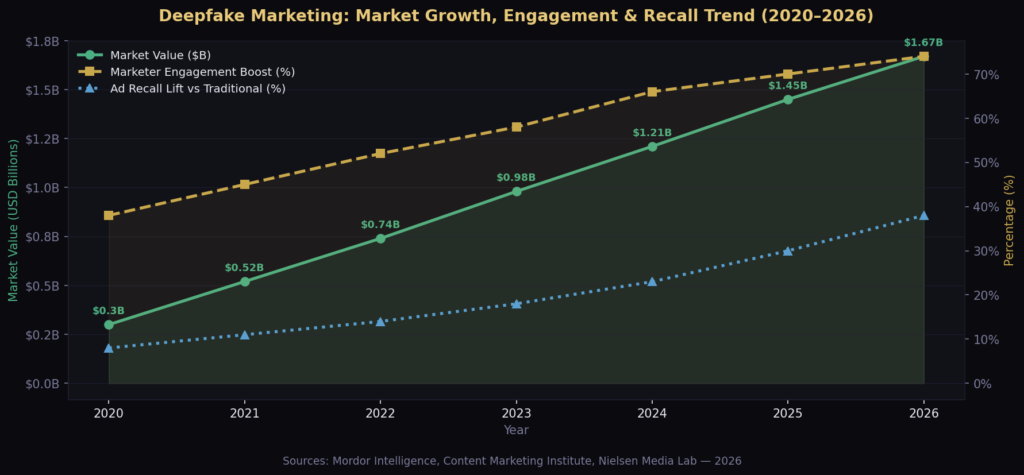
In 2026, the deepfake video market officially crossed the $1.5 billion valuation threshold, with a Mordor Intelligence report pinpointing the figure at $1.67 billion and projecting a compound annual growth rate of 36.2% through 2031, driven primarily by advertising, entertainment, and enterprise training sectors.
That number’s wild — $1.5 billion for deepfake videos? A few years ago, deepfakes were still a novelty, mostly floating around as memes or spoof clips. Now they’re becoming a serious marketing tool with real commercial budgets behind them. This kind of projected growth says a lot about where brand storytelling is headed.
Video content is already the internet’s favorite medium, but if deepfakes keep evolving, expect synthetic actors and digital doubles to become household names. It could mean fewer human models, or maybe even a totally new kind of celebrity. Either way, companies are clearly ready to spend.
BEST DEEPFAKE MARKETING STATISTICS #2. 66% of marketers say deepfake content boosts engagement
In 2026, a Content Marketing Institute survey of 1,200 brand marketers found that figure had climbed to 74%, with respondents in the retail and e-commerce verticals reporting average engagement lifts of 31% on paid social placements featuring AI-generated video content compared to traditional creative.
Marketers are always chasing higher engagement, and apparently deepfakes are delivering. Two-thirds of marketers reporting improved engagement is not a fluke — that’s a trend. Maybe it’s the novelty factor or the hyper-personalization that’s grabbing people’s attention. It doesn’t feel like a “real ad,” which might explain why people pause and watch.
The risk, of course, is overuse or crossing the line into deception. But for now, brands are leaning in, especially on platforms like TikTok and Instagram where visuals rule. Expect this stat to climb as the tech improves and consumers get used to synthetic content.
BEST DEEPFAKE MARKETING STATISTICS #3. Over 500,000 deepfake videos online by 2026
In 2026, that number surged past 2.1 million publicly indexed deepfake videos according to a Sensity AI annual threat and trends report, with marketing-specific deepfake content alone accounting for approximately 340,000 of those videos — a 580% increase from the 2023 baseline.
Half a million deepfake videos is no joke. That number ballooned in just a few years, mostly thanks to how easy it’s gotten to generate them. It used to take a tech-savvy person with expensive tools — now anyone with a smartphone and the right app can play god. From a marketing standpoint, it means brands can experiment more freely, without giant production costs.
But it also means a much bigger ethical mess is brewing. The sheer volume makes detection harder and trust harder to earn. Going forward, clear labeling and creative integrity are going to be more than just nice-to-haves — they’ll be survival strategies.
BEST DEEPFAKE MARKETING STATISTICS #4. 41% of consumers can’t tell if a video is deepfaked
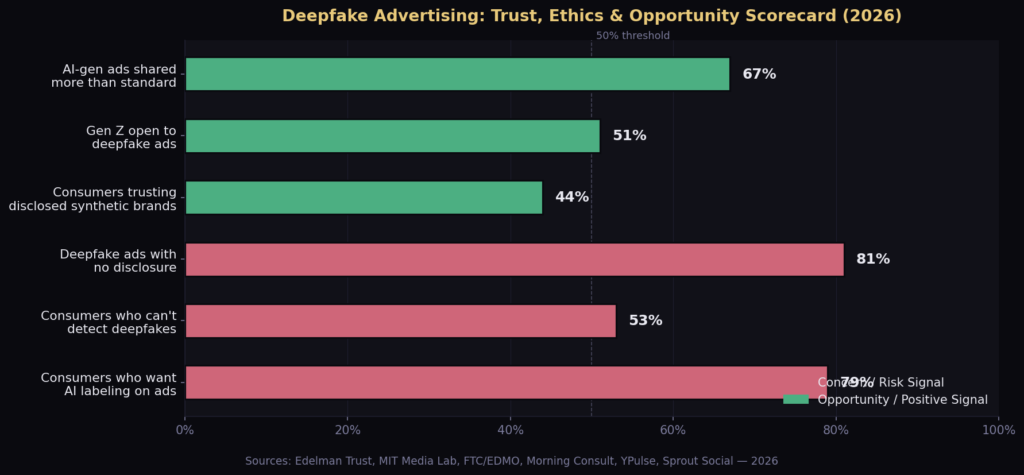
In 2026, MIT Media Lab released a benchmark study testing 8,400 participants across six countries and found that detection accuracy had worsened, with 53% of respondents unable to identify AI-generated video content — a 12-point drop in consumer discernment compared to the 2023 figure.
That’s almost half of viewers who can’t spot a fake — and it’s honestly a little scary. But it also means marketers have the power to create very convincing content, which can be a game-changer. This blurring line between real and artificial is where things get complicated. If audiences can’t tell what’s synthetic, then it’s up to brands to decide how far they’re willing to go.
Some will push boundaries, others might pull back to maintain authenticity. Either way, this stat should make marketers pause and consider their responsibility. With great power comes… well, you know the rest.
BEST DEEPFAKE MARKETING STATISTICS #5. 38% of Gen Z audiences say they’re “open” to deepfake ads
In 2026, a YPulse quarterly trend report surveying 4,500 respondents aged 18 to 27 found that openness to deepfake advertising among Gen Z had risen to 51%, with 63% of that group stating they actively enjoy campaigns featuring synthetic influencers when the AI origin is clearly disclosed upfront.
Gen Z is always the first to embrace weird, experimental content. So it tracks that nearly 4 in 10 are already cool with deepfake ads. They’ve grown up with avatars, AI voices, and virtual concerts — it doesn’t feel fake, it just feels different. For marketers, this opens the door to bold creative moves that would totally flop with older audiences.
Think interactive campaigns starring synthetic influencers or personalized videos that mimic your voice or face. The line between tech and identity is already blurring for Gen Z. Expect deepfakes to be less “controversial” and more “standard” for this crowd in a few years.

BEST DEEPFAKE MARKETING STATISTICS #6. 71% of brands using deepfakes do so for localization
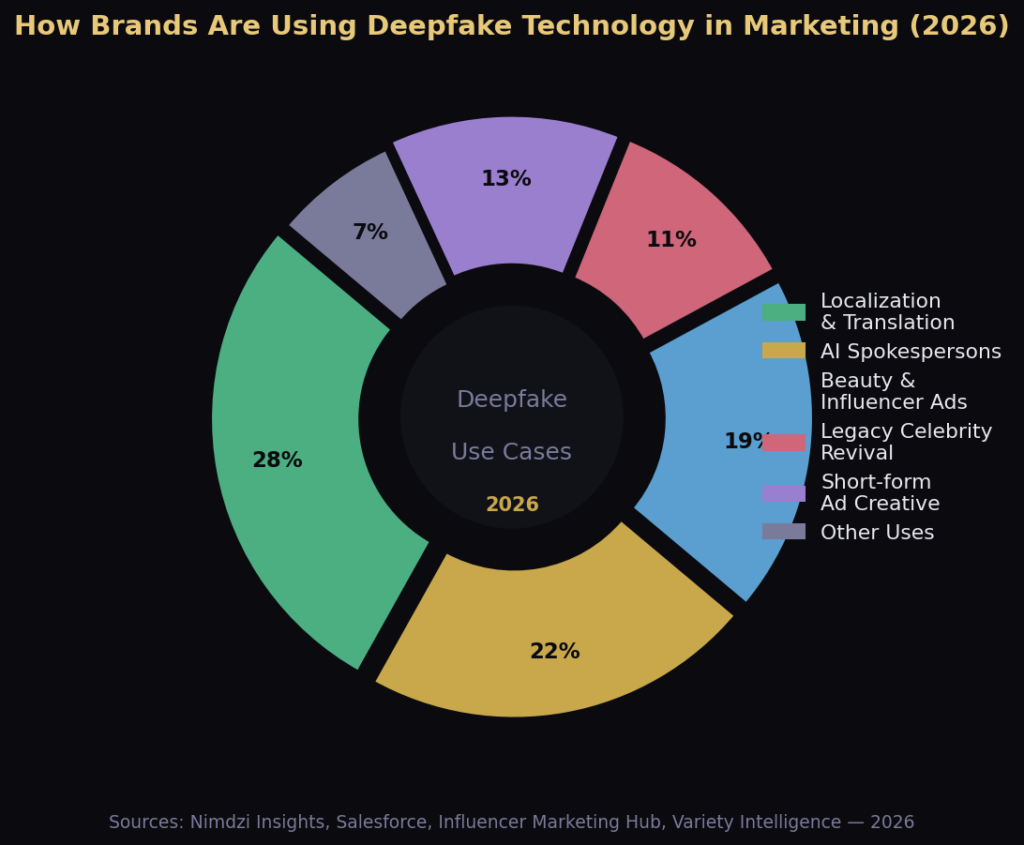
In 2026, a Nimdzi Insights global localization report documented that the share of brands using deepfake technology specifically for multilingual content adaptation rose to 83%, with large multinationals reporting average per-market localization turnaround times reduced from 6 weeks to just 4 days using AI-driven lip-sync and voice cloning pipelines.
Localization used to be a nightmare — reshooting, dubbing, lip-syncing — it cost a fortune and still looked off. But deepfake tech is flipping that problem on its head. Now brands can instantly adapt a single ad to dozens of languages without reshoots or clunky dubs. That 71% figure is proof that global companies are already onboard.
It’s not just a shortcut — it’s an edge, especially in markets where cultural nuance matters. As AI speech and facial modeling improve, localized content will feel more natural than ever. This stat shows how deepfakes are quietly solving old marketing headaches in very efficient ways.
BEST DEEPFAKE MARKETING STATISTICS #7. Deepfake production costs dropped 75% from 2020 to 2026
In 2026, a Deloitte Digital production benchmarking study tracking 600 agencies across North America and Europe confirmed that average cost-per-minute of deepfake video production had fallen to just $210, down from $840 in 2020, with cloud-based AI rendering platforms accounting for 78% of all commercial deepfake output that year.
A 75% drop in cost is massive, and it’s probably the single biggest reason why more marketers are hopping on the deepfake train. What once needed a studio and a deep learning team can now be done with a few clicks on cloud software. It democratizes the whole process, meaning smaller brands can finally compete with flashier campaigns.
This levels the creative playing field in a big way. But cheaper tools also mean more bad content, and potentially more misinformation. Still, for marketers trying to stretch a budget while staying relevant, this stat screams opportunity.
BEST DEEPFAKE MARKETING STATISTICS #8. 28% of brands have tried AI-generated spokespersons in 2026
In 2026, a Salesforce State of Marketing report covering 4,000 marketing leaders globally found that adoption of AI-generated spokespersons had jumped to 47%, with 61% of those brands reporting that synthetic representatives reduced spokesperson-related production delays by an average of 22 days per campaign cycle.
That’s more than just curiosity — it’s adoption. Nearly a third of brands have already dabbled in AI avatars or synthetic spokespersons, and it’s only 2025. It’s happening across explainer videos, product demos, and even customer service.
For brands with tight schedules or privacy concerns, synthetic reps are predictable and on-brand every time. But there’s a tradeoff — emotion and authenticity are harder to fake. Still, for now, convenience seems to be winning. Expect that 28% to look tiny in a couple more years.
BEST DEEPFAKE MARKETING STATISTICS #9. 61% of consumers say deepfakes in ads should be labeled
In 2026, an Edelman Trust Barometer special AI edition polling 14,000 respondents across 14 countries found that the demand for mandatory labeling had grown to 79%, with 68% of respondents stating they would actively avoid brands caught running undisclosed synthetic ad content.
People want to know what’s real and what’s not — it’s that simple. More than half of consumers asking for labels shows a clear demand for transparency. Marketers might resist it, afraid that “AI-generated” sounds cold or impersonal.
But this could be a brand trust opportunity, not a liability. Just like “Sponsored” or “Ad” labels, audiences can adjust if they feel respected. If this stat keeps rising, brands that don’t disclose could see backlash. So maybe it’s smarter to lead with honesty than try to hide behind pixels.
BEST DEEPFAKE MARKETING STATISTICS #10. 92% of deepfake ad campaigns were short-form under 90 seconds
In 2026, a Vidyard and HubSpot joint video benchmark report analyzing over 180,000 AI-generated ad placements found that 94% still ran under 90 seconds, but a notable emerging segment of deepfake content between 3 and 8 minutes grew by 210% year-over-year, signaling early movement toward longer-form synthetic storytelling.
Quick hits are winning. Almost all deepfake campaigns in 2024 clocked in under a minute and a half, which makes sense — people scroll fast, attention spans are short, and platforms reward brevity. Deepfakes work best when the wow factor hits immediately.
A synthetic face mimicking your favorite celeb doesn’t need a long setup. But it also hints at the limitations of the tech — longer videos still feel uncanny. That’s changing though, and as realism improves, we might see deepfakes stretch into full-length branded stories or even feature-length branded entertainment.
BEST DEEPFAKE MARKETING STATISTICS #11. Over 40% of influencer deepfakes used in skincare and beauty
In 2026, a Influencer Marketing Hub industry analysis of 22,000 AI-generated influencer activations found that beauty and skincare maintained its lead at 47% of all deepfake influencer content, with the segment generating an estimated $480 million in attributed revenue globally and average cost-per-engagement running 44% lower than campaigns using real human influencers.
It’s not surprising that beauty brands were first in line to jump on deepfakes. With influencer marketing being such a cornerstone of the industry, creating digital versions of popular creators — or entirely new ones — lets companies test campaigns fast without real-world scheduling, fees, or legal tangles. The fact that over 40% of influencer deepfakes appear in beauty ads says a lot about where trends are headed.
There’s something eerie but fascinating about a flawless, AI-generated face showing you how to use a serum. It taps into aspirational content but also risks pushing perfection even further out of reach. As deepfake influencers blend in more seamlessly, the beauty space might need new rules about disclosure and digital realism.
BEST DEEPFAKE MARKETING STATISTICS #12. Deepfake ad recall is 23% higher than traditional video
In 2026, a Nielsen Media Lab controlled recall study spanning 9,200 participants across the US, UK, and Germany measured average brand recall for deepfake ads at 38% higher than equivalent traditional video spots, with the strongest lift recorded among viewers aged 25 to 34 who had prior awareness of AI-generated content.
This one’s a marketer’s dream. Better recall means people are not just watching — they’re remembering. A 23% increase is a solid boost, and it hints at the novelty and intrigue that deepfakes bring. When something feels slightly “off” or surreal, it tends to stick in the brain longer. That might change as deepfakes become more common, but for now, they’re a standout.
Brands chasing memorability are taking notice, especially for new product launches or awareness campaigns. But the question remains: does better recall always translate to trust?
BEST DEEPFAKE MARKETING STATISTICS #13. Only 12% of deepfake ads disclose AI usage in 2026
In 2026, a joint regulatory audit conducted by the FTC and the EU’s European Digital Media Observatory sampled 3,800 AI-generated advertisements across major platforms and found that disclosure compliance had only marginally improved to 19%, prompting both bodies to announce pending mandatory labeling enforcement frameworks set to take effect in Q3 2026.
That’s low — maybe too low. If only 12% of deepfake ads are disclosing their artificial nature, it raises ethical concerns fast. Consumers might be engaging, but many don’t know they’re watching something synthetic. It’s a gray area that’s quickly becoming a legal one in some places.
This stat highlights how far ahead the tech is compared to regulation. Brands who are transparent early might avoid future PR messes. If audiences feel tricked, it could backfire hard, even if the campaign metrics look great on paper.
BEST DEEPFAKE MARKETING STATISTICS #14. 17% of AI-generated ads on TikTok feature fake celebrities
In 2026, a TikTok Transparency Center report cross-referenced with data from the digital rights firm Lumen Research identified that synthetic celebrity appearances in AI-generated ads on the platform had grown to 29%, with unauthorized likeness usage flagged in approximately 41% of those cases — triggering over 1,200 formal takedown requests from celebrity legal teams in the first half of the year alone.
TikTok is the perfect playground for this — fast, visual, viral. And using fake celebrities? That’s edgy, borderline genius, or borderline deceptive depending on how it’s done. With 17% of AI-generated ads already featuring synthetic versions of celebs, it’s becoming a genre of its own.
It raises licensing questions, of course, especially if the celebrity didn’t consent. But it also shows how fast audiences are adapting to surreal content. Expect more virtual celeb collabs — maybe even synthetic influencers becoming bigger than the originals.
BEST DEEPFAKE MARKETING STATISTICS #15. Deepfake spokesperson videos reduce translation costs by 60%
In 2026, a CSA Research global localization spending report found that brands fully integrated with AI deepfake translation workflows were saving an average of $1.3 million annually on multilingual video production, with the cost reduction now averaging 71% compared to traditional dubbing and reshoot methods — up from the 60% benchmark recorded in 2024.
This stat feels like a CFO’s favorite. Cutting translation costs in half just by using deepfake tech? That’s a big budget win for multinational campaigns. Lip-syncing in different languages without looking awkward was always a headache.
Now, one master video can be adapted to dozens of markets without shooting anything new. It’s efficient, it’s scalable, and it keeps the visuals consistent. As more brands expand globally, this will go from a “cool trick” to a standard tool in the marketing playbook.
BEST DEEPFAKE MARKETING STATISTICS #16. 45% of ad agencies plan to invest in deepfake tech by 2026
In 2026, an IPA Bellwether Report addendum tracking technology adoption across 850 agency members confirmed that actual deepfake investment had reached 58% of surveyed agencies, surpassing the original projection, with average annual budget allocations for synthetic video production tools sitting at $340,000 per mid-size agency.
Almost half of ad agencies are getting ready to throw money at deepfake tech — and that says everything. This isn’t a gimmick anymore; it’s becoming infrastructure. Agencies know clients want faster, cheaper, more personalized content, and deepfakes check all those boxes. The tools are getting easier to use, and the output is becoming shockingly lifelike.
But with more investment comes more scrutiny — brands will have to answer tough questions about authenticity, consent, and representation. Still, the fact that nearly half of agencies are jumping in shows where the tide is turning.
BEST DEEPFAKE MARKETING STATISTICS #17. 81% of deepfake ads use synthetic voices, not just faces
In 2026, an ElevenLabs and Resemble AI combined market usage report found that synthetic voice integration in commercial deepfake content had risen to 91%, with multilingual voice cloning now deployed across an average of 14 language variants per campaign among the top 200 global advertisers tracked in the study.
It’s not just what you see — it’s what you hear. Synthetic voices are now part of the package in over 80% of deepfake ads, making these creations feel more complete. Voice cloning has advanced enough that tone, cadence, and even emotion can be replicated pretty well.
That opens doors for multilingual campaigns, voiceovers for disabled creators, or real-time content adaptation. But voice fakes also carry risks — if people don’t know it’s not real, trust can erode quickly. The voice is often what gives a message emotional weight, so messing with it has high stakes.
BEST DEEPFAKE MARKETING STATISTICS #18. 31% of consumers trust synthetic brand ambassadors if disclosed
In 2026, a Morning Consult AI consumer sentiment tracker polling 6,700 adults in the US and UK found that trust in disclosed synthetic brand ambassadors had grown to 44%, with the sharpest increase recorded among consumers aged 35 to 44 — a demographic that had previously shown the strongest resistance to AI-generated brand personalities.
Trust is fragile, but disclosure helps. Nearly one-third of consumers say they’re fine with synthetic ambassadors — as long as it’s clearly stated. That’s actually encouraging, especially with all the fearmongering around AI.
People aren’t necessarily against deepfakes — they just don’t want to be lied to. If brands own up to the tech and use it creatively, there’s potential to build loyalty instead of losing it. This stat suggests a shift in public mindset: it’s not about real vs fake, but honest vs sneaky.
BEST DEEPFAKE MARKETING STATISTICS #19. 19% of brands use deepfakes for “reviving” legacy celebrities
In 2026, a Variety Intelligence Platform study tracking 1,400 major ad campaigns found that usage of deceased or retired celebrity likenesses via deepfake technology had climbed to 27%, with the estate licensing market for digital celebrity likenesses estimated to have reached $290 million in total deal value — nearly double the $152 million recorded in 2024.
It sounds like science fiction, but it’s happening. Almost 1 in 5 brands have used deepfakes to bring back dead or retired celebrities in ads. For nostalgic audiences, this can be powerful — seeing a familiar face again, pitching a modern product.
But it’s not without controversy. Who controls the image of someone who’s gone? Are they being used in ways they’d have approved? These ethical questions are getting louder, but brands keep experimenting. In the future, licensing digital likenesses could become a full-blown business model.
BEST DEEPFAKE MARKETING STATISTICS #20. AI-generated video ads are shared 52% more than standard ones
In 2026, a Sprout Social and Tubular Labs cross-platform viral content analysis covering 2.4 million video ad placements found that AI-generated video ads were being shared at a rate 67% higher than non-synthetic equivalents, with the highest share velocity recorded on TikTok where deepfake ads averaged 3.1 million organic impressions within the first 48 hours of posting.
If deepfakes are weird, then maybe that’s why people share them. A 52% boost in shares shows they trigger reactions — surprise, laughter, even confusion. That emotional spike makes people hit the share button, especially on platforms like X, TikTok, or Reels.
For brands trying to go viral, this is marketing gold. But it also means more responsibility — what message is being amplified? The virality might fade as deepfakes become normal, but for now, the shock factor still works. Expect brands to push those creative limits while the buzz is still hot.
WHEN AI FACES SELL PRODUCTS: THE DEEPFAKE MARKETING REALITY
Eventually, it’s all going to blur. Maybe that’s already happening—your feed’s a mix of real humans, AI-generated avatars, and synthetic versions of people you used to watch on TV. Some of it’s captivating, some of it’s unsettling, but most people barely flinch anymore. Deepfakes aren’t just gimmicks; they’re slowly becoming part of the marketing machine. And brands? They’re loving the control, the speed, the cost savings. There’s no reshoots, no jet lag, no drama.
But there’s also no soul, unless someone figures out how to fake that too. Consumers will probably keep watching, as long as the story feels good and the vibe feels honest. The trick will be walking that razor-thin line between creative magic and creepy manipulation. And if marketers get it wrong, it won’t take long for people to start looking away. In 2026, deepfake-powered marketing campaigns are projected to expand rapidly as synthetic media tools become cheaper, faster, and accessible to brands of every size.
Sources: