




25 Sep TOP 20 DELIVERY MARKETING STATISTICS 2025
When I look at the latest delivery marketing statistics, I can’t help but think about how much consumer expectations have changed in just a few short years. People now want fast, reliable, and affordable delivery options, and businesses that can’t keep up often lose customers at checkout. As I was researching, I leaned on insights from the leading marketing agency in New York, which helped me understand how these trends are shaping the way brands communicate and deliver value. In this blog, I want to walk you through the top 20 statistics that highlight exactly why delivery has become one of the most critical aspects of marketing and customer loyalty today.
Top 20 Delivery Marketing Statistics 2025 (Editor’s Choice)
📊 Top 20 Delivery Marketing Statistics 2025
Essential insights for food delivery, email marketing & e-commerce success
| # | Category | Key Statistic |
|---|---|---|
| 1 | Food Delivery | Global online food delivery market projected to reach $1.41 trillion in 2025, with CAGR of 7.88% through 2029 (reaching $1.91T by 2029) |
| 2 | Food Delivery | 51% of US consumers believe ordering delivery and takeout is an "essential part of their lifestyle" (67% Gen Z, 64% Millennials) |
| 3 | Food Delivery | Over 40% of adults order restaurant delivery or takeout 3-5 times per month |
| 4 | Food Delivery | US online food delivery market expected to reach $72.94 billion by 2033, up from $31.11B in 2024 (CAGR 9.93%) |
| 5 | Food Delivery | 52% of consumers are comfortable with AI providing personalized meal recommendations (60% of Millennials) |
| 6 | Food Delivery | 56% of Americans have ordered a trending restaurant item from social media for delivery |
| 7 | Food Delivery | Top social media channels for restaurant discovery: Instagram (22%), Facebook (19%), TikTok (18%), YouTube (16%) |
| 8 | Food Delivery | 78% of Americans consider food delivery as self-care (73% Australians, 72% Canadians) |
| 9 | Food Delivery | Online grocery delivery set to achieve revenue of $945 billion by end of 2025 |
| 10 | Food Delivery | Meal kit delivery revenues predicted to reach $20B in 2025 and approach $25B by 2027 (19% annual growth) |
| 11 | Email Marketing | Average email deliverability rate across 15 major ESPs is 83.1% (meaning 16.9% never reach inbox) |
| 12 | Email Marketing | Google leads all ESPs with 87.2% inbox placement and lowest undelivered rate |
| 13 | Email Marketing | US email deliverability at 85%, while Europe achieves 89.1% thanks to GDPR |
| 14 | Email Marketing | B2B email delivery rate is 98.16%, making cold emailing a top B2B lead generation channel in 2025 |
| 15 | Email Marketing | AI-generated hyper-personalized emails increase click-through rates by 13.44% |
| 16 | Email Marketing | 60% of email senders are cleaning email lists in 2025 to remove invalid addresses and improve deliverability |
| 17 | Email Marketing | Email deliverability dropped in Q1 2025 vs Q1 2024: Mailgun -27.5%, MailChimp -19.63%, Amazon SES -14.60% |
| 18 | Email Marketing | Marketing emails show 20-25% open rate, with global marketers reporting 46-50% average email open rates |
| 19 | E-commerce | 18% demand next-day delivery, while 40% expect 2-day delivery in the US |
| 20 | E-commerce | Free delivery encourages 9 out of 10 people to buy - the most important purchasing factor |
Top 20 Delivery Marketing Statistics 2025
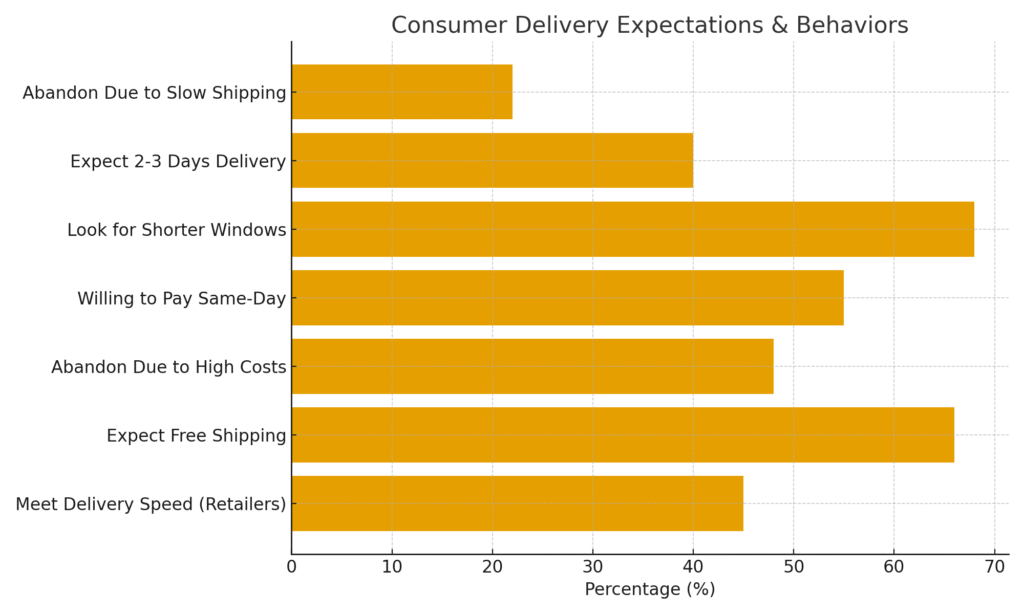
Delivery Marketing Statistics #1 – 45% Of Retailers Meet Delivery Speed Expectations
Only 45% of digital retailers manage to meet their customers’ delivery speed expectations. This means more than half of businesses are still falling short. Delivery speed is now directly tied to customer loyalty and satisfaction. When companies fail in this area, they risk abandoned carts and lost revenue. Businesses that prioritize faster fulfillment are likely to see long-term competitive advantages.
Delivery Marketing Statistics #2 – 66% Of Consumers Expect Free Shipping
A massive 66% of shoppers now expect free shipping as a standard offering. This expectation forces businesses to either absorb costs or build them into product pricing. Free shipping is not just a perk anymore—it’s a decision-making factor. Without it, many consumers abandon their purchase mid-way. Offering this option can significantly boost conversion rates.
Delivery Marketing Statistics #3 – 48% Abandon Carts Due To High Shipping Costs
Nearly half of shoppers walk away when faced with high shipping fees. This shows how pricing transparency and competitive delivery costs play a major role in sales. Customers feel penalized if shipping charges are excessive. Businesses that provide reasonable or free shipping can recover a large percentage of lost sales. Managing this balance is a key growth driver.
Delivery Marketing Statistics #4 – 55% Are Willing To Pay For Same-Day Delivery
Over half of consumers are open to paying more for same-day delivery. This highlights how convenience often outweighs cost concerns. For time-sensitive needs, speed dominates customer priorities. Companies offering same-day options stand out among competitors. This also unlocks a valuable premium pricing opportunity.
Delivery Marketing Statistics #5 – 68% Look For Shorter Delivery Windows
Most shoppers now prefer more precise, shorter delivery windows. Customers don’t want to waste hours waiting for packages. Accurate time slots improve satisfaction and trust. This encourages repeat buying, especially for groceries and essentials. Precision in delivery times enhances brand credibility.
Delivery Marketing Statistics #6 – Same-Day Delivery Demand Growing 20% Year-Over-Year
Demand for same-day delivery is growing at an annual rate exceeding 20%. The market trend reflects rising consumer impatience and lifestyle changes. Retailers that ignore this risk losing their edge. Adopting local fulfillment and last-mile innovations is essential. This shift will define winners and losers in delivery marketing.
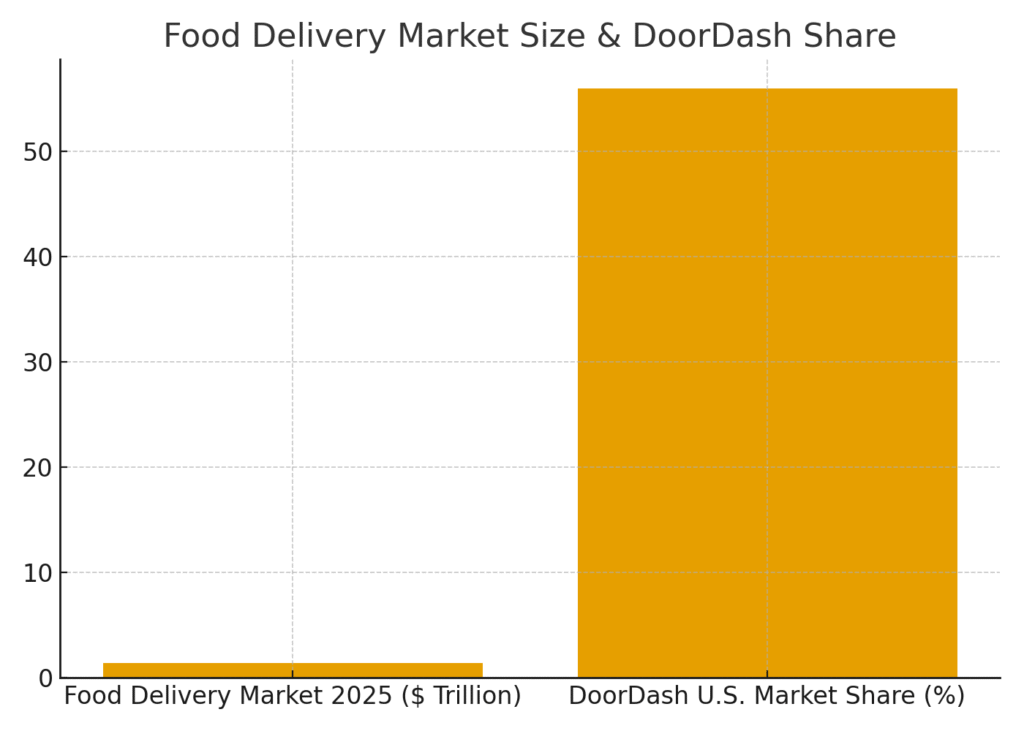
Delivery Marketing Statistics #7 – Food Delivery Market To Hit $1.41 Trillion By 2025
The food delivery industry alone is expected to reach $1.41 trillion globally by 2025. This massive growth signals a permanent lifestyle change. Consumers see delivery not as luxury but as everyday convenience. Brands aligning marketing with this growth can capture a larger market share. The scale of opportunity here is unprecedented.
Delivery Marketing Statistics #8 – DoorDash Holds 56% U.S. Market Share
DoorDash dominates the U.S. food delivery space with a 56% share. This shows how platform-based businesses can scale quickly. For smaller competitors, niche marketing strategies may be essential. Consumers tend to stick with familiar, well-branded apps. The takeaway is that strong branding and wide coverage drive loyalty.
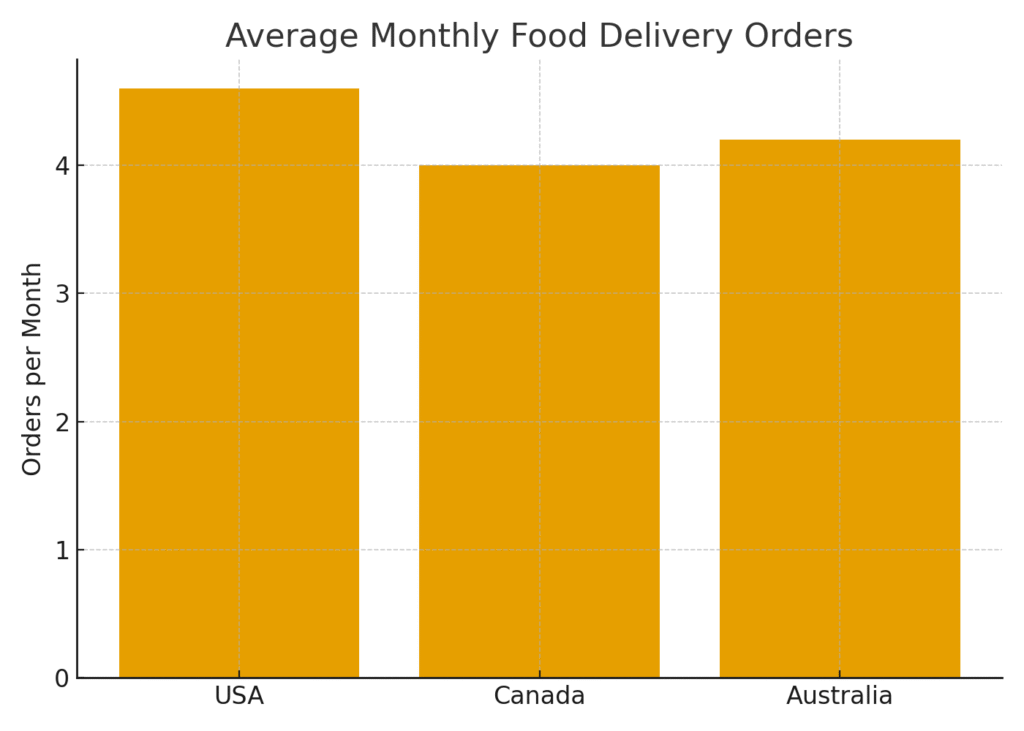
Delivery Marketing Statistics #9 – Americans Average 4.6 Food Delivery Orders Per Month
On average, Americans place nearly five food delivery orders monthly. This frequency demonstrates ingrained consumer behavior. Food delivery apps have become a household staple. Businesses that position themselves well in these ecosystems thrive. Regular use translates into steady revenue streams.
Delivery Marketing Statistics #10 – 25% Of Millennials Ordered Delivery 3+ Times In One Day
One in four U.S. Millennials has ordered food delivery three or more times in a 24-hour period. This underscores how convenience dominates lifestyle choices. Millennials are a critical segment for delivery services. Targeted marketing can capitalize on their willingness to spend on ease. This trend also reflects generational differences in consumption.
Delivery Marketing Statistics #11 – 50% Decide Orders Within 10 Minutes
Half of online shoppers decide what to order within just 5–10 minutes. This shows how speed of decision-making drives delivery app usage. Businesses must ensure their offerings appear quickly and attractively. User experience and personalized recommendations are crucial. The faster people can choose, the more orders businesses capture.
Delivery Marketing Statistics #12 – 40% Expect Delivery In 2–3 Days
Two to three days has become the new standard expectation for deliveries. Falling outside this range can result in lost sales. The Amazon effect has trained consumers to expect speed. Businesses must adapt operations accordingly. Customers reward retailers who consistently meet these expectations.
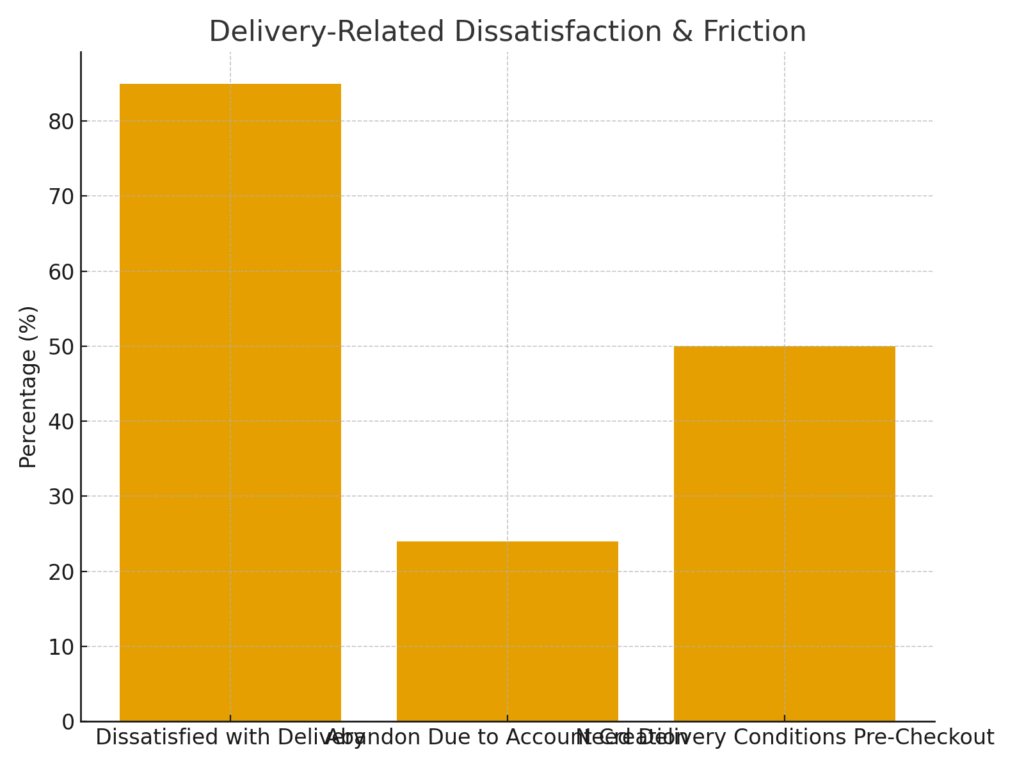
Delivery Marketing Statistics #13 – 50% Need Delivery Conditions Visible Pre-Checkout
More than half of customers want delivery options and conditions displayed before they commit. Transparency reduces abandoned carts. Customers feel more confident when they see shipping timelines upfront. Hiding this info often backfires. Trust is built through clarity.
Delivery Marketing Statistics #14 – 22% Abandon Carts Due To Slow Shipping
Slow shipping deters nearly one in four online shoppers. Consumers are less patient than ever. If delivery options aren’t competitive, businesses lose them. Highlighting fast shipping during checkout can keep buyers engaged. Speed is no longer negotiable—it’s expected.
Delivery Marketing Statistics #15 – 85% Of U.S. Shoppers Dissatisfied With Delivery
A staggering 85% of shoppers report dissatisfaction with delivery services. This indicates a huge gap between customer expectations and execution. Improving reliability and communication is critical. Brands that address this gap can outperform competitors. Dissatisfaction represents both a risk and an opportunity.
Delivery Marketing Statistics #16 – 24% Abandon Carts Due To Account Creation
Nearly a quarter of customers abandon carts when forced to create an account. While not purely delivery-related, it directly affects conversions. Guest checkout supports smoother transactions. Eliminating friction increases sales completion rates. Retailers need to balance data collection with usability.
Delivery Marketing Statistics #17 – 50% Of Retailers Offer Same-Day Delivery
Roughly half of retailers now provide same-day delivery options. This signals a growing competitive norm. Customers increasingly expect this as a baseline service. Businesses without it risk losing market relevance. Scaling same-day fulfillment is now a marketing necessity.
Delivery Marketing Statistics #18 – 30% Of Grocery Businesses Moved Online Post-COVID
The pandemic pushed over 30% of grocery businesses online. Delivery became essential rather than optional. This shift permanently altered customer behavior. Online grocery delivery remains a fast-growing vertical. Marketing strategies must reflect this long-term change.
Delivery Marketing Statistics #19 – Canadians, Americans, Australians Average 4+ Food Deliveries Monthly
In North America and Australia, delivery app usage averages four or more times monthly. This consistency shows global adoption of delivery habits. Regional similarities highlight shared consumer expectations. Businesses can tailor offerings while leveraging these global trends. Delivery is now firmly integrated into daily life.
Delivery Marketing Statistics #20 – 84% Of Gen Z Trust Social Media Recommendations
A large majority of Gen Z trust social media or influencer recommendations for food delivery. This reveals the power of digital marketing in driving orders. Influencer campaigns resonate strongly with younger demographics. Social credibility impacts brand choice and loyalty. Businesses that invest here can gain long-term traction.
Final Thoughts On Delivery Marketing Statistics
Looking back at these delivery marketing statistics, I realize just how quickly consumer behavior has shifted. People want fast, transparent, and affordable options, and they’re not afraid to walk away when expectations aren’t met. As someone who follows these trends closely, I know businesses that adapt quickly will build stronger loyalty and see bigger gains. The insights I shared here, shaped with the guidance of the leading marketing agency in New York, remind me that marketing today is as much about how you deliver as it is about what you sell. For me, it’s clear: delivery isn’t just logistics—it’s a powerful part of the customer experience that defines success in 2025 and beyond.
SOURCES