



30 Sep TOP 20 DELIVERY PLATFORM MARKETING STATISTICS 2025
When I think about how much delivery apps have shaped my daily life, I realize just how big the shift has been in consumer behavior. That’s why I wanted to dive deep into delivery platform marketing statistics, because understanding this space helps me and so many others plan strategies that resonate with today’s digital-first customers. As someone who closely follows industry changes, I often rely on insights shared by experts like a leading marketing agency in New York. These numbers aren’t just abstract figures—they tell the story of how people interact with food, convenience, and technology every day. Let’s walk through the top 20 stats that highlight the exciting opportunities and challenges in this space.
Top 20 Delivery Platform Marketing Statistics 2025 (Editor’s Choice)
🚀 Top 20 Delivery Platform Marketing Statistics
Latest Data-Driven Insights for 2025
| Rank | Marketing Statistic | Value |
|---|---|---|
| 1 | 📈Global online food delivery market value by 2029 | $1.91T |
| 2 | 💰US online food delivery market value by 2033 | $72.94B |
| 3 | 📊Global market CAGR (2025-2029) | 7.88% |
| 4 | 🎯DoorDash US market share | 45% |
| 5 | 👥Global meal delivery users by 2029 | 2.7B |
| 6 | 📱Platform-to-consumer segment market share | 73% |
| 7 | 💳Online payment method usage in delivery apps | 79% |
| 8 | 🌏Asia Pacific market CAGR (2025-2030) | 10.1% |
| 9 | 🥡Meal kit delivery market value by 2027 | $25B |
| 10 | 🚚Last mile delivery market growth (2025-2029) | $51.1B |
| 11 | ⏱️Consumers preferring 2-3 day delivery | 80% |
| 12 | 📍Real-time tracking rated as essential | 92% |
| 13 | 💵Average revenue per user in US grocery delivery | $1,360 |
| 14 | ⚡Customers satisfied with delivery speed | 68% |
| 15 | ❌Less likely to reorder if delivery exceeds 2 days | 69% |
| 16 | 📢More likely to click ads mentioning fast shipping | 69% |
| 17 | 🎁Consumers prefer free delivery with 2-day speed | 67% |
| 18 | 🇨🇳China's expected revenue in platform delivery | $174.6B |
| 19 | 👤Global user penetration in meal delivery (2025) | 30.6% |
| 20 | 📦Purchase likelihood with 2-day or less delivery | 77% |
Top 20 Delivery Platform Marketing Statistics 2025
Delivery Platform Marketing Statistics #1 – AI Recommendation Upsell Success (28%)
AI-driven upsell and recommendation features on delivery platforms show a 28% success rate in getting customers to add extra items. This demonstrates the growing sophistication of personalization algorithms in capturing additional revenue. For marketers, it highlights the value of data-driven strategies that leverage customer purchase history and context. Restaurants can partner with platforms to push profitable add-ons, boosting overall basket size. It also reflects how technology is shaping modern upselling techniques in ways traditional menus never could.
Delivery Platform Marketing Statistics #2 – Market Growth (13% CAGR)
The global delivery platform market is expanding rapidly at an annual growth rate of 13% between 2023 and 2027. This growth is fueled by consumer preference for convenience and the integration of delivery options beyond food. For businesses, this means a steady stream of marketing opportunities with a constantly growing user base. The CAGR also signals intense competition, making brand differentiation more critical than ever. If you’re in marketing, this stat is a reminder that there’s plenty of growth pie left to capture.
Delivery Platform Marketing Statistics #3 – Projected Market Size ($1.41 Trillion)
By 2025, the global digital food delivery market is projected to hit $1.41 trillion. That’s a staggering figure that shows just how deeply entrenched delivery has become in consumer culture. For marketers, this indicates both scale and saturation—opportunity on one side, but fiercer competition on the other. Platforms will continue to innovate with features like express delivery and bundled promotions to claim their share. Brands that align with consumer convenience will be the biggest winners.
Delivery Platform Marketing Statistics #4 – U.S. Market Revenue ($353.3B to $534.6B)
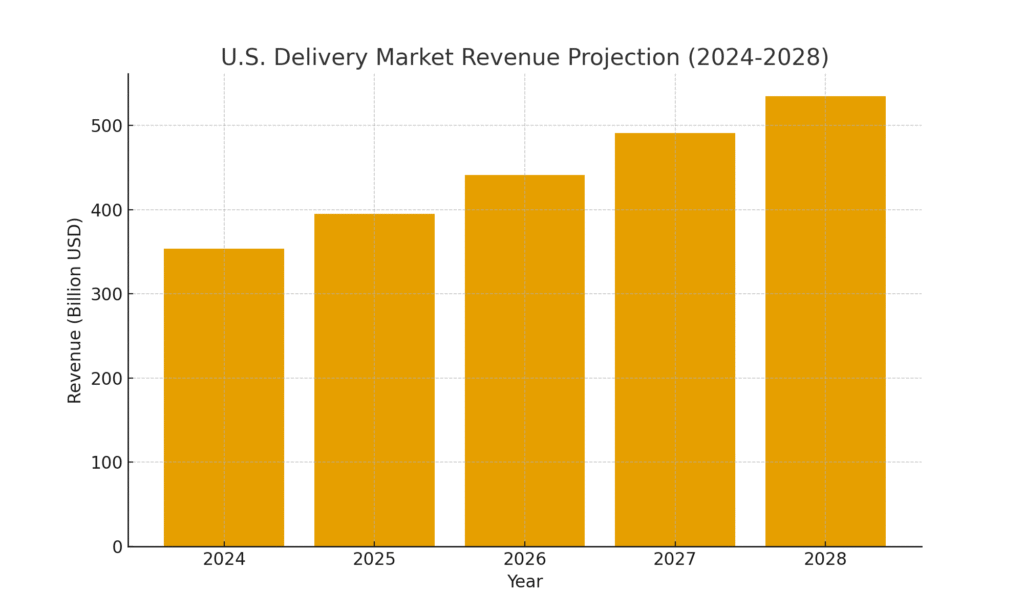
In the U.S. alone, delivery platform revenue is expected to grow from $353.3 billion in 2024 to $534.6 billion in 2028. That’s a CAGR of nearly 11%, underscoring how central the American consumer is to this industry. U.S. marketers must take advantage of this momentum with tailored campaigns for regional demographics. The growth also suggests ongoing reliance on delivery for everything from meals to groceries. Businesses that fail to adapt risk losing out on this massive revenue surge.
Delivery Platform Marketing Statistics #5 – Penetration (51%+ of U.S. Population)
More than half of the U.S. population is expected to use meal delivery services in 2024. This is no longer a niche behavior but a mainstream lifestyle choice. The challenge for marketers is moving from simple customer acquisition to building long-term loyalty. Platforms will need to lean into rewards programs, app gamification, and social proof to retain users. This penetration level makes delivery platforms an essential part of the modern marketer’s toolkit.

Delivery Platform Marketing Statistics #6 – Consumer Adoption (Two-Thirds Use Apps)
Roughly two-thirds of consumers report having used a food ordering app at least once. This means the majority of people are already comfortable engaging with delivery platforms. For marketing campaigns, the takeaway is that education barriers are low—it’s all about persuasion and preference now. The key will be differentiating among apps through branding and unique value propositions. Adoption rates this high prove delivery apps are deeply embedded in consumer routines.
Delivery Platform Marketing Statistics #7 – Platform vs Direct Ordering Preferences
In the U.S., 46% of consumers prefer ordering through third-party delivery platforms over direct restaurant apps. Similar numbers appear in Australia (48%) and Canada (56%). This shows platforms still dominate because they aggregate options, making them the go-to choice. For marketers, this creates an opportunity to maximize exposure by working with major delivery partners. However, it also reinforces the importance of standing out within crowded aggregator ecosystems.
Delivery Platform Marketing Statistics #8 – Convenience as the Main Driver (42–49%)
Between 42% and 49% of consumers cite convenience as the top reason for using delivery apps. This highlights the emotional driver behind platform use—it’s not just about food, but about time saved. For marketers, this means campaigns should emphasize lifestyle, not just the product. Messaging that frames delivery as a stress-free or time-saving experience resonates most strongly. Convenience will always be the heart of this industry’s marketing story.
Delivery Platform Marketing Statistics #9 – Order Frequency (4–4.6 Orders Monthly)
Average monthly order frequency is 4.6 in the U.S., 4.2 in Australia, and 4 in Canada. This consistent pattern shows users treat delivery apps as a regular habit, not just an occasional indulgence. Frequency-driven marketing tactics such as loyalty programs, subscriptions, and push notifications can amplify this habit. Regular use also provides platforms with rich data to further personalize recommendations. The statistic underscores the “stickiness” of delivery platforms in consumer life.
Delivery Platform Marketing Statistics #10 – Social Media Influence (67% of Gen Z)
In the U.S., 67% of Gen Z and 63% of Millennials trust restaurant reviews from influencers when deciding on delivery. This stat reflects how social proof has shifted from traditional reviews to content creators. Marketers must leverage influencer campaigns that showcase food delivery experiences authentically. Platforms that integrate influencer partnerships gain stronger brand affinity with younger audiences. This makes influencer-driven strategies essential in modern delivery marketing.
Delivery Platform Marketing Statistics #11 – Sustainability Importance (87–95% of Gen Z)
Among Gen Z consumers, 87% in Canada, 92% in the U.S., and 95% in Australia value sustainability when choosing delivery options. This signals a generational demand for eco-friendly packaging, carbon offsets, and responsible sourcing. Marketing strategies must highlight these initiatives front and center. Failing to emphasize sustainability risks alienating one of the most influential consumer groups. It’s clear that “green delivery” is the next big competitive edge.
Delivery Platform Marketing Statistics #12 – Uber Ads Revenue ($1 Billion Run Rate)
Uber’s advertising division, tied to Uber Eats and ride apps, has achieved a $1 billion annual revenue run rate. This underscores how delivery platforms are doubling as powerful ad networks. For marketers, it’s proof that in-app promotions and targeted ads are increasingly effective. Uber’s first-party data gives brands an unmatched ability to reach intent-driven consumers. It sets the stage for delivery apps to rival social platforms in ad effectiveness.
Delivery Platform Marketing Statistics #13 – Third-Party Dependence of Restaurants
Many restaurants still rely heavily on third-party platforms for a significant share of digital orders. This dependence creates opportunities for delivery platforms to negotiate commissions and marketing partnerships. For restaurants, however, it means reduced control over branding and customer data. Marketers must balance exposure with long-term customer relationship goals. The statistic shows how intertwined restaurant survival has become with delivery apps.
Delivery Platform Marketing Statistics #14 – High Commission Costs (15–30%)
Restaurants often pay 15–30% commission fees to platforms, eating into profit margins. This cost dynamic is central to delivery platform marketing conversations. Restaurants often highlight these fees in debates, but consumers tend to prioritize convenience over cost. Marketers must help restaurants frame value and justify pricing despite the commissions. For platforms, this statistic is both a strength (income source) and a weakness (restaurant pushback).
Delivery Platform Marketing Statistics #15 – Churn and Retention Challenges
Delivery apps struggle with churn as many users try them once without repeating. This emphasizes the importance of retention strategies like loyalty programs, discounts, and personalized experiences. For marketers, focusing on lifecycle campaigns is crucial to combat churn. A “trial-to-habit” funnel is key—turning first-time users into repeat customers. The statistic highlights why retention is as critical as acquisition in delivery marketing.

Delivery Platform Marketing Statistics #16 – Preference for Local Restaurants (31–38%)
About 31% of U.S., 36% of Australian, and 38% of Canadian users prefer ordering from local single-store restaurants. This shows a consumer push toward authenticity and supporting smaller businesses. Marketers can leverage “shop local” campaigns to tap into this sentiment. Delivery platforms that spotlight local options may win favor over competitors. This stat proves that community-focused messaging resonates strongly with users.
Delivery Platform Marketing Statistics #17 – Deliveroo Partnerships (182,000+)
Deliveroo collaborates with over 182,000 restaurants, grocers, and retailers as of 2024. This illustrates the scale at which delivery platforms now operate globally. For marketers, these partnerships represent countless cross-promotion opportunities. Consumers benefit from choice, while restaurants gain wider reach through platform partnerships. The statistic underscores the network effect driving delivery app growth.
Delivery Platform Marketing Statistics #18 – Expansion into New Verticals
Delivery platforms are diversifying into groceries, convenience items, and retail. This expansion signals that delivery is no longer only about restaurants. For marketers, this widens the opportunity to target audiences with diverse products. Cross-selling between verticals becomes a powerful strategy. The statistic reflects the industry’s constant evolution to meet consumer demand.
Delivery Platform Marketing Statistics #19 – DoorDash U.S. Market Share (56%)
DoorDash holds about 56% market share in the U.S. delivery market. This dominance highlights the competitive imbalance among platforms. For marketers, being visible on DoorDash is almost non-negotiable. Smaller platforms must adopt niche strategies to carve out space. The statistic shows how one player can define consumer behavior in a given market.
Delivery Platform Marketing Statistics #20 – Global Platform-to-Consumer Volume ($630B)
In 2023, platform-to-consumer delivery volume reached approximately $630 billion, part of the $1 trillion global delivery industry. This scale reflects the dominance of platforms over restaurant-direct channels. For marketers, it proves that most consumer engagement runs through aggregators. Platforms must continuously innovate to capture and retain this massive flow. The statistic underscores the role delivery apps now play in shaping global commerce.

Final Thoughts on Delivery Platform Marketing Statistics
Looking at these delivery platform marketing statistics, I’m struck by just how much opportunity there is for businesses willing to adapt. From AI-driven upsells to sustainability-driven loyalty, these numbers show us where consumer priorities are headed. As someone who works closely with digital strategies, I find it inspiring to see how platforms are blending technology, convenience, and community into their offerings. I often rely on insights from a leading marketing agency in New York to understand how to position brands in this competitive space. What stands out most to me is that success in this industry isn’t just about being on a platform—it’s about connecting meaningfully with the consumer behind every order.
SOURCES