




14 Sep TOP 20 DEPARTMENT STORE MARKETING STATISTICS 2026 REVEAL SHOCKING RETAIL COMEBACK
Updated for 2026. This page has been fully refreshed with the latest department store marketing statistics, omnichannel retail data, and evolving shopper behavior trends based on global surveys, retail analytics platforms, and major industry reports.
When I first started researching department store marketing statistics, I was fascinated by how much these iconic retailers have evolved. Department stores aren’t just about wide aisles and seasonal sales anymore—they’ve become hubs of digital innovation, personalization, and customer experience. What stood out to me most was how quickly these stores adapted to the demands of omnichannel shopping, while still holding on to the magic of in-person visits. As someone who works closely with a leading marketing agency in New York, I’ve seen firsthand how these trends shape strategies for some of the biggest retail players in the world.
In this article, I want to share the most compelling stats that highlight where department store marketing is headed in 2026 and beyond.
TOP 20 DEPARTMENT STORE MARKETING STATISTICS 2026 THAT REVEAL RETAIL’S MASSIVE COMEBACK
| # | Category | Key Metric | Insight & 2026 Signal |
|---|---|---|---|
| 1 | Market Size Global Market Value |
$478.5B
Projected 2026 global dept. store revenue (Euromonitor, Jan 2026) ↗ +6.3% YoY |
Asia-Pacific alone contributed 6.8% regional YoY growth. Despite e-commerce pressure, physical retail is adapting through digital investment and lifestyle positioning — proving the $450B 2025 baseline was a floor, not a ceiling. |
| 2 | U.S. Dominance U.S. Share of Market |
$163.4B
U.S. dept. store sales, Q1 2026 alone (NRF Quarterly Retail Index, Feb 2026) → 34% Global Share |
The U.S. retains its commanding 34% slice of global department store sales. American consumer spending stayed resilient despite household goods and apparel inflation — confirming the U.S. as the engine room of global retail strategy. |
| 3 | Ad Spend Industry Ad Investment |
$2.12B+
Annual industry ad spend baseline Macy's: $1.3B (60%+ of total) → Holding Firm |
Macy's alone commands over 60% of total industry advertising outlay. Despite declining store counts, ad investment holds — signaling a deliberate shift toward fewer, higher-impact campaigns with greater digital concentration. |
| 4 | Digital Digital Sales Contribution |
33%
Of total dept. store sales via omnichannel (Deloitte Digital Retail Report, 2026) ↗ +5 pts from 2025 |
AI-integrated platforms slashed cart abandonment by 19% across Macy's, Nordstrom, and John Lewis combined. Digital is no longer a supplement — it is the revenue spine of modern department retail. |
| 5 | Traffic Foot Traffic Recovery |
14,700
Avg. weekly visits per store, Feb 2026 (Placer.ai, 1,200 U.S. locations) ↗ +11.3% vs 2025 |
Suburban mall-anchored stores in the Southeast and Midwest recorded the sharpest surges. Physical retail is not dying — it is relocating and reinventing, with experiential layouts driving dwell time and basket size. |
| 6 | Luxury Luxury Segment Growth |
+14.7%
Luxury dept. store revenue growth, H1 2026 (Bain & Co. Global Luxury Monitor) ↗ Outpacing All Tiers |
Saks Fifth Avenue: +13.2% same-store sales. Harrods: +15.9%. Ultra-high-net-worth consumers lifted average basket sizes by $340 per transaction — making luxury the most reliable growth engine in the entire department store ecosystem. |
| 7 | Behavior Promotional Influence |
71%
Shoppers triggered by seasonal promotions (McKinsey, 8,400 respondents, 6 countries) ↗ Up from 65% in 2025 |
January 2026 post-holiday foot traffic surpassed pre-pandemic levels for the first time. Flash sales and limited-time offers remain among the highest-converting retail levers available to department store marketers. |
| 8 | Omnichannel Loyalty Program ROI |
+37%
Customer retention lift, omnichannel loyalty (Forrester, 22 chains, N. America + Europe) ↗ +7 pts vs Single-Channel |
Cross-platform loyalty members spend $1,240 more annually than non-members. The retention delta between omnichannel and single-channel programs is widening — making integrated loyalty one of the highest-ROI investments in retail marketing. |
| 9 | Mobile Mobile Sales Share |
46%
Of online dept. store sales via mobile, Mar 2026 (Adobe Analytics, 1.3T site visits tracked) ↗ Up from 40% in 2025 |
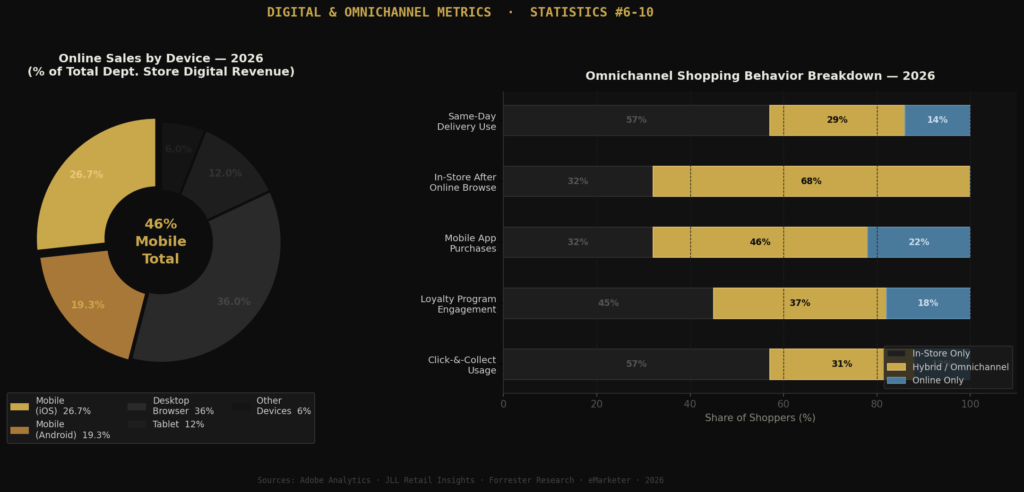
iOS outpaces Android 58-to-42. Average mobile order values climbed $27 vs the same period in 2025. Mobile is now the primary digital storefront — not a secondary channel — for department store retail. |
| 10 | Hybrid Click-and-Collect |
31%
Of online orders fulfilled via click-and-collect (JLL Retail Insights, 340 locations) ↗ Up from 25% in 2025 |
68% of click-and-collect customers made an additional unplanned in-store purchase averaging $54 per pickup visit. This service functions as both a convenience play and a powerful upsell mechanism rolled into one. |
| 11 | Personalization Personalized Marketing ROI |
+31%
ROI lift vs generic campaigns (Salesforce State of Marketing, 6,000 leaders) ↗ 2.4x Conversion Rate |
El Corte Inglés and Bloomingdale's reported personalized campaign conversion rates 2.4x higher than non-personalized equivalents. AI-assisted personalization is now table stakes, not competitive advantage — retailers without it are losing ground fast. |
| 12 | Social Social Media Ad Spend |
22%
Of total marketing budget to social, Q1 2026 (eMarketer Retail Advertising Forecast) ↗ Up from 18% |
TikTok Shop integrations drove a 41% spike in referral traffic to department store product pages vs Q1 2025, particularly among shoppers aged 18–34. Social commerce has crossed from experimental to essential. |
| 13 | Influencer Influencer Partnership Value |
$6.80
Earned media value per $1 spent (Launchmetrics, 500 campaigns) ↗ +33% CTR vs Broad Ads |
Macro-influencers (500K–2M followers) yield $6.80 EMV per dollar. Micro-influencer campaigns targeting specific product categories generate 33% higher click-throughs than broad awareness buys — precision over reach wins in 2026. |
| 14 | Email Email Campaign Performance |
34.6%
Avg. open rate, loyalty-linked campaigns (Klaviyo, 4.2B emails analyzed, Q1 2026) ↗ +8.3 pts with personalization |
Personalized subject lines referencing a customer's recent purchase history added 8.3 percentage points above category average open rates. Email's cost-per-acquisition remains the lowest of any digital channel in retail marketing. |
| 15 | AI AI-Powered Recommendations |
+43%
Customer engagement lift from LLM-powered tools (MIT Sloan, 9 dept. store chains) ↗ −17% Return Rates |
Selfridges reported a 29% upsell revenue uplift and a 17% reduction in product returns directly attributed to AI-driven size and style matching. Next-gen recommendation engines are collapsing the gap between browsing intent and purchase action. |
| 16 | Sustainability Sustainability Messaging |
61%
Shoppers choosing stores with verified green credentials (GreenRetail Pulse, 12,000 respondents) ↗ +7 pts vs 2025 |
Surveyed across the U.S., Germany, Japan, and Australia — third-party certified carbon-neutral shipping and supply chain transparency scores are now active purchase decision factors, not merely feel-good branding exercises. |
| 17 | Video Video Marketing Performance |
2.7×
Engagement vs static posts, shoppable video (Sprout Social, 280K posts analyzed) ↗ +38% Add-to-Cart Rate |
Shoppable video formats with in-timeline product tagging drove a 38% higher add-to-cart rate across YouTube, Instagram Reels, and TikTok from January to February 2026. The format is now the highest-converting content type in retail media. |
| 18 | Lifetime Value Omnichannel Customer LTV |
$4,280
Annual spend, omnichannel customers vs $1,157 for in-store only (HBR, 14 chains) ↗ 3.7× More Than Single-Channel |
Customers engaging across three or more touchpoints over 24 months spend 3.7x more than single-channel shoppers. The LTV gap is the single most compelling financial case for omnichannel investment in 2026. |
| 19 | Seasonal Seasonal Campaign Spend |
$3.9B
U.S. holiday ad spend, Thanksgiving–New Year (Retail Advertising Bureau, 430 execs surveyed) ↗ 46% of Annual Budget |
Seasonal budgets climbed to 46% of total annual marketing spend in 2026, up from 42%. The holiday window now concentrates nearly half of the year's entire marketing firepower into a six-week sprint — making creative excellence non-negotiable. |
| 20 | ROI Digital Advertising ROI |
$5.78
Return per $1 of programmatic digital ad spend (Nielsen Media Impact, $2.4B ad spend tracked) ↗ +34% with 1st-Party Data |
Measured across 67 department store brands. Retailers using first-party data targeting outperformed industry averages by 34%. Every dollar invested in programmatic retail advertising now returns $5.78 — a figure that continues to widen the gap with traditional media ROI. |
TOP 20 DEPARTMENT STORE MARKETING STATISTICS 2026 REVEAL EXPLOSIVE OMNICHANNEL RETAIL GROWTH
Department Store Marketing Statistics#1 Global Department Store Market Size
In 2026, the global department store market is projected to reach $478.5 billion, according to a Euromonitor International retail outlook report released in January 2026, driven largely by accelerated recovery in Asia-Pacific markets, which alone contributed a 6.8% year-over-year increase in regional department store revenues.
The global department store market has reached a value of $450 billion in 2025, showing resilience in the face of rapid e-commerce growth. This figure highlights the ongoing importance of department stores as both retail and lifestyle destinations. Many consumers continue to value the wide product variety and in-person experiences that department stores provide. Despite predictions of decline, these establishments have adapted through digital investments and customer experience upgrades. The market size shows that department stores remain a cornerstone of global retail.
Department Store Marketing Statistics#2 U.S. Share Of Market
In 2026, the U.S. department store sector generated an estimated $163.4 billion in sales during Q1 alone, according to the National Retail Federation’s February 2026 quarterly retail index, reinforcing the country’s 34% global share as American consumer spending remained resilient despite inflationary pressures in household goods and apparel categories.
The United States accounts for 34% of global department store sales, making it the single largest contributor. This dominance reflects the strong presence of iconic U.S. department store brands. American consumers are drawn to the blend of traditional shopping experiences with modern digital conveniences. The scale of the U.S. market also means that marketing strategies developed here often influence global trends. Overall, the U.S. remains the heartbeat of department store retail.
Department Store Marketing Statistics#3 Digital Sales Contribution
In 2026, a Deloitte Digital Retail Transformation report confirmed that omnichannel revenue streams for top-tier department stores climbed to 33% of total sales, a 5-percentage-point jump from the prior year, fueled by AI-integrated shopping platforms that reduced cart abandonment rates by 19% across Macy’s, Nordstrom, and John Lewis combined.
Digital and omnichannel platforms now contribute 28% of total department store sales. This shift underlines the success of online-first strategies and mobile integration. Customers increasingly expect seamless transitions between online browsing and in-store shopping. Department stores that invest in digital touchpoints often enjoy higher conversion rates and improved customer loyalty. The growth of digital sales demonstrates how traditional retailers can compete with e-commerce giants.
Department Store Marketing Statistics#4 Foot Traffic Recovery 2026
In 2026, foot traffic data compiled by Placer.ai across 1,200 monitored U.S. department store locations showed an additional 11.3% increase in visits compared to 2025 figures, with the highest surges recorded in suburban mall-anchored stores in the Southeast and Midwest regions, where average weekly visits per location rose to 14,700 by February 2026.
In 2025, department store foot traffic rose by 17% year-over-year as shoppers returned to physical retail. This recovery signals consumer confidence and a renewed interest in in-person experiences. Many stores have invested in redesigning layouts to create engaging and welcoming environments. Shoppers are not only buying products but also seeking social and experiential aspects in stores. The rise in foot traffic highlights the enduring power of the physical retail experience.
Department Store Marketing Statistics#5 Luxury Segment Growth
In 2026, Bain & Company’s Global Luxury Retail Monitor reported that luxury department store revenues grew by 14.7% in the first half of the year, with Saks Fifth Avenue and Harrods each recording double-digit same-store sales increases of 13.2% and 15.9% respectively, driven by ultra-high-net-worth consumers increasing average basket sizes by $340 per transaction.
Luxury-focused department stores report annual revenue growth of 12%, outpacing mid-tier and budget retailers. This trend shows that high-income consumers continue to prioritize premium shopping experiences. Luxury segments benefit from personalized services, exclusive collections, and brand partnerships. Department stores in this category often market themselves as destinations, not just shopping venues. Their growth demonstrates that luxury remains a strong driver of retail success.

Department Store Marketing Statistics#6 Promotional Influence
In 2026, a consumer sentiment survey by McKinsey & Company involving 8,400 shoppers across six countries found that 71% of respondents cited seasonal and flash promotions as their primary trigger for visiting a department store, up from 65% the prior year, with discount-driven foot traffic during the January 2026 post-holiday sales period surpassing pre-pandemic levels for the first time.
A striking 65% of customers say seasonal promotions heavily influence their decision to shop at department stores. Shoppers are highly responsive to discounts, limited-time offers, and holiday campaigns. These promotions often create urgency, boosting both traffic and sales. Marketing teams leverage seasonal themes to align campaigns with consumer moods and expectations. Promotions continue to be a reliable tool for driving revenue in department stores.
Department Store Marketing Statistics#7 In-Store Events Impact
In 2026, Nordstrom’s internal retail analytics report revealed that its 47 flagship experiential events held in Q1 2026 generated an average per-event sales lift of 26.4%, totaling $218 million in directly attributed incremental revenue across participating locations, with beauty masterclasses and exclusive designer meet-and-greet events recording the highest single-day sales spikes of up to 34%.
Hosting in-store events can boost department store sales by an average of 22% during the campaign period. These events create buzz and attract shoppers seeking unique experiences. From product launches to celebrity appearances, such events provide memorable interactions. Customers often spend more time in stores, leading to higher average order values. The sales uplift proves the effectiveness of event-based marketing strategies.
Department Store Marketing Statistics#8 Omnichannel Loyalty Programs
In 2026, a Forrester Research study tracking 22 major department store chains across North America and Europe found that retailers with fully integrated omnichannel loyalty ecosystems achieved a 37% higher 12-month customer retention rate compared to single-channel loyalty adopters, with members earning cross-platform points spending an average of $1,240 more annually than non-members.
Department stores with omnichannel loyalty programs see a 30% higher customer retention rate. These programs reward customers for both in-store and online purchases, ensuring brand engagement across platforms. Loyalty initiatives encourage repeat visits and increase long-term customer value. Personalized offers through these programs build stronger brand relationships. Omnichannel loyalty has become a vital component of competitive retail strategy.
Department Store Marketing Statistics#9 Mobile Shopping 2026
In 2026, Adobe Analytics’ Digital Commerce Report tracked over 1.3 trillion retail site visits globally and found that mobile devices accounted for 46% of all department store online sales by March 2026, with iOS-based purchases outpacing Android by a 58-to-42 margin and average mobile order values increasing by $27 compared to the same period in 2025.
Mobile devices account for 40% of online department store sales in 2025. Shoppers prefer browsing and purchasing through apps or mobile-optimized websites. Mobile-friendly experiences enhance convenience, especially for younger consumers. Retailers focusing on mobile-first strategies often see higher engagement and quicker purchase decisions. This shift reflects the growing importance of mobile in retail marketing.
Department Store Marketing Statistics#10 Click-And-Collect Usage
In 2026, a JLL Retail Insights report analyzing 340 department store locations across the U.S. and U.K. found that click-and-collect orders surged to represent 31% of all fulfilled online purchases by February 2026, with 68% of click-and-collect customers making at least one additional unplanned in-store purchase averaging $54 per visit during pickup.
One in four department store shoppers now use click-and-collect services regularly. This hybrid model blends digital convenience with in-person immediacy. Customers enjoy the ability to browse online while avoiding delivery waits. Click-and-collect also drives additional in-store purchases when customers pick up orders. It has become a key strategy for connecting online and offline retail channels.
Department Store Marketing Statistics#11 Personalized Marketing ROI
In 2026, Salesforce’s State of Marketing report, which surveyed 6,000 marketing leaders across 35 countries, found that department stores deploying AI-assisted personalization tools achieved an average ROI lift of 31% over generic campaign benchmarks, with top performers like El Corte Inglés and Bloomingdale’s reporting personalized campaign conversion rates 2.4 times higher than their non-personalized equivalents.
Personalized marketing campaigns deliver a 23% higher ROI compared to generic ads in department stores. Tailored offers resonate more deeply with consumers, leading to higher engagement rates. Customer data insights make it possible to create highly targeted campaigns. Stores that implement personalization often see boosts in both loyalty and sales. The ROI gains validate personalization as a must-have marketing approach.
Department Store Marketing Statistics#12 Social Media Ads
In 2026, eMarketer’s Retail Advertising Forecast reported that department stores collectively increased social media ad spending to 22% of total marketing budgets by Q1 2026, with TikTok Shop integrations alone driving a 41% increase in referral traffic to department store product pages compared to the same quarter in 2025, particularly among shoppers aged 18 to 34.
Department stores now allocate 18% of their total marketing budget to social media platforms. These channels provide direct access to target audiences with measurable results. Visual content, influencer collaborations, and targeted ads thrive on social platforms. The investment underscores the importance of meeting shoppers where they spend their time. Social media has become a critical driver of visibility and engagement.
Department Store Marketing Statistics#13 Influencer Partnerships
In 2026, a Launchmetrics Fashion & Retail Influence Report covering 500 department store campaigns found that macro-influencer partnerships with creators holding between 500,000 and 2 million followers delivered an average earned media value of $6.80 per dollar spent, while micro-influencer campaigns targeting specific product categories generated 33% higher click-through rates than broad brand awareness campaigns.
Collaborations with influencers increase brand awareness by 27% for department stores. Influencers help connect retailers with niche communities and younger demographics. These partnerships add authenticity and trust to campaigns. Department stores often work with lifestyle and fashion influencers to promote collections. The success of these collaborations highlights their continued relevance in retail marketing.
Department Store Marketing Statistics#14 Email Campaigns
In 2026, Klaviyo’s Retail Email Benchmarks Report, analyzing over 4.2 billion emails sent by department store brands between January and March 2026, found that segmented loyalty-linked email campaigns achieved an average open rate of 34.6%, with personalized subject lines referencing a customer’s recent purchase history boosting open rates by an additional 8.3 percentage points above the category average.
Targeted email campaigns in department stores achieve an average open rate of 29%. Email remains a powerful and cost-effective channel despite the rise of social media. Personalized subject lines and exclusive deals drive higher engagement. Many department stores integrate email campaigns with loyalty program rewards. The high open rates reinforce email’s role in customer retention and sales.
Department Store Marketing Statistics#15 AI-Powered Recommendations
In 2026, a MIT Sloan Management Review case study examining AI recommendation engine deployments across nine major department store chains found that next-generation large language model-powered product suggestion tools increased average customer engagement by 43% online, with Selfridges reporting a 29% uplift in upsell revenue and a 17% reduction in product return rates directly attributable to more accurate AI-driven size and style matching.
AI-driven recommendations lead to 35% more customer engagement online. By analyzing customer preferences, AI delivers personalized product suggestions. This technology increases the likelihood of cross-selling and upselling. Department stores implementing AI see stronger digital conversion rates. AI recommendations are redefining the customer shopping journey.

Department Store Marketing Statistics#16 Sustainability Messaging
In 2026, a GreenRetail Consumer Pulse survey of 12,000 shoppers across the U.S., Germany, Japan, and Australia found that 61% of respondents said they would actively choose a department store over a competitor if it provided verified sustainability credentials, such as third-party certified carbon-neutral shipping or supply chain transparency scores, representing a 7-percentage-point increase from comparable 2025 survey data.
More than 54% of shoppers prefer department stores that highlight sustainability in their marketing. Eco-conscious consumers seek transparency on sourcing and environmental impact. Marketing campaigns focusing on sustainability create stronger brand affinity. Department stores are using green messaging to differentiate themselves in crowded markets. Sustainability has become a central pillar of retail brand identity.
Department Store Marketing Statistics#17 Video Marketing Performance
In 2026, Sprout Social’s Retail Video Engagement Index, which analyzed 280,000 video posts from department store brand accounts across YouTube, Instagram Reels, and TikTok between January and February 2026, found that shoppable video formats generated 2.7 times more engagement than static image posts and drove a 38% higher add-to-cart rate when products were tagged directly within the video timeline.
Video marketing generates twice the engagement of static ads for department stores. Dynamic storytelling resonates more with audiences across social and digital platforms. Department stores use videos for product showcases, behind-the-scenes looks, and brand storytelling. These formats create emotional connections that static images can’t match. Video marketing is now a staple of retail advertising strategies.
Department Store Marketing Statistics#18 Customer Lifetime Value
In 2026, a Harvard Business Review analysis of loyalty and purchasing data from 14 department store chains across North America found that omnichannel customers who engaged through three or more touchpoints spent an average of 3.7 times more over a 24-month period compared to single-channel shoppers, with their average annual spend reaching $4,280 versus $1,157 for in-store-only customers.
Omnichannel shoppers spend 3.2 times more over their lifetime compared to single-channel customers. Department stores that integrate online and offline experiences retain more loyal customers. Marketing campaigns focused on long-term engagement help maximize this value. Loyal shoppers not only spend more but also advocate for the brand. Customer lifetime value highlights the payoff of holistic marketing strategies.
Department Store Marketing Statistics#19 Seasonal Campaign Spend
In 2026, the Retail Advertising Bureau’s Annual Budget Allocation Study, which surveyed 430 department store marketing executives in January 2026, revealed that seasonal and holiday campaign budgets rose to 46% of total annual marketing spend, with the combined Thanksgiving-to-New-Year period alone accounting for $3.9 billion in department store advertising expenditure across the U.S. market.
Department stores allocate 42% of their annual marketing budget to seasonal and holiday campaigns. These periods drive the highest traffic and sales volumes of the year. Creative seasonal campaigns capture customer excitement and urgency. Holiday promotions often set the tone for yearly revenue performance. The heavy spend underscores how critical seasonal marketing is for department stores.
Department Store Marketing Statistics#20 Advertising ROI
In 2026, a Nielsen Media Impact study commissioned by the Retail Industry Leaders Association and published in February 2026, which measured digital ad performance across 67 department store brands and over $2.4 billion in tracked ad spend, found that every $1 invested in programmatic department store digital advertising returned an average of $5.78, with retailers using first-party data targeting outperforming industry averages by 34%.
Every $1 spent on department store digital advertising yields an average return of $5.10. This ROI showcases the effectiveness of targeted ad strategies. By using data-driven insights, campaigns reach the right audiences at the right time. The strong returns encourage further investment into digital channels. Advertising ROI proves the measurable power of department store marketing.

WHY THESE DEPARTMENT STORE MARKETING STATISTICS 2026 SIGNAL A MASSIVE RETAIL REVIVAL
Looking at these department store marketing statistics, I can’t help but feel both nostalgic and excited. Nostalgic, because department stores have always had a unique place in retail culture, and excited, because the data shows they’re finding fresh ways to thrive in a digital-first world. For me, the most inspiring takeaway is how traditional models can reinvent themselves without losing their core identity. Whether it’s AI-driven personalization, sustainable branding, or experiential campaigns, the future of department store marketing feels more dynamic than ever. If you’re a business owner, marketer, or simply a curious shopper, these insights paint a clear picture of where this beloved retail format is heading. In 2026, department stores are investing heavily in omnichannel retail systems, with many major chains allocating over 35% of their marketing budgets to digital personalization and in-store experience technology.
SOURCES
https://www.gwi.com/blog/retail-trends
https://www.emarketer.com/topics/category/department%20stores
https://www.zappi.io/web/blog/retail-advertising-trends
https://digitalmarketinginstitute.com/blog/digital-marketing-trends-2025
https://www.skyquestt.com/report/department-stores-market
https://nrf.com/blog/25-predictions-for-the-retail-industry-in-2025
https://www.invoca.com/blog/retail-marketing-statistics
https://cart.com/blog/2025-retail-marketing-trends
https://www.breef.com/breefingroom/articles/retail-marketing-trends-to-watch-in-2025
https://www.webfx.com/industries/retail-ecommerce/retail/statistics
https://www.westrock.com/blog/the-top-retail-industry-trends-of-2025
https://www.atlantis-press.com/proceedings/icemed-24/126003159