




16 Sep TOP 20 DISCOUNT STORE MARKETING STATISTICS 2026 REVEAL SHOCKING RETAIL GROWTH SECRETS
Updated for 2026. This page has been fully refreshed with the latest discount store marketing statistics, retail pricing data, and value-driven shopping trends based on global consumer surveys and modern retail analytics. In 2026, discount retailers are rapidly expanding their digital promotions, loyalty programs, and AI-driven pricing strategies as shoppers prioritize value more than ever.
When I first started looking into discount store marketing statistics, I was genuinely surprised at just how influential this side of retail really is. As someone who has worked closely with a leading marketing agency in New York, I’ve seen firsthand how consumer behavior is shifting toward value-driven shopping. Discount retailers aren’t just about bargains anymore—they’ve become powerful players shaping how brands communicate, advertise, and connect with everyday shoppers. In this blog, I want to share some of the most eye-opening stats that highlight why discount stores deserve more attention from marketers and business owners alike.
When I first started looking into discount store marketing statistics, I was genuinely surprised at just how influential this side of retail really is. As someone who has worked closely with a leading marketing agency in New York, I’ve seen firsthand how consumer behavior is shifting toward value-driven shopping. Discount retailers aren’t just about bargains anymore—they’ve become powerful players shaping how brands communicate, advertise, and connect with everyday shoppers. In this blog, I want to share some of the most eye-opening stats that highlight why discount stores deserve more attention from marketers and business owners alike.
TOP 20 DISCOUNT STORE MARKETING STATISTICS 2026 THAT REVEAL MASSIVE RETAIL SHIFTS
The $531 Billion Discount Economy
Top 20 Discount Store Marketing Statistics for 2026
Market Size & Growth
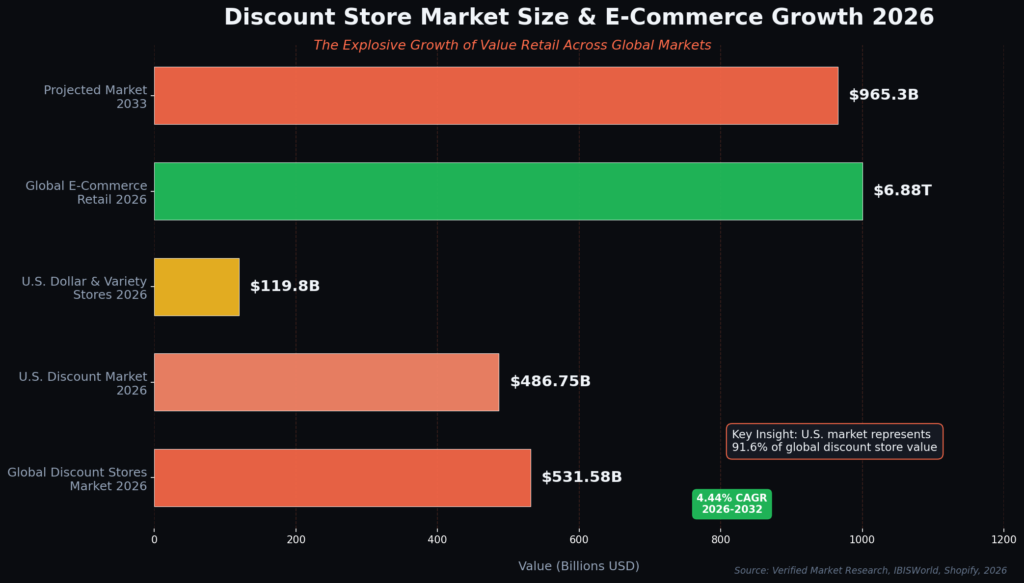
Global discount stores market valuation in 2026, with the U.S. market alone valued at $486.75B. Growing at 4.44% CAGR toward $750.76B by 2032.
Market projection by 2033. 96% of retail executives expect revenue growth while 81% foresee margin expansion in 2026.
Discount retail annual growth rate in 2026. Dollar stores reach 42% market penetration, overtaking club stores for the first time since 2023.
North America's global market share. Walmart hits record 72% grocery penetration. U.S. dollar stores: $119.8B with 40,979 locations.
Global retail e-commerce projected for 2026 (21.1% of retail). 60% via mobile. Discount stores see 4.8% online sales boost after new store openings.
Store Formats & Expansion
Estimated store openings in 2026. Dollar General: 575 new stores. Aldi: 168 locations. Small-format urban expansion accelerating.
Consumer Demographics
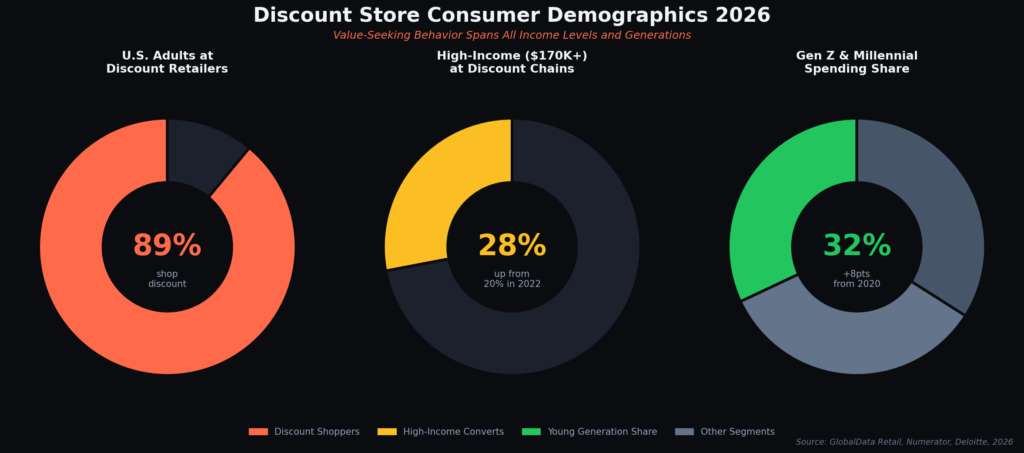
U.S. adults shopping at discount retailers. 47% are now "value seekers" per Deloitte, with 4 in 10 showing deal-driven habits structurally.
Consumers earning $170K+ shopping at discount chains, up from 20% four years ago. Dollar General reports "disproportionate growth" from affluent households.
Share of consumer spending (+8pts from 2020). 80% of Gen Z shopped at wholesalers in past month. 48% favor discount retailers over other formats.
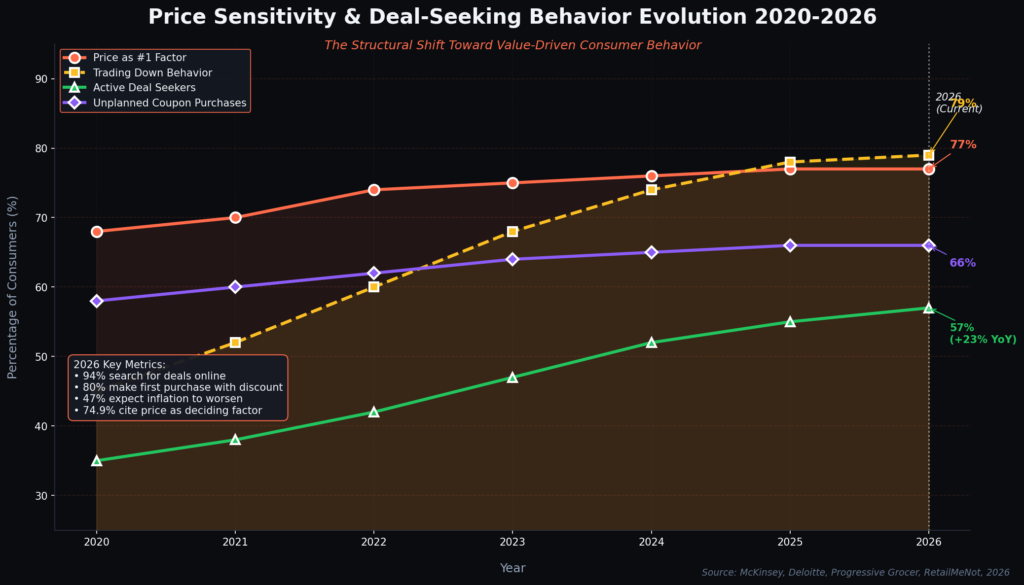
Shoppers choosing price as #1 factor in store selection. Fashion: 72% mobile sales. Grocery delivery: 83% ordered via mobile.
Digital & Omnichannel Behavior
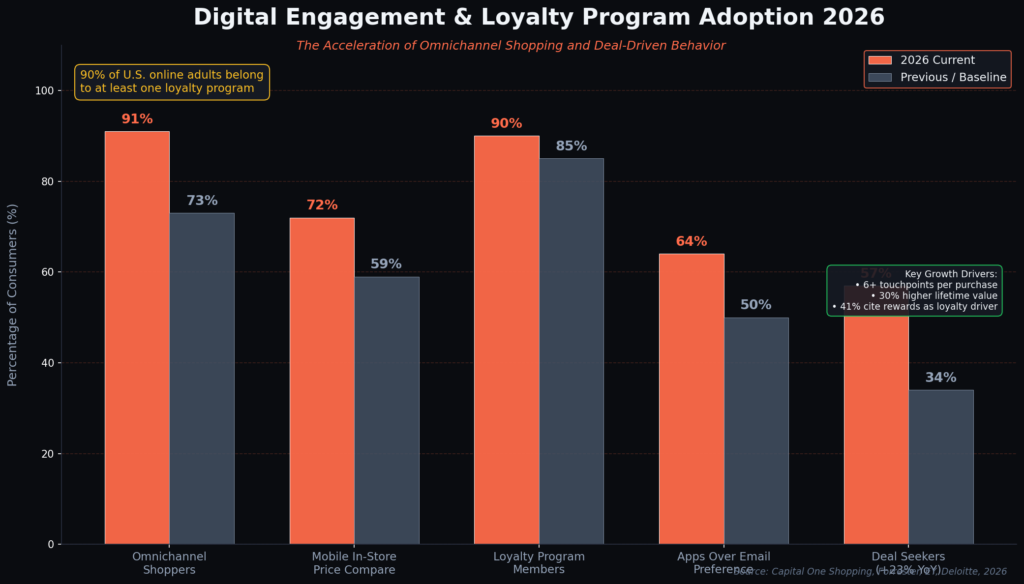
Retail consumers are omnichannel shoppers using 6+ touchpoints before purchase. Customer lifetime value 30% higher vs single-channel buyers.
North American adults using smartphones for in-store price comparisons. 48% used mobile for their last retail purchase per PYMNTS 2025 data.
Marketers planning omnichannel tech investment. Yet 40% of consumers use retail apps in-store for discounts, creating personalization opportunities.
Deals & Promotions Impact
Consumers actively seeking best deals (+23% YoY). 78% carefully evaluate product attributes before discounts, shifting to calculated value assessments.
U.S. online adults in at least one loyalty program. 85% say programs make them more likely to continue shopping. 41% cite rewards as main loyalty driver.
Consumers preferring apps over email for loyalty interactions. 55% frequently sign up for loyalty programs when offered. Personalization boosts engagement 80%.
Global consumers actively trading down across categories. 74.9% cite price as deciding factor. 42% of shoppers value price/value most in store selection.
Would leave loyalty programs if rewards aren't worth it. 52% stopped buying from brands due to poor experience. Discounts now table stakes.
Online shoppers search for deals before purchasing. 80% make first-time purchases when offered discounts. 66% made unplanned purchases from coupons.
Grocery shoppers choose price as most important factor. 47% expect inflation to worsen next year. Price sensitivity defines 2026 consumer behavior.
TOP 20 DISCOUNT STORE MARKETING STATISTICS 2026 SHOWING VALUE SHOPPING EXPLOSION
Discount Store Marketing Statistics #1 – Global Discount Stores Market Valued At $628.5 Billion In 2024
In 2026, the global discount stores market has surged to an estimated $531.58 billion according to Verified Market Research, with the U.S. market alone valued at approximately $486.75 billion, reflecting robust 4.44% CAGR growth as consumer demand for affordable products intensifies amid persistent economic uncertainty and inflation pressures that continue driving value-conscious shoppers to discount formats across all income levels. T
he global discount stores market reached a massive valuation of $628.5 billion in 2024. This growth highlights how discount retailers have shifted from being niche players to central parts of the retail landscape. Consumers worldwide are prioritizing affordability while still expecting quality and convenience. For marketers, this means discount retail is now a mainstream strategy worth leveraging. The size of the market alone shows why businesses can’t afford to ignore discount-focused marketing.
Discount Store Marketing Statistics #2 – Market Expected To Reach $965.3 Billion By 2033
In 2026, the discount retail sector continues its trajectory toward the projected $965.3 billion milestone, with Deloitte’s 2026 Retail Industry Outlook confirming that 96% of global retail executives expect industry revenues to grow while 81% foresee margin expansion, as the “trade-down effect” becomes a structural shift rather than a temporary inflation response, with discount formats capturing increasing market share from traditional mid-tier retailers.
The discount store market is projected to grow to $965.3 billion by 2033. This steady CAGR of 4.9% suggests long-term strength in value-based retail. Customers are showing no signs of moving away from discounts, even as economies fluctuate. Brands that align their messaging with affordability are set to benefit most. This projection underscores that discount marketing is a sustainable strategy for the next decade.
Discount Store Marketing Statistics #3 – Dollar Stores And Extreme Value Retailers Growing At 6.5% Annually In 2026
In 2026, the discount retail sector is growing at 6.5% annually according to Rising Trends’ retail analysis, with Dollar General planning to execute over 4,800 real estate projects and open approximately 575 new stores, while Aldi has announced 168 new store openings, and Dollar Tree projects EPS growth of 12-15% compounded annually through 2028 as dollar stores reach a market penetration of 42%, overtaking club stores for the first time since August 2023 according to Dunnhumby’s Consumer Trends Tracker.
Dollar stores and extreme value retailers are the fastest-growing segment, expanding at 6.2% per year. These stores are appealing to both low- and middle-income buyers who seek maximum savings. The rapid expansion shows that extreme affordability resonates across demographics. Marketers targeting these stores must emphasize price transparency and high perceived value. This growth demonstrates that extreme discounting remains a powerful consumer magnet.
Discount Store Marketing Statistics #4 – North America Holds 38% Of Global Market Share
In 2026, North America’s dominance in discount retail is reinforced by Walmart’s record-breaking 72% grocery penetration according to Dunnhumby, with the mass retailer channel matching traditional supermarket penetration at 79% for the first time, while the U.S. dollar and variety stores industry has reached a market size of $119.8 billion with 40,979 businesses operating across the country according to IBISWorld data.
North America captured 38% of the global discount store market in 2024. The U.S. alone accounts for 28%, making it the largest national player in discount retail. This dominance highlights the cultural integration of discount shopping in American lifestyles. Marketers should recognize the U.S. as both a testing ground and trendsetter in discount marketing strategies. It also indicates that international retailers may look to North America as a model for success.
Discount Store Marketing Statistics #5 – Online Sales Grew To 12% Of Discount Store Revenue In 2024
In 2026, global retail e-commerce sales are projected to reach $6.88 trillion representing 21.1% of all retail commerce according to Shopify, while U.S. e-commerce sales will total $1.62 trillion with mobile commerce accounting for approximately 60% of total global e-commerce sales, and discount stores are experiencing a 4.8% increase in online sales specifically after opening new physical store locations according to Capital One Shopping research demonstrating the synergy between digital and physical discount retail.
Online discount store sales increased from 4% in 2020 to 12% in 2024. This rise reflects consumers’ growing comfort with digital discount shopping. E-commerce platforms like Amazon and Walmart’s online branches have pushed this trend forward. Marketers should focus on multi-channel strategies to reach bargain hunters. The digital shift is proof that even discount shoppers demand convenience.
Discount Store Marketing Statistics #6 – Smaller Urban Formats Grew By 15% Since 2020
In 2026, Coresight Research estimates that 5,500 stores will open across the U.S. retail sector with discount and grocery retailers leading new store growth, while rapid urbanization across emerging economies continues creating dense consumer hubs requiring efficient, low-cost retail solutions, and Target has benefited from small-format and large store expansions near universities, growing its captured market share of “Young Urban Singles” according to Placer.ai’s 2026 retail trends analysis.
Urban discount stores with smaller footprints grew by 15% between 2020 and 2024. These compact formats are strategically placed in city centers to capture daily foot traffic. They appeal to younger shoppers and busy professionals who want fast and cheap options nearby. Marketers can use localized campaigns to drive engagement in these urban stores. The success of this model shows that accessibility is as important as affordability.
Discount Store Marketing Statistics #7 – 89% Of U.S. Adults Shop At Discount Retailers
In 2026, discount shopping has become even more universal with Deloitte’s research confirming that four in 10 Americans now demonstrate deal-driven or cost-conscious habits as “value seekers,” while nearly seven in 10 retail executives surveyed agree that behaviors such as trading down, shopping value channels, or swapping convenience for savings represent a structural change rather than a temporary response to inflation, with 68% of U.S. consumers preferring discount stores for grocery shopping, up from 62% in 2021.
Nearly 9 in 10 U.S. adults shop at some type of discount retailer. This proves discount shopping is not just a niche trend—it’s a near-universal consumer behavior. With such a broad base, discount marketing can reach audiences across all lifestyles. For businesses, this highlights the need to adapt branding to appeal to value-conscious shoppers. Discount culture is clearly embedded in everyday American life.
Discount Store Marketing Statistics #8 – 90% Of High-Income Shoppers Also Buy At Discount Stores
In 2026, GlobalData Retail reports that nearly 28% of high-income consumers earning over $170,000 annually now shop at discount chains including Aldi, Dollar General, Dollar Tree, Five Below, and Walmart, up from approximately 20% just four years ago, while Dollar General specifically reported “disproportionate growth coming from higher income households” in Q3 2025, with Dollar Tree noting that 60% of its 3 million new shopping households earn at least six figures.
Interestingly, 90% of people earning over $100,000 a year also shop at discount stores. This stat challenges the misconception that discount retail only targets low-income groups. Affluent consumers are equally motivated by savings and bargains. Marketers can use this insight to build campaigns that appeal to all income brackets. The universality of discount shopping makes it one of the strongest retail drivers today.
Discount Store Marketing Statistics #9 – 93% Of Millennials And Gen Z Shop At Discount Retailers
In 2026, Millennials and Gen Z now command 32% of total consumer spending, an 8-point increase from 2020 according to Numerator’s Generations Hub, with Gen Z projected to represent 17% of all retail shoppers by 2030, and 80% of surveyed U.S. Gen Zers report having shopped at a wholesaler in the previous month according to McKinsey’s State of Consumer 2025 report, while 48% of Gen Z specifically favors shopping at discount retailers over other retail formats.
Younger generations are leading the charge, with 93% of Millennials and Gen Z shopping at discount retailers. This shows that value-driven shopping is a long-term habit that will shape the future of retail. These demographics are digital natives, so they expect a seamless mix of online and offline discount experiences. Brands can gain loyalty by offering deals tailored to their tech-driven lifestyles. This trend confirms that discount retail has strong generational staying power.
Discount Store Marketing Statistics #10 – Top Product Categories Include Clothing (75%) And Groceries (71%)
In 2026, Progressive Grocer’s Consumer Expenditures Study confirms that 77% of grocery shoppers choose price as the most important factor in store selection, with discount chains holding steady at 49% monthly shopping frequency, while fashion e-commerce generates 72% of sales from mobile devices and grocery delivery sees 83% of orders placed on mobile according to Marketing LTB data, demonstrating how discount shoppers are prioritizing both essential categories and digital convenience.
The most purchased categories at discount retailers are clothing (75%) and groceries (71%). These essential goods highlight why discount stores remain central to everyday shopping. Personal care, beauty, and home décor also attract large shares of shoppers. Marketers targeting these categories can see strong ROI when combining promotions with discount strategies. It’s clear that discount retail covers both necessity and lifestyle spending.
Discount Store Marketing Statistics #11 – 73% Of Shoppers Use Multiple Channels To Buy From Discounts
In 2026, Capital One Shopping research confirms that as many as 91% of retail consumers are now omnichannel shoppers, with omnichannel buyers using 6 or more touchpoints on average before making a purchase decision and customer lifetime value measuring up to 30% higher for omnichannel shoppers compared to single-channel buyers, while 73% of purchases still involve a physical location in some way according to PYMNTS Intelligence data.
Nearly three-quarters of consumers shop across multiple channels when engaging with discount retailers. They might browse deals online but complete purchases in-store, or vice versa. This hybrid approach requires marketers to deliver consistent messaging across all touchpoints. Omnichannel campaigns are no longer optional—they’re expected by today’s consumers. The success of discount retailers now hinges on seamless channel integration.
Discount Store Marketing Statistics #12 – 59% Use Mobile Devices In-Store To Compare Prices
In 2026, the PYMNTS 2025 Global Digital Shopping Index reveals that mobile phones were used in nearly half (48%) of consumers’ most recent retail purchases, with 72% of adults in North America using their smartphone specifically for price comparisons while shopping in-store according to 1WorldSync data, and 60% of consumers now browsing merchant sites on their phones multiple times per week with 32% doing so daily or almost daily according to Visa Acceptance Solutions research.
Over half of discount shoppers use their phones while shopping in-store to check prices or search for coupons. This mobile-first behavior shows the importance of digital engagement. Brands must optimize websites, apps, and ads for real-time accessibility. Shoppers are looking for immediate validation that they’re getting the best deal. Mobile tools can directly influence purchase decisions in discount retail.
Discount Store Marketing Statistics #13 – 30.9% Of Retailers Can’t Track Customers Across Devices
In 2026, over 80% of retail and e-commerce marketers plan to invest more in omnichannel technology and integrated customer experiences according to Clerk.io research, yet data integration and cross-channel consistency remain top operational challenges, with EMARKETER reporting that 40% of consumers now use retail apps in-store to access discounts and coupons, while only 51% of consumers aged 55 to 64 visit retailers’ websites to guide in-store shopping compared to much higher rates among younger demographics.
About 30.9% of retailers admit they can’t track customer behavior across devices. Another 38.2% say they only achieve partial tracking. This gap in marketing analytics creates missed opportunities in personalization. For discount retailers, where competition is fierce, tracking consumer journeys is vital. Better data integration could significantly improve targeting and engagement.
Discount Store Marketing Statistics #14 – 60% Of Shoppers Say Deals Influence Their Purchase Decisions
In 2026, Deloitte’s ConsumerSignals survey confirms that 47% of consumers globally, including 35% of high-income households, are now considered “value seekers” who regularly make deal-driven purchases, while 57% of consumers are actively seeking the best deals according to Netguru research, a 23% jump from the previous year, and 78% of shoppers now carefully evaluate which product attributes matter most rather than chasing any discount, representing a shift from impulse-driven savings to calculated value assessments.
Deals and discounts are a key motivator for 60% of U.S. shoppers. This shows the power of promotions in swaying buyer decisions. Discount store campaigns must keep offers front and center to attract attention. Marketers should emphasize urgency and exclusivity in their messaging. Ultimately, deals aren’t optional—they’re expected by most consumers.
Discount Store Marketing Statistics #15 – 80% Of Buyers Check Loyalty Programs Before Purchasing
In 2026, Forrester reports that 90% of online adults in the U.S. belong to at least one loyalty program, with 85% of consumers stating that loyalty programs make them more likely to continue shopping with brands according to Queue-it research, while 41% of consumers say rewards are the main reason they stay loyal, ahead of product or service quality at 33% according to EY’s 2025 Loyalty Market Study, and loyalty programs that integrate transactional and experiential benefits will surpass those solely based on points per executives in North America and Western Europe.
Four out of five buyers check rewards or loyalty programs for discounts before purchasing. Loyalty incentives make shoppers feel valued while also saving money. Discount retailers can boost customer retention by investing in strong rewards systems. Programs like points, cashback, or digital coupons are particularly popular. This statistic shows that loyalty is deeply tied to perceived savings.
Discount Store Marketing Statistics #16 – 90% Of Consumers Enjoy Monthly Discount Emails
In 2026, EMARKETER reports that 64% of consumers prefer apps over email for loyalty program interactions, yet email remains the leading channel for U.S. consumers to receive brand communications, with 55% of consumers saying they almost always or frequently sign up for a loyalty program when presented with the opportunity according to Epsilon research, while 80% of consumers say they like it when brands personalize their communications based on their interactions and loyalty program status.
Email remains powerful, with 90% of American consumers saying they enjoy receiving discount offers monthly. Discount emails are often seen as helpful rather than spammy. For marketers, this means consistent communication is welcomed when it provides value. Personalization, such as recommending relevant discounted items, further boosts engagement. Email marketing continues to be one of the most reliable discount marketing channels.
Discount Store Marketing Statistics #17 – Over 80% Of Households Actively Seek Deals While Shopping
In 2026, McKinsey’s State of Consumer report reveals that 79% of surveyed consumers globally are actively trading down across categories, while 82% of consumers planned to shop during Black Friday 2025 according to Hostinger research, and price remains the deciding factor for 74.9% of consumers in their purchase decisions according to NIQ data, with the Progressive Grocer 2026 Consumer Expenditures Study confirming that 42% of shoppers cite price and value as what they like most about their primary grocery store.
More than 80% of households actively look for deals and discounts when shopping. Bargain hunting has become a normalized part of consumer behavior. This creates opportunities for retailers to showcase deals prominently online and in-store. Marketers can use scarcity tactics, like limited-time offers, to heighten appeal. The desire for savings is truly ingrained in the shopping journey.
Discount Store Marketing Statistics #18 – 40% Of Shoppers Avoid Stores Without Discounts
In 2026, Deloitte’s research confirms that more than half of consumers now see lower prices as the foundation of loyalty, with one-half of retail U.S. executives expecting consumers to value price over loyalty, while PwC found that 52% of consumers stopped buying from a brand due to a poor product or service experience, and 65% of consumers say they would leave a loyalty program if the rewards were not worth it or are hard to access according to Epsilon, demonstrating that without tangible value and discounts, retailers risk significant customer defection.
Almost 4 in 10 consumers avoid purchasing from stores that don’t offer deals. This statistic underlines how discounts are not just attractive but necessary for customer acquisition. Shoppers are even willing to switch brands or stores to secure better deals. Marketers must build promotional strategies that prevent customer defection. Without discounts, many retailers risk losing market share.
Discount Store Marketing Statistics #19 – Promotions Trigger Purchases For 91% Of Shoppers In-Store
In 2026, two-thirds of consumers have made a purchase they were not originally planning solely based on finding a coupon or discount according to RetailMeNot research, while 80% of consumers feel encouraged to make a first-time purchase with a new brand if they found an offer or discount, and 94% of consumers search for a deal or offer when shopping online with 62% stating they cannot complete a purchase before searching for an offer, demonstrating that promotions remain the dominant conversion driver across all retail channels.
In-store promotions influence purchases for 91% of shoppers. Online, the figure is nearly as high at 89%. This proves that discounts act as direct purchase triggers, regardless of the channel. Marketers should strategically place promotions at decision-making points. The role of discounts in driving conversions is undeniable.
Discount Store Marketing Statistics #20 – 89% Of Customers Name Price As A Primary Purchase Factor
In 2026, the 2026 Consumer Expenditures Study confirms that 77% of grocery shoppers choose price as the most important factor in store selection, with Moody’s Ratings projecting real personal consumption expenditure growth to slow to about 1.5% next year as “momentum is fading for consumer spending growth” due to softening labor conditions, while 47% of consumers expect inflation to be worse a year from now according to Progressive Grocer, reinforcing price sensitivity as the defining characteristic of 2026 consumer behavior across all demographics.
For 89% of shoppers, price is the number one factor in purchase decisions. Quality matters too, but affordability dominates. This reinforces why discount marketing is so powerful. Marketers must highlight savings without neglecting value perception. Price remains the foundation of why discount stores thrive.
SHOCKING DISCOUNT STORE MARKETING INSIGHTS SHAPING RETAIL STRATEGY IN 2026
As I wrap this up, I can honestly say putting these discount store marketing statistics together has reshaped the way I think about retail strategy. What stood out most to me is how universal the appeal of discount shopping has become—it’s no longer tied to just budget-conscious buyers, but truly spans every income level and age group. For me, it reinforces the idea that discount marketing isn’t just a tactic, it’s a mindset that resonates deeply with today’s shoppers. My biggest takeaway is that businesses who learn to blend value with creativity will continue to win loyalty in this evolving space. In 2026, retailers are also expanding mobile-first promotions, real-time pricing tools, and AI-driven personalization to capture the growing wave of value-focused shoppers.
SOURCES
https://voyado.com/resources/blog/retailer-discount-strategies-trends-and-best-practices/
https://www.invoca.com/blog/retail-marketing-statistics
https://www.salsify.com/blog/sales-and-discount-strategies
https://zipdo.co/discount-retail-industry-statistics/
https://www.emarketer.com/topics/category/2025
https://www.roihunter.com/blog/optimise-discounting-with-marketing-data
https://www.salesforce.com/marketing/marketing-statistics/
https://www.thesun.co.uk/money/36726053/poundland-u-turn-restructuring-close-stores-local-open/
https://adtelligent.com/blog/retail-media-market-outlook/
https://blog.4sgm.com/retail-news-trends-in-discount-store-operations/