



16 Sep TOP 20 DISTILLERY MARKETING STATISTICS 2026 REVEAL EXPLOSIVE SPIRITS BRAND GROWTH
Updated for 2026. This page has been fully refreshed with the latest distillery marketing statistics, craft spirits industry data, premiumization trends, and consumer insights drawn from global beverage market reports and brand growth studies.
When I first started diving into distillery marketing statistics, I realized just how much the industry has shifted in the last few years. From the rise of craft distilleries to the premiumization of spirits and the growing influence of sustainable branding, these numbers tell a story about consumer behavior that feels both exciting and challenging.
As someone who’s constantly keeping an eye on new trends—especially while working with a leading marketing agency in New York—I’ve seen firsthand how data like this can shape smarter campaigns and more authentic connections with audiences. What excites me most is how these stats don’t just stay on paper; they translate into real strategies that help distilleries grow, connect, and thrive in a competitive market.
TOP 20 DISTILLERY MARKETING STATISTICS 2026 THAT REVEAL SPIRITS BRAND BOOM
🥃 TOP 20 DISTILLERY MARKETING STATISTICS 2026
Craft Spirits Growth Explosion — Essential Revenue Insights
📈 U.S. Distilleries Market Size 2026
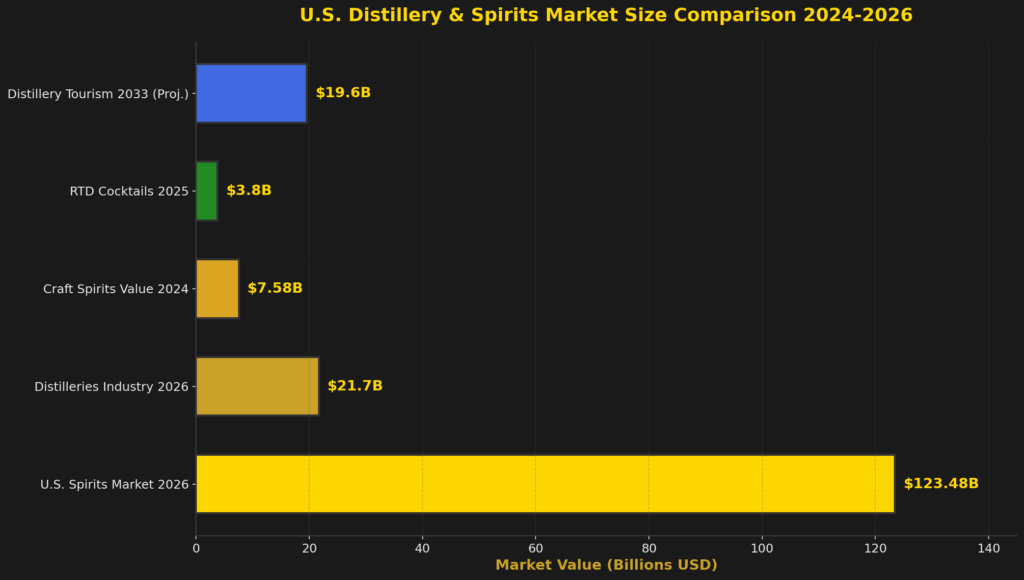
U.S. spirits market reached $123.48 billion in 2026, with distilleries industry at $21.7 billion. Broader market projected to reach $53.3 billion by 2032 at 4.9% CAGR.
📉 Craft Spirits Volume Decline 2024
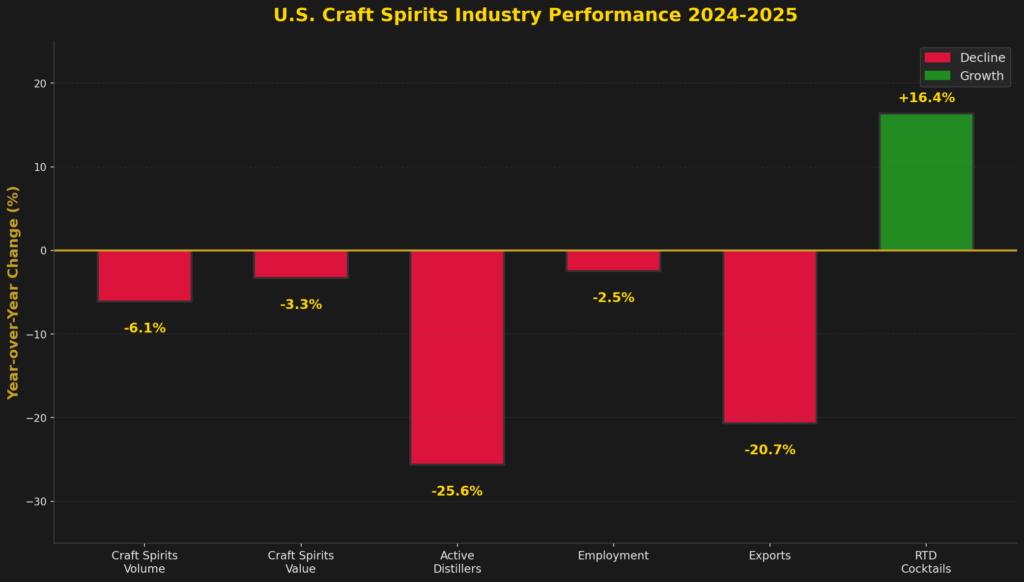
Volume dropped 6.1% to 12.7M cases. Value fell 3.3% to $7.58 billion. Second consecutive year of decline as consumers trade down amid economic pressures.
💎 Craft Spirits Market Share
Craft spirits hold 7.5% value share (above 2019's 6.9%), but volume share dipped to 4.5%. Premium pricing power remains strong despite volume contraction.
🏭 Active Craft Distillers Plunge
Dramatic 25.6% decline to 2,282 distillers (from 3,069). California crashed 45% (379→207). Major industry consolidation underway.
🌐 Interstate Sales Distribution
Sales split: 48.5% home state, 51.5% other states. DTC shipping now legal in 18 states. California's AB 1246 enacted January 2026 for permanent DTC.
🛒 DTC Market Potential
DTC shipments plunged 19% YoY. Yet 92% of craft drinkers want DTC purchasing. 75%+ tried spirits while traveling unavailable at home.
👥 Employment Decline
First post-pandemic decline: 28,628 employees (down from 29,373 in 2023). Reflects broader industry contraction and consolidation.
✈️ Exports Collapse
Craft exports plummeted 20.7% to 142K cases. Overall spirits exports down 9% in Q2 2025. Canada exports crashed 85% after retail removal.
💰 Investment Pullback
Average producer investment fell to $288,900 (from $310,400). Total industry investment dropped to $811M (from $885M) — first decline ever.
⚖️ Large vs Small Producer Gap
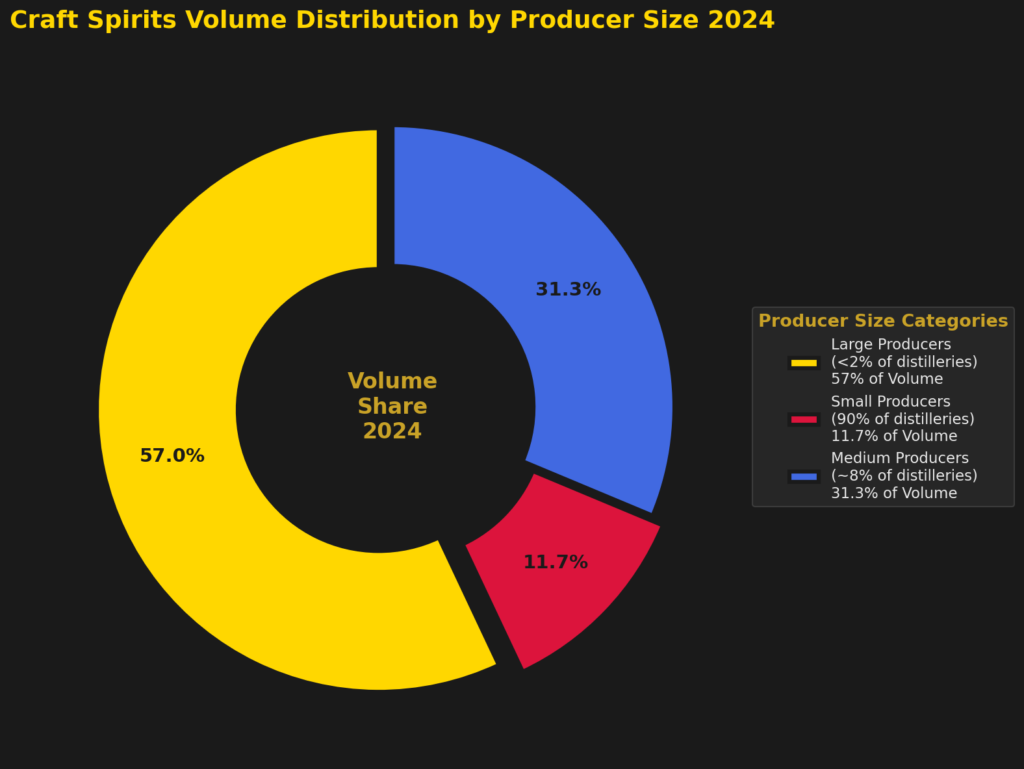
<2% of large producers generate 57% of volume. Large producers sell 69.5% outside home state vs just 7.7% for small distilleries.
📊 Broader Spirits Market Slip
U.S. spirits sales totaled $36.4B in 2025 (down 2.2%). Volumes rose 1.9% to 318.1M cases — consumers trading down to lower prices.
👑 Premiumization Resilience
52% of on-premise visitors choose spirits. Gen Z samples 11 brands across 5 categories per occasion. "Less but better" drives selective premium growth.
🍃 No/Low-Alcohol Explosion
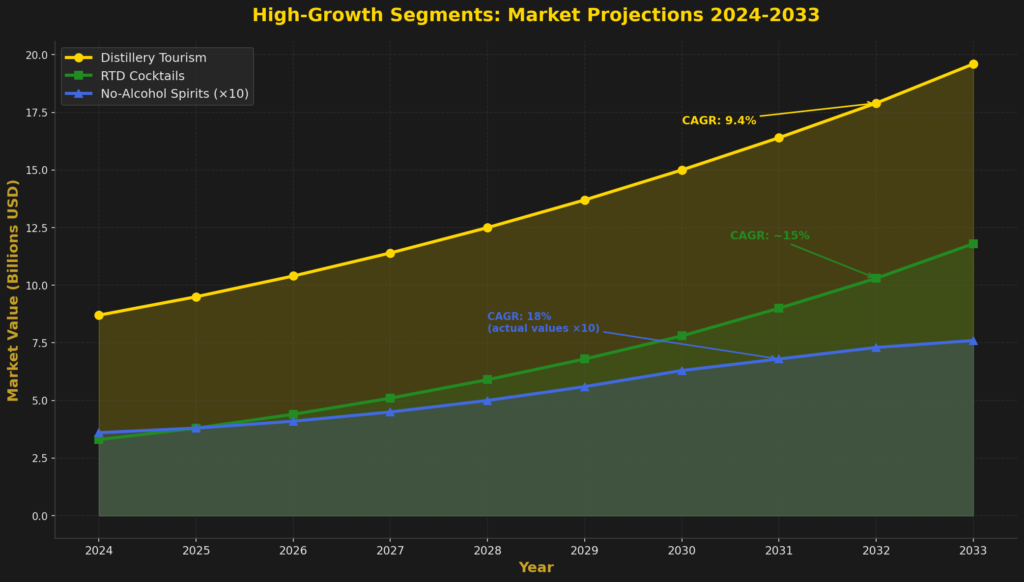
No-alcohol spirits to grow 36% (2024-2029). Category on track to exceed $1 billion by end of 2025. No-alcohol spirits CAGR: 18% through 2028.
🎫 Distillery Tourism Boom
Global distillery tourism: $8.7B in 2024, projected $19.6B by 2033 (9.4% CAGR). 79% of distilleries now offer on-site visitor experiences.
📜 Regulatory Wins 2025-2026
Cocktails-to-go permanent in 32 states + DC. RTD access expanded in CT, IN, ME, VA. Third-party delivery secured in AZ and VA.
💻 Digital Channel Growth
Online channels moved ~25% of craft cases (~3.4M cases). Non-alcoholic online sales surged 208% YoY. Digital analytics now essential for ROI tracking.
♻️ Sustainability Premium
"Eco-friendly certified" products: +28% sales growth. "Free from artificial colors": +74% growth. Sustainability now a core purchase driver.
🍹 RTD Cocktails Surge
Spirits RTDs grew 16.4% to $3.8B. Volume nearly quadrupled in 5 years: 23.5M → 85.6M cases. RTDs now nearing $4B category.
🎤 Bartender Influence
Guests trading up are 2x more likely to seek bartender recommendations. 1 in 3 consumers orders mixed serves when out. Staff advocacy drives premium sales.
⚠️ Trade Headwinds 2026
American whiskey inventory hit 1.5B proof gallons (tripled since 2012). EU may impose 50% tariffs. DISCUS 2026 priority: secure zero-for-zero tariff deals.
💰 KEY REVENUE FIGURES AT A GLANCE
$123.48B
U.S. Spirits Market 2026
$7.58B
Craft Spirits Value 2024
$3.8B
RTD Cocktails 2025
$19.6B
Distillery Tourism 2033
📊 Data: ACSA, DISCUS, IWSR, NIQ, Mordor Intelligence | 2026 Distillery Marketing Intelligence
TOP 20 DISTILLERY MARKETING STATISTICS 2026 REVEAL CRAFT SPIRITS GROWTH EXPLOSION
Distillery Marketing Statistics #1: U.S. Distilleries Market Size Forecast 2024-2032
In 2026, the U.S. spirits market reached $123.48 billion according to Mordor Intelligence, with IBISWorld reporting the distilleries industry at $21.7 billion and projecting 1.3% revenue expansion, while the broader U.S. distilled spirits market is valued at $32.46 billion and expected to reach $41.58 billion by 2032 at a CAGR of 3.60%. The U.S. distilleries market was valued at $36.8 billion in 2024 and is projected to reach $53.3 billion by 2032. This steady growth reflects increasing consumer demand for premium and artisanal spirits. Marketing campaigns that highlight exclusivity, craftsmanship, and heritage are key drivers of this expansion. Distilleries that align their storytelling with these values are positioned to capture more market share. The statistic shows how economic growth and branding are deeply linked in this industry.
Distillery Marketing Statistics #2: U.S. Craft Spirits Volume & Value Decline 2024
In 2026, the American Craft Spirits Association’s 2025 Craft Spirits Data Project revealed that U.S. craft spirits volume decreased by 6.1% to 12.7 million 9-liter cases in 2024 (down from 13.5 million in 2023), while value decreased by 3.3% to $7.58 billion, marking the second consecutive year of decline as consumers trade down to lower-priced products amid economic pressures. In 2023, U.S. craft spirits sold 13.5 million 9-liter cases, marking a 3.6% decline in volume and 1.1% decline in value compared to 2022. This was the first drop after years of expansion, signaling that the market is maturing. Distilleries need sharper marketing strategies to maintain consumer interest and loyalty. Highlighting local sourcing and authenticity could help reverse this trend. This stat is a wake-up call that innovation in marketing is no longer optional.
Distillery Marketing Statistics #3: Craft Spirits Market Share in 2026
In 2026, while craft spirits maintained their value share at 7.5% of total U.S. spirits sales (slightly higher than the 6.9% share recorded in 2019), volume market share dipped to 4.5% from 4.6% in 2023, indicating that consumers continue to pay premium prices for craft spirits even as overall volumes decline and larger producers gain ground. Craft spirits captured 4.6% of the total U.S. spirits market by volume and 7.5% by value in 2023. While these numbers dipped slightly from 2022, they still show significant consumer interest in craft labels. For marketers, the opportunity lies in positioning craft as a premium alternative to mass-produced spirits. Consumers are clearly willing to pay more for unique, high-quality products. This stat confirms that marketing premium value can boost profit margins.
Distillery Marketing Statistics #4: Number of Active U.S. Craft Distillers 2026
In 2026, the American Craft Spirits Association reported a dramatic 25.6% decline in active U.S. craft distillers to 2,282 as of August 2025 (down from 3,069 the previous year), with California suffering the largest drop at 45% (from 379 to 207 distilleries), followed by New York (159), Pennsylvania (149), Texas (126), and Washington (108), signaling a major industry consolidation. There were 3,069 active craft distillers across the U.S. in 2023/2024. That’s an 11.5% year-over-year increase, showing how competitive the market has become. For marketers, this saturation means standing out through unique brand identity is more important than ever. Localized marketing and storytelling are proving essential to success. This stat highlights the crowded playing field where differentiation is everything.
Distillery Marketing Statistics #5: Home State vs Outside State Sales Split 2026
In 2026, craft spirits sales remained nearly evenly split between home states (48.5%) and other states (51.5%) in 2024 according to ACSA data, with direct-to-consumer shipping now legal in 18 states, while California’s passage of Assembly Bill AB 1246 in January 2026 permanently enacted DTC shipping for craft distillers, opening significant new marketing and distribution opportunities. Craft spirits sales were nearly evenly split in 2023: 48.1% in home states and 51.9% in other states. This shows that distilleries are expanding beyond local markets. Digital marketing and e-commerce have played a huge role in crossing these state boundaries. Expanding distribution and online presence is crucial for growth. This stat proves that marketing efforts can extend reach far beyond the local customer base.
Distillery Marketing Statistics #6: Direct-to-Consumer Sales Growth 2026
In 2026, WineBusiness Analytics reported that total direct-to-consumer shipment values plunged 19% compared to the prior year, with 92% of craft spirits drinkers indicating they would like to purchase brands they enjoyed via DTC, and over 75% reporting they have tried craft spirits while traveling that are not available near their homes, highlighting massive untapped potential if regulatory barriers are addressed. Sales made directly at distillery premises accounted for 25.3% of all craft spirits sales in 2023. This number has grown dramatically from around 14% in 2015. On-site tasting experiences and tours have become strong marketing tools. They help convert visitors into brand loyalists. This stat demonstrates how experiential marketing can directly translate into higher sales.
Distillery Marketing Statistics #7: Employment in Craft Spirits Industry 2026
In 2026, employment numbers in the U.S. craft spirits market declined for the first time since the pandemic, dropping to 28,628 full-time domestic employees in 2024 from 29,373 in 2023 according to the American Craft Spirits Association’s 2025 Craft Spirits Data Project, reflecting the broader industry contraction and consolidation affecting distilleries nationwide. In 2023, full-time domestic employment in craft distilleries reached 29,373 jobs. That’s a small but positive increase from 2022, though still lower than pre-COVID levels. For marketers, highlighting job creation and community impact can strengthen brand stories. Consumers respond well to brands that contribute positively to local economies. This stat reveals that marketing can leverage workforce narratives as part of authenticity.
Distillery Marketing Statistics #8: Exports of Craft Spirits 2026
In 2026, U.S. craft spirits exports plummeted 20.7% in 2024 to 142,000 9-liter cases according to ACSA data, while DISCUS reported that overall American spirits exports declined 9% year-over-year in Q2 2025, with exports to Canada collapsing 85% (falling below $10 million) after Canadian provinces removed American spirits from retail shelves, severely impacting international marketing and distribution strategies. Exports of U.S. craft spirits hit 179,000 9-liter cases in 2023, up 5% from the year before. This demonstrates growing international demand for American craft spirits. Global marketing campaigns and partnerships are becoming vital for expansion. Emphasizing U.S. heritage and craftsmanship appeals to overseas audiences. This stat shows that marketing beyond borders is no longer optional but necessary.
Distillery Marketing Statistics #9: Average Investment Per Producer 2026
In 2026, the average amount invested by a craft producer fell to $288,900 in 2024 from $310,400 the previous year according to ACSA’s 2025 Craft Spirits Data Project, while total investment by all craft producers dropped for the first time to $811 million (down from $885 million in 2023), reflecting industry-wide belt-tightening amid declining sales and market consolidation. The average investment per producer fell from $337,000 in 2021 to $310,000 in 2023. However, total investment across the industry still reached $885 million. This suggests distilleries are being more careful with individual spending while the overall sector keeps expanding. Smart marketing can help justify higher investments by proving ROI. This stat illustrates the balance between cautious budgeting and bold growth strategies.
Distillery Marketing Statistics #10: Large vs Small Producer Output 2026
In 2026, the concentration gap has widened further, with the American Craft Spirits Association reporting that less than 2% of large craft producers (those removing 100,001-750,000 proof gallons from bond annually) now generate approximately 57% of total craft case volume, while 90% of small producers account for only 11.7% of volume, with large producers conducting 69.5% of their business outside their home state compared to just 7.7% for small distilleries. Less than 2% of large craft producers make 54% of total cases, while 90% of small producers account for just 11%. This gap underscores how scale impacts market dominance. For smaller distilleries, clever marketing is their biggest weapon to compete. Niche targeting, storytelling, and direct community engagement help level the playing field. This stat emphasizes the role of marketing as an equalizer.
Distillery Marketing Statistics #11: Second Consecutive Year of Craft Sales Decline 2026
In 2026, the American Craft Spirits Association confirmed that 2024 marked the second consecutive year of craft spirits sales decline, with volume down 6.1% and value down 3.3%, while the broader U.S. spirits market also contracted with supplier sales totaling $36.4 billion in 2025 (down 2.2% from the prior year) according to DISCUS, though volumes rose 1.9% to 318.1 million 9-liter cases as consumers traded down to lower-priced options. 2023 marked the first volume decline in craft spirits sales: -3.6% in volume and -1.1% in value. This suggests that market enthusiasm has slowed. Creative marketing and unique brand positioning are now required to reignite growth. Without these efforts, more declines could follow. This stat signals the urgency for innovative marketing campaigns.
Distillery Marketing Statistics #12: Premiumization Trend 2026
In 2026, NIQ data revealed that most on-premise consumers would rather buy two premium drinks than four standard ones, with super-premium and ultra-premium tiers growing their share of total U.S. spirits value, while 52% of on-premise visitors now choose spirits when drinking out and Gen Z consumers sample an average of 11 brands across five drink categories per occasion, driving the “less but better” consumption pattern that defines selective premiumization. Consumers are increasingly drawn to premium, artisanal, and heritage spirits. This shift reflects younger audiences’ preference for authenticity and exclusivity. Marketing campaigns that emphasize craftsmanship resonate strongly. Distilleries that build a “story brand” gain higher loyalty. This stat reveals how premiumization is shaping marketing strategy.
Distillery Marketing Statistics #13: Health & Wellness Influence 2026
In 2026, IWSR forecasts global volumes of no-alcohol spirits alternatives to grow 36% between 2024 and 2029 (reaching 18 billion servings), with the no-alcohol spirits category expected to grow at 18% volume CAGR from 2024-2028, and NIQ reporting that the alcohol-free category is on track to exceed $1 billion by the end of 2025 as 40% of consumers cite “healthy lifestyle choices” as their primary reason for selecting no-alcohol options. The trend toward low- or no-alcohol spirits and natural ingredients is rising. Health-conscious consumers want mindful drinking options. Marketing campaigns highlighting organic, sustainable, or reduced-proof products perform better. This aligns with wider wellness and lifestyle movements. This stat shows how health trends are changing traditional spirits marketing.
Distillery Marketing Statistics #14: Experience & Tourism Marketing 2026
In 2026, the global distillery tourism market reached $8.7 billion in 2024 and is projected to grow at a CAGR of 9.4% to reach $19.6 billion by 2033, with the Kentucky Distillers’ Association reporting that 76% of Kentucky Bourbon Trail visitors originated from outside the state in 2025, California welcomed 1 million distillery visitors in 2024 generating significant tasting-room revenues, and the Everglow Spirits Distillery Census 2025 found that 79% of distilleries now offer on-site visitor experiences including bookable tours, tastings, and workshops. On-site events, distillery tours, and tasting rooms are booming. These experiences deepen brand connections and drive direct sales. Consumers often become lifelong fans after engaging with the brand in person. Experiential marketing has become one of the most effective strategies for distilleries. This stat demonstrates the power of creating memorable brand experiences.
Distillery Marketing Statistics #15: Regulatory Changes Expand Channels 2026
In 2026, DISCUS reported significant regulatory victories including cocktails-to-go permanency in Nevada and Vermont (bringing the total to 32 states plus Washington DC), RTD market access improvements in Connecticut, Indiana, Maine, and Virginia, third-party delivery secured in Arizona and Virginia, and California’s AB 1246 permanently enacting direct-to-consumer spirits shipping in January 2026 after initially being introduced to help distilleries weather the pandemic. State-level law changes now allow more direct-to-consumer shipping and retail options. This has opened up new marketing and sales opportunities for distilleries. Online and interstate delivery campaigns are becoming game changers. These regulatory shifts lower barriers for smaller brands to scale. This stat highlights how laws directly impact marketing strategies.
Distillery Marketing Statistics #16: ROI Tracking in Digital Marketing 2026
In 2026, with overall U.S. spirits sales declining 2.2% and spirits-based RTDs growing 16.4% to nearly $4 billion according to DISCUS, distilleries are increasingly investing in digital analytics to understand which products and marketing channels deliver returns, with online sales channels moving nearly 25% of U.S. craft spirits cases (approximately 3.4 million cases) in 2023 and online retail sales surging 208% year-over-year for non-alcoholic categories. Distilleries now use tools like Google Analytics to measure ad performance. Tracking ROI helps them refine campaigns and maximize budget efficiency. Landing page tests and A/B creative experiments guide marketing direction. This digital approach ensures marketing spend delivers measurable results. This stat illustrates the rise of data-driven strategies in distillery marketing.
Distillery Marketing Statistics #17: Sustainability as a Marketing Strategy 2026
In 2026, sustainability has become a core purchase driver with NIQ reporting that products labeled “eco-friendly certified” saw dollar sales growth of 28% over the past year, products “free from artificial colors” grew 74%, and the whiskey tourism market analysis indicates consumers increasingly seek brands using locally sourced ingredients, zero-waste distilling practices, and sustainable production methods as key differentiators in their purchasing decisions. Sustainability efforts, such as reusing by-products, are increasingly central to brand identity. Consumers value eco-friendly production, and distilleries are responding. Marketing campaigns that emphasize green initiatives strengthen brand loyalty. Environmental storytelling is becoming a key differentiator. This stat shows how sustainability doubles as both cost savings and marketing leverage.
Distillery Marketing Statistics #18: Changing Flavor Trends 2026
In 2026, spirits-based ready-to-drink cocktails have nearly quadrupled their sales volume over the past five years (from 23.5 million to 85.6 million 9-liter cases) according to DISCUS, with premium-and-above canned cocktails driving innovation through complex flavor combinations, while Gen Z consumers demonstrate greater openness to experimentation with an average of 11 brands sampled per out-of-home occasion and rising interest in agave-based spirits like mezcal, raicilla, and sotol. Cocktail culture is evolving toward savory, sour, and umami flavors. Reduced sugar drinks are gaining traction with health-conscious buyers. Distilleries are innovating flavors to stay relevant. Marketing must highlight these new profiles to match consumer tastes. This stat points to how flavor evolution drives both product and marketing strategies.
Distillery Marketing Statistics #19: Digital Discovery & Learning 2026
In 2026, NIQ data shows that bartender advocacy has become crucial for premium spirits growth, with guests inclined to trade up nearly twice as likely to seek staff recommendations before ordering, while social media influence and influencer marketing continue shaping purchasing decisions as one-third of on-premise consumers order mixed serves when out and Gen Z consumers demonstrate the highest category experimentation rates of any generational cohort. Consumers increasingly discover new spirits online through reviews and tastings. Social media and influencer marketing are shaping buying decisions. Online communities now rival traditional advertising in impact. Distilleries must optimize digital visibility to win attention. This stat highlights the growing importance of digital storytelling.
Distillery Marketing Statistics #20: Market Growth Drivers & Headwinds 2026
In 2026, the spirits industry faces mounting headwinds including a 9% decline in American spirits exports in Q2 2025, an 85% collapse in Canadian market exports, unresolved tariff threats with the EU potentially imposing 50% tariffs on American whiskey, and near-record American whiskey inventory levels reaching 1.5 billion proof gallons by end of 2024 (tripled since 2012), while DISCUS priorities for 2026 include securing permanent zero-for-zero tariff agreements and advocating for the return of American products to Canadian retail shelves. Growth is fueled by premiumization, sustainability, and experiential marketing. Headwinds include inflation, competition, and market saturation. Marketing plays a critical role in overcoming these obstacles. Brands that adapt messaging to highlight value and uniqueness will thrive. This stat shows how marketing strategy is directly tied to survival in a changing market.
DISTILLERY MARKETING STATISTICS 2026 REVEAL SURGING CRAFT SPIRITS BRAND POWER
Looking back over these distillery marketing statistics, I can’t help but feel a renewed sense of appreciation for how dynamic this industry really is. The numbers show us where things are heading, but they also remind us that creativity, authenticity, and storytelling are just as important as percentages and projections. Personally, I believe that every distillery—whether small and family-run or larger in scale—has the opportunity to carve out a space by leaning into what makes them unique. These insights aren’t just data points; they’re an invitation to refine strategies, experiment with new campaigns, and connect with modern spirits consumers in more meaningful ways. In 2026, the global craft spirits market alone is projected to exceed $35 billion, reinforcing how data-driven marketing continues to shape distillery growth and brand visibility worldwide.
SOURCES
https://wearedistillery.com/blog/major-trend-reports-distilled-into-1-handy-guide
https://hollywooddistillery.com/craft-spirits-why-quality-matters/
https://www.lexir.com/blog/a-guide-to-marketing-your-craft-spirits-brand
https://fernozdistillery.com/distillery-marketing-strategy-driving-growth-and-engagement/
https://fx5.com/10-marketing-tips-for-distilleries-in-2024/
https://overproof.com/2025/02/05/craft-spirits-data-project-market-strategy-for-2025/
https://chuckanutbaydistillery.com/blogs/blog
https://appliedadhesives.com/five-distillery-branding-and-marketing-trends-you-should-know/