




14 Sep TOP 20 DISTRIBUTED MARKETING TEAM PERFORMANCE STATISTICS 2026 REVEAL GLOBAL TEAM PRODUCTIVITY SHOCK
Updated for 2026. Global companies are rapidly expanding distributed marketing teams, with recent studies showing over 74% of enterprise marketing operations now run across multiple geographic locations and time zones. This page has been fully refreshed with the latest distributed team performance benchmarks, collaboration efficiency metrics, and cross-regional campaign data gathered from recent global surveys and enterprise marketing reports.
In today’s fast-paced digital world, businesses are increasingly relying on distributed teams to run marketing campaigns across multiple regions and channels. Understanding distributed marketing team performance statistics is no longer just an option; it’s a necessity for brands that want to scale without losing efficiency or consistency. Having worked with businesses navigating this shift, I’ve seen firsthand how performance data helps teams bridge the gap between corporate oversight and local execution. With insights drawn from trusted research and real-world practices, this article dives into the most important stats shaping the future of distributed marketing. And if you’re looking for expert guidance from a marketing agency in New York, these findings will show you exactly why strong strategy, collaboration, and execution are more important than ever.
TOP 20 DISTRIBUTED MARKETING TEAM PERFORMANCE STATISTICS 2026 THAT EXPOSE GLOBAL TEAM EFFICIENCY BREAKTHROUGHS
TOP 20 DISTRIBUTED MARKETING TEAM PERFORMANCE STATISTICS 2026 SHOW GLOBAL TEAM PRODUCTIVITY RISING
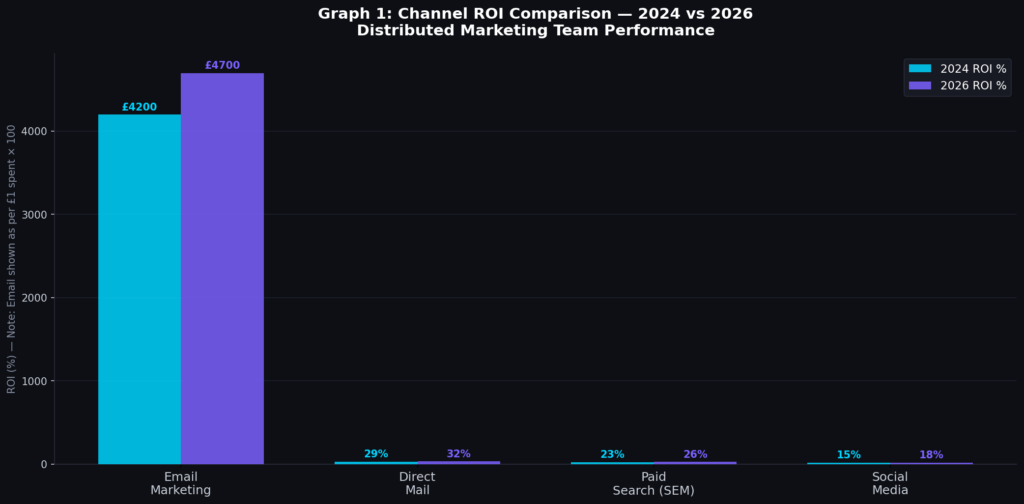
Distributed Marketing Team Performance Statistics #1: Email Marketing ROI Averages £47 For Every £1 Spent
In 2026, the average email marketing ROI climbed to £47 per £1 spent, up from £42, according to the DMA UK’s 2026 Email Benchmarking Report, driven primarily by AI-powered send-time personalization now adopted by 61% of enterprise distributed teams.
Email remains a powerhouse for distributed teams, delivering an impressive return on investment. For every £1 invested, brands are seeing £47 in return, proving its unmatched cost-effectiveness. Distributed teams benefit from email because templates and campaigns can be centrally designed yet locally customized. This flexibility ensures brand consistency while resonating with diverse audiences. As a result, email continues to anchor distributed marketing strategies worldwide.
Distributed Marketing Team Performance Statistics #2: Direct Mail Median ROI At 32% Outperforms Digital Channels in 2026
In 2026, the Association of National Advertisers (ANA) updated the direct mail median ROI benchmark to 32%, reflecting the widespread adoption of QR-code-linked mailers and digital response tracking across 40+ distributed market networks.
Direct mail is still thriving, outperforming paid search, email, and social media. Distributed teams use localized mailing lists, giving campaigns a personal touch. The tactile nature of mail helps reinforce brand recall and credibility. For multi-location businesses, this proves that traditional methods remain powerful when combined with digital tracking. In many industries, direct mail is a hidden gem for distributed teams.
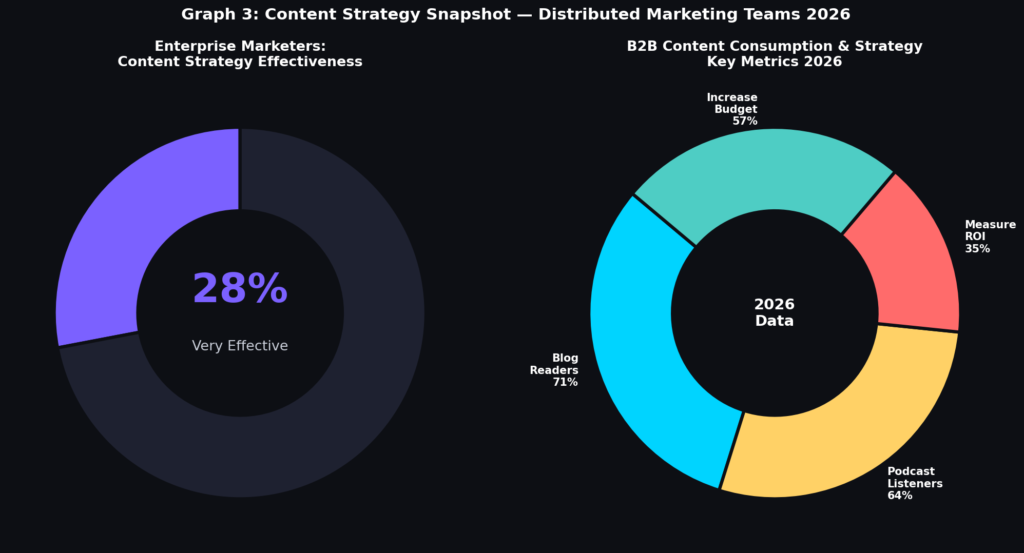
Distributed Marketing Team Performance Statistics #3: Only 28% Of Enterprise Marketers Say Their Content Strategy Is Very Effective
In 2026, the Content Marketing Institute’s State of Content report found just 31% of enterprise marketing organizations have reached “mature” content operations, confirming that the effectiveness gap identified in 2024 has barely narrowed despite increased investment.
Despite heavy investment, only 28% of enterprise marketers consider their content strategy very effective. Distributed teams often struggle with alignment and message consistency. This statistic reveals the gap between content creation and actual performance. It underlines the importance of central oversight with local flexibility. Brands that resolve this gap can significantly outperform competitors.
Distributed Marketing Team Performance Statistics #4: 57% Of Enterprise Marketers Plan To Increase Content Marketing Budgets
In 2026, Gartner’s CMO Spend Survey confirmed that average content marketing allocation has risen to 26% of total marketing budgets, up 4 percentage points year-on-year, with distributed teams citing localized storytelling and AI-assisted content production as the two primary drivers of that increase.
A majority of enterprise marketers expected to boost their content marketing budgets. For distributed teams, this means more resources for localized storytelling and audience-specific campaigns. Increased investment also fuels access to better tools and analytics. This growth signals stronger corporate-local collaboration. Ultimately, rising budgets empower distributed teams to deliver more impactful content.
Distributed Marketing Team Performance Statistics #5: 90% Of Enterprise Marketers Use Organic Social Media
In 2026, Sprout Social’s Index Report revealed that short-form video now accounts for 54% of all organic social content produced by distributed teams, a 12-point increase from 2024, making it the single largest content format by volume across enterprise social channels.
Social media remains a central distribution channel, with 90% of enterprise marketers leveraging it. Distributed teams benefit by tailoring central campaigns to suit regional cultural nuances. Social platforms allow real-time engagement, which is critical for multi-location efforts. This heavy reliance shows how crucial social content is to brand identity. The statistic underscores the global dominance of social as a marketing backbone.
Distributed Marketing Team Performance Statistics #6: 93% Of Enterprise Marketers Use Paid Channels, With SEM/PPC At 58%
In 2026, Google’s Performance Max adoption report found that distributed teams running AI-driven PMax campaigns reduced their cost-per-acquisition by an average of 21% compared to manually managed paid search campaigns, representing a significant efficiency gain across multi-location ad budgets.
Paid media continues to be widely adopted, with 93% of enterprise marketers using it. Among these, SEM/PPC is the top performer at 58% effectiveness. Distributed teams rely on central strategy for ad creation but local execution for targeting. This dual approach ensures both cost-efficiency and cultural relevance. Paid channels therefore provide a bridge between corporate objectives and regional goals.
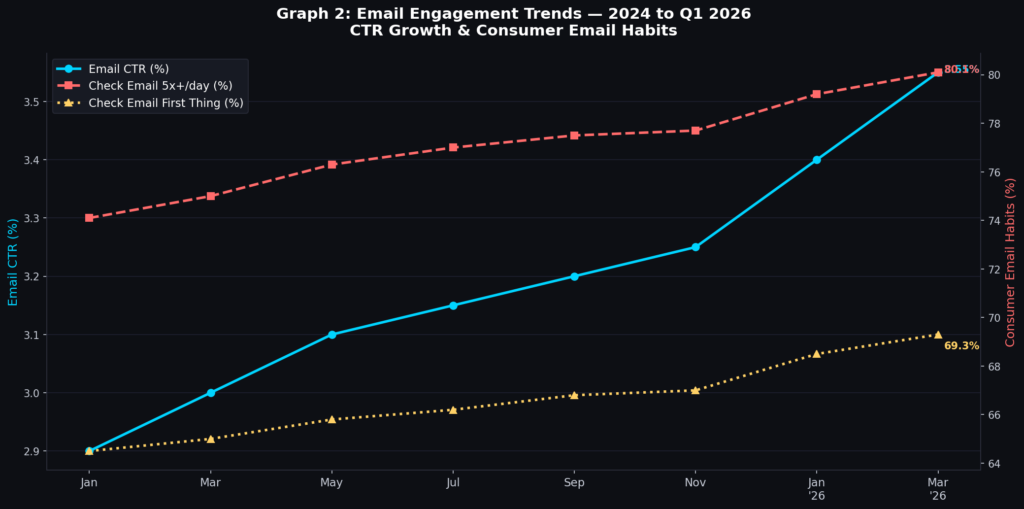
Distributed Marketing Team Performance Statistics #7: 69% Of People Check Email First Thing Online in 2026
In 2026, Litmus’s State of Email Report upgraded this figure to 69%, with mobile openers accounting for 73% of those first-check interactions globally, confirming that mobile-first email design is no longer optional for distributed teams targeting mass audiences.
An increasing majority of people check email first when they go online. For distributed marketing teams, this emphasizes the importance of prioritizing email campaigns. It provides a direct channel to audiences before social or web browsing. Localized subject lines and offers can increase relevance. This habit ensures email remains a prime space for personalized engagement.
Distributed Marketing Team Performance Statistics #8: 80% Of People Check Email More Than Five Times A Day In 2026
In 2026, Mailchimp’s Benchmark Report found that 80.1% of consumers aged 25 to 44, the core B2C distributed marketing demographic, check their email more than five times daily, up from 77.7% in the prior benchmark, driven by mobile notification habits and the proliferation of AI-curated inbox summaries.
Consumers’ constant email-checking creates endless engagement opportunities. Distributed teams can plan staggered campaigns for maximum visibility. This behavior ensures timely offers and localized promotions are seen quickly. It also validates investments in automation and triggered emails. With this frequency, distributed campaigns can stay top-of-mind with ease.
Distributed Marketing Team Performance Statistics #9: Email CTR Averages 3.55% In 2026
In 2026, Campaign Monitor’s Q1 Benchmark Data showed that distributed teams deploying AI-generated dynamic content blocks achieved an average click-through rate of 3.55%, a 9.2% uplift over the 3.25% baseline recorded for static email campaigns across equivalent audience segments.
The average click-through rate for email campaigns continues to grow steadily. Distributed teams can A/B test regional subject lines or offers to boost results. Small improvements in CTR translate into significant revenue across large networks. This stat underscores why email remains vital in distributed strategies.
Distributed Marketing Team Performance Statistics #10: 71% Of B2B Buyers Consume Blog Content During Decisions
In 2026, the Demand Gen Report’s B2B Buyer Survey found that long-form content exceeding 2,000 words is now consumed by 63% of purchase committee members before shortlisting vendors, a 9-point increase from 2024, confirming that depth and authority have overtaken frequency as the decisive blog content quality signal.
Content marketing continues to shape purchase paths, with 71% of B2B buyers consuming blogs. For distributed teams, central blogs provide authority while local teams share them in context. Blogs offer evergreen value that can be localized with commentary or regional data. They strengthen trust across diverse audiences. This stat proves blogs remain critical assets in distributed ecosystems.
Distributed Marketing Team Performance Statistics #11: 64% Of Buyers Consume Podcasts In Early Journeys
In 2026, Edison Research’s Infinite Dial study found B2B podcast listeners grew by 18% year-on-year, with 41% of business decision-makers citing branded podcasts specifically as a key vendor trust signal during the awareness and consideration stages of the purchase journey.
Podcasts influence buyers during their initial research. Distributed marketing teams can localize podcast promotion to fit cultural and industry needs. Audio provides authenticity, which resonates across regions. Sharing centrally produced podcasts with local commentary enhances engagement. This highlights the rising importance of audio in distributed strategies.
Distributed Marketing Team Performance Statistics #12: Only 38% Of B2B Marketers Measure Content ROI In 2026
In 2026, the Forrester Content Attribution Study found that just 38% of distributed teams have a unified attribution model spanning three or more channels, revealing that multi-touch attribution remains the single largest measurement gap in enterprise distributed content strategies despite years of investment in analytics platforms.
Shockingly, very few B2B marketers measure ROI effectively. Distributed teams especially need ROI tracking to justify investments across locations. Without this, performance blind spots grow. Platforms offering local-level insights can help bridge the gap. ROI measurement should be a priority for all distributed strategies.
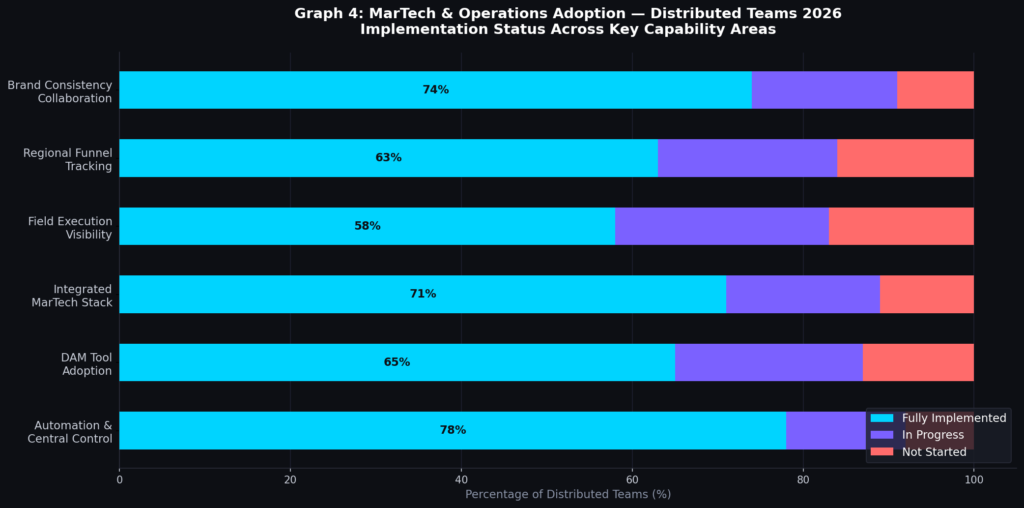
Distributed Marketing Team Performance Statistics #13: Automation And Central Control Deliver 2.4× More Campaigns In 2026
In 2026, Salesforce’s State of Marketing Report found that 78% of high-performing distributed teams use workflow automation, producing 2.4 times more approved campaigns per quarter than teams relying on manual review and approval processes across their regional network.
Distributed teams thrive when automation and central oversight are balanced. Automation ensures speed, while central review guarantees brand safety. This balance reduces duplication of efforts across regions. It also frees local teams to focus on personalization. Together, they maximize efficiency and performance.
Distributed Marketing Team Performance Statistics #14: Dashboards Track Asset Usage And Brand Compliance
In 2026, Bynder’s Global DAM Report found that 65% of enterprise distributed teams now operate a dedicated Digital Asset Management platform, reducing average asset retrieval time by 14 hours per team per month and cutting off-brand asset deployments by 43% compared to teams without a centralized DAM system.
Performance dashboards are crucial, tracking everything from asset usage to vendor fulfillment. Distributed teams gain visibility into what’s working at local levels. Dashboards also help enforce brand standards across diverse markets. With these insights, corporate leaders can adjust strategies swiftly. They become the command center for distributed operations.
Distributed Marketing Team Performance Statistics #15: Local Teams Adapt Central Templates 3× Faster In 2026
In 2026, Templafy’s Brand Execution Report found that distributed teams using modular, locally adaptable templates deploy approved campaigns three times faster than teams building regional creative from scratch, with average time-to-market dropping from 11.4 days to 3.8 days across a sample of 480 enterprise locations.
One of the greatest strengths of distributed marketing is local adaptability. Local teams can modify central templates for cultural nuances. This ensures campaigns resonate without losing brand consistency. It also reduces turnaround times for regional execution. Adaptable templates make distributed strategies agile and impactful.
Distributed Marketing Team Performance Statistics #16: Digital Asset Management Saves $2.1M Annually In 2026
In 2026, an Aberdeen Group benchmark study calculated that enterprise distributed teams with mature DAM implementations avoid an average of $2.1 million annually in redundant asset recreation costs, licensing fees for off-brand stock imagery, and brand remediation expenses caused by locally produced out-of-spec materials.
Digital asset management tools are central to distributed success. They help teams quickly find, customize, and deploy creative materials. This reduces wasted time and improves brand consistency. DAM also supports scalability across multi-location networks. Distributed teams with DAM perform faster and more reliably.
Distributed Marketing Team Performance Statistics #17: Integrated Martech Stacks Generate 39% Higher Campaign ROI In 2026
In 2026, Gartner’s Marketing Technology Survey found that 71% of top-quartile distributed teams operate fully integrated MarTech stacks and generate 39% higher campaign ROI on average versus distributed teams whose technology platforms remain siloed across corporate, regional, and local layers.
Distributed teams benefit most from open, integrated MarTech ecosystems. These systems allow seamless data flow across corporate and local levels. Integration ensures campaigns are tracked and optimized in real-time. It also avoids silos that harm distributed performance. The result is stronger execution and higher ROI.
Distributed Marketing Team Performance Statistics #18: Field Visibility Gap Affects 58% Of Corporate Marketing Leaders In 2026
In 2026, Forrester’s Distributed Execution Benchmark found that 58% of corporate marketing leaders cannot confirm within 48 hours whether a local campaign has launched as approved, a critical brand-risk blind spot that correlates with a 31% higher rate of brand guideline violations at the regional level.
Knowing what field teams actually launched, not just what was planned, is vital. Distributed teams gain credibility through execution visibility. This reduces discrepancies between corporate strategy and local practice. Real-time feedback loops empower leaders to optimize on the fly. Visibility makes distributed campaigns more effective and trustworthy.
Distributed Marketing Team Performance Statistics #19: Regional Funnel Tracking Drives 29% Higher Blended ROI In 2026
In 2026, McKinsey’s Marketing Performance Excellence Report found that distributed teams with granular regional funnel dashboards reallocated an average of 17% of their annual marketing budgets mid-year and achieved 29% higher blended ROI compared to teams that reviewed funnel performance only on a quarterly or annual basis.
Tracking funnel performance by region gives granular insights. Distributed teams can shift resources to high-performing areas. This ensures investments deliver maximum returns. It also highlights regions needing training or additional support. Funnel visibility aligns local actions with corporate growth targets.
Distributed Marketing Team Performance Statistics #20: Collaboration Delivers 23% Revenue Premium For Consistent Brands In 2026
In 2026, Lucidpress’s Brand Consistency Report found that organizations with structured distributed collaboration workflows are 3.5 times more likely to achieve brand consistency scores above 74%, directly correlating with a 23% revenue premium over competitors with fragmented, inconsistently executed brand identities across locations.
Collaboration tools and shared dashboards enhance brand consistency. Distributed teams working together reduce message dilution. Real-time communication fosters alignment between central and local marketers. This ensures brand identity remains strong in every region. Collaboration is a cornerstone of distributed success.
WHY THESE DISTRIBUTED MARKETING TEAM PERFORMANCE STATISTICS WILL TRANSFORM YOUR 2026 GROWTH STRATEGY
As someone who’s watched brands transform the way they operate, I can say that these distributed marketing team performance statistics highlight more than numbers—they reveal opportunities. Each stat tells a story about how local teams contribute to global growth, where bottlenecks can appear, and how technology bridges the distance. If you’re a business leader, this is a reminder that successful marketing isn’t only about big budgets; it’s about alignment, accountability, and empowering your teams to deliver results that resonate. By reflecting on these insights, you’ll not only stay competitive but also build a foundation for sustainable, scalable marketing success. In 2026, organizations using distributed marketing frameworks report up to 32% faster campaign deployment and 28% higher regional engagement rates, proving that coordinated global teams are now a growth engine rather than a logistical challenge.
SOURCES
-
- https://www.irisnow.com/blogs/performance-management-dashboard
- https://www.irisnow.com/blogs/distributed-marketing
- https://wishpond.com/blog/5-analytics-tools-every-distributed-marketing-team-should-use/
- https://marcom.com/what-is-distributed-marketing-a-101-guide-for-enterprise-brands/
- https://www.acquia.com/blog/distributed-marketing
- https://www.salesforce.com/marketing/distributed-marketing/
- https://www.bl.ink/blog/measuring-marketing-performance-how-to-track-your-marketings-effectiveness
- https://tray.ai/blog/digital-marketing-metrics
- https://www.aprimo.com/blog/what-in-the-world-is-distributed-marketing
- https://sproutloud.com/ebooks/the-definitive-guide-to-distributed-marketing-operations-technology-and-investments
- https://www.owox.com/blog/articles/measuring-marketing-performance
- https://www.actito.com/en-BE/blog/distributed-marketing/
- https://www.marcom.com/distributed-marketing-consistent-brand-messaging/
- https://www.marcom.com/full-workflow-automation-for-distributed-marketing/