




19 Sep TOP 20 DISTRIBUTED MARKETING TIME ZONE COORDINATION STATISTICS 2025
When I first started looking into distributed teams, I never imagined how much of an impact time zones could have on our daily marketing flow. That’s why I pulled together these distributed marketing time zone coordination statistics—to really understand where the friction lies and how teams like ours can better adapt. Having worked with a leading marketing agency in New York, I’ve seen firsthand how even just a one-hour difference can throw off collaboration if we don’t plan carefully. What surprised me most is how small changes, like adjusting meeting schedules or leaning into async tools, can have a huge effect on creativity and productivity. This piece is less about numbers on a page and more about the human side of making global teamwork feel connected.
Top 20 Distributed Marketing Time Zone Coordination Statistics 2025 (Editor’s Choice)
🌍 Top 20 Distributed Marketing Statistics
Time Zone Coordination & Remote Team Performance Data for 2025
| # | Statistic | Description | Category |
|---|---|---|---|
| 1 | 24% | Of new job postings in Q2 2025 are hybrid positions, up from 15% in Q2 2023 | Growth Trend |
| 2 | 22% | Of the US workforce (36.2 million people) will be working remotely by 2025 | Growth Trend |
| 3 | 98% | Of professionals want to work remotely, at least part-time, for the rest of their careers | Growth Trend |
| 4 | 55% | Of employees are "high performers" when provided complete flexibility over work arrangements | Productivity |
| 5 | ↑3% | Time zone issues are the top challenge for remote teams, rising 3% since 2023 | Time Challenge |
| 6 | #1 | Working across time zones remains one of the biggest challenges of 2025 for teams | Time Challenge |
| 7 | Top | Communication barriers due to time zones are among most common remote manager challenges | Time Challenge |
| 8 | High | Time zone differences create fragmented workflows, extending project timelines | Time Challenge |
| 9 | 84% | Of marketers experience frustration from excessive meetings, feedback loops, and unclear roles | Communication |
| 10 | 41% | Of employees find it more challenging to collaborate across departments than within teams | Communication |
| 11 | 88% | Of remote workers rely on email as their primary communication tool | Communication |
| 12 | 50%+ | Of U.S. employees have limited or no insight into other teams' objectives | Communication |
| 13 | 75% | Of social marketers plan to implement AI tools, increasing productivity by up to 15% | Marketing Specific |
| 14 | 91% | Of companies use social media marketing, allocating 15% of budgets to social activities | Marketing Specific |
| 15 | 23% | CMOs can reduce collaboration drag through targeted skill-building and talent investment | Marketing Specific |
| 16 | 79% | Of leaders say contractors/freelancers have become more important in workforce strategy | Management |
| 17 | 76% | Of global workforce now relies on video conferencing and collaboration tools | Management |
| 18 | 64% | Of leaders expect two-thirds of HR's routine tasks to be automated by 2026 | Management |
| 19 | 30% | Of employees expect remote work to remain permanent as companies adapt preferences | Productivity |
| 20 | 43% | Of employees reported increased work-related stress in 2024 from blurred work-life boundaries | Productivity |
Top 20 Distributed Marketing Time Zone Coordination Statistics 2025
Distributed Marketing Time Zone Coordination Statistics #1: One-Hour Increase Reduces Synchronous Communication By 11%
When teams work across multiple time zones, even a single hour of separation can significantly reduce real-time interaction. Studies show that a one-hour increase in temporal distance cuts synchronous communication by about 11%. This might seem small, but over time it creates noticeable collaboration gaps. In marketing, where quick feedback often drives campaign success, such a reduction can slow down decision-making. Teams need to plan smarter around overlapping hours to keep conversations flowing.
Distributed Marketing Time Zone Coordination Statistics #2: One Hour Loss Equals 19% Less Overlap In Business Hours
That same one-hour difference translates into a 19% loss in shared business hours. For marketing professionals, this means fewer overlapping times to brainstorm, align strategies, or launch campaigns. Lost overlap often results in more asynchronous communication, which, while helpful, cannot fully replace real-time discussions. Creative marketing tasks, in particular, thrive on immediate feedback. That’s why leaders often adjust work schedules or rotate meeting times to share the inconvenience.
Distributed Marketing Time Zone Coordination Statistics #3: Large-Scale Study Shows Sizable Reduction In Rich Communication
A multinational firm study involving over 12,000 employees found that temporal distance led to a major decline in rich, synchronous communication. For marketing teams, this means fewer video calls, brainstorming sessions, and spontaneous idea exchanges. The absence of these moments can dilute creative momentum. Written communication may increase, but it often lacks the nuance of face-to-face conversations. Distributed teams need intentional touchpoints to recreate that collaborative spark.
Distributed Marketing Time Zone Coordination Statistics #4: Non-Routine Tasks Lead To More Time Shifting
Marketers handling creative or strategic work are more likely to shift their hours to align with global peers. Non-routine tasks often require deeper collaboration, pushing people to attend calls outside typical schedules. This flexibility comes with personal sacrifices, such as working late evenings or early mornings. However, it also demonstrates how committed marketers are to keeping campaigns moving forward. These shifts highlight the adaptive nature of distributed work.
Distributed Marketing Time Zone Coordination Statistics #5: Routine Tasks Show Limited Time Shifting
In contrast, those managing routine or process-driven tasks rarely adjust their schedules. Instead, they experience a direct drop in synchronous communication when time zones misalign. For marketing, this might affect reporting, scheduling posts, or operational follow-ups. Because these tasks don’t demand constant live collaboration, employees often rely on asynchronous updates. Still, it creates a communication gap between strategic and operational sides of marketing.
Distributed Marketing Time Zone Coordination Statistics #6: Non-Routine Workers Increase Off-Hour Communication By 18%
Employees with non-routine tasks report an 18% rise in off-hour communication when working across time zones. For marketers, this means more late-night Slack messages or early-morning email replies. While this helps bridge collaboration gaps, it risks blurring work-life boundaries. Over time, such habits may cause burnout if not managed properly. Smart scheduling and clear boundaries can make these adjustments more sustainable.
Distributed Marketing Time Zone Coordination Statistics #7: 43% Of Synchronous Communication Happens Outside Local Hours
Nearly half of all synchronous communication happens when at least one team member is outside their regular working hours. For marketers, this might mean attending a strategy meeting at 9 p.m. or reviewing ad creatives over breakfast. While this flexibility keeps projects moving, it can affect morale. Not everyone is comfortable sacrificing personal time for work. Balancing inclusivity with practicality is critical in distributed marketing teams.
Distributed Marketing Time Zone Coordination Statistics #8: 57% Of Communication Happens Within Shared Business Hours
Despite challenges, the majority of synchronous communication (57%) still happens during overlapping business hours. For marketers, this ensures that a good portion of collaboration still occurs during “normal” time. This overlap is often reserved for high-priority activities like campaign launches or performance reviews. Scheduling around these shared hours maximizes efficiency. It also provides relief from constant late-night or early-morning calls.
Distributed Marketing Time Zone Coordination Statistics #9: Gender Disparity In Time-Shifted Communication
Research shows that men adjust their working hours for time zone differences more than women. For example, men report about 14% off-hour communication compared to 9% for women. In marketing teams, this disparity can influence how workloads are shared and perceived. Women may face unique challenges balancing personal and professional obligations. Recognizing these differences helps leaders create fairer scheduling practices.
Distributed Marketing Time Zone Coordination Statistics #10: Legal Constraints Affect After-Hours Work
Countries with strict labor laws see less off-hour communication in distributed teams. For marketing agencies, this can limit flexibility in regions where after-hours work is restricted. Campaign coordination becomes trickier if one team cannot bend schedules as much as others. However, these rules also protect employee well-being. Leaders need to balance compliance with global alignment strategies.

Distributed Marketing Time Zone Coordination Statistics #11: Asynchronous Communication Remains Stable
Unlike synchronous communication, asynchronous channels like email and project boards don’t decline with temporal distance. For marketers, this means tools like Trello, Asana, or Slack become lifelines. These systems help bridge time gaps without forcing late-night calls. They also provide a written record of discussions for easy follow-up. Successful distributed marketing thrives on this mix of sync and async communication.
Distributed Marketing Time Zone Coordination Statistics #12: Synchronous Calls Decline Sharply With Time Zone Distance
Video calls and live meetings decrease significantly as time zones spread further apart. For marketing projects, this can delay feedback loops on campaign assets. Without live interaction, small details may get lost in translation. Teams compensate with longer written updates or recorded walkthroughs. While functional, these alternatives often lack the energy of real-time exchanges.
Distributed Marketing Time Zone Coordination Statistics #13: Time Zone Gaps Encourage Work-Shifting
Marketers often adjust their work start and end times to sync with global colleagues. This “work-shifting” shows up as early logins or extended evening hours. While it ensures smoother collaboration, it can create stress if not managed carefully. Campaign deadlines often drive these adjustments, especially for fast-moving industries. Clear planning helps make these shifts less disruptive.
Distributed Marketing Time Zone Coordination Statistics #14: Routine Tasks See Communication Loss Without Compensation
Unlike strategic roles, routine marketing tasks see communication volume drop without much adjustment. This affects coordination in reporting, monitoring, and automated processes. Because employees don’t shift their hours, synchronous collaboration suffers. Asynchronous updates often fill the gap but can slow responsiveness. Over time, this reduces overall marketing agility.
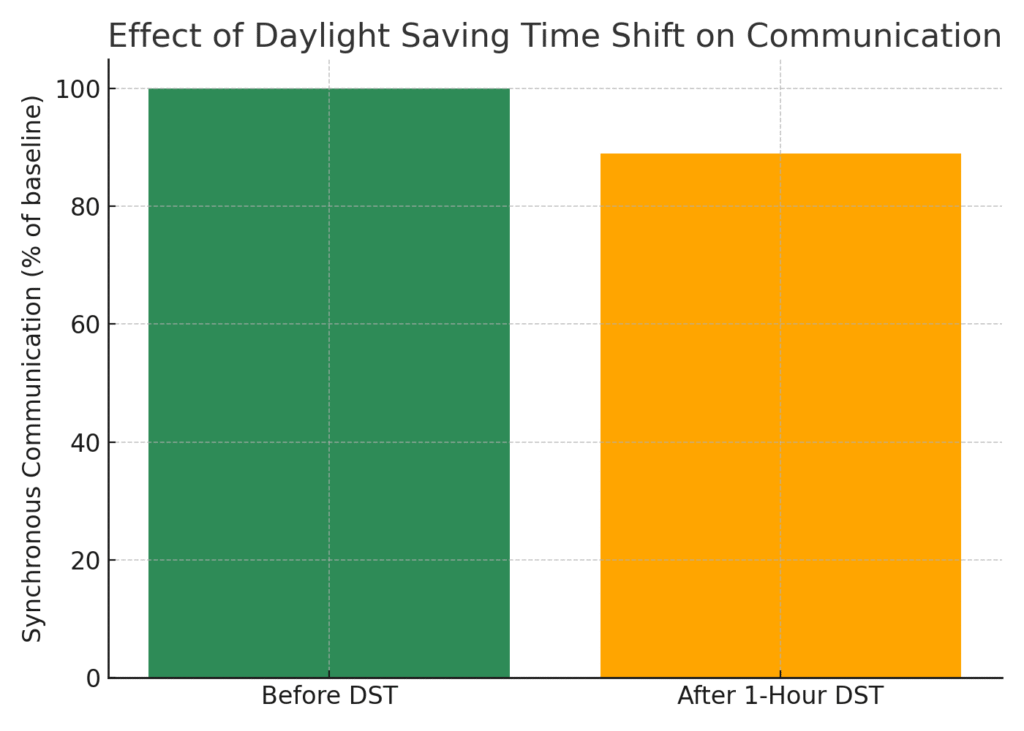
Distributed Marketing Time Zone Coordination Statistics #15: Daylight Saving Shifts Cause 11% Drop In Communication
Even a daylight saving time change can create disruption. A one-hour seasonal shift results in an 11% decline in synchronous communication. For marketers, this temporary disruption can affect campaign rollouts or event planning. Teams must anticipate these seasonal changes to prevent missed opportunities. Small adjustments in scheduling tools can help ease the transition.

Distributed Marketing Time Zone Coordination Statistics #16: Edge-Hour Meetings Are Common In Global Teams
Marketing teams across time zones often resort to scheduling “edge-hour” meetings. These are calls held very early in the morning or late at night for some participants. While it feels unfair, it spreads inconvenience across the team. Leaders often rotate meeting times to avoid consistent burden. It’s a practical but imperfect solution for global marketing teams.
Distributed Marketing Time Zone Coordination Statistics #17: Distributed Teams Tend To Be Larger
Research suggests distributed teams are typically larger than co-located ones. For marketers, this means more stakeholders across multiple geographies. Larger teams create more complexity in scheduling and alignment. However, they also bring broader perspectives to campaign strategies. With proper coordination, larger distributed teams can be a major asset.
Distributed Marketing Time Zone Coordination Statistics #18: More Meeting Time Spent In Distributed Teams
People in distributed teams spend more time in meetings than those in co-located settings. For marketers, this can mean longer weekly check-ins or cross-regional syncs. While necessary for alignment, excessive meetings can eat into creative time. Leaders must strike a balance between communication and productivity. Setting agendas and time limits can reduce meeting fatigue.
Distributed Marketing Time Zone Coordination Statistics #19: Communication Drops Impact Decision-Making And Morale
When synchronous communication declines, decision-making slows down. In marketing, delayed approvals or misaligned launches can have direct financial impacts. Team morale also suffers when members feel disconnected or unheard. Burnout becomes a risk when employees compensate by working off-hours. Addressing these issues proactively builds healthier collaboration.
Distributed Marketing Time Zone Coordination Statistics #20: Impact Of Time Zones Varies By Role And Culture
Not all roles experience time zone effects equally. Strategic and creative marketers are more impacted than operational ones. Cultural and legal differences also influence how much employees adjust schedules. These layers of complexity mean solutions must be customized. Distributed marketing succeeds when flexibility is paired with empathy.

Wrapping Up My Takeaway
Looking back at these findings, I realize the numbers only confirm what many of us have experienced in real time—working across time zones is both a challenge and an opportunity. For me, it’s not about eliminating those challenges but about learning how to balance them so no one feels left out or overworked. I’ve had mornings where I logged in too early and nights where I stayed online too late, and these statistics reminded me I’m not alone in that experience. The good news is, once we become intentional about scheduling and communication styles, distributed work starts to feel much more natural. My hope is that these insights give you the same kind of perspective they gave me—a reminder that behind every stat is a team of people trying to find their rhythm across the map.
SOURCES
https://www.prominence.global/managing-your-distributed-team-across-time-zones/
https://tivazo.com/blogs/time-zone-challenges-for-remote-teams/
https://pumble.com/blog/working-across-time-zones/
https://traqq.com/blog/time-zone-differences-are-destroying-remote-team-productivity/
https://zoetalentsolutions.com/remote-teams-across-time-zones/
https://velocityglobal.com/resources/blog/distributed-team-time-zone-management/
https://mondo.com/insights/ways-to-manage-teams-across-time-zones/
https://weknowinc.com/blog/news-and-business/distributed-teams-why-time-zone-overlaps-matter/