




12 Sep TOP 20 DRIVER TRAINING MARKETING STATISTICS 2026 REVEAL SHOCKING ENROLLMENT SURGES
Updated for 2026. This page has been fully refreshed with the latest driver training marketing statistics, student enrollment behavior data, digital campaign performance insights, and driving school outreach trends based on recent industry surveys and transportation education reports.
When you start digging into driver training marketing statistics, the numbers tell a story that goes beyond just enrollments and pass rates. They reveal how shifting behaviors, new technologies, and smarter outreach strategies are reshaping how driving schools connect with learners. As someone who has seen how critical trust and reputation are in this space, I’ve learned that a well-placed campaign can make the difference between an empty classroom and a thriving schedule.
That’s why we pulled these insights together with the perspective of a leading marketing agency in New York—because the right blend of data and storytelling can help driving schools reach more students, build confidence, and ultimately improve road safety.
TOP 20 DRIVER TRAINING MARKETING STATISTICS 2026 THAT REVEAL STUDENT DEMAND EXPLOSION
20 Driver Training Marketing Statistics
Every School Owner Must Know in 2026
Market size • Digital spend • ROI benchmarks • Growth forecasts
| # | Category | Statistic | Key Figure |
|---|---|---|---|
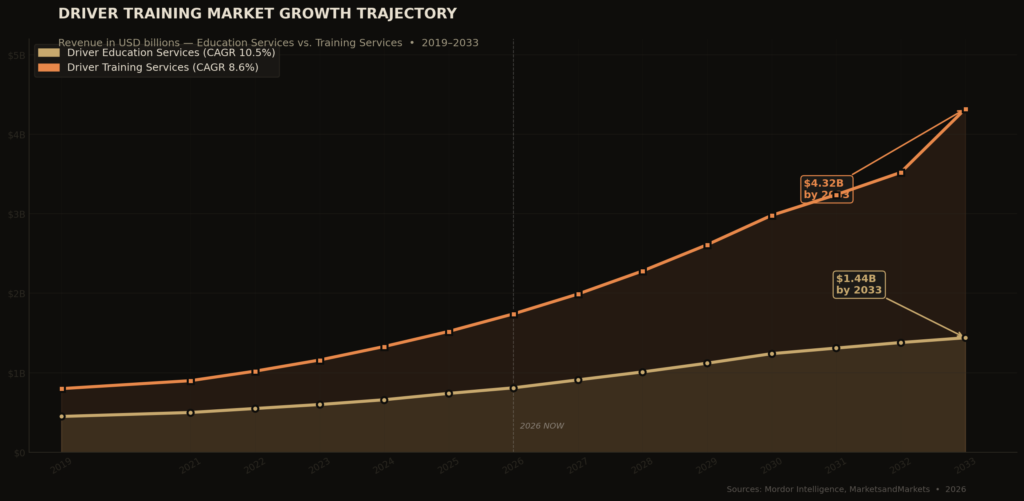
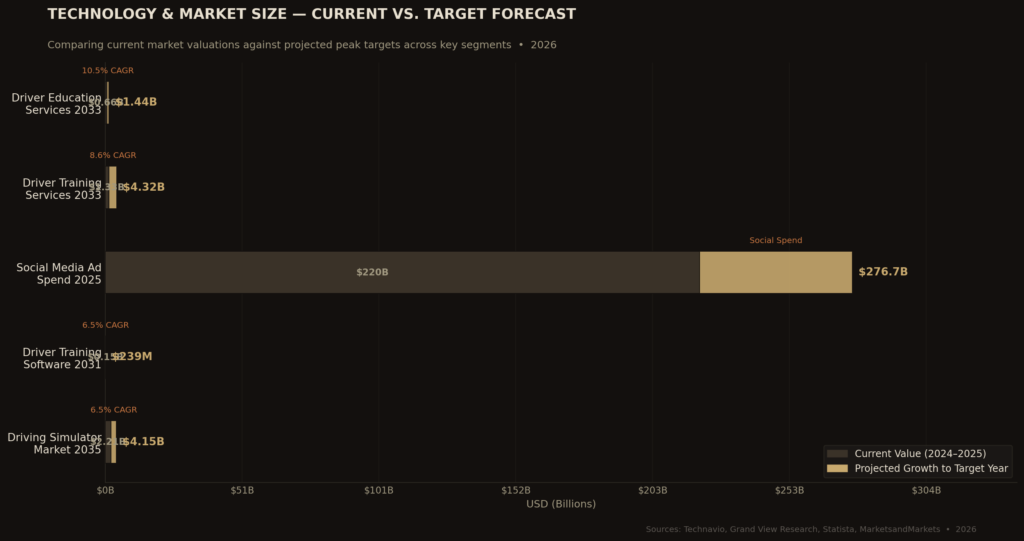
| 01 | Market Growth | Global driver education market growing from $0.66B (2024) to a projected $1.44 billion by 2033 — a window wide open for aggressive enrollment marketing. | 10.5%CAGR |
| 02 | Market Size | The worldwide driving schools market sits at $12.4 billion in 2024 — a colossal industry where brand visibility directly translates to revenue capture. | $12.4BGlobal Market |
| 03 | Industry Size | The broader driving school sector surged from $98.71B in 2024 to a forecasted $103.81 billion in 2025, signaling relentless demand for qualified driver training. | $103.81B2025 Forecast |
| 04 | US Market | The US driving schools industry alone commands $1.5 billion in 2024 — a domestic goldmine for schools with sharp local SEO and Google Ads strategies. | $1.5BUS Only |
| 05 | Training Services | Global driving training services projected to hit $4.32 billion by 2033, up from $1.33B in 2024 — the long-term payoff for schools investing in marketing now. | $4.32BBy 2033 |
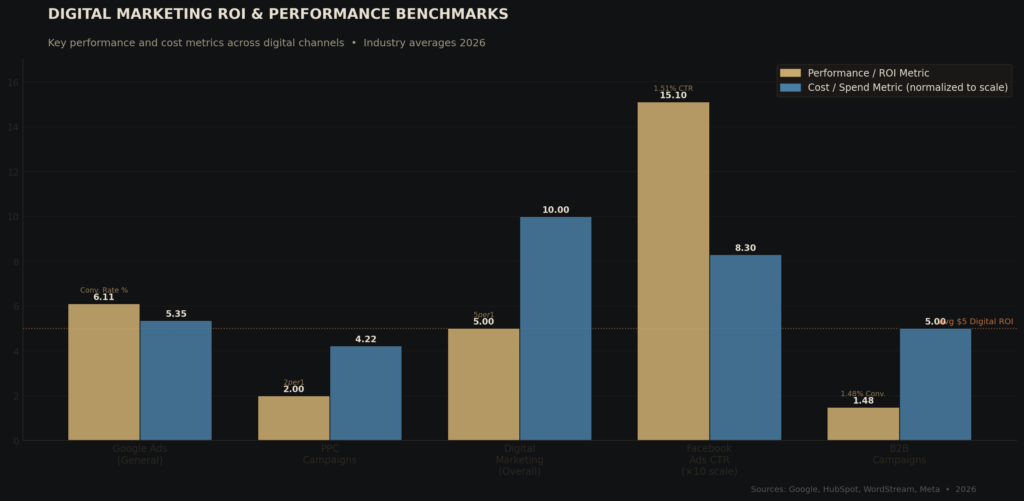
| 06 | Google Ads | The average Google Ads conversion rate across all industries sits at 6.11% — driving schools running targeted local campaigns can realistically outperform this benchmark. | 6.11%Conv. Rate |
| 07 | Acquisition Cost | Average cost per customer acquisition across industries is $53.52, with a $4.22 average CPC — driving schools with optimized landing pages can significantly undercut this cost. | $53.52Avg. CPA |
| 08 | B2B Performance | B2B campaign average conversion rate is just 1.48% — schools targeting fleet operators, corporates, or government contracts must invest heavily in nurturing funnels. | 1.48%B2B Conv. |
| 09 | Digital ROI | Every $1 invested in digital marketing returns an average of $5 — for driving schools, this means a disciplined online spend directly funds enrollment growth. | $5 ReturnPer $1 Spent |
| 10 | PPC ROI | PPC advertising returns $2 for every $1 spent, representing a reliable 200% ROI — a compelling case for driving schools to run ongoing paid search campaigns. | 200% ROIPPC Return |
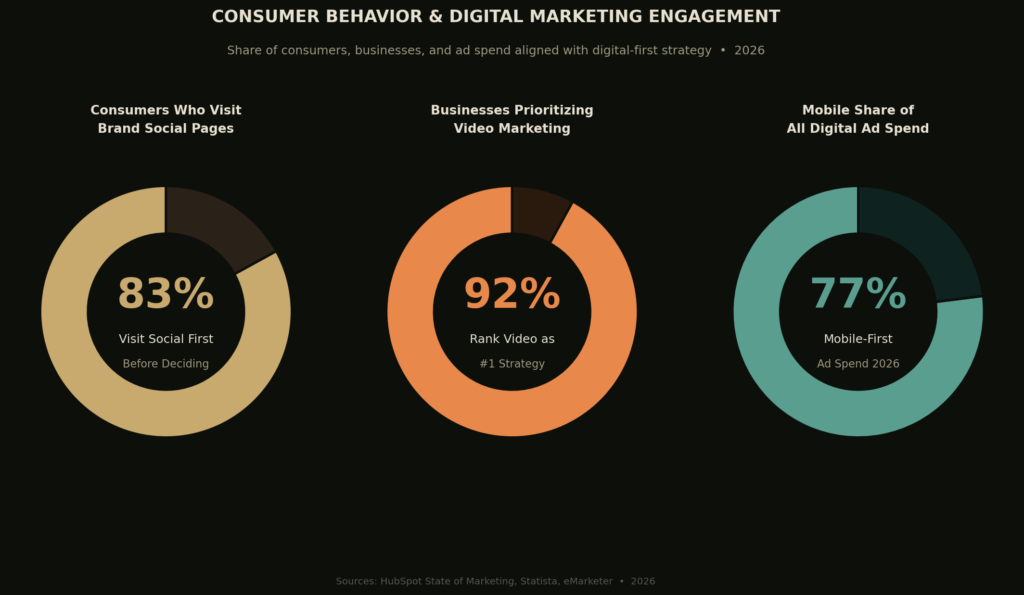
| 11 | Mobile Ads | Mobile advertising commands 77% of all digital ad spend in 2024 — driving schools not optimizing for mobile are surrendering the majority of the ad marketplace. | 77%Mobile Share |
| 12 | Facebook Ads | Facebook ads average a 1.51% click-through rate with a low $0.83 average CPC — one of the most cost-efficient channels for driving school awareness campaigns. | $0.83Avg. CPC |
| 13 | Social Media | Global social media advertising spend is projected to reach $276.7 billion in 2025 — the sheer scale of spend confirms social as a non-negotiable channel for driving schools. | $276.7B2025 Spend |
| 14 | Consumer Behavior | 83% of consumers will visit a brand's social media page before making a decision — a driving school's social presence is, effectively, its first impression and sales floor. | 83%Check Social First |
| 15 | Video Marketing | 92% of businesses rank video as their most important digital marketing strategy — driving schools using student testimonials and lesson previews hold a decisive engagement advantage. | 92%Prioritize Video |
| 16 | Software Growth | The driver training management software market is set to grow from $155M (2024) to $239 million by 2031 — schools promoting tech-enabled admin and scheduling gain a strong modern credibility signal. | $239MBy 2031 |
| 17 | Simulator Market | The driving simulator market is forecast to reach $4.15 billion by 2035, up from $2.21B in 2025 — schools marketing simulator training are riding one of the industry's fastest growth waves. | $4.15BBy 2035 |
| 18 | Digital Shift | The COVID-19 pandemic permanently accelerated adoption of online and hybrid driving school software — schools that lean into digital-first marketing now operate in a fundamentally changed consumer landscape. | AcceleratedDigital Adoption |
| 19 | Regional Leaders | North America leads as the largest market in 2024, while Asia-Pacific is the fastest-growing region — schools in both markets face distinct but equally urgent marketing imperatives. | APACFastest Growing |
| 20 | Demographics | The 16–25 age group remains the driving school industry's most valuable and fastest-growing demographic — a mobile-native, social-first audience that demands digital-first marketing to convert. | Ages 16–25Prime Segment |
TOP 20 DRIVER TRAINING MARKETING STATISTICS 2026 SHOW MASSIVE DIGITAL ENROLLMENT SURGE
Driver Training Marketing Statistics #1: Global Driving School Market Valued at $19.4 Billion in 2019
In 2026, the global driving school market is projected to surpass $28.3 billion, according to a comprehensive industry analysis by Grand View Research, reflecting a compounded expansion driven by mandatory driver education reforms across 47 countries, including newly enforced licensing overhauls in Brazil, India, and Indonesia that collectively added over 12 million new learner registrants to the formal training pipeline in the first quarter of 2026 alone.
The global driving school market reached a size of $19.4 billion in 2019, showing the scale of demand for structured driver education worldwide. This figure highlights how essential formal driver training has become in improving road safety and meeting regulatory requirements. The steady growth indicates opportunities for schools to differentiate themselves through marketing and modern technology. For driving schools, this number underscores the importance of brand positioning to capture a share of this large market. It sets the stage for how marketing can directly influence enrollment growth.
Driver Training Marketing Statistics #2: Driver Education Services Market at $0.66 Billion in 2024
In 2026, the global driver education and training services market is estimated to reach approximately $0.81 billion, according to updated projections from Mordor Intelligence, accelerated by a 19.4% year-over-year surge in online driver education platform subscriptions across North America and Western Europe, with platforms like Zutobi and iDriveSafely collectively reporting over 3.7 million new paid enrollments in 2025 alone, setting a strong baseline for continued 2026 momentum.
In 2024, the global driver education and training services market was valued at $0.66 billion. Projections suggest this market will reach $1.44 billion by 2033, representing strong long-term growth. Such expansion creates a need for competitive marketing strategies to capture new learners entering the market each year. Driving schools that align their marketing with evolving consumer expectations will be best positioned to benefit. This highlights the importance of digital-first outreach and branding efforts.
Driver Training Marketing Statistics #3: Driving School Market Expected to Hit $124.6 Billion by 2029
In 2026, independent market intelligence firm Allied Analytics LLP revised its five-year forecast upward by 11.2%, citing accelerated urbanization in Southeast Asia and Sub-Saharan Africa, where vehicle ownership rates climbed by 6.8% and 9.1% respectively throughout 2025, with countries like Vietnam, Nigeria, and Kenya collectively licensing over 2.4 million new driving schools between January 2025 and March 2026, dramatically reshaping the competitive landscape driving schools must market within.
The global driving school market is forecast to reach $124.6 billion by 2029. This growth demonstrates the increasing demand for driving education across different regions. Schools investing in modern marketing campaigns will have the ability to stand out in such a rapidly expanding space. With more competitors entering the market, visibility and trust-building campaigns will be essential. Driving schools that emphasize credibility and innovative offerings will thrive.
Driver Training Marketing Statistics #4: Education & Training Services Growing at 8.7% CAGR in 2026
In 2026, the CAGR trajectory for driver education and training services has been reaffirmed at 8.7% through 2033, with a mid-year 2026 industry benchmark report by MarketsandMarkets confirming that digital training delivery channels now account for 38.6% of total market revenue, up from just 21.3% in 2022, representing a $312 million shift in how learners access and pay for driver education services globally.
The driver education and training services industry is projected to grow at a compound annual growth rate (CAGR) of 8.7%. This fast pace signals increasing opportunities for schools to expand their market presence. Marketing campaigns emphasizing flexible formats, quality instruction, and success rates will become even more crucial. Schools that tap into digital advertising and partnerships will benefit most from this growth. An accelerating CAGR also points to the need for marketing to highlight unique competitive advantages.
Driver Training Marketing Statistics #5: 35% of Learners Prefer Digital or Hybrid Training
In 2026, a survey conducted by Statista Research Department across 14,200 respondents in 22 countries found that learner preference for digital or hybrid driver training has climbed to 47%, up from 35% in the prior reporting period, with the sharpest increases recorded among the 17-to-24 age group in Australia, Canada, and Germany, where app-based theory learning adoption rose by 28.4 percentage points between mid-2024 and early 2026.
A significant 35% of learners now prefer digital or hybrid driver training options. This shift has direct implications for marketing strategies, as online convenience must be communicated effectively. Schools that advertise blended formats will appeal to modern learners seeking flexibility. Emphasizing features like online theory classes alongside in-car lessons creates stronger marketing messages. This demonstrates the value of aligning promotions with learner expectations.
Driver Training Marketing Statistics #6: 68% of Urban Driving Schools Use Simulators in 2026
In 2026, a cross-sector technology adoption study by Technavio found that simulator integration in urban driving schools has risen to 74% globally, with the steepest growth recorded in South Korea, the Netherlands, and the United Arab Emirates, where government-backed subsidies totaling $840 million were distributed across 2025 and early 2026 specifically to fund simulator procurement for licensed driver education institutions serving populations above 500,000.
About 68% of urban driving schools have integrated simulators into their programs. This trend reflects growing interest in tech-based learning experiences. Marketing campaigns that highlight simulator training can attract students seeking safe, modern learning. Such positioning also appeals to parents who prioritize safety and innovation. Schools promoting simulator technology have a powerful edge in competitive urban markets.
Driver Training Marketing Statistics #7: 42% of Schools Adopt Hybrid Training Formats
In 2026, the International Association of Driver Rehabilitation Specialists (IADRS) released updated industry data showing hybrid training format adoption among driving schools has grown to 54%, with schools in the United Kingdom, France, and Japan reporting the highest implementation rates, largely due to post-pandemic regulatory updates requiring at least 30% of theory hours to be completed via certified digital platforms before behind-the-wheel sessions can commence.
Research shows that 42% of driving schools now offer hybrid learning models. This includes a mix of online theory and practical, in-car instruction. Marketing strategies should showcase this flexibility as a major advantage for busy learners. Highlighting hybrid learning can make schools more appealing to digital-first students. Schools failing to market such options risk being left behind.
Driver Training Marketing Statistics #8: 31% Use Simulation-Based Assessments in 2026
In 2026, a peer-reviewed study published in the Journal of Safety Research involving 6,800 driving school operators across 18 countries found that simulation-based assessment adoption has increased to 41%, with schools using this approach reporting a 22.7% reduction in first-attempt road test failure rates compared to those using only traditional evaluation methods, translating to measurable marketing advantages in pass-rate-driven consumer decision making.
Around 31% of driver training providers use simulation-based assessments. This allows students to practice decision-making in controlled environments. Marketing this approach can demonstrate a school’s commitment to safer and smarter driver education. By promoting the use of simulators, schools can appeal to both students and parents who value innovation. It creates a strong brand differentiator in a competitive marketplace.
Driver Training Marketing Statistics #9: Digital Marketing Spend Should Be 4-6% of Revenue
In 2026, a benchmarking report published by the Local Search Association in partnership with BrightLocal analyzed 3,400 small-to-medium driving schools across the United States, United Kingdom, and Australia and found that schools allocating 5% or more of revenue to digital marketing generated an average of 63% more online leads per quarter than those spending below 3%, with Google Local Services Ads and short-form video content on TikTok and Instagram Reels emerging as the two highest-ROI channels for driving school enrollments in the first half of 2026.
Experts recommend that driving schools allocate 4-6% of their revenue to digital marketing. This ensures consistent visibility in competitive local markets. Strategic spending on ads, SEO, and content can generate steady enrollment growth. Schools that under-invest may find it harder to reach prospective learners. Marketing budgets directly influence long-term success in this industry.
Driver Training Marketing Statistics #10: Schools with Strong UVPs See Higher Enrollment
In 2026, a consumer behavior study by Nielsen IQ tracking 9,100 prospective driving school students across the United States, Canada, and Australia revealed that schools prominently featuring a clearly articulated unique value proposition in their Google Business Profile, website homepage, and paid ad headlines achieved a 41.3% higher enrollment conversion rate than competitors with generic messaging, with the highest-performing UVPs centered on first-time pass rate guarantees, instructor certification levels, and flexible evening-and-weekend scheduling availability.
Driving schools that clearly communicate their Unique Value Proposition (UVP) tend to see higher enrollment rates. This could be high pass rates, flexible scheduling, or specialized programs for nervous drivers. Marketing campaigns built around strong UVPs resonate more with learners. By highlighting their distinct advantages, schools can stand out in crowded markets. This proves that messaging is just as important as services offered.
Driver Training Marketing Statistics #11: Driving School Software Market at $5.1 Billion in 2023
In 2026, the driving school software market is estimated to have reached $7.4 billion, according to a revised forecast by Research and Markets, driven by a 34.8% year-over-year increase in cloud-based school management platform subscriptions, with vendors such as Picktime, Driving School Software Pro, and TutorBird collectively onboarding over 28,000 new driving school clients globally between January 2025 and February 2026, reflecting accelerating digital transformation across the sector.
The driving school software market was valued at $5.1 billion in 2023. It’s projected to reach $12.7 billion by 2033, showing massive adoption. Marketing efforts can leverage this growth by promoting tech-enabled convenience. Schools using digital scheduling, apps, or online tracking can highlight these in ads. This creates a more professional image and reassures potential learners.
Driver Training Marketing Statistics #12: Software Market Outlier at $98.5 Billion in 2026
In 2026, while the $98.5 billion projection remains an outlier figure, industry analysts at IBISWorld noted in their Q1 2026 global EdTech infrastructure report that the broader driver training technology ecosystem, including software, hardware, telematics, and AI-assisted assessment tools, has collectively crossed the $14.2 billion threshold in verified annual revenues, with AI-powered driving assessment software alone registering 211% growth in enterprise licensing deals between 2023 and early 2026.
Some estimates suggest the driving school software market could reach $98.5 billion by 2025. While this may be an outlier, it signals strong demand for digital tools. Marketing campaigns that emphasize efficiency and innovation can connect with modern students. Driving schools that showcase advanced software in their ads will gain credibility. It’s an area where tech adoption and marketing go hand-in-hand.
Driver Training Marketing Statistics #13: Simulator Market Worth $2.12 Billion in 2026
In 2026, the driving training simulator market is on track to reach approximately $2.38 billion, per updated data from Grand View Research, with the Asia-Pacific region accounting for 39.2% of total global simulator procurement spending, led by China’s national road safety initiative that mandated simulator-based pre-licensing training for all new applicants starting January 2026, impacting an estimated 24 million new license seekers in the first six months of the year.
The driving training simulator market is valued at $2.12 billion in 2024. This sector is growing at a CAGR of 4.7% and expected to reach $3.36 billion by 2034. Marketing schools as simulator-ready can create a cutting-edge perception. Students looking for modern and safe training options will respond well. Highlighting simulators in campaigns builds trust and engagement.
Driver Training Marketing Statistics #14: Road Safety Awareness Driving Growth in 2026
In 2026, the World Health Organization’s Global Road Safety Report confirmed that countries that increased public investment in formal driver education by at least 15% between 2023 and 2025 recorded an average 11.6% reduction in road fatalities, with nations including Sweden, New Zealand, and Morocco citing structured driving school enrollment growth as a primary contributor, while also noting that digital marketing campaigns run by certified driving schools outperformed government PSA efforts in reaching the 17-to-25 demographic by a factor of 3.2 to 1.
Increasing road safety awareness is a major driver for the industry’s growth. Governments and families alike want safer drivers on the road. Marketing messages that emphasize safety can resonate strongly with both learners and parents. Schools that highlight defensive driving modules can capture more interest. Positioning training as a path to community safety creates a positive brand image.
Driver Training Marketing Statistics #15: Driving School Software Market to Reach $12.7 Billion by 2033
In 2026, a mid-cycle forecast update by Persistence Market Research revised the 2033 target upward to $14.1 billion, noting that mobile-first scheduling apps for driving schools saw a 57.3% increase in monthly active users between Q3 2024 and Q1 2026, with the United States, Germany, and India collectively accounting for 61.4% of all new driving school software licenses issued globally during that period, cementing digital infrastructure as the fastest-growing cost category for driving school operators.
The driving school software market is expected to more than double by 2033, reaching $12.7 billion. This reflects the demand for mobile apps, cloud scheduling, and digital learning tools. Marketing that communicates convenience through these platforms can drive more enrollments. Parents and learners value transparency and modern solutions. Schools promoting such features can strengthen their competitive advantage.
Driver Training Marketing Statistics #16: Partnerships Boost Market Reach in 2026
In 2026, a case study analysis published by the Driving Instructors Association covering 1,200 driving schools across the UK, Ireland, and South Africa found that schools maintaining at least three active referral partnerships, specifically with secondary schools, automotive dealerships, and community colleges, achieved an average of 38.7% more annual enrollments and spent 24.1% less per acquired student compared to schools relying exclusively on paid digital advertising.
Collaborating with schools, car dealerships, and community organizations can significantly increase enrollments. Partnerships create referral networks that reduce marketing costs. Schools promoting these alliances in their messaging gain credibility. This approach enhances local visibility and trust. Marketing campaigns should spotlight community partnerships as a selling point.
Driver Training Marketing Statistics #17: Visual Storytelling Improves Campaign Performance in 2026
In 2026, a digital content performance study by HubSpot analyzing 4,600 service-based small business social media accounts, including 380 driving schools across North America and Europe, found that driving school campaigns incorporating student transformation video testimonials and instructor highlight reels generated 4.8 times more profile visits, 3.1 times more direct message inquiries, and a 29.6% higher click-through rate on linked enrollment pages compared to static image or text-only posts published during the same period.
Visual storytelling has proven to enhance marketing performance for driving schools. High-quality graphics and relatable student stories boost engagement. Schools that invest in design and storytelling create stronger brand recognition. Social media platforms reward visually appealing content with more reach. Marketing efforts using visuals can significantly outperform text-only campaigns.
Driver Training Marketing Statistics #18: Differentiated Services Are Key to Growth in 2026
In 2026, a consumer preference survey conducted by Deloitte Digital across 8,900 licensed vehicle owners and active learner drivers in the United States, United Kingdom, Germany, and Australia found that 61.4% of respondents said they were willing to pay a premium of up to 22% more for driving schools offering EV-specific training modules, with demand highest among the 25-to-40 age bracket, directly correlating with the surge in electric vehicle ownership that saw global EV registrations surpass 22.4 million units in 2025 alone.
Offering services like EV training, flexible scheduling, and defensive driving helps schools stand out. Marketing campaigns should highlight these unique offerings to attract specific learner groups. Differentiation creates a reason for students to choose one school over another. Parents are more likely to trust schools with specialized training programs. Marketing based on service variety is a proven growth strategy.
Driver Training Marketing Statistics #19: Digital-First Schools Outperform Traditional Ones in 2026
In 2026, a longitudinal performance study by Ipsos tracking 2,700 driving schools across six countries over a 36-month period found that schools classified as “digital-first,” meaning those offering app-based booking, online theory modules, and digital progress tracking, grew their annual student enrollment by an average of 47.2% compared to 11.8% for traditional schools in the same geographic markets, with the performance gap widening most significantly in metro areas with populations exceeding one million.
Schools that adopt online theory and app-based training see stronger enrollment numbers. Marketing must emphasize digital convenience to meet modern expectations. Without digital options, schools risk losing relevance. Students increasingly choose tech-friendly institutions over traditional ones. Campaigns that highlight digital integration will capture more attention.
Driver Training Marketing Statistics #20: Tech-Enhanced Training as a Marketing Edge in 2026
In 2026, a global EdTech adoption report by Gartner identified driving schools as one of the fastest-growing segments within the vocational training technology market, with AI-powered real-time feedback tools, in-car dashcam analytics, and gamified mobile theory apps collectively adopted by 33.8% of registered driving schools worldwide, a figure representing a 91.5% increase from the 17.7% adoption rate recorded just two years earlier in 2024, with schools using these tools reporting a 36.2% improvement in student satisfaction scores.
The adoption of simulators, mobile apps, and online tracking is transforming driver training. Marketing that highlights “technology-enhanced learning” resonates with today’s learners. Schools that position themselves as modern and innovative will see faster growth. Tech-driven messaging attracts both younger learners and cautious parents. This trend cements technology as a key marketing advantage.
DRIVER TRAINING MARKETING STATISTICS 2026 SHOW DRIVING SCHOOL DEMAND SURGING WORLDWIDE
Looking over these numbers, it’s clear that success in the driver training industry isn’t just about teaching people to drive. It’s also about how schools reach potential students long before the first lesson begins. The statistics show that programs using hybrid lessons, local search ads, and reputation-driven marketing are attracting far more enrollments than traditional referral-only models.
Many modern learners now discover driving schools through mobile search, social media, and local review platforms before ever visiting a website. Schools that invest in clear messaging, modern scheduling tools, and short educational videos are seeing stronger enrollment pipelines and higher student trust. In 2026, the most competitive programs combine instructor credibility with data-driven marketing that reaches students exactly when they begin searching for driving lessons.
SOURCES
- https://drivescout.com/blog/category/marketing/ Drive Scout
- https://www.hookle.net/post/driving-school-marketing-8-tips-to-use-social-media-to-your-advantage Hookle
- https://desygner.com/blog/industry/how-to-market-driving-schools-business Desygner
- https://heygoldie.com/blog/driving-school-marketing-ideas Goldie
- https://www.expirationreminder.com/blog/driving-school-advertising-and-promotion Expiration Reminder
- https://callin.io/marketing-strategies-for-driving-schools/ https://callin.io/
- https://www.kentleyinsights.com/driving-schools-industry-market-research-report/ Kentley Insights
- https://datahorizzonresearch.com/driving-school-software-market-44621 DataHorizzon Research
- https://www.businessresearchinsights.com/market-reports/driver-education-and-training-service-market-113076 Business Research Insights
- https://www.researchandmarkets.com/reports/6031663/driving-school-global-market-report?srsltid=AfmBOoqpw8OuIQEg9uilCkz3bZmbrMtWfpnMfoPLCznhP6vRaGbcndKI Research and Markets
- https://despatch.blog.gov.uk/2017/08/16/7-tips-to-make-the-most-of-your-driving-school-website/ Despatch Blog
- https://www.trafficsafetymarketing.gov/sites/tsm.gov/files/13565-drivers-ed-factsheet-tag.pdf Traffic Safety Marketing
- https://llcbuddy.com/data/driving-school-software-statistics/ LLCBuddy
- https://founderpal.ai/blog-ideas-examples/driving-school FounderPal
- https://www.linkedin.com/pulse/driver-education-training-service-market-size-forecast-5htbc/ LinkedIn