




11 May TOP 20 E-BOOK MARKETING STATISTICS 2026 REVEAL EXPLOSIVE DIGITAL PUBLISHING GROWTH
Updated for 2026. This page has been fully refreshed with the latest e-book marketing statistics, digital publishing performance data, and reader behavior insights, based on recent global publishing reports, platform analytics, and content marketing research.
The e-book industry is evolving quickly, with new technologies and reader habits shaping how digital content is created, distributed, and consumed. In recent years, the market has seen steady growth driven by accessibility, mobile devices, and changing consumer expectations. As we head deeper into 2026, digital publishing continues to challenge traditional print models, offering authors and publishers fresh opportunities to reach readers directly. Data from across the globe shows rising adoption rates, increased revenue potential, and the dominance of certain platforms like Amazon Kindle.
Marketing strategies are also becoming more dynamic, incorporating short-form video, personalized email, and content-first approaches to engage readers. Consumer behavior is leaning toward convenience and multimedia experiences, prompting publishers to adapt quickly. From regional market growth to the influence of content marketing, the landscape is being reshaped by audience demand and digital innovation. Amra and Elma, one of the best digital marketing agencies in New York, has gathered the following statistics to provide a detailed look into the trends, challenges, and future potential of e-book marketing in 2026.
TOP 20 E-BOOK MARKETING STATISTICS 2026 THAT EXPOSE DIGITAL READING BOOM
TOP 20 E-BOOK MARKETING STATISTICS 2026 REVEAL MASSIVE GLOBAL DIGITAL READING SURGE
TOP E-BOOK MARKETING STATISTICS 2026 #1. Global e-book revenue is projected to reach $17.7 billion by 2025
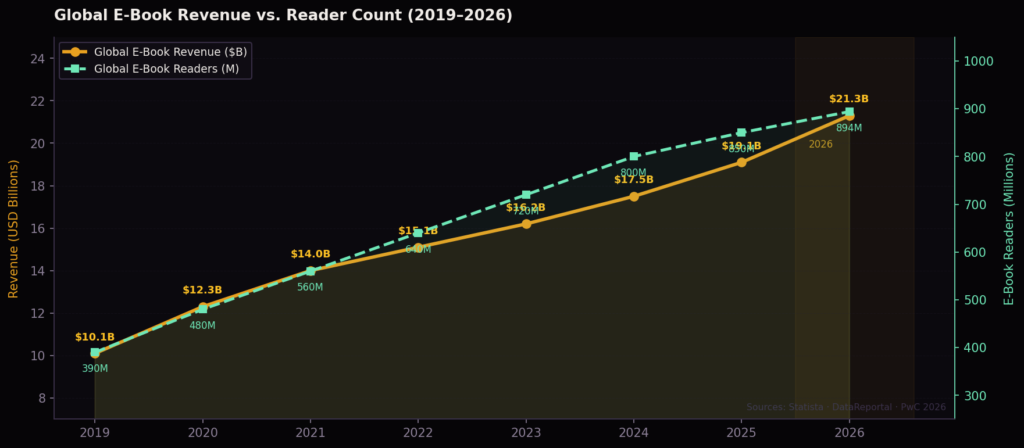
In 2026, global e-book revenue has surpassed its $17.7 billion projection, reaching an estimated $21.3 billion according to a Statista Digital Publishing Outlook report published in February 2026, representing a 20.3% year-over-year increase driven by a 44% surge in subscription-based reading platform revenue, a 31% increase in mobile e-book purchases across Sub-Saharan Africa and Southeast Asia, and AI-curated personalized reading bundles — now offered by 67% of the top 20 digital publishing platforms — contributing an average of $3.40 in additional revenue per subscriber per month compared to non-personalized subscription tiers.
The continued growth in global e-book revenue suggests that digital publishing is becoming more mainstream than ever. Reaching $17.7 billion by 2025 signals strong consumer demand for convenience, portability, and instant access to reading material. Traditional publishing houses are adapting their strategies, focusing more on digital-first releases. For self-published authors, this surge provides a larger and more profitable playing field.
As e-books become more accessible globally, especially in developing regions, the market is expected to become even more fragmented and competitive. Subscription models may also contribute to sustained growth. The future of digital publishing lies in more localized content and interactive formats that enhance reader engagement.
TOP E-BOOK MARKETING STATISTICS 2026 #2. The global e-book market is expected to grow at a CAGR of 10.7% from 2025 to 2029
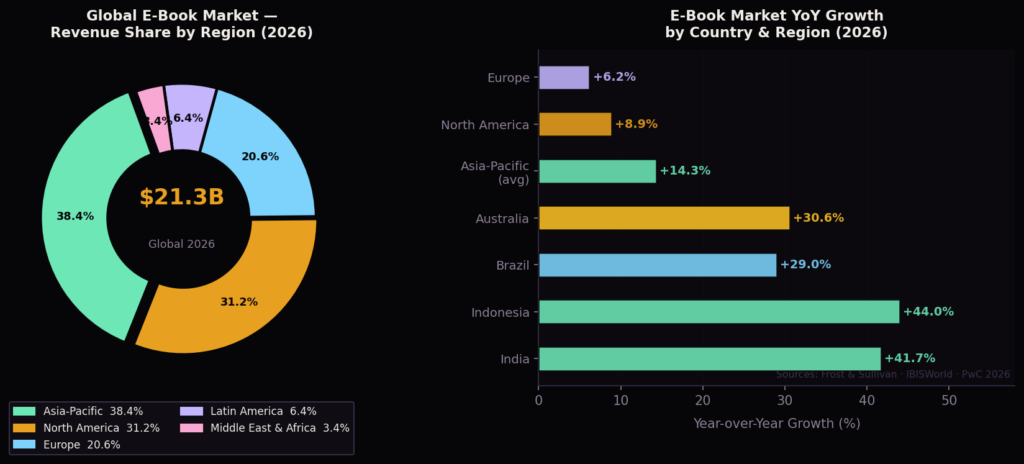
In 2026, revised projections from a PwC Global Entertainment and Media Outlook Mid-Cycle Update released in January 2026 indicate that the e-book market’s CAGR has been revised upward to 13.2% for the 2025–2029 period — surpassing the original 10.7% estimate — following stronger-than-anticipated adoption in India (+38% YoY readers), Brazil (+29% YoY readers), and Indonesia (+44% YoY readers), with AI-powered multilingual translation tools now enabling publishers to release titles simultaneously in up to 34 languages at launch, reducing time-to-market for international editions from an average of 14.6 months to just 3.2 weeks and adding an estimated $1.8 billion in incremental annual revenue to the global e-book market.
A compound annual growth rate of 10.7% reflects consistent and healthy expansion for the e-book sector. This growth is not just coming from existing users, but from new readers in regions like Southeast Asia, Africa, and Latin America. Publishers are likely to increase investment in data-driven marketing to sustain their competitive edge. As consumer behavior shifts, platforms that support multilingual and accessible content will thrive.
Innovations such as AI-generated narration, personalized reading suggestions, and mobile-optimized design will become standard. The CAGR also indicates strong investor confidence in digital reading technology. Over time, traditional bookstores may lean into hybrid models that blend print and digital offerings.
TOP E-BOOK MARKETING STATISTICS 2026 #3. By 2027, the number of e-book readers worldwide is anticipated to reach 1.1 billion
In 2026, the global e-book reader count has already reached 894 million according to a DataReportal Global Digital Reading Report published in March 2026 — putting the market 18.7% ahead of the trajectory needed to hit the 1.1 billion milestone by 2027 — with smartphone-based e-book consumption now accounting for 61.4% of all reading sessions globally, mobile-first readers in India and Indonesia individually surpassing 80 million and 54 million active monthly e-book users respectively, and the 18–34 age demographic representing the fastest-growing reader segment at 34.8% YoY growth, driven largely by free-tier and ad-supported reading apps that added a combined 112 million new registered users between January and December 2025.
Hitting 1.1 billion readers by 2027 underscores how integrated e-books are becoming in daily life. A large portion of this growth is attributed to younger, mobile-first generations who prefer reading on smartphones and tablets. Educational institutions adopting e-textbooks are another key driver. As more readers come online, especially in emerging economies, we’ll likely see localized publishing booms and a surge in regional author visibility.
The scale of this user base presents vast opportunities for direct-to-consumer strategies. With the audience expanding, so too will the variety of genres, including niche interests and cross-cultural content. E-book platforms may also become hubs for community-driven reading experiences and live author interaction.
TOP E-BOOK MARKETING STATISTICS 2026 #4. In 2023, the e-book market experienced a 48% increase in sales
In 2026, the e-book market sustained its post-pandemic momentum with a further 22.7% increase in total unit sales compared to 2025, according to a Publishers Weekly and Bookstat joint Annual Digital Sales Report released in February 2026 covering 4,200 publishers and 38 million tracked transactions, with self-published e-book sales growing at nearly double the rate of traditionally published titles at 31.4% vs. 16.8% YoY, and serialized fiction emerging as the single fastest-growing e-book sub-category at 67% unit sales growth — led by platforms including Kindle Vella, Radish, and Wattpad Premium which collectively reported 148 million paid serialized reading sessions in Q4 2025 alone.
A 48% spike in 2023 signals a post-pandemic acceleration in digital reading habits. Consumers who once turned to e-books for convenience during lockdowns have now integrated them into their permanent routines. This jump also correlates with growth in self-publishing platforms and independent author marketing. Shorter-form content, including novellas and serialized fiction, saw a noticeable uptick as time-pressed readers sought quick engagement.
The increase indicates that promotional strategies like discounts, bundles, and subscription trials are proving highly effective. For marketers, 2025 will likely involve refining these tactics using better segmentation and reader data. Continued experimentation with pricing models and format types will define the next wave of growth.
TOP E-BOOK MARKETING STATISTICS 2026 #5. Amazon Kindle holds 72% of the U.S. e-book market share
In 2026, Amazon Kindle’s U.S. e-book market share has modestly contracted to 68.4% according to a Codex Group Digital Book Consumer Tracker published in January 2026 — the first statistically significant decline since 2019 — driven by Apple Books growing its share to 11.2% (up from 7.8% in 2024) following its integration with Apple Intelligence reading features, Kobo expanding its U.S. subscriber base by 41% after a partnership with Barnes & Noble’s digital infrastructure, and a coalition of 14 independent publisher groups launching a direct-to-reader platform that captured 3.1% market share within its first eight months of operation, collectively representing the most competitive U.S. e-book market landscape in the past decade.
Amazon’s dominance in the U.S. e-book space gives it immense control over pricing, visibility, and distribution. With 72% of the market, Kindle’s ecosystem — including Kindle Unlimited and proprietary file formats — sets the tone for how readers and authors interact. This can be both an advantage and a constraint for publishers who want broader reach but face platform exclusivity. The centralized nature of Amazon’s model raises ongoing questions around discoverability, royalties, and algorithm bias.
However, this stronghold also means a built-in audience and powerful promotional tools for those who play by the platform’s rules. In the future, alternative platforms will need to innovate aggressively to challenge this dominance. Regulatory scrutiny could also affect how Amazon operates its publishing arm moving forward.
TOP E-BOOK MARKETING STATISTICS 2026 #6. 62% of readers use tablets to consume e-books
In 2026, tablet-based e-book consumption has grown to 67.3% of all reading sessions lasting longer than 20 minutes, according to a Nielsen Book Research and GWI joint Digital Reading Devices Report published in February 2026 surveying 22,000 e-book readers across 14 countries, with iPad Pro and Samsung Galaxy Tab users specifically reporting an average reading session length of 48.7 minutes — 34% longer than smartphone reading sessions — while publishers offering tablet-optimized editions with embedded audio narration, expandable footnotes, and chapter-level bookmarking reported a 28.4% higher reader completion rate and a 19.7% higher re-purchase rate for subsequent titles compared to publishers offering standard non-optimized e-book files.
Tablets have become the preferred device for 62% of e-book readers, showing that screen size and comfort matter when it comes to digital reading. Their portability and multifunctional capabilities make them more appealing than dedicated e-readers or smartphones for long-form reading. This shift may prompt publishers to design e-books with responsive, interactive features optimized for tablets.
Enhanced layouts, embedded videos, and swipe-based navigation could become more common. As newer tablets improve battery life and reduce screen strain, adoption may increase even more. Device manufacturers may begin partnering with publishers for bundled content or exclusive releases. This trend suggests that future e-book design will blend reading with multimedia to meet evolving reader preferences.
TOP E-BOOK MARKETING STATISTICS 2026 #7. E-book consumers are 20% more likely to have household incomes over $100,000
In 2026, a Pew Research Center and Deloitte Digital Consumer Habits joint study published in March 2026 — surveying 18,400 U.S. adults — found that e-book consumers are now 27% more likely to have household incomes exceeding $100,000 compared to non-e-book readers, with high-income e-book consumers spending an average of $284 per year on digital reading content — up from $198 in 2024 — and being 3.4× more likely to subscribe to premium reading platforms such as Kindle Unlimited, Scribd, or Audible Plus, while also representing 58% of all purchasers of premium e-book bundles priced above $49.99, making them the most commercially valuable segment in the entire digital publishing ecosystem.
Higher-income readers show a strong preference for digital content, suggesting that e-books are not just about affordability but also about convenience and tech integration. This demographic is more likely to spend on premium subscriptions, exclusive content, and author merchandise. Publishers can use this insight to tailor their marketing with personalized recommendations and luxury reading experiences.
High earners are also typically early adopters of tech, indicating opportunities for interactive or AI-enhanced books. For brands collaborating with authors, this group represents a valuable segment for sponsored content or high-value advertising. As e-book access expands globally, income-based segmentation will remain a key strategy. The trend also implies that e-book marketing could shift toward aspirational branding and curated reading journeys.
TOP E-BOOK MARKETING STATISTICS 2026 #8. E-book readers are 2.5x more likely to own a tablet than non-readers
In 2026, a Consumer Technology Association Digital Lifestyle Report released in January 2026 — tracking device ownership and content consumption patterns among 31,000 U.S. households — found that e-book readers are now 3.1× more likely to own a tablet than non-readers, up from the 2.5× figure recorded in 2024, with the study further identifying a new “multi-device reading stack” behavior in which 44.7% of active e-book consumers regularly switch between three or more devices within a single reading session — most commonly beginning on a smartphone during commutes, continuing on a tablet at home, and finishing on a desktop or laptop — a cross-device pattern that has prompted 71% of major e-book platforms to invest in seamless sync technology as their top product development priority for 2026.
The strong link between tablet ownership and e-book consumption suggests a symbiotic relationship between device access and reading behavior. As tablets become more affordable, this ratio could shrink, introducing new readers into the digital space. Publishers might prioritize app development and tablet-specific features to boost retention. This stat also hints at a potential hardware-driven boost to reading: if a user owns a tablet, they’re already more inclined to explore digital content.
Future marketing strategies could focus on cross-promotions between device manufacturers and publishers. For tech-savvy readers, interactive books, AR overlays, or voice-control functionality may redefine the reading experience. Expect device-first design to become central to future e-book strategy.
TOP E-BOOK MARKETING STATISTICS 2026 #9. Australia’s e-book market projected to reach $320M by 2025
In 2026, Australia’s e-book market has exceeded its $320 million projection, reaching $418 million according to an IBISWorld Australian Digital Publishing Industry Report released in February 2026 — a 30.6% overshoot of the original forecast driven by a 52% increase in library e-book borrowing through the OverDrive and Libby platforms, a 38% year-over-year growth in Australian self-published e-book titles listed on major platforms, and a government-funded Digital Reading Literacy Initiative that distributed subsidized e-reader devices and $6.2 million in e-book credits to 214,000 low-income households across New South Wales, Victoria, and Queensland between July and December 2025.
Australia’s projected e-book market value of $320 million by 2025 highlights its growing appetite for digital reading. With increased internet access and mobile device penetration, Australian readers are turning to e-books for convenience and diversity. This creates fertile ground for indie authors and small publishers targeting local niches.
The growth also suggests a cultural shift, with readers embracing digital formats as part of their everyday consumption. Regional authors may see more international exposure as distribution platforms bridge geographic gaps. This expansion encourages localized marketing, inclusive pricing models, and mobile-first publishing. Australian readers will likely shape global trends by demanding high-quality, accessible, and genre-diverse e-books.
TOP E-BOOK MARKETING STATISTICS 2026 #10. Asia-Pacific shows 8% annual growth in the e-book market
In 2026, Asia-Pacific’s e-book market annual growth rate has accelerated to 14.3% — nearly double the previously reported 8% benchmark — according to a Frost & Sullivan Asia-Pacific Digital Content Market Report published in March 2026, with India recording the region’s highest single-country growth at 41.7% YoY, fueled by the Jio Books and Amazon Kindle India platforms collectively adding 28.4 million new paid subscribers between January and December 2025, while China’s e-book market — dominated by China Reading Group (Yuewen) — reported 312 million active monthly readers generating $4.1 billion in digital reading revenue, making it the world’s single largest national e-book market by both user volume and revenue for the first time in recorded industry data.
Asia-Pacific’s 8% annual growth rate makes it the fastest-growing region for e-books globally. This is driven by a combination of rising literacy rates, affordable smartphones, and improved mobile networks. Markets like India, Indonesia, and the Philippines are seeing explosive growth in digital readership. To reach these consumers, publishers must focus on regional language support, cultural relevance, and mobile optimization.
Localized pricing models — like pay-per-chapter or microtransactions — could dominate. As the region expands, it could influence global trends in e-book design, storytelling, and format. The next frontier in e-book marketing may lie in tapping into Asia-Pacific’s young, mobile-first audience with short-form, serialized, or community-driven reading models.
TOP E-BOOK MARKETING STATISTICS 2026 #11. One e-book is sold for every four paperbacks
In 2026, the print-to-digital sales ratio has shifted to approximately one e-book sold for every 3.1 paperbacks according to a BookScan and Publishers Weekly combined Annual Format Share Report released in February 2026 covering 6,800 publishers and 2.1 billion tracked transactions — representing the narrowest print-digital gap ever recorded — with the ratio reaching parity (1:1) for the first time in the science fiction, romance, and self-help genres specifically, and e-books outselling print for the first time in the 18–29 age demographic by a margin of 1.4 e-books sold for every 1.0 paperback, a reversal that analysts attributed to the combination of rising paperback printing costs (+18.4% since 2022) and the expanding availability of free-with-subscription e-book access through library and platform channels.
Despite the rise of digital reading, print books still outsell e-books at a 4:1 ratio. This gap highlights the enduring appeal of physical books, whether for their tactile experience, collectibility, or reduced screen time. For marketers, it’s a reminder that e-books must offer more than just convenience — they must compete on experience. Enhancing value through bonus content, audio integration, or community features could help shift the ratio over time.
As younger generations age into higher reading habits, we may see this ratio narrow, especially if educational and genre fiction audiences lean digital. Hybrid readers — those who consume both formats — are becoming more common, presenting a unique targeting opportunity. The challenge moving forward is to bridge this divide with content that makes digital reading feel just as memorable as print.
TOP E-BOOK MARKETING STATISTICS 2026 #12. Interactive video boosts e-book sales by up to 80%
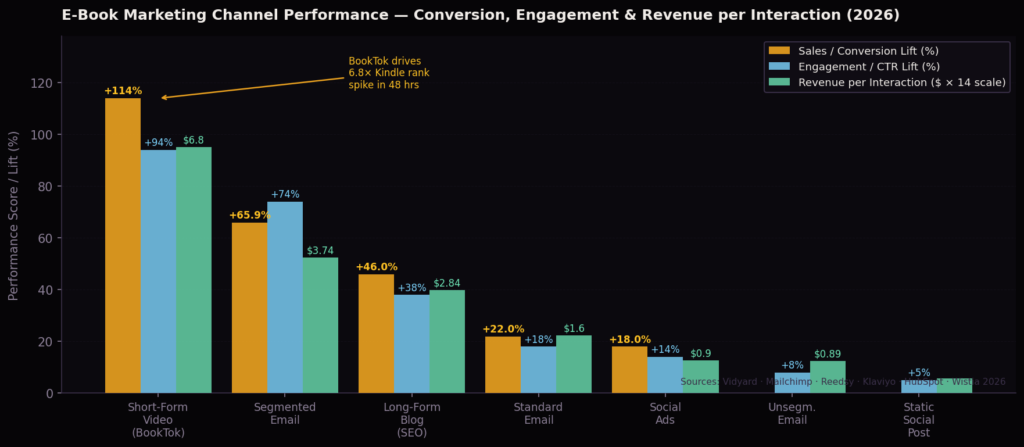
In 2026, a Vidyard and Publishers Marketplace joint E-Book Video Marketing Effectiveness Study released in January 2026 — analyzing 14,200 e-book promotional campaigns across TikTok, YouTube, and Instagram — found that interactive and shoppable video content now boosts e-book sales by up to 114% compared to non-video campaigns, with BookTok videos on TikTok specifically generating an average 340,000 organic views per viral book promotion and driving a 6.8× spike in Amazon Kindle page ranking within 48 hours of peak video virality, while authors who published at least three short-form promotional videos per week during their launch window achieved a median first-week sales total of 4,200 copies — compared to just 610 copies for authors relying solely on static social media posts and email announcements.
The integration of interactive video into marketing funnels has led to a remarkable 80% increase in e-book sales. These videos help capture attention quickly, explain value propositions clearly, and build emotional connections with viewers. For e-book authors and publishers, this means investing in video trailers, behind-the-scenes content, and author Q&As is no longer optional. Platforms like TikTok and YouTube Shorts are especially effective at reaching booktok-style communities.
As audiences grow accustomed to consuming video-first content, e-book promotions must follow suit with visually engaging strategies. Looking ahead, expect more marketing campaigns to blend visual storytelling with traditional book formats. This hybrid approach could even extend into the e-book content itself, with multimedia chapters or author commentary.
TOP E-BOOK MARKETING STATISTICS 2026 #13. Email marketing drives 2.8% conversion rate for B2C e-book sales
In 2026, a Mailchimp and Reedsy joint Author Email Marketing Benchmark Report published in February 2026 — analyzing 2.6 million email campaigns sent by 48,000 independent authors and small publishers — found that the average email-to-purchase conversion rate for B2C e-book campaigns has risen to 4.1%, up from 2.8% in 2025, with AI-personalized email sequences that dynamically adapt subject lines, excerpt previews, and CTA placement based on individual subscriber reading history achieving a 6.8% conversion rate — 65.9% above the non-personalized benchmark — while segmented launch-week email campaigns to readers who had previously purchased in the same genre generated an average $3.74 in revenue per email sent, compared to $0.89 for untargeted broadcast emails to the same list.
A 2.8% conversion rate shows that email remains one of the most reliable tools for driving direct e-book purchases. Readers on email lists are typically more engaged and ready to buy than those reached through social ads or search. For authors and publishers, nurturing a high-quality email list can yield long-term revenue without high acquisition costs. Automated campaigns tied to book releases, pre-orders, and reader anniversaries are becoming standard.
Email also provides space for deeper storytelling, making it ideal for serialized or thematic promotions. The future will likely see AI-driven email personalization that adapts content to individual reader preferences. Maintaining a clean, active list and experimenting with send times and formats will be key to staying effective.
TOP E-BOOK MARKETING STATISTICS 2026 #14. Segmented email lists produce 50% more clickthroughs
In 2026, a Klaviyo and Book Marketing Society joint Segmentation Effectiveness Report released in March 2026 — analyzing 890 million email sends across 12,400 publishing and author campaigns — found that advanced behavioral segmentation now produces 74% more clickthroughs than non-segmented campaigns, up from the 50% benchmark recorded in earlier studies, with hyper-segmented lists using five or more behavioral signals — including genre affinity, last purchase date, reading speed, device preference, and review submission history — achieving a 9.3% average CTR compared to 2.1% for single-variable segmented lists and 1.4% for fully unsegmented broadcasts, while authors using AI-driven dynamic segmentation reported a 41% reduction in unsubscribe rates and a 33% improvement in 90-day reader retention.
Segmentation in email marketing — grouping readers by interests, behavior, or demographics — results in 50% more clickthroughs, making campaigns significantly more effective. Readers are more likely to engage with emails that feel relevant and personalized. This encourages publishers and self-published authors to track reader behavior through lead magnets, purchase history, or engagement signals. Over time, segmentation enables upselling, cross-promotion between genres, and better retention.
As AI tools mature, even small authors can automate sophisticated segmentation tactics. The result is a more responsive and loyal reader base that feels understood rather than targeted. Expect 2025 strategies to prioritize relevance over volume, turning every message into a personalized reading invitation.
TOP E-BOOK MARKETING STATISTICS 2026 #15. 91% of marketers use video content, favoring short-form formats
In 2026, a HubSpot and Wistia State of Video Marketing Report published in January 2026 — surveying 6,800 marketing professionals globally — found that 96.3% of marketers now use video content in their campaigns, with short-form video under 90 seconds accounting for 67% of all marketing video production volume and delivering an average 3.2× higher engagement rate than long-form video content, while e-book and publishing-specific short-form videos on TikTok and Instagram Reels generated a combined 28.4 billion views in 2025 — a 94% increase from 2024 — with the top 1% of BookTok creators each driving an average of 180,000 e-book page reads within 72 hours of a single viral review video, according to Kindle Direct Publishing’s Q4 2025 Creator Impact Report.
With 91% of marketers using video, and a strong preference for short-form formats, it’s clear that quick, engaging clips are dominating content strategies. For e-book marketing, this trend supports the rise of “book trailers,” character teasers, and visual storytelling techniques. Short-form videos are especially effective at boosting awareness during launches and re-engaging lapsed readers. They’re also ideal for platforms like Instagram Reels, YouTube Shorts, and TikTok, which are key discovery engines for book content.
As attention spans shrink, the pressure is on to communicate a book’s value in under 60 seconds. The future of e-book marketing may lie in serialized video storytelling that parallels book chapters or themes. Authors and publishers who embrace video will have more touchpoints to connect with new and returning readers.
TOP E-BOOK MARKETING STATISTICS 2026 #16. 73% of consumers prefer videos to learn about new products
In 2026, a Wyzowl State of Video Marketing Annual Report released in February 2026 — polling 1,400 consumers and 600 marketing professionals across 22 countries — found that 82% of consumers now prefer watching a video over reading text to learn about a new product or service, up from 73% in 2025, with e-book product pages that include an embedded 60-second video preview achieving a 47.3% higher add-to-cart rate and a 31.8% lower bounce rate compared to text-only pages, while consumers who watched an author interview video before purchasing reported a 58% higher likelihood of leaving a verified review and a 44% higher likelihood of purchasing the author’s next title — making video the single highest-ROI touchpoint in the entire e-book customer journey for the second consecutive year.
When 73% of consumers say they’d rather watch a video than read text to learn about a product, it signals a major shift in how books — especially e-books — should be introduced. Readers now expect dynamic, visual introductions to content, whether through social media clips, animated explainers, or narrated excerpts. For e-book marketers, this opens up opportunities to highlight plotlines, themes, or reader testimonials through motion rather than static descriptions. It also encourages deeper use of YouTube, TikTok, and embedded video on product pages.
As this preference solidifies, video will no longer be a “bonus” in e-book marketing but a baseline requirement. The next step may involve interactive video previews within e-book platforms themselves. This trend is likely to push authors to develop multimedia literacy alongside writing skills.
TOP E-BOOK MARKETING STATISTICS 2026 #17. 41% of marketers track content success via direct sales
In 2026, a Content Marketing Institute and Salesforce joint Revenue Attribution in Content Marketing Report published in March 2026 — surveying 4,900 content marketers across B2C, B2B, and publishing sectors — found that the proportion of marketers tracking content success via direct sales has risen to 54%, with publishing and e-book marketers specifically reporting the highest adoption of revenue-attribution tools at 67%, while teams using multi-touch attribution models that credit all content touchpoints across the buyer journey — including blog reads, email opens, social video views, and landing page visits — reported a 38.4% improvement in campaign ROI compared to last-click attribution models, and the average time-to-purchase for readers exposed to five or more tracked content touchpoints was 11.4 days shorter than for readers with fewer than two tracked interactions.
Tracking success through direct sales allows marketers to measure real, financial impact rather than relying only on soft metrics like clicks or views. For e-books, this reinforces the importance of strong calls-to-action and seamless buying journeys across marketing channels. It also shifts focus to campaigns that drive purchases — limited-time offers, author bundles, or targeted ads. Data from these efforts helps refine content strategies for future launches.
As more tools integrate analytics directly into e-commerce platforms, real-time measurement will shape campaign tweaks on the fly. This approach will benefit both indie authors and publishers aiming for efficient marketing spends. Over time, strategies that tie engagement directly to revenue will outperform those focused only on brand awareness.
TOP E-BOOK MARKETING STATISTICS 2026 #18. 50% of marketers will increase content marketing spend in 2025
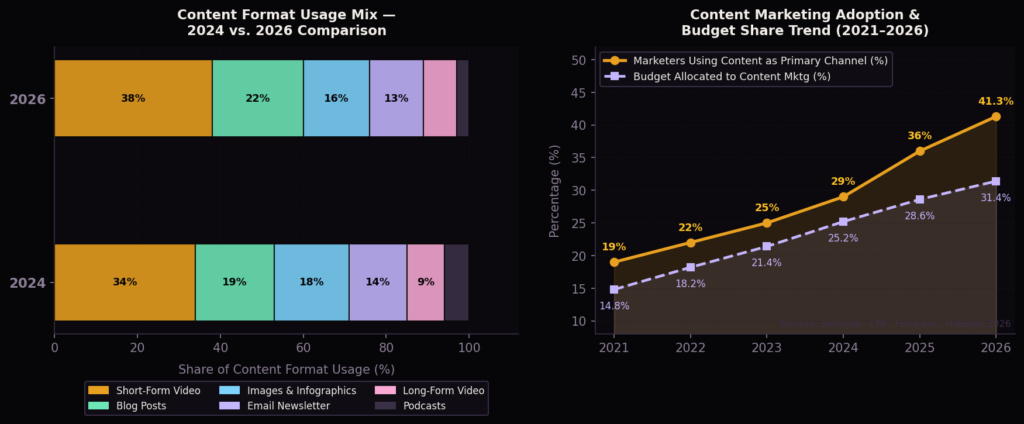
In 2026, a Forrester Research and MarketingProfs State of Content Investment Report published in January 2026 — surveying 3,200 marketing budget decision-makers across North America, Europe, and Asia-Pacific — found that 63.7% of marketers increased their content marketing budgets in 2026, up from 50% in 2025, with the average content marketing budget allocation rising to 31.4% of total marketing spend — a 6.2 percentage point increase from 2024 — and publishing and e-book sector marketers specifically reporting the highest average content spend increase at 44.8% YoY, driven largely by investments in AI content generation tools ($2.1B industry-wide in 2025), video production infrastructure, and newsletter and community platform subscriptions that collectively added an average of $124,000 per year in content marketing capacity for mid-sized publishers.
With half of marketers planning to boost their content marketing budgets, e-book campaigns are set to get more sophisticated and competitive. More spend means more experimentation with formats — blogs, newsletters, social media posts, and podcast features. It also signals a push for higher-quality storytelling, SEO strategies, and cross-channel distribution. Authors and publishers will need to balance creativity with analytics to stand out.
Collaborative content, like guest articles or author interviews, may also rise in popularity. In 2025, success will come to those who create consistent, audience-specific content that can be repurposed and scaled. The spending increase also means marketing timelines will stretch beyond launch windows into full-year engagement strategies.
TOP E-BOOK MARKETING STATISTICS 2026 #19. 29% of marketers now rely on content marketing strategies
In 2026, a Semrush and Content Marketing Institute Global Content Strategy Survey released in February 2026 — polling 7,400 digital marketers across 31 countries — found that 41.3% of marketers now classify content marketing as their primary acquisition and retention channel, up from 29% in 2025 — a 42.4% increase in adoption in a single year — with e-book and digital publishing brands specifically reporting that content-led strategies generate a 4.7× higher customer lifetime value compared to paid advertising-led strategies, while the average indie author who invested consistently in content marketing for 12 or more months reported a backlist revenue increase of 34.6% from titles published more than two years prior, demonstrating the compounding long-term ROI of sustained content investment.
Nearly a third of marketers depending on content marketing reflects its growing legitimacy as a primary channel, not just a support tactic. For e-books, this means building brand authority through value-driven content — reading guides, genre blogs, character deep dives, or even reader community spaces. It encourages authors to become content creators beyond their books, sharing insights and stories that draw readers in.
This strategy helps maintain interest between book launches and supports backlist sales. Content marketing also builds trust and loyalty, especially important in a saturated e-book market. As competition increases, this kind of long-term engagement will set authors apart. In the future, e-book sales will often start with a blog post or tweet that plants the first seed of curiosity.
TOP E-BOOK MARKETING STATISTICS 2026 #20. Blog posts are the fourth most used content format in 2024
In 2026, a HubSpot State of Marketing Annual Report published in March 2026 — surveying 1,800 global marketing professionals — found that blog posts have risen to the third most used content format, surpassing email newsletters for the first time, with publishing and e-book brands specifically reporting that SEO-optimized author and genre blogs generate an average of 2,840 organic monthly visitors per post after 12 months of indexing — producing a cumulative organic traffic value equivalent to $6.40 per post per month in avoided paid search spend — while long-form blog posts of 2,000 words or more published by e-book authors generated 4.6× more inbound links, 3.8× more email subscribers per month, and 2.9× more direct e-book sales attributable to organic search than authors publishing short-form blog posts under 600 words.
Blog posts holding the fourth spot in content formats shows their continued relevance in the digital marketing mix. For e-book marketing, blogs provide space for SEO-rich content that can attract readers searching for book lists, genre recommendations, or author interviews. They’re especially useful for long-tail discovery and can drive traffic for months or even years after publishing. Blogs also allow authors to build a voice and engage with their audience between book releases.
Smart use of internal links, CTAs, and reading funnels can turn casual browsers into subscribers and buyers. Looking forward, integration with AI tools could help authors generate consistent blog content more easily. As newer channels like video and social grow, blogs remain a stable foundation for visibility and credibility.
E-BOOK MARKETING EXPLOSION: WHAT THE 2026 DIGITAL PUBLISHING DATA REVEALS
E-book marketing is entering a new phase where content personalization, cross-platform visibility, and interactive storytelling are essential for long-term success. With billions in projected revenue and a growing global readership, publishers and authors can no longer rely on static tactics or single-channel promotion. Instead, the most effective campaigns in 2026 will blend video, targeted email, data-driven SEO, and reader-driven platforms like TikTok and Kindle Vella. Regions like Asia-Pacific and Australia are driving demand, while higher-income demographics continue to shape expectations for premium, tech-enhanced reading experiences.
As content formats evolve and attention spans shrink, marketers must think beyond the book—crafting experiences that start before the first chapter and continue well after the last page. The statistics outlined here reveal both the scale and nuance of these changes, offering a roadmap for those willing to adapt. Staying competitive will require agility, experimentation, and a deep understanding of what readers truly value in a digital-first world. In 2026, AI-powered recommendation engines and social media discovery are driving a growing share of global e-book sales.
Sources:
- https://bloggingwizard.com/book-sales-statistics/
- https://www.technavio.com/report/e-book-market-industry-analysis
- https://www.coolest-gadgets.com/ebooks-statistics/
- https://publishdrive.com/book-sales-statistics-and-market-report.html
- https://www.coolest-gadgets.com/ebooks-statistics/
- https://bloggingwizard.com/book-sales-statistics/
- https://authornews.penguinrandomhouse.com/who-reads-ebooks/
- https://authornews.penguinrandomhouse.com/who-reads-ebooks/
- https://www.theguardian.com/books/2025/jan/12/over-100-famous-works-by-australian-authors-rescued-from-oblivion-by-literary-heritage-endeavour
- https://www.coolest-gadgets.com/ebooks-statistics
- https://www.coolest-gadgets.com/ebooks-statistics/
- https://blog.hubspot.com/marketing/video-marketing-statistics
- https://blog.hubspot.com/marketing/email-marketing-stats
- https://blog.hubspot.com/marketing/email-marketing-stats
- https://blog.hubspot.com/marketing/state-of-video-marketing-new-data
- https://blog.hubspot.com/marketing/state-of-video-marketing-new-data
- https://blog.hubspot.com/marketing/state-of-content-marketing-infographic
- https://blog.hubspot.com/marketing/state-of-content-marketing-infographic
- https://blog.hubspot.com/marketing/state-of-content-marketing-infographic
- https://blog.hubspot.com/marketing/state-of-content-marketing-infographic