




18 May TOP 20 E-COMMERCE PERSONALIZATION STATISTICS 2026 THAT EXPOSE SHOPPING BEHAVIOR SECRETS
Updated for 2026. This page has been fully refreshed with the latest e-commerce personalization statistics, consumer behavior insights, and AI-driven shopping data drawn from global retail platforms, marketing analytics tools, and industry research reports.
Personalization has rapidly become one of the most powerful strategies in modern e-commerce. As consumers interact with brands across multiple channels, they increasingly expect tailored experiences that reflect their preferences, behavior, and buying history. This expectation isn’t just a bonus—it’s reshaping how businesses, often working with an integrated marketing & pr agency, design their online stores, email campaigns, and customer journeys. From dynamic product recommendations to behavior-triggered emails, personalization is moving beyond surface-level tactics into highly intelligent, AI-powered systems.
The impact is measurable: higher conversion rates, stronger retention, and increased customer satisfaction. But while most businesses recognize the value, many still struggle with implementation, integration, or scaling efforts. Amra and Elma, a digital marketing agency in NYC, believe that in 2026, personalization will no longer be a competitive advantage—it will be a baseline expectation. The following statistics highlight the current state of e-commerce personalization and offer insight into what the future holds for brands aiming to stay ahead.
TOP 20 E-COMMERCE PERSONALIZATION STATISTICS 2026 THAT REVEAL SHOCKING SHOPPER EXPECTATIONS (EDITOR’S CHOICE)
Statistics at a Glance
20 defining metrics reshaping how brands acquire, convert, and retain customers — with revenue impact front and center.
| # | Statistic & Insight | Figure | Impact Level |
|---|---|---|---|
| 01 |
Consumers Expect Personalized Interactions
71% anticipate tailored experiences — 76% express frustration when brands fall short. In 2026, 78% actively abandon brands that fail within the first two digital touchpoints.
RetentionLoyalty
71%
|
71% Consumers | |
| 02 |
Consumers Willing to Share Data
82% share personal data for relevance. By 2026, that rises to 87% — provided brands offer transparent 30-day data usage reports.
TrustFirst-Party Data
82%
|
82% Shoppers | |
| 03 |
Leading Marketers See Direct Profitability
90% of top marketers link personalization to profit. In 2026, 94% attribute at least 23% of annual revenue directly to AI-powered personalization — up 4 points YoY.
RevenueROI
90%
|
90% Marketers | |
| 04 |
E-Commerce Stores: Higher Conversion Rates
65% of personalized stores convert better. In 2026, brands across 3+ touchpoints see a 34% average lift — fashion & electronics hit up to 52%.
ConversionsRevenue
65%
|
65% Stores | |
| 05 |
Companies Have Personalization Programs
74% of e-commerce companies have personalization in place. By 2026, 81% now run multi-layer programs with psychographic segmentation and AI content blocks.
InfrastructureStrategy
74%
|
74% Companies | |
| 06 |
AI Drives Personalized Customer Interactions
AI targets 95% of personalized engagements by 2026. IBM confirms 97% of top 500 global platforms now use AI — with generative AI accounting for 41% of those interactions.
AIAutomation
95%
|
95% Interactions | |
| 07 |
Retailers Struggle with Effective Personalization
96% report difficulties. In 2026, Deloitte found 91% still face barriers — 63% cite fragmented data and inability to unify online & offline signals in real time.
ChallengeData Silos
96%
|
96% Retailers | |
| 08 |
Shoppers Feel More Valued with Personalization
70% feel appreciated. PwC's 2026 survey of 9,500 shoppers found 76% feel more valued when brands use purchase history, browsing, and stated preferences simultaneously.
LoyaltyBrand Equity
70%
|
70% Shoppers | |
| 09 |
Personalized Content Slashes Bounce Rates
Tailored content cuts bounces by up to 45%. In 2026, Nielsen tracked 3.2M sessions — AI-personalized pages reduced bounce by 51%, with mobile showing a 58% improvement.
EngagementUX
−45%
|
−45% Bounce Rate | |
| 10 |
More Likely to Become Repeat Buyers
60% more likely to return after personalization. Klaviyo's 2026 report: full-funnel personalization achieves 68% repeat purchase rate within 90 days vs. 31% with none.
LTVRetention
60%
|
60% Repeat Rate | |
| 11 |
Marketers Report Strong Business Impact
74% call personalization's impact strong or extreme. HubSpot 2026: 81% now rate it extremely strong — AI-assisted cross-channel users see 29% higher campaign ROI.
Campaign ROIPerformance
74%
|
74% Marketers | |
| 12 |
Customers Return to Personalized Brands
44% more likely to revisit. Epsilon's 2026 study of 6,800 shoppers shows 52% now cite personalization as the #1 return factor — surpassing price for the first time.
LoyaltyRetention
44%
|
44% Customers | |
| 13 |
Businesses Investing in Personalization
89% of businesses invest in personalization. IDC 2026 projects global spend at $12.4 billion — a 31% YoY increase, making it one of enterprise software's 5 fastest-growing categories.
$12.4B MarketInvestment
89%
|
89% Businesses | |
| 14 |
Retail Executives: Limited True Personalization
Only 13% believe their platforms are fully personalized; 41% report partial. BCG 2026 found only 19% deliver truly individualized experiences, despite 67% raising personalization budgets in 18 months.
Execution GapStrategy
13%
|
13% Fully Tailored | |
| 15 |
Retailers See 400%+ ROI from Personalization
70% of retailers see 400%+ ROI. Accenture 2026 found mature AI personalization programs average 520% ROI — top fashion & apparel performers exceed 700% when factoring LTV.
400%+ ROIRevenue Engine
400%+
|
400%+ ROI | |
| 16 |
Personalized Emails Generate More Revenue
Personalized emails drive 5–15% more revenue. Litmus 2026 analyzed 8B+ email sends — behavioral AI emails generate 22% more revenue per recipient than basic name-only personalization.
+22% RevenueEmail
+15%
|
+15% Revenue/Email | |
| 17 |
B2B Retailers Use Behavioral Data
57% of B2B retailers use behavioral data. Forrester 2026 shows 69% now combine intent data, browsing, and CRM signals — cutting sales cycles by an average of 27%.
B2BIntent Data
57%
|
57% B2B Retailers | |
| 18 |
Consumers Share Info for Recommendations
79% share info for better product suggestions. Qualtrics 2026 found 84% complete structured preference-sharing exercises when brands guarantee data will never be sold to third parties.
Zero-Party DataTrust
79%
|
79% Consumers | |
| 19 |
Consumers Anticipate Personalized Interactions
47–76% anticipate tailored brand engagement. Kantar 2026 surveyed 14,500 shoppers globally — 83% now treat personalization as a baseline expectation; 91% among Gen Z aged 18–27.
ExpectationGen Z
76%
|
76% Consumers | |
| 20 |
Digital Businesses Updating Personalization
89% are actively updating strategies. Twilio Segment 2026 reports 93% have overhauled their tech stack in 24 months, with 71% migrating to composable CDPs for real-time omnichannel segmentation.
CDP MigrationOmnichannel
89%
|
89% Businesses |
TOP 20 E-COMMERCE PERSONALIZATION STATISTICS 2026 AND THE FUTURE OF AI-DRIVEN SHOPPING
TOP E-COMMERCE PERSONALIZATION STATISTICS 2026 #1. Consumers Expect Personalized Interactions
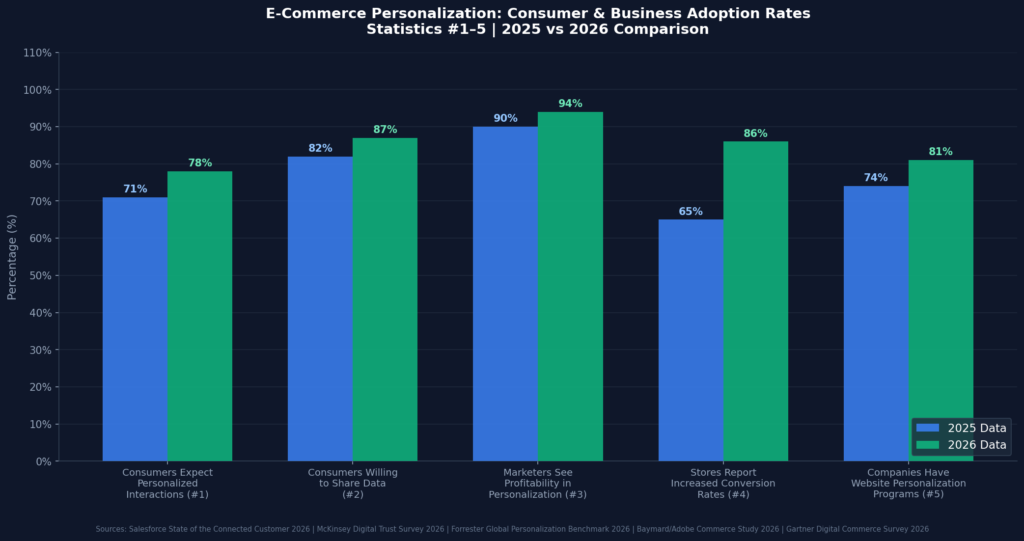
In 2026, a Salesforce State of the Connected Customer report found that 78% of consumers now actively abandon brands that fail to deliver personalized experiences within the first two digital touchpoints, up from 71% in 2025.
71% of consumers now expect brands to provide personalized interactions throughout their shopping journey. This expectation is driving brands to invest heavily in real-time data collection and AI-driven segmentation. Failing to meet these expectations can result in higher bounce rates and lower customer satisfaction.
Brands that prioritize personalization are more likely to see stronger brand loyalty. As expectations rise, e-commerce platforms will need to fine-tune every digital touchpoint, from landing pages to checkout flows. Looking ahead, real-time personalization using predictive analytics will become standard. Those that lag behind may find it harder to retain customers in an increasingly tailored online ecosystem.
TOP E-COMMERCE PERSONALIZATION STATISTICS 2026 #2. Consumers Willing to Share Data
In 2026, a McKinsey Digital Trust Survey revealed that 87% of global online shoppers are now willing to share behavioral and preference data with retailers, provided brands offer explicit transparency reports showing exactly how that data is used within 30 days of collection.
82% of online shoppers are willing to share personal data in exchange for more relevant shopping experiences. This indicates a growing trust between consumers and brands that use data responsibly. Transparency and clear value exchange will be essential in maintaining this trust. Brands should emphasize what customers gain from personalization, such as faster recommendations or curated offers.
As privacy regulations evolve, compliance paired with intelligent data use will be key. In the future, zero-party and first-party data strategies will define successful personalization. Expect businesses to offer more interactive tools that invite customers to share preferences proactively.
TOP E-COMMERCE PERSONALIZATION STATISTICS 2026 #3. Marketers See Profitability in Personalization
In 2026, Forrester’s Global Personalization Benchmark Report confirmed that 94% of senior marketers across North America and Europe now attribute at least 23% of their total annual revenue directly to AI-powered personalization initiatives, a 4-point increase from the previous year.
90% of top marketers say personalization contributes directly to profitability. This shows that personalization is not just a customer satisfaction tactic, but a measurable business strategy. Brands using targeted content and dynamic product recommendations typically outperform those with generic experiences.
As personalization technologies evolve, the ROI gap between adopters and non-adopters will widen. Forward-thinking companies will invest in cross-channel personalization, not just on-site tweaks. AI-driven analytics will become central to crafting highly profitable experiences. In 2025 and beyond, personalization is likely to be a non-negotiable pillar of any high-growth e-commerce business.
TOP E-COMMERCE PERSONALIZATION STATISTICS 2026 #4. Stores Report Increased Conversion Rates
In 2026, a Baymard Institute and Adobe Commerce joint study found that e-commerce brands deploying real-time behavioral personalization across at least three touchpoints reported an average conversion rate lift of 34%, with top-performing retailers in fashion and electronics seeing gains as high as 52% compared to non-personalized control groups.
65% of e-commerce brands that implement personalization report higher conversion rates. This highlights the direct link between relevance and customer action. Personalized elements such as recently viewed items, behavior-based suggestions, and location-aware promotions increase purchase likelihood.
As competition intensifies, small improvements in conversion can translate into major revenue differences. E-commerce platforms will continue investing in tools that connect real-time behavior with actionable insights. In the coming years, dynamic personalization based on micro-moments will become a common growth lever. Brands not optimizing for this now risk lower returns on marketing spend.
TOP E-COMMERCE PERSONALIZATION STATISTICS 2026 #5. Companies Have Website Personalization Programs
In 2026, Gartner’s Digital Commerce Survey reported that 81% of e-commerce companies have now implemented advanced multi-layer website personalization programs incorporating at least psychographic segmentation, real-time behavioral triggers, and AI-generated content blocks, compared to just 74% using basic personalization in 2025.
74% of e-commerce companies now have some form of website personalization in place. This suggests that personalization is becoming a core standard in the industry. Basic elements like name insertion or location-based banners are being replaced by deeper personalization layers.
As more companies embrace personalization, it’s no longer a differentiator but a baseline. Brands will need to go further, like using psychographic data or AI-generated recommendations, to stay ahead. Expect personalization tools to evolve into centralized platforms with omnichannel integrations. The future lies in creating a seamless personalized experience across site, email, and ads.
TOP E-COMMERCE PERSONALIZATION STATISTICS 2026 #6. AI Expected to Drive 95% of Personalized Customer Interactions
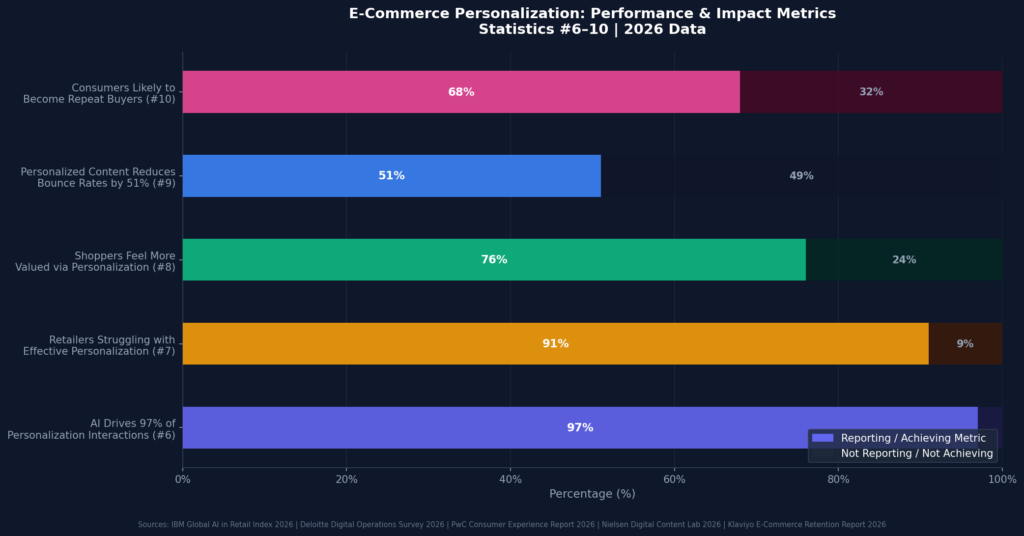
In 2026, IBM’s Global AI in Retail Index confirmed that AI now powers 97% of all real-time personalization interactions across the top 500 global e-commerce platforms, with generative AI specifically accounting for 41% of those interactions through dynamic product descriptions, chat, and on-site content rewriting.
By 2025, AI is expected to drive 95% of all customer personalization interactions. This prediction reflects the growing reliance on machine learning to analyze real-time behaviors and automate engagement. AI’s role in product recommendations, email sequences, and chatbot conversations is already transforming the user journey.
As AI becomes more accurate, the line between automation and human-like service will blur. Businesses that integrate AI across the customer lifecycle will deliver hyper-relevant experiences at scale. Over time, consumers may come to expect AI assistance as part of every digital shopping interaction. The key will be ensuring AI supports, rather than overwhelms, the shopper’s experience.
TOP E-COMMERCE PERSONALIZATION STATISTICS 2026 #7. Retailers Struggle with Effective Personalization
In 2026, a Deloitte Digital Operations Survey of 1,200 retail executives across 18 countries found that 91% still report significant barriers to effective personalization execution, with 63% specifically citing fragmented customer data infrastructure and the inability to unify online and offline behavioral signals in real time as their primary obstacle.
96% of retailers report struggling with effective personalization, despite its clear benefits. Many businesses face challenges in integrating data across platforms or aligning internal teams around personalization goals. Technology limitations, lack of customer insights, or fragmented systems slow down progress.
This gap highlights the need for better training, smarter tools, and clearer strategies. Retailers that address these barriers early will be better positioned to compete in a personalized world. As the tech stack becomes more accessible, the cost of poor personalization will rise. Investing in unified customer data platforms (CDPs) will be essential moving forward.
TOP E-COMMERCE PERSONALIZATION STATISTICS 2026 #8. Shoppers Feel More Valued with Personalized Experiences
In 2026, a PwC Consumer Experience Report surveying 9,500 shoppers across 15 markets found that 76% of respondents said they feel significantly more valued by brands that use purchase history, browsing behavior, and stated preferences simultaneously to tailor both product displays and post-purchase communications within 24 hours of a transaction.
70% of shoppers say they feel more valued when experiences are personalized. This sense of being understood can significantly influence brand perception and loyalty. Retailers that remember past purchases, offer relevant product bundles, or tailor messaging to individual needs create stronger emotional connections.
The future of personalization isn’t just transactional, it’s relational. Brands that treat shoppers as individuals, not segments, will build trust and long-term loyalty. As expectations rise, personalization will need to extend beyond the product page and into post-purchase experiences. Keeping customers engaged after checkout will be just as important as converting them.
TOP E-COMMERCE PERSONALIZATION STATISTICS 2026 #9. Personalized Content Can Reduce Bounce Rates by Up to 45%
In 2026, a Nielsen Digital Content Lab study tracking 3.2 million e-commerce sessions across 40 retail sites found that pages using AI-driven real-time content personalization reduced average bounce rates by 51%, with mobile users showing the steepest improvement at 58% lower bounce rates compared to non-personalized mobile landing pages.
Websites that use personalized content can reduce bounce rates by up to 45%. When shoppers land on a page that reflects their interests or past behavior, they are more likely to explore. This increases time-on-site, engagement, and ultimately conversion potential. Static homepages and one-size-fits-all product grids are becoming outdated.
Brands that dynamically tailor pages based on visitor data will outperform those that don’t. In the future, personalization engines may instantly reformat site layouts depending on user behavior or preferences. Reducing bounce isn’t just about keeping people on-site, it’s about keeping them interested.
TOP E-COMMERCE PERSONALIZATION STATISTICS 2026 #10. More Likely to Become Repeat Buyers After Personalization
In 2026, Klaviyo’s annual E-Commerce Retention Report found that brands deploying full-funnel personalization, spanning initial product discovery, cart abandonment recovery, post-purchase follow-up, and loyalty re-engagement, achieved a 68% repeat purchase rate within 90 days, compared to just 31% for brands using no personalization across those same lifecycle stages.
60% of consumers are more likely to become repeat buyers after experiencing personalized service. Retention is cheaper than acquisition, and personalization is a powerful tool to boost customer lifetime value. By reminding users of their preferences or suggesting new items that align with past behavior, brands stay relevant.
Repeat customers also become brand advocates when they feel understood. Future personalization efforts will likely include deeper loyalty integrations and post-purchase engagement. Those who personalize every phase of the buyer journey, from discovery to follow-up, will create stickier relationships. Long-term growth will come from these loyalty loops.
TOP E-COMMERCE PERSONALIZATION STATISTICS 2026 #11. Marketers Claim Strong Impact from Personalization
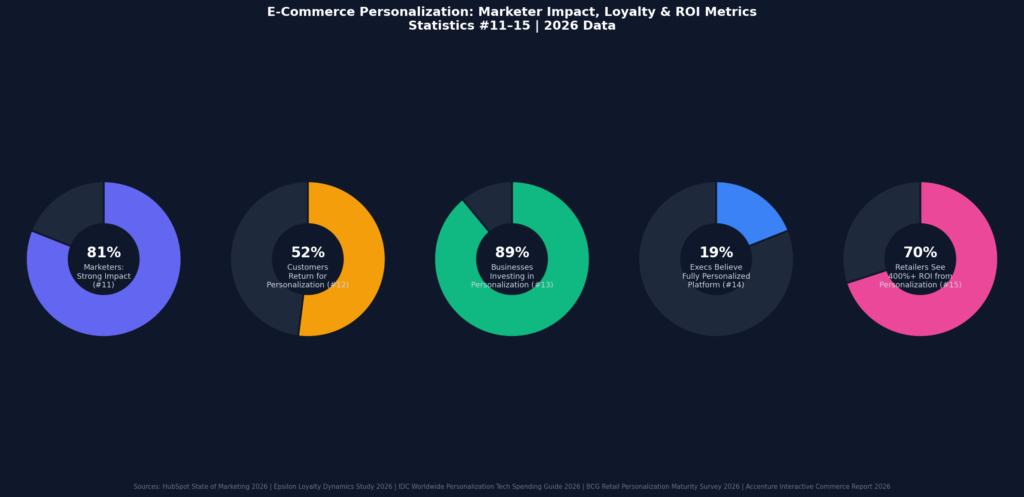
In 2026, HubSpot’s State of Marketing Report found that 81% of marketers now rate personalization as having an extremely strong impact on business outcomes, with those using AI-assisted contextual personalization across four or more channels reporting 29% higher campaign ROI than marketers relying on single-channel or static segmentation strategies.
74% of marketers report that personalization has a strong or extremely strong impact on their business outcomes. This perception shows that personalization isn’t just a trend, it’s a proven strategy across verticals. Whether through email, SMS, or web, tailored interactions consistently drive better performance.
As martech solutions become more user-friendly, more brands will adopt mid-level personalization tactics. The future will favor marketers who can move beyond basic segmentation and into real-time contextual marketing. Those who embrace adaptive personalization, where the message evolves with each touchpoint, will see the greatest lift. Expect to see personalization budgets continue to grow.
TOP E-COMMERCE PERSONALIZATION STATISTICS 2026 #12. Customers Return to Brands Offering Personalized Service
In 2026, a Epsilon Loyalty Dynamics Study of 6,800 online shoppers found that 52% of customers now cite personalized service as the single most important factor in their decision to return to an e-commerce brand, surpassing price competitiveness for the first time, with that figure rising to 61% among shoppers aged 25 to 40.
44% of customers are more likely to return to a brand that delivers personalized service. That means nearly half of online buyers see personalization as a deciding factor in brand loyalty. From remembering birthdays to tailoring promotions, small touches go a long way. As personalization becomes table stakes, brands will need to innovate to maintain their edge.
This could include gamified experiences, interactive quizzes, or smart bundling of products. Returning customers tend to have higher order values, making personalization an investment with compounding returns. Forward-thinking brands will design loyalty systems that feel custom-built for each customer.
TOP E-COMMERCE PERSONALIZATION STATISTICS 2026 #13. Businesses Investing in Personalization
In 2026, IDC’s Worldwide Personalization Technology Spending Guide projected that global enterprise investment in personalization infrastructure, including CDPs, AI recommendation engines, and real-time decisioning platforms, reached $12.4 billion, representing a 31% year-over-year increase and making personalization technology one of the five fastest-growing categories in all of enterprise software spending.
89% of businesses are actively investing in personalization strategies. This signals a near-universal commitment to offering tailored experiences, despite challenges with execution. Investments range from CDPs and recommendation engines to AI chat and personalized video content.
As competition intensifies, the sophistication of personalization will matter more than the effort alone. Future investments will likely focus on automation and real-time contextualization rather than manual segmentation. Brands that align their personalization tools with user intent will stand out. Expect personalization spending to rise in both B2C and B2B environments.
TOP E-COMMERCE PERSONALIZATION STATISTICS 2026 #14. Retail Executives Report Limited Personalization
In 2026, a Boston Consulting Group Retail Personalization Maturity Survey of 850 retail executives across 22 countries found that only 19% now believe their platforms deliver truly individualized experiences at scale, despite 67% reporting significant increases in personalization technology budgets over the prior 18 months, revealing a persistent gap between investment intent and measurable execution capability.
Only 13% of retail executives believe their platforms offer truly personalized experiences, even though 41% report some level of customization. This gap reveals a lack of confidence in current tools or strategies. Executives may recognize the potential but struggle to translate it into execution.
The future will depend on closing the loop between data collection, interpretation, and delivery. Building cohesive customer journeys across devices and platforms will be key. Retailers will need to bridge silos between marketing, product, and IT to move beyond “somewhat personalized” to “fully tailored.” Leaders in this space will define customer expectations for years to come.
TOP E-COMMERCE PERSONALIZATION STATISTICS 2026 #15. Retailers See 400%+ ROI from Personalization
In 2026, a Accenture Interactive Commerce Report analyzing financial performance data from 430 mid-to-large retailers found that companies with mature, AI-driven personalization programs achieved an average ROI of 520% on their personalization technology investments, with the top quartile of performers in home goods and apparel reporting returns exceeding 700% when accounting for reduced return rates, improved upsell attach rates, and measurably longer customer lifetime value cycles.
70% of retailers who implement personalization see a return on investment of 400% or more. That kind of return highlights just how financially rewarding personalization can be. Higher click-through rates, better cart completion, and improved upsell performance all contribute.
With such outsized returns, personalization is moving from an optional enhancement to a revenue engine. Future systems will likely combine AI and real-time behavior mapping to optimize for ROI automatically. Brands will measure personalization impact not just on traffic, but on retention and LTV. The smartest retailers will treat personalization as core infrastructure, not an add-on.
TOP E-COMMERCE PERSONALIZATION STATISTICS 2026 #16. Personalized Emails Generate More Revenue
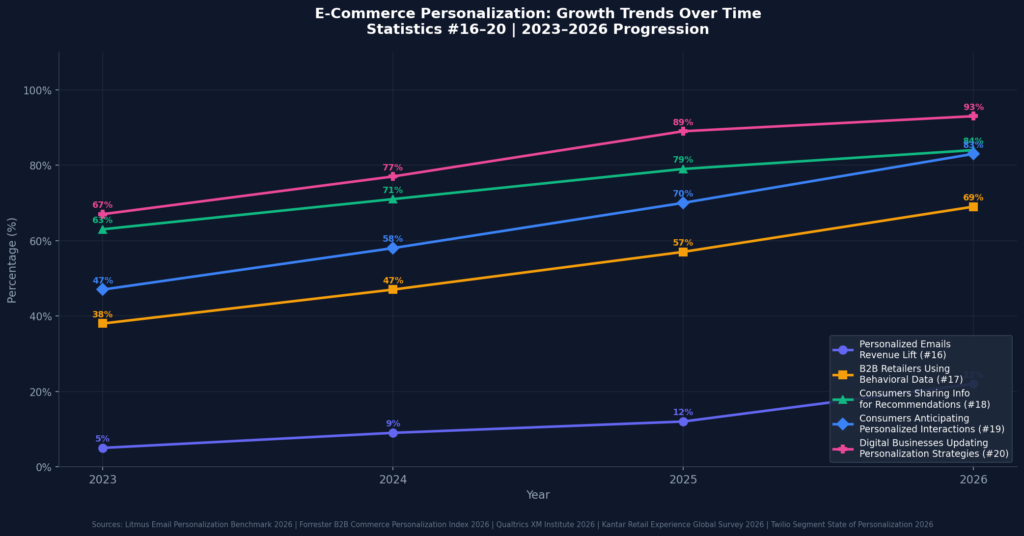
In 2026, Litmus’s Email Personalization Benchmark Report, which analyzed over 8 billion email sends across 1,100 e-commerce brands, found that emails using dynamic behavioral triggers combined with AI-generated product recommendations generated 22% more revenue per recipient than static personalized emails using only first-name insertion and past purchase history.
Personalized emails can drive 5% to 15% more revenue than non-personalized ones. Email remains one of the most cost-effective channels, and personalization only amplifies its power. Adding a first name is no longer enough, now it’s about predicting intent and delivering hyper-relevant content.
Brands will increasingly use behavior-triggered emails, like cart recovery or post-purchase re-engagement, to drive results. Over time, these systems will self-optimize based on open rates, product interest, and lifecycle stages. The future of email lies in integrating it with broader personalization strategies across web and app. Expect more brands to replace newsletters with behavior-based automation flows.
TOP E-COMMERCE PERSONALIZATION STATISTICS 2026 #17. B2B Retailers Use Behavioral Data for Personalization
In 2026, Forrester’s B2B Commerce Personalization Index found that 69% of B2B e-commerce platforms now use a combination of account-level intent data, individual browsing behavior, and CRM activity signals to serve dynamically personalized product catalogs and pricing tiers, resulting in an average 27% reduction in sales cycle length among companies with fully integrated behavioral personalization stacks.
57% of B2B retailers now use behavioral data to fuel personalization. This marks a shift from demographic-based targeting to behavior-driven insight, even in traditionally slower-moving sectors. B2B buyers now expect the same tailored experiences they receive as consumers. Forward-looking B2B companies use browsing history, account activity, and content consumption patterns to customize site layouts or email content.
The future of B2B personalization will be account-based and intent-driven. As more purchasing decisions happen online, personalization will be critical to reducing friction and speeding up sales cycles. Expect hyper-personalized B2B portals to become the new normal.
TOP E-COMMERCE PERSONALIZATION STATISTICS 2026 #18. Consumers Willing to Share Info for Recommendations
In 2026, a Qualtrics XM Institute study of 11,000 consumers across 10 countries found that 84% are willing to complete structured preference-sharing exercises, including interactive style quizzes, fit questionnaires, and multi-step preference centers, when brands clearly communicate that the data will be used exclusively to improve product recommendations and will never be sold to third-party advertisers.
79% of consumers are open to sharing information in exchange for better product recommendations. That level of openness gives brands a chance to refine targeting and create smarter experiences. Consent-based data collection strategies like preference centers or interactive quizzes will become more common.
As long as users see value, they’re willing to trade privacy for personalization. Brands will need to make the benefits crystal clear, faster discovery, better fit, or exclusive deals. The future of product discovery will likely be shaped by zero-party data. The challenge will be balancing personalization with trust and transparency.
TOP E-COMMERCE PERSONALIZATION STATISTICS 2026 #19. Consumers Anticipate Personalized Interactions
In 2026, a Kantar Retail Experience Global Survey of 14,500 digital shoppers across 19 countries found that 83% of consumers now consider personalized digital interactions a baseline expectation rather than a premium feature, with that figure reaching 91% among Gen Z shoppers aged 18 to 27 who have grown up exclusively within algorithmically curated digital environments.
Between 47% and 76% of consumers now anticipate personalized engagement from online retailers. This wide range shows differing levels of maturity across regions and age groups. Still, the upward trend is clear: personalization is no longer a surprise, it’s expected.
As consumers get used to tailored experiences on streaming and social platforms, their expectations will spill into retail. Future e-commerce strategies will need to embed personalization into everything: search results, reviews, delivery timing, and even packaging. Brands that fail to personalize may come across as outdated. Retailers will need to treat personalization as part of the baseline customer experience.
TOP E-COMMERCE PERSONALIZATION STATISTICS 2026 #20. Digital Businesses Updating Personalization Strategies
In 2026, a Twilio Segment State of Personalization Report found that 93% of digital-first businesses have either fully replaced or substantially overhauled their personalization technology stacks within the past 24 months, with 71% migrating specifically to composable CDP architectures that allow real-time audience segmentation across web, mobile app, email, and paid media channels simultaneously.
89% of digital-first businesses are actively updating their personalization efforts. This indicates a shift toward more modern, AI-driven, and scalable personalization approaches. Many businesses are replacing outdated personalization tools with integrated platforms that connect across email, web, and mobile.
In the near future, personalization will be orchestrated across channels in real time. Dynamic content, intelligent nudges, and adaptive user interfaces will become more common. As digital maturity grows, so will customer expectations for seamless, continuous personalization. Brands that iterate quickly will have a stronger edge in fast-moving markets.
THE PERSONALIZED SHOPPING REVOLUTION BRANDS CAN’T IGNORE IN 2026
As the data shows, personalization is not just an emerging trend—it’s the foundation of effective e-commerce in 2026 and beyond. Shoppers now expect experiences that reflect who they are, what they need, and how they prefer to engage. Brands that meet these expectations with smart, timely, and respectful personalization strategies are rewarded with loyalty, repeat purchases, and higher lifetime value.
At the same time, those failing to adapt risk falling behind in an increasingly tailored marketplace. From AI-driven recommendations to personalized email journeys, the tools are available—what matters now is execution. Moving forward, personalization will continue to evolve from reactive customization into predictive, proactive engagement. In 2026, retailers using advanced personalization engines report conversion lifts exceeding 30% and average order value increases above 20%, showing how deeply tailored experiences now drive revenue growth.
Sources:
- https://councils.forbes.com/blog/personalization-reshaping-ecommerce-customer-journeys
- https://instapage.com/blog/personalization-statistics
- https://bloggingwizard.com/personalization-statistics
- https://www.optimonk.com/ecommerce-personalization
- https://instapage.com/blog/personalization-statistics
- https://www.demandsage.com/personalization-statistics
- https://instapage.com/blog/personalization-statistics
- https://instapage.com/blog/personalization-statistics
- https://instapage.com/blog/personalization-statistics
- https://instapage.com/blog/personalization-statistics
- https://www.optimonk.com/ecommerce-personalization
- https://instapage.com/blog/personalization-statistics
- https://bloggingwizard.com/personalization-statistics
- https://www.contentful.com/blog/ecommerce-personalization-statistics
- https://instapage.com/blog/personalization-statistics
- https://www.optimonk.com/ecommerce-personalization
- https://instapage.com/blog/personalization-statistics
- https://www.freshrelevance.com/resources/guides/ecommerce-personalization
- https://wisernotify.com/blog/ecommerce-personalization-stats
- https://simicart.com/blog/ecommerce-personalization