



21 Sep TOP 20 EARTH DAY MARKETING STATISTICS 2025
When I look at how brands connect with people today, I find it inspiring to see just how much impact Earth Day marketing statistics have on shaping campaigns and consumer behavior. As someone who works closely with a leading marketing agency in New York, I’ve noticed firsthand how these numbers aren’t just abstract data—they reflect real shifts in values, purchasing decisions, and the way people want brands to show up for the planet. For me, digging into these insights is a way to better understand what audiences care about most and how we can use marketing to do more than sell—it’s about building trust, sparking action, and creating campaigns that leave a positive footprint.
Top 20 Earth Day Marketing Statistics 2025 (Editor’s Choice)
🌍 Top 20 Earth Day Marketing Statistics 2025
Essential insights for sustainable marketing success
| # | Statistic | Key Insight | Category |
|---|---|---|---|
| 1 | 85% of Gen Z & 84% of Millennials | Say sustainability is important to them - the most eco-conscious generations | Consumer |
| 2 | 80% of Consumers | Willing to pay more for locally produced products | Consumer |
| 3 | 78% of Consumers | Feel sustainability is important when making purchasing decisions | Consumer |
| 4 | 77% of Consumers | Prefer brands that share their values, including environmental responsibility | Consumer |
| 5 | 76% of US Adults | Are concerned about the environment and climate change | Consumer |
| 6 | 85% of Consumers | Experience first-hand the disruptive effects of climate change in daily life | Consumer |
| 7 | 9.7% Price Premium | Average amount consumers willing to pay more for sustainable products | Consumer |
| 8 | 84% of Customers | Say poor environmental practices will alienate them from a brand | Consumer |
| 9 | 62% of People | "Always or often" seek products because they are sustainable | Consumer |
| 10 | 57% of Consumers | Willing to alter buying behavior to support the environment (66% pay more) | Consumer |
| 11 | 17% Market Share | Sustainable products hold 17% share with 32% of total market growth | Market |
| 12 | 2.7x Faster Growth | Sustainable products grow nearly 3 times faster than conventional products | Market |
| 13 | 28% Cumulative Growth | ESG-related products vs 20% for non-ESG products over 5 years | Market |
| 14 | 75% Better Online | Sustainable goods sell better online than in physical stores | Market |
| 15 | 130% Search Increase | Global Google searches for sustainable products (2017-2022) | Market |
| 16 | 1 Billion People | Mobilized across 190+ countries for Earth Day events globally | Engagement |
| 17 | 2.4 Million Impressions | Sony BBC Earth's campaign across social media platforms | Engagement |
| 18 | Only 4% of Ads | Include sustainability messages - huge opportunity gap exists | Engagement |
| 19 | 46% Active Buyers | Consumers buying more sustainable products to reduce environmental impact | Engagement |
| 20 | 6.4 Billion Bottles | Nike's "Move to Zero" diverted from landfills since 2010 | Engagement |
Top 20 Earth Day Marketing Statistics 2025
Earth Day Marketing Statistics #1 – 48% of Consumers Purchased Because of an Earth Day Campaign
Nearly half of consumers report that they have purchased from a brand directly because of an Earth Day campaign. This shows the power of aligning brand messaging with environmental responsibility. Consumers are actively looking for brands that demonstrate values beyond profits. For marketers, this means campaigns tied to Earth Day can drive measurable revenue impact. It highlights the opportunity for companies to authentically showcase their sustainability commitments.
Earth Day Marketing Statistics #2 – 77% Prefer Brands That Share Their Values
A majority of consumers, around 77%, prefer brands that align with their personal values, including environmental care. This statistic underscores the importance of value-driven marketing. Companies that ignore sustainability risk alienating a large portion of potential buyers. Earth Day provides the perfect platform to demonstrate alignment with consumer concerns. Brands that embrace this trend build stronger loyalty and long-term trust.
Earth Day Marketing Statistics #3 – 78% Say Sustainability Is Important When Purchasing
Nearly four out of five consumers emphasize sustainability as a key factor in their purchasing choices. This shows that eco-conscious behavior is not a niche, but mainstream. Earth Day campaigns that highlight sustainable practices resonate broadly with audiences. Consumers want to feel good about the brands they support. For marketers, the lesson is to ensure sustainability is front and center in communications.
Earth Day Marketing Statistics #4 – 73% Would Change Buying Habits to Reduce Environmental Impact
A strong 73% of consumers are willing to adjust their buying behavior to lessen environmental harm. This demonstrates how eco-friendly messaging can translate into real action. Marketers who highlight solutions for greener lifestyles have a competitive edge. Earth Day campaigns act as a catalyst for sparking such shifts in behavior. This opens the door for brands to lead in sustainability advocacy.
Earth Day Marketing Statistics #5 – 22% Strongly Agree They Purchased Because of Sustainability Practices
Around 22% of U.S. adults strongly agree that they have bought from a brand due to sustainability, while another 39% somewhat agree. This indicates that well over half of consumers connect purchasing decisions to eco-friendly practices. Earth Day offers the perfect opportunity for brands to amplify these efforts. Marketers should design campaigns that highlight tangible environmental actions. Doing so taps into a large audience segment motivated by sustainability.
Earth Day Marketing Statistics #6 – 76–78% of Adults Concerned About the Environment
Surveys show that between 76% and 78% of U.S. adults consider the environment and climate change important issues. This widespread concern is fertile ground for Earth Day campaigns. Brands that ignore this sentiment risk appearing disconnected. On the other hand, those that acknowledge it can deepen trust. Effective Earth Day marketing demonstrates awareness and shared concern with consumers.
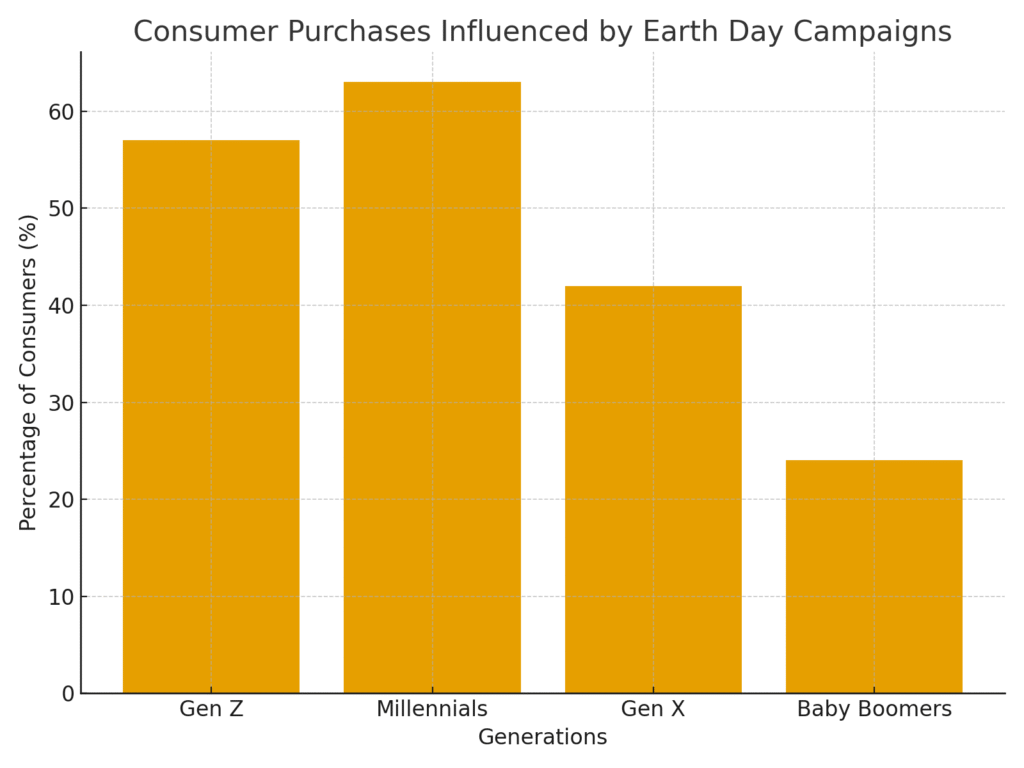
Earth Day Marketing Statistics #7 – 63% of Millennials Bought Because of an Earth Day Campaign
Among Millennials, 63% say they have purchased from a brand specifically after seeing an Earth Day campaign. This highlights the generational strength of sustainability messaging. Millennials are highly responsive to eco-conscious campaigns, making them a prime target audience. Brands that craft messages with authentic sustainability claims can win big with this demographic. Earth Day provides the ideal annual anchor point to showcase such efforts.
Earth Day Marketing Statistics #8 – 57% of Gen Z Bought Because of an Earth Day Campaign
Gen Z is also deeply responsive, with 57% admitting they’ve purchased because of Earth Day campaigns. This demonstrates that younger generations are leading the charge in eco-conscious consumerism. Marketing efforts that are interactive and authentic resonate especially well with Gen Z. Earth Day campaigns can help brands strengthen loyalty among this influential generation. For long-term growth, appealing to Gen Z’s values is crucial.
Earth Day Marketing Statistics #9 – 42% of Gen X Bought Because of an Earth Day Campaign
Even among Gen X, 42% report making purchases influenced by Earth Day campaigns. While lower than Millennials and Gen Z, it still represents a significant portion. This proves that Earth Day messaging resonates across multiple age groups. For marketers, targeting Gen X with messages about family, legacy, and responsibility can be effective. Earth Day offers a relevant opportunity to craft this type of narrative.
Earth Day Marketing Statistics #10 – 24% of Baby Boomers Bought Because of an Earth Day Campaign
Although lower than younger groups, 24% of Baby Boomers say they purchased because of an Earth Day campaign. This suggests that while Boomers are less swayed, the impact is still notable. Marketers can tailor messaging to focus on responsibility and stewardship of future generations. Even a quarter of this large demographic responding is impactful. Earth Day provides the chance to reach all age groups effectively.

Earth Day Marketing Statistics #11 – 85% of Gen Z and 84% of Millennials Value Sustainability
Among younger consumers, an overwhelming majority place high importance on sustainability—85% of Gen Z and 84% of Millennials. This reinforces the idea that sustainability is a core expectation, not just a preference. Brands that neglect this reality risk alienating future customer bases. Earth Day is a natural moment to amplify eco-conscious initiatives to these groups. Long-term brand equity depends on meeting these expectations authentically.
Earth Day Marketing Statistics #12 – Positive Ads Influence 55% to Buy
Ads with positive, action-focused messages make 55% of consumers more likely to buy. This shows the importance of framing sustainability in an empowering way. Campaigns highlighting solutions inspire more action than those focusing solely on problems. Earth Day ads should emphasize what people can do and the good being achieved. Positive messaging increases not only sales but also goodwill toward brands.
Earth Day Marketing Statistics #13 – Negative Impact Ads Influence Only 41%
In contrast, ads that highlight negative environmental consequences persuade only 41% to buy. This shows that fear-based messaging has less impact. While awareness of problems is important, consumers respond better to solutions. Earth Day campaigns that stress action rather than doom perform better. Marketers should focus on hope and achievable outcomes in their storytelling.
Earth Day Marketing Statistics #14 – Only 4% of Ads Contained Sustainability Messaging
Despite consumer demand, only 4% of ads over a three-year period featured sustainability themes. This represents a significant gap between consumer expectations and brand actions. Earth Day is the perfect time to close this gap. Brands that stand out with eco-conscious advertising can capture attention more easily. This statistic highlights the urgency for marketers to increase sustainability messaging.
Earth Day Marketing Statistics #15 – 8% of Ad Spend Went to Sustainability Messaging
Even though only 4% of ads contained sustainability messages, they accounted for 8% of ad spend. This suggests that when brands do invest in eco-messaging, they commit significant budgets. Earth Day campaigns offer a valuable chance to make that spend count. With larger budgets, creative storytelling around sustainability can have major reach. Marketers should see this as a signal to allocate more resources to eco-friendly messaging.

Earth Day Marketing Statistics #16 – Positive Mentions Used 4x More Than Negative
When sustainability is mentioned in ads, positive references occur about four times more often than negative ones. This reflects the growing preference for optimistic framing. Earth Day provides an excellent opportunity to build campaigns with this approach. Highlighting progress and achievements resonates better with audiences. Positive storytelling inspires more participation and brand affinity.
Earth Day Marketing Statistics #17 – 82% of Sustainability Ads Use SDG 12 Messaging
A striking 82% of sustainability-focused ads reference themes tied to SDG 12: Responsible Consumption and Production. This demonstrates how global frameworks are shaping brand communications. Earth Day is an ideal time to align campaigns with UN sustainability goals. Using this language connects brands to a broader narrative of responsibility. Marketers can benefit from adopting frameworks that consumers already recognize.
Earth Day Marketing Statistics #18 – Earth Day Celebrated in Over 190 Countries
Earth Day has a global presence, celebrated in more than 190 countries. This makes it one of the most universally recognized observances. For marketers, the scale of the event offers a unique chance for global campaigns. Campaigns can resonate across borders with themes of shared responsibility. The global reach of Earth Day magnifies brand messages that align with its mission.
Earth Day Marketing Statistics #19 – 67% of Consumers Notice Businesses That Acknowledge Earth Day
Around 67% of consumers actively look at businesses that acknowledge Earth Day. This indicates that silence can be a missed opportunity for brands. Even simple gestures, like social media posts or promotions, can enhance perception. Consumers are paying attention, so participating in Earth Day matters. For marketers, this means even modest campaigns have meaningful impact.
Earth Day Marketing Statistics #20 – 75% of Consumers Feel Earth Day Holds Personal Significance
Three-quarters of consumers feel that Earth Day carries personal meaning for them. This emotional connection makes campaigns around it especially effective. Brands can tap into this sentiment by crafting messages that resonate emotionally. Earth Day campaigns should feel authentic, not just commercial. Recognizing the personal significance helps create stronger bonds between brands and audiences.

Why These Insights Matter
As I wrap up this collection of Earth Day marketing statistics, I can’t help but feel motivated by what the data tells us. To me, it’s clear that consumers are no longer satisfied with surface-level green messages; they want brands to take real, meaningful steps toward sustainability. I believe these numbers remind us that every campaign has the power to educate, inspire, and influence change, no matter the size of the business. Personally, I see Earth Day as more than a single day—it’s a chance to reaffirm our responsibility as marketers to connect purpose with action. And if there’s one takeaway I carry with me, it’s that the future of marketing lies in how authentically we align our strategies with the values of the people we serve.
SOURCES
https://www.harmonresearch.com/blog/harmon-research-blog
https://www.campaignlive.co.uk/article/earth-day-2025-futures-bright-futures-still-green/1914666
https://blog.rakutenadvertising.com/events/earth-day-2025/
https://sustainabilitymag.com/articles/earth-day-2025-our-power-our-planet
https://www.advance-metrics.com/en/blog/earth-day-marketing/
https://www.emarketer.com/topics/category/earth%20day
https://advertising.amazon.com/library/guides/earth-day-advertising
https://grounded.world/earth-day-campaigns/
https://www.outbrain.com/blog/best-earth-day-campaigns/
https://fivethirtyeight.com/features/earth-day-is-the-victim-of-its-own-success/