




19 Sep TOP 20 EDGE COMPUTING MARKETING STATISTICS 2025
When I first started diving into edge computing marketing statistics, I realized how quickly this space is evolving and reshaping the way businesses connect with their audiences. From IoT adoption to the rise of real-time analytics, every number tells a story about how companies are pushing boundaries to stay ahead. As someone who works closely with a leading marketing agency in New York, I’ve seen firsthand how these insights are not just numbers on a page, but actual guiding lights for strategy and growth. For me, gathering these stats is about more than just presenting data—it’s about uncovering trends that help brands prepare for what’s coming next.
Top 20 Edge Computing Marketing Statistics 2025 (Editor’s Choice)
🚀 Top 20 Edge Computing Marketing Statistics 2025
The Complete Data-Driven Guide to Edge Computing Market Trends
| # | Category | Key Statistic | Value/Growth | Source |
|---|---|---|---|---|
| 1 | Market Size | Global edge computing market size projected growth from 2025 to 2030 | $168.4B → $249.1B (8.1% CAGR) |
MarketsandMarkets |
| 2 | Market Size | Alternative market size forecast showing higher growth trajectory | $227.8B → $424.2B (13.24% CAGR) |
Mordor Intelligence |
| 3 | Market Size | Global spending on edge computing in 2024 with forecast to 2028 | $228B → $378B (14% increase) |
IDC |
| 4 | Market Size | Most aggressive market growth projection through 2033 | $23.7B → $327.8B (33.0% CAGR) |
Grand View Research |
| 5 | Market Size | U.S. edge computing market size growth projection | $7.2B → $46.2B (23.7% CAGR) |
IMARC Group |
| 6 | Hardware | Hardware segment's dominant share of edge computing market | 45.2% Market Share |
Mordor Intelligence |
| 7 | Hardware | Software segment projected to have highest growth rate | 37%+ CAGR 2025-2033 |
Grand View Research |
| 8 | Hardware | Edge servers expected to account for largest market share | Largest Share During forecast |
MarketsandMarkets |
| 9 | Enterprise | North America's dominance in global edge computing market | 38%+ Revenue Share |
Grand View Research |
| 10 | Enterprise | SME segment projected to have highest growth rate | Highest Growth 2025-2033 |
Grand View Research |
| 11 | Enterprise | Large enterprise segment's current market leadership | Major Share 2024 Leader |
Grand View Research |
| 12 | Industry | Industrial IoT segment holds largest revenue share | Largest Share IIoT Applications |
Grand View Research |
| 13 | Industry | Manufacturing's share of U.S. edge computing market | 24% Market Share |
Statista |
| 14 | Industry | Healthcare segment projected highest growth rate | Highest Growth 2025-2033 |
Grand View Research |
| 15 | Industry | AR/VR segment expected fastest growth in applications | Fastest Growth 2025-2033 |
Grand View Research |
| 16 | IoT & Data | IoT device growth trajectory through 2026 | 17.1B → 21.1B 2024-2026 |
Market Research |
| 17 | IoT & Data | IoT connected devices forecast to 2033 | 40 Billion 3x increase |
Statista |
| 18 | IoT & Data | Global data volume growth driving edge adoption | 97ZB → 181ZB 2022-2025 |
Statista |
| 19 | Regional | Asia Pacific fastest-growing region with China leadership | 15.1% CAGR 26% sites in China |
Mordor Intelligence |
| 20 | Regional | North America market leadership and growth projection | 35% Share $94.3B by 2025 |
Statista |
Top 20 Edge Computing Marketing Statistics 2025
Edge Computing Marketing Statistics#1 Global Market Size Reached $18.3 Billion In 2024
The global edge computing market was valued at around $18.3 billion in 2024, showing how quickly adoption has accelerated. This number highlights the growing reliance on decentralized data processing. Marketers can leverage this growth to position edge solutions as cost-effective and future-ready. With so many industries adopting edge computing, it sets the stage for even more innovation. For brands, this figure represents a strong signal to adjust messaging towards scalability and efficiency.
Edge Computing Marketing Statistics#2 Broader Market Size Valued At $432.94 Billion In 2024
Some reports measure the market much more broadly, valuing it at $432.94 billion in 2024. This wider scope includes hardware, software, and services across many verticals. For marketers, it reflects just how diverse and expansive the edge ecosystem truly is. This kind of scale makes edge computing an attractive story for investors and clients alike. Framing campaigns around this massive potential can help establish trust and thought leadership.
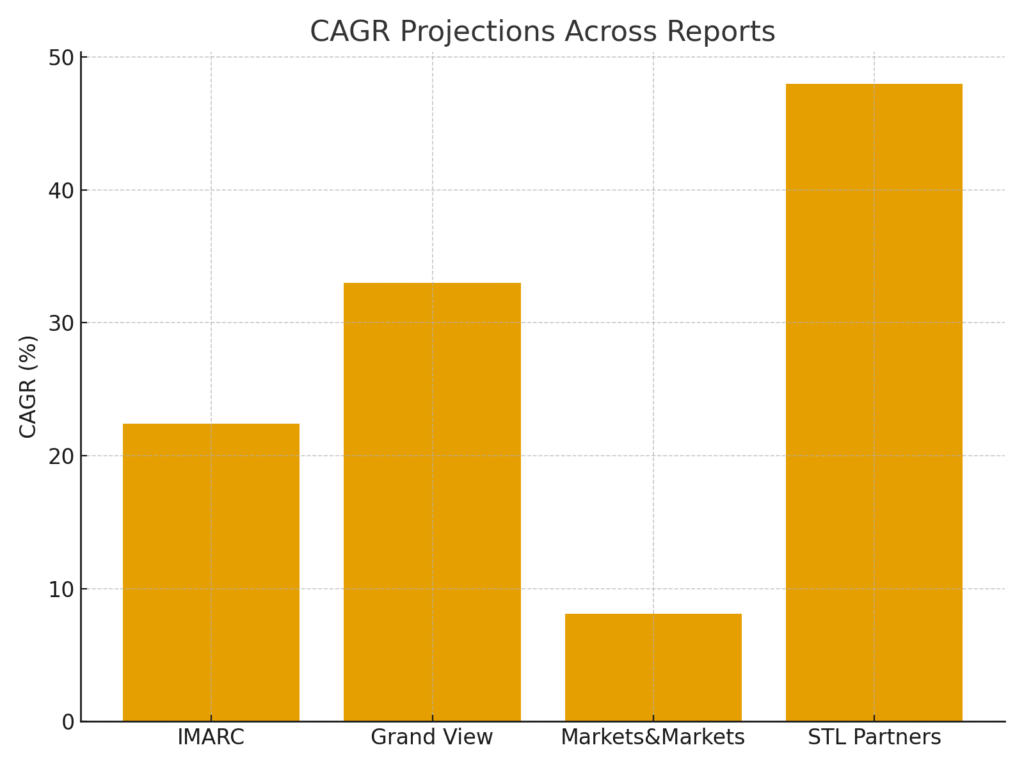
Edge Computing Marketing Statistics#3 Market Expected To Reach $114.4 Billion By 2033 (22.4% CAGR)
Projections show the market could grow from $18.3 billion in 2024 to $114.4 billion by 2033. That represents a compound annual growth rate (CAGR) of 22.4%. For marketers, this indicates steady momentum and long-term reliability. Campaigns can confidently stress the resilience and demand for edge solutions. Such growth creates fertile ground for customer education and brand differentiation.
Edge Computing Marketing Statistics#4 Market May Grow To $327.79 Billion By 2033 (33% CAGR)
Other forecasts are even more ambitious, suggesting the industry could hit $327.79 billion by 2033. This translates to an impressive CAGR of 33%. For marketing teams, this opens opportunities to target innovative, high-growth niches. Highlighting exponential growth rates can help justify early adoption to hesitant clients. A message built around acceleration and competitiveness resonates strongly in fast-changing markets.
Edge Computing Marketing Statistics#5 Market Forecast Of $249.06 Billion By 2030
Markets & Markets predicts the market will expand to $249.06 billion by 2030. Starting from $168.40 billion in 2025, this growth shows clear upward momentum. Marketers can use these figures to show consistent confidence in the sector. Highlighting steady CAGR (around 8.1%) makes edge computing a reliable long-term bet. Businesses can market stability and maturity alongside innovation.

Edge Computing Marketing Statistics#6 Addressable Market Could Reach $445 Billion By 2030
STL Partners estimates the addressable edge computing market will reach $445 billion by 2030. That’s a huge jump from $9 billion in 2020, showing extraordinary acceleration. Marketers can use this as evidence of untapped opportunities. With such massive growth, positioning products as early movers is powerful. It reinforces urgency and potential ROI for customers.
Edge Computing Marketing Statistics#7 North America Holds Over 38% Market Share
North America dominated edge computing revenues in 2024, with more than 38% share. This reflects the region’s advanced infrastructure and technology adoption. Marketers targeting U.S. and Canadian audiences can use this leadership as proof of innovation. It also shows where case studies and success stories can be sourced. For global campaigns, emphasizing North American benchmarks makes messages credible.
Edge Computing Marketing Statistics#8 East Asia Projected To Lead In Network Edge Sites By 2026
East Asia, led by China, is projected to host around 26% of global network edge sites by 2026. This highlights the region’s heavy investment in 5G and IoT infrastructure. Marketers can emphasize Asia’s leadership in cutting-edge applications. Global strategies must acknowledge Asia-Pacific as a growth engine. Brands entering these markets should frame themselves as partners in progress.
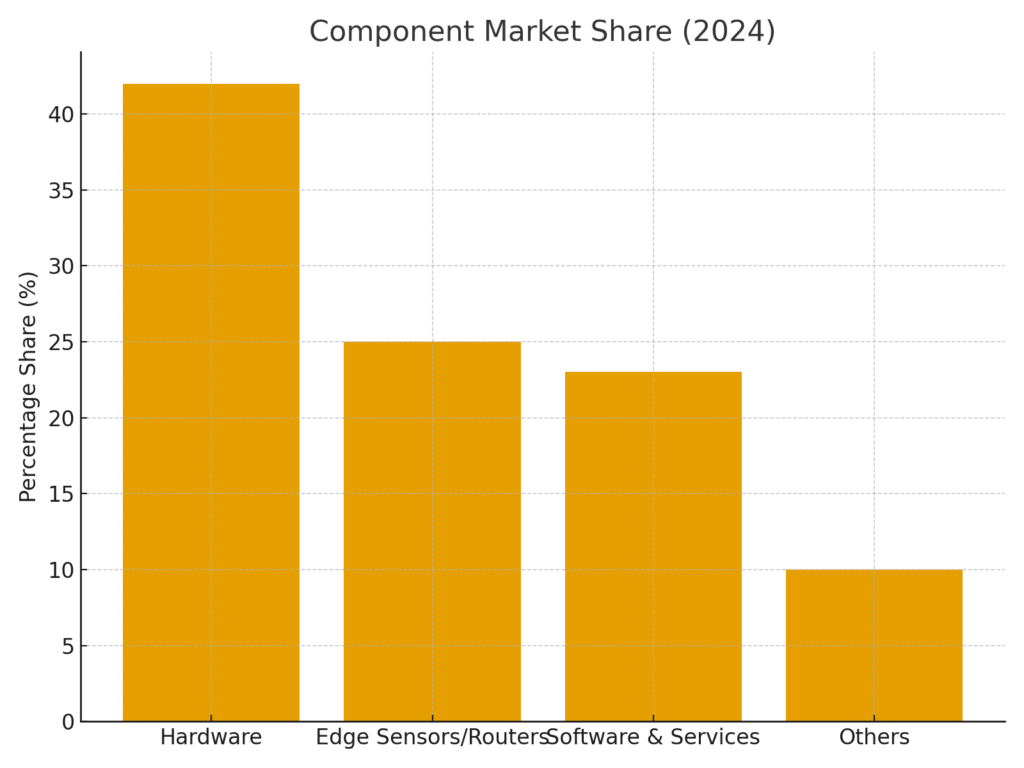
Edge Computing Marketing Statistics#9 Hardware Dominates With 42% Market Share
Hardware components such as servers, nodes, and edge routers dominate with about 42% share in 2024. This reveals how critical infrastructure is for enabling edge use cases. Marketing campaigns can highlight hardware reliability and scalability. Partnerships with hardware vendors can boost credibility. For buyers, showcasing robust equipment is a key differentiator.
Edge Computing Marketing Statistics#10 Edge Sensors And Routers Account For 25% Of Revenue
Edge sensors and routers made up about 25% of market revenue. These devices are the backbone of edge connectivity. For marketers, it’s proof that demand extends beyond software and into devices. Messaging should emphasize interoperability and integration. Highlighting strong sensor performance can build trust with industrial clients.

Edge Computing Marketing Statistics#11 Industrial IoT Is The Largest Application Vertical
Industrial IoT is currently the largest vertical using edge computing. This includes manufacturing, logistics, and smart factories. For marketers, IIoT provides rich storytelling opportunities about efficiency and automation. Brands can target B2B customers with data-driven case studies. Positioning edge as critical for Industry 4.0 resonates with decision-makers.
Edge Computing Marketing Statistics#12 Energy And Utilities Are Among Top Performing Verticals
Energy and utilities are also major adopters of edge computing. They use it for grid optimization, predictive maintenance, and smart metering. For marketers, this sector represents stability and long-term contracts. Messaging can highlight sustainability and efficiency outcomes. Case studies here can appeal to government and corporate buyers alike.
Edge Computing Marketing Statistics#13 5G Rollout Is A Key Driver Of Growth
The expansion of 5G is one of the strongest growth drivers for edge computing. It enables ultra-low latency and faster data transfer. Marketers can connect edge computing directly with the 5G revolution. Campaigns linking both technologies create excitement about next-generation innovation. Clients see this pairing as essential for real-time applications.
Edge Computing Marketing Statistics#14 Rising Number Of IoT Devices Fuels Market
Billions of connected devices now demand faster processing at the edge. This surge in IoT adoption is fueling edge computing growth. For marketers, it’s a chance to position solutions as “future-proof” against device overload. Messaging should stress agility and responsiveness. The link between IoT and edge computing is a powerful storytelling angle.
Edge Computing Marketing Statistics#15 Low Latency Demand Accelerates Adoption
Applications such as autonomous vehicles and AR/VR require ultra-low latency. Edge computing directly addresses this demand. Marketers can build campaigns around speed and responsiveness. Highlighting latency reduction as a tangible benefit makes messaging relatable. Customers see direct value in faster and safer operations.
Edge Computing Marketing Statistics#16 CAGR Ranges Between 22% And 33% Across Reports
Forecasts suggest CAGR ranges between 22% and 33% through 2033. This variance shows both the certainty of growth and the diversity of definitions. Marketers can use this to stress widespread confidence in the industry. Campaigns can highlight consensus rather than discrepancies. Growth messaging remains strong regardless of the exact number.
Edge Computing Marketing Statistics#17 Aggressive Forecasts Show 48% CAGR Potential
Some analysts predict CAGR could climb as high as 48% under broader definitions. This showcases edge computing’s disruptive potential. For marketers, this is a chance to stress urgency and bold innovation. High-growth narratives inspire investors and innovators alike. Positioning solutions as part of exponential growth makes messaging compelling.
Edge Computing Marketing Statistics#18 Security Concerns Are A Notable Challenge
Despite growth, data security and privacy are major concerns at the edge. Processing at distributed nodes raises new risks. For marketers, this is an opportunity to highlight safety and trust. Campaigns should focus on compliance and encryption capabilities. Clients respond well to transparency and proactive protection strategies.
Edge Computing Marketing Statistics#19 Infrastructure Costs Remain A Barrier
Edge deployments often involve high costs for power, connectivity, and maintenance. This remains a restraint on growth for some industries. Marketers can respond by stressing cost-saving benefits over time. Case studies about ROI help overcome hesitation. Positioning solutions as efficient offsets upfront investment concerns.
Edge Computing Marketing Statistics#20 Asia-Pacific Expected To Be The Fastest Growing Region
Asia-Pacific is projected to be the fastest-growing region for edge adoption. Countries like China, India, and Japan are investing heavily in edge and 5G. For marketers, this region represents the next big opportunity. Messaging should focus on adaptability and local partnerships. Campaigns can highlight success stories from the region to build credibility.
My Final Thoughts on Edge Computing Marketing
Looking back at all these insights, I can honestly say I’ve gained a deeper appreciation for how powerful edge computing will be in the near future. It’s not just a buzzword—it’s a movement that’s transforming industries and opening doors for smarter, faster, and more connected experiences. What excites me most is how these trends give us practical direction on where to invest our time and creativity. Personally, I see these statistics as both a roadmap and a motivator to keep learning and innovating. If you’re as curious as I am, then I hope this exploration has sparked fresh ideas for how you approach the future of marketing.
SOURCES
https://www.stlpartners.com/articles/edge-computing/edge-computing-market-trends/
https://www.digi.com/blog/post/edge-computing-trends
https://sevenkoncepts.com/blog/edge-computing-in-tech-marketing/
https://www.dell.com/en-us/blog/navigating-the-edge-computing-revolution-peering-into-the-future/
https://www.nlyte.com/blog/the-edge-data-center-market-growth-trends-and-future-outlook/
https://logitgroup.com/edge-computing-market-research/
https://www.packetpower.com/blog/the-rise-of-edge-computing-in-the-us