




27 Sep TOP 20 ELECTRIC DELIVERY MARKETING STATISTICS 2025
As I was diving into the latest electric delivery marketing statistics, I couldn’t help but notice how quickly this space is changing. From e-commerce giants to postal services, everyone seems to be investing in electric fleets not only to save costs but also to position themselves as sustainable leaders. For me, what really stands out is how much of this movement is being used in brand storytelling—companies proudly market “green delivery” as a way to connect with eco-conscious customers. Since I often look at this data from both a business and creative perspective, I wanted to share some of the most impactful numbers that highlight the opportunities ahead. With insights inspired by a leading marketing agency in New York, these stats show how electrification is shaping the way brands approach logistics and consumer engagement.
Top 20 Electric Delivery Marketing Statistics 2025 (Editor’s Choice)
⚡ Top 20 Electric Delivery Marketing Statistics 2025
Powering the Future of Logistics & Last-Mile Delivery
| # | Category | Key Statistic |
|---|---|---|
| 1 | Global Market | 17 million electric vehicles were sold globally in 2024, representing a 25% increase year-over-year |
| 2 | Global Market | Over 20 million electric vehicles are projected to be sold globally by the end of 2025, representing one in four new vehicles sold |
| 3 | Global Market | Global EV sales projected to reach 21.3 million units in 2025 (24% market share), more than doubling to 40.1 million by 2030 |
| 4 | Global Market | The global electric fleet reached almost 58 million cars by the end of 2024 |
| 5 | Global Market | Over 4 million EVs sold worldwide in Q1 2025 - 35% more than in Q1 2024 |
| 6 | Regional | China, Europe, and the USA account for around 95% of all electric vehicle sales in 2024 |
| 7 | Regional | Europe's EV market share is set to reach 25% in 2025 and nearly 63% by 2030 |
| 8 | Regional | U.S. EV market share was 7.4% in Q2 2025, with 310,839 vehicles sold |
| 9 | Regional | UK electric car sales reached nearly 30% market share, up from 24% in 2023 |
| 10 | Regional | Norway achieved 88% of car sales being battery electric and under 3% plug-in hybrids in 2024 |
| 11 | Commercial Fleet | Amazon now has 20,000 electric delivery vehicles as part of its goal to reach 100,000 by 2030 through Rivian partnership |
| 12 | Commercial Fleet | IKEA's Ingka Group served 40% of home deliveries with zero-emission vehicles in 2024, targeting 90% by 2028 |
| 13 | Commercial Fleet | Rivian represented 40% of the US electric commercial vehicle market in 2024 with steadily growing sales |
| 14 | Technology | Battery demand is forecast to surpass 1 TWh in 2025, highlighting accelerating electrification scale worldwide |
| 15 | Technology | 785 electric car models were available for consumers in 2024, with 1,000 models predicted by 2026 |
| 16 | Market Trends | Tesla's U.S. EV market share stands at 46% in Q2 2025, though sales are down 10% year-over-year |
| 17 | Market Trends | Nearly 300,000 new electric vehicles were sold in Q1 2025 in the U.S., an increase of 11.4% year over year |
| 18 | Consumer Behavior | 18% of U.S. online shoppers demand next-day delivery, while 40% expect delivery within two days |
| 19 | Last Mile Delivery | Global last mile delivery market expected to grow from $176.99 billion in 2025 to $373.92 billion by 2033 at 9.8% CAGR |
| 20 | E-Mobility | Electric two- and three-wheelers remained the most electrified road transport segment with 9% of global fleet electric and 10 million sold in 2024 |
Top 20 Electric Delivery Marketing Statistics 2025
Electric Delivery Marketing Statistics #1 – Market Growth To $205.1 Billion By 2035
The electric last-mile delivery vehicle market is projected to jump from $34.8 billion in 2025 to $205.1 billion by 2035. This rapid growth highlights the strong momentum for electrification in logistics. Companies are investing heavily as they recognize the dual benefits of cost savings and improved brand image. For marketers, this creates a rich story around future-ready and sustainable delivery. The narrative isn’t just about efficiency—it’s about innovation driving trust.
Electric Delivery Marketing Statistics #2 – All-Electric E-Commerce Delivery Market Reaching $100 Billion
The all-electric e-commerce delivery sector is expected to grow from $15 billion in 2024 to $100 billion by 2030. This surge reflects the demand for eco-friendly logistics in online shopping. Customers now consider sustainability when choosing retailers, making electric fleets a branding advantage. The sheer size of this growth shows how much marketing can leverage eco-delivery promises. In my view, companies that position themselves early will stand out the most.
Electric Delivery Marketing Statistics #3 – 87% Of Fleet Owners Plan To Add EVs In 5 Years
A survey found that 87% of fleet owners expect to add EVs within the next five years. This signals a major industry shift that marketers should not ignore. It shows confidence in the long-term value of electric adoption, despite upfront costs. For storytelling, brands can highlight this commitment as part of their future-proofing strategy. Personally, I see this as a great way to connect with eco-minded business partners.
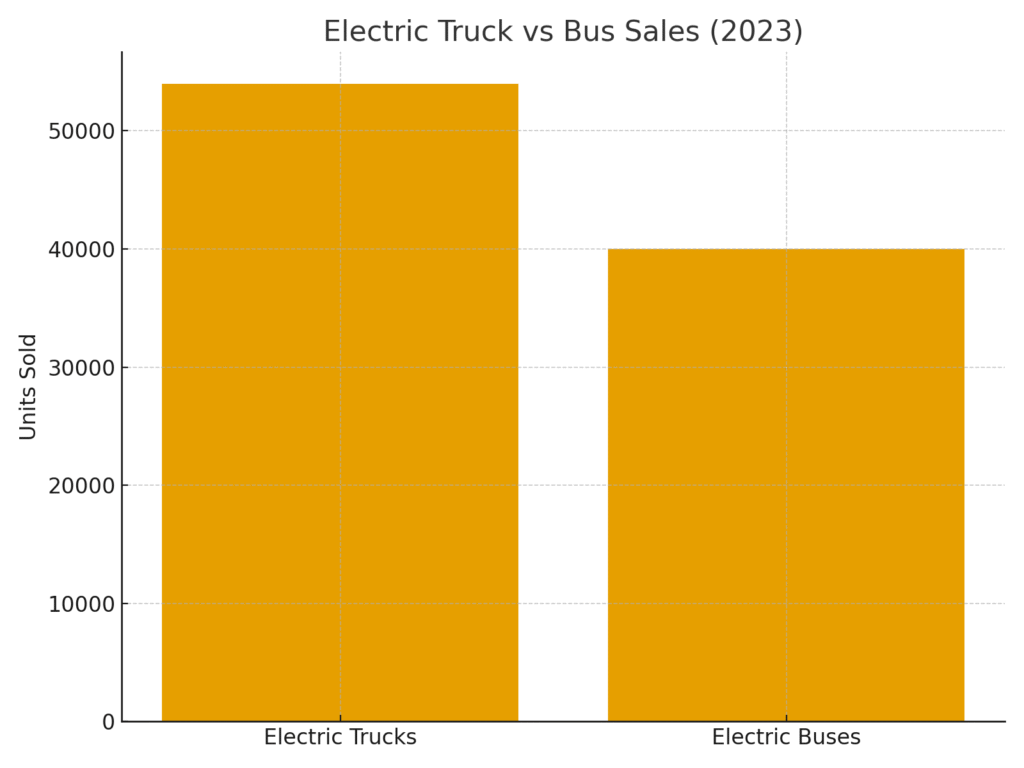
Electric Delivery Marketing Statistics #4 – Electric Truck Sales Grew 35% In 2023
Electric truck sales rose by 35% in 2023, surpassing electric buses in growth. This trend reflects the increasing adoption of heavy-duty EVs in logistics. For marketing teams, this milestone demonstrates that electrification is no longer limited to small delivery vans. Campaigns can now highlight large-scale sustainability in freight operations. To me, it’s proof that electric logistics are moving mainstream faster than expected.
Electric Delivery Marketing Statistics #5 – 1.3 Million Charging Points Added In 2024
In 2024, more than 1.3 million new public charging points were installed globally. This expansion makes electric delivery fleets more practical than ever. For marketing, infrastructure growth reassures customers that EV adoption is viable. Companies can share this story to ease concerns about logistics reliability. I find it encouraging to see the ecosystem growing alongside vehicle adoption.

Electric Delivery Marketing Statistics #6 – 17 Million Electric Cars Sold In 2024
Electric car sales exceeded 17 million globally in 2024. This record reflects rising consumer trust in EV technology. The growth also influences business delivery decisions, as fleets often follow consumer adoption trends. For marketers, this number is proof that “electric” is no longer niche. Personally, I think this helps normalize electric delivery branding.
Electric Delivery Marketing Statistics #7 – EVs Accounted For 18% Of New Car Sales In 2023
In 2023, 18% of all new cars sold worldwide were electric. This is a powerful indicator of mainstream adoption. For delivery services, this trend reinforces the value of aligning fleets with consumer preferences. Marketers can emphasize that brands are part of a larger societal shift. I see this as both a logistics choice and a lifestyle alignment.
Electric Delivery Marketing Statistics #8 – 58 Million EVs In Global Fleet By End Of 2024
By the end of 2024, nearly 58 million electric cars were on the road worldwide. This accounted for about 4% of all passenger vehicles. For logistics marketers, this offers credibility when promoting EV fleets. Brands can frame their actions as part of a global community shift. I think it’s an opportunity to tell a story of belonging and progress.
Electric Delivery Marketing Statistics #9 – EV Light-Duty Vehicles To Reach 40% Of Sales By 2030
Electric light-duty vehicles are projected to represent 40% of total sales by 2030. By 2035, that number could climb to 55%. These vehicles are critical for last-mile delivery operations. Marketers can leverage these projections to show their long-term readiness. Personally, I see this stat as a roadmap for storytelling campaigns.
Electric Delivery Marketing Statistics #10 – First/Last Mile Delivery Market At $446.4 Billion By 2034
The first and last mile delivery market is set to expand from $186.6 billion in 2025 to $446.4 billion by 2034. While not exclusively EVs, electrification is a big part of this growth. For marketers, tying electric delivery to this booming market creates credibility. Companies can highlight their role in a fast-expanding sector. I think it adds weight to eco-branding strategies.
Electric Delivery Marketing Statistics #11 – Global Last-Mile Delivery Market To Reach $340.56 Billion By 2032
The global last-mile delivery market is forecast to grow to $340.56 billion by 2032. EVs are becoming the backbone of this transformation. Brands can link their fleet decisions to this industry trajectory. Customers respond positively to businesses that are prepared for the future. To me, it shows that electrification is no longer optional.
Electric Delivery Marketing Statistics #12 – Amazon Deploys 10,000 Rivian EV Vans
Amazon has rolled out 10,000 Rivian electric vans across 1,800 U.S. cities. This makes it one of the largest corporate EV fleets in the world. For marketers, Amazon sets a clear benchmark for brand leadership in sustainability. Competitors can leverage this example to inspire their own campaigns. Personally, I find this scale both ambitious and inspiring.
Electric Delivery Marketing Statistics #13 – USPS To Acquire 66,000 EVs By 2028
The U.S. Postal Service plans to acquire 66,000 electric delivery vehicles by 2028. This investment is backed by $3 billion in federal support. For marketing, this demonstrates government-level commitment to electrification. Companies can frame their initiatives as aligned with public policy. I think this adds legitimacy to sustainability claims.
Electric Delivery Marketing Statistics #14 – Amazon Orders 150 Electric Heavy Goods Vehicles
Amazon has ordered more than 150 electric HGVs to expand its European fleet. This reflects a growing commitment to heavy-duty electrification. Marketers can use this as an example of scaling green logistics. It also sends a strong signal to competitors about innovation. To me, it’s another milestone in Amazon’s branding power.
Electric Delivery Marketing Statistics #15 – USPS 2024 Purchase Split Between EVs And Gas
In 2024, USPS purchased 28,000 new vehicles, with 22,000 still gas-powered. Future plans call for a 50/50 balance between electric and ICE models. For marketers, this stat highlights the transitional stage of adoption. Companies can show they are ahead by going further into electrification. I think it creates a contrast worth highlighting in campaigns.
Electric Delivery Marketing Statistics #16 – UPS And FedEx Each Roll Out 1,000 EV Vans
UPS and FedEx have deployed around 1,000 EV vans each. However, battery shortages have slowed their full transition. For marketers, this story illustrates both ambition and challenge. It shows that even industry giants must navigate real-world constraints. Personally, I think it makes their progress even more credible.
Electric Delivery Marketing Statistics #17 – Battery Pack Costs Projected To Fall 56% By 2050
Battery costs are projected to drop between 51% and 56% by 2050. This decline makes electric delivery vehicles increasingly affordable. Marketers can frame this as a long-term cost advantage story. It reassures customers that electric fleets are not just sustainable but financially smart. I see this as a way to blend financial and eco-storytelling.
Electric Delivery Marketing Statistics #18 – McKinsey Highlights Economic Viability Of EV Fleets
McKinsey reports that EV fleet economics are already viable in many contexts. Lower operating costs offset higher initial investments. For marketers, this provides a strong argument for early adoption. It’s not only about green branding but also about financial sense. Personally, I love how numbers can back up sustainability claims.
Electric Delivery Marketing Statistics #19 – “Green Delivery” As A Marketing Differentiator
EV fleet adoption is increasingly marketed as “green delivery.” Companies use it as a way to connect with eco-conscious customers. For marketers, this creates storytelling potential around values. It’s no longer just a logistics choice but a brand identity move. I believe customers are responding strongly to this positioning.
Electric Delivery Marketing Statistics #20 – Consumer Demand Driving EV Adoption In Delivery
Consumer demand for sustainability is one of the strongest drivers of EV adoption. Regulations and cost savings also play a role, but marketing stories lean heavily on consumer preference. Brands can use this to justify their investments publicly. For me, this reinforces the link between customer trust and fleet decisions. It’s a stat that ties everything back to brand credibility.

Wrapping Up The Future Of Electric Delivery
Looking at these electric delivery marketing statistics, I feel inspired about how sustainability and business growth are merging into one story. It’s fascinating to see delivery fleets not just as vehicles, but as marketing tools that showcase responsibility and innovation. Personally, I think this transition goes beyond numbers—it’s about creating trust with customers who care about the planet. As brands continue to electrify their operations, they’re also electrifying their relationships with consumers. I’m excited to keep watching this journey unfold and to share more insights that help us understand where delivery and marketing meet sustainability.
SOURCES
-
https://www.futuremarketinsights.com/reports/electric-last-mile-delivery-vehicle-market
-
https://www.iea.org/reports/global-ev-outlook-2024/trends-in-heavy-electric-vehicles
-
https://www.iea.org/reports/global-ev-outlook-2025/electric-vehicle-charging
-
https://www.iea.org/reports/global-ev-outlook-2025/trends-in-electric-car-markets-2
-
https://www.iea.org/reports/global-ev-outlook-2024/trends-in-electric-cars
-
https://www.iea.org/reports/global-ev-outlook-2024/outlook-for-electric-mobility
-
https://uk.finance.yahoo.com/news/first-last-mile-delivery-markets-112100600.html
-
https://www.axios.com/2023/10/17/amazon-rivian-electrification-10000-climate