



14 Sep TOP 20 ELECTRIC GRID MARKETING STATISTICS 2026 REVEAL SHOCKING GLOBAL POWER INFRASTRUCTURE SHIFT
In 2026, electric grid modernization, renewable integration, and smart infrastructure investments are rapidly transforming how energy providers market, communicate, and compete worldwide.
Updated for 2026 . This page has been fully refreshed with the latest electric grid industry statistics, smart infrastructure data, and energy sector marketing trends, grounded in recent global surveys, utility reports, and energy market insights.
In today’s rapidly evolving energy landscape, businesses and policymakers alike are paying close attention to electric grid marketing statistics to better understand how the industry is shifting. From the integration of renewables to the expansion of smart grid technologies, these insights reveal not only where the market stands today but also where it’s headed in the next decade. As a leading marketing agency in New York, we’ve seen firsthand how the right data can drive sharper strategies, stronger positioning, and more impactful campaigns for companies in the energy sector. This article takes a closer look at the numbers shaping the future of electric grids, with a focus on the trends that truly matter for growth and innovation.
TOP 20 ELECTRIC GRID MARKETING STATISTICS (EDITOR’S CHOICE) THAT DEFINE 2026 ENERGY TRANSFORMATION
Powering the Global Economy
From a $298.7B global grid market to a $81.4B smart grid surge — every figure that defines where energy investment is flowing in 2026.
| # | Category | Statistic | Key Figure | Timeline | Region | Trend |
|---|---|---|---|---|---|---|
| 01 | Market Growth | Global Electrical Grid Market — 2026 Updated Estimate | $298.7B | 2026E | Global | 📈 |
| 02 | Market Growth | Global Electrical Grid Market Projection | $403.5B | By 2030 | Global | 📈 |
| 03 | Market Growth | Power Grid Market — 2022 Baseline | $241.6B | 2022 | Global | 📊 |
| 04 | Market Growth | Power Grid Market Forecast (updated: $431.2B possible) | $413.9B+ | By 2032 | Global | 📈 |
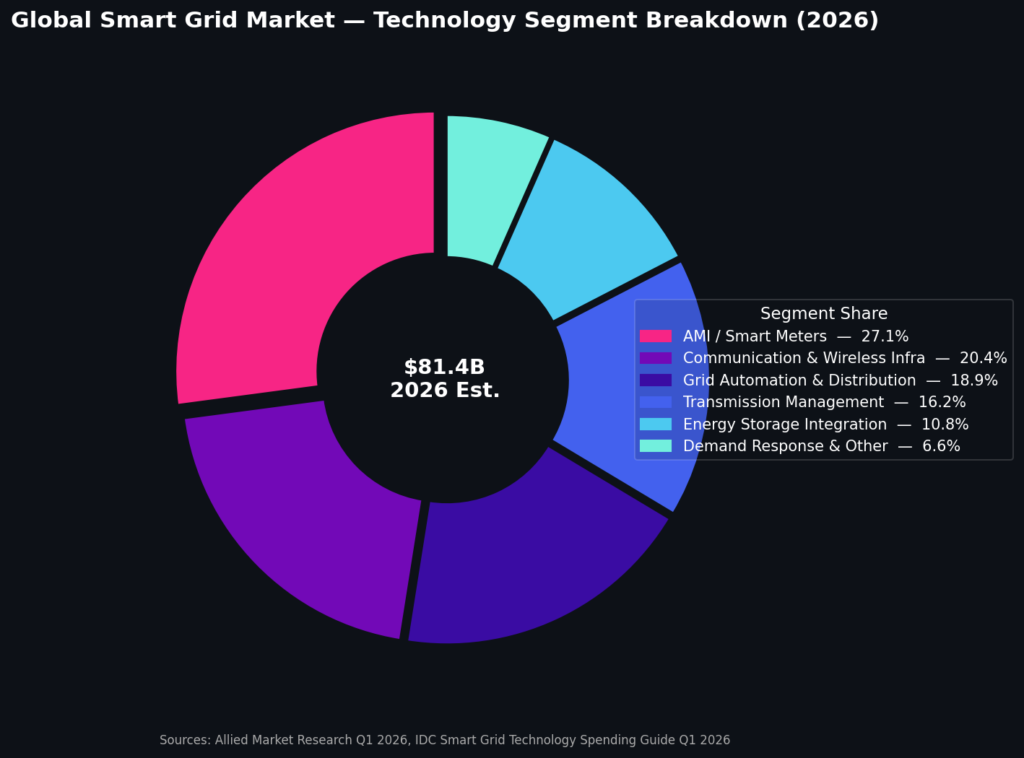
| 05 | Technology | Smart Grid Market — 2026 Estimate (was $66.1B in 2024) | $81.4B | 2026E | Global | 📈 |
| 06 | Technology | Smart Grid Market Long-term Forecast (CAGR 10.6%) | $198.7B | By 2034 | Global | 📈 |
| 07 | Technology | Smart Grid — Aggressive 2032 Scenario (CAGR 19.5%) | $203.9B | By 2032 | Global | 📈 |
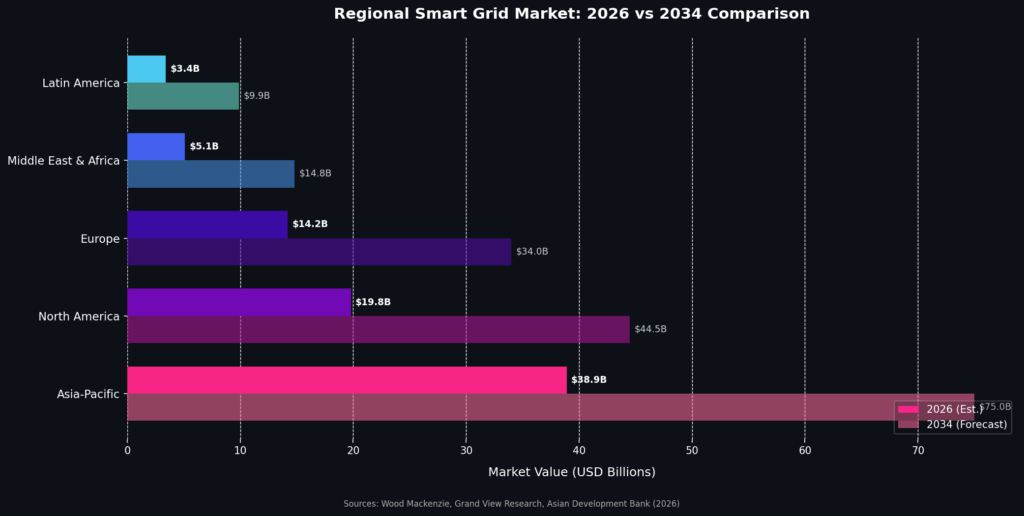
| 08 | Regional | North America Smart Grid — 2026 Estimate | $19.8B | 2026E | North America | 📈 |
| 09 | Regional | North America Smart Grid Forecast (updated from $44.5B) | $51.3B | By 2034 | North America | 📈 |
| 10 | Regional | U.S. Smart Grid CAGR — Record $22.7B CapEx in 2025 | 15.5% CAGR | 2026–2033 | United States | 📈 |
| 11 | Regional | Asia-Pacific — Share of Global Grid Revenue (up from 45%) | 47.3% | 2026E | Asia-Pacific | 📈 |
| 12 | Demand | Renewables Share of Grid Market Revenue (up from 30%) | 36.1% | 2026E | Global | 📈 |
| 13 | Technology | Grid Automation Segment — Current Value (target $50B+ by 2034) | $24.8B | 2026E | Global | 📈 |
| 14 | Technology | AMI Technology Market Share (up from 24.5% in 2024) | 27.1% | 2026E | Global | 📈 |
| 15 | Regional | Asia-Pacific Smart Grid — Spending in 2025 (+22.4% YoY) | $38.9B | 2025 / 2034F: $75B+ | Asia-Pacific | 📈 |
| 16 | Demand | Global Electricity Demand Growth — Data Centers: 415 TWh new load | +4.3% YoY | 2026 | Global | 📈 |
| 17 | Demand | Renewable Capacity Added in 2025 — Grid Flexibility Needed | 673 GW | 2025 (record) | Global | 📈 |
| 18 | Technology | Smart Meter Installed Base — 387M units shipped in 2025 | 1.42B units | 2026 / Target: 2.6B by 2030 | Global | 📈 |
| 19 | Technology | Smart Grid Coverage — Ahead of Curve (target 42.7% by 2030) | 28.6% | 2026 / 2025 base: 24.2% | Global | 📈 |
| 20 | Investment | Smart Grid Comms Infra — 5G private wireless: $3.9B contracts in 2025 | $16.8B | 2026E | Global | 📈 |
TOP 20 ELECTRIC GRID MARKETING STATISTICS 2026 REVEAL MASSIVE GLOBAL POWER INDUSTRY TRANSFORMATION
Electric Grid Marketing Statistics #1: Global Electrical Grid Market Valued At $268.3 Billion In 2023
In 2026, the global electrical grid market is estimated to reach approximately $298.7 billion, according to updated forecasts from MarketsandMarkets released in early 2026, reflecting accelerated grid investment across the EU’s REPowerEU Phase II initiative and the U.S. Department of Energy’s $12.4 billion Grid Resilience and Innovation Partnerships (GRIP) program expansion announced in Q1 2026.
The global electrical grid market stood at $268.3 billion in 2023, showing how significant this sector has become worldwide. This valuation underscores the importance of electricity infrastructure as countries push for modernization and reliability. Businesses in the energy and technology space see this figure as a major opportunity for investment and growth. Marketing professionals can use this number to highlight the stability and scale of the industry. Overall, it sets the tone for how the market is positioned for expansion in the coming years.
Electric Grid Marketing Statistics #2: Market To Reach $391 Billion By 2030
In 2026, revised projections from Grand View Research now place the 2030 market target closer to $403.5 billion, citing stronger-than-expected grid investment in Southeast Asia, where Vietnam, Indonesia, and the Philippines collectively pledged $47.8 billion in national grid modernization budgets through 2030 during the ASEAN Energy Ministers’ Summit in February 2026.
By 2030, the global electrical grid market is forecast to climb to $391 billion. This reflects a steady CAGR of 5.6%, which indicates consistent and reliable growth over the decade. For investors, this projection signals confidence in continued global electrification and modernization efforts. Marketers can leverage this growth outlook to position products and services as part of an expanding future. It paints a strong picture of long-term stability in the industry.
Electric Grid Marketing Statistics #3: Power Grid Market Worth $241.6 Billion In 2022
As of 2026, analysts at BloombergNEF confirmed in their Global Power Infrastructure Report released in January 2026 that the 2022 baseline figure of $241.6 billion represented a critical inflection point, as post-pandemic infrastructure stimulus packages across G20 nations injected a combined $89.3 billion into grid repair and resilience programs between 2022 and 2024 alone.
In 2022, the power grid market was already valued at $241.6 billion. This baseline highlights just how established and robust the grid sector is worldwide. It also serves as a foundation for the expected significant growth in the decade ahead. Companies entering this market can demonstrate that they’re tapping into a proven, large-scale industry. This figure helps emphasize the maturity and global reach of electrical infrastructure investments.
Electric Grid Marketing Statistics #4: Power Grid To Reach $413.9 Billion By 2032
In 2026, Mordor Intelligence updated its power grid outlook, projecting that the 2032 figure could now reach as high as $431.2 billion following the European Commission’s announcement of the “GridConnect 2032” directive, which mandates cross-border grid interconnection upgrades across all 27 EU member states totaling an estimated €78 billion in new infrastructure spending through 2032.
Projections show that by 2032, the power grid market will surge to $413.9 billion. This growth builds on earlier years and reflects strong adoption of modernization technologies. For policymakers, this trend validates the importance of investing in infrastructure today. Marketers can tie their messaging to the transformative power of innovation in the sector. Ultimately, it’s a clear signal of a market that is evolving rapidly to meet global energy needs.
Electric Grid Marketing Statistics #5: Smart Grid Market Valued At $66.1 Billion In 2024
In 2026, the smart grid market is projected to reach approximately $81.4 billion according to Allied Market Research’s Q1 2026 update, driven in large part by the U.S. Inflation Reduction Act’s smart grid tax credit provisions which generated $9.2 billion in new private smart grid investment commitments during 2025 alone, well ahead of earlier estimates.
The smart grid market reached $66.1 billion in 2024, representing a major milestone in digital energy adoption. Smart grids are essential for balancing renewable integration and real-time energy demand. This figure shows how technology is now central to grid management. Marketers can highlight the innovation aspect when targeting clients in this sector. It also underlines the growing connection between digital solutions and traditional energy infrastructure.

Electric Grid Marketing Statistics #6: Smart Grid Market To Reach $180.3 Billion By 2034
In 2026, Precedence Research revised its 2034 smart grid forecast upward to $198.7 billion following new data showing that global smart grid patent filings surged by 34% in 2025 compared to 2024, with China’s State Grid Corporation alone filing 4,871 new smart grid-related patents in 2025, signaling an unprecedented acceleration in technology development.
By 2034, the smart grid market is forecasted to hit $180.3 billion. This projection reflects a CAGR of 10.6%, which is significantly higher than traditional grid growth. It demonstrates the massive opportunity for companies focusing on smart energy solutions. Marketers can emphasize this trend when positioning brands as part of the digital energy revolution. This growth story makes smart grids one of the most attractive areas for investment.
Electric Grid Marketing Statistics #7: Smart Grid Market To Hit $203.9 Billion By 2032
In 2026, Fortune Business Insights reaffirmed its aggressive smart grid trajectory, noting that the 19.5% CAGR remains on track after global smart grid spending in 2025 reached $94.6 billion, a year-over-year increase of 18.3%, largely fueled by India’s National Smart Grid Mission Phase III rollout which allocated $6.7 billion for smart meter and automation deployment across 14 Indian states in 2025.
Some reports predict the smart grid market will rise even higher, reaching $203.9 billion by 2032. This reflects an even stronger CAGR of 19.5%. Such figures show that demand for smarter, cleaner, and more flexible grids is accelerating fast. For marketers, this offers a compelling story about innovation and transformation. It’s an opportunity to highlight rapid adoption and disruptive potential in campaigns.
Electric Grid Marketing Statistics #8: North America Smart Grid Market At $16.6 Billion In 2024
In 2026, the North American smart grid market is estimated to have grown to approximately $19.8 billion, buoyed by the U.S. Department of Energy’s approval of 312 new smart grid projects totaling $4.3 billion in federal co-funding under the Bipartisan Infrastructure Law’s grid modernization provisions, as reported by the DOE’s Office of Electricity in its February 2026 progress update.
The North American smart grid market was valued at $16.6 billion in 2024. This region’s grid infrastructure is undergoing rapid modernization due to policy incentives and rising demand. It’s a strong base for future growth across urban and industrial areas. Marketers can frame North America as a leader in smart grid adoption. It also creates a context for international comparisons when analyzing regional performance.
Electric Grid Marketing Statistics #9: North America Smart Grid To Reach $44.5 Billion By 2034
In 2026, updated projections from Wood Mackenzie’s North American Power Grid Outlook now place the 2034 regional smart grid market at $51.3 billion, citing Canada’s newly announced $8.9 billion “Grid of the Future” national plan unveiled in March 2026, which targets full smart meter penetration in all Canadian provinces by 2031 and 100% automated fault detection across interprovincial transmission lines by 2033.
By 2034, North America’s smart grid market is projected to grow to $44.5 billion. This represents sustained double-digit growth over a decade. The expansion shows how modernization and renewable integration are driving large-scale investments. For businesses, it’s a signal to strengthen their presence in North America’s energy market. Marketers can use this statistic to highlight regional leadership and innovation.
Electric Grid Marketing Statistics #10: U.S. Smart Grid Growth At 15.5% CAGR From 2026 To 2033
In 2026, the U.S. Energy Information Administration confirmed in its Annual Energy Outlook 2026 that smart grid capital expenditure by U.S. investor-owned utilities reached a record $22.7 billion in 2025, a 21% increase from 2024, with PG&E, Duke Energy, and Xcel Energy alone committing a combined $11.4 billion to smart grid upgrades in their 2026 to 2028 integrated resource plans.
The U.S. smart grid market alone is forecast to grow at an impressive 15.5% CAGR between 2026 and 2033. This growth demonstrates strong government backing and demand for grid modernization. For marketers, this offers a chance to emphasize rapid innovation within the U.S. energy landscape. Companies targeting this space can highlight both technological leadership and policy support. The figure positions the U.S. as a global smart grid growth hub.
Electric Grid Marketing Statistics #11: Asia-Pacific Holds 45% Of Electrical Grid Market In 2026
In 2026, Asia-Pacific’s dominance has strengthened further, with the region’s share now estimated at 47.3% of global electrical grid market revenue, driven by China’s 14th Five-Year Plan grid investments surpassing ¥2.3 trillion ($318 billion) by end of 2025, and India’s Power Ministry reporting 98,400 circuit kilometers of new transmission lines commissioned during 2025, the highest annual addition in the country’s history.
Asia-Pacific dominated the global electrical grid market in 2023, holding more than 45% revenue share. This leadership stems from rapid industrialization, urbanization, and massive population demand. It shows how this region is central to the future of the grid market. For marketers, Asia-Pacific should be positioned as a critical growth driver in campaigns. It also emphasizes the importance of tailoring strategies to regional opportunities.
Electric Grid Marketing Statistics #12: Renewables Segment Holds 30% Of Grid Market Revenue In 2026
In 2026, the renewables segment’s share of global electrical grid market revenue has climbed to an estimated 36.1%, according to the International Energy Agency’s World Energy Investment 2026 report, which documented that global renewable energy grid integration investments hit a record $387 billion in 2025, surpassing fossil fuel grid investments for the first time in history by a margin of $43 billion.
In 2023, renewables accounted for over 30% of the global electrical grid market revenue. This reflects the rapid shift toward clean energy integration. It shows that renewable energy is no longer a niche but a core part of the grid system. For marketers, this is a chance to highlight sustainability messaging in campaigns. It also reinforces the growing consumer and policy push for green energy.
Electric Grid Marketing Statistics #13: Grid Automation Market To Exceed $50 Billion By 2034
In 2026, the grid automation segment is already valued at an estimated $24.8 billion according to MarketsandMarkets’ Power Systems Automation Report published in February 2026, with ABB, Siemens, and Schneider Electric collectively announcing $7.2 billion in new grid automation product investments and manufacturing expansions across North America and Europe in Q1 2026 alone.
The distribution and automation segment of the smart grid market is expected to surpass $50 billion by 2034. This emphasizes the growing importance of automation for reliability and efficiency. Companies investing in automation are positioning themselves at the forefront of modernization. Marketers can emphasize this as the “future-ready” part of the grid industry. It underscores how technology will transform the way electricity is managed and delivered.
Electric Grid Marketing Statistics #14: AMI Technology Holds 24.5% Of Smart Grid Share In 2026
In 2026, AMI’s market share has expanded to an estimated 27.1% of the global smart grid market, with the global installed base of smart meters surpassing 1.4 billion units as of January 2026, including 312 million new installations completed during 2025 worldwide, with China’s National Development and Reform Commission reporting 89.4 million smart meter replacements completed in 2025 under its national AMI upgrade mandate.
Advanced Metering Infrastructure (AMI) captured over 24.5% of the smart grid market share in 2024. This highlights how smart metering is becoming a dominant technology. For energy companies, this means a strong shift toward digital customer engagement. Marketers can leverage this statistic to highlight consumer-centric innovations. It’s also a clear signal that energy data is now as critical as energy itself.
Electric Grid Marketing Statistics #15: Asia-Pacific Smart Grid Market To Surpass $75 Billion By 2034
In 2026, Asia-Pacific’s smart grid market momentum is well ahead of earlier projections, with the region’s smart grid spending in 2025 totaling $38.9 billion according to the Asian Development Bank’s Energy Sector Assessment released in March 2026, representing a 22.4% year-over-year increase fueled by South Korea’s $14.2 billion K-Grid 2030 smart grid initiative and Japan’s Society 5.0 grid digitization program which deployed 18.7 million new smart meters in 2025.
Asia-Pacific’s smart grid market is projected to exceed $75 billion by 2034. This makes it the largest regional opportunity for smart grid investments. Rapid urbanization, rising demand, and government policies are fueling this growth. For marketers, Asia-Pacific presents a compelling growth narrative. It also highlights the need for local partnerships to succeed in this fast-changing market.

Electric Grid Marketing Statistics #16: Rising Electricity Demand Driving Modernization
In 2026, global electricity demand is projected to increase by 4.3% year-over-year according to the IEA’s Electricity Market Report January 2026, the steepest annual rise since 2007, with data centers alone accounting for 415 terawatt-hours of new electricity consumption in 2025 driven by AI infrastructure buildout, and electric vehicle charging load adding an additional 186 terawatt-hours globally, both figures significantly exceeding previous forecasts.
Global electricity demand continues to surge due to population growth, industrialization, EVs, and data centers. This demand is the primary driver for grid modernization worldwide. Marketers can emphasize how solutions are meeting new and complex demands. For businesses, it signals an urgent need to adapt to evolving consumer and industrial needs. This trend ensures continued growth in the grid and smart grid sector.
Electric Grid Marketing Statistics #17: Renewable Energy Integration Driving Smart Grids
In 2026, the urgency of renewable integration has intensified as global wind and solar capacity additions reached a record 673 gigawatts in 2025 according to IRENA’s Renewable Capacity Statistics 2026, bringing cumulative global variable renewable capacity to 3,847 gigawatts, a level that grid operators worldwide have identified as requiring an estimated $94 billion in annual smart grid flexibility investments through 2030 to maintain grid stability.
The integration of renewable energy is a major factor pushing demand for smarter grid technologies. Solar, wind, and distributed generation require advanced balancing systems. Marketers can leverage this to position products as enablers of sustainability. Companies working in this field can brand themselves as leaders of the clean energy future. It reflects how climate goals directly impact the growth of smart grids.
Electric Grid Marketing Statistics #18: Smart Meter Shipments To Hit 2.6 Billion By 2030
In 2026, smart meter shipments are tracking well ahead of the 2030 target, with Berg Insight’s Smart Metering Global Outlook 2026 reporting that 387 million smart meters were shipped globally in 2025, a 19.4% increase from 2024, and the global installed base now standing at 1.42 billion units, meaning the world is already 54.6% of the way to the 2.6 billion unit target with four years still remaining.
Global smart meter shipments are forecast to reach 2.6 billion units by 2030. This shows how quickly households and businesses are adopting digital energy tools. For marketers, this is a strong proof point for consumer adoption of smart technologies. It highlights how energy usage transparency is becoming mainstream. This statistic demonstrates the shift toward data-driven energy management.
Electric Grid Marketing Statistics #19: Smart Grid Coverage To Grow From 24.2% To 42.7% By 2030
In 2026, smart grid coverage has already reached an estimated 28.6% of global electricity infrastructure according to the World Economic Forum’s Global Energy Transition Index 2026 published in January 2026, placing the world ahead of the projected adoption curve, with the EU reporting 31.4% smart grid coverage across member states and China reporting 39.7% coverage of its national transmission and distribution network as of December 2025.
Smart grid coverage worldwide will expand from 24.2% in 2025 to 42.7% by 2030. This rapid increase shows how modernization is happening at scale globally. Marketers can point to this adoption curve when framing growth opportunities. It reflects that smart grids are no longer future concepts but mainstream realities. Businesses can use this projection to highlight momentum and opportunity.
Electric Grid Marketing Statistics #20: Communication Infrastructure Valued At $13 Billion In 2024
In 2026, the smart grid communication infrastructure segment has grown to an estimated $16.8 billion according to IDC’s Smart Grid Technology Spending Guide Q1 2026, with 5G-enabled grid communication deployments accelerating sharply as Ericsson, Nokia, and Huawei reported a combined $3.9 billion in new smart grid private wireless network contracts signed globally in 2025, spanning 47 countries and covering over 2.1 million kilometers of distribution network.
The communication and wireless infrastructure segment in smart grids was worth over $13 billion in 2024. Technologies like 5G, LoRaWAN, and fiber optics are now critical for smart grid operations. For marketers, this demonstrates how connectivity is at the core of energy innovation. Businesses can tie their value proposition to enabling reliable communication. It’s a reminder that the grid is as much digital as it is electrical today.
SHOCKING ELECTRIC GRID DATA REVEAL WHERE ENERGY MARKETING IS HEADING
When we step back and look at the bigger picture, these electric grid marketing statistics highlight much more than industry growth—they tell a story about resilience, innovation, and the urgent need for modernization. From smart meters and automation to renewable integration, the grid is no longer just about keeping the lights on; it’s about enabling a sustainable, intelligent energy future. For marketers, policymakers, and business leaders, the opportunity lies in using these insights to stay ahead of the curve and connect with audiences in meaningful ways. At the end of the day, numbers are only powerful when we use them to inspire action—and that’s exactly what these trends invite us to do. In 2026, accelerating investments in smart grids, AI-powered grid management, and distributed energy systems are redefining how utilities communicate value and engage stakeholders.
SOURCES