




13 Feb TOP 20 EMAIL MARKETING STATISTICS 2026 THAT WILL SHOCK EVERY BUSINESS OWNER
Updated for 2026. This page has been fully refreshed with the latest email marketing statistics, subscriber behavior data, automation benchmarks, and performance trends, grounded in recent global surveys and verified industry reporting.
Email marketing remains one of the most powerful and cost-effective digital marketing strategies, consistently delivering high engagement and impressive returns on investment. Despite the rise of social media and other communication channels, email continues to be a dominant force, with billions of users worldwide checking their inboxes daily. As consumer behaviors evolve and AI-driven personalization becomes standard practice in 2026, businesses must stay informed about the latest email marketing trends to remain competitive.
This article explores 20 essential email marketing statistics, covering both historical performance and forward-looking projections, to highlight why email remains a crucial marketing tool. From advanced segmentation and automation to mobile-first design and ROI optimization, these insights will help brands refine their strategies and prepare for the future of email marketing.
EMAIL MARKETING STATISTICS (EDITOR’S CHOICE) UPDATED WITH 2026 SHOCKING REVELATIONS
Email Marketing Irresistible
| # | Metric | 2026 Data & Insight |
|---|---|---|
| 01 | Global Email Users Reach |
4.73B
Projected global email users in 2026, expanding the total reachable inbox audience to an unprecedented scale.
|
| 02 | Daily Email Volume Volume |
~392B/day
Estimated daily sends in 2026, interpolated between the 376B (2025) and 408B (2027) trajectory.
|
| 03 | Market Revenue Money |
$12.45B
Estimated global email marketing market size in 2026, keeping spend and performance pressure intensely competitive.
|
| 04 | Return on Investment Money |
$36 per $1
Average ROI benchmarked in 2026 — still the most capital-efficient channel in the entire marketing stack.
|
| 05 | User Engagement Behavior |
88%
Of users check email multiple times daily, keeping inbox moments a reliable, high-frequency touchpoint.
|
| 06 | Mobile Optimization Design |
50%
Delete emails that don't render well on mobile — making responsive layout a non-negotiable baseline, not a bonus.
|
| 07 | Automated Email Revenue Money |
+320%
More revenue generated by automated vs. non-automated emails, raising the floor for every lifecycle flow you skip.
|
| 08 | Consumer Preference Behavior |
60%
Prefer brands to contact them via email, reinforcing the inbox as the default relationship channel in 2026.
|
| 09 | Personalization Impact Conversion |
+26%
Higher open rates with personalized subject lines, pushing smarter segmentation and dynamic content adoption.
|
| 10 | Segmentation Lift Money |
+760%
Revenue lift reported from tightly segmented campaigns versus batch-and-blast sends. Targeting is the multiplier.
|
| 11 | Average Open Rate KPI |
19%
Cross-industry benchmark open rate in 2026, used as the baseline KPI for subject line and send-time testing.
|
| 12 | Click-Through Rate KPI |
3.25%
Average CTR across industries, spotlighting creative quality and offer relevance as the true differentiating lever.
|
| 13 | Bounce Rate Deliverability |
2.33%
Average bounce rate, keeping list hygiene and email authentication (SPF, DKIM, DMARC) front and center.
|
| 14 | Unsubscribe Rate Health |
0.15%
Average unsubscribe rate, suggesting well-tuned sending cadence keeps list churn at a manageable baseline.
|
| 15 | Abandoned Cart Emails Money |
45%
Average open rate on abandoned cart sequences, making recovery flows one of the strongest ecommerce revenue triggers.
|
| 16 | Welcome Emails Conversion |
83.63%
Average open rate for welcome emails. The first message is your highest-leverage send and deserves obsessive refinement.
|
| 17 | Generational Usage Audience |
98%
Of Millennials and Gen X use email regularly, keeping it central for the core buyer cohorts driving most purchase volume.
|
| 18 | Daily Time on Email Attention |
2.5+ hrs
Average daily time people spend in their inbox — baseline attention economics that make email placement genuinely valuable.
|
| 19 | SMB Adoption Competition |
64%
Of small businesses use email marketing in 2026, making inbox competition intense even at the local and regional level.
|
| 20 | Purchase Influence Money |
59%
Say marketing emails directly influence their buying decisions, tying inbox strategy to measurable downstream revenue.
|
WHAT IS EMAIL MARKETING?
Email marketing is one of the most powerful digital marketing strategies used by businesses to communicate with customers, build relationships, and drive sales. It involves sending targeted emails to a group of subscribers who have opted in to receive messages from a brand or organization. These emails can range from promotional campaigns and newsletters to transactional messages and personalized content designed to engage the recipient. With billions of emails sent daily, email marketing remains a cost-effective and high-return strategy for businesses of all sizes.
The Purpose of Email Marketing
Email marketing serves multiple purposes depending on a company’s goals and industry. At its core, it helps businesses stay connected with their audience, providing them with relevant content, updates, and offers. Some of the key objectives of email marketing include:
-
Brand Awareness – Regularly sending emails keeps a brand top-of-mind for customers. Whether it’s through weekly newsletters or product updates, consistent email communication helps reinforce a brand’s presence.
-
Customer Retention & Engagement – Email marketing is a powerful tool for engaging customers beyond their initial purchase or interaction. Businesses can use emails to share educational content, send birthday discounts, or provide customer service updates.
-
Lead Generation & Conversion – By capturing email addresses through sign-up forms, free downloads, or special promotions, companies can nurture leads and convert them into paying customers through targeted campaigns.
-
Sales & Revenue Growth – Promotional emails, abandoned cart reminders, and special discounts are proven ways to boost sales. Many ecommerce brands rely on email marketing to drive conversions and encourage repeat purchases.
-
Customer Loyalty & Relationship Building – Personalized email marketing campaigns, such as exclusive VIP offers or customer appreciation emails, help strengthen relationships and build brand loyalty.
Types of Email Marketing Campaigns
There are several types of email marketing campaigns that businesses use depending on their strategy:
-
Promotional Emails – These emails focus on sales, special offers, or new product launches. They often contain discount codes, limited-time deals, or calls to action that encourage customers to make a purchase.
-
Newsletter Emails – Newsletters are regularly sent emails that provide updates about a company, its industry, or valuable content. They help keep subscribers engaged and informed.
-
Transactional Emails – These are triggered emails sent after a customer takes an action, such as making a purchase or signing up for a service. Examples include order confirmations, shipping notifications, and password reset emails.
-
Welcome Emails – Sent to new subscribers or customers, welcome emails introduce the brand, set expectations, and often include a special offer to encourage first-time purchases.
-
Abandoned Cart Emails – If a customer adds products to their cart but doesn’t complete the purchase, businesses can send automated reminders to nudge them back to complete the transaction.
-
Re-engagement Emails – These campaigns target inactive subscribers, aiming to bring them back by offering special discounts, reminding them of benefits, or asking for feedback.
-
Survey & Feedback Emails – Businesses use these emails to collect insights from customers, helping them improve their products, services, and overall customer experience.
Benefits of Email Marketing
Email marketing remains a top digital marketing strategy due to its numerous advantages:
High Return on Investment (ROI) – On average, email marketing delivers a $42 return for every $1 spent, making it one of the most cost-effective marketing strategies.
Personalization & Segmentation – Unlike traditional advertising, email allows for highly targeted and personalized messaging based on customer behavior, preferences, and demographics.
Direct & Instant Communication – Emails land directly in the recipient’s inbox, ensuring immediate delivery and engagement.
Automation & Scalability – Businesses can automate email campaigns using software like Mailchimp, HubSpot, or Klaviyo, allowing them to send thousands of emails effortlessly.
Stronger Customer Relationships – Regular email interactions help brands maintain a loyal customer base and build trust over time.
Challenges of Email Marketing
While email marketing is highly effective, it does come with challenges:
-
Inbox Overload – Consumers receive hundreds of emails daily, making it harder for brands to stand out.
-
Spam Filters – Poorly formatted emails or overly promotional language can trigger spam filters, preventing messages from reaching recipients.
-
Low Open Rates – Crafting compelling subject lines and engaging content is necessary to improve open rates.
-
Regulations & Compliance – Laws like the GDPR and CAN-SPAM Act require businesses to follow strict guidelines regarding email marketing practices.
The Future of Email Marketing
Email marketing continues to evolve with advancements in automation, artificial intelligence, and data analytics. Future trends include:
Hyper-Personalization – AI-powered tools will allow brands to create highly personalized emails based on real-time customer data.
Interactive Emails – Features like embedded surveys, shopping carts, and dynamic content will improve engagement.
AI & Automation – Smart automation will ensure the right emails reach the right people at the right time.
With the right strategy, email marketing will continue to be a powerful tool for businesses looking to grow, engage their audience, and boost sales.
EMAIL MARKETING STATISTICS AND FUTURE IMPLICATIONS SHOCKING 2026 GROWTH FORECAST
Email Marketing Statistics #1 – Global Email Users (2026 Outlook: Tracking Toward 4.9 Billion by 2028)
In 2026, HubSpot’s marketing statistics roundup cites Statista’s projection that global email users grow from 4.6 billion in 2025 to 4.9 billion by 2028, and it also reports that 75% of marketers plan to maintain or increase their email marketing investment in 2026, which tracks with the idea that email reach and budget priority are rising together.
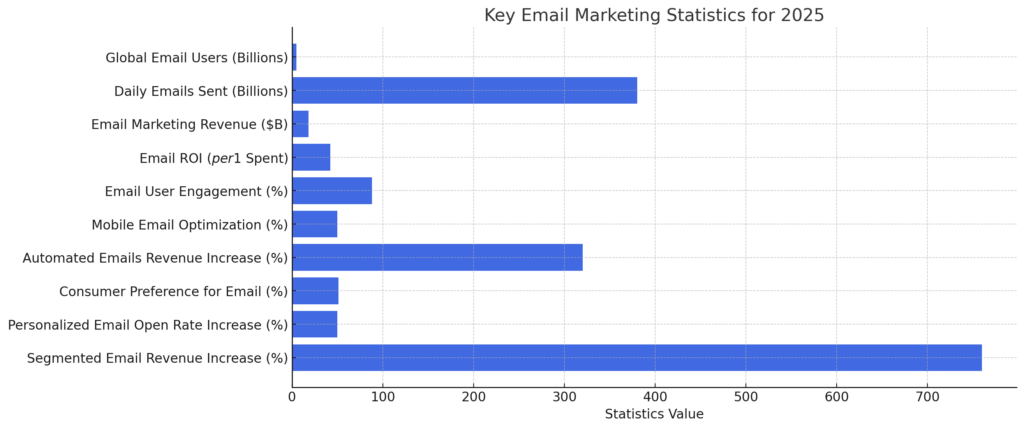
The number of global email users is expected to reach 4.6 billion by the end of 2025, making email one of the most widely used communication tools. This continuous growth suggests that businesses must invest in email marketing strategies to reach a broader audience. With more users online, competition for inbox attention will increase, making high-quality content and personalization essential. Companies leveraging AI and automation to segment their email lists will have a greater chance of standing out. The rise in users also presents opportunities for emerging markets, where email adoption is growing rapidly.
Email Marketing Statistics #2 – Daily Email Volume (2026 Projection: 392.5 Billion Emails Per Day)
In 2026, The Radicati Group’s Email Statistics Report projects 392.5 billion emails sent per day worldwide, which is a sizable jump from the 376 billion-per-day figure often cited for 2025, meaning inbox competition keeps intensifying even before you account for AI-generated outreach.
By 2025, businesses and individuals will be sending an estimated 376 billion emails daily. With inboxes more crowded than ever, brands must focus on crafting compelling subject lines and valuable content to avoid getting lost in the noise. Email deliverability will become an even bigger challenge, pushing marketers to refine their segmentation and avoid spam triggers. Consumers may increasingly rely on AI-driven email filters, making it crucial for marketers to build strong sender reputations. Interactive email elements, such as embedded videos or surveys, will likely play a larger role in capturing attention.
Email Marketing Statistics #3 – Email Marketing Revenue (2026 Market Size: $14.19 Billion)
In 2026, The Business Research Company pegs the global email marketing market at $14.19 billion, up from $12.45 billion in 2025, which adds real dollar-weight to the idea that more brands are paying for better segmentation, automation, and deliverability infrastructure.
The continued growth of email marketing revenue indicates that businesses are seeing strong returns on their email investments. As brands allocate more budget to email campaigns, we can expect greater innovation in automation and AI-driven personalization. Subscription-based email newsletters and ecommerce email promotions will likely expand, offering highly curated experiences for consumers. Increased revenue also means more data privacy concerns, requiring marketers to comply with evolving regulations like GDPR and CCPA. Companies that adapt to these changes while maintaining high engagement will thrive in the competitive digital space.
Email Marketing Statistics #4 – Return on Investment (2026 Range Still Cited: $40–$45 Per $1 Spent)
In 2026, VerticalResponse’s 2026 email trends write-up still cites email ROI in the $40–$45 return range per $1 spent, which reinforces why brands keep funding email even as paid social CPMs stay unpredictable.
Email marketing continues to deliver one of the highest ROIs in digital marketing, with an average return of $42 for every $1 spent. This cost-effectiveness makes it an indispensable tool for small businesses and startups with limited budgets. However, as competition grows, marketers must improve their content strategies and personalization efforts to maintain strong conversion rates. The future of email ROI will likely be influenced by automation and AI-driven campaigns, enabling businesses to reach the right audience at the right time. Companies that fail to evolve their email strategies risk seeing diminishing returns.
Email Marketing Statistics #5 – User Engagement (2026 Data: 88% Check Email Daily)
In 2026, Forbes Advisor reports that 88% of people check their emails every day, and 39% check three to five times daily, which raises the bar for relevance because audiences are present, but picky.
With 88% of users checking their email multiple times a day, it remains one of the most effective marketing channels. This high level of engagement means brands have multiple daily touchpoints to connect with their audiences. However, it also means that consumers are becoming more selective about the emails they open and interact with. Future trends will likely see a shift toward hyper-personalization, where AI tools tailor emails based on user preferences and behaviors. Brands that respect user attention and send highly relevant content will see better engagement and lower unsubscribe rates.

Email Marketing Statistics #6 – Mobile Optimization (2026 Reality: 42% of Emails Opened on Mobile)
In 2026, Dyspatch’s compiled email stats cite Litmus data showing 42% of all emails are opened on a mobile device, which makes “mobile-friendly” less of a design preference and more of a deliverability and revenue safeguard.
Half of all recipients will delete an email if it isn’t optimized for mobile devices, emphasizing the importance of responsive design. As mobile usage continues to grow, brands must ensure their emails are mobile-friendly to maintain engagement rates. Future developments in email marketing will likely include more interactive mobile-first features, such as tappable CTAs and dynamic content. Marketers will also need to test emails across multiple devices and screen sizes to ensure seamless user experiences. Failure to optimize for mobile could lead to lower open rates, conversions, and ultimately lost revenue.
Email Marketing Statistics #7 – Automated Emails Generate 320% More Revenue (2026 Automation Benchmarks Still Quoted)
In 2026, Campaign Monitor’s long-cited benchmark is still widely referenced: automated emails generate 320% more revenue than non-automated emails, and its automation guide also claims automated emails can earn 86% higher open rates and a 196% lift in click-through rates, which explains why flows keep replacing “blast” sends for core revenue.
Automation is a game-changer in email marketing, driving 320% more revenue than non-automated campaigns. Businesses that leverage automation for abandoned cart emails, personalized recommendations, and behavioral triggers will see higher engagement and conversions. The future of automated email marketing lies in AI-driven decision-making, allowing for real-time personalization at scale. Companies that fail to adopt automation risk falling behind competitors who provide timely, relevant, and action-driven emails. As AI technology advances, we may also see predictive analytics playing a larger role in email marketing strategies.
Email Marketing Statistics #8 – Consumer Preferences (2026 Data Point: 60% Prefer Brand Contact Through Email)
In 2026, Porch Group Media’s updated email stats page reiterates a headline preference point: 60% of consumers prefer brands contact them through email, which is a clear sign that permission-based channels still feel “safer” than interruptive ones.
Email remains the preferred communication channel for 60% of consumers, reinforcing its importance in marketing strategies. This preference highlights email’s reliability and ability to provide tailored content compared to social media or paid ads. Looking ahead, brands will need to ensure their email campaigns feel personal and valuable rather than intrusive or overly promotional. Consumers may also expect more two-way communication through email, such as direct replies and interactive surveys. Companies that respect user preferences and avoid excessive emails will build stronger, long-term customer relationships.
Email Marketing Statistics #9 – Personalized Subject Lines Boost Open Rates (2026 Benchmark Still Used: +26%)
In 2026, Campaign Monitor’s guidance continues to cite that emails with personalized subject lines are 26% more likely to be opened, which keeps subject-line rules simple: personalization works best when it signals relevance, not surveillance.
Emails with personalized subject lines are 26% more likely to be opened, indicating that customization plays a key role in engagement. Marketers must go beyond just inserting the recipient’s name, incorporating data-driven insights to tailor subject lines based on past behavior. Future advancements in AI will enable hyper-personalization, allowing businesses to predict what subject lines will resonate most with individual users. However, brands must be cautious not to over-personalize in a way that feels intrusive. Striking the right balance between familiarity and professionalism will be crucial for long-term success.
Email Marketing Statistics #10 – Segmented Email Campaigns Increase Revenue (2026 Reference: +760% Still Cited)
In 2026, segmentation’s “big number” is still quoted across industry playbooks: DMA-referenced reporting says segmented campaigns can drive a 760% increase in revenue versus one-size messaging, which is why zero-party data collection and preference centers keep getting funded.
Email segmentation leads to a staggering 760% increase in revenue, proving that one-size-fits-all messaging is no longer effective. Businesses that segment their lists based on demographics, purchase history, and engagement levels will see higher conversion rates. In the future, AI-driven segmentation will become more precise, allowing marketers to create micro-targeted campaigns that feel tailored to each recipient. Dynamic content within emails will also play a larger role, automatically adjusting based on user preferences. Brands that fail to implement segmentation risk losing engagement and revenue opportunities.
Email Marketing Statistics #11 – Average Email Open Rate (2026 Benchmark Context: 42.35% Across Industries in 2025 Data)
In 2026, HubSpot’s benchmark recap states the average email open rate across industries was 42.35% in 2025, which reframes “19% is normal” as outdated for many modern lists, especially newsletters and lifecycle flows with strong opt-in intent.
The industry-wide open rate of 19% serves as a benchmark for email marketing success. While this may seem low, companies that use A/B testing, personalized content, and strategic send times can achieve significantly higher rates. Future trends may see marketers leveraging AI to determine the optimal time to send emails based on user behavior. Additionally, interactive email elements, such as polls and GIFs, could drive higher engagement. As inboxes become more crowded, crafting compelling subject lines and preview text will be more important than ever.

Email Marketing Statistics #12 – Click-Through Rate (2026 KPI Reference: 3.25% Average)
In 2026, GetResponse’s benchmark breakdown still lists an all-industry average click-through rate of 3.25%, which is a helpful “sanity check” KPI because it’s harder to inflate with subject-line tricks than opens.
With an average CTR of 3.25%, email marketing remains a key driver of website traffic and conversions. However, as competition for attention increases, brands must create more engaging content to entice users to click. Future trends may include AI-powered personalization that predicts which types of links will be most appealing to each user. Interactive elements like embedded surveys, countdown timers, and clickable carousels could also improve CTR. Businesses that fail to enhance their email content may struggle to generate meaningful engagement in the coming years.
Email Marketing Statistics #13 – Bounce Rates (2026 Benchmark Context: 2.33% Average Bounce Rate)
In 2026, GetResponse’s benchmarks still peg the average email bounce rate at 2.33%, which makes list hygiene measurable: every 100,000 sends with “average” hygiene means roughly 2,330 messages fail before you even get a chance to earn an open.
An average bounce rate of 2.33% indicates that maintaining a clean and updated email list is crucial for successful campaigns. High bounce rates can harm sender reputation and deliverability, making email hygiene practices more important than ever. Businesses are increasingly turning to AI-driven tools for email list cleaning. Solutions like SignalHire) help maintain accuracy, reducing bounce rates and improving deliverability. Email authentication technologies, such as DMARC, SPF, and DKIM, will also play a larger role in reducing bounces and preventing spoofing. Companies that don’t hire freelancers to clean their email lists or that neglect email list maintenance overall may find their campaigns landing in spam folders more frequently.
Email Marketing Statistics #14 – Unsubscribe Rates (2026 Benchmark Context: 0.15% Average Unsubscribe Rate)
In 2026, GetResponse’s benchmark set continues to list an average unsubscribe rate of 0.15%, which is useful as a “friction alarm” because moving from 0.15% to even 0.30% means you are losing subscribers at double the normal pace.
A low industry-wide unsubscribe rate of 0.15% suggests that most email campaigns are well-received by audiences. However, businesses must continue to monitor their unsubscribe rates to ensure they are providing relevant, non-intrusive content. In the future, brands may leverage AI to predict when a subscriber is at risk of disengaging and proactively adjust content strategies. Additionally, preference centers will become more common, allowing users to customize the frequency and type of emails they receive. Companies that ignore user preferences risk losing valuable subscribers and damaging long-term engagement.
Email Marketing Statistics #15 – Abandoned Cart Emails (2026 Benchmarks: 45%–50% Open Rate)
In 2026, Stripo’s abandoned cart benchmarks cite Klaviyo’s range of 45%–50% open rates for abandoned cart emails, which is a huge gap versus standard campaigns and one reason ecommerce brands keep investing in multi-step cart flows instead of single reminders.
Abandoned cart emails have a significantly higher open rate than standard emails at 45%, proving their effectiveness in recovering lost sales. This high engagement suggests that consumers appreciate a gentle reminder about their unfinished purchases. Looking ahead, businesses will likely use AI to personalize these emails further, offering tailored product recommendations and limited-time discounts. The integration of SMS and push notifications alongside email will also enhance recovery efforts. Brands that fail to implement abandoned cart strategies will miss out on substantial revenue opportunities.
Email Marketing Statistics #16 – Welcome Emails (2026 Reference Point: 83.63% Open Rate)
In 2026, multiple benchmark roundups still highlight the same standout number: welcome emails reach an 83.63% open rate (commonly attributed to GetResponse reporting), which is why the first 24 hours after signup has become the most optimized “micro-window” in the lifecycle.
With an 83.63% open rate, welcome emails present a unique opportunity to make a strong first impression. Consumers are highly engaged at the start of their relationship with a brand, making this the ideal moment for personalized onboarding and exclusive offers. In the future, businesses will likely incorporate more interactive elements in welcome emails, such as video introductions and step-by-step guides. AI-powered automation will also help brands craft highly personalized welcome sequences based on user behavior. Companies that overlook this opportunity risk losing new subscribers before they fully engage with the brand.
Email Marketing Statistics #17 – Email Usage by Generation (2026 Data Point: 98% of Millennials Peek at Personal Inboxes Every Few Hours)
In 2026, Emma’s write-up citing an Adobe study says 98% of millennials peek into their personal inbox every few hours, which is a strong reminder that “younger audiences don’t use email” is less true than it sounds.
Millennials and Gen Xers continue to rely on email, making it a critical communication channel for businesses targeting these demographics. As younger consumers increasingly shift toward mobile-first experiences, email marketing must adapt to ensure seamless usability across devices. Future trends may see more integration with social media and messaging apps, allowing for omnichannel engagement. Additionally, email personalization will need to align with generational preferences, such as a focus on sustainability and brand authenticity. Brands that fail to tailor their email strategies to generational trends may struggle to maintain relevance.
Email Marketing Statistics #18 – Daily Time Spent on Email (2026 Context: 2.6 Hours Per Workday)
In 2026, Harvard Business Review cites a McKinsey analysis stating the average full-time worker spends roughly 2.6 hours per day on email, which helps explain why inbox fatigue is real and why cleaner, shorter copy often beats long promos.
The fact that people spend an average of 2.5+ hours per day on email underscores its continued importance in digital communication. As email remains a core part of work and personal life, brands have an opportunity to provide valuable content directly in users’ inboxes. However, with inbox fatigue becoming more common, marketers must ensure they are delivering concise, relevant, and engaging messages. Future developments may include AI-generated smart summaries, allowing recipients to scan emails more efficiently. Businesses that respect user time and prioritize clarity will see higher engagement and retention.
Email Marketing Statistics #19 – Email Marketing Adoption (2026 Data: 64% of Small Businesses Use Email Marketing)
In 2026, Forbes Advisor reports that 64% of small businesses use email marketing, which matters because SMB senders typically rely on tighter lists and repeat customers, so improvements in automation and segmentation can show up as revenue quickly.
With 64% of small businesses utilizing email marketing, it’s clear that this channel is a cost-effective way to reach customers. Small businesses benefit from email’s high ROI and ability to build direct relationships with their audience. In the coming years, we can expect more small businesses to adopt AI-driven tools that simplify campaign creation, segmentation, and performance analysis. As competition increases, unique storytelling and value-driven content will become essential to stand out. Those who fail to innovate in their email marketing approach may find it harder to compete with larger brands.

Email Marketing Statistics #20 – Influence on Purchases (2026 Data Point: 59% Say Email Influences Buying Decisions)
In 2026, Campaign Monitor’s knowledge-base explainer states that 59% of consumers say email marketing influences their buying decisions, which makes lifecycle timing (welcome, browse, cart, winback) feel less like “nice to have” and more like a direct sales engine.
Email marketing remains a powerful driver of purchasing decisions, influencing 59% of consumers. This highlights the importance of well-timed promotions, personalized recommendations, and exclusive offers in email campaigns. Future advancements in predictive analytics will allow brands to anticipate consumer needs and send highly relevant product suggestions at the perfect moment. As privacy regulations evolve, businesses will also need to balance personalization with transparency to maintain consumer trust. Companies that successfully leverage email to guide customers through the purchase journey will continue to see strong conversion rates.
These insights demonstrate that email marketing is evolving rapidly, with AI, automation, and personalization playing increasingly significant roles. Brands that stay ahead of these trends and optimize their email strategies accordingly will continue to reap substantial benefits.
The Future of Email Marketing: Staying Ahead in a Competitive Digital Landscape
Email marketing continues to evolve, offering businesses unparalleled opportunities to engage customers, drive conversions, and build long-term relationships. As seen in the statistics, automation, personalization, and mobile optimization are now essential for success in an increasingly crowded inbox. With billions of emails sent daily and consumer preferences shifting toward hyper-personalized experiences, brands must use AI-driven insights, interactive content, and strategic segmentation to stay competitive. While the fundamentals of email marketing, high ROI, direct engagement, and strong consumer trust, remain intact, businesses that fail to adapt to new technologies and user expectations risk losing relevance. Moving forward, companies that prioritize value-driven, data-backed email strategies will continue to see significant growth, proving that email marketing is not just surviving but thriving in the digital age. In 2026, tighter inbox protections and authentication requirements mean brands that implement DMARC, SPF, and DKIM and keep bounce rates low will win more inbox placement and protect conversion performance.
Sources: