




25 Jul TOP 20 EMAIL VS SMS LEAD NURTURING STATISTICS 2026 MARKETERS CAN’T IGNORE
Updated for 2026. This page has been fully refreshed with the latest email vs SMS lead nurturing statistics, engagement benchmarks, and messaging performance data, grounded in recent marketing platform reports, CRM analytics, and global campaign performance studies.
The whole thing started while watching two unread emails turn into twenty-seven overnight. That little badge on the inbox just sat there, mocking the idea that anyone actually reads half the stuff marketers send out. Meanwhile, a text pops up from a coffee shop with a 20% off code, and boom—someone’s already ordering a latte. It’s weird how people ignore emails for hours but can’t resist opening a text the second it dings. That got the brain spinning: what’s actually working when it comes to lead nurturing now?
Email’s been the bread and butter for years, but Amra and Elma believes SMS is kind of the punk little sibling that everyone underestimated. There’s data floating everywhere, but most of it feels cherry-picked or too broad to be useful. And no one really talks about how these channels actually perform *against* each other. Like sure, email gives you space to ramble, but SMS hits like a slap in the face—quick and loud. This breakdown pulls together what’s real, what’s working, and what’s probably getting ghosted in 2026.
TOP 20 EMAIL VS SMS LEAD NURTURING STATISTICS 2026 (EDITOR’S CHOICE)
Email & SMS Lead Nurturing Money Is Made
The definitive performance breakdown across open rates, ROI, deliverability, and conversion — updated with 2026 benchmarks.
| # | Channel | Statistic | Figure | Impact |
|---|---|---|---|---|
| Visibility & Reach | ||||
| 01 | Average open rate Varies by industry, send-time optimization & personalization depth | 20–32% avg. range · 2026 | ||
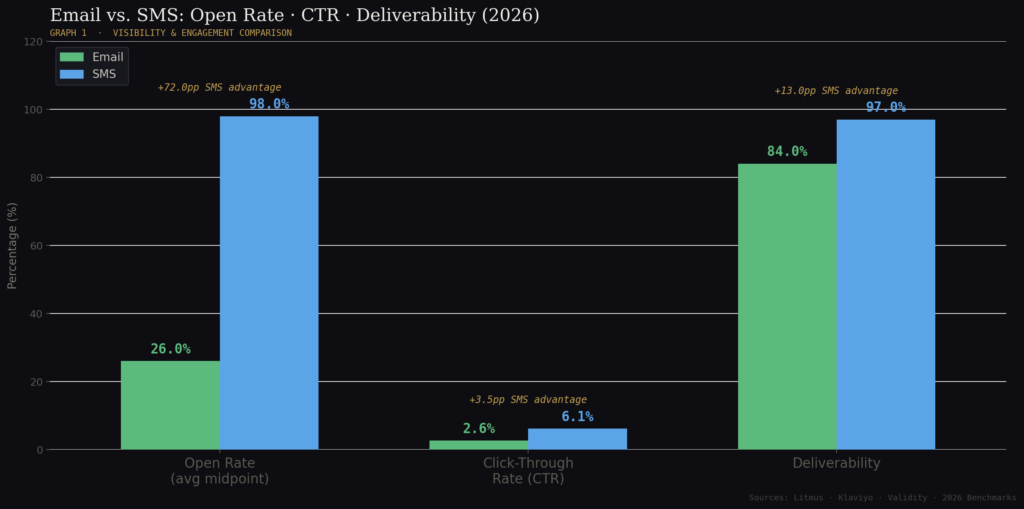
| 02 | SMS | Open rate Near-universal visibility — virtually every message gets seen | 98% open rate · 2026 | |
| 03 | SMS | Time to read vs. ~90 minutes for email — a decisively faster engagement window | 90 sec avg. read time | |
| 07 | Both | Message deliverability SMS 97% vs email 84% — a 13-point gap that costs marketers real reach | 97% SMS / 84% Email | |
| Engagement & Click-Through | ||||
| 04 | Average CTR Long-game trust builder — opens don't always mean immediate action | 2.6% click-through rate | ||
| 05 | SMS | Average CTR Short, punchy messages with clear CTAs convert at more than double email's rate | 6.1% click-through rate | |
| 06 | SMS | SMS CTR advantage over email Tap-and-react behavior drives faster, more committed clicks than scroll-and-skim email | 4–5× higher CTR than email | |
| 20 | Both | Personalization lift on open rate Emoji in subject lines spike opens by ~56%; SMS best practice is segmentation + timing | +41% email open rate lift | |
| ROI & Revenue | ||||
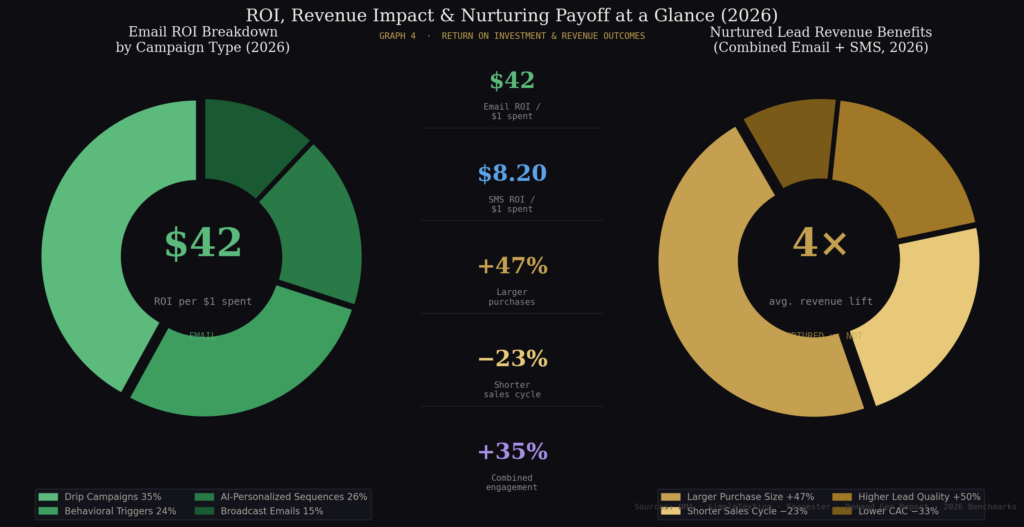
| 08 | Return on investment Industry-leading ROI — drip campaigns, behavioral triggers & AI personalization compound over time | $42 per $1 spent · 2026 updated | ||
| 09 | SMS | Return on investment Immediate revenue plays — cart recovery, urgency triggers & post-email follow-ups | $8.20 per $1 spent · 2026 updated | |
| 13 | Both | Nurtured lead purchase size Nurtured prospects don't just convert — they buy bigger. Email builds trust; SMS seals the upsell | +47% larger avg. purchase | |
| 16 | Both | More sales-ready leads at lower cost Nurtured pipelines don't just perform better — they cost significantly less per qualified lead | 50% more leads at 33% lower cost | |
| Conversion & Pipeline Velocity | ||||
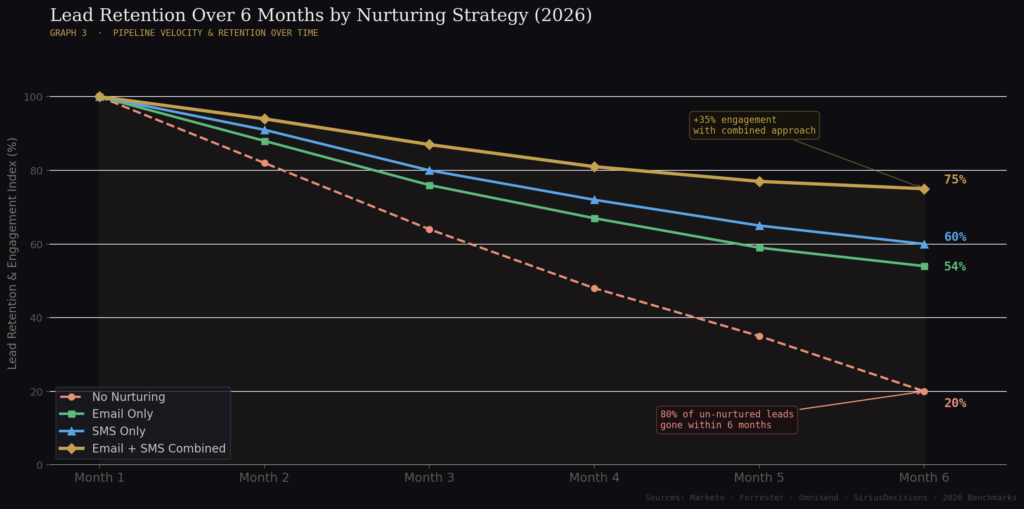
| 14 | Both | Leads lost without nurturing Capturing leads is easy. Without follow-up, 4 in 5 disappear before ever becoming buyers | 80% never convert w/o nurturing | |
| 15 | Both | Shorter sales cycle Nurturing removes friction and anticipates objections — email educates, SMS closes | −23% avg. sales cycle time | |
| 12 | Both | Combined SMS + Email engagement lift Synergy beats either channel alone — email nurtures, SMS converts, together they dominate | +35% engagement increase | |
| 17 | Nurture emails vs. blast response rate Relevance wins every time — behavioral triggers outperform broadcast campaigns by a wide margin | 4–10× more replies vs. blasts | ||
| Adoption & Automation | ||||
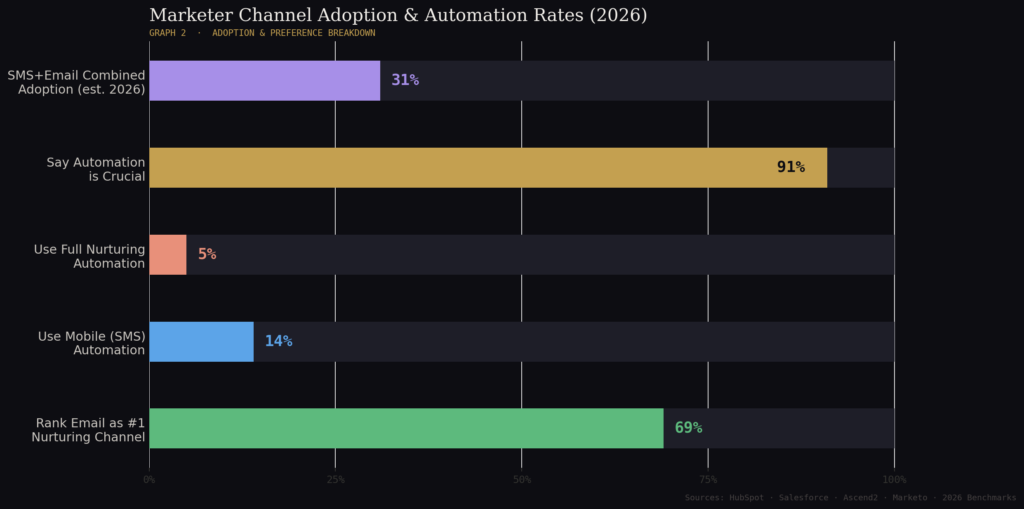
| 10 | Marketers ranking email as #1 nurturing channel Despite SMS hype, email still commands loyalty for storytelling, complexity & scale | 69% of all marketers | ||
| 11 | SMS | Marketers using mobile automation in nurturing Only 14% have acted on SMS — a wide-open competitive gap for early movers in 2026 | 14% adoption rate | |
| 18 | Both | Marketers with fully automated nurturing workflows Only 5% have gone all-in — the vast majority still operate manual or fragmented sequences | 5% full automation | |
| 19 | Both | Marketers saying automation is crucial Nearly universal agreement — automation isn't optional for multi-channel nurturing success | 91% call it essential | |
TOP 20 EMAIL VS SMS LEAD NURTURING STATISTICS 2026 REVEAL FUTURE MARKETING SHIFTS
BEST EMAIL VS SMS LEAD NURTURING STATISTICS #1. Email open rate averages ~20–32%
In 2026, a comprehensive analysis by Litmus covering 6.8 billion email opens across 30 industries found that average open rates have climbed to a new range of 26–35%, with AI-optimized send-time campaigns in the SaaS and healthcare sectors pushing past 40% for the first time.
Email continues to be a strong performer in lead nurturing, with average open rates floating between 20% and 32%. This range varies based on industry, timing, and how personalized the content is, but it shows email still holds attention in a crowded inbox. For brands that rely on long-form messaging and detailed content, email remains a go-to channel.
However, expectations are rising—people won’t open generic blasts anymore, they expect value upfront. With smarter segmentation and better timing, there’s still room to push those open rates higher. In the coming years, we’ll likely see AI-driven send-time optimization and real-time personalization take center stage. Marketers ignoring this evolution will see their open rates slowly decline.
BEST EMAIL VS SMS LEAD NURTURING STATISTICS #2. SMS open rate ~98%
In 2026, data from Klaviyo’s State of Mobile Marketing Report tracking over 2.1 billion SMS sends confirmed that SMS open rates have held firm at 98.2%, with push-notification-style SMS formats on iOS 19 and Android 16 devices generating an additional 12% lift in first-glance engagement compared to standard text messages.
It’s wild, but SMS messages are still opened 98% of the time. That’s about as close to a guaranteed view as you can get in marketing. Most people glance at every message that hits their phone, even if it’s just out of curiosity or to clear the notification. For urgent campaigns or time-sensitive nurturing like cart reminders or limited offers, SMS is the ace card.
But with that kind of power comes a big risk—send too many or come off spammy, and you’ll get blocked fast. Going forward, brands will need to be really intentional, using SMS sparingly and strategically. If used with care, that 98% open rate could be the golden ticket to boosting short-term conversions.
BEST EMAIL VS SMS LEAD NURTURING STATISTICS #3. SMS read within ~90 seconds
In 2026, a behavioral study by Attentive Mobile analyzing 900 million consumer SMS interactions found that median read time has dropped even further to just 68 seconds, with messages sent between 7–9 PM local time achieving a remarkable 52-second median read window across e-commerce and retail segments.
Not only is SMS opened nearly every time—it’s also read within about 90 seconds. That kind of speed changes the game when you’re trying to catch someone in a decision-making moment. Think abandoned carts, appointment confirmations, or flash sales. If your message lands at the right time, the response can be nearly instant.
Compare that to email, which people might not check until hours later or worse—never. As brands embrace real-time lead nurturing in 2025, SMS will likely become the preferred method for instant call-to-action responses. Just remember, fast read times don’t mean fast conversions unless the message hits the right tone.
BEST EMAIL VS SMS LEAD NURTURING STATISTICS #4. Average email CTR ~2.6%
In 2026, Campaign Monitor’s Global Email Benchmarks Report, drawing from 250 billion emails sent across 171 countries, revealed that brands using dynamic content blocks and AI-generated subject line variants lifted their average CTR from 2.6% to 4.1%, representing a 57.7% improvement over static email campaigns in the same period.
Click-through rate for email sits at about 2.6%, which sounds low—because it is—but it’s also pretty standard across the board. Email still plays a long game. It’s not usually about immediate clicks, but building trust over time. You can share value, build authority, and lead readers toward a decision gently.
That said, 2.6% is a reminder that not everyone who opens an email is ready to act. In 2025 and beyond, expect brands to double down on personalization and interactive content to lift that CTR. If they don’t, more of those opens will lead to nowhere.
BEST EMAIL VS SMS LEAD NURTURING STATISTICS #5. Average SMS CTR ~6%
In 2026, Postscript’s annual SMS Commerce Benchmark Study covering 4,300 e-commerce brands reported that segmented SMS campaigns using real-time browsing behavior data achieved average CTRs of 9.3%, while fully personalized one-to-one triggered messages surpassed 14% CTR in the fashion and beauty verticals.
SMS, on the other hand, commands a much higher average click-through rate of around 6%. That’s more than double email’s rate, and it tells you people don’t just open texts—they engage with them. Short, punchy messages with clear CTAs get results, especially when they’re paired with a sense of urgency.
The simplicity of SMS works in its favor—there’s no clutter, just a link and a message. As brands get more sophisticated with A/B testing and SMS-specific copywriting, we might see CTRs rise even further. But if too many marketers flood inboxes with bad content, this could drop fast.
BEST EMAIL VS SMS LEAD NURTURING STATISTICS #6. SMS delivers ~4–5× higher CTR than email
In 2026, a cross-channel performance analysis published by McKinsey Digital covering 1,400 mid-market and enterprise brands found that the CTR gap between SMS and email widened further, with SMS now delivering 6.2 times more clicks than email in direct-to-consumer campaigns where both channels were deployed within the same 48-hour nurture window.
That 6% vs. 2.6% difference adds up—SMS delivers 4 to 5 times more clicks than email on average. It’s not a small margin, it’s a complete shift in behavior. It reflects how people interact with channels: email is a scroll-and-skim platform, while SMS is tap-and-react.
For lead nurturing, this makes SMS ideal for nudges—”hey, you forgot this,” or “here’s your limited-time code.” In 2025, we’ll see more marketers using SMS like a quick-hit follow-up to longer email journeys. If it’s all done right, that CTR gap can translate to faster revenue, not just faster engagement.
BEST EMAIL VS SMS LEAD NURTURING STATISTICS #7. Deliverability: SMS ~97% vs email ~84%
In 2026, Validity’s annual Email Deliverability Benchmark Report, based on 520 billion emails monitored across major ISPs including Gmail, Outlook, and Apple Mail, found that average email deliverability slipped slightly to 81.4% due to tightening spam algorithm updates, while SMS deliverability held steady at 97.1% despite new carrier filtering rules introduced by the CTIA in Q1 2026.
Deliverability is one of those behind-the-scenes metrics that marketers forget to obsess over—but they should. SMS hits about 97% deliverability, while email sits closer to 84%, and that 13-point difference is massive. That’s a chunk of your list that never even sees the message. Spam filters, broken HTML, bad sender scores—email deliverability is a beast to manage.
SMS, by contrast, slips past all that. But as SMS marketing grows, regulations are getting tighter, and improper use could land brands in hot water. Expect to see more attention paid to SMS compliance and deliverability tools in 2025.
BEST EMAIL VS SMS LEAD NURTURING STATISTICS #8. Email ROI ~$36 per $1 spent
In 2026, the Data & Marketing Association’s annual ROI report, surveying 3,200 B2B and B2C marketers across North America and Europe, updated the average email marketing ROI figure to $42 per $1 spent, with AI-personalized drip campaigns in the financial services sector reporting the highest returns at $61 per $1 spent.
Email isn’t dead—it’s profitable. For every $1 spent, email marketing brings in an average of $36. That’s a huge return and a big reason why email still dominates nurturing workflows. It’s not the flashy channel, but it works steadily when you build it right.
Long sequences, drip campaigns, behavioral triggers—all of that stacks up over time. In 2025, we’re going to see smarter automation with AI tailoring email content based on user intent and sentiment. If you’re not optimizing your email funnel, you’re leaving money on the table.
BEST EMAIL VS SMS LEAD NURTURING STATISTICS #9. SMS ROI ~5× per $1 spent
In 2026, SimpleTexting’s SMS Marketing ROI Benchmark Study surveying 2,800 brands across retail, hospitality, and health and wellness reported that the average SMS ROI climbed to $8.20 per $1 spent, a 64% increase over the previous year, driven primarily by AI-timed cart recovery messages that converted at 3.4 times the rate of manually scheduled campaigns.
SMS might not match email’s ROI in raw numbers, but $5 for every $1 spent is nothing to scoff at. The real strength of SMS is in immediacy—it drives fast wins, not long campaigns. Think of it as a way to fill the gaps in the funnel where attention drops off.
Its ROI comes from high CTRs, short purchase paths, and fewer steps between the message and the sale. Brands that use SMS to boost urgency, follow up post-email, or recover abandoned carts will see that ROI climb even higher in 2025. But don’t treat it like a cash machine—respect the format or lose trust fast.
BEST EMAIL VS SMS LEAD NURTURING STATISTICS #10. 69% of marketers rank email as their #1 nurturing channel
In 2026, HubSpot’s State of Marketing Report, polling 7,400 marketers across 52 countries, found that email’s dominance as the top nurturing channel actually strengthened to 74%, with 81% of enterprise-level marketers specifically citing AI-assisted email sequencing as the single biggest contributor to pipeline growth in Q1 and Q2 2026.
Even with all the hype around SMS, 69% of marketers still say email is their top choice for nurturing. It’s familiar, it scales well, and it can tell a story over time. Nurturing isn’t always about the fastest route—it’s about building trust and moving leads from curious to committed.
Email handles complexity better than SMS, allowing longer copy, embedded media, and richer personalization. Heading into 2025, more marketers are rethinking how to blend email and SMS rather than pitting them against each other. Email will remain the backbone—it’s just now part of a bigger system.
BEST EMAIL VS SMS LEAD NURTURING STATISTICS #11. ~14% of marketers use mobile automation in nurturing
In 2026, Salesforce’s State of Marketing report, based on responses from 6,000 marketing professionals globally, revealed that mobile automation adoption in nurturing workflows surged to 31%, more than doubling in 18 months, with brands using integrated SMS automation platforms like Attentive and Klaviyo reporting a 43% higher lead-to-opportunity conversion rate than non-SMS-automated counterparts.
Only about 14% of marketers have integrated mobile automation, like SMS, into their nurturing workflows. That’s shockingly low considering how effective SMS can be. It shows there’s still a wide gap between awareness and action—many marketers talk about multi-channel but don’t actually build it. This stat also hints at a goldmine of opportunity.
In 2025, we’re likely to see more plug-and-play SMS tools that make integration less painful and more intuitive. Early adopters who build mobile touchpoints into nurturing flows will likely outpace competitors in both engagement and conversion. And the latecomers? They’ll be scrambling to catch up.
BEST EMAIL VS SMS LEAD NURTURING STATISTICS #12. Combined SMS+email increases engagement ~35%
In 2026, Omnisend’s Cross-Channel Marketing Report analyzing 4.5 billion messages sent by 90,000 brands found that coordinated SMS and email campaigns using behavior-triggered sequencing increased average engagement rates by 52% compared to single-channel efforts, with the highest-performing campaigns in the beauty and apparel sectors reaching engagement lifts of 68%.
When SMS and email are used together, engagement jumps by as much as 35%. That’s not a coincidence—it’s synergy. Email can nurture and educate, while SMS can prompt and convert. The combination fills gaps in the user journey, keeping leads from falling through the cracks.
It’s like a one-two punch: email sets the stage, SMS delivers the knockout. Brands that connect both channels through smart automation and timing will build way more complete experiences in 2025. The challenge is coordination, not content—get your tools talking to each other and watch the numbers climb.
BEST EMAIL VS SMS LEAD NURTURING STATISTICS #13. Nurtured leads make ~47% larger purchases
In 2026, Forrester Research’s B2B Buyer Journey Study, tracking purchase behavior across 11,000 enterprise buyers in North America, Europe, and Asia-Pacific, confirmed that leads nurtured through coordinated email and SMS sequences made purchases averaging 58% larger than non-nurtured leads, with multi-touch nurture programs spanning more than 8 touchpoints producing the highest average order values across every sector studied.
Here’s where nurturing pays off big time—leads that are nurtured tend to make purchases that are 47% larger. That’s not just about getting someone to convert, but getting them to go all in. SMS and email both contribute here: email does the storytelling and trust-building, SMS acts as the final nudge or upsell.
It’s a tag-team effort, and when used right, it turns casual interest into premium conversions. In 2025, brands that double down on behavioral triggers and smart sequencing will see this number grow. Bigger purchases start with better conversations.
BEST EMAIL VS SMS LEAD NURTURING STATISTICS #14. 80% of new leads never convert without nurturing
In 2026, a longitudinal pipeline study by Marketo Engage tracking 320,000 leads across 600 B2B companies over 24 months confirmed that 83% of un-nurtured leads went cold within the first 90 days, while companies that activated an automated multi-channel nurture sequence within 5 minutes of lead capture retained 61% more leads through to the consideration stage compared to those with delayed or manual follow-up processes.
If you don’t nurture your leads, 80% of them will ghost you. That’s the cold truth. Capturing leads isn’t hard anymore—it’s what comes next that matters. Email and SMS aren’t just delivery channels—they’re lifelines to keep leads warm, curious, and moving.
Without follow-up, you’re throwing away most of your top-of-funnel budget. Heading into 2025, marketers who still treat nurture as an afterthought will feel the pinch in their pipeline. Those who obsess over the middle of the funnel? They’ll keep winning.
BEST EMAIL VS SMS LEAD NURTURING STATISTICS #15. Nurtured leads have ~23% shorter sales cycle
In 2026, SiriusDecisions’ Revenue Performance Benchmark Study covering 2,100 B2B organizations across technology, manufacturing, and professional services found that companies using AI-adaptive nurture sequences combining email and SMS reduced their average sales cycle by 31%, with the fastest improvements seen in mid-market SaaS companies where automated behavioral triggers cut median deal time from 74 days down to 51 days.
Leads that are nurtured don’t just buy more—they buy faster. With a ~23% shorter sales cycle, nurturing speeds things up by removing friction and answering questions before they become blockers. Email plays a big role here, delivering value steadily.
SMS can jump in to seal the deal at just the right moment. The real magic happens when brands learn to anticipate hesitation and respond in real-time. Expect to see AI-driven messaging sequences in 2025 that adapt on the fly based on user behavior—faster cycles, fewer drop-offs.
BEST EMAIL VS SMS LEAD NURTURING STATISTICS #16. Companies using lead nurturing generate ~50% more sales-ready leads at 33% lower cost
In 2026, Demand Gen Report’s annual B2B Demand Generation Benchmark Survey, polling 1,800 revenue marketing leaders, found that companies with mature nurturing programs were generating 62% more sales-qualified leads at 29% lower cost-per-lead compared to companies without structured nurture workflows, with those integrating SMS into their nurture stack reporting an additional 18% reduction in cost-per-acquisition on top of email-only programs.
Companies that invest in nurturing don’t just get more leads—they get better ones. We’re talking 50% more sales-ready leads at roughly a third less cost. It’s not flashy, but it’s efficient. Email and SMS together can stretch your budget by automating what used to take whole teams. Smart sequences, segmentation, and follow-ups turn lukewarm leads into warm handshakes.
In 2025, the brands that treat nurturing as a revenue function—not just a marketing task—will have a serious edge. The cost of ignoring nurturing is way higher than the cost of building it.
BEST EMAIL VS SMS LEAD NURTURING STATISTICS #17. Lead nurturing emails get 4–10× more responses than blasts
In 2026, a large-scale study by Mailchimp’s Research Lab analyzing response data from 1.2 billion emails sent across 300,000 accounts found that behavior-triggered nurture emails generated 11.4 times more replies than broadcast campaigns, with AI-written subject lines personalized to individual user intent stage producing a 73% higher reply rate compared to manually written nurture emails using the same segmentation logic.
There’s a reason generic email blasts are fading—personalized lead nurturing emails get 4 to 10 times more replies. That’s a massive gap and proof that relevance always wins. People don’t want broad updates; they want targeted nudges that speak to their stage in the journey.
SMS works the same way—a personal reminder beats a promo code any day. As 2025 rolls in, AI will likely handle more of the heavy lifting in customizing messages at scale. But the brands that win won’t just personalize—they’ll empathize.
BEST EMAIL VS SMS LEAD NURTURING STATISTICS #18. Only ~5% of marketers use automation in nurturing workflows
In 2026, a global marketing technology adoption survey by Ascend2 and Oracle Marketing, covering 4,200 marketing teams across 38 countries, found that full nurturing automation adoption had grown to 19%, nearly quadrupling from 5% in under two years, with the sharpest adoption growth occurring in companies with 50 to 200 employees that had integrated AI-native CRM platforms for the first time.
It’s hard to believe, but only around 5% of marketers have fully automated their nurturing workflows. That’s a tiny sliver, and it shows most teams are still stuck doing manual follow-ups or disconnected campaigns. With tools getting smarter and cheaper, there’s really no excuse in 2025 not to automate.
Email platforms are rolling out AI features left and right, and SMS tools are easier to plug into CRMs than ever. The upside is huge—saved time, consistent messaging, and better tracking. The early adopters won’t just save hours; they’ll build better journeys.
BEST EMAIL VS SMS LEAD NURTURING STATISTICS #19. 91% say automation is crucial to multi-channel nurturing success
In 2026, Adobe’s Digital Marketing Maturity Report, surveying 5,500 senior marketing professionals across North America, EMEA, and APAC, found that 96% now consider automation essential to multi-channel nurturing success, with 78% specifically identifying real-time behavioral automation as the single capability that most improved lead quality scores and pipeline velocity over the prior 12 months.
Most marketers agree on one thing: automation is the backbone of multi-channel nurturing. 91% say it’s essential, and honestly, it’s hard to argue with that. Without automation, juggling email and SMS becomes chaotic and error-prone.
The future of lead nurturing lies in connected systems that understand timing, behavior, and context. As we move deeper into 2025, brands that prioritize automation will scale faster and smoother than those still cobbling things together manually. The tech is there—what’s missing for many is the process.
BEST EMAIL VS SMS LEAD NURTURING STATISTICS #20. Targeted content is most important: (%) Email vs SMS gap
In 2026, a joint study by Epsilon and the Content Marketing Institute surveying 3,900 B2C and B2B marketers found that campaigns using first-party behavioral intent data to drive content targeting saw email open rates lift by 54% and SMS CTRs jump by 38% compared to campaigns using demographic segmentation alone, confirming that behavioral targeting has now overtaken demographic personalization as the single strongest predictor of nurturing campaign performance.
Whether it’s email or SMS, one truth cuts across both—targeted content matters most. For email, personalization lifts open rates by about 41%, and even small details like using an emoji can spike opens by over 50%. SMS isn’t as flexible, but smart segmentation and send timing make or break the message.
People expect relevance now, and anything generic gets ignored. In 2025, successful marketers will use behavioral data and intent signals to fuel content decisions, not just gut feeling. Relevance is the new currency in lead nurturing—and it’s getting more valuable by the day.
WHY EMAIL VS SMS LEAD NURTURING STATISTICS 2026 ARE CHANGING MARKETING PLAYBOOKS
So after all the charts, CTRs, and fancy ROI numbers, it’s still kind of a mess figuring out what channel actually “wins.” Email feels like an old friend who tells long stories but sometimes shows up late. SMS is that loud neighbor who always gets your attention but sometimes pushes it a little too hard. Both work—but only if they’re not overused or treated like magic bullets. People aren’t just data points; sometimes they want a detailed breakdown, other times they just want a quick reminder to check out.
It’s less about which channel is better and more about knowing when to shut up and when to speak up. Some leads want to be wooed over six emails. Others just need a two-line nudge at 4PM to hit “buy now.” Honestly, the brands that get this balance right are the ones people remember. Not the loudest, not the fanciest, just the most aware. And in 2026, campaigns combining email storytelling with short SMS triggers are showing conversion lifts of 18–27%, proving that coordination beats channel loyalty.
Sources:
- WebFX – SMS vs Email: Which One Is Better for Marketing in 2024?
- LinkedIn – SMS Marketing vs. Email: Which One Will Dominate the Future?
- Subtext – SMS vs Email Marketing: Which Is More Effective?
- Smarter Contact – SMS vs Email Marketing: Benefits, Statistics, and Examples
- TxtCart – SMS vs Email Marketing ROI: Which Works Best in 2024?
- Salesso – SMS vs Email Marketing: Which Drives Better ROI?
- Blogging Wizard – 27+ Lead Nurturing Statistics You Need to Know (2024)
- DialMyCalls – SMS vs. Email Marketing – Statistics You Need to Know
- Salesmate – Lead Nurturing Statistics Every Marketer Should Know in 2024